


 Скачать презентацию Principles of Neuronavigation Frame and Frameless
6f91685535f98b01ac405b60033ead57.ppt
- Количество слайдов: 44
 Principles of Neuronavigation: Frame and Frameless
 • • History “Stereotactic”: From Greek “stereos”=3 -dimensional and Latin “tactus”=to touch 1908: Horsely and Clarke develop first apparatus for insertion of probes into the brain based upon Cartesian planes and bony landmarks; only used in primates 1947: Spiegel and Wycis report first human use of stereotactic device. Goal was to perform minimally-invasive psychosurgery but first use was movement disorders 1948: Leksell develops first arc-centered frame 1957: Talairach publishes first atlas based upon ventriculography and intracranial brain landmarks rather than bone landmarks 1986: Kelley develops frame-based system for eye-tracking of operative microscope 1986: Roberts develops frameless acoustic-based system for tracking operative microscope 1991: Bucholz develops the first prototype for frameless sonic navigation of tracking tools and instruments in human cranial surgery – Soon after incorporated optical digitizers to reduce inaccuracies from sound echoes
 General Principles of Stereotaxy • Navigation is based upon targeting relative to known reference points • Fiducial : – From latin “fiducia” meaning trust – A point of reference that can be visualized on imaging and identified by the surgeon and/or software package – Accuracy of targeting is influenced by the number of fiducials around a target zone and the constancy of fiducials relative to the target – Frame-based stereotaxy: Fiducials are bars built into cage or box that sits on frame during imaging – Frameless stereotaxy: Fiducials are reference markers (stickers, bone screws) which are fixed directly to the patient prior to imaging
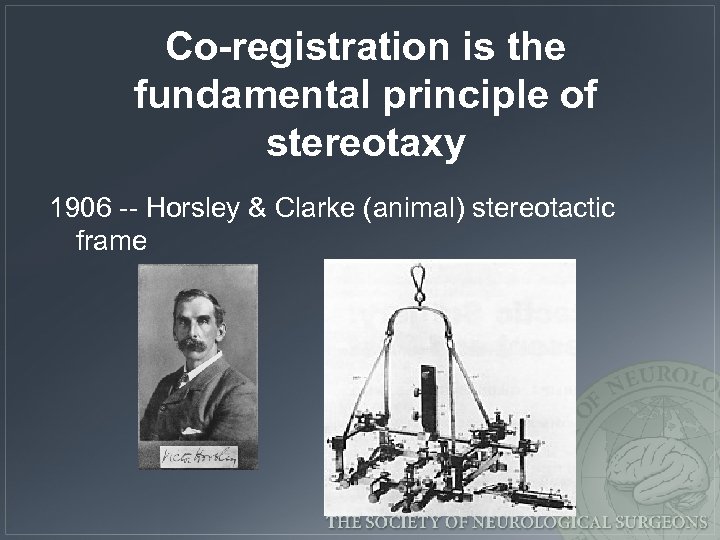 Co-registration is the fundamental principle of stereotaxy 1906 -- Horsley & Clarke (animal) stereotactic frame
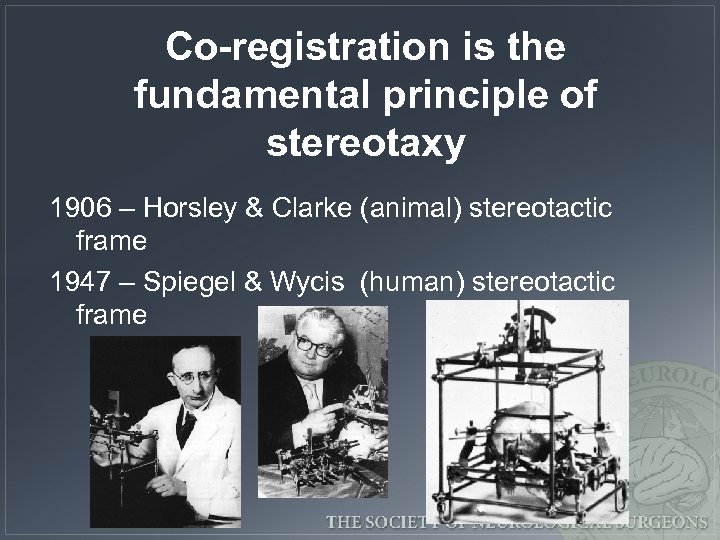 Co-registration is the fundamental principle of stereotaxy 1906 – Horsley & Clarke (animal) stereotactic frame 1947 – Spiegel & Wycis (human) stereotactic frame
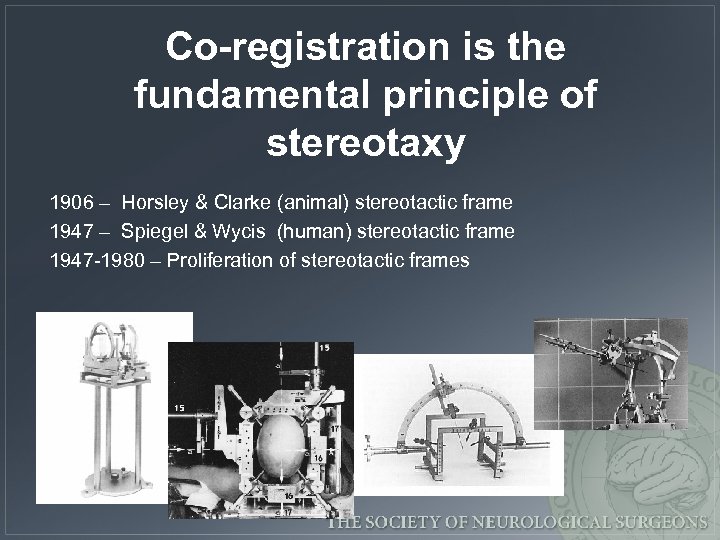 Co-registration is the fundamental principle of stereotaxy 1906 – Horsley & Clarke (animal) stereotactic frame 1947 – Spiegel & Wycis (human) stereotactic frame 1947 -1980 – Proliferation of stereotactic frames
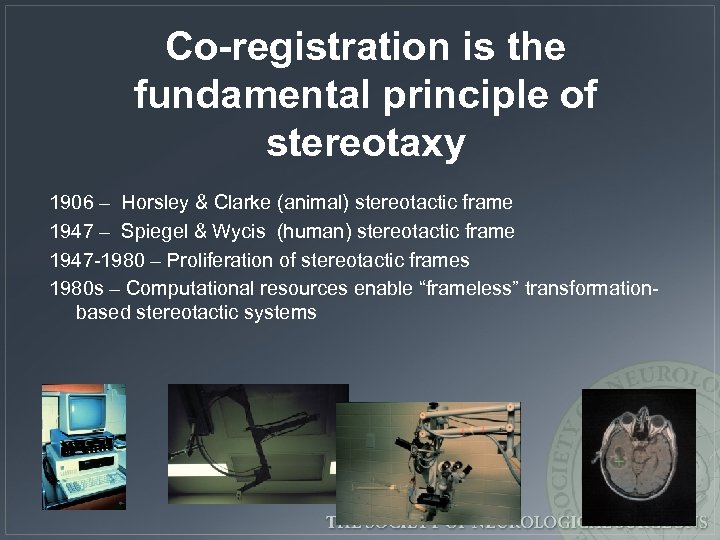 Co-registration is the fundamental principle of stereotaxy 1906 – Horsley & Clarke (animal) stereotactic frame 1947 – Spiegel & Wycis (human) stereotactic frame 1947 -1980 – Proliferation of stereotactic frames 1980 s – Computational resources enable “frameless” transformationbased stereotactic systems
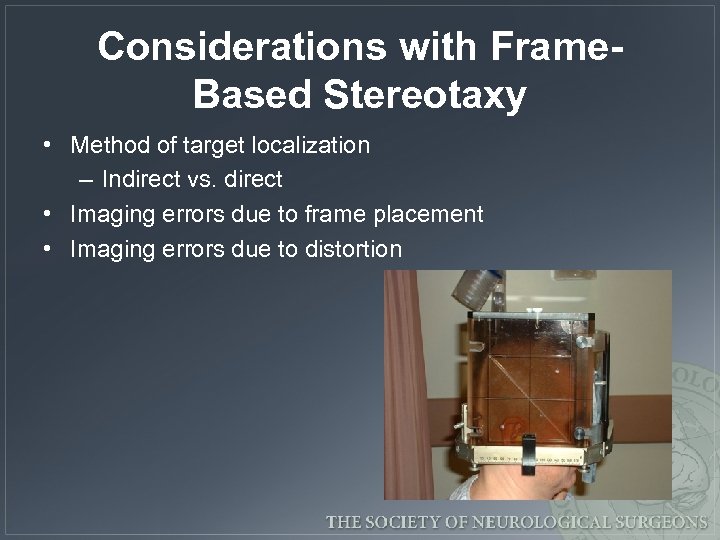 Considerations with Frame. Based Stereotaxy • Method of target localization – Indirect vs. direct • Imaging errors due to frame placement • Imaging errors due to distortion
 Methods of Image-Based Target Localization • Indirect (Based upon position of AC-PC) – Standard coordinates • Leksell’s pallidotomy target is classic example – Adjusted map • Schaltenbrand-Wahren is most common • Average AC-PC distance is 23 -27 mm; greater than 30 mm should raise accuracy concerns • Direct (Target visually chosen from scan)
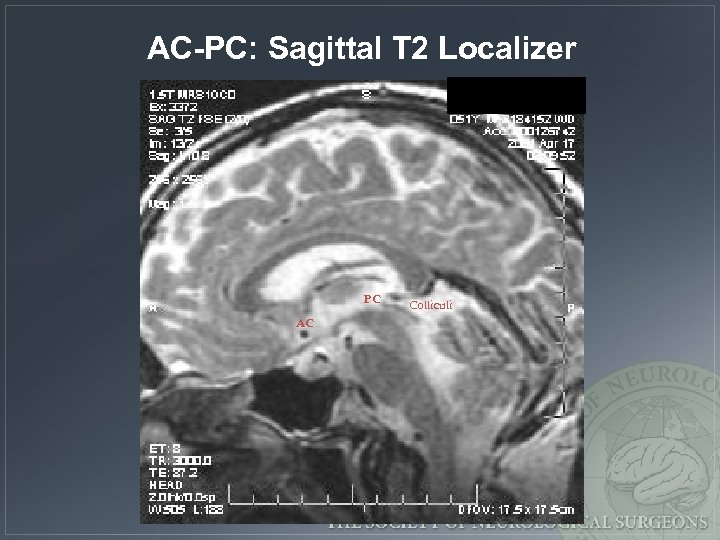 AC-PC: Sagittal T 2 Localizer PC AC Colliculi
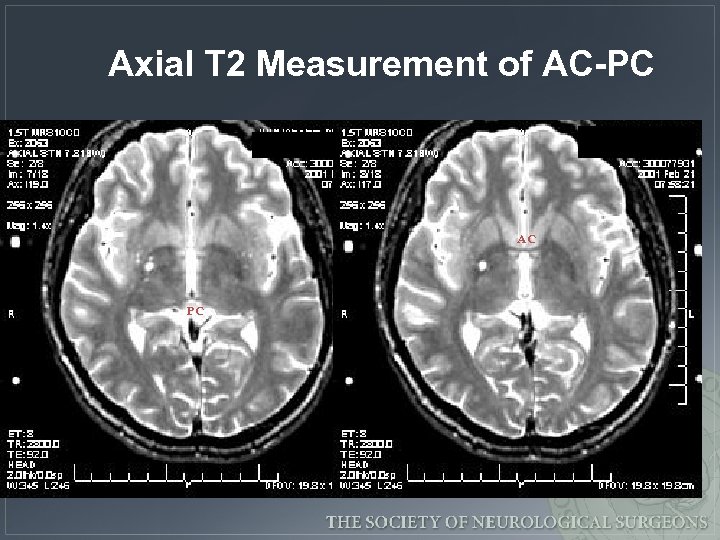 Axial T 2 Measurement of AC-PC AC PC
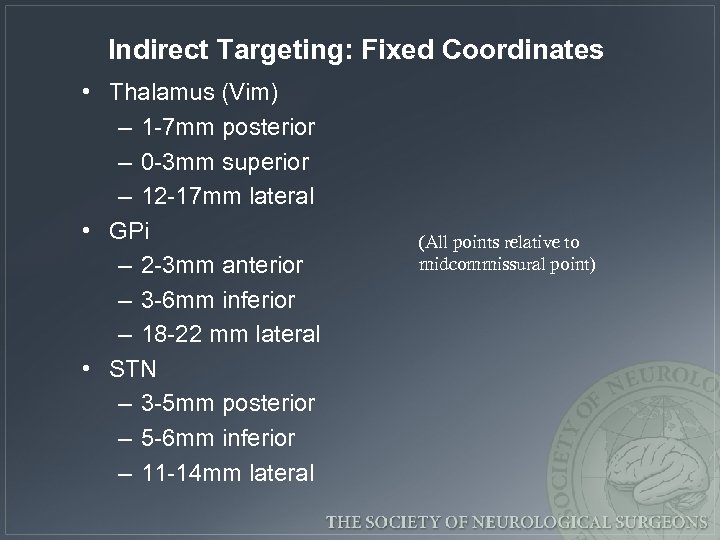 Indirect Targeting: Fixed Coordinates • Thalamus (Vim) – 1 -7 mm posterior – 0 -3 mm superior – 12 -17 mm lateral • GPi – 2 -3 mm anterior – 3 -6 mm inferior – 18 -22 mm lateral • STN – 3 -5 mm posterior – 5 -6 mm inferior – 11 -14 mm lateral (All points relative to midcommissural point)
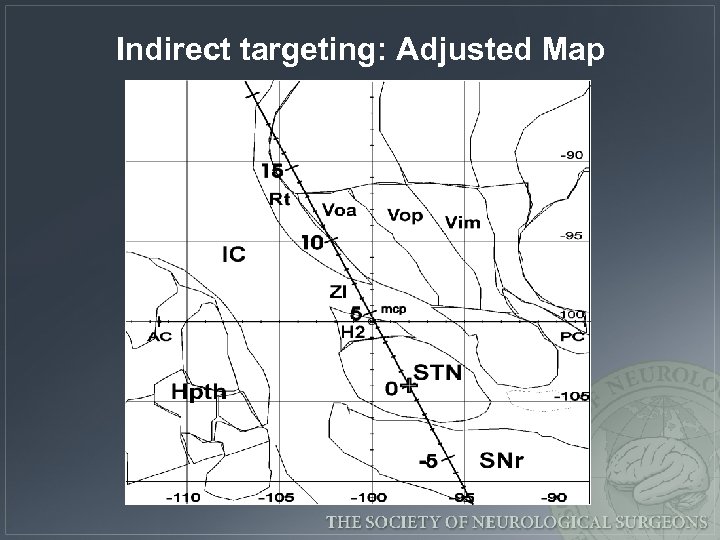 Indirect targeting: Adjusted Map
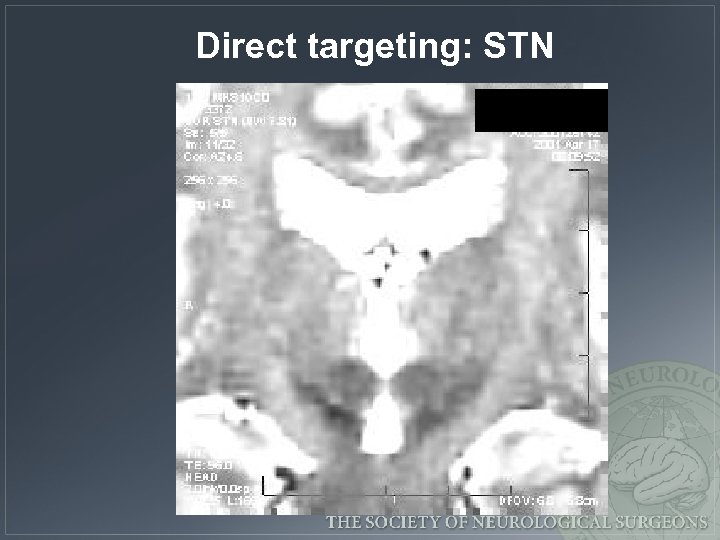 Direct targeting: STN
 Sources of Error: MRI Image Distortion • Magnetic field inhomogeneities and non-linear magnetic field gradients cause distortion – Distortion often worst in coronal sections; measuring Leksell fiducials can determine distortion severity • Frame may introduce additional distortion – Measuring target distance from MCP on preop MRI can guide targeting from framed image • CT not subject to these distortions; CT/MRI fusion may minimize effects of distortion • Bandwidth can influence contrast – Lower bandwidth increases gray/white contrast to a point – Very low bandwidth can worsen distortion
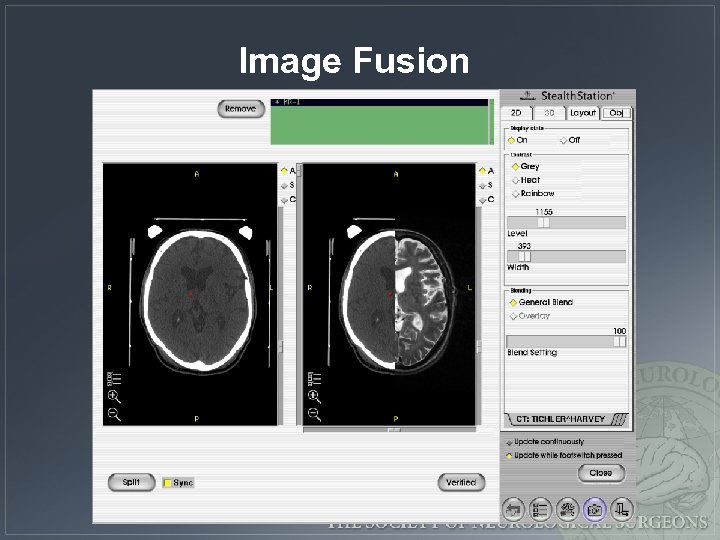 Image Fusion
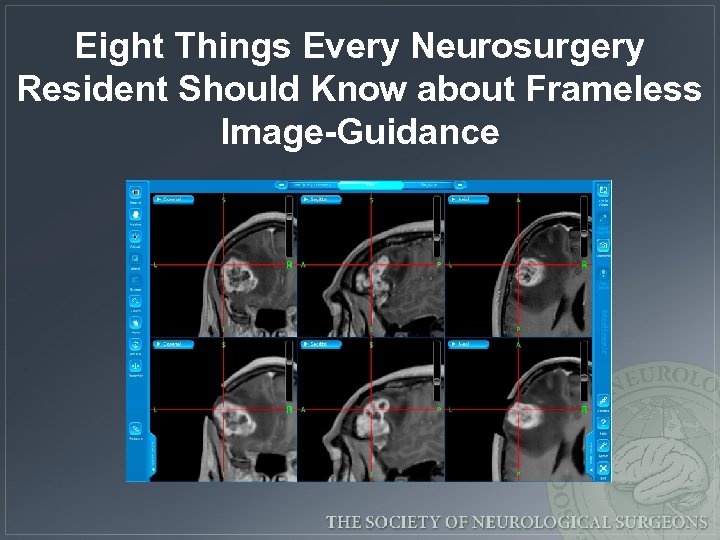 Eight Things Every Neurosurgery Resident Should Know about Frameless Image-Guidance
 What is image-guided surgery and how does it work? • Image-guided surgery (neuronavigation, “frameless stereotaxy”) is an operative technique by which correlation between imaging studies and the operative field is provided. • This is accomplished by co-registration of imaging studies with the OR patient.
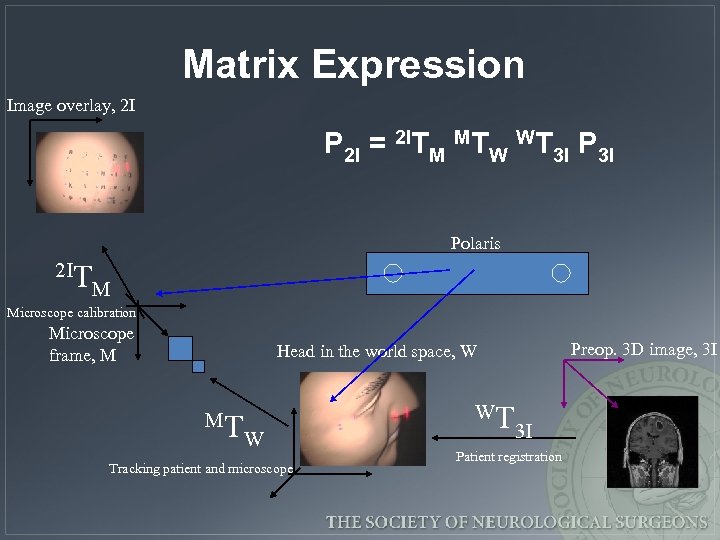 Matrix Expression Image overlay, 2 I P 2 I = 2 ITM MTW WT 3 I Polaris 2 IT M Microscope calibration Microscope frame, M Preop. 3 D image, 3 I Head in the world space, W MT W Tracking patient and microscope WT 3 I Patient registration
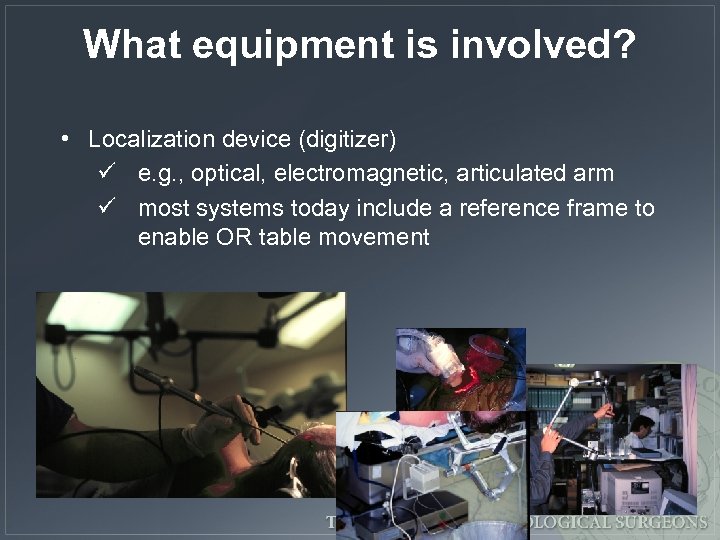 What equipment is involved? • Localization device (digitizer) ü e. g. , optical, electromagnetic, articulated arm ü most systems today include a reference frame to enable OR table movement
 What equipment is involved? • Localization device (digitizer) – e. g. , optical, electromagnetic, articulated arm • Computer with registration algorithm
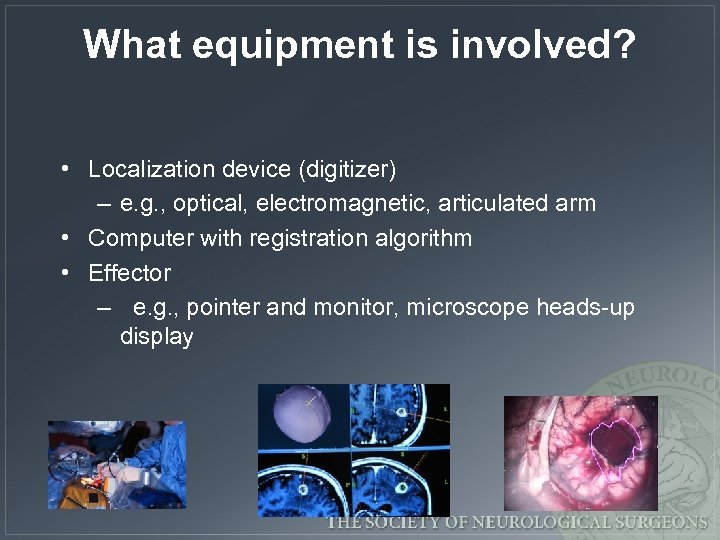 What equipment is involved? • Localization device (digitizer) – e. g. , optical, electromagnetic, articulated arm • Computer with registration algorithm • Effector – e. g. , pointer and monitor, microscope heads-up display
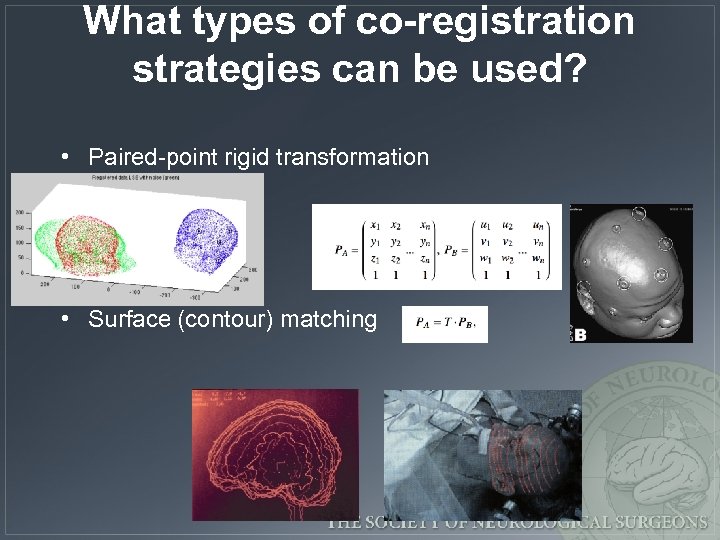 What types of co-registration strategies can be used? • Paired-point rigid transformation • Surface (contour) matching
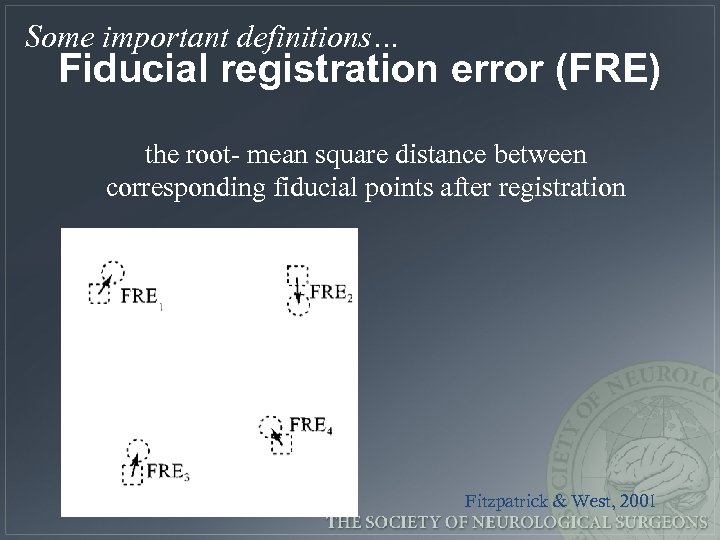 Some important definitions… Fiducial registration error (FRE) the root- mean square distance between corresponding fiducial points after registration Fitzpatrick & West, 2001
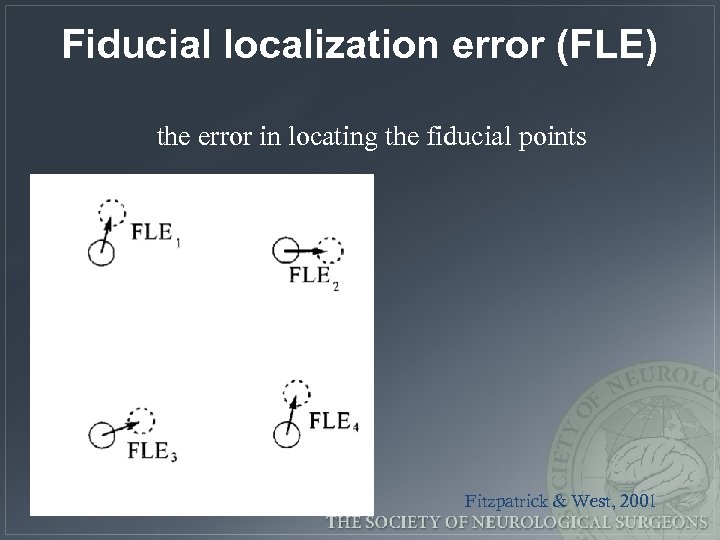 Fiducial localization error (FLE) the error in locating the fiducial points Fitzpatrick & West, 2001
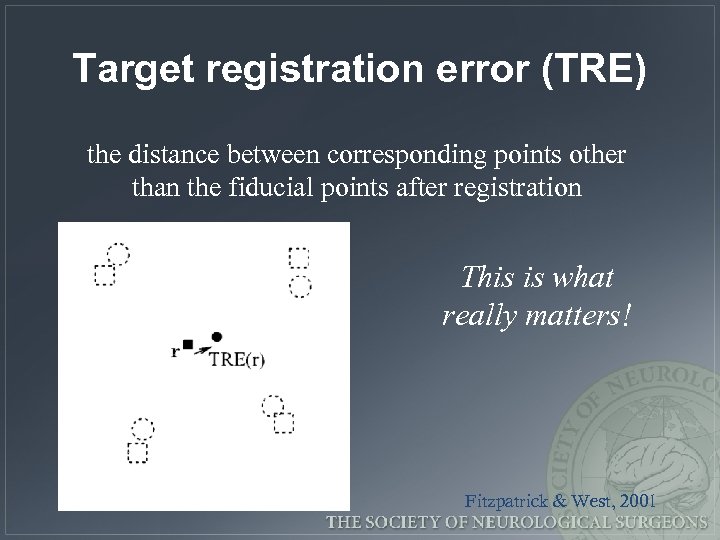 Target registration error (TRE) the distance between corresponding points other than the fiducial points after registration This is what really matters! Fitzpatrick & West, 2001
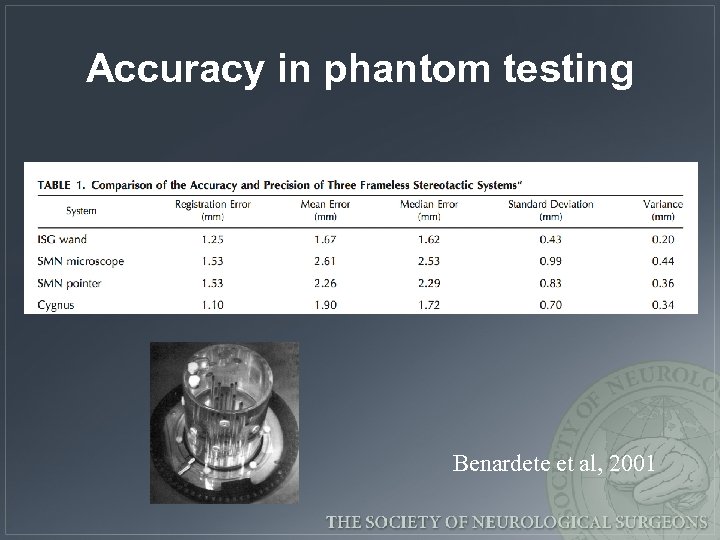 Accuracy in phantom testing Benardete et al, 2001
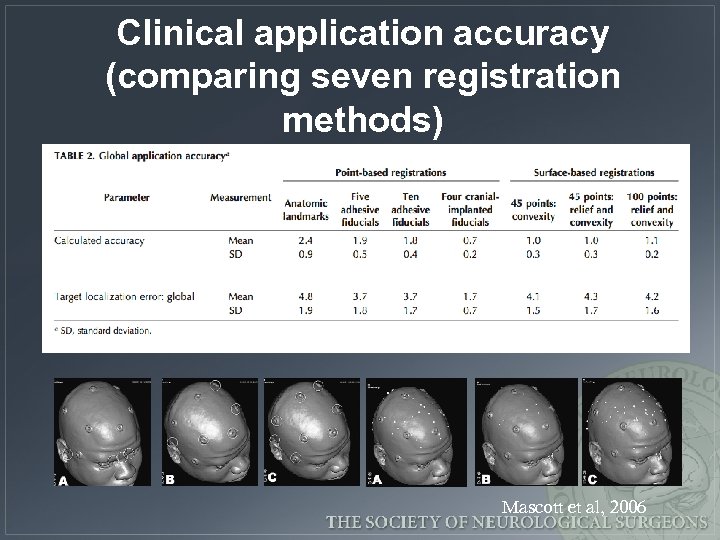 Clinical application accuracy (comparing seven registration methods) Mascott et al, 2006
 What are the sources of error? • Imaging data set – resolution – e. g. , slice thickness, pixel/voxel size – spatial infidelity – e. g. , magnetic field inhomogenieties in echo planar f. MRI – imaging study fusion – e. g. , CT–MRI, atlas–MRI –
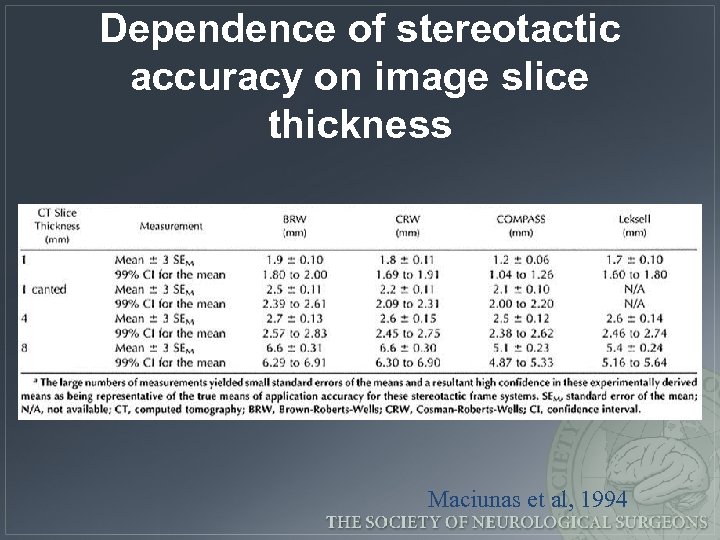 Dependence of stereotactic accuracy on image slice thickness Maciunas et al, 1994
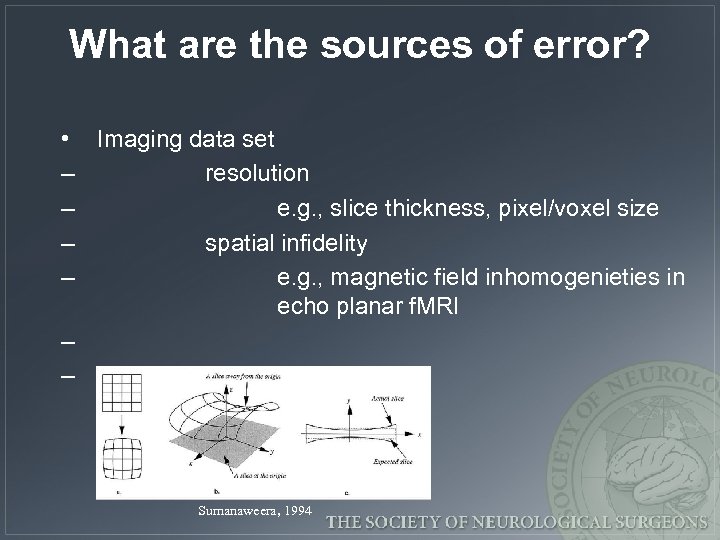 What are the sources of error? • Imaging data set – resolution – e. g. , slice thickness, pixel/voxel size – spatial infidelity – e. g. , magnetic field inhomogenieties in echo planar f. MRI – – Sumanaweera, 1994
 What are the sources of error? • Imaging data set – resolution – e. g. , slice thickness, pixel/voxel size – spatial infidelity – e. g. , magnetic field inhomogenieties in echo planar f. MRI – imaging study fusion – e. g. , CT–MRI, atlas–MRI –
 What are the sources of error? • • Imaging data set Registration process (image–OR space) – axes orientation (handedness of coordinate system) – algorithm ambiguity – fiducial number, configuration, displacement, OR localization (surgeon & digitizer) – –
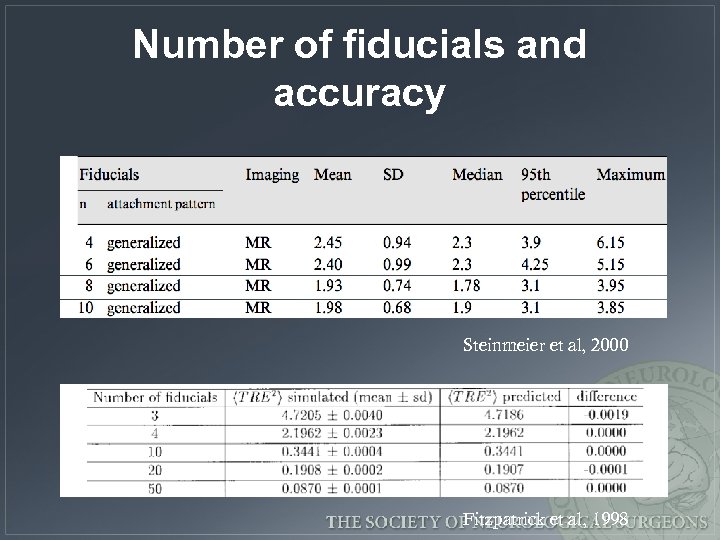 Number of fiducials and accuracy Steinmeier et al, 2000 Fitzpatrick et al, 1998
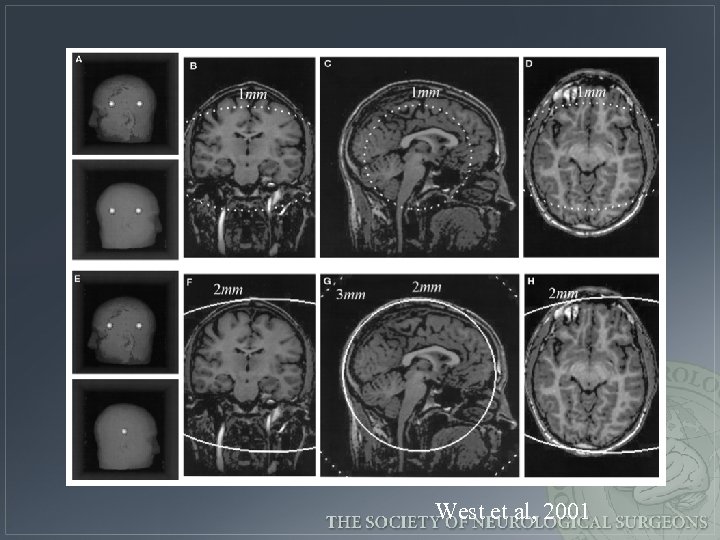 West et al, 2001
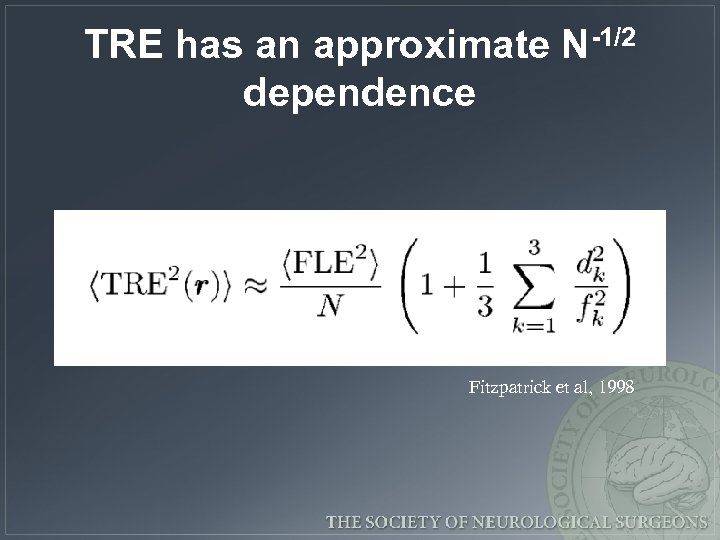 TRE has an approximate N-1/2 dependence Fitzpatrick et al, 1998
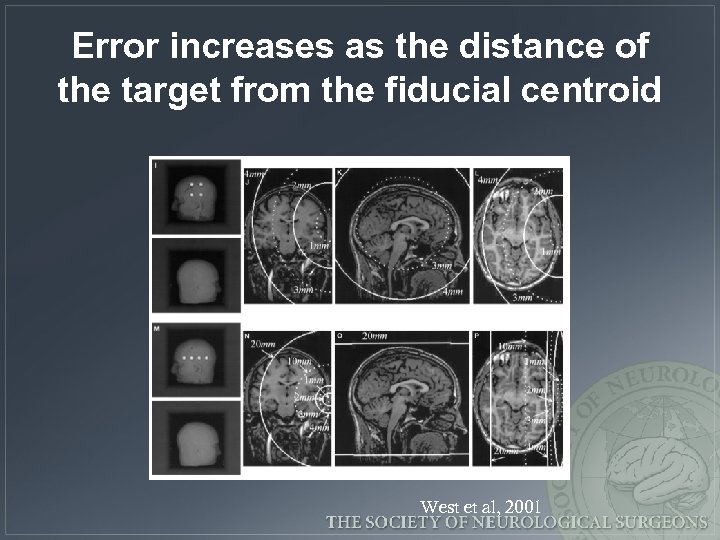 Error increases as the distance of the target from the fiducial centroid West et al, 2001
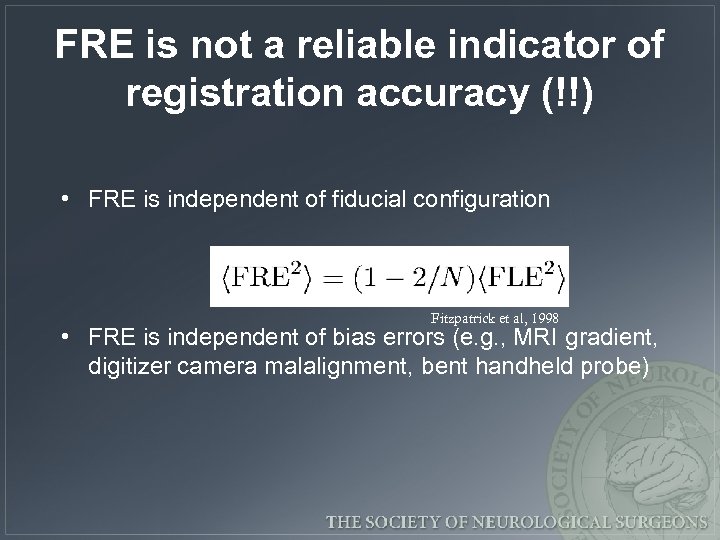 FRE is not a reliable indicator of registration accuracy (!!) • FRE is independent of fiducial configuration Fitzpatrick et al, 1998 • FRE is independent of bias errors (e. g. , MRI gradient, digitizer camera malalignment, bent handheld probe)
 Tips regarding fiducials 1. Avoid linear fiducial configurations 2. Arrange fiducials so that the center of their configuration is close to the region of interest during surgery 3. Spread out the fiducials 4. Use as many fiducials as reasonably possible 5. Mark scalp at fiducial site 6. Avoid occipital region or distorted scalp partially adapted from West et al, 2001
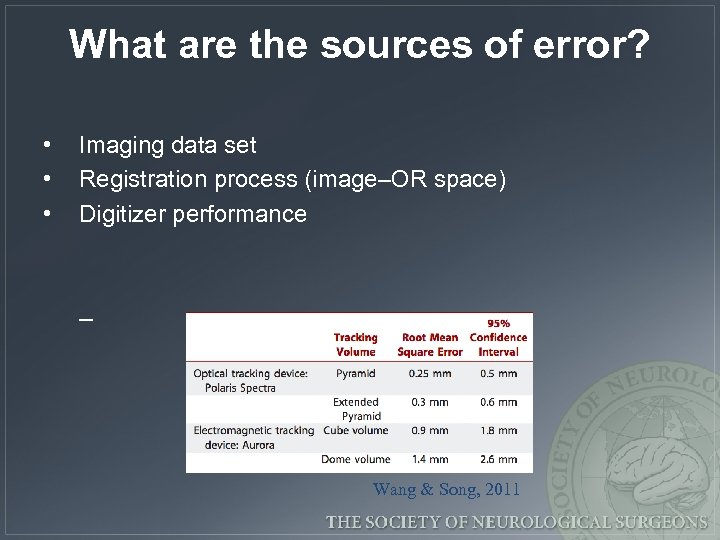 What are the sources of error? • • • Imaging data set Registration process (image–OR space) Digitizer performance – Wang & Song, 2011
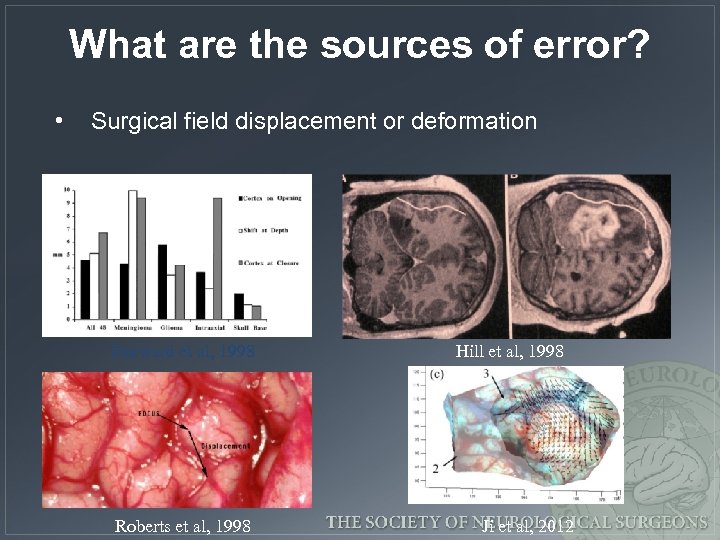 What are the sources of error? • Surgical field displacement or deformation Dorward et al, 1998 Roberts et al, 1998 Hill et al, 1998 Ji et al, 2012
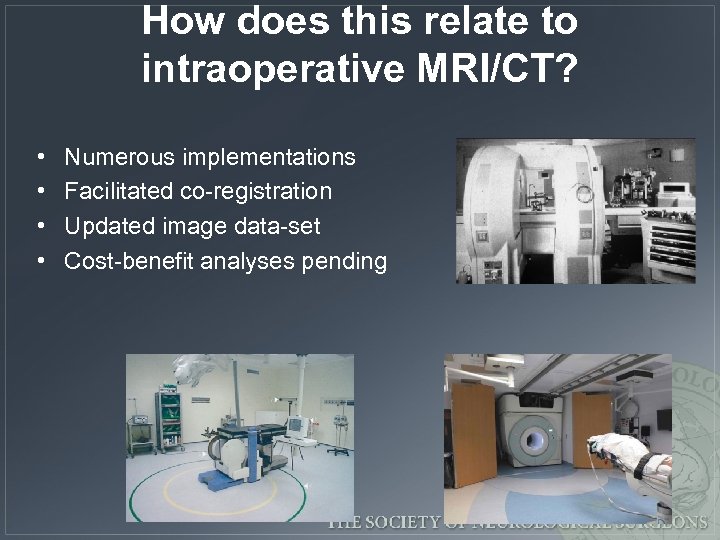 How does this relate to intraoperative MRI/CT? • • Numerous implementations Facilitated co-registration Updated image data-set Cost-benefit analyses pending
 In what applications has imageguidance been important? • • Tumor (biopsy, resection of glial and met tumor) Epilepsy (structural & physiologic data, resection) Functional (DBS) Spine (instrumentation) Radiosurgery (frameless technologies) Cerebrovascular (? ) Other: ENT, Plastics, Ortho, General
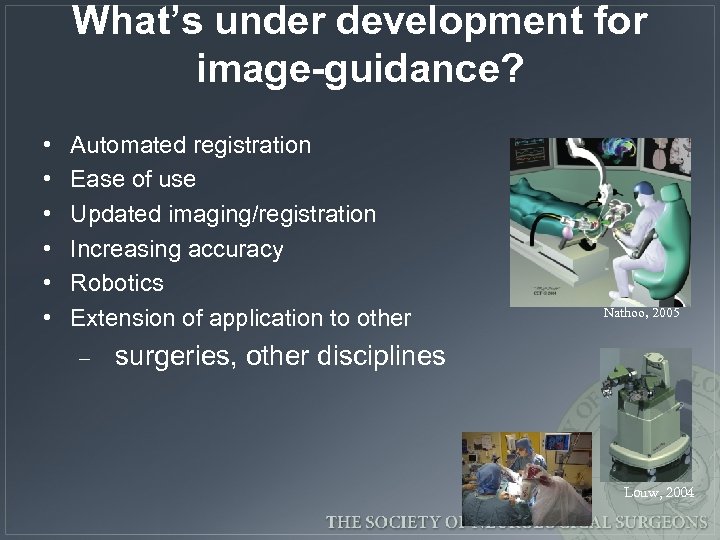 What’s under development for image-guidance? • • • Automated registration Ease of use Updated imaging/registration Increasing accuracy Robotics Extension of application to other – Nathoo, 2005 surgeries, other disciplines Louw, 2004