 Скачать презентацию Principles of Microeconomics 7 Taxes Subsidies and Introduction
fef0add02331e93e9688fa7172f83501.ppt
- Количество слайдов: 35



Principles of Microeconomics 7. Taxes, Subsidies, and Introduction to Welfare Analysis* Akos Lada July 29 th, 2014 * Slide content principally sourced from N. Gregory Mankiw “Principles of Economics” Premium Powe. Point
Lecture 8 - Contents 1. Review of previous lecture 2. More on taxes 3. Willingness to pay and consumer surplus 4. Costs and producer surplus

1. Review
Price controls • Binding vs. non-binding constraints. • Binding price ceilings (e. g. rent control) • Leads to shortage • Effect is more severe in the long run • Rationing, informal market, decrease in quality • Binding price floors (e. g. minimum wage) • Leads to surplus (under the assumptions of the model
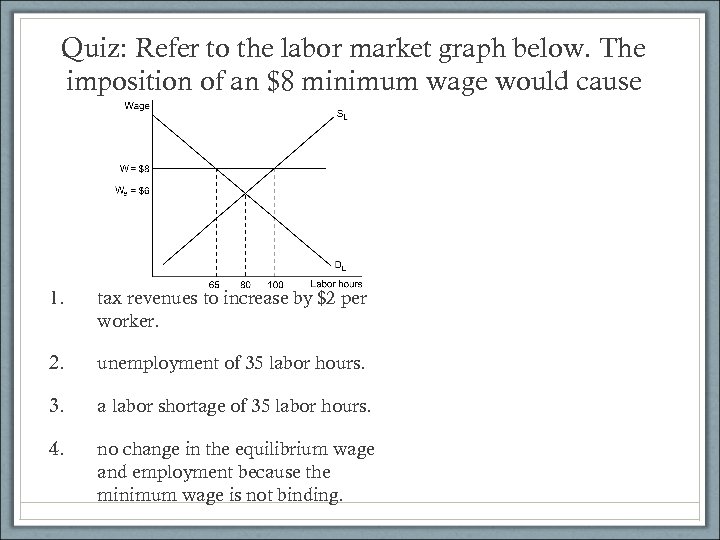
Quiz: Refer to the labor market graph below. The imposition of an $8 minimum wage would cause 1. tax revenues to increase by $2 per worker. 2. unemployment of 35 labor hours. 3. a labor shortage of 35 labor hours. 4. no change in the equilibrium wage and employment because the minimum wage is not binding.
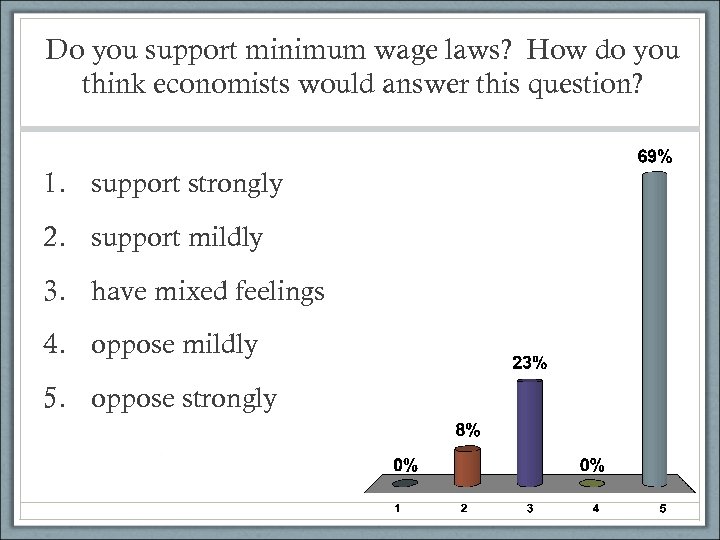
Do you support minimum wage laws? How do you think economists would answer this question? 1. support strongly 2. support mildly 3. have mixed feelings 4. oppose mildly 5. oppose strongly
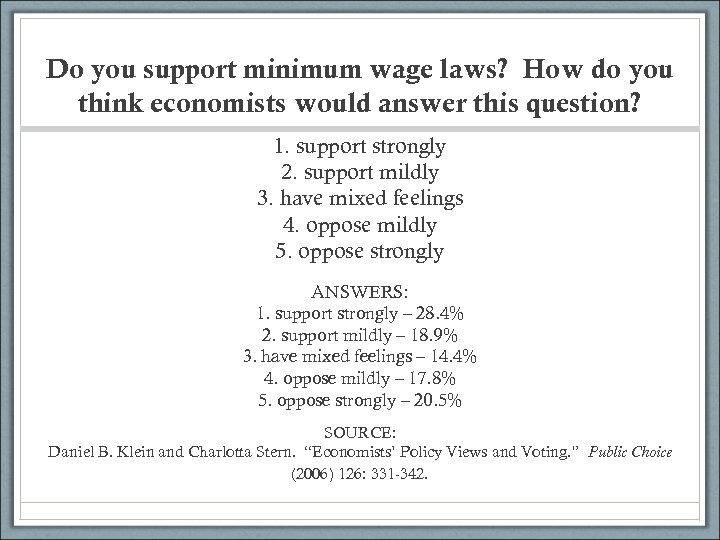
Do you support minimum wage laws? How do you think economists would answer this question? 1. support strongly 2. support mildly 3. have mixed feelings 4. oppose mildly 5. oppose strongly ANSWERS: 1. support strongly – 28. 4% 2. support mildly – 18. 9% 3. have mixed feelings – 14. 4% 4. oppose mildly – 17. 8% 5. oppose strongly – 20. 5% SOURCE: Daniel B. Klein and Charlotta Stern. “Economists’ Policy Views and Voting. ” Public Choice (2006) 126: 331 -342.
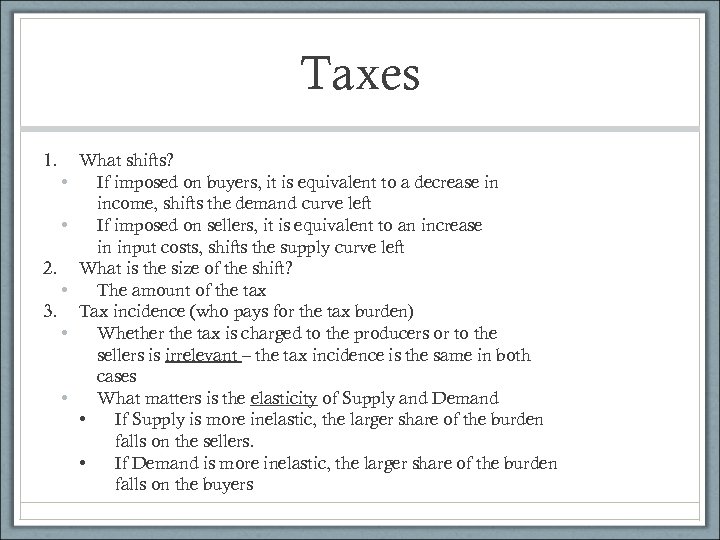
Taxes 1. • • 2. • 3. • • What shifts? If imposed on buyers, it is equivalent to a decrease in income, shifts the demand curve left If imposed on sellers, it is equivalent to an increase in input costs, shifts the supply curve left What is the size of the shift? The amount of the tax Tax incidence (who pays for the tax burden) Whether the tax is charged to the producers or to the sellers is irrelevant – the tax incidence is the same in both cases What matters is the elasticity of Supply and Demand • If Supply is more inelastic, the larger share of the burden falls on the sellers. • If Demand is more inelastic, the larger share of the burden falls on the buyers
2. More on taxes
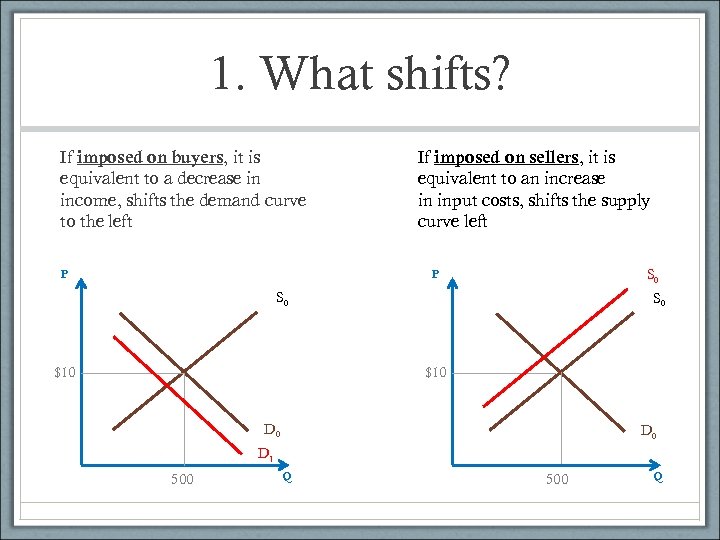
1. What shifts? If imposed on buyers, it is equivalent to a decrease in income, shifts the demand curve to the left P If imposed on sellers, it is equivalent to an increase in input costs, shifts the supply curve left S 0 P S 0 $10 D 0 D 1 500 Q
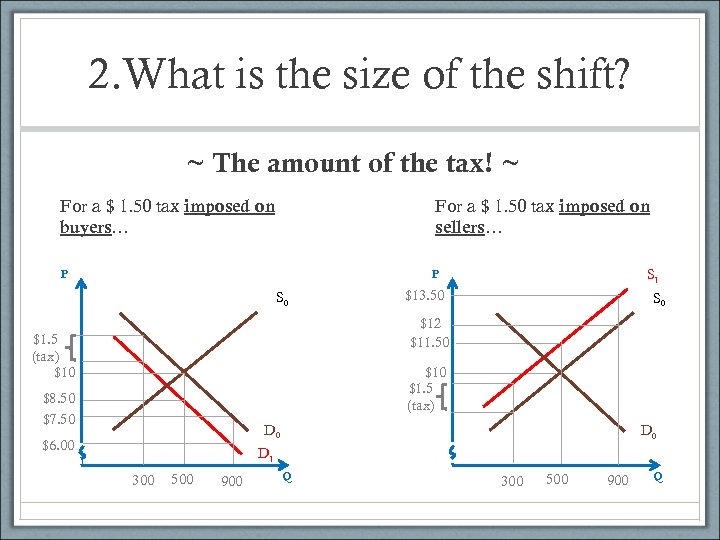
2. What is the size of the shift? ~ The amount of the tax! ~ For a $ 1. 50 tax imposed on buyers… For a $ 1. 50 tax imposed on sellers… P P S 0 S 1 $13. 50 S 0 $12 $11. 50 $1. 5 (tax) $10 $1. 5 (tax) $8. 50 $7. 50 D 0 $6. 00 D 1 300 500 900 Q
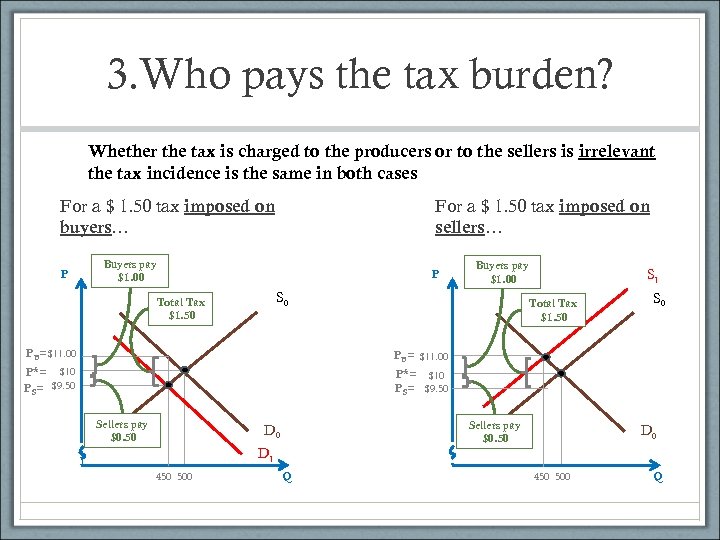
3. Who pays the tax burden? Whether the tax is charged to the producers or to the sellers is irrelevant the tax incidence is the same in both cases For a $ 1. 50 tax imposed on buyers… P For a $ 1. 50 tax imposed on sellers… Buyers pay $1. 00 P Buyers pay $1. 00 S 0 Total Tax $1. 50 PB= $11. 00 S 1 Total Tax $1. 50 S 0 PB= $11. 00 P*= $10 PS= $9. 50 Sellers pay $0. 50 D 0 D 1 450 500 Q
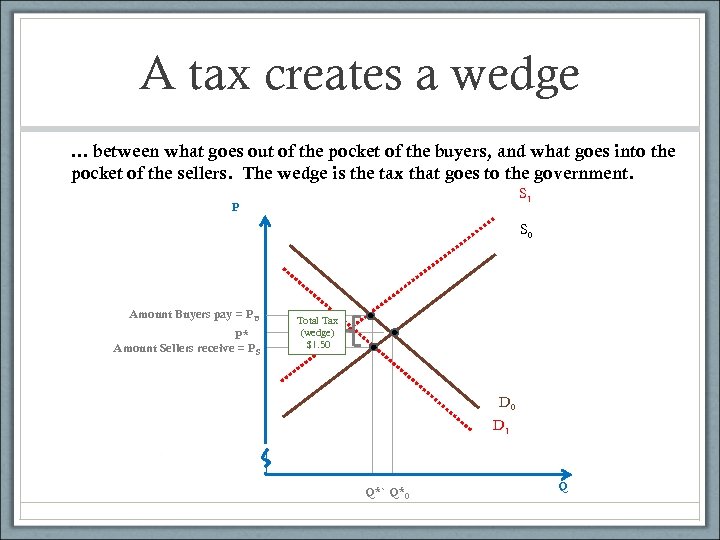
A tax creates a wedge … between what goes out of the pocket of the buyers, and what goes into the pocket of the sellers. The wedge is the tax that goes to the government. S 1 P S 0 Amount Buyers pay = PB P* Amount Sellers receive = PS Total Tax (wedge) $1. 50 D 1 Q*` Q*0 Q
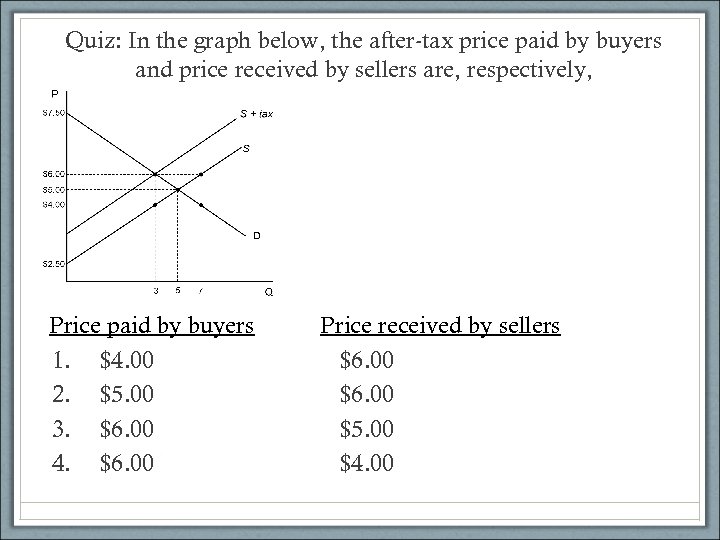
Quiz: In the graph below, the after-tax price paid by buyers and price received by sellers are, respectively, Price paid by buyers 1. $4. 00 2. $5. 00 3. $6. 00 4. $6. 00 Price received by sellers $6. 00 $5. 00 $4. 00
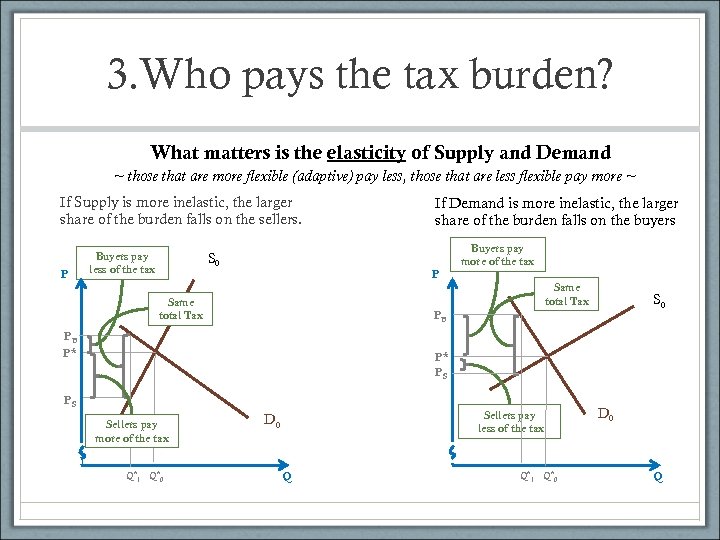
3. Who pays the tax burden? What matters is the elasticity of Supply and Demand ~ those that are more flexible (adaptive) pay less, those that are less flexible pay more ~ If Supply is more inelastic, the larger share of the burden falls on the sellers. P S 0 Buyers pay less of the tax If Demand is more inelastic, the larger share of the burden falls on the buyers P Buyers pay more of the tax Same total Tax S 0 PB PB P* P* PS PS Sellers pay more of the tax Q*1 Q*0 Sellers pay less of the tax D 0 Q Q*1 Q*0 D 0 Q
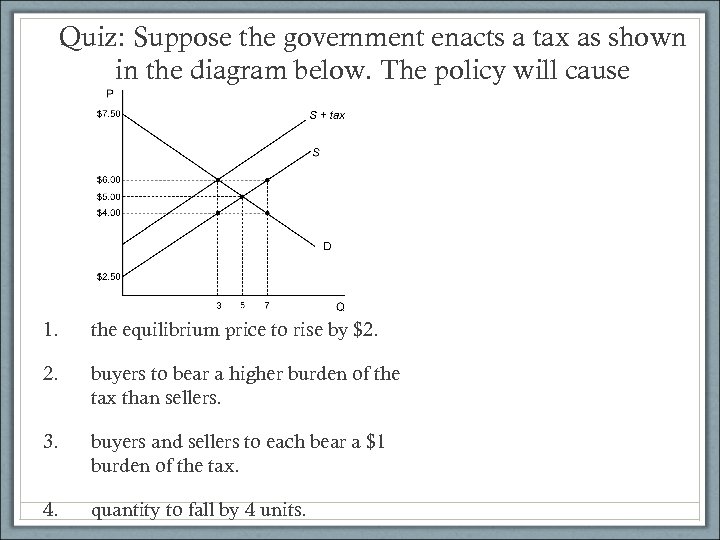
Quiz: Suppose the government enacts a tax as shown in the diagram below. The policy will cause 1. the equilibrium price to rise by $2. buyers to bear a higher burden of the tax than sellers. 3. buyers and sellers to each bear a $1 burden of the tax. 4. quantity to fall by 4 units.
3. Willingness to Pay and Consumer Surplus
Welfare Economics • Recall, the allocation of resources refers to: • how much of each good is produced • which producers produce it • which consumers consume it • Welfare economics studies how the allocation of resources affects economic well-being. • First, we look at the well-being of consumers.
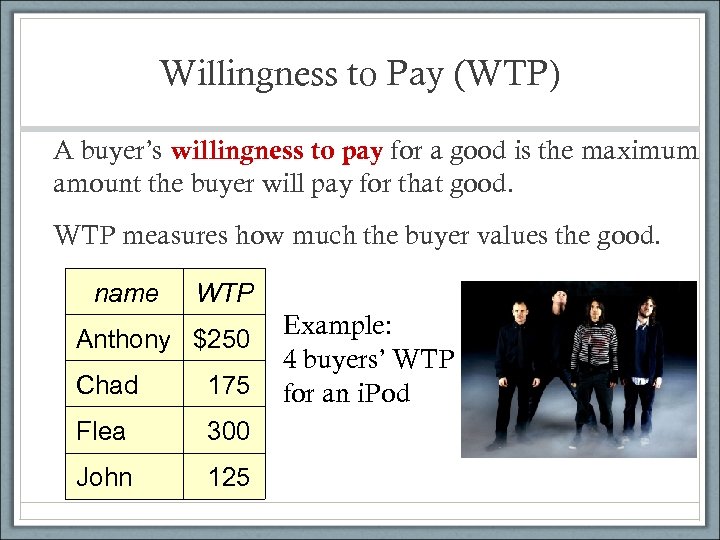
Willingness to Pay (WTP) A buyer’s willingness to pay for a good is the maximum amount the buyer will pay for that good. WTP measures how much the buyer values the good. name WTP Anthony $250 Chad 175 Flea 300 John 125 Example: 4 buyers’ WTP for an i. Pod
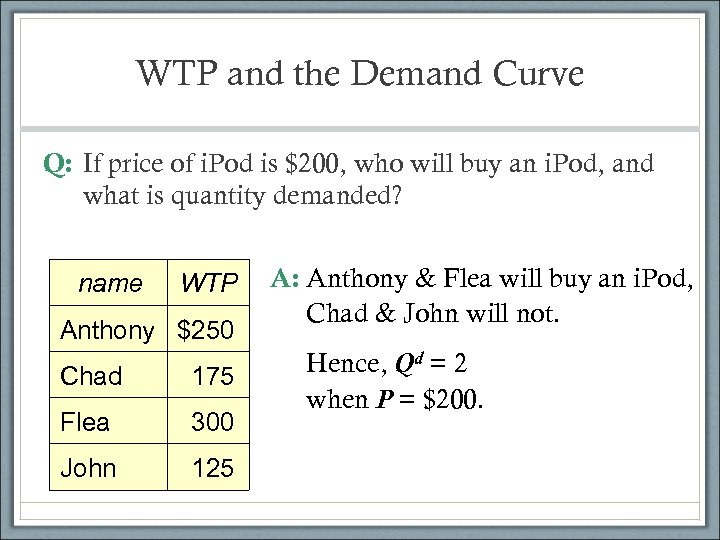
WTP and the Demand Curve Q: If price of i. Pod is $200, who will buy an i. Pod, and what is quantity demanded? name WTP Anthony $250 Chad 175 Flea 300 John 125 A: Anthony & Flea will buy an i. Pod, Chad & John will not. Hence, Qd = 2 when P = $200.
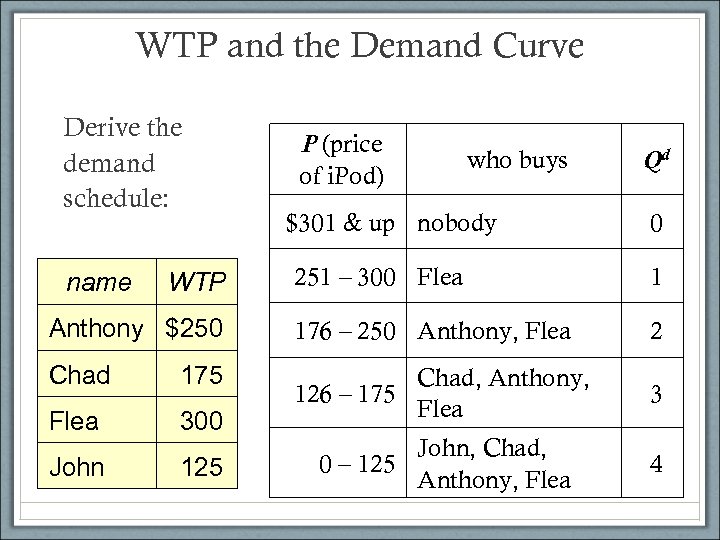
WTP and the Demand Curve Derive the demand schedule: P (price of i. Pod) who buys $301 & up nobody Qd 0 251 – 300 Flea 1 Anthony $250 176 – 250 Anthony, Flea 2 Chad 175 Flea 300 Chad, Anthony, 126 – 175 Flea 3 name John WTP 125 0 – 125 John, Chad, Anthony, Flea 4
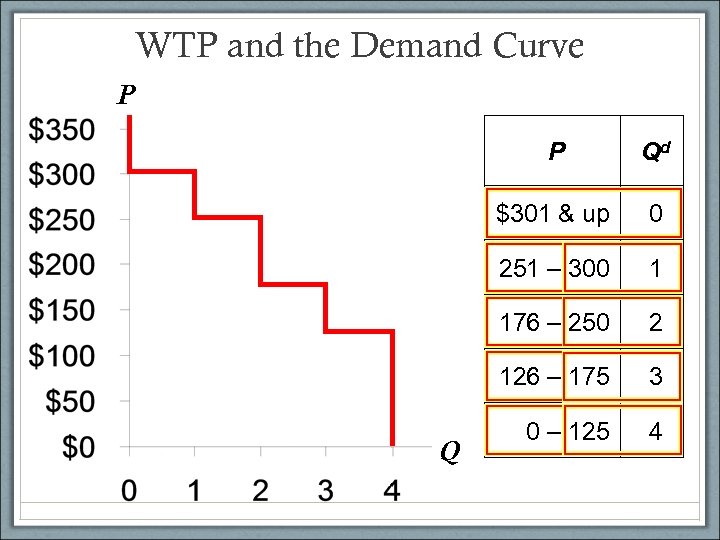
WTP and the Demand Curve P P $301 & up 0 251 – 300 1 176 – 250 2 126 – 175 Q Qd 3 0 – 125 4
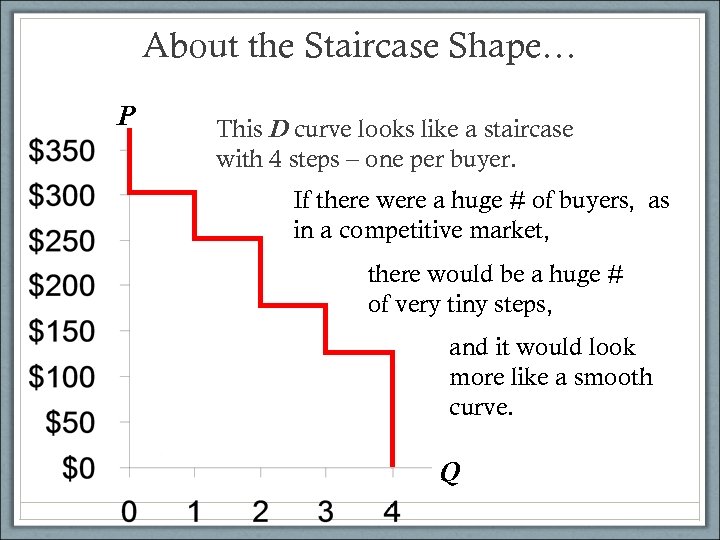
About the Staircase Shape… P This D curve looks like a staircase with 4 steps – one per buyer. If there were a huge # of buyers, as in a competitive market, there would be a huge # of very tiny steps, and it would look more like a smooth curve. Q
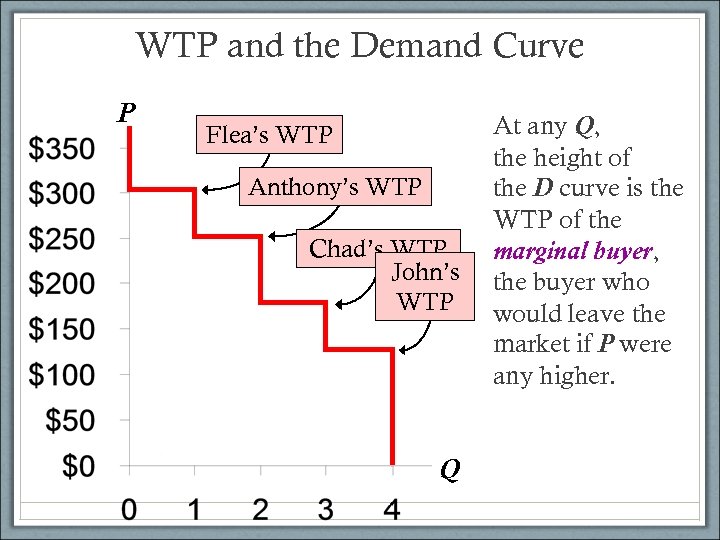
WTP and the Demand Curve P Flea’s WTP Anthony’s WTP Chad’s WTP John’s WTP Q At any Q, the height of the D curve is the WTP of the marginal buyer, the buyer who would leave the market if P were any higher.
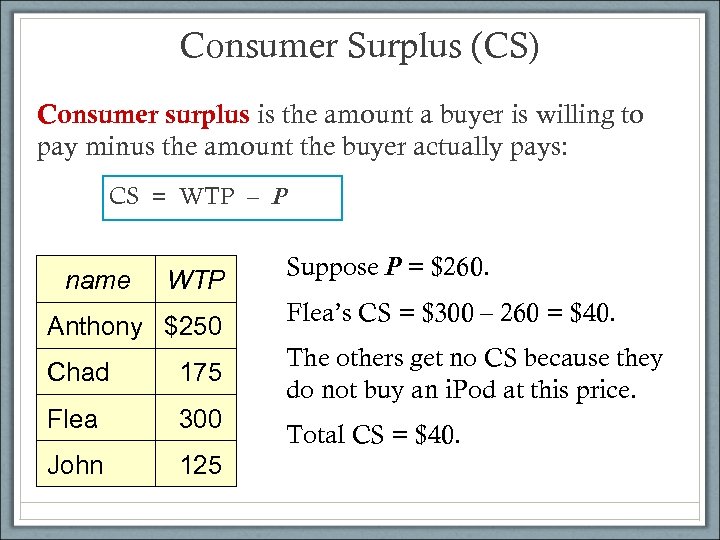
Consumer Surplus (CS) Consumer surplus is the amount a buyer is willing to pay minus the amount the buyer actually pays: CS = WTP – P name WTP Anthony $250 Chad 175 Flea 300 John 125 Suppose P = $260. Flea’s CS = $300 – 260 = $40. The others get no CS because they do not buy an i. Pod at this price. Total CS = $40.
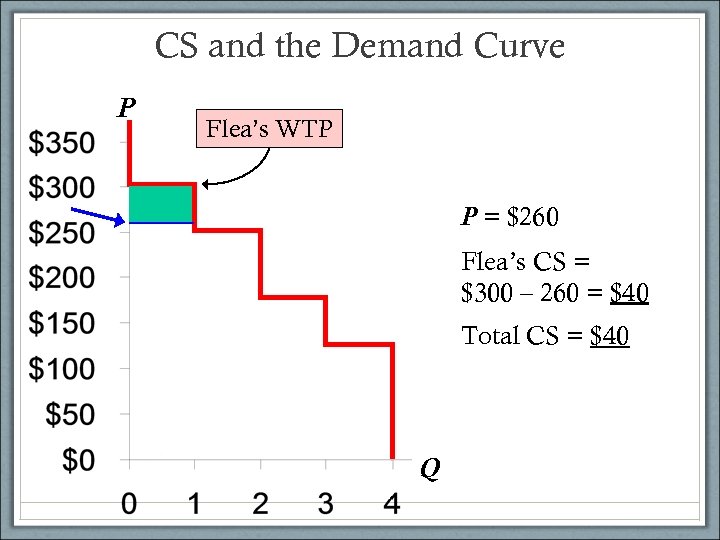
CS and the Demand Curve P Flea’s WTP P = $260 Flea’s CS = $300 – 260 = $40 Total CS = $40 Q
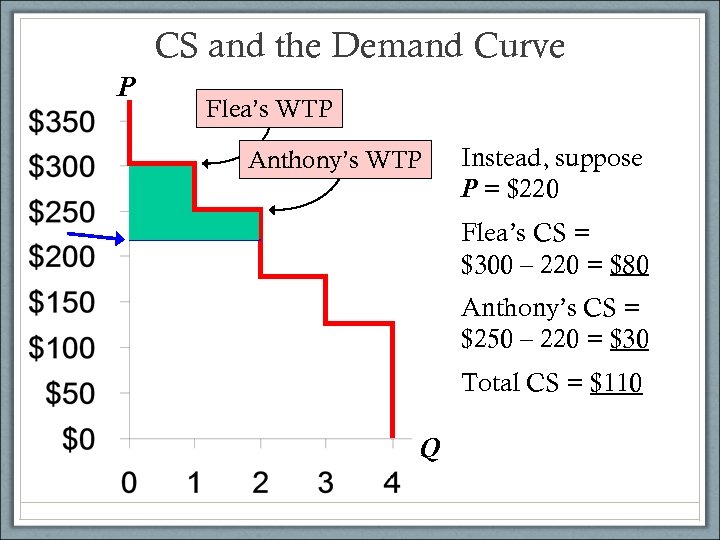
CS and the Demand Curve P Flea’s WTP Anthony’s WTP Instead, suppose P = $220 Flea’s CS = $300 – 220 = $80 Anthony’s CS = $250 – 220 = $30 Total CS = $110 Q
4. Costs and Producer Surplus
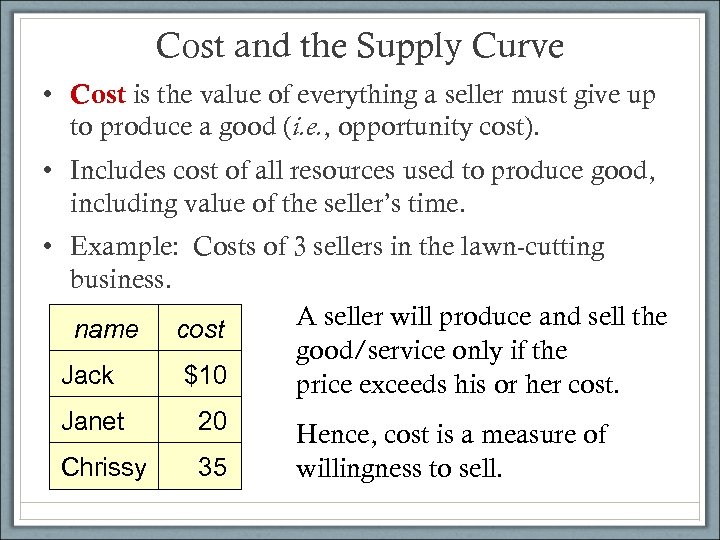
Cost and the Supply Curve • Cost is the value of everything a seller must give up to produce a good (i. e. , opportunity cost). • Includes cost of all resources used to produce good, including value of the seller’s time. • Example: Costs of 3 sellers in the lawn-cutting business. A seller will produce and sell the name cost good/service only if the Jack $10 price exceeds his or her cost. Janet 20 Chrissy 35 Hence, cost is a measure of willingness to sell.
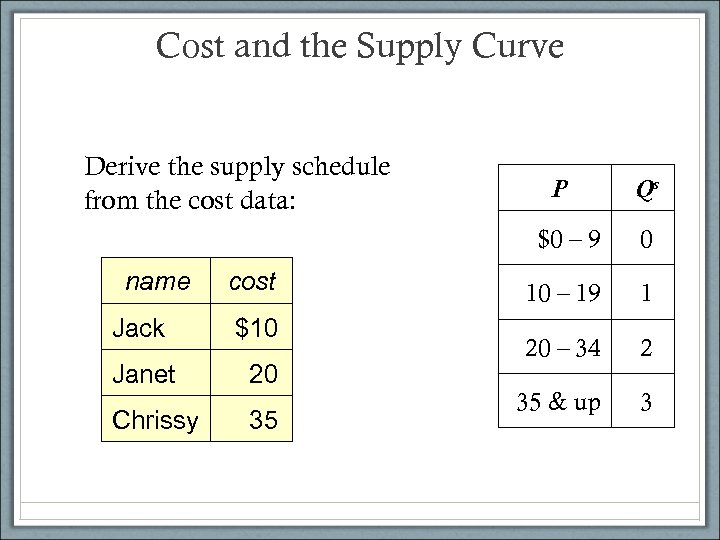
Cost and the Supply Curve Derive the supply schedule from the cost data: P Qs $0 – 9 name cost Jack $10 Janet 20 Chrissy 35 0 10 – 19 1 20 – 34 2 35 & up 3
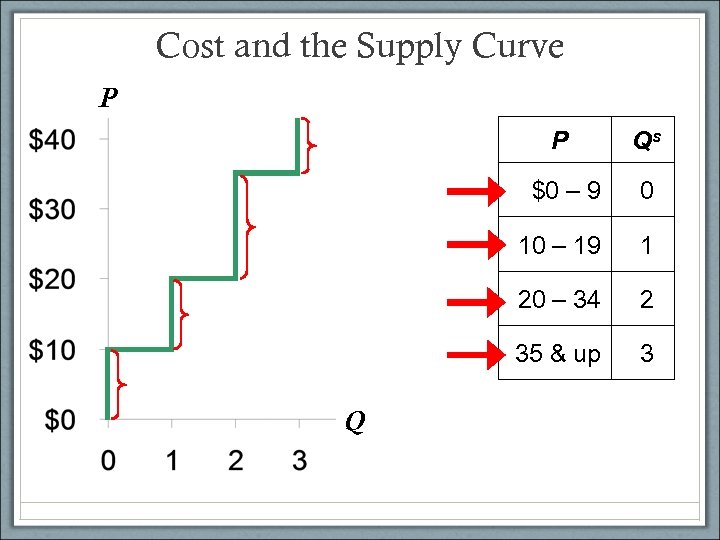
Cost and the Supply Curve P P $0 – 9 0 10 – 19 1 20 – 34 2 35 & up Q Qs 3
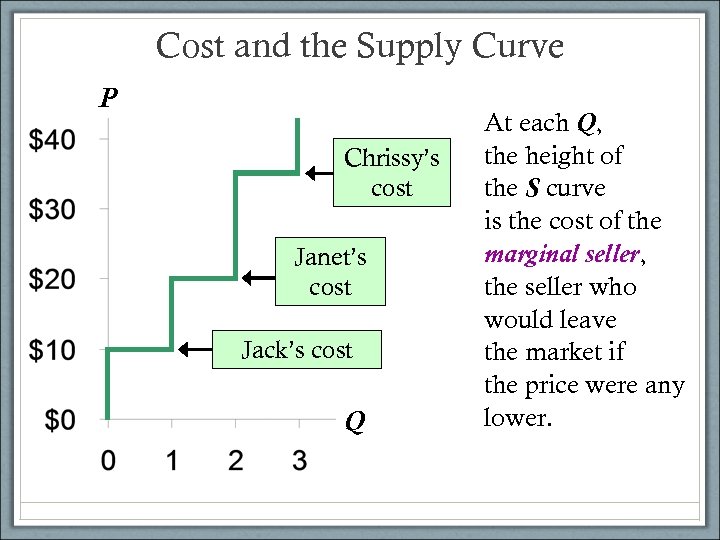
Cost and the Supply Curve P Chrissy’s cost Janet’s cost Jack’s cost Q At each Q, the height of the S curve is the cost of the marginal seller, the seller who would leave the market if the price were any lower.
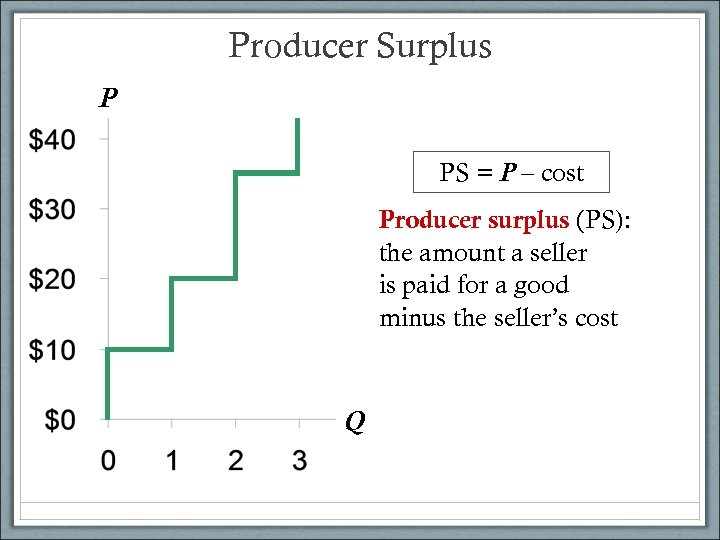
Producer Surplus P PS = P – cost Producer surplus (PS): the amount a seller is paid for a good minus the seller’s cost Q
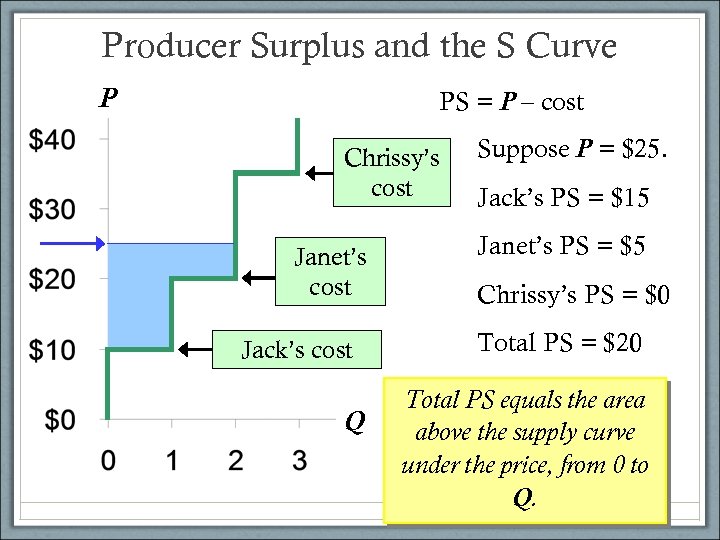
Producer Surplus and the S Curve P PS = P – cost Chrissy’s cost Janet’s cost Jack’s cost Q Suppose P = $25. Jack’s PS = $15 Janet’s PS = $5 Chrissy’s PS = $0 Total PS = $20 Total PS equals the area above the supply curve under the price, from 0 to Q.
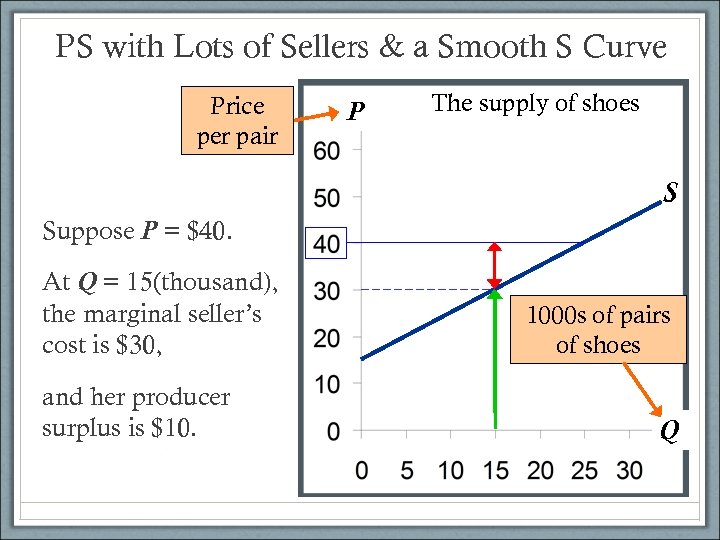
PS with Lots of Sellers & a Smooth S Curve Price per pair P The supply of shoes S Suppose P = $40. At Q = 15(thousand), the marginal seller’s cost is $30, and her producer surplus is $10. 1000 s of pairs of shoes Q
Скачать презентацию Principles of Microeconomics 7 Taxes Subsidies and Introduction
fef0add02331e93e9688fa7172f83501.ppt