


 Скачать презентацию Principles of Marketing Prof univ dr Smaranda COSMA
7115a368891d905fe6ed1c1703089b1a.ppt
- Количество слайдов: 130
 Principles of Marketing Prof. univ. dr. Smaranda COSMA Lect. univ. dr. Marius BOTA Facultatea de Business Universitatea Babeş-Bolyai
 Principles of Marketing Chapter 3 Developing marketing mix Product, Price, Place, Promotion
 Selective references 1. 2. 3. 4. 5. 6. 7. Armstrong, G. , Harker, M. , Kotler, Ph, Brennan, R. , Marketing: An Introduction, Pearson Education Limited, Edinburgh Gate, 2009. (google books) + video cases Baker M. J. , Saren, M. , Marketing Theory: A Student Case, Sage Publications Inc. , London, 2010. (google books) Cosma, S. , Bota, M. , Bazele marketingului, Editura Alma Mater, Cluj-Napoca, 2004. Kotler, Ph. , Keller, K. L. , Marketing Management, 13 th edition, Prentice Hall, 2011. Kotler, Ph. , Armstrong, G. , Wong, V. , Saunders, J. A. , Principles of marketing, Pearson Education Limited, Edinburgh Gate, 2008. (google books) Ph. Kotler, Managementul marketingului, ediţia a 4 -a, Editura Teora, Bucureşti, 2004. N. Paina s. a, Bazele marketingului , Editura Presa Universitara Clujeana, Cluj-Napoca, 2002.
 Chapter 3 Marketing mix • Represents a combination (mixing) of some variables, designed to meet the changes in marketing environment. • Marketing mix variables are considered as internal variables, with which managers take decisions and provide control.
 Marketing mix • Marketing mix concept was introduced in 1964 by Prof. Neil Borden, including the following 12 elements: product, advertising, brand, sales promotion, packaging, product presentation, price, aftersales services, distribution, logistics, personal selling and marketing research. • In the same year, Prof. Jerome Mc. Carthy, simplifies Borden's model synthesising it into the 4 P: Product, Price, Place & Promotion
 „ 4 P” versus „ 4 C” 4 P Product Price Place Promotion 4 C Customer Cost Comodity in acquisition Communication
 Product Ø According to the classical concept, the product is viewed as an amount of tangible attributes and features, physical and chemical together in an identifiable form. Ø In the marketing concept, the product represents all tangible and intangible elements that trigger the demand expressed by the consumer on the market and that must be designed in a system concept integrating the whole ambience of the object that surrounds him, consisting of a wide range of intangible, symbolic, informational elements.
 The product is built from a set of features that are grouped as follows: • Observed features including: ▫ ▫ • • Physical characteristics: shape, color etc. Functional features: the ability to perform certain functions Services offered by product: delivery time, payment terms, after - sales service, information of exploitation; Symbolic features: brand, prestige, freedom.
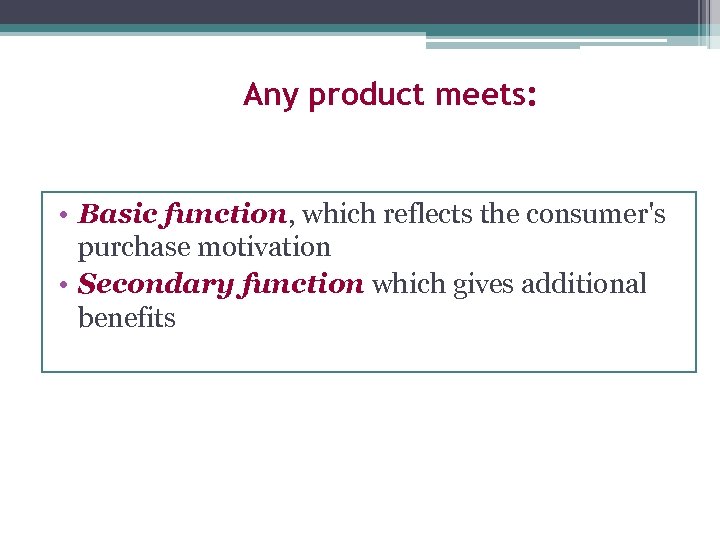 Any product meets: • Basic function, which reflects the consumer's purchase motivation • Secondary function which gives additional benefits
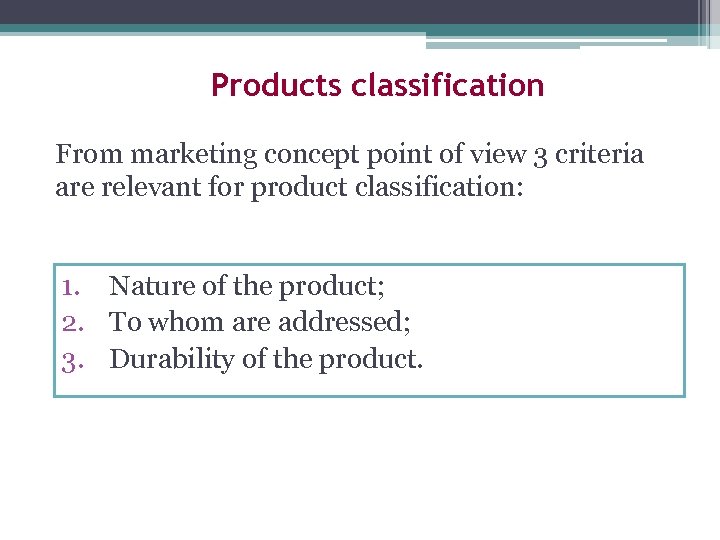 Products classification From marketing concept point of view 3 criteria are relevant for product classification: 1. Nature of the product; 2. To whom are addressed; 3. Durability of the product.
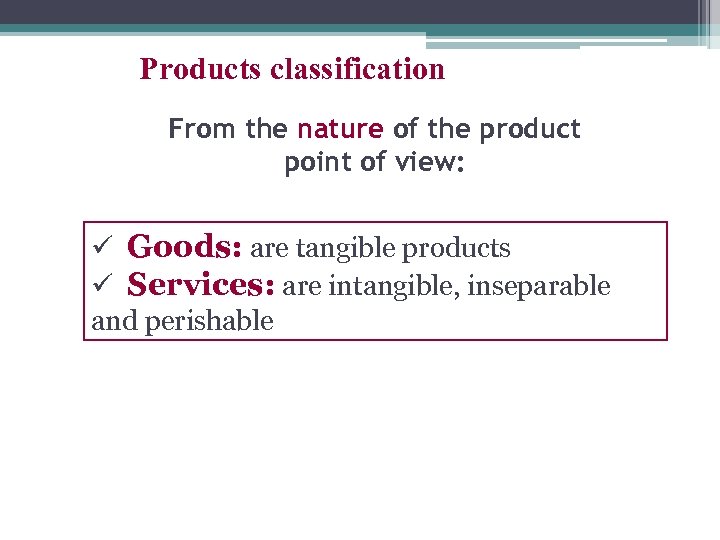 Products classification From the nature of the product point of view: ü Goods: are tangible products ü Services: are intangible, inseparable and perishable
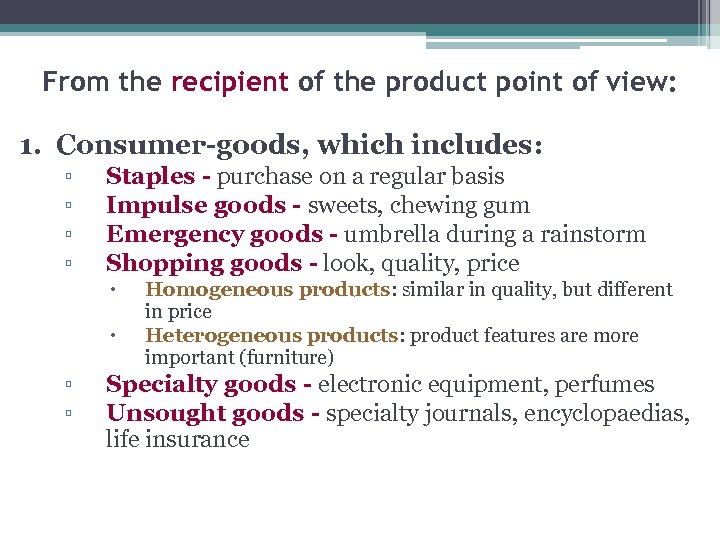 From the recipient of the product point of view: 1. Consumer-goods, which includes: ▫ ▫ Staples - purchase on a regular basis Impulse goods - sweets, chewing gum Emergency goods - umbrella during a rainstorm Shopping goods - look, quality, price ▫ ▫ Homogeneous products: similar in quality, but different in price Heterogeneous products: product features are more important (furniture) Specialty goods - electronic equipment, perfumes Unsought goods - specialty journals, encyclopaedias, life insurance
 From the recipient of the product point of view: 2. Industrial goods: bought by organizations. ▫ ▫ ▫ Materials and parts: enter the manufacturer’s product completely; Capital items: enter the finish product partly – installations and accessory equipment; Suppliers and services: do not enter the finished product at all – typing paper, pencils etc.
 From the durability of the product point of view: 1. Durable goods – survive many uses; 2. Nondurable goods – are consumed in one or a few uses.
 Competitive differentiation and positioning of the marketing offer Offer differentiation is the act of designing a set of meaningful differences to distinguish the company's offering from competitor's offerings.
 Differentiation – potential competitive advantage of the company Product mix levels 1. Expected product consists of the core product plus the minimum conditions expected when customers purchase product. 2. Augmented product consists of additional benefits that allows differentiation of the same kind of goods in a competitive market. 3. Potential product includes all the features that might be useful to consumers, warning them about possible evolution of the product.
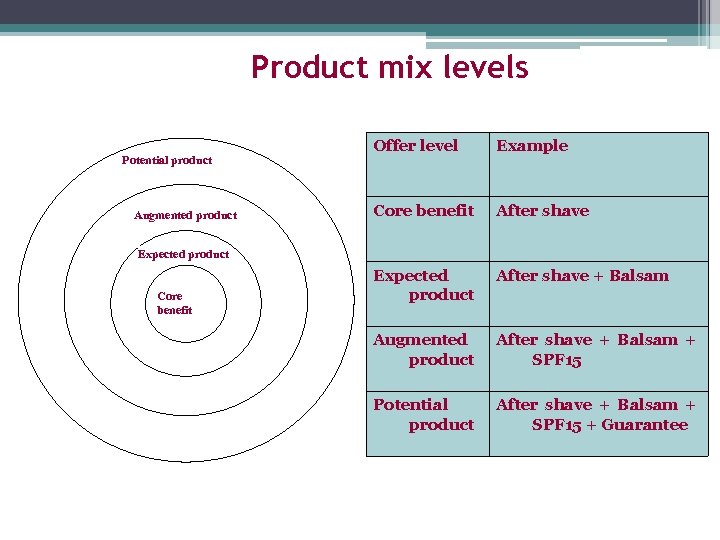 Product mix levels Potential product Augmented product Offer level Example Core benefit After shave Expected product After shave + Balsam Augmented product After shave + Balsam + SPF 15 Potential product After shave + Balsam + SPF 15 + Guarantee Expected product Core benefit
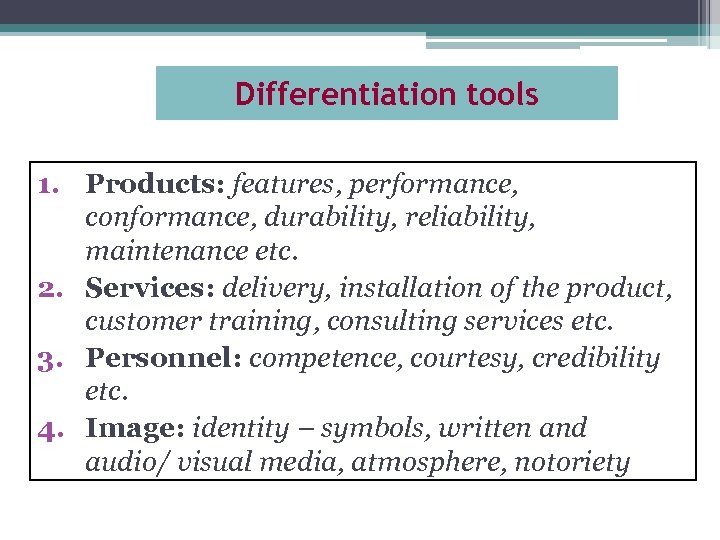 Differentiation tools 1. Products: features, performance, conformance, durability, reliability, maintenance etc. 2. Services: delivery, installation of the product, customer training, consulting services etc. 3. Personnel: competence, courtesy, credibility etc. 4. Image: identity – symbols, written and audio/ visual media, atmosphere, notoriety
 Offer positioning Positioning – the act of designing company’s offer so that it occupies a distinct and valued place in the target customers’ minds.
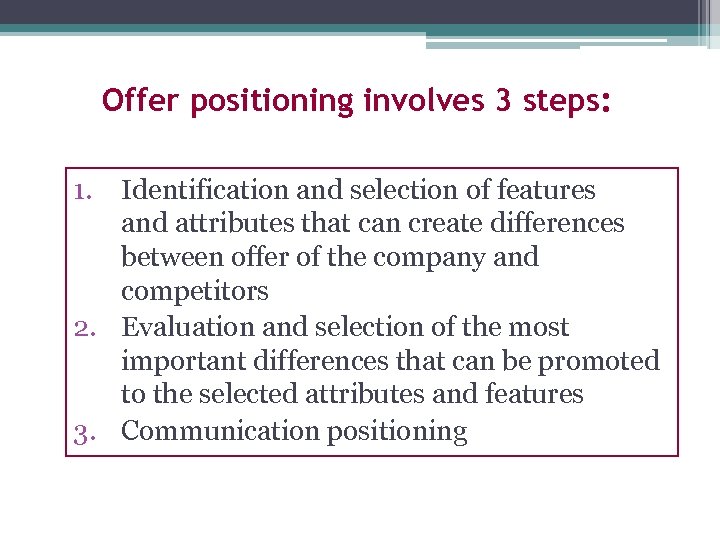 Offer positioning involves 3 steps: 1. Identification and selection of features and attributes that can create differences between offer of the company and competitors 2. Evaluation and selection of the most important differences that can be promoted to the selected attributes and features 3. Communication positioning
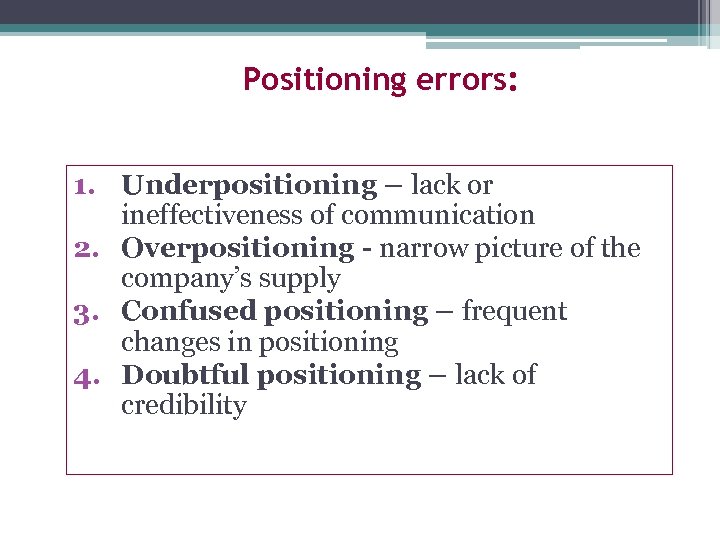 Positioning errors: 1. Underpositioning – lack or ineffectiveness of communication 2. Overpositioning - narrow picture of the company’s supply 3. Confused positioning – frequent changes in positioning 4. Doubtful positioning – lack of credibility
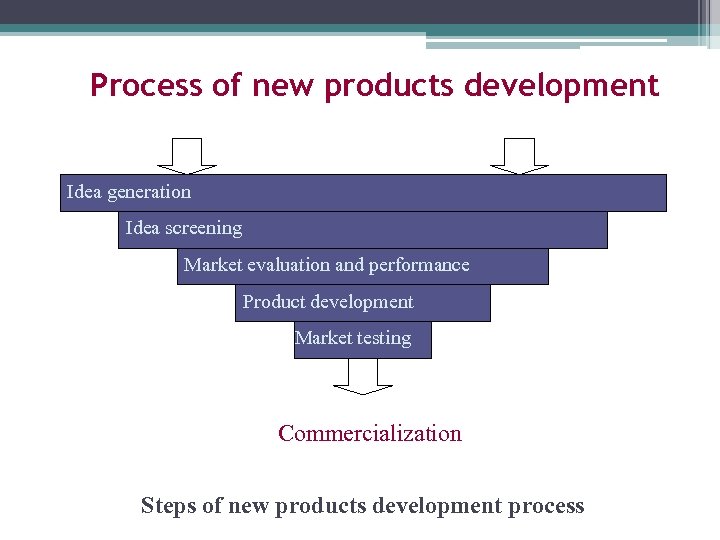 Process of new products development Idea generation Idea screening Market evaluation and performance Product development Market testing Commercialization Steps of new products development process
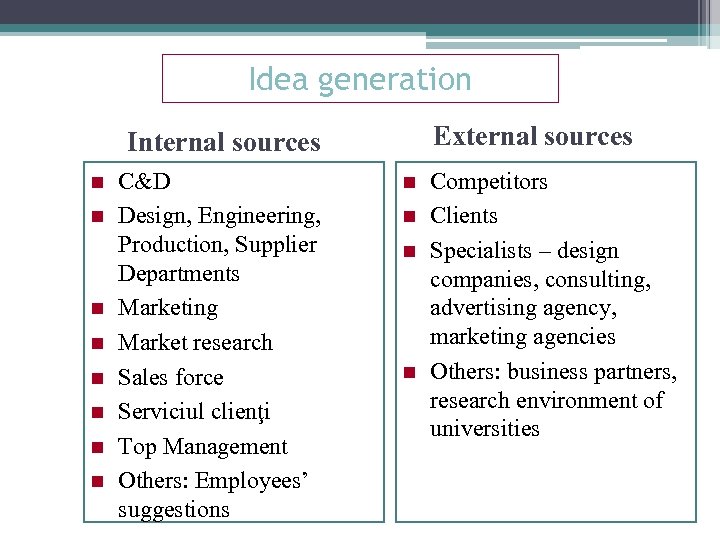 Idea generation External sources Internal sources n n n n C&D Design, Engineering, Production, Supplier Departments Marketing Market research Sales force Serviciul clienţi Top Management Others: Employees’ suggestions n n Competitors Clients Specialists – design companies, consulting, advertising agency, marketing agencies Others: business partners, research environment of universities
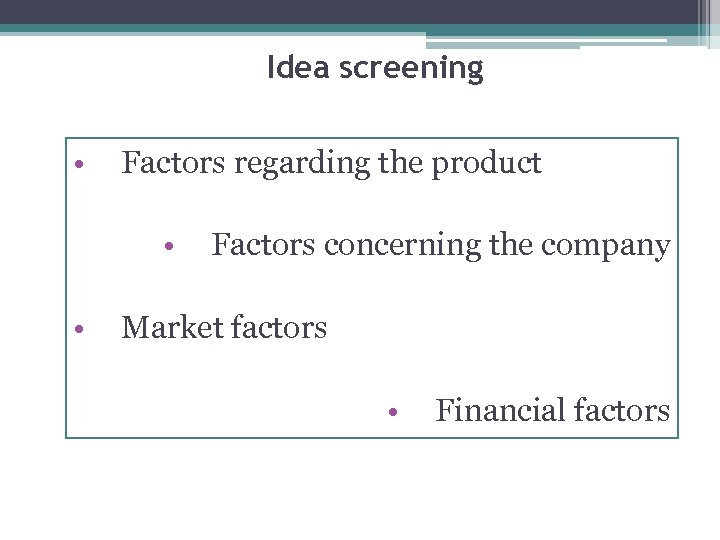 Idea screening • Factors regarding the product • • Factors concerning the company Market factors • Financial factors
 Market evaluation and performance - market investigation and marketing analysis, financial projecting and cost estimation - ü Concept development ü Concept testing ü Market evaluation and designing of business plan ü Economical analysis: turnover forecast, necessary investments, costs and profit projection
 Product development - total effort of a team ØInputs for new product designing and development • Market study and consumer behavior • Company objective • C&D department • Product policy • Supplying • Logistics and raw materials • Engineering • Production planning • Added services • Marketing consultancy: product test, consumer tests etc.
 Market testing - commercial risk decreasing - v. Reliable forecast of future sales v. Determine costs of necessary marketing operations v. Testing entire marketing mix v. Practice in manufacturing, delivering and sailing
 Product commercialization üEstablish market-entry timing When? üDefining geographical strategy Where? üChoosing distribution channels How? – To whom? üConsumer adoption process
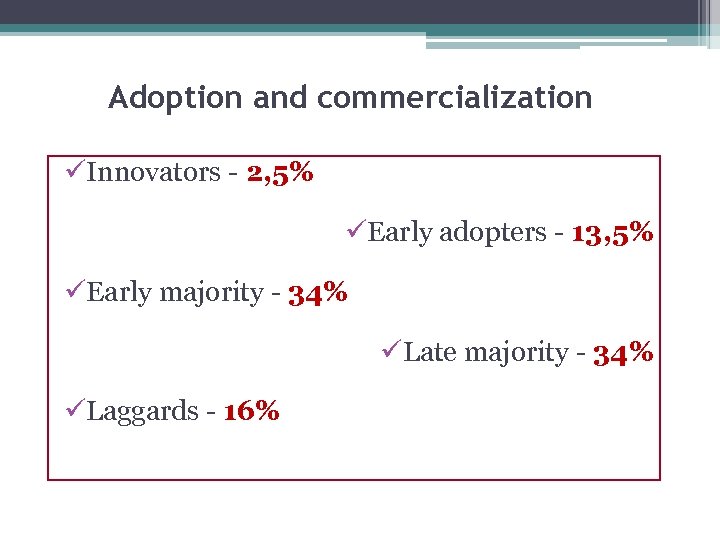 Adoption and commercialization üInnovators - 2, 5% üEarly adopters - 13, 5% üEarly majority - 34% üLate majority - 34% üLaggards - 16%
 Product life cycle Period of time between product appearing on the market and product eliminating of manufacturing.
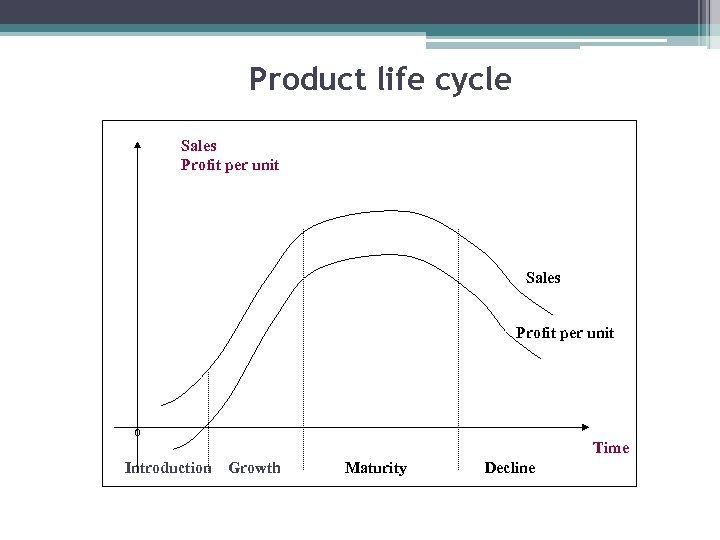 Product life cycle Sales Profit per unit 0 Time Introduction Growth Maturity Decline
 INTRODUCTION The objective is to create awareness and stimulating product trial. Features of Introduction: • • • slow start of sales ; reduced benefits, even negative in the beginning; relatively high price weak competition, the product is not known; segment of consumers - innovators.
 INTRODUCTION Marketing strategies and policies: Ø Standard, basic product; ØCost-oriented price; ØSelective distribution; ØPromotion tools: informing advertising, strong sales force to persuade consumers.
 GROWTH The objective is to maximize competitive position and to increase brand preference Features of Growth: 1. 2. 3. 4. sales are growing fast; benefits are increasing; unit cost is average competition is weak to medium buyers – mostly early adopters
 GROWTH Marketing strategies and policies: 1. 2. 3. 4. Product: product line expansion; Price decrease, market penetration prices; Intensive distribution; Promotion tools: increasing awareness, product image creation, sales promotion.
 MATURITY Maturity in growth Stable maturity Maturity in decline Objectives of maturity: 1. Maximise profit 2. Defending market share 3. Increase costumer loyalty.
 MATURITY Features of maturity: 1. highest sales in stable mature; 2. highest benefits in maturity in decline; 3. unit cost is the lowest; 4. competition is very strong; 5. buyers are majority
 MATURITY Marketing strategies and policies: § Product: differentiation and rejuvenation; § Price: adapted to the main competitors; § Intensive to selective distribution; § Promotion tools: reminder advertising, image building and increasing loyalty.
 DECLINE Decline objectives are: 1. Reduce expenditures 2. Harvesting/Milking the brand Main features: 1. 2. 3. 4. 5. declining sales; benefits are declining; production and marketing costs decrease; competition is in decline; product is required only traditional customers (laggards).
 DECLINE Marketing strategies and policies: • • Product: removal from manufacturing; Price: continuous decrease; Distribution: selective, în restrângere; Promotion actions: reduce to minimum.
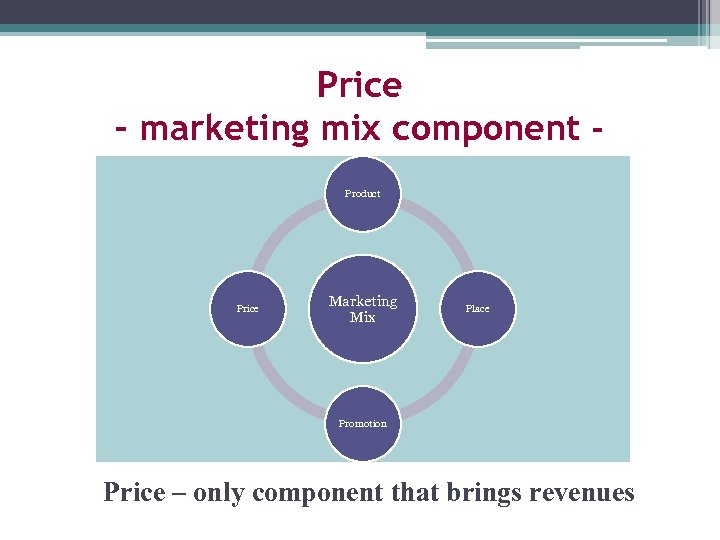 Price – marketing mix component Product Price Marketing Mix Place Promotion Price – only component that brings revenues
 Price - definition • Price is an amount of money that customer accepts and is willing to pay the seller in exchange for purchased products. • The size of the price reflected the amount that a client is able and willing to "sacrifice" to meet a particular need or desire.
 Price particularities: 1. Price is a mobile and flexible element of marketing mix • price can be changed easily • effect of price change is usually immediate and measurable
 2. Price is a result of endogenous and exogenous factors interaction Endogen § Internal conditions of company § Technical and organisational level of production § Production costs § Transport, distribution, commercialisation § Quality of company management Exogen § Particularities of national economy § Balance of power in the market § State pricing policy § International regulations and restrictions
 Price can vary between 2 limits: 1. lower limit corresponding to the production and marketing costs and ensure a minimum profit margin. 2. upper limit determined by the product acceptability
 3. The price is considered a measure of adaptability of the company to a highly dynamic competitive environment 4. Company must obtain an interaction, interdependence between pricing and policies of product, distribution and promotion – in marketing strategy.
 Pricing objectives • Objectives related to profit • Objectives related to sales
 Objectives related to profit • survival • Production overcapacity • Strong competition on the market • Changing consumer wants • maximum current profit
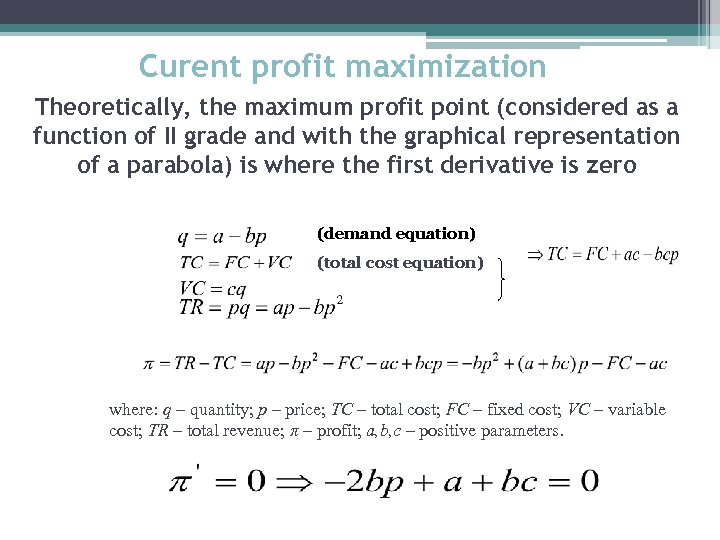 Curent profit maximization Theoretically, the maximum profit point (considered as a function of II grade and with the graphical representation of a parabola) is where the first derivative is zero (demand equation) (total cost equation) where: q – quantity; p – price; TC – total cost; FC – fixed cost; VC – variable cost; TR – total revenue; π – profit; a, b, c – positive parameters.
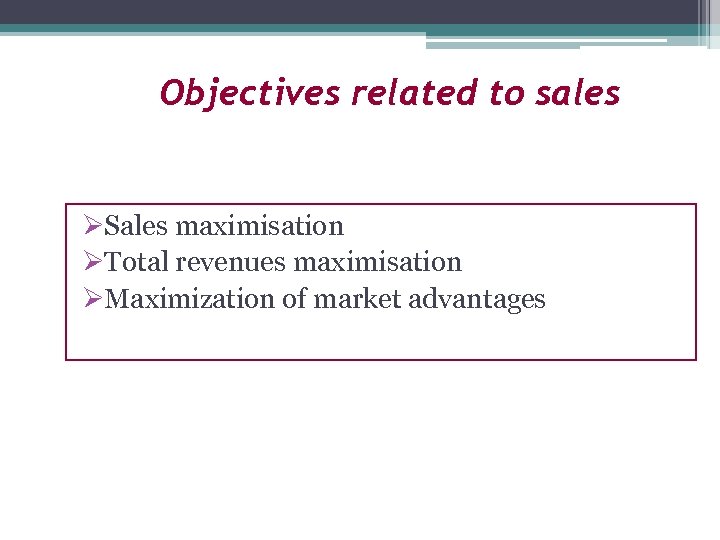 Objectives related to sales ØSales maximisation ØTotal revenues maximisation ØMaximization of market advantages
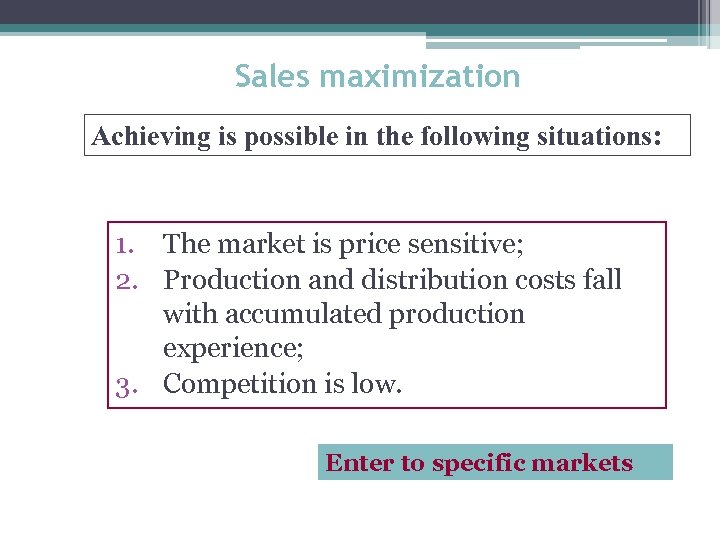 Sales maximization Achieving is possible in the following situations: 1. The market is price sensitive; 2. Production and distribution costs fall with accumulated production experience; 3. Competition is low. Enter to specific markets
 Total revenue maximization • Long term effect is maximization of profit and market share of the company. • Pricing that maximizes turnover is based on demand total revenues equation.
 Maximization of market advantages Achieving is possible in the following situations: § Current demand is high; § Production costs are not extremely high; § Competition is low; § It is promoting the image of a product quality leadership.
 Determinants of price 1. 2. 3. 4. 5. Costs Competition Demand Product life cycle Other marketing mix elements
 Costs • Fixing the price that cover total costs and a minimum profit margin
 Competition • Big companies ▫ Low prices (market-penetration pricing) ▫ High prices (market-skimming pricing) • Small companies (competition orientated pricing) ▫ Imitative aligning ▫ Differentiated aligning
 Demand • Is used in case of elastic demand Price elasticity of demand
 Product life cycle in introduction the price is fixed at a high level in growth and especially in maturity, prices are decreasing because of the competition and costs decreasing usually in decline price falls further to align to the decrease in demand.
 Other marketing mix elements • Final price should take into account the quality of the brand the company's promotion policy, as well as that practiced by competitors.
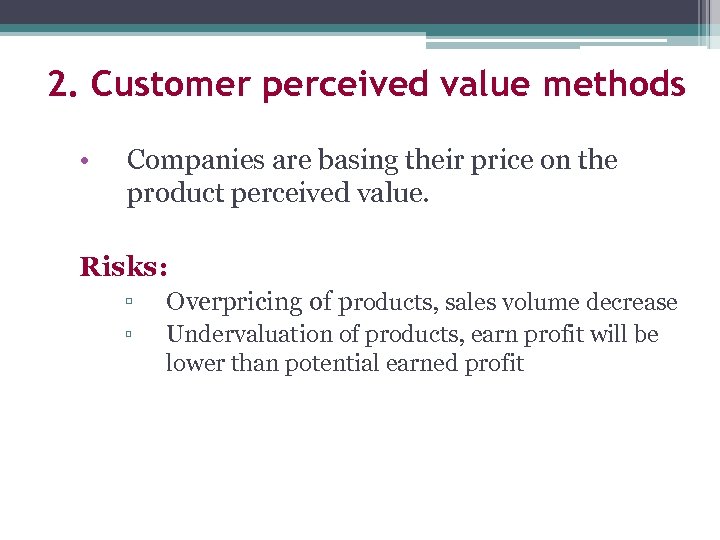
 Pricing methods 1. Cost based methods; 2. Customer perceived value methods; 3. Competition based methods.
 1. Cost based methods 1. Markup pricing 2. Target-return pricing
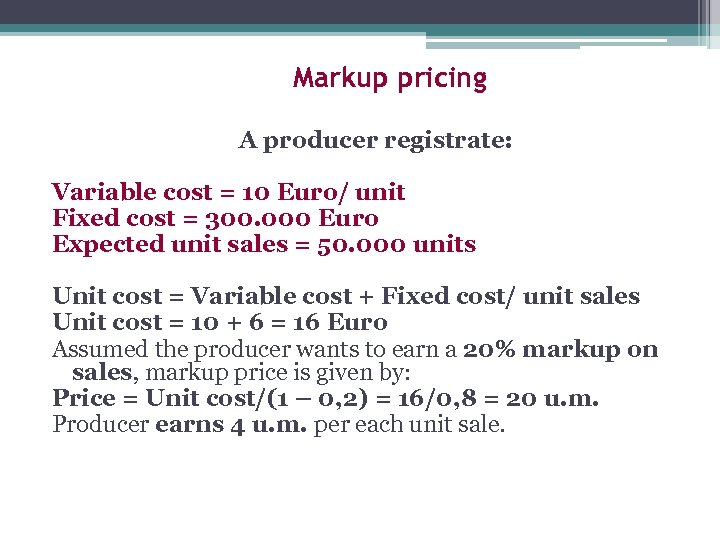 Markup pricing A producer registrate: Variable cost = 10 Euro/ unit Fixed cost = 300. 000 Euro Expected unit sales = 50. 000 units Unit cost = Variable cost + Fixed cost/ unit sales Unit cost = 10 + 6 = 16 Euro Assumed the producer wants to earn a 20% markup on sales, markup price is given by: Price = Unit cost/(1 – 0, 2) = 16/0, 8 = 20 u. m. Producer earns 4 u. m. per each unit sale.
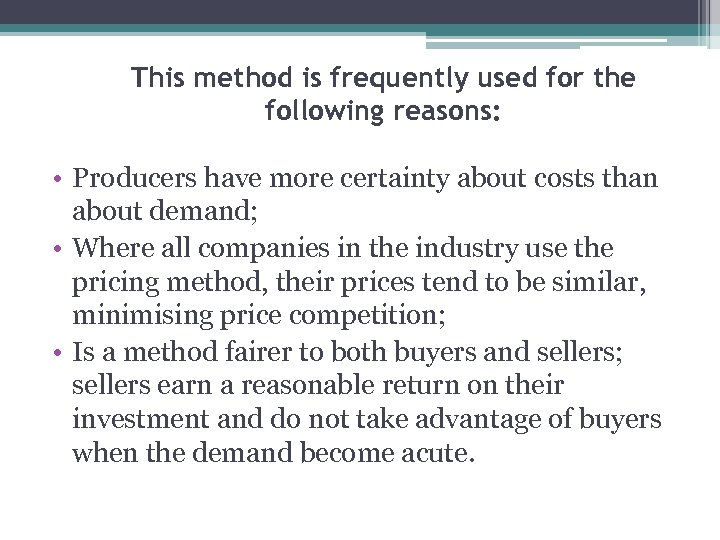 This method is frequently used for the following reasons: • Producers have more certainty about costs than about demand; • Where all companies in the industry use the pricing method, their prices tend to be similar, minimising price competition; • Is a method fairer to both buyers and sellers; sellers earn a reasonable return on their investment and do not take advantage of buyers when the demand become acute.
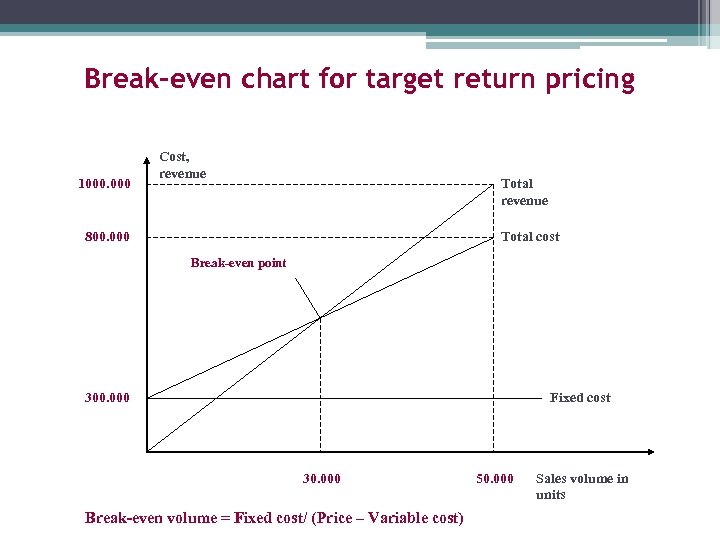
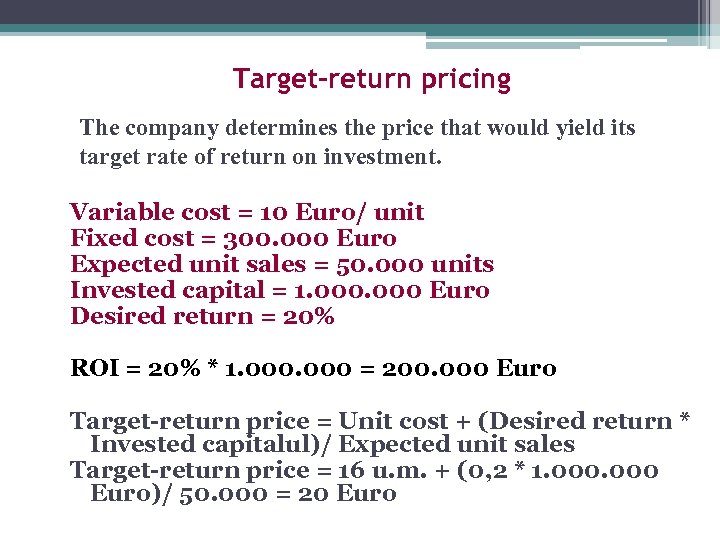 Target-return pricing The company determines the price that would yield its target rate of return on investment. Variable cost = 10 Euro/ unit Fixed cost = 300. 000 Euro Expected unit sales = 50. 000 units Invested capital = 1. 000 Euro Desired return = 20% ROI = 20% * 1. 000 = 200. 000 Euro Target-return price = Unit cost + (Desired return * Invested capitalul)/ Expected unit sales Target-return price = 16 u. m. + (0, 2 * 1. 000 Euro)/ 50. 000 = 20 Euro
 Break-even chart for target return pricing 1000. 000 Cost, revenue Total revenue 800. 000 Total cost Break-even point 300. 000 Fixed cost 30. 000 Break-even volume = Fixed cost/ (Price – Variable cost) 50. 000 Sales volume in units
 2. Customer perceived value methods • Companies are basing their price on the product perceived value. Risks: ▫ Overpricing of products, sales volume decrease ▫ Undervaluation of products, earn profit will be lower than potential earned profit
 3. Competition based methods • Going rate pricing • Sealed-bid pricing
 Selecting the final price There are 5 categories of prices: 1. Negotiated prices 2. Product mix prices 3. Differentiated prices based on some criteria 4. Psychological prices 5. Promotional prices
 1. Negotiated pricing • prices that reward consumers for: • immediate payment (cash discounts) • purchase a large quantity of goods (quantity discounts) • purchase seasonal products at the end of season (seasonal discounts) • Turning in an old item when buying a new one (trade-in allowances) • preferential prices for distributors (functional discounts) • original price is increased by "emergency tax"
 2. Product mix pricing • Captive-product pricing (printer – cartridge) • Product-bundling pricing (desktop + monitor) • Byproduct pricing (meat, milk) • Optional feature pricing (cars)
 3. Discriminatory pricing – Differentiated prices based on some criteria § Geographical pricing § Customer-segment pricing § Product-form pricing (product image) § Location and time pricing
 4. Psychological pricing Setting the size of these prices is based on responses to two questions: 1. What is the minimum price you consider the product has poor quality? 2. What is the maximum price above which you consider the product is too expensive?
 Types of psychological prices: ØPrestige pricing ØCustomary pricing ØProfessional pricing ØOdd-even pricing
 5. Promotional pricing • Low prices, aiming to promote the product.
 Distribution consists of all operations that a produced product is made available to the consumer. The distribution includes a set of activities that separates the end of production by product purchasing.
 Distribution role Based on position it occupy in the economic cycle of products, distribution plays an important role in achieving marketing objectives for: Ø customer Ø company Ø society
 For customer: • products needed by consumers in terms of quantity and structure; • reduce the time needed for purchasing goods and required variety by approaching producer-consumer; • add value to the product and conserve its properties.
 For company: § efficient transfer of products from producer to final consumer; § continuity of production flow; § increasing economic efficiency of commercial activities; § a way of balancing supply and demand ratio in different periods and areas through storage; § increase financial profitability of the company; § obtaining information useful for marketing research.
 For society: • increasing the employment, being creator of jobs
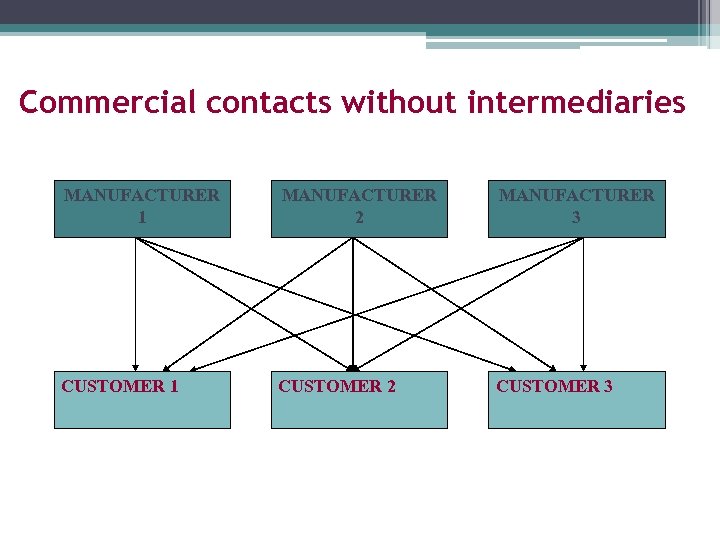 Commercial contacts without intermediaries MANUFACTURER 1 MANUFACTURER 2 MANUFACTURER 3 CUSTOMER 1 CUSTOMER 2 CUSTOMER 3
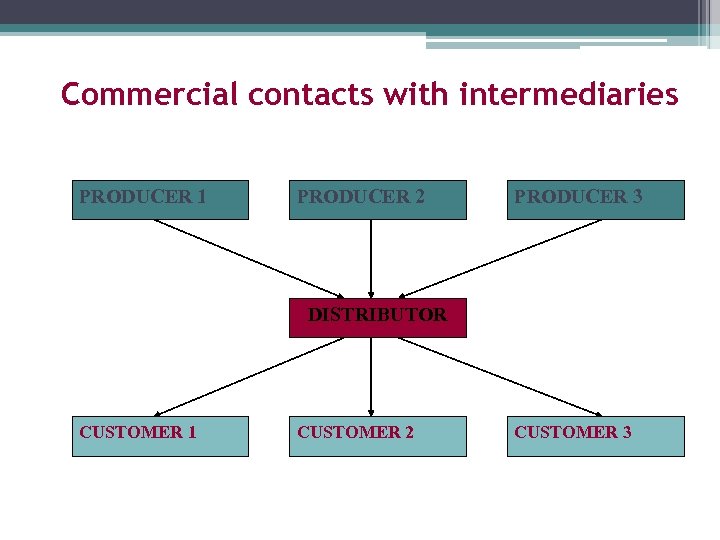 Commercial contacts with intermediaries PRODUCER 1 PRODUCER 2 PRODUCER 3 DISTRIBUTOR CUSTOMER 1 CUSTOMER 2 CUSTOMER 3
 The basic components of distribution are: • • routes of products from producers to customer all economic acts that are carried out on these routes physical processes for products on these routes (transport, storage, handling, storage, packaging, labeling etc. ) system of human and material resources that ensures the transfer of products
 Main marketing flows between participants to distribution activities are: 1. negotiation flow – establishing terms and conditions for ownership transfer; 2. ordering flow – transmit buying intension; 3. products flow – physical transfer of product, ownership; 4. payment flow – pay debts for purchased products; 5. information flow - collect information about the environment in which business operates; 6. promotion flow - establish methods and techniques to communicate the offers on the market.
 Distribution channel • represents itinerary of moving goods from producer to consumer, and the ways in which their successive transfer takes place between participants to the distribution process • includes producer and final consumer as extreme points, and between specialized companies in distribution activities, called intermediaries.
 Distribution channels have 3 dimensions: 1. Length 2. Width 3. Depth of channel
 Length of the distribution channel ü represents the number of intermediary links involved in the distribution process
 Depending on their length distribution channels can be: 1. Direct (one level) channel, when manufacturer sell directly to the final consumer, without intermediaries 2. Indirect (multi level) channel, when two or more intermediaries appear in distribution process. short long
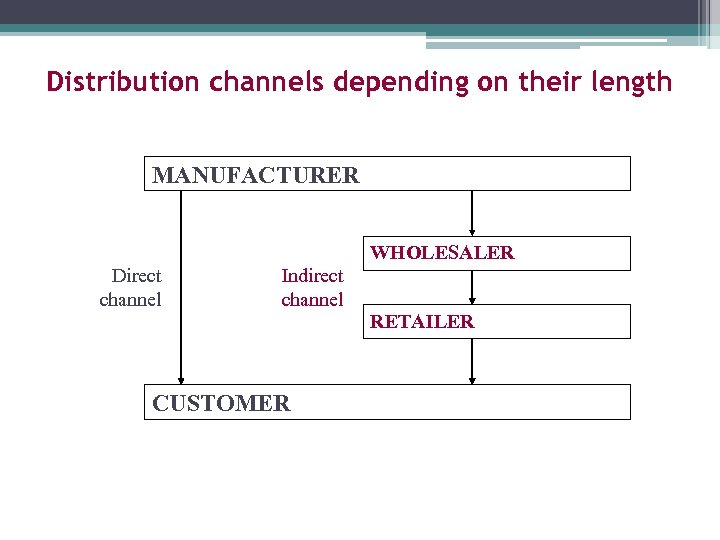 Distribution channels depending on their length MANUFACTURER WHOLESALER Direct channel Indirect channel CUSTOMER RETAILER
 Width of the distribution channel • Represents the total number of units composing a certain intermediary link Ø Wide channels are for common goods Ø Narrow channel for industrial products
 Depth of the distribution channel v how close to the final consumption location does an intermediary deliver the products v mailing or sale of milk at home
 Channel design decisions 1. 2. number of intermediaries selecting and evaluating channel members 3. terms and responsibilities of each channel participant
 1. Number of intermediaries Company sets the width of the distribution channel: • quantity (number of distribution points) • quality (nature, type of operational units)
 2. Selecting and evaluating channel members v Choosing and setting the most appropriate distribution channels must be the result of a careful examination of the factors which influence sales.
 Product characteristics § value of the product § product size § technical aspects § required type of storage
 Customer/Middlemen characteristics • buyers and their behavior • purchasing methods • number of potential clients
 Distribution costs • organizational expenses • physical distribution expenses • general expenses
 ØCompetition and distribution networks used by them Ø Financial resources of the company Ø General economic development
 3. Terms and responsibilities of each channel participant The main components of the " commercial relations mix " are: Ø price policy Ø commercial conditions Ø territorial rights of distributors Ø services and mutual obligations
 Distribution channel control • each channel member wants to have as much influence as possible to control and obtain higher profits • as long the channel is as complex and intense is the competition for power and control • control of the channel is a necessary ingredient for system to work
 Leader of the channel • Manufacturer ▫ economic and financial power is greater than the remaining members • Wholesalers ▫ producers are not giants ▫ compete in markets where is a large number of small and medium • Retailer ▫ giant retailers
 Channel types of organisation 1. Conventional marketing channels 2. Corporate vertical marketing channels 3. Administered vertical marketing channels 4. Contractual vertical marketing channels
 Conventional marketing channels • independent manufacturers, wholesalers and retailers with the aim of maximizing their profit • no member of the channel has control over others
 Corporate vertical marketing channels • production and sales processes are coordinated by a single unit for: • economic reasons (to reduce distribution costs) • strategic (channel control) • integration can be done both upstream and downstream
 Administered vertical marketing channels • production and sales processes are supervised by a company • company cooperate with intermediaries for activities that aims: • merchandising goods • products promotion • pricing of products
 Contractual vertical marketing channels • different manufacturers and intermediaries established contractual relationships in order to reduce costs and increase sales volume
 Franchise 1. franchisor (host of the system) 2. franchisee (business beneficial)
 Franchising can be of three types: ØProduct franchise ØIndustry franchise, by product or production ØServices franchise
 Promotion - definition • Promotion - actions and tools of informing and attracting potential buyers to the point of sale, in order to meet their needs and desires and increase economic efficiency of companies.
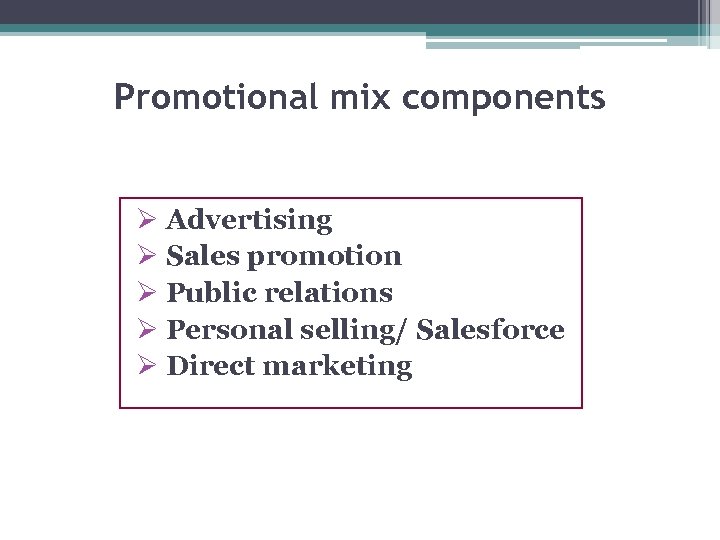 Promotional mix components Ø Advertising Ø Sales promotion Ø Public relations Ø Personal selling/ Salesforce Ø Direct marketing
 Advertising Any paid form of nonpersonal presentation and promotion of ideas, goods or services by an identified sponsor.
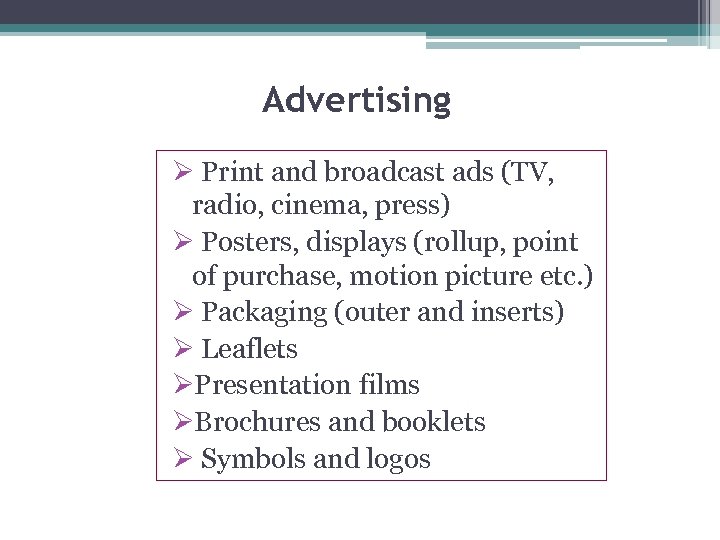 Advertising Ø Print and broadcast ads (TV, radio, cinema, press) Ø Posters, displays (rollup, point of purchase, motion picture etc. ) Ø Packaging (outer and inserts) Ø Leaflets ØPresentation films ØBrochures and booklets Ø Symbols and logos
 Sales promotion Short term incentives to encourage purchase or sale of a product or service.
 Sales promotion • • • Contests, games, sweepstakes, lotteries Gifts Sampling Fairs and trade shows Exhibits Demonstrations Couponing Rebates Possibility of change an old product with a new one • Packs
 Public relations A variety of programs designed to improve, maintain or protect a company or product image.
 Public relations § Press kits § Speeches § Seminars § Annual reports § Charitable activities § Sponsorships § Publications § Company magazines § Special events § Community relations § Lobbing § Identity media
 Personal selling/ Salesforce Oral presentation in a conversation with one or more prospective purchasers for the purpose of making sales.
 Personal selling • • Sales presentations Sales meeting Incentive programs Samples
 Direct Marketing Interactive system of marketing which uses one or more advertising media to effect a measurable response and/or transaction at any location.
 Direct marketing Ø Catalogs Ø Direct mail ØTelemarketing ØElectronic shopping
 Any communication action must respect 3 conditions: • truth about the product - its essential performance; • truth about the company - any company has an identity and a culture that can not be ignored; • truth about consumers - communication must be adapted to their expectations.
 Developing effective communication Promotion strategy of the company must be in correlation with the strategies adopted for the product, price and distribution. Its starting point is the overall marketing strategy.
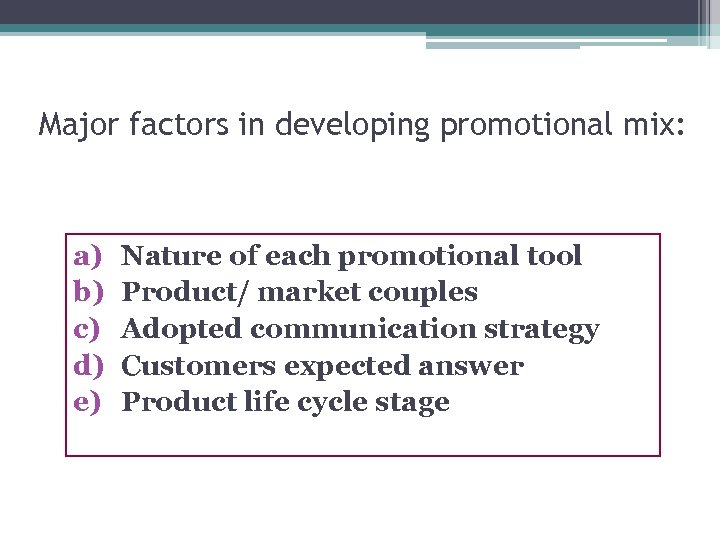 Major factors in developing promotional mix: a) b) c) d) e) Nature of each promotional tool Product/ market couples Adopted communication strategy Customers expected answer Product life cycle stage
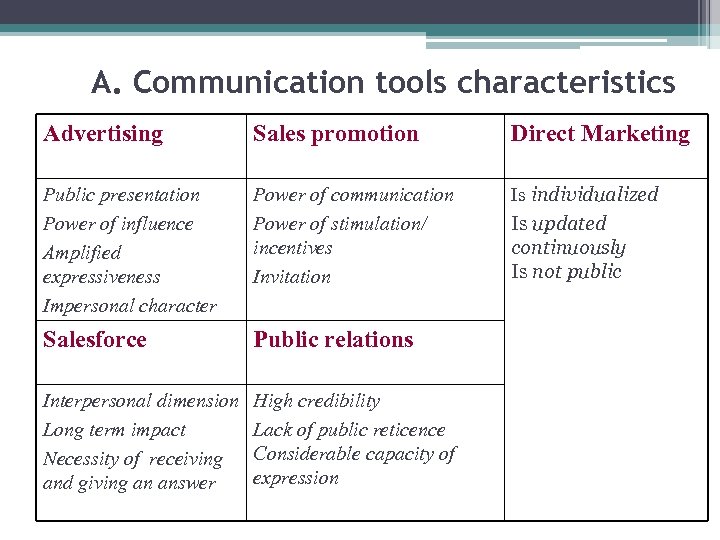 A. Communication tools characteristics Advertising Sales promotion Direct Marketing Public presentation Power of influence Amplified expressiveness Impersonal character Power of communication Power of stimulation/ incentives Invitation Is individualized Is updated continuously Is not public Salesforce Public relations Interpersonal dimension Long term impact Necessity of receiving and giving an answer High credibility Lack of public reticence Considerable capacity of expression
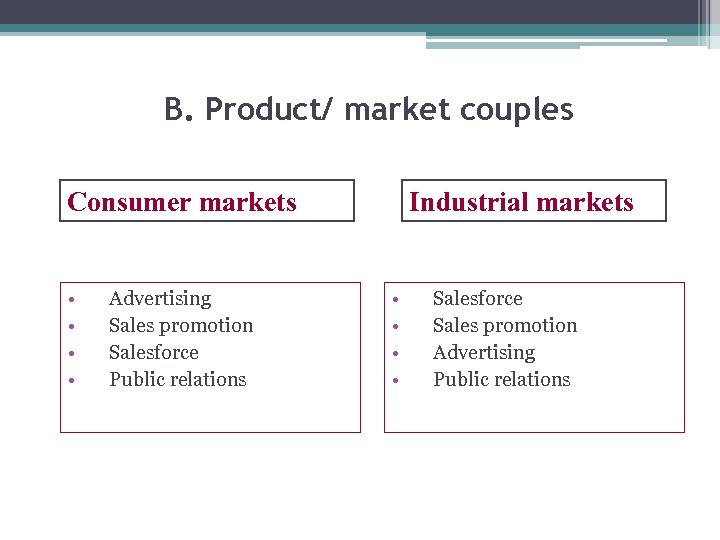 B. Product/ market couples Consumer markets • • Advertising Sales promotion Salesforce Public relations Industrial markets • • Salesforce Sales promotion Advertising Public relations
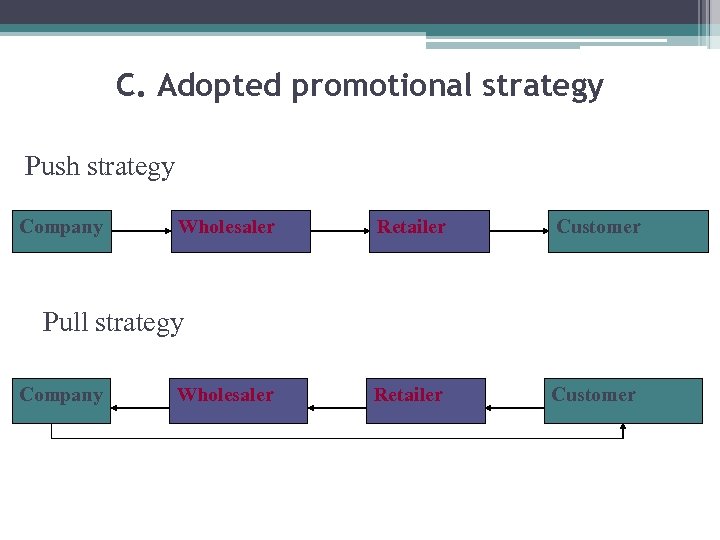 C. Adopted promotional strategy Push strategy Company Wholesaler Retailer Customer Pull strategy Company Wholesaler
 D. Customers expected answer • Advertising and public relations are more efficient than salesforce in awareness sage and for developing notoriety. • For customer conviction and closing the sale the most efficient is salesforce.
 E. Product life cycle stage Øintroduction Øadvertising and public relation have high cost effectiveness Øgrowth Ø promotional investments can be toned down Ømaturity Ø maximum level of all promotional instruments Ødecline Ø promotional activities are reduced gradually
 Determining the target audience • Consists of actual and potential buyers of the product
 Determining the communication objectives • Notoriety - informing • Action/ Purchase- attracting customer • Image - creating and developing a positive image Image is a set of believes, ideas and impressions that a person holds of an object.
 Establishing the promotion budget 1. 2. 3. 4. Percentage of sales method Competitive parity method Affordable method Objective and task method