


 Скачать презентацию Principles of Marketing n Fall Term 2009 —
05617fc72cec036dfbad151958ec89a7.ppt
- Количество слайдов: 15
 Principles of Marketing n Fall Term 2009 - MKTG 220 n Dr. Abdullah Sultan 1 Copyright 2007, Prentice Hall, Inc. 1
 The Importance of Marketing Information n Companies need information about their: q q q Customers’ needs Marketing environment Competition Copyright 2007, Prentice Hall, Inc. 2
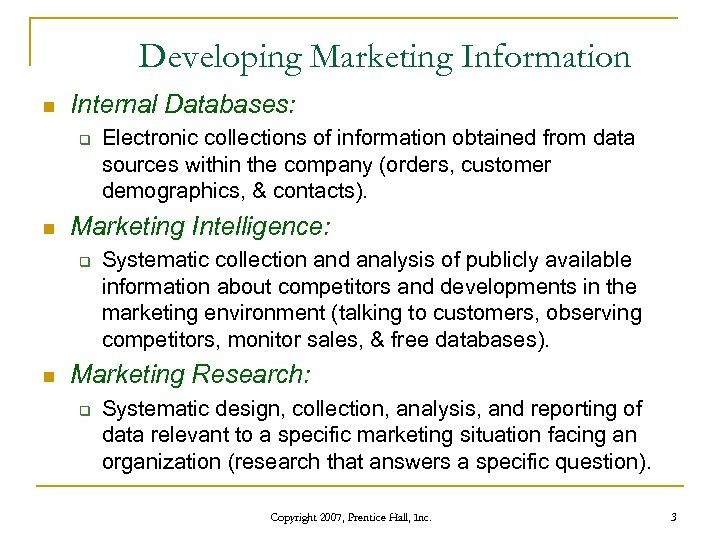 Developing Marketing Information n Internal Databases: q n Marketing Intelligence: q n Electronic collections of information obtained from data sources within the company (orders, customer demographics, & contacts). Systematic collection and analysis of publicly available information about competitors and developments in the marketing environment (talking to customers, observing competitors, monitor sales, & free databases). Marketing Research: q Systematic design, collection, analysis, and reporting of data relevant to a specific marketing situation facing an organization (research that answers a specific question). Copyright 2007, Prentice Hall, Inc. 3
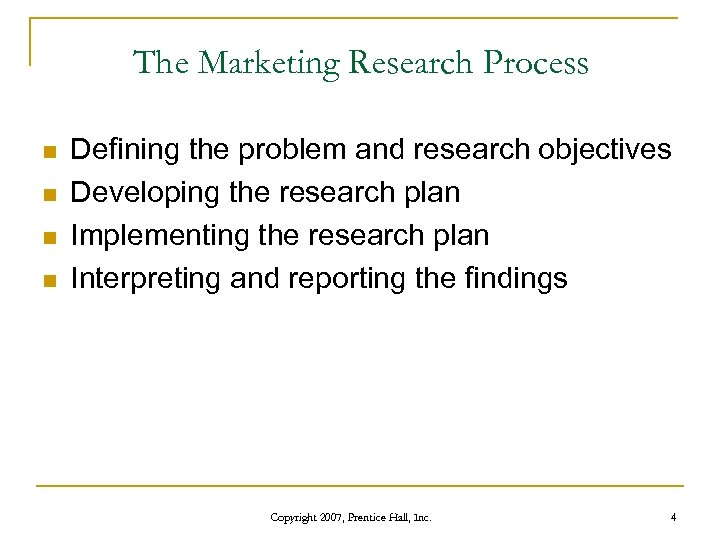 The Marketing Research Process n n Defining the problem and research objectives Developing the research plan Implementing the research plan Interpreting and reporting the findings Copyright 2007, Prentice Hall, Inc. 4
 Defining Problem & Objectives n Exploratory Research: q n Descriptive Research: q n Gathers preliminary information that will help define the problem and suggest hypotheses. Describes things (e. g. , market potential for a product, demographics and attitudes of consumers who buy the product). Causal Research: q Tests hypotheses about cause-and-effect relationships (would consumers buy a car that cost KD 9, 999 or KD 10, 000? ). Copyright 2007, Prentice Hall, Inc. 5
 Developing the Research Plan n Includes: q q q n Determining the exact information needed. Developing a plan for gathering it efficiently. Presenting the written plan to management. Outlines: q q q Sources of existing data Specific research approaches (observational, surveys, experiments) Contact methods (phone, mail, personal, online) Sampling plans (sample size, sampling procedure) Instruments for data collection (questionnaire, mechanical instruments) Copyright 2007, Prentice Hall, Inc. 6
 Gathering Secondary Data n Information that already exists somewhere: q q q n n Internal databases Commercial data services from companies Government sources Available more quickly and at a lower cost than primary data. But, must be relevant, accurate, current, and impartial. Copyright 2007, Prentice Hall, Inc. 7
 Primary Data Collection n n Consists of information collected for the specific purpose at hand. Must be relevant, accurate, current, and unbiased. Costly Must determine: q q Research approach Contact methods Sampling plan Research instruments Copyright 2007, Prentice Hall, Inc. 8
 Observational Research n n The gathering of primary data by observing relevant people, actions, and situations. Ethnographic research: q n Mechanical observation: q q n Observation in “natural environment” People meters (Nielsen ranking) Checkout scanners (Retailers) Costly and subjective. Copyright 2007, Prentice Hall, Inc. 9
 Survey Research n n Most widely used method for primary data collection. Approach best suited for gathering descriptive information. Can gather information about people’s knowledge, attitudes, preferences, or buying behavior. Not very costly, but results in data-driven findings. Copyright 2007, Prentice Hall, Inc. 10
 Experimental Research n n Tries to explain cause-and-effect relationships, but it is costly Involves: q q n selecting matched groups of subjects giving different treatments controlling unrelated factors checking differences in group responses Example: a car that sells for KD 9, 999 vs. KD 10, 000 Copyright 2007, Prentice Hall, Inc. 11
 Contact Methods n n n Mail surveys Telephone surveys Personal interviews q q n Individual interviewing Focus group interviewing Online marketing research q q q Surveys Experiments Focus groups Copyright 2007, Prentice Hall, Inc. 12
 Implementing the Research Plan n Collecting the data q q n Processing the data q q n Most expensive phase Subject to error Check for accuracy Code for analysis Analyzing the data q Tabulate results Copyright 2007, Prentice Hall, Inc. 13
 Interpreting and Reporting Findings n n n Interpret the findings Draw conclusions Report to management q Present findings and conclusions that will be most helpful to decision making. Copyright 2007, Prentice Hall, Inc. 14
 In-class Activity Assume you work for Starbucks and your task is to assess customer satisfaction. Discuss the strengths and weaknesses of each contact method used in marketing research: n q q Mail questionnaire Telephone interviewing Personal interviewing Online collection method