


 Скачать презентацию Principles of Marketing An Asian Perspective Instructor Supplements
265e48c5b24b3457657900af51311682.ppt
- Количество слайдов: 105

 Principles of Marketing: An Asian Perspective Instructor Supplements • Created by Geoffrey da Silva
 Marketing Channels and Supply Chain Management 3 © 2012 Principles of Marketing: An Asian Perspective 12
 Chapter 12 Outline 12. 1 Supply Chains and the Value Delivery Network 12. 2 Channel Behavior and Organization 12. 3 Channel Design Decisions 12. 4 Channel Management Decisions 12. 5 Public Policy and Distribution Decisions 12. 6 Marketing Logistics and Supply Chain Management 4 © 2012 Principles of Marketing: An Asian Perspective
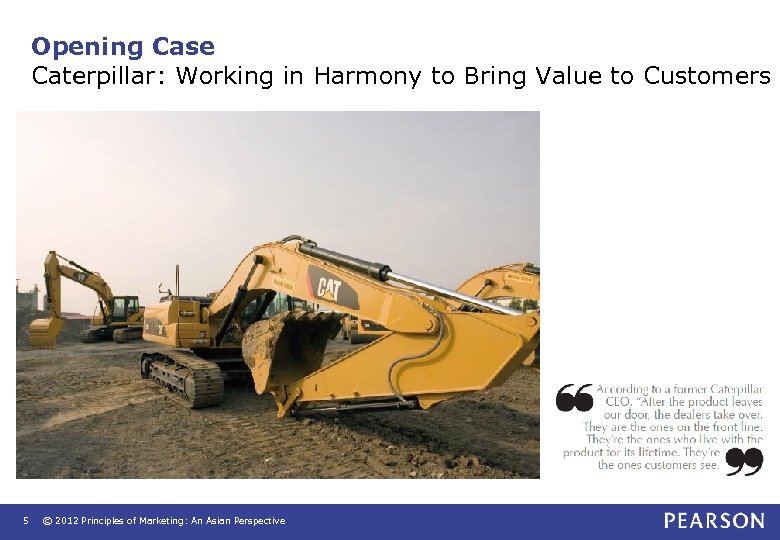 Opening Case Caterpillar: Working in Harmony to Bring Value to Customers 5 © 2012 Principles of Marketing: An Asian Perspective
 12. 1 Supply Chains and the Value Delivery Network 6 12. 1 © 2012 Principles of Marketing: An Asian Perspective
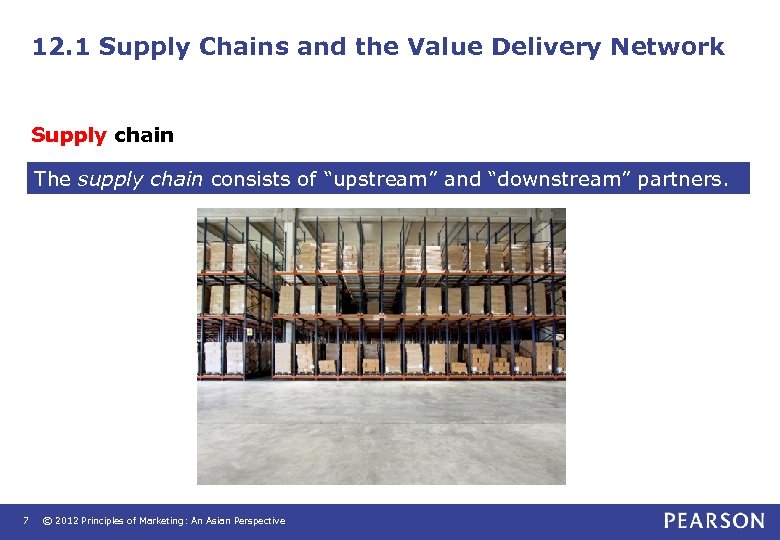 12. 1 Supply Chains and the Value Delivery Network Supply chain The supply chain consists of “upstream” and “downstream” partners. 7 © 2012 Principles of Marketing: An Asian Perspective
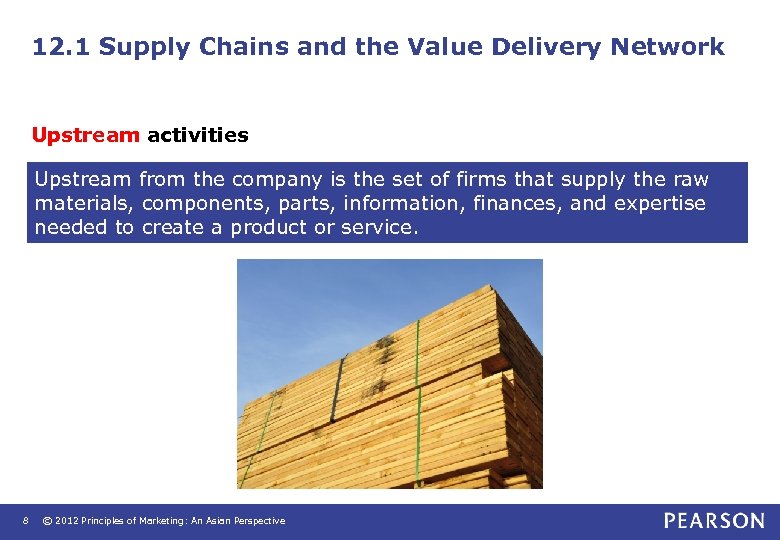 12. 1 Supply Chains and the Value Delivery Network Upstream activities Upstream from the company is the set of firms that supply the raw materials, components, parts, information, finances, and expertise needed to create a product or service. 8 © 2012 Principles of Marketing: An Asian Perspective
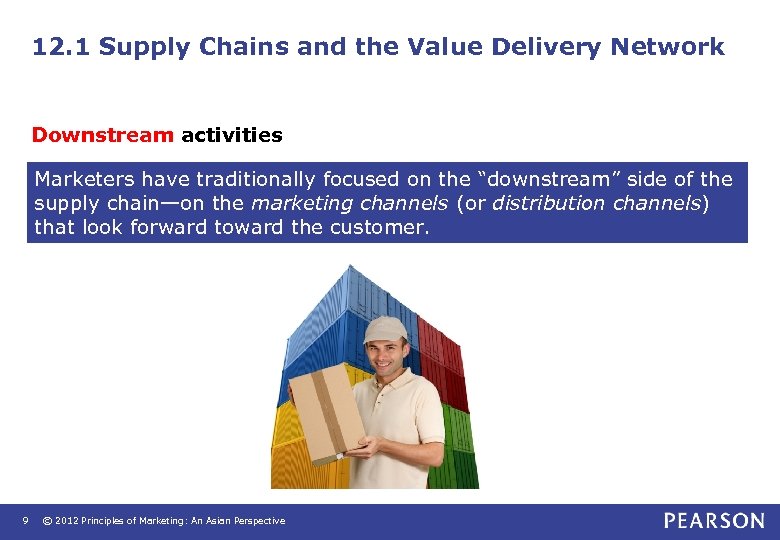 12. 1 Supply Chains and the Value Delivery Network Downstream activities Marketers have traditionally focused on the “downstream” side of the supply chain—on the marketing channels (or distribution channels) that look forward toward the customer. 9 © 2012 Principles of Marketing: An Asian Perspective
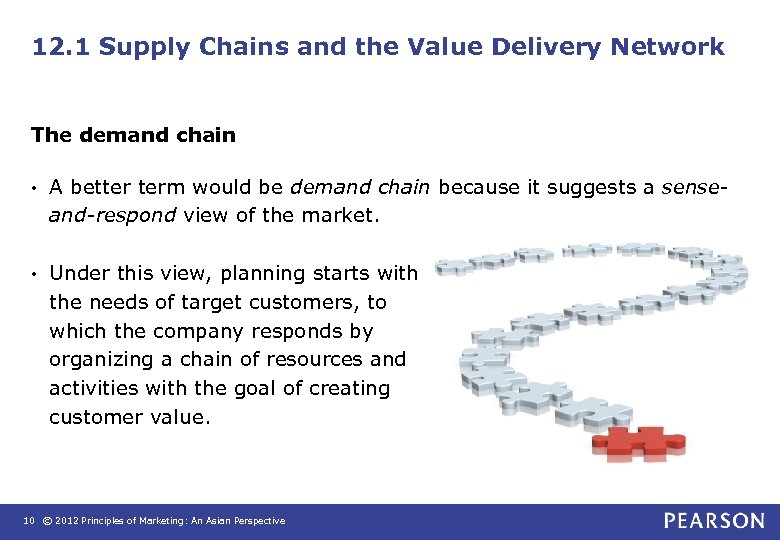 12. 1 Supply Chains and the Value Delivery Network The demand chain • A better term would be demand chain because it suggests a senseand-respond view of the market. • Under this view, planning starts with the needs of target customers, to which the company responds by organizing a chain of resources and activities with the goal of creating customer value. 10 © 2012 Principles of Marketing: An Asian Perspective
 12. 1 Supply Chains and the Value Delivery Network Value delivery network A value delivery network is made up of the company, suppliers, distributors, and ultimately customers who “partner” with each other to improve the performance of the entire system. 11 © 2012 Principles of Marketing: An Asian Perspective
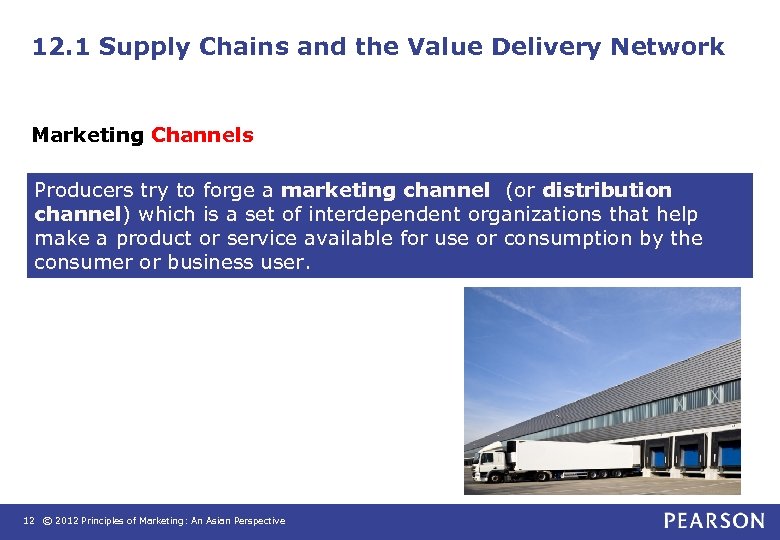 12. 1 Supply Chains and the Value Delivery Network Marketing Channels Producers try to forge a marketing channel (or distribution channel) which is a set of interdependent organizations that help make a product or service available for use or consumption by the consumer or business user. 12 © 2012 Principles of Marketing: An Asian Perspective
 12. 1 Supply Chains and the Value Delivery Network Key issues in this chapter There are four major questions concerning marketing channels: 1. What is the nature of marketing channels and why are they important? 2. How do channel firms interact and organize to do the work of the channel? 3. What problems do companies face in designing and managing their channels? 4. What role do physical distribution and supply chain management play in attracting and satisfying customers? 13 © 2012 Principles of Marketing: An Asian Perspective
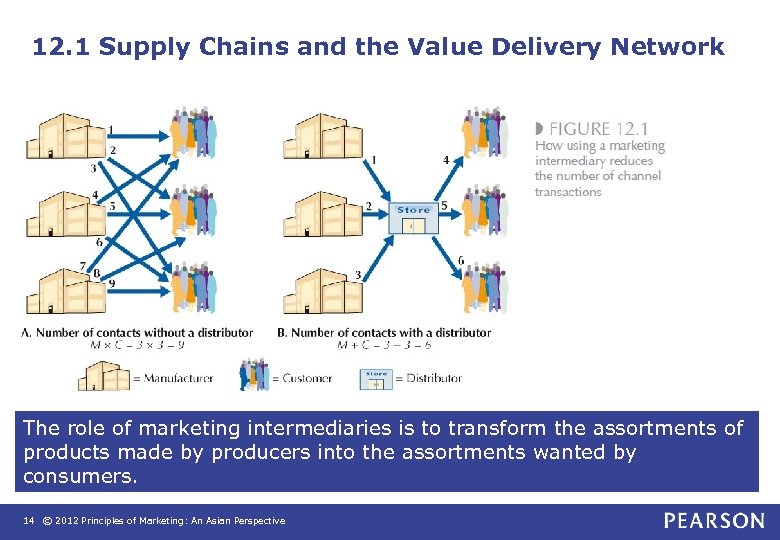 12. 1 Supply Chains and the Value Delivery Network The role of marketing intermediaries is to transform the assortments of products made by producers into the assortments wanted by consumers. 14 © 2012 Principles of Marketing: An Asian Perspective
 12. 1 Supply Chains and the Value Delivery Network Functions of marketing channel members: completing transactions • Information—gathering and distributing market ing research and intelligence information about actors and forces in the marketing environment needed for planning and aiding exchange. • Promotion—developing and spreading persuasive communications about an offer. 15 © 2012 Principles of Marketing: An Asian Perspective
 12. 1 Supply Chains and the Value Delivery Network Functions of marketing channel members: completing transactions • Contact—finding and communicating with prospective buyers. • Matching—shaping and fitting the offer to the buyer’s needs, including activities such as manufacturing, grading, assembling, and packaging. • Negotiation—reaching an agreement on price and other terms of the offer so that ownership or possession can be transferred. 16 © 2012 Principles of Marketing: An Asian Perspective
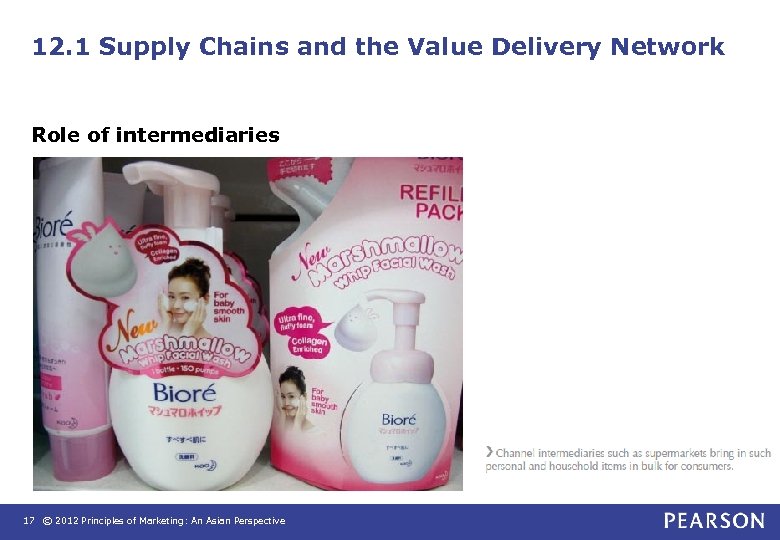 12. 1 Supply Chains and the Value Delivery Network Role of intermediaries 17 © 2012 Principles of Marketing: An Asian Perspective
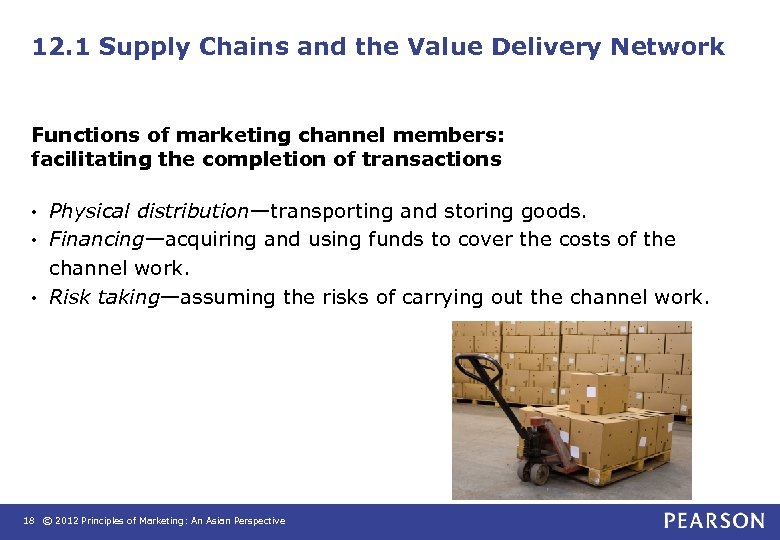 12. 1 Supply Chains and the Value Delivery Network Functions of marketing channel members: facilitating the completion of transactions Physical distribution—transporting and storing goods. • Financing—acquiring and using funds to cover the costs of the channel work. • Risk taking—assuming the risks of carrying out the channel work. • 18 © 2012 Principles of Marketing: An Asian Perspective
 12. 1 Supply Chains and the Value Delivery Network Reviewing the Key Concepts Explain why companies use marketing channels and discuss the functions these channels perform. 19 © 2012 Principles of Marketing: An Asian Perspective
 12. 1 Supply Chains and the Value Delivery Network Number of channel levels • A channel level is each layer of marketing intermediaries that performs some work in bringing the product and its ownership closer to the final buyer. • The number of intermediary levels indicates the length of a channel. (Figure 12. 2) 20 © 2012 Principles of Marketing: An Asian Perspective
 12. 1 Supply Chains and the Value Delivery Network Number of channel levels • A direct marketing channel has no intermediary levels; the company sells directly to consumers. An indirect marketing channel contains one or more intermediaries. • From the producer’s point of view, a greater number of levels mean less control and greater channel complexity. • 21 © 2012 Principles of Marketing: An Asian Perspective
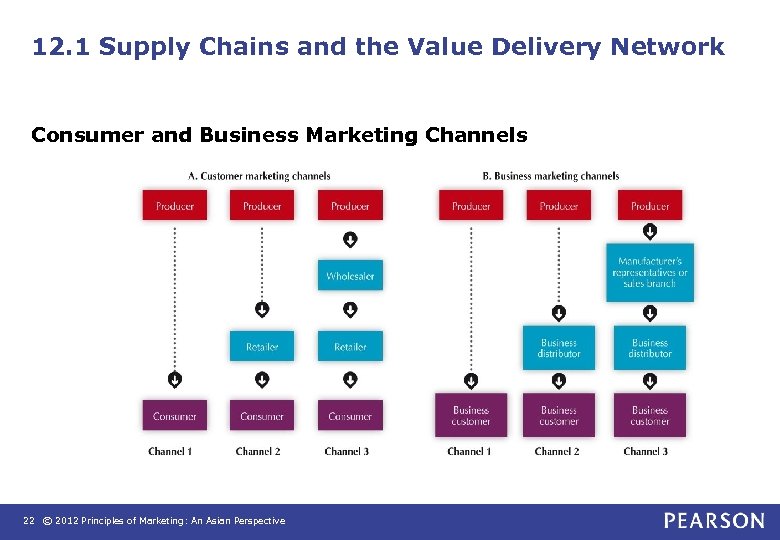 12. 1 Supply Chains and the Value Delivery Network Consumer and Business Marketing Channels 22 © 2012 Principles of Marketing: An Asian Perspective
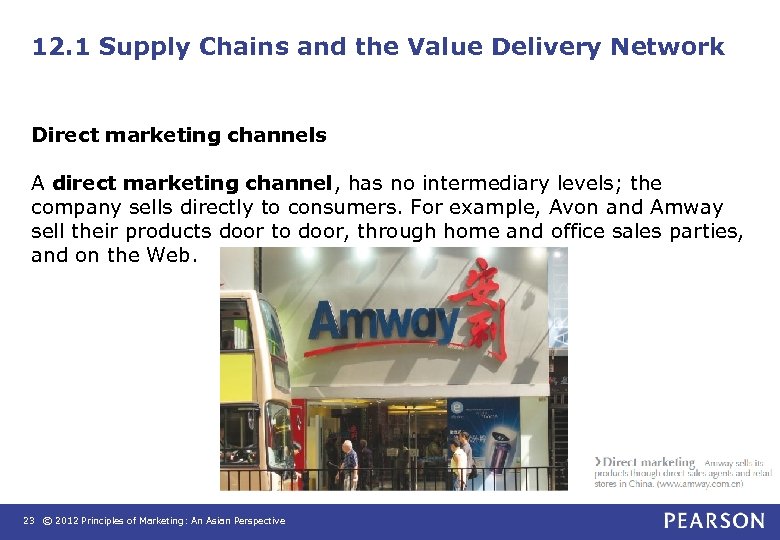 12. 1 Supply Chains and the Value Delivery Network Direct marketing channels A direct marketing channel, has no intermediary levels; the company sells directly to consumers. For example, Avon and Amway sell their products door to door, through home and office sales parties, and on the Web. 23 © 2012 Principles of Marketing: An Asian Perspective
 12. 2 Channel Behavior and Organization 12. 2 24 © 2012 Principles of Marketing: An Asian Perspective
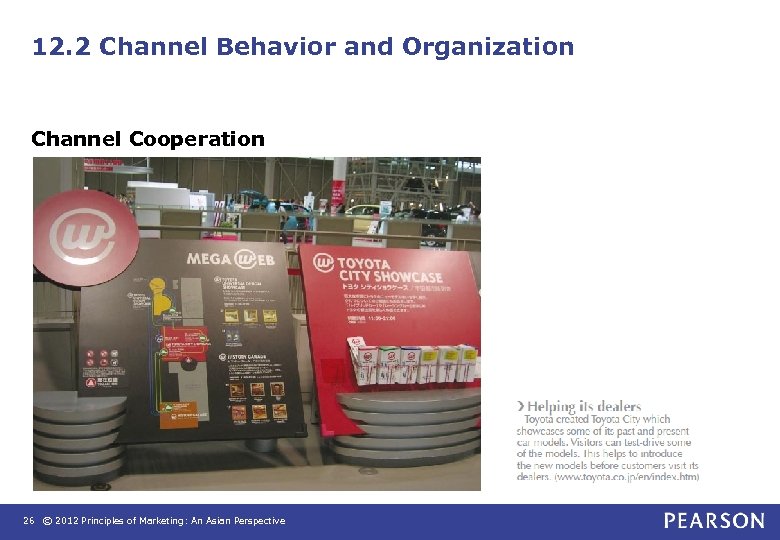
 12. 2 Channel Behavior and Organization Channel Behavior A marketing channel consists of firms that have partnered for their common good. Each channel member depends on the others. • Each channel member plays a specialized role in the channel. The channel will be most effective when each member assumes the tasks it can do best. • Disagreements over goals, roles, and rewards generate channel conflict. • 25 © 2012 Principles of Marketing: An Asian Perspective
 12. 2 Channel Behavior and Organization Channel Cooperation 26 © 2012 Principles of Marketing: An Asian Perspective
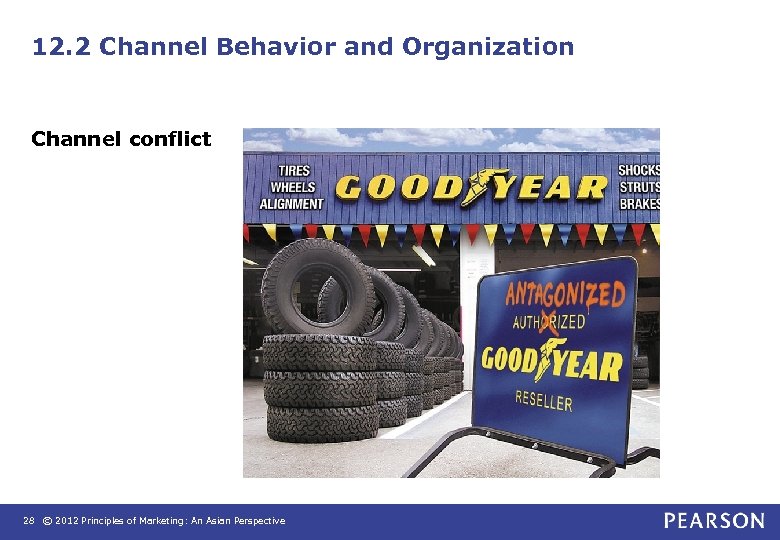
 12. 2 Channel Behavior and Organization Channel conflict • Horizontal conflict occurs among firms at the same level of the channel. • Vertical conflict occurs between different levels of the same channel. 27 © 2012 Principles of Marketing: An Asian Perspective
 12. 2 Channel Behavior and Organization Channel conflict 28 © 2012 Principles of Marketing: An Asian Perspective
 12. 2 Channel Behavior and Organization Comparison of conventional distribution with vertical marketing system 29 © 2012 Principles of Marketing: An Asian Perspective
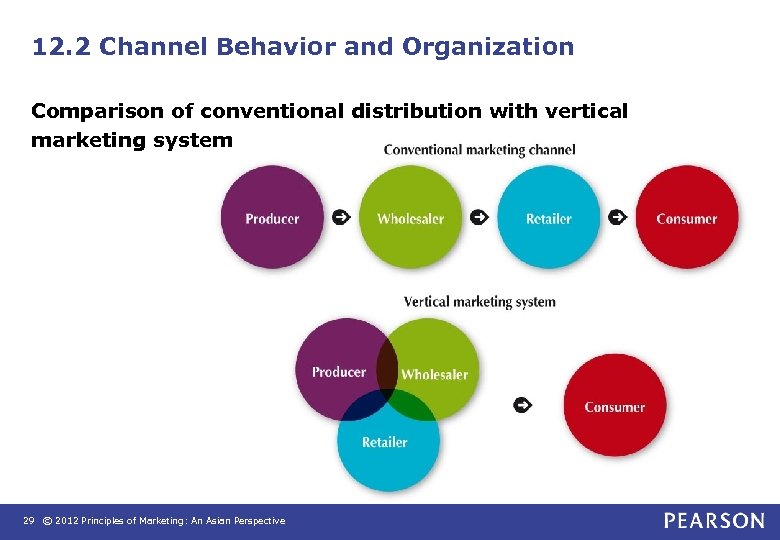
 12. 2 Channel Behavior and Organization Conventional distribution channel • A conventional distribution channel consists of one or more independent producers, wholesalers, and retailers. • Each is a separate business seeking to maximize its own profits, perhaps even at the expense of the system as a whole. 30 © 2012 Principles of Marketing: An Asian Perspective
 12. 2 Channel Behavior and Organization Vertical Marketing System (VMS) • A vertical marketing system (VMS) consists of producers, wholesalers, and retailers acting as a unified system. • One channel member owns the others, has contracts with them, or wields so much power that they must all cooperate. (Figure 12. 3) 31 © 2012 Principles of Marketing: An Asian Perspective
 12. 2 Channel Behavior and Organization Corporate VMS 32 © 2012 Principles of Marketing: An Asian Perspective
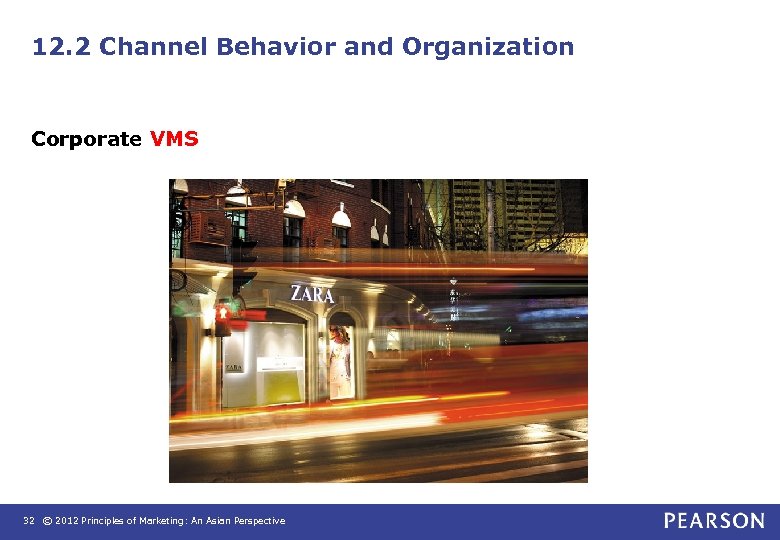
 12. 2 Channel Behavior and Organization Corporate VMS • A Corporate VMS integrates successive stages of production and distribution under single ownership. Zara is an example: • Zara has control over almost every aspect of the supply chain, from design and production to its own worldwide distribution network. • Zara makes 40 percent of its own fabrics and produces more than half of its own clothes, rather than relying on a hodgepodge of slow-moving suppliers. 33 © 2012 Principles of Marketing: An Asian Perspective
 12. 2 Channel Behavior and Organization Corporate VMS • New designs feed into Zara manufacturing centers, which ship finished products directly to Zara stores in 68 countries, saving time, eliminating the need for warehouses, and keeping inventories low. • Effective vertical integration makes Zara faster, more flexible, and more efficient than its competitors. 34 © 2012 Principles of Marketing: An Asian Perspective
 12. 2 Channel Behavior and Organization Contractual VMS A contractual VMS consists of independent firms at different levels of production and distribution who join together through contracts to obtain more economies or sales impact than each could achieve alone. 35 © 2012 Principles of Marketing: An Asian Perspective
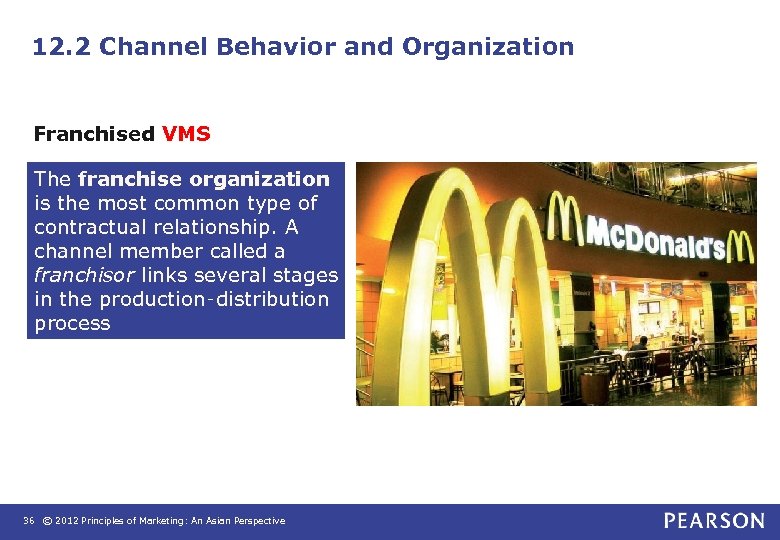 12. 2 Channel Behavior and Organization Franchised VMS The franchise organization is the most common type of contractual relationship. A channel member called a franchisor links several stages in the production‑distribution process 36 © 2012 Principles of Marketing: An Asian Perspective
 12. 2 Channel Behavior and Organization 3 types of franchises: The manufacturer‑sponsored retailer franchise system—for example, Toyota and its network of independent franchised dealers. • The manufacturer‑sponsored wholesaler franchise system— Coca‑Cola licenses bottlers (wholesalers) in various markets who buy Coca Cola syrup concentrate and then bottle and sell the finished product to retailers in local markets. • The service‑firm‑sponsored retailer franchise system—examples are found in the auto rental business (Avis), the fast‑food service business (Mc. Donald’s), and the motel business (Hilton). • 37 © 2012 Principles of Marketing: An Asian Perspective
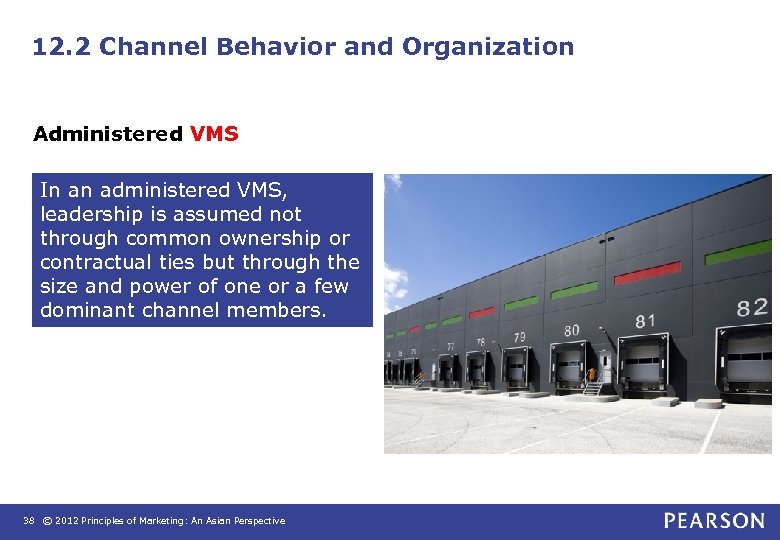 12. 2 Channel Behavior and Organization Administered VMS In an administered VMS, leadership is assumed not through common ownership or contractual ties but through the size and power of one or a few dominant channel members. 38 © 2012 Principles of Marketing: An Asian Perspective
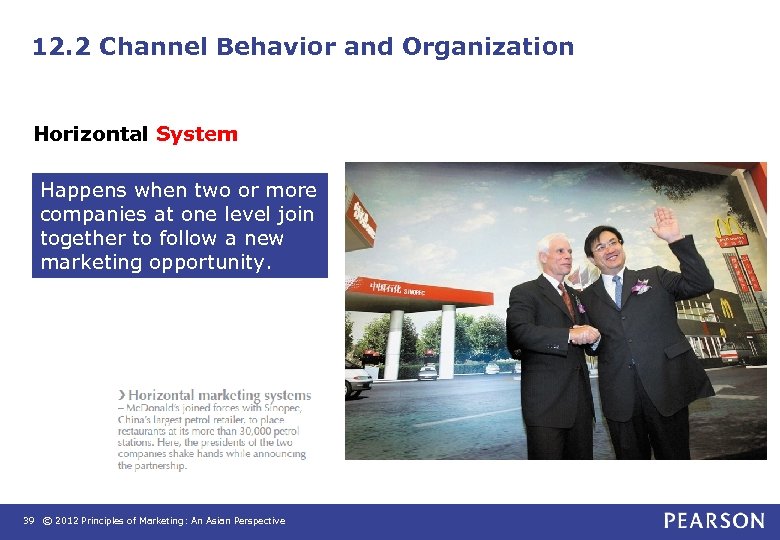 12. 2 Channel Behavior and Organization Horizontal System Happens when two or more companies at one level join together to follow a new marketing opportunity. 39 © 2012 Principles of Marketing: An Asian Perspective
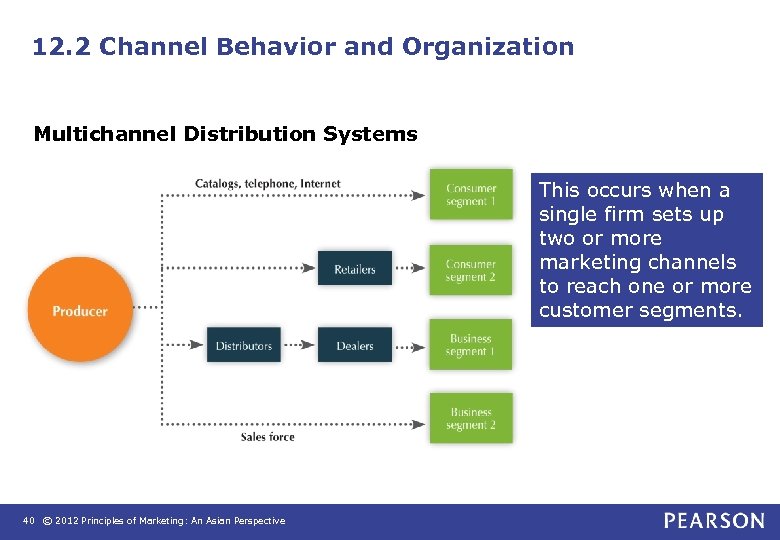 12. 2 Channel Behavior and Organization Multichannel Distribution Systems This occurs when a single firm sets up two or more marketing channels to reach one or more customer segments. 40 © 2012 Principles of Marketing: An Asian Perspective
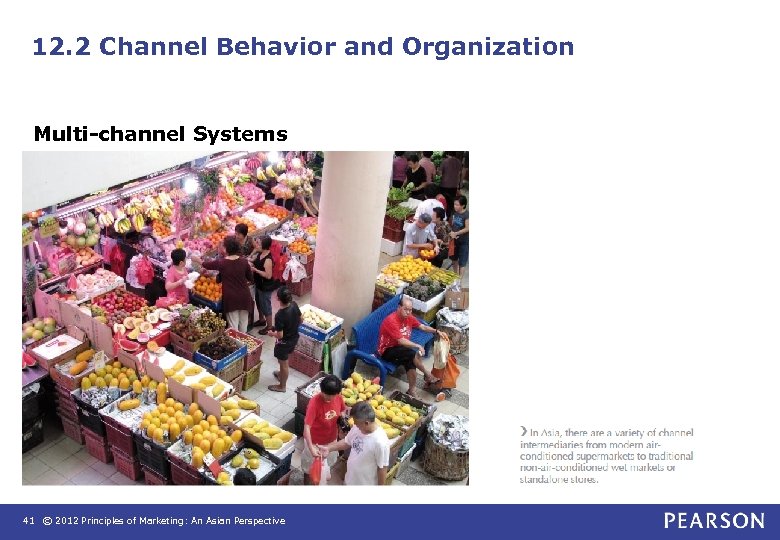 12. 2 Channel Behavior and Organization Multi-channel Systems 41 © 2012 Principles of Marketing: An Asian Perspective
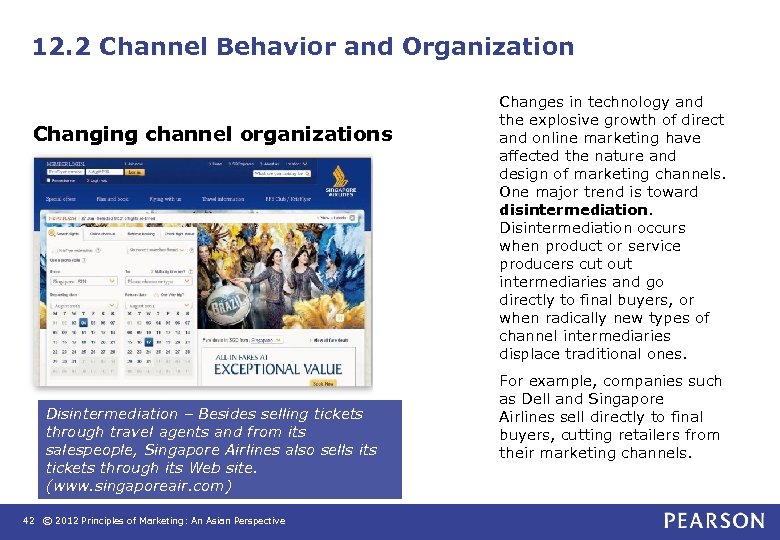 12. 2 Channel Behavior and Organization Changing channel organizations Disintermediation – Besides selling tickets through travel agents and from its salespeople, Singapore Airlines also sells its tickets through its Web site. (www. singaporeair. com) 42 © 2012 Principles of Marketing: An Asian Perspective Changes in technology and the explosive growth of direct and online marketing have affected the nature and design of marketing channels. One major trend is toward disintermediation. Disintermediation occurs when product or service producers cut out intermediaries and go directly to final buyers, or when radically new types of channel intermediaries displace traditional ones. For example, companies such as Dell and Singapore Airlines sell directly to final buyers, cutting retailers from their marketing channels.
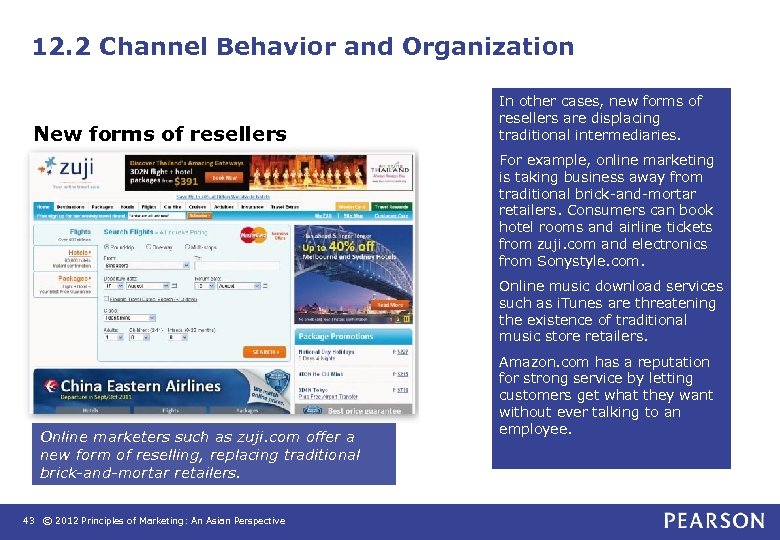 12. 2 Channel Behavior and Organization New forms of resellers In other cases, new forms of resellers are displacing traditional intermediaries. For example, online marketing is taking business away from traditional brick and mortar retailers. Consumers can book hotel rooms and airline tickets from zuji. com and electronics from Sonystyle. com. Online music download services such as i. Tunes are threatening the existence of traditional music store retailers. Online marketers such as zuji. com offer a new form of reselling, replacing traditional brick-and-mortar retailers. 43 © 2012 Principles of Marketing: An Asian Perspective Amazon. com has a reputation for strong service by letting customers get what they want without ever talking to an employee.
 12. 2 Channel Behavior and Organization Problems and opportunities of disintermediation • Disintermediation presents problems and opportunities. • To avoid being swept aside, traditional intermediaries must find new ways to add value to the supply chain. • To remain competitive, product and service producers must develop new channel opportunities such as the Internet and other direct channels. 44 © 2012 Principles of Marketing: An Asian Perspective
 12. 2 Channel Behavior and Organization Problems and opportunities of disintermediation • However, developing these new channels often brings them into direct competition with their established channels, resulting in conflict. 45 © 2012 Principles of Marketing: An Asian Perspective
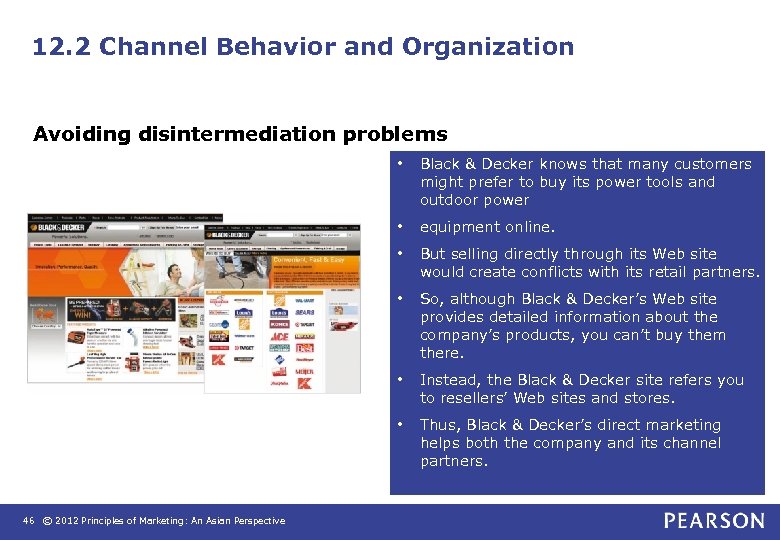 12. 2 Channel Behavior and Organization Avoiding disintermediation problems • • equipment online. • But selling directly through its Web site would create conflicts with its retail partners. • So, although Black & Decker’s Web site provides detailed information about the company’s products, you can’t buy them there. • Instead, the Black & Decker site refers you to resellers’ Web sites and stores. • 46 © 2012 Principles of Marketing: An Asian Perspective Black & Decker knows that many customers might prefer to buy its power tools and outdoor power Thus, Black & Decker’s direct marketing helps both the company and its channel partners.
 12. 2 Channel Behavior and Organization Reviewing the Key Concepts Discuss how channel members interact and how they organize to perform the work of the channel. 47 © 2012 Principles of Marketing: An Asian Perspective
 12. 3 Channel Design Decisions 12. 3 48 © 2012 Principles of Marketing: An Asian Perspective
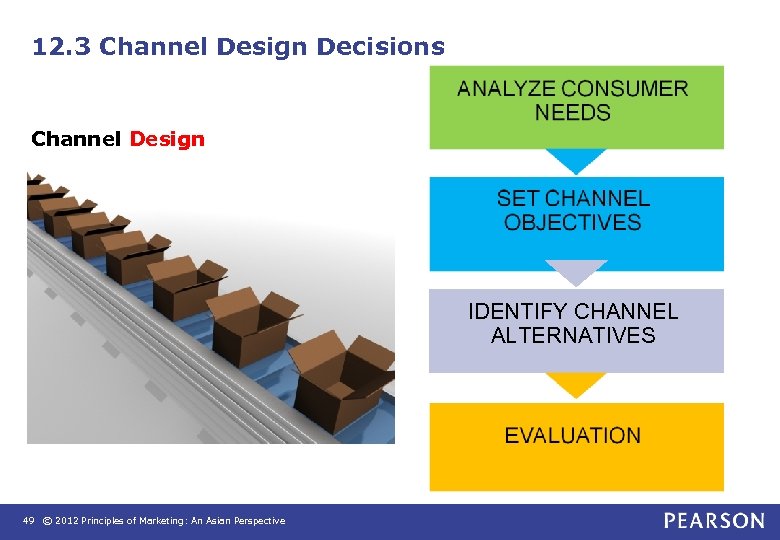 12. 3 Channel Design Decisions Channel Design IDENTIFY CHANNEL ALTERNATIVES 49 © 2012 Principles of Marketing: An Asian Perspective
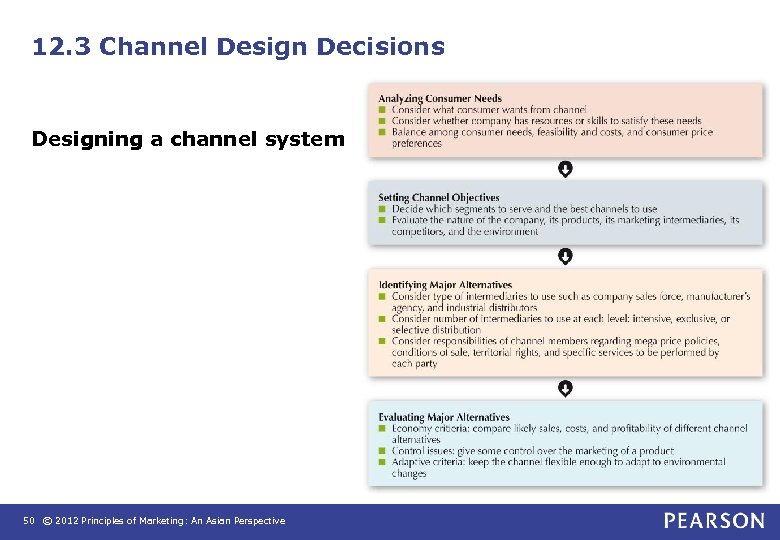 12. 3 Channel Design Decisions Designing a channel system 50 © 2012 Principles of Marketing: An Asian Perspective
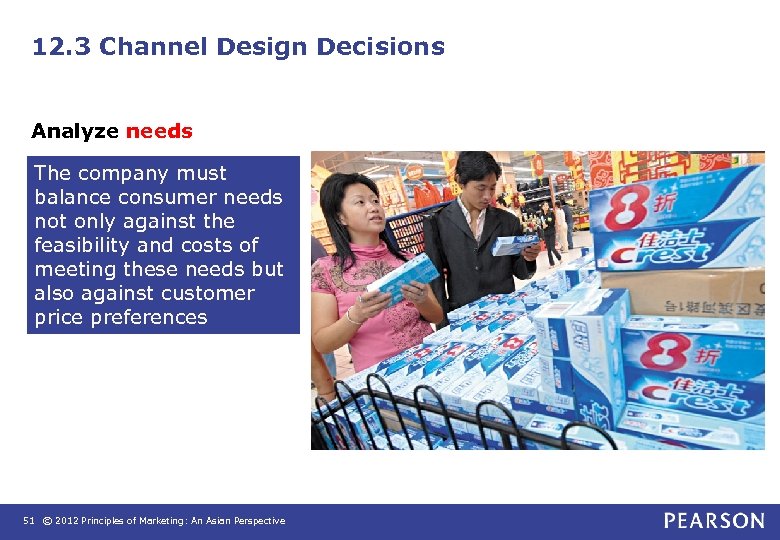 12. 3 Channel Design Decisions Analyze needs The company must balance consumer needs not only against the feasibility and costs of meeting these needs but also against customer price preferences 51 © 2012 Principles of Marketing: An Asian Perspective
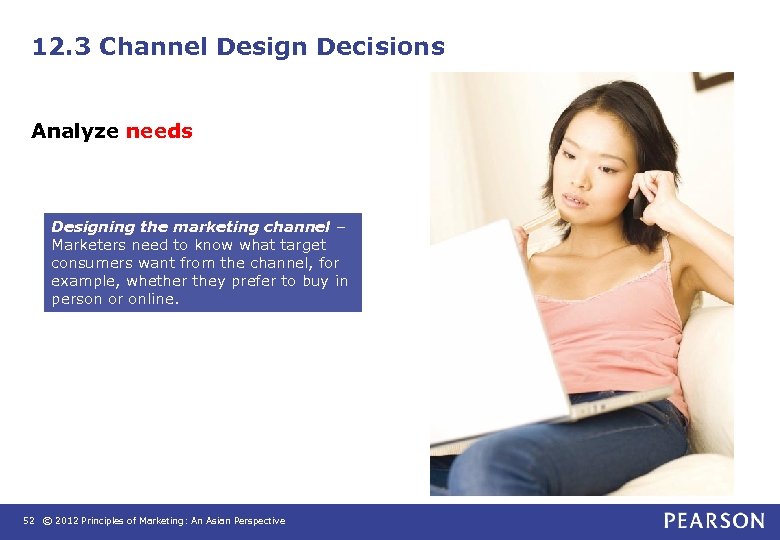 12. 3 Channel Design Decisions Analyze needs Designing the marketing channel – Marketers need to know what target consumers want from the channel, for example, whether they prefer to buy in person or online. 52 © 2012 Principles of Marketing: An Asian Perspective
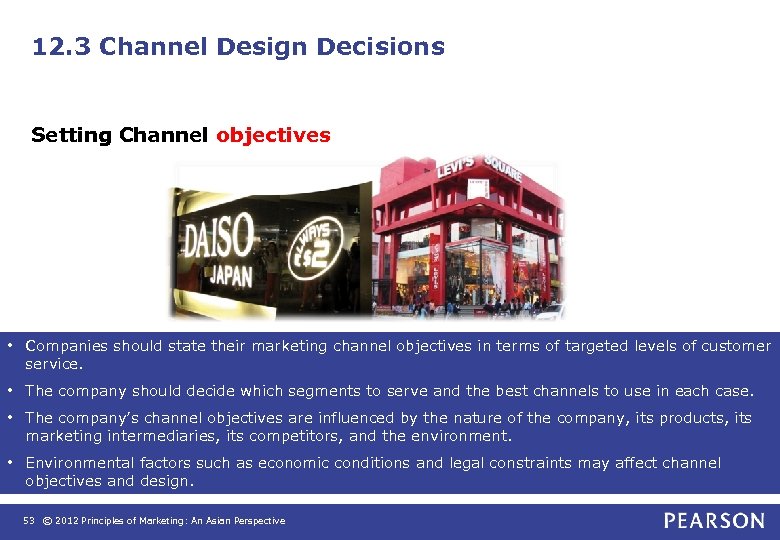 12. 3 Channel Design Decisions Setting Channel objectives • Companies should state their marketing channel objectives in terms of targeted levels of customer service. • The company should decide which segments to serve and the best channels to use in each case. • The company’s channel objectives are influenced by the nature of the company, its products, its marketing intermediaries, its competitors, and the environment. • Environmental factors such as economic conditions and legal constraints may affect channel objectives and design. 53 © 2012 Principles of Marketing: An Asian Perspective
 12. 3 Channel Design Decisions Identifying Major Alternatives A. Types of Intermediaries – A firm should identify the types of channel members available to carry out its channel work. B. Number of Marketing Intermediaries – Companies must also determine the number of channel members to use at each level. 54 © 2012 Principles of Marketing: An Asian Perspective
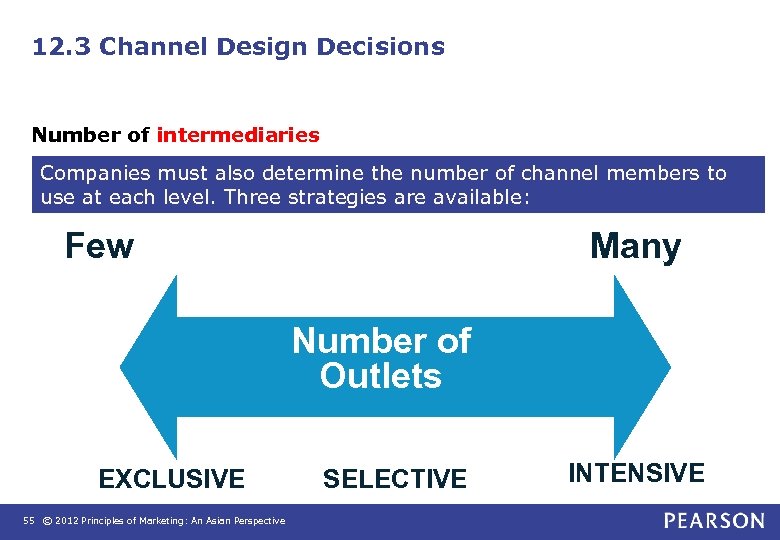 12. 3 Channel Design Decisions Number of intermediaries Companies must also determine the number of channel members to use at each level. Three strategies are available: Few Many Number of Outlets EXCLUSIVE 55 © 2012 Principles of Marketing: An Asian Perspective SELECTIVE INTENSIVE
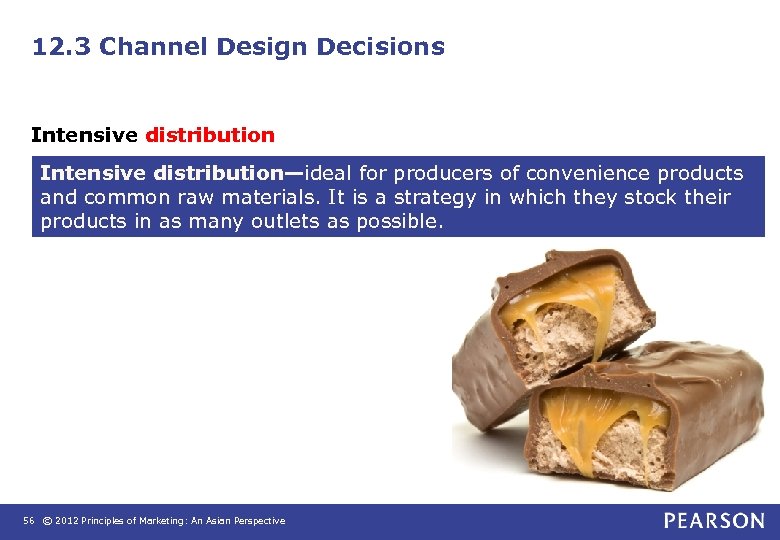 12. 3 Channel Design Decisions Intensive distribution—ideal for producers of convenience products and common raw materials. It is a strategy in which they stock their products in as many outlets as possible. 56 © 2012 Principles of Marketing: An Asian Perspective
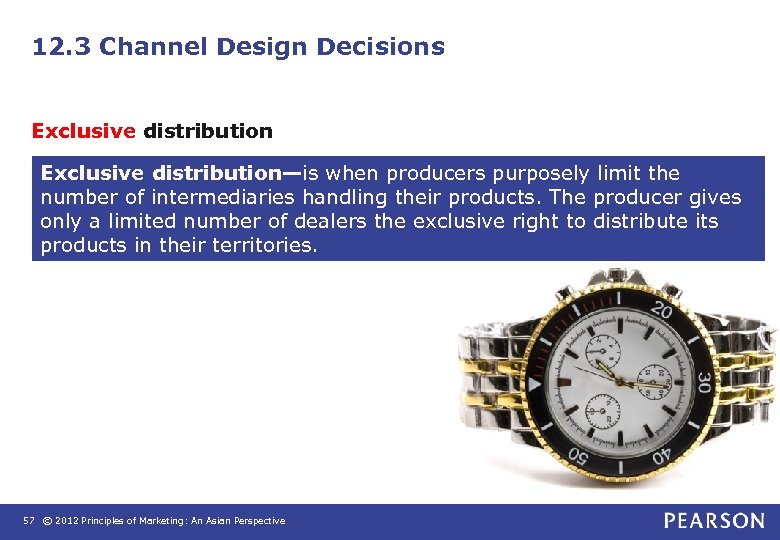 12. 3 Channel Design Decisions Exclusive distribution—is when producers purposely limit the number of intermediaries handling their products. The producer gives only a limited number of dealers the exclusive right to distribute its products in their territories. 57 © 2012 Principles of Marketing: An Asian Perspective
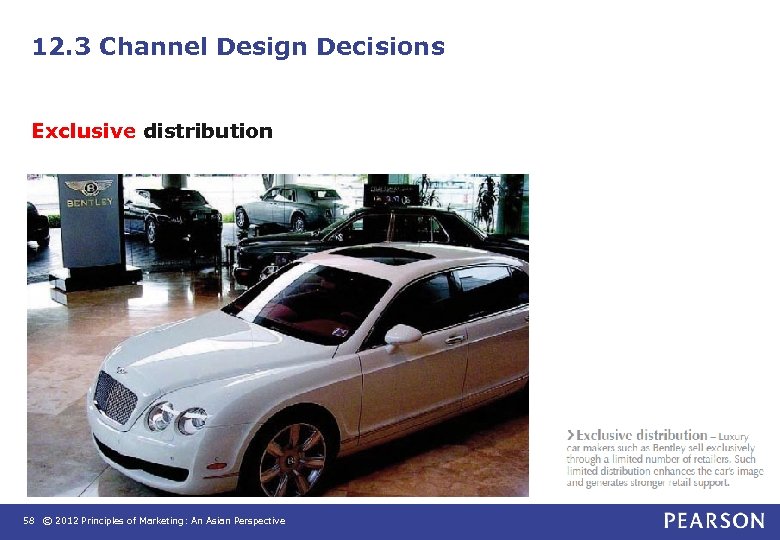 12. 3 Channel Design Decisions Exclusive distribution 58 © 2012 Principles of Marketing: An Asian Perspective
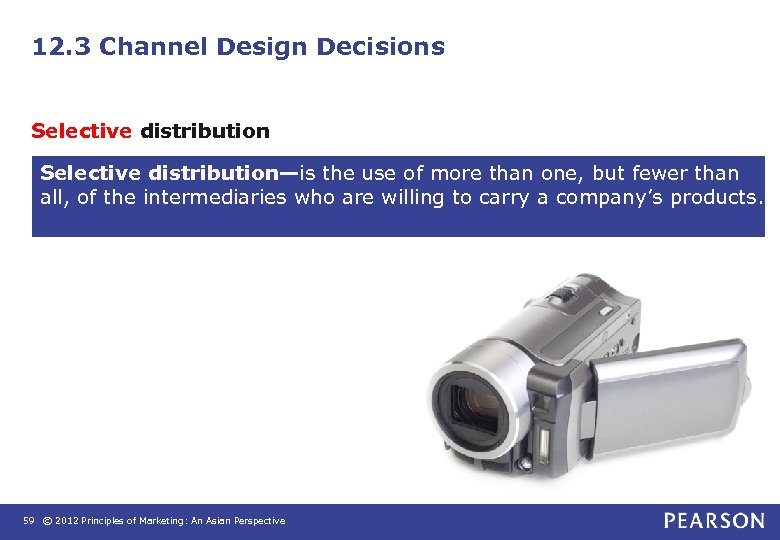 12. 3 Channel Design Decisions Selective distribution—is the use of more than one, but fewer than all, of the intermediaries who are willing to carry a company’s products. 59 © 2012 Principles of Marketing: An Asian Perspective
 12. 3 Channel Design Decisions Reviewing the Key Concepts Identify the major channel alternatives open to a company. 60 © 2012 Principles of Marketing: An Asian Perspective
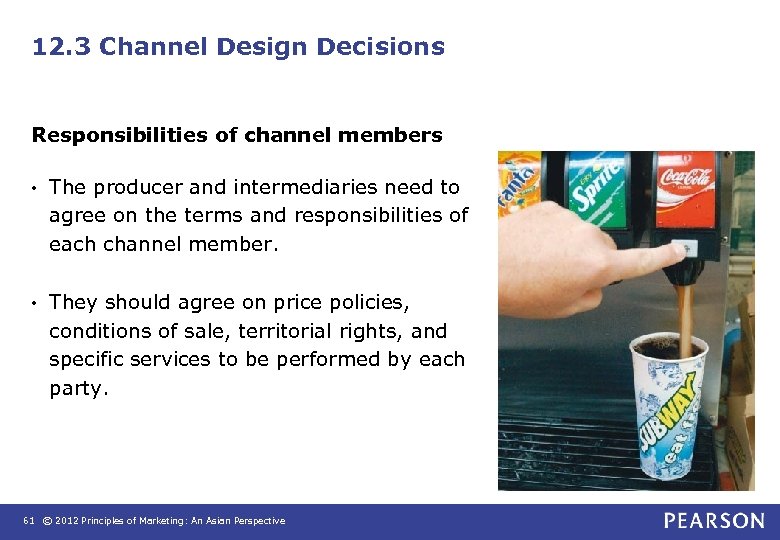 12. 3 Channel Design Decisions Responsibilities of channel members • The producer and intermediaries need to agree on the terms and responsibilities of each channel member. • They should agree on price policies, conditions of sale, territorial rights, and specific services to be performed by each party. 61 © 2012 Principles of Marketing: An Asian Perspective
 12. 3 Channel Design Decisions Evaluating the channel alternatives • Using economic criteria, a company compares the likely sales, costs, and profitability of different channel alternatives. • Control issues must be considered. Using intermediaries means giving them some control over the marketing of the product, and some intermediaries take more control than others. • Adaptability criteria must be applied. Companies want to keep the channel flexible so that it can adapt to environmental changes. 62 © 2012 Principles of Marketing: An Asian Perspective
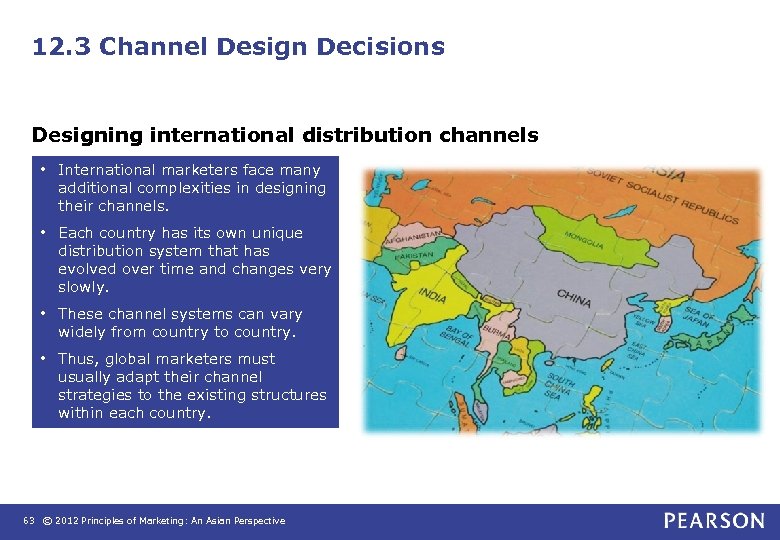 12. 3 Channel Design Decisions Designing international distribution channels • International marketers face many additional complexities in designing their channels. • Each country has its own unique distribution system that has evolved over time and changes very slowly. • These channel systems can vary widely from country to country. • Thus, global marketers must usually adapt their channel strategies to the existing structures within each country. 63 © 2012 Principles of Marketing: An Asian Perspective
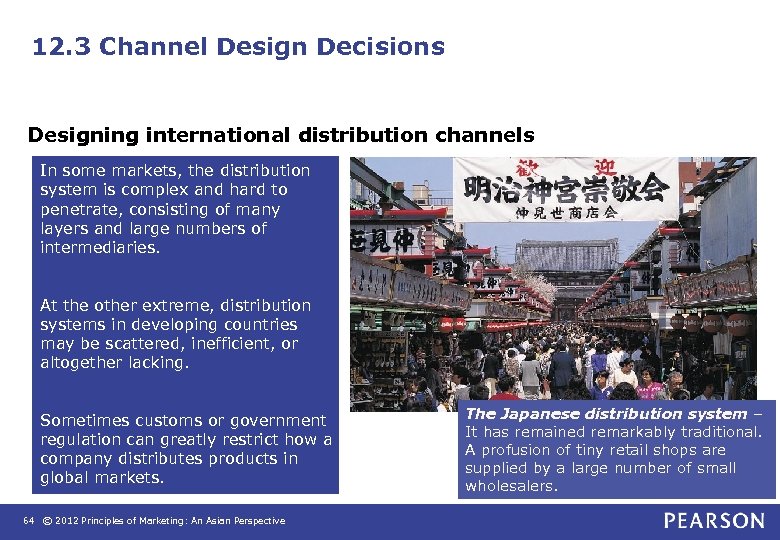 12. 3 Channel Design Decisions Designing international distribution channels In some markets, the distribution system is complex and hard to penetrate, consisting of many layers and large numbers of intermediaries. At the other extreme, distribution systems in developing countries may be scattered, inefficient, or altogether lacking. Sometimes customs or government regulation can greatly restrict how a company distributes products in global markets. 64 © 2012 Principles of Marketing: An Asian Perspective The Japanese distribution system – It has remained remarkably traditional. A profusion of tiny retail shops are supplied by a large number of small wholesalers.
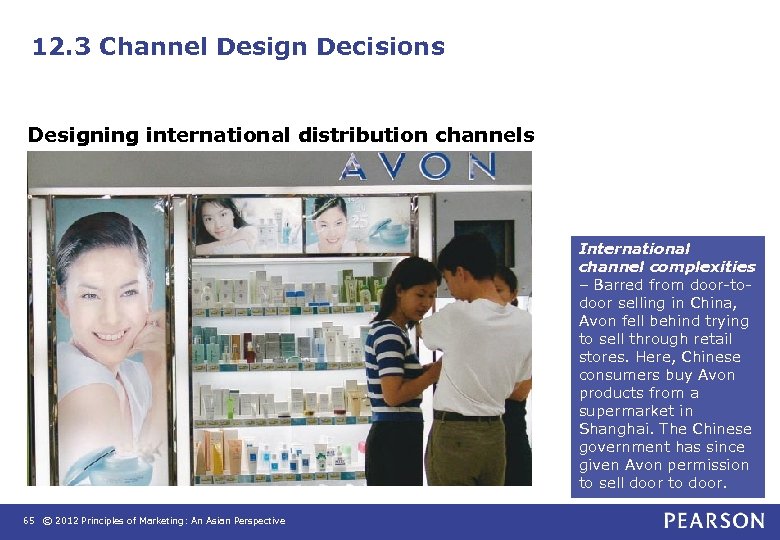 12. 3 Channel Design Decisions Designing international distribution channels International channel complexities – Barred from door to door selling in China, Avon fell behind trying to sell through retail stores. Here, Chinese consumers buy Avon products from a supermarket in Shanghai. The Chinese government has since given Avon permission to sell door to door. 65 © 2012 Principles of Marketing: An Asian Perspective
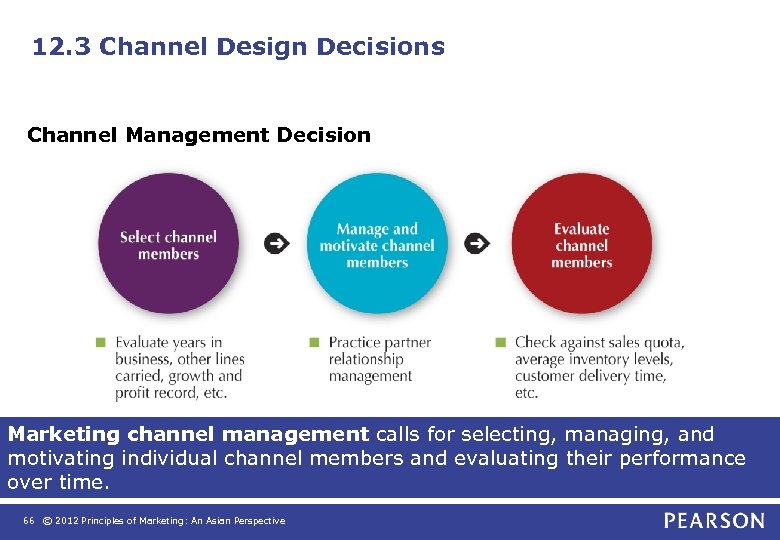 12. 3 Channel Design Decisions Channel Management Decision Marketing channel management calls for selecting, managing, and motivating individual channel members and evaluating their performance over time. 66 © 2012 Principles of Marketing: An Asian Perspective
 12. 4 Channel Management Decisions 12. 4 67 © 2012 Principles of Marketing: An Asian Perspective
 12. 4 Channel Management Decisions Channel management decisions A. Selecting Channel Members – When selecting intermediaries, the company should determine what characteristics distinguish the better ones. B. Managing and Motivating Channel Members – The company must sell not only through the intermediaries but to and with them. – Most companies practice strong partner relationship management (PRM) to forge long‑term partnerships with channel members. 68 © 2012 Principles of Marketing: An Asian Perspective
 12. 4 Channel Management Decisions Channel management decisions C. Evaluating Channel Members – The company should recognize and reward intermediaries who are performing well and adding good value for consumers. – Those who are performing poorly should be assisted or, as a last resort, replaced. – Finally, manufacturers must be sensitive to their dealers. 69 © 2012 Principles of Marketing: An Asian Perspective
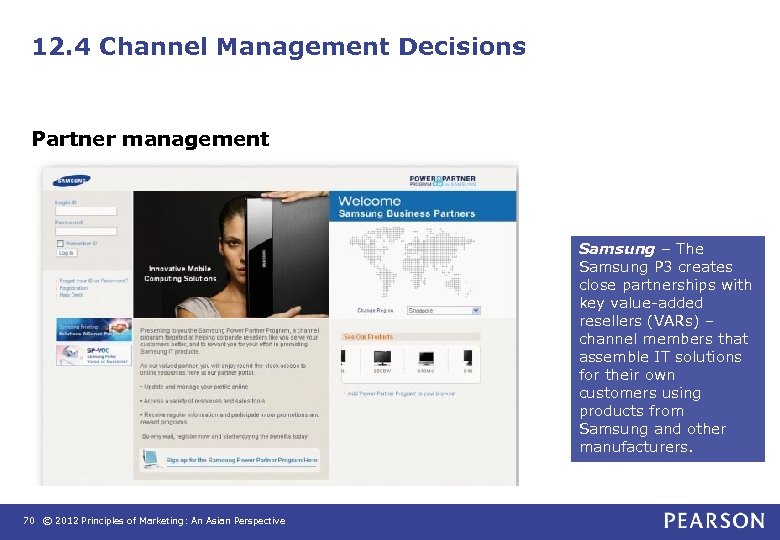 12. 4 Channel Management Decisions Partner management Samsung – The Samsung P 3 creates close partnerships with key value added resellers (VARs) – channel members that assemble IT solutions for their own customers using products from Samsung and other manufacturers. 70 © 2012 Principles of Marketing: An Asian Perspective
 12. 4 Channel Management Decisions Reviewing the Key Concepts Explain how companies select, motivate, and evaluate channel members. 71 © 2012 Principles of Marketing: An Asian Perspective
 12. 5 Public Policy and Distribution Decisions 12. 5 72 © 2012 Principles of Marketing: An Asian Perspective
 12. 5 Public Policy and Distribution Decisions Public policy and distribution • Exclusive dealing • Exclusive territorial agreements • Tying agreements 73 © 2012 Principles of Marketing: An Asian Perspective
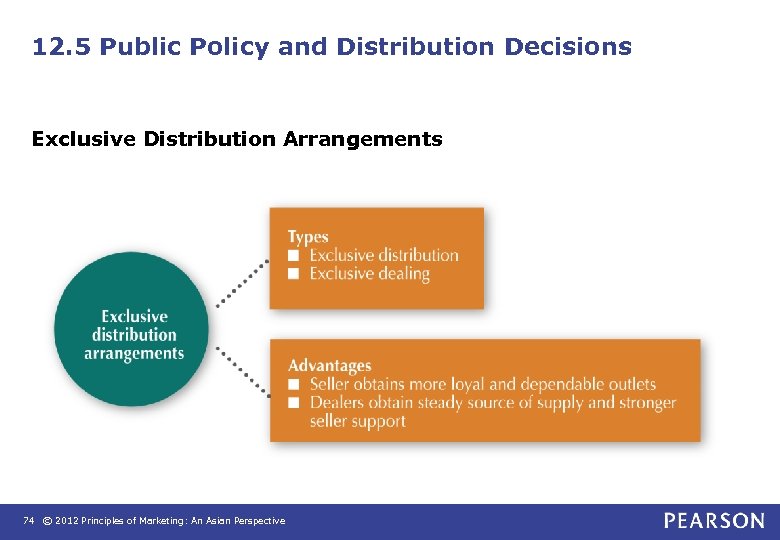 12. 5 Public Policy and Distribution Decisions Exclusive Distribution Arrangements 74 © 2012 Principles of Marketing: An Asian Perspective
 12. 5 Public Policy and Distribution Decisions Public policy and distribution decisions • Exclusive distribution occurs when the seller allows only certain outlets to carry its products. • Exclusive dealing occurs when the seller requires that these dealers not handle competitors’ products. • Exclusive arrangements exclude other producers from selling to these dealers. 75 © 2012 Principles of Marketing: An Asian Perspective
 12. 5 Public Policy and Distribution Decisions Public policy and distribution decisions • Exclusive territorial agreements occur when the producer agrees not to sell to other dealers in a given area, or the buyer may agree to sell only in its own territory. • Full-line forcing occurs when producers of a strong brand sell only to dealers if they agree to take some or all of the rest of the line. This is also known as a tying agreement. • In general, sellers can drop dealers “for cause. ” 76 © 2012 Principles of Marketing: An Asian Perspective
 12. 6 Marketing Logistics and Supply Chain Management 12. 6 77 © 2012 Principles of Marketing: An Asian Perspective
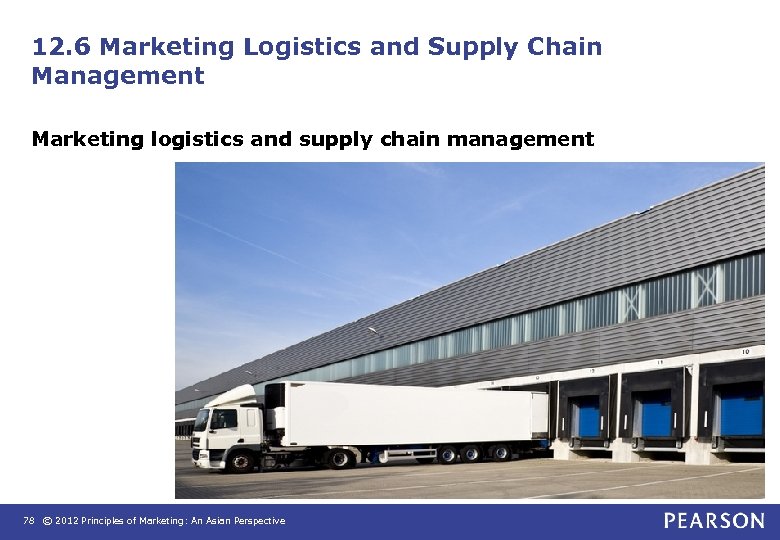 12. 6 Marketing Logistics and Supply Chain Management Marketing logistics and supply chain management 78 © 2012 Principles of Marketing: An Asian Perspective
 12. 6 Marketing Logistics and Supply Chain Management Marketing logistics • Marketing logistics (also called physical distribution) involves planning, implementing, and controlling the physical flow of goods, services, and related information from points of origin to points of consumption to meet customer requirements at a profit. • Marketing logistics involves outbound distribution (moving products from the factory to resellers and ultimately to customers), inbound distribution (moving products and materials from suppliers to the factory), and reverse distribution (moving broken, unwanted, or excess products returned by consumers or resellers). 79 © 2012 Principles of Marketing: An Asian Perspective
 12. 6 Marketing Logistics and Supply Chain Management • Marketing logistics involves the entire supply chain management —managing upstream and downstream value added flows of materials, final goods, and related information among suppliers, the company, resellers, and final consumers. 80 © 2012 Principles of Marketing: An Asian Perspective
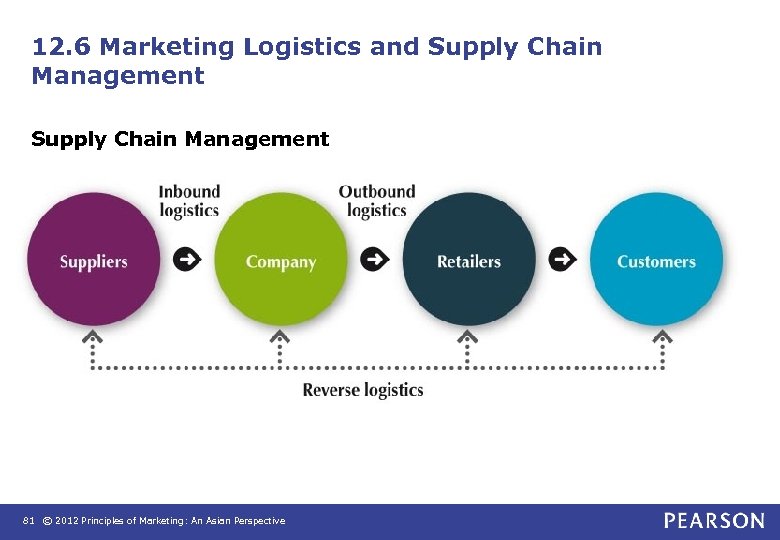 12. 6 Marketing Logistics and Supply Chain Management 81 © 2012 Principles of Marketing: An Asian Perspective
 12. 6 Marketing Logistics and Supply Chain Management Benefits of marketing logistics 1. 2. 3. 4. 5. Companies can gain a powerful competitive advantage by using improved logistics to give customers better service or lower prices. Improved logistics can yield tremendous cost savings to both the company and its customers. The explosion in product variety has created a need for improved logistics management. Improvements in information technology have created opportunities for major gains in distribution efficiency. More than almost any other marketing function, logistics affects the environment and a firm’s environmental sustainability efforts. 82 © 2012 Principles of Marketing: An Asian Perspective
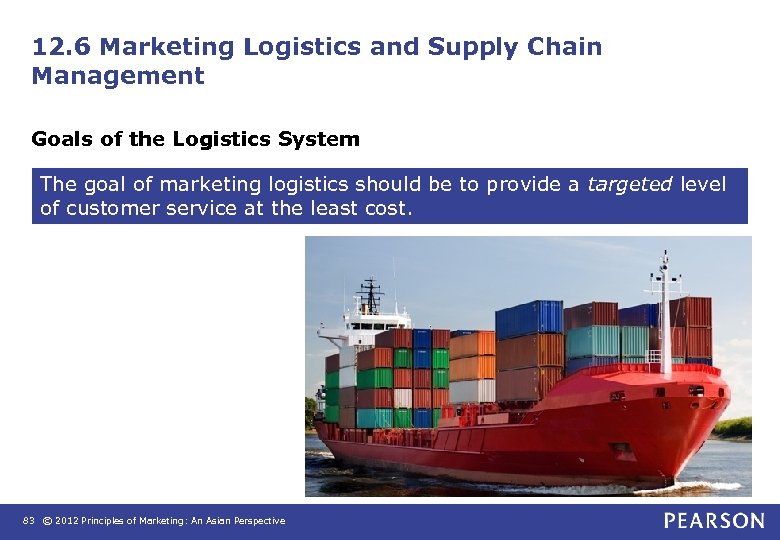 12. 6 Marketing Logistics and Supply Chain Management Goals of the Logistics System The goal of marketing logistics should be to provide a targeted level of customer service at the least cost. 83 © 2012 Principles of Marketing: An Asian Perspective
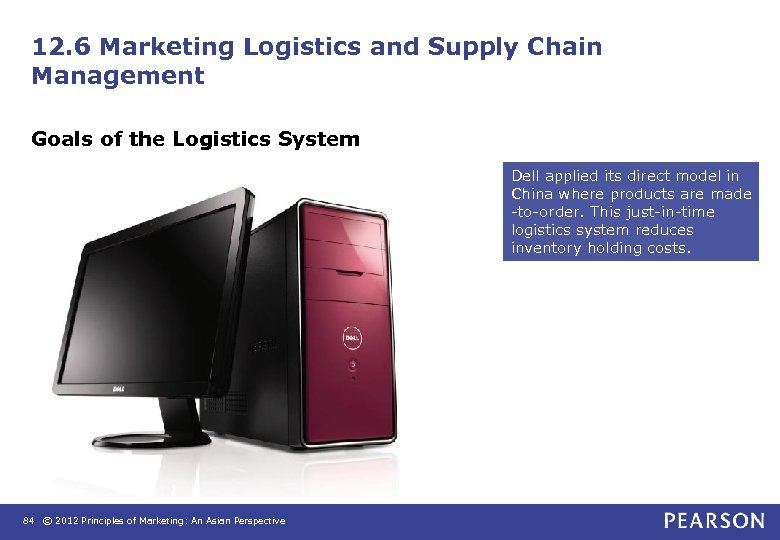 12. 6 Marketing Logistics and Supply Chain Management Goals of the Logistics System Dell applied its direct model in China where products are made to order. This just in time logistics system reduces inventory holding costs. 84 © 2012 Principles of Marketing: An Asian Perspective
 12. 6 Marketing Logistics and Supply Chain Management Logistics functions • Warehousing • Inventory Management • Transportation • Information Management 85 © 2012 Principles of Marketing: An Asian Perspective
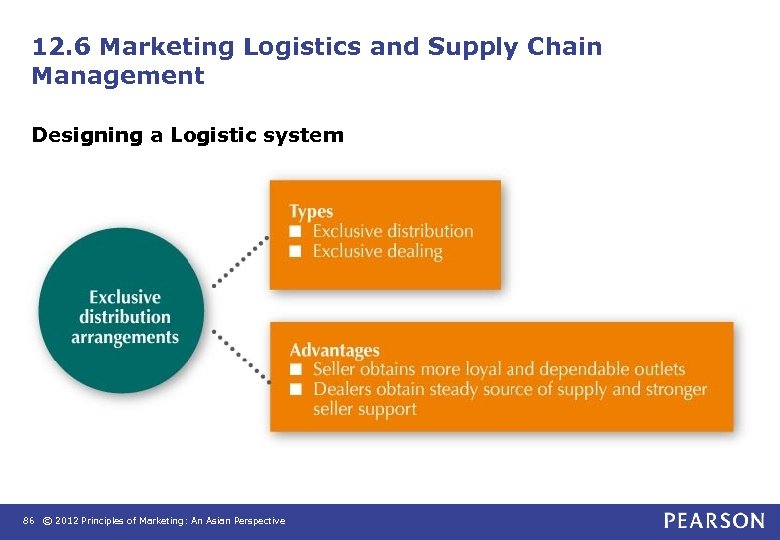 12. 6 Marketing Logistics and Supply Chain Management Designing a Logistic system 86 © 2012 Principles of Marketing: An Asian Perspective
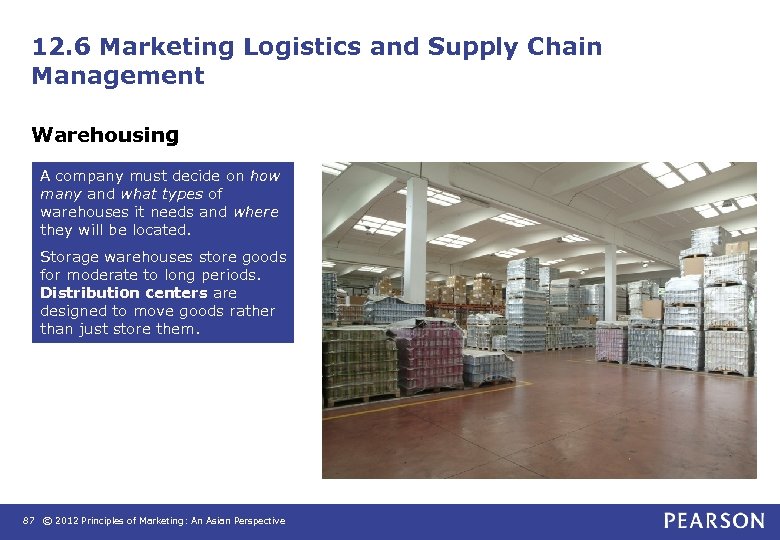 12. 6 Marketing Logistics and Supply Chain Management Warehousing A company must decide on how many and what types of warehouses it needs and where they will be located. Storage warehouses store goods for moderate to long periods. Distribution centers are designed to move goods rather than just store them. 87 © 2012 Principles of Marketing: An Asian Perspective
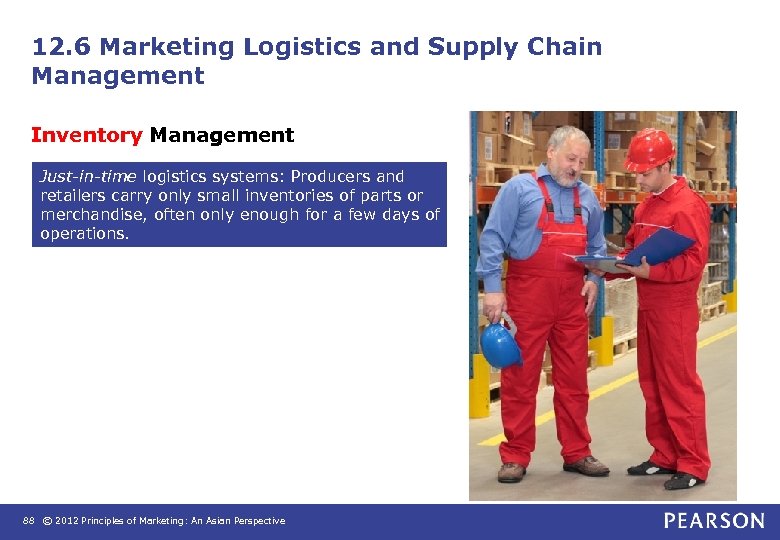 12. 6 Marketing Logistics and Supply Chain Management Inventory Management Just-in-time logistics systems: Producers and retailers carry only small inventories of parts or merchandise, often only enough for a few days of operations. 88 © 2012 Principles of Marketing: An Asian Perspective
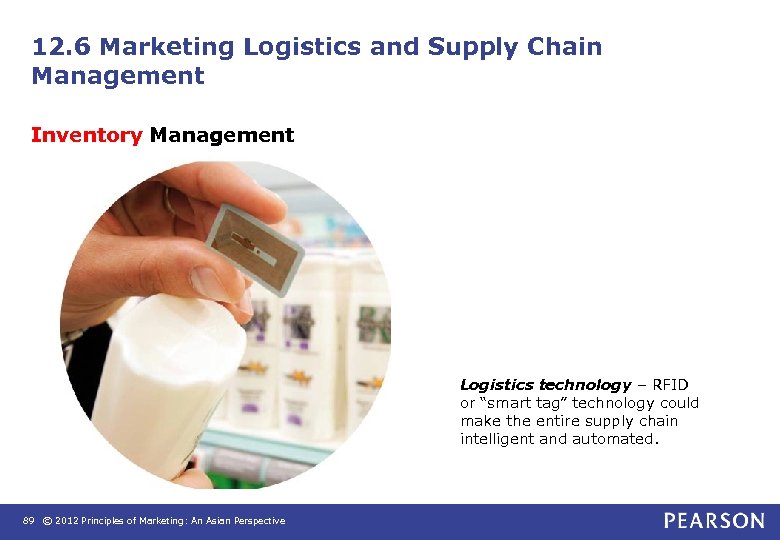 12. 6 Marketing Logistics and Supply Chain Management Inventory Management Logistics technology – RFID or “smart tag” technology could make the entire supply chain intelligent and automated. 89 © 2012 Principles of Marketing: An Asian Perspective
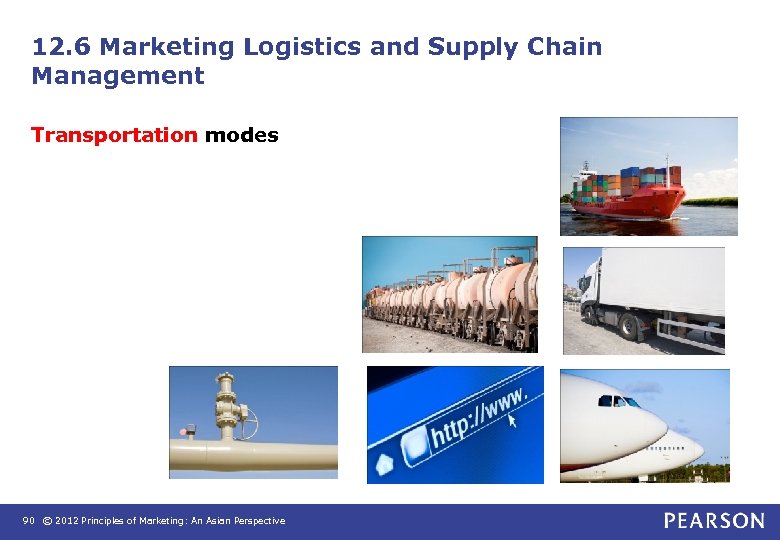 12. 6 Marketing Logistics and Supply Chain Management Transportation modes 90 © 2012 Principles of Marketing: An Asian Perspective
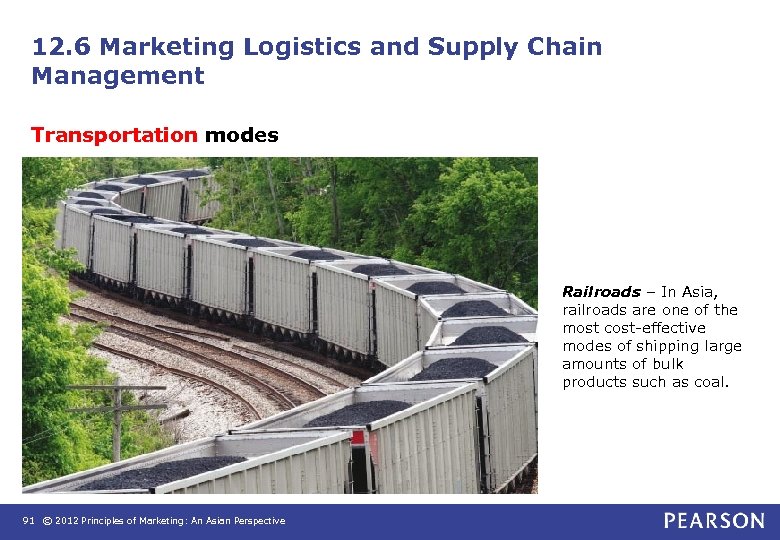 12. 6 Marketing Logistics and Supply Chain Management Transportation modes Railroads – In Asia, railroads are one of the most cost effective modes of shipping large amounts of bulk products such as coal. 91 © 2012 Principles of Marketing: An Asian Perspective
 12. 6 Marketing Logistics and Supply Chain Management Inter-modal transportation Intermodal transportation means combining two or more modes of transportation. • Piggyback—rail and trucks • Fishyback—water and trucks • Trainship—water and rail • Airtruck—air and trucks 92 © 2012 Principles of Marketing: An Asian Perspective
 12. 6 Marketing Logistics and Supply Chain Management Logistics Information management 93 © 2012 Principles of Marketing: An Asian Perspective
 12. 6 Marketing Logistics and Supply Chain Management Logistics Information management • Electronic data interchange (EDI) is the computerized exchange of data between organizations. • Vendor-managed inventory (VMI) systems or continuous inventory replenishment systems, is the customer sharing real time data on sales and current inventory levels with the supplier. The supplier then takes full responsibility for managing inventories and deliveries. 94 © 2012 Principles of Marketing: An Asian Perspective
 12. 6 Marketing Logistics and Supply Chain Management Integrated logistics management • Integrated logistics management is a concept that recognizes that providing better customer service and trimming distribution costs require teamwork, both inside the company and among all the marketing channel organizations. • Involves two main aspects: 1. Cross-Functional Teamwork Inside the Company 2. Building Logistics Partnerships 95 © 2012 Principles of Marketing: An Asian Perspective
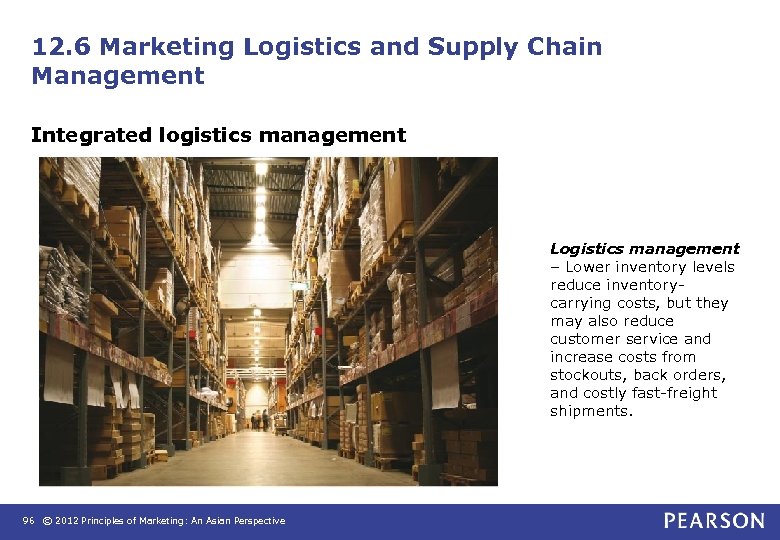 12. 6 Marketing Logistics and Supply Chain Management Integrated logistics management Logistics management – Lower inventory levels reduce inventory carrying costs, but they may also reduce customer service and increase costs from stockouts, back orders, and costly fast freight shipments. 96 © 2012 Principles of Marketing: An Asian Perspective
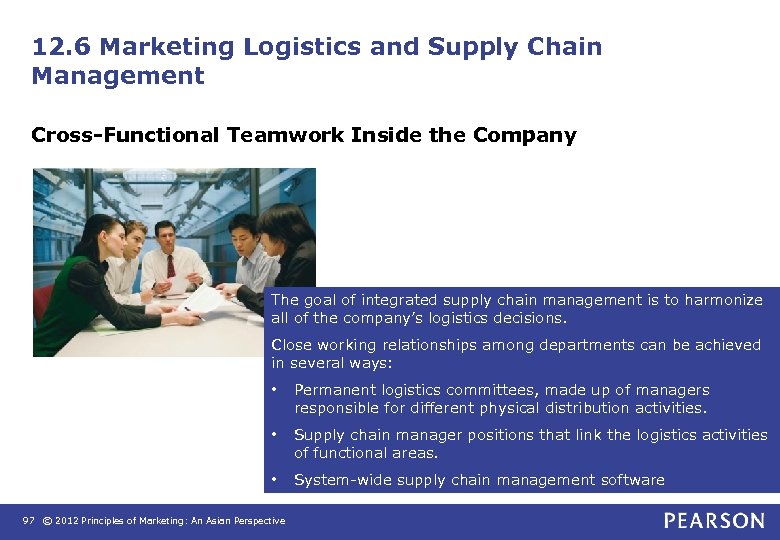 12. 6 Marketing Logistics and Supply Chain Management Cross-Functional Teamwork Inside the Company The goal of integrated supply chain management is to harmonize all of the company’s logistics decisions. Close working relationships among departments can be achieved in several ways: • Permanent logistics committees, made up of managers responsible for different physical distribution activities. • Supply chain manager positions that link the logistics activities of functional areas. • System wide supply chain management software 97 © 2012 Principles of Marketing: An Asian Perspective
 12. 6 Marketing Logistics and Supply Chain Management Building Logistics Partnerships • • • Companies must do more than simply improve their own logistics. They must also work with other channel partners to improve whole channel distribution. The members of a marketing channel are linked closely in creating customer value and building customer relationships. One company’s distribution system is another company’s supply system. The success of each channel member depends on the performance of the entire supply chain. 98 © 2012 Principles of Marketing: An Asian Perspective
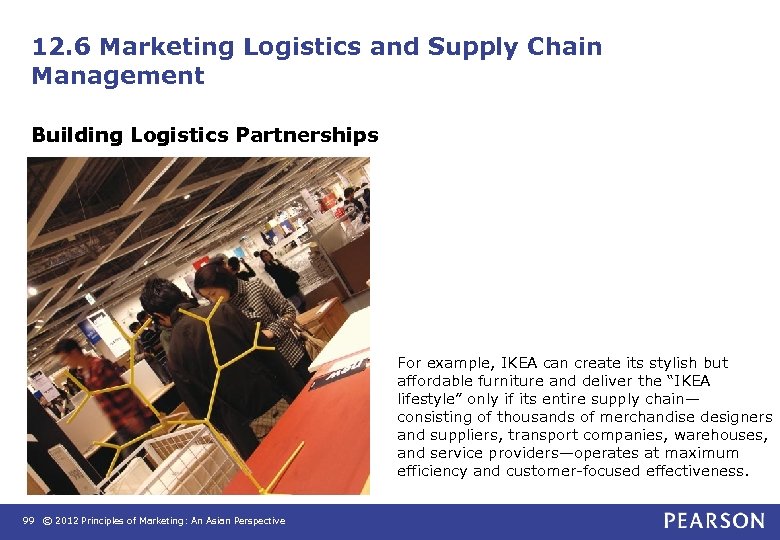 12. 6 Marketing Logistics and Supply Chain Management Building Logistics Partnerships For example, IKEA can create its stylish but affordable furniture and deliver the “IKEA lifestyle” only if its entire supply chain— consisting of thousands of merchandise designers and suppliers, transport companies, warehouses, and service providers—operates at maximum efficiency and customer focused effectiveness. 99 © 2012 Principles of Marketing: An Asian Perspective
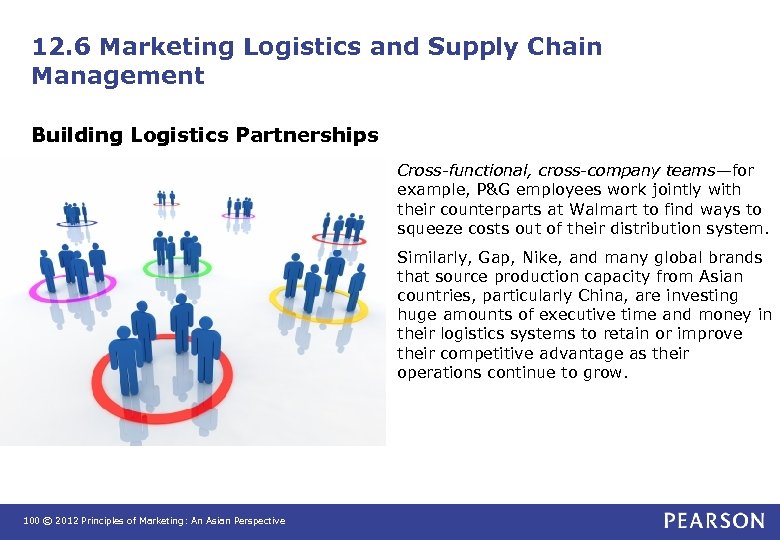 12. 6 Marketing Logistics and Supply Chain Management Building Logistics Partnerships Cross-functional, cross-company teams—for example, P&G employees work jointly with their counterparts at Walmart to find ways to squeeze costs out of their distribution system. Similarly, Gap, Nike, and many global brands that source production capacity from Asian countries, particularly China, are investing huge amounts of executive time and money in their logistics systems to retain or improve their competitive advantage as their operations continue to grow. 100 © 2012 Principles of Marketing: An Asian Perspective
 12. 6 Marketing Logistics and Supply Chain Management Third-Party Logistics Third-party logistics (3 PL) providers help clients tighten up overstuffed supply chains, slash inventories, and get products to customers more quickly and reliably. (Also called outsourced logistics or contract logistics. ) • Companies use third party logistics providers for several reasons: – These providers can often do it more efficiently and at a lower cost. – Outsourcing logistics frees a company to focus more intensely on its core business. – Integrated logistics companies understand increasingly complex logistics environments. • 101 © 2012 Principles of Marketing: An Asian Perspective
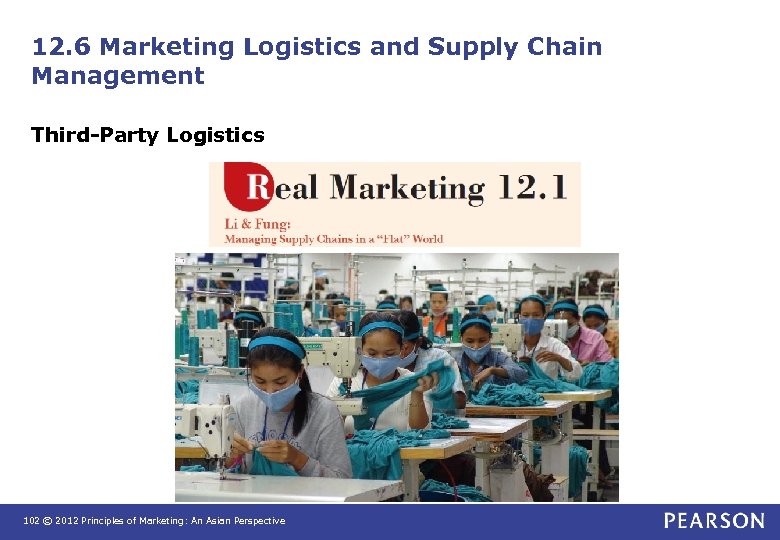 12. 6 Marketing Logistics and Supply Chain Management Third-Party Logistics 102 © 2012 Principles of Marketing: An Asian Perspective
 12. 6 Marketing Logistics and Supply Chain Management Reviewing the Key Concepts Discuss the nature and importance of marketing logistics and integrated supply chain management. 103 © 2012 Principles of Marketing: An Asian Perspective
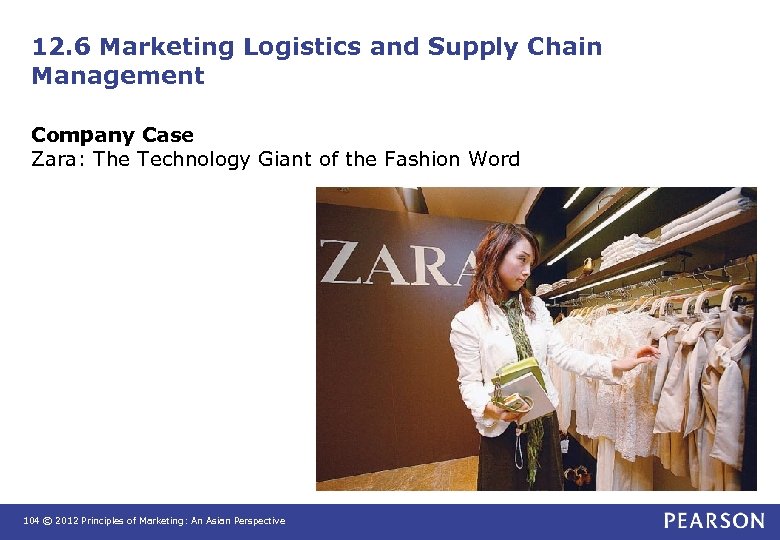 12. 6 Marketing Logistics and Supply Chain Management Company Case Zara: The Technology Giant of the Fashion Word 104 © 2012 Principles of Marketing: An Asian Perspective
 Thank you