


 Скачать презентацию PRINCIPLES OF MACROECONOMICS PART III The Core of
cd109e82f647faba316ad84d250d1b41.ppt
- Количество слайдов: 66
 PRINCIPLES OF MACROECONOMICS PART III The Core of Macroeconomic Theory TENTH EDITION CASE FAIR OSTER © 2012 Pearson Education, Inc. Publishing as Prentice Hall Prepared by: Fernando Quijano & Shelly Tefft of 66
 PART III The Core of Macroeconomic Theory © 2012 Pearson Education, Inc. Publishing as Prentice Hall 2 of 66
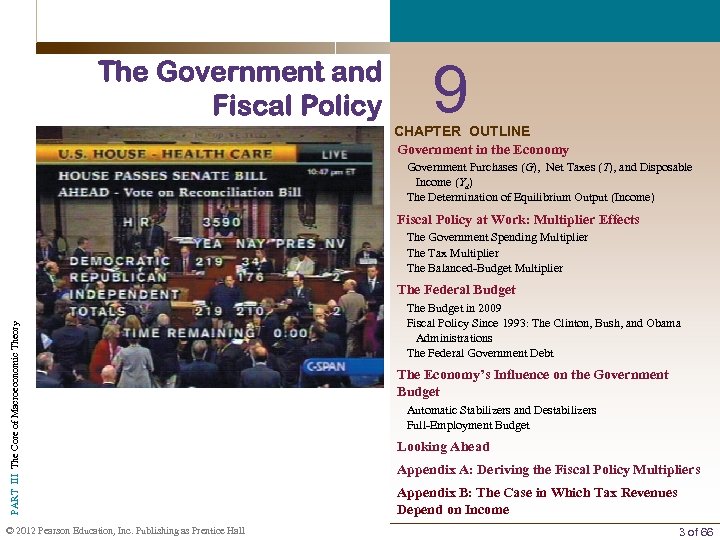 The Government and Fiscal Policy 9 CHAPTER OUTLINE Government in the Economy Government Purchases (G), Net Taxes (T), and Disposable Income (Yd) The Determination of Equilibrium Output (Income) Fiscal Policy at Work: Multiplier Effects The Government Spending Multiplier The Tax Multiplier The Balanced-Budget Multiplier PART III The Core of Macroeconomic Theory The Federal Budget © 2012 Pearson Education, Inc. Publishing as Prentice Hall The Budget in 2009 Fiscal Policy Since 1993: The Clinton, Bush, and Obama Administrations The Federal Government Debt The Economy’s Influence on the Government Budget Automatic Stabilizers and Destabilizers Full-Employment Budget Looking Ahead Appendix A: Deriving the Fiscal Policy Multipliers Appendix B: The Case in Which Tax Revenues Depend on Income 3 of 66
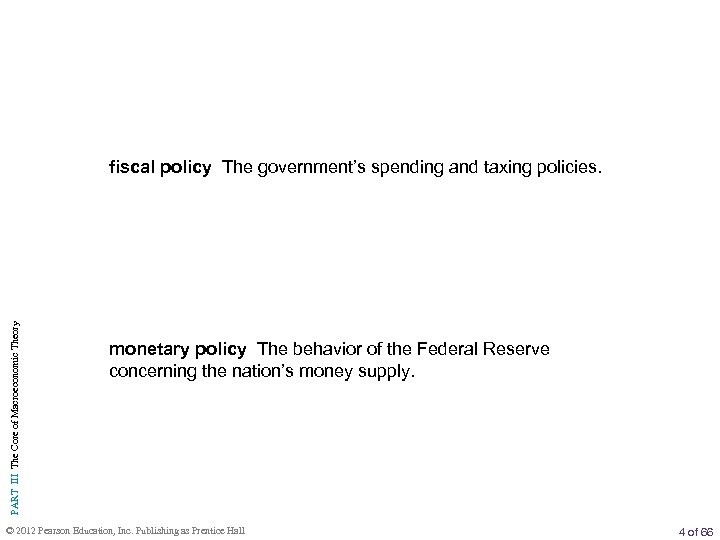 PART III The Core of Macroeconomic Theory fiscal policy The government’s spending and taxing policies. monetary policy The behavior of the Federal Reserve concerning the nation’s money supply. © 2012 Pearson Education, Inc. Publishing as Prentice Hall 4 of 66
 PART III The Core of Macroeconomic Theory The behavior of the Federal Reserve concerning the nation’s money supply is called: a. Discretionary fiscal policy. b. Automatic fiscal policy. c. Budgetary policy. d. Monetary policy. © 2012 Pearson Education, Inc. Publishing as Prentice Hall 5 of 66
 PART III The Core of Macroeconomic Theory The behavior of the Federal Reserve concerning the nation’s money supply is called: a. Discretionary fiscal policy. b. Automatic fiscal policy. c. Budgetary policy. d. Monetary policy. © 2012 Pearson Education, Inc. Publishing as Prentice Hall 6 of 66
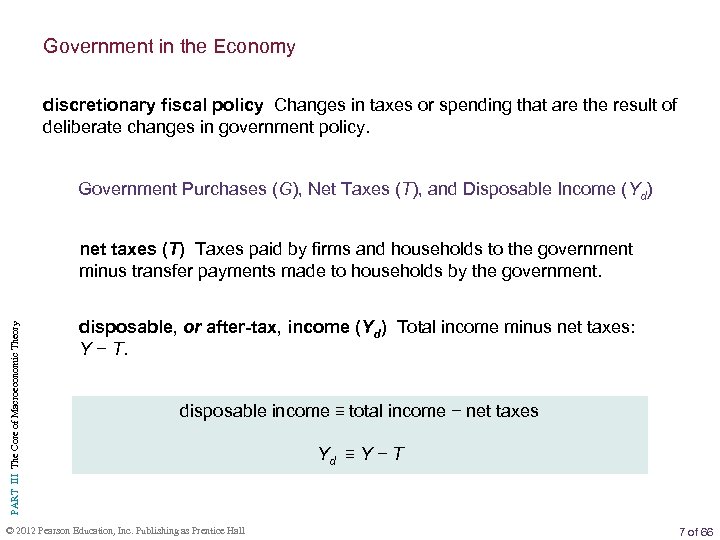 Government in the Economy discretionary fiscal policy Changes in taxes or spending that are the result of deliberate changes in government policy. Government Purchases (G), Net Taxes (T), and Disposable Income (Yd) PART III The Core of Macroeconomic Theory net taxes (T) Taxes paid by firms and households to the government minus transfer payments made to households by the government. disposable, or after-tax, income (Yd) Total income minus net taxes: Y − T. disposable income ≡ total income − net taxes © 2012 Pearson Education, Inc. Publishing as Prentice Hall Yd ≡ Y − T 7 of 66
 PART III The Core of Macroeconomic Theory Over which of the following categories does the government have more control? a. Tax revenue. b. Government expenditures. c. Tax rates. d. The size of corporate profits. © 2012 Pearson Education, Inc. Publishing as Prentice Hall 8 of 66
 PART III The Core of Macroeconomic Theory Over which of the following categories does the government have more control? a. Tax revenue. b. Government expenditures. c. Tax rates. d. The size of corporate profits. © 2012 Pearson Education, Inc. Publishing as Prentice Hall 9 of 66
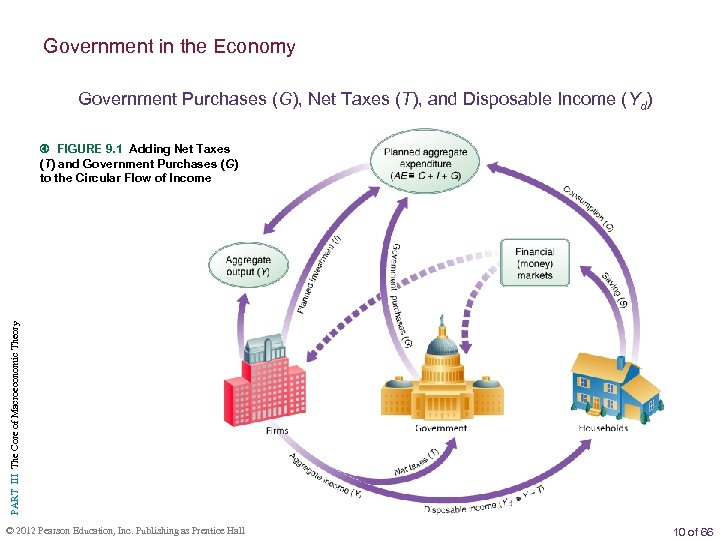 Government in the Economy Government Purchases (G), Net Taxes (T), and Disposable Income (Yd) PART III The Core of Macroeconomic Theory FIGURE 9. 1 Adding Net Taxes (T) and Government Purchases (G) to the Circular Flow of Income © 2012 Pearson Education, Inc. Publishing as Prentice Hall 10 of 66
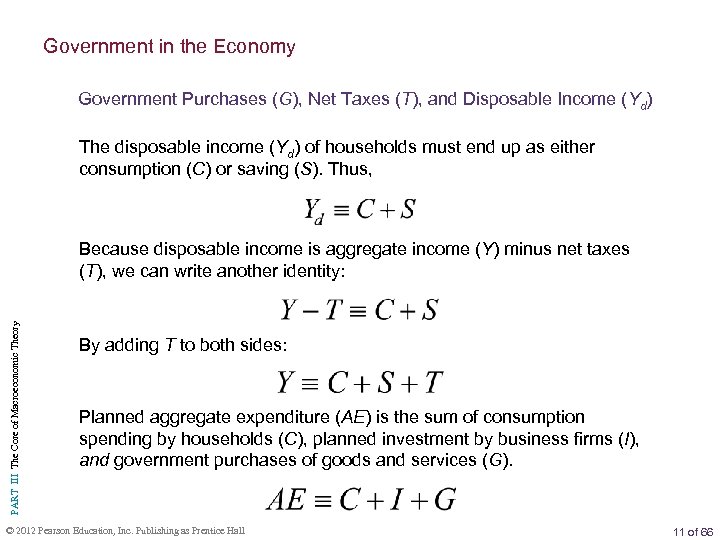 Government in the Economy Government Purchases (G), Net Taxes (T), and Disposable Income (Yd) The disposable income (Yd) of households must end up as either consumption (C) or saving (S). Thus, PART III The Core of Macroeconomic Theory Because disposable income is aggregate income (Y) minus net taxes (T), we can write another identity: By adding T to both sides: Planned aggregate expenditure (AE) is the sum of consumption spending by households (C), planned investment by business firms (I), and government purchases of goods and services (G). © 2012 Pearson Education, Inc. Publishing as Prentice Hall 11 of 66
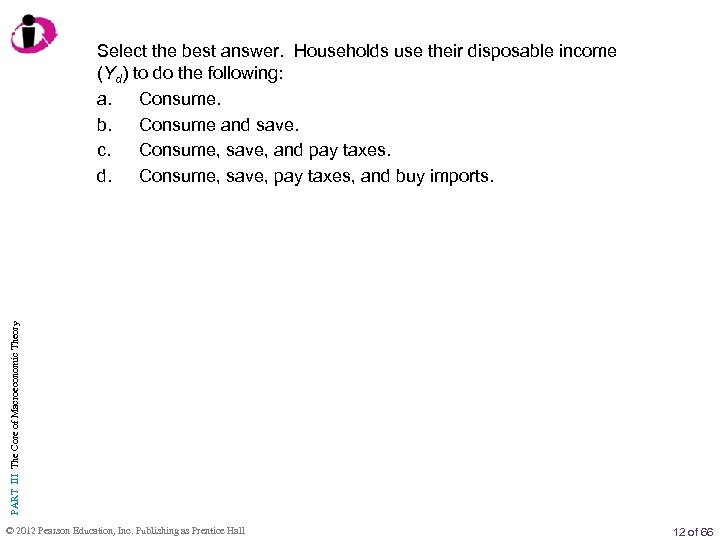 PART III The Core of Macroeconomic Theory Select the best answer. Households use their disposable income (Yd) to do the following: a. Consume. b. Consume and save. c. Consume, save, and pay taxes. d. Consume, save, pay taxes, and buy imports. © 2012 Pearson Education, Inc. Publishing as Prentice Hall 12 of 66
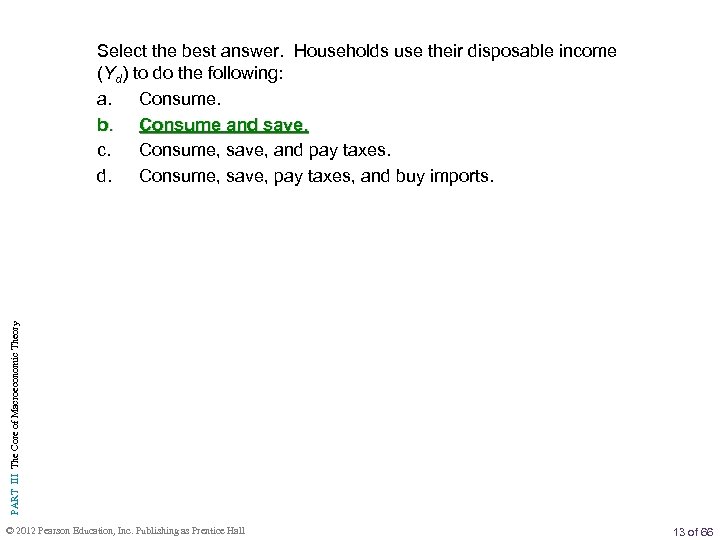 PART III The Core of Macroeconomic Theory Select the best answer. Households use their disposable income (Yd) to do the following: a. Consume. b. Consume and save. c. Consume, save, and pay taxes. d. Consume, save, pay taxes, and buy imports. © 2012 Pearson Education, Inc. Publishing as Prentice Hall 13 of 66
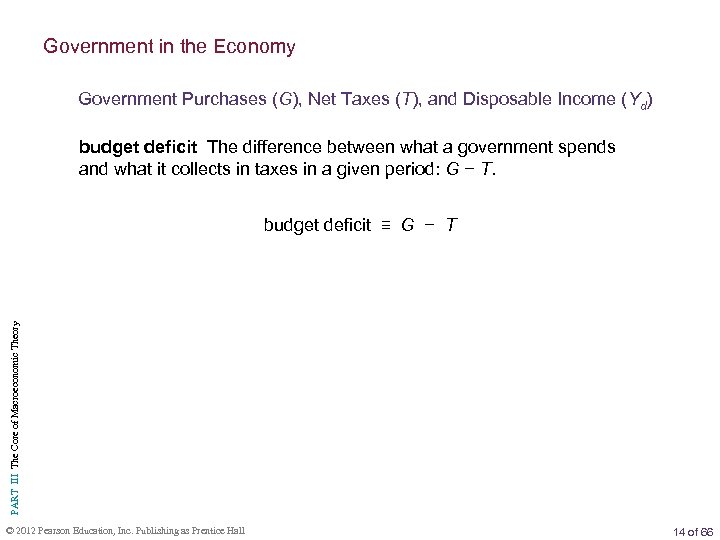 Government in the Economy Government Purchases (G), Net Taxes (T), and Disposable Income (Yd) budget deficit The difference between what a government spends and what it collects in taxes in a given period: G − T. PART III The Core of Macroeconomic Theory budget deficit ≡ G − T © 2012 Pearson Education, Inc. Publishing as Prentice Hall 14 of 66
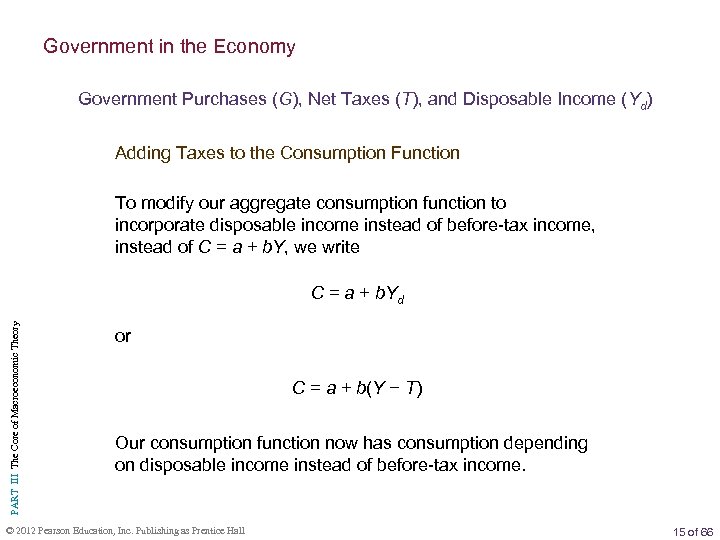 Government in the Economy Government Purchases (G), Net Taxes (T), and Disposable Income (Yd) Adding Taxes to the Consumption Function To modify our aggregate consumption function to incorporate disposable income instead of before-tax income, instead of C = a + b. Y, we write PART III The Core of Macroeconomic Theory C = a + b. Yd or C = a + b(Y − T) Our consumption function now has consumption depending on disposable income instead of before-tax income. © 2012 Pearson Education, Inc. Publishing as Prentice Hall 15 of 66
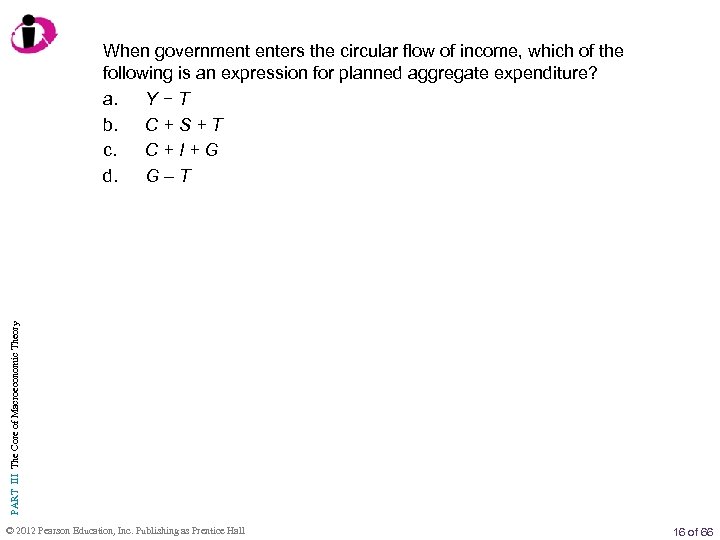 PART III The Core of Macroeconomic Theory When government enters the circular flow of income, which of the following is an expression for planned aggregate expenditure? a. Y−T b. C+S+T c. C+I+G d. G–T © 2012 Pearson Education, Inc. Publishing as Prentice Hall 16 of 66
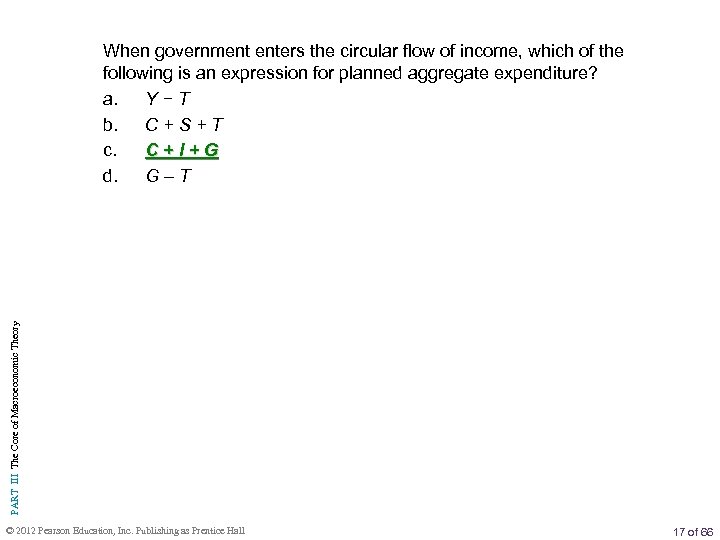 PART III The Core of Macroeconomic Theory When government enters the circular flow of income, which of the following is an expression for planned aggregate expenditure? a. Y−T b. C+S+T c. C+I+G d. G–T © 2012 Pearson Education, Inc. Publishing as Prentice Hall 17 of 66
 Government in the Economy Government Purchases (G), Net Taxes (T), and Disposable Income (Yd) Planned Investment PART III The Core of Macroeconomic Theory The government can affect investment behavior through its tax treatment of depreciation and other tax policies. © 2012 Pearson Education, Inc. Publishing as Prentice Hall 18 of 66
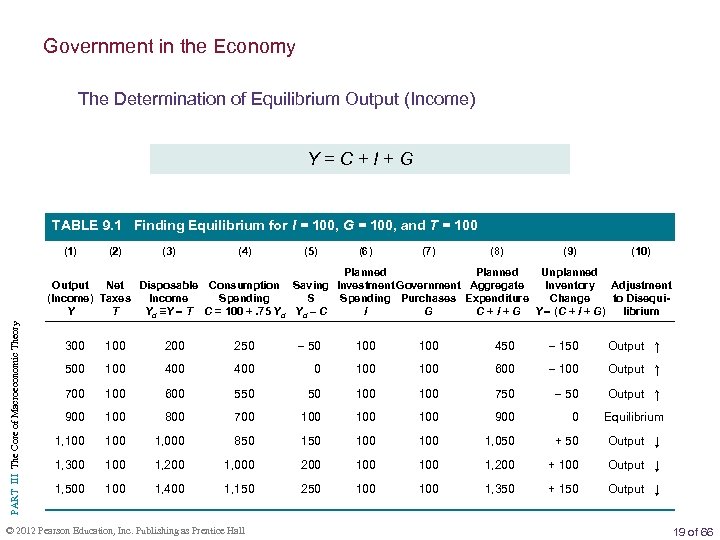 Government in the Economy The Determination of Equilibrium Output (Income) Y=C+I+G TABLE 9. 1 Finding Equilibrium for I = 100, G = 100, and T = 100 (1) (2) (3) (4) PART III The Core of Macroeconomic Theory Output Net Disposable Consumption (Income) Taxes Income Spending Y T Yd ≡Y - T C = 100 +. 75 Yd (5) (6) (7) (8) (9) (10) Planned Unplanned Saving Investment Government Aggregate Inventory Adjustment S Spending Purchases Expenditure Change to Disequi. Yd – C I G C + I + G Y - (C + I + G) librium 300 100 250 - 50 100 450 - 150 Output ↑ 500 100 400 0 100 600 - 100 Output ↑ 700 100 600 550 50 100 750 - 50 Output ↑ 900 100 800 700 100 100 900 0 1, 100 1, 000 850 100 1, 050 + 50 Output ↓ 1, 300 1, 200 1, 000 200 100 1, 200 + 100 Output ↓ 1, 500 1, 400 1, 150 250 100 1, 350 + 150 Output ↓ © 2012 Pearson Education, Inc. Publishing as Prentice Hall Equilibrium 19 of 66
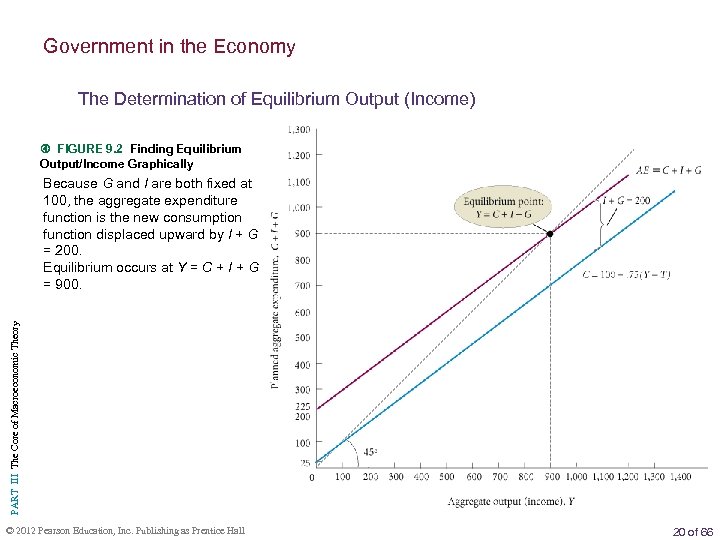 Government in the Economy The Determination of Equilibrium Output (Income) FIGURE 9. 2 Finding Equilibrium Output/Income Graphically PART III The Core of Macroeconomic Theory Because G and I are both fixed at 100, the aggregate expenditure function is the new consumption function displaced upward by I + G = 200. Equilibrium occurs at Y = C + I + G = 900. © 2012 Pearson Education, Inc. Publishing as Prentice Hall 20 of 66
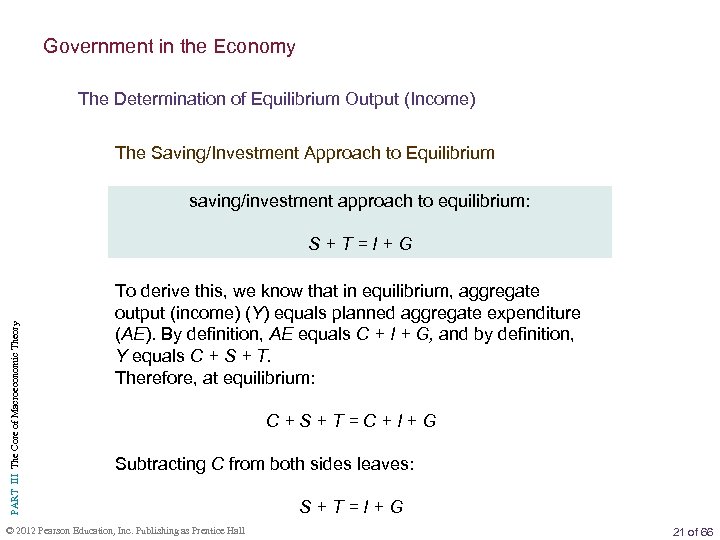 Government in the Economy The Determination of Equilibrium Output (Income) The Saving/Investment Approach to Equilibrium saving/investment approach to equilibrium: PART III The Core of Macroeconomic Theory S+T=I+G To derive this, we know that in equilibrium, aggregate output (income) (Y) equals planned aggregate expenditure (AE). By definition, AE equals C + I + G, and by definition, Y equals C + S + T. Therefore, at equilibrium: C+S+T=C+I+G Subtracting C from both sides leaves: © 2012 Pearson Education, Inc. Publishing as Prentice Hall S+T=I+G 21 of 66
 PART III The Core of Macroeconomic Theory In the circular flow that includes households, firms, and government, which of the following expressions is the leakages/injections approach to equilibrium? a. Y = C + I + G. b. C + S = I + G. c. Y = a + b. T + I + G. d. S + T = I + G. © 2012 Pearson Education, Inc. Publishing as Prentice Hall 22 of 66
 PART III The Core of Macroeconomic Theory In the circular flow that includes households, firms, and government, which of the following expressions is the leakages/injections approach to equilibrium? a. Y = C + I + G. b. C + S = I + G. c. Y = a + b. T + I + G. d. S + T = I + G. © 2012 Pearson Education, Inc. Publishing as Prentice Hall 23 of 66
 Fiscal Policy at Work: Multiplier Effects At this point, we are assuming that the government controls G and T. In this section, we will review three multipliers: Government spending multiplier Tax multiplier PART III The Core of Macroeconomic Theory Balanced-budget multiplier © 2012 Pearson Education, Inc. Publishing as Prentice Hall 24 of 66
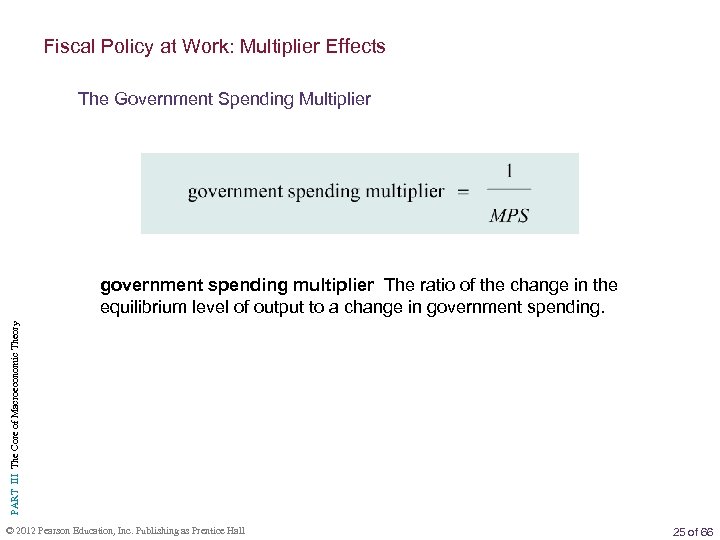 Fiscal Policy at Work: Multiplier Effects The Government Spending Multiplier PART III The Core of Macroeconomic Theory government spending multiplier The ratio of the change in the equilibrium level of output to a change in government spending. © 2012 Pearson Education, Inc. Publishing as Prentice Hall 25 of 66
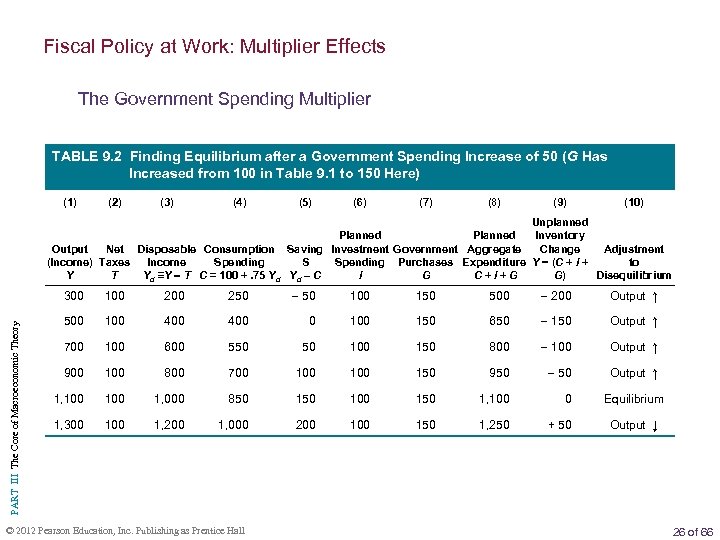 Fiscal Policy at Work: Multiplier Effects The Government Spending Multiplier TABLE 9. 2 Finding Equilibrium after a Government Spending Increase of 50 (G Has Increased from 100 in Table 9. 1 to 150 Here) (1) (2) (3) (4) Output Net Disposable Consumption (Income) Taxes Income Spending Y T Yd ≡Y - T C = 100 +. 75 Yd (5) (6) (7) (8) (9) (10) Unplanned Planned Inventory Saving Investment Government Aggregate Adjustment Change S Spending Purchases Expenditure Y - (C + I + to Yd – C I G C+I+G G) Disequilibrium PART III The Core of Macroeconomic Theory 300 100 250 - 50 100 150 500 - 200 Output ↑ 500 100 400 0 100 150 650 - 150 Output ↑ 700 100 600 550 50 100 150 800 - 100 Output ↑ 900 100 800 700 100 150 950 - 50 Output ↑ 1, 100 1, 000 850 100 150 1, 100 0 1, 300 1, 200 1, 000 200 150 1, 250 + 50 © 2012 Pearson Education, Inc. Publishing as Prentice Hall Equilibrium Output ↓ 26 of 66
 PART III The Core of Macroeconomic Theory How much of an increase in government spending would be required to generate a $200 billion increase in the equilibrium level of output? a. An amount less than $200 billion in government spending. b. An amount greater than $200 billion in government spending. c. Exactly $200 billion in government spending. d. None of the above. Equilibrium output does not change with changes in government spending. © 2012 Pearson Education, Inc. Publishing as Prentice Hall 27 of 66
 PART III The Core of Macroeconomic Theory How much of an increase in government spending would be required to generate a $200 billion increase in the equilibrium level of output? a. An amount less than $200 billion in government spending. b. An amount greater than $200 billion in government spending. c. Exactly $200 billion in government spending. d. None of the above. Equilibrium output does not change with changes in government spending. © 2012 Pearson Education, Inc. Publishing as Prentice Hall 28 of 66
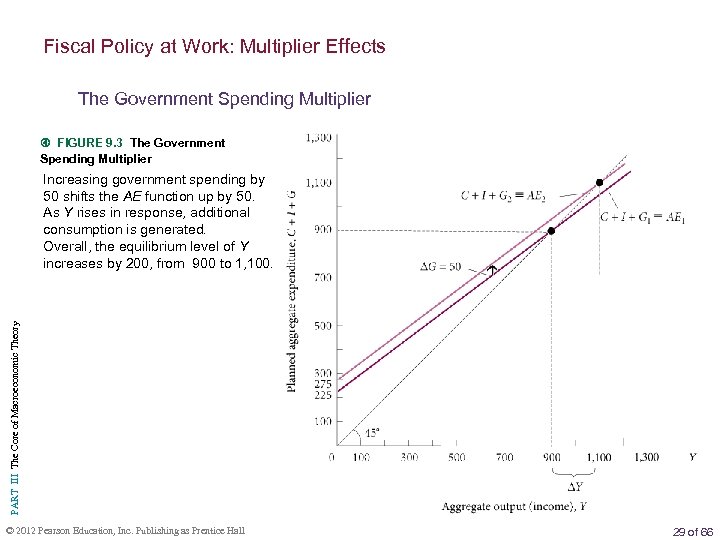 Fiscal Policy at Work: Multiplier Effects The Government Spending Multiplier FIGURE 9. 3 The Government Spending Multiplier PART III The Core of Macroeconomic Theory Increasing government spending by 50 shifts the AE function up by 50. As Y rises in response, additional consumption is generated. Overall, the equilibrium level of Y increases by 200, from 900 to 1, 100. © 2012 Pearson Education, Inc. Publishing as Prentice Hall 29 of 66
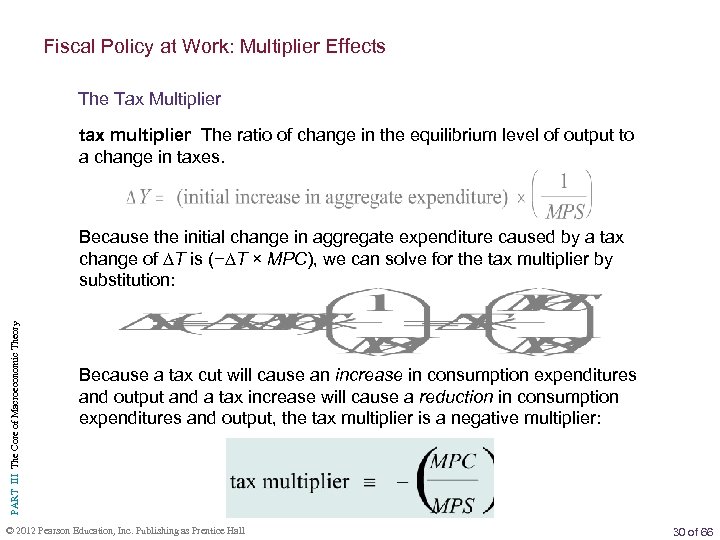 Fiscal Policy at Work: Multiplier Effects The Tax Multiplier tax multiplier The ratio of change in the equilibrium level of output to a change in taxes. PART III The Core of Macroeconomic Theory Because the initial change in aggregate expenditure caused by a tax change of ∆T is (−∆T × MPC), we can solve for the tax multiplier by substitution: Because a tax cut will cause an increase in consumption expenditures and output and a tax increase will cause a reduction in consumption expenditures and output, the tax multiplier is a negative multiplier: © 2012 Pearson Education, Inc. Publishing as Prentice Hall 30 of 66
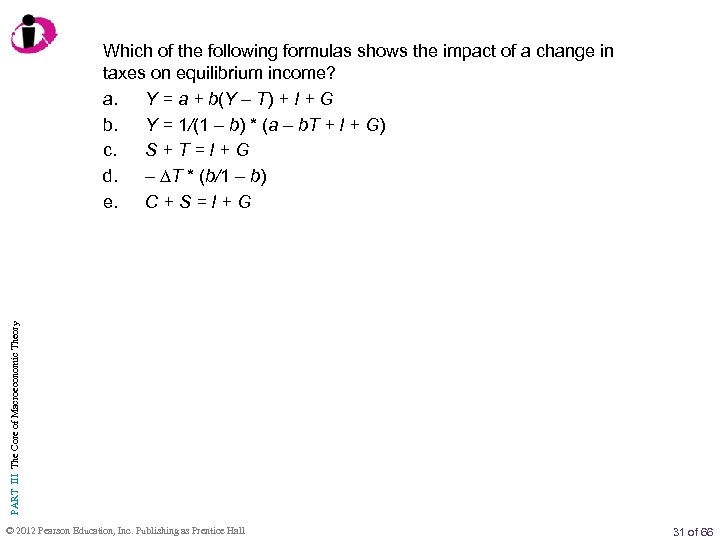 PART III The Core of Macroeconomic Theory Which of the following formulas shows the impact of a change in taxes on equilibrium income? a. Y = a + b(Y – T) + I + G b. Y = 1/(1 – b) * (a – b. T + I + G) c. S+T=I+G d. – ∆T * (b/1 – b) e. C+S=I+G © 2012 Pearson Education, Inc. Publishing as Prentice Hall 31 of 66
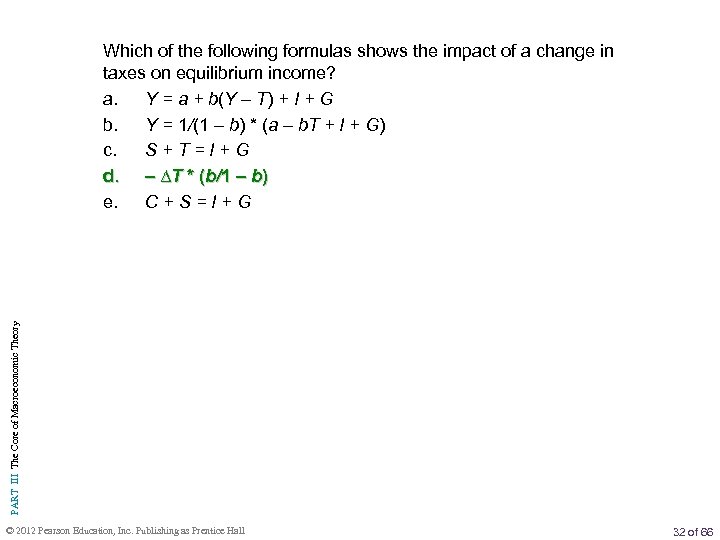 PART III The Core of Macroeconomic Theory Which of the following formulas shows the impact of a change in taxes on equilibrium income? a. Y = a + b(Y – T) + I + G b. Y = 1/(1 – b) * (a – b. T + I + G) c. S+T=I+G d. – ∆T * (b/1 – b) e. C+S=I+G © 2012 Pearson Education, Inc. Publishing as Prentice Hall 32 of 66
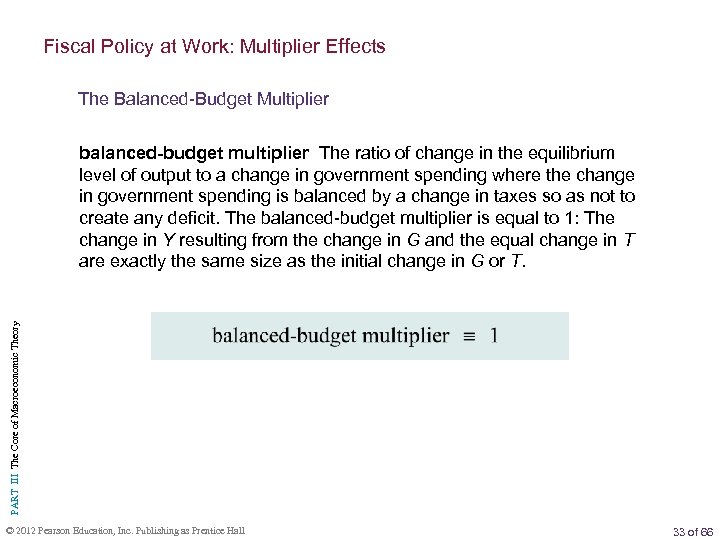 Fiscal Policy at Work: Multiplier Effects The Balanced-Budget Multiplier PART III The Core of Macroeconomic Theory balanced-budget multiplier The ratio of change in the equilibrium level of output to a change in government spending where the change in government spending is balanced by a change in taxes so as not to create any deficit. The balanced-budget multiplier is equal to 1: The change in Y resulting from the change in G and the equal change in T are exactly the same size as the initial change in G or T. © 2012 Pearson Education, Inc. Publishing as Prentice Hall 33 of 66
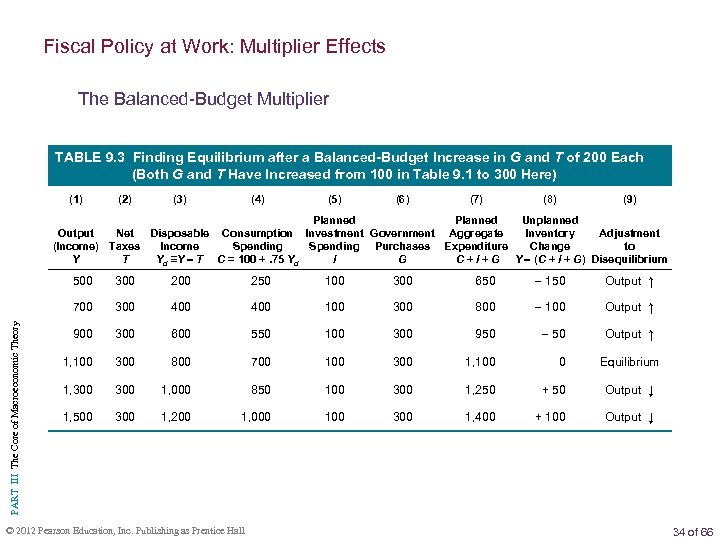 Fiscal Policy at Work: Multiplier Effects The Balanced-Budget Multiplier TABLE 9. 3 Finding Equilibrium after a Balanced-Budget Increase in G and T of 200 Each (Both G and T Have Increased from 100 in Table 9. 1 to 300 Here) (1) (2) (3) (4) Output Net Disposable Consumption (Income) Taxes Income Spending Y T Yd ≡Y - T C = 100 +. 75 Yd (5) (6) (7) (8) (9) Planned Unplanned Investment Government Aggregate Inventory Adjustment Spending Purchases Expenditure Change to I G C + I + G Y - (C + I + G) Disequilibrium 300 250 100 300 650 - 150 Output ↑ 700 PART III The Core of Macroeconomic Theory 500 300 400 100 300 800 - 100 Output ↑ 900 300 600 550 100 300 950 - 50 Output ↑ 1, 100 300 800 700 100 300 1, 100 0 1, 300 1, 000 850 100 300 1, 250 + 50 Output ↓ 1, 500 300 1, 200 1, 000 100 300 1, 400 + 100 Output ↓ © 2012 Pearson Education, Inc. Publishing as Prentice Hall Equilibrium 34 of 66
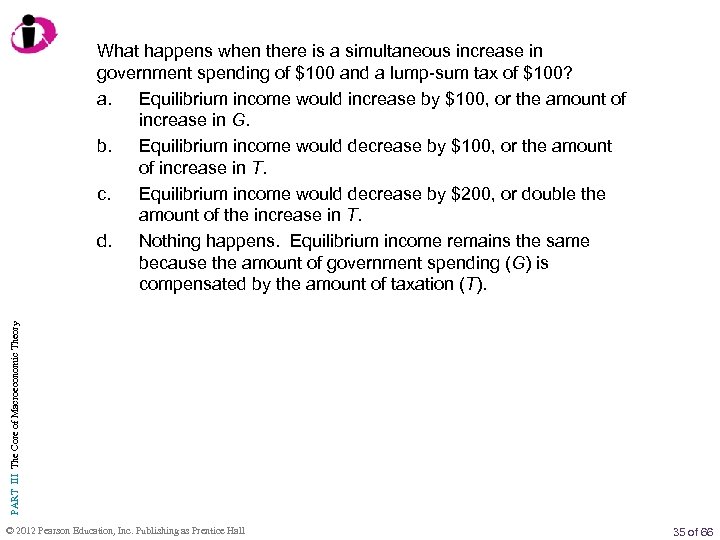 PART III The Core of Macroeconomic Theory What happens when there is a simultaneous increase in government spending of $100 and a lump-sum tax of $100? a. Equilibrium income would increase by $100, or the amount of increase in G. b. Equilibrium income would decrease by $100, or the amount of increase in T. c. Equilibrium income would decrease by $200, or double the amount of the increase in T. d. Nothing happens. Equilibrium income remains the same because the amount of government spending (G) is compensated by the amount of taxation (T). © 2012 Pearson Education, Inc. Publishing as Prentice Hall 35 of 66
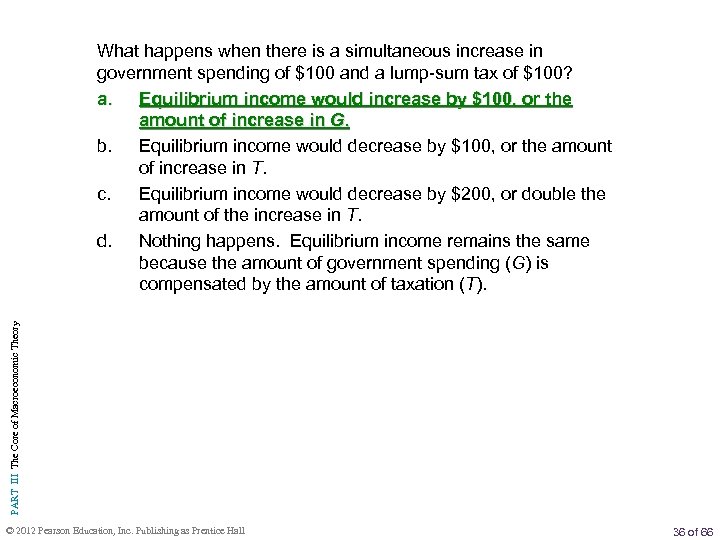 PART III The Core of Macroeconomic Theory What happens when there is a simultaneous increase in government spending of $100 and a lump-sum tax of $100? a. Equilibrium income would increase by $100, or the amount of increase in G. b. Equilibrium income would decrease by $100, or the amount of increase in T. c. Equilibrium income would decrease by $200, or double the amount of the increase in T. d. Nothing happens. Equilibrium income remains the same because the amount of government spending (G) is compensated by the amount of taxation (T). © 2012 Pearson Education, Inc. Publishing as Prentice Hall 36 of 66
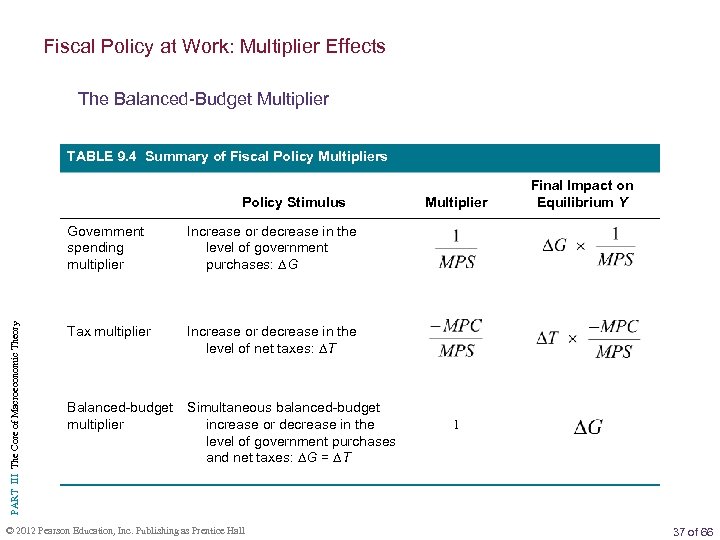 Fiscal Policy at Work: Multiplier Effects The Balanced-Budget Multiplier TABLE 9. 4 Summary of Fiscal Policy Multipliers Policy Stimulus PART III The Core of Macroeconomic Theory Government spending multiplier Increase or decrease in the level of government purchases: ∆G Tax multiplier Increase or decrease in the level of net taxes: ∆T Balanced-budget multiplier Simultaneous balanced-budget increase or decrease in the level of government purchases and net taxes: ∆G = ∆T Multiplier Final Impact on Equilibrium Y © 2012 Pearson Education, Inc. Publishing as Prentice Hall 1 37 of 66
 Fiscal Policy at Work: Multiplier Effects The Balanced-Budget Multiplier A Warning Although we have added government, the story told about the multiplier is still incomplete and oversimplified. PART III The Core of Macroeconomic Theory We have been treating net taxes (T) as a lump-sum, fixed amount, whereas in practice, taxes depend on income. Appendix B to this chapter shows that the size of the multiplier is reduced when we make the more realistic assumption that taxes depend on income. We continue to add more realism and difficulty to our analysis in the chapters that follow. © 2012 Pearson Education, Inc. Publishing as Prentice Hall 38 of 66
 The Federal Budget federal budget The budget of the federal government. The “budget” is really three different budgets: It is a political document that dispenses favors to certain groups or regions and places burdens on others. PART III The Core of Macroeconomic Theory It is a reflection of goals the government wants to achieve. The budget may be an embodiment of some beliefs about how (if at all) the government should manage the macroeconomy. © 2012 Pearson Education, Inc. Publishing as Prentice Hall 39 of 66
 PART III The Core of Macroeconomic Theory The federal budget can be conceived as: a. A political document that dispenses favors to some groups and places burdens on others. b. A reflection of goals the government wants to achieve. c. An embodiment of some beliefs about how (if at all) the government should manage the macroeconomy. d. All of the above. © 2012 Pearson Education, Inc. Publishing as Prentice Hall 40 of 66
 PART III The Core of Macroeconomic Theory The federal budget can be conceived as: a. A political document that dispenses favors to some groups and places burdens on others. b. A reflection of goals the government wants to achieve. c. An embodiment of some beliefs about how (if at all) the government should manage the macroeconomy. d. All of the above. © 2012 Pearson Education, Inc. Publishing as Prentice Hall 41 of 66
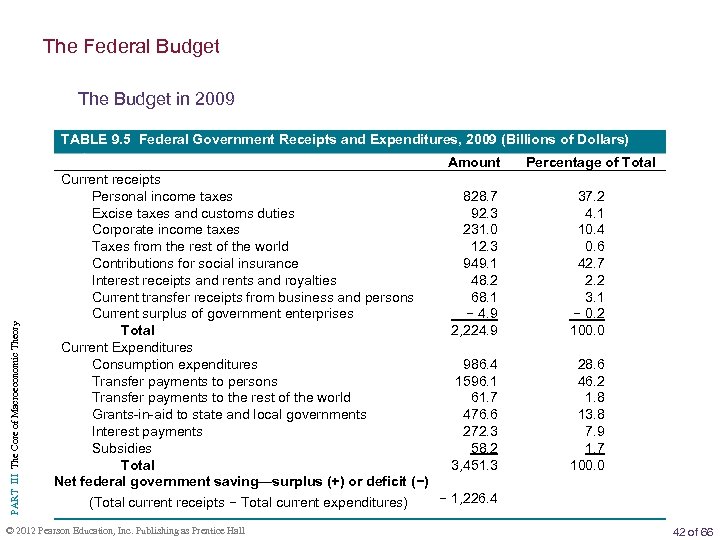 The Federal Budget The Budget in 2009 TABLE 9. 5 Federal Government Receipts and Expenditures, 2009 (Billions of Dollars) PART III The Core of Macroeconomic Theory Amount Current receipts Personal income taxes 828. 7 Excise taxes and customs duties 92. 3 Corporate income taxes 231. 0 Taxes from the rest of the world 12. 3 Contributions for social insurance 949. 1 Interest receipts and rents and royalties 48. 2 Current transfer receipts from business and persons 68. 1 Current surplus of government enterprises − 4. 9 Total 2, 224. 9 Current Expenditures Consumption expenditures 986. 4 Transfer payments to persons 1596. 1 Transfer payments to the rest of the world 61. 7 Grants-in-aid to state and local governments 476. 6 Interest payments 272. 3 Subsidies 58. 2 Total 3, 451. 3 Net federal government saving—surplus (+) or deficit (−) − 1, 226. 4 (Total current receipts − Total current expenditures) © 2012 Pearson Education, Inc. Publishing as Prentice Hall Percentage of Total 37. 2 4. 1 10. 4 0. 6 42. 7 2. 2 3. 1 − 0. 2 100. 0 28. 6 46. 2 1. 8 13. 8 7. 9 1. 7 100. 0 42 of 66
 The Federal Budget The Budget in 2009 PART III The Core of Macroeconomic Theory federal surplus (+) or deficit (−) Federal government receipts minus expenditures. © 2012 Pearson Education, Inc. Publishing as Prentice Hall 43 of 66
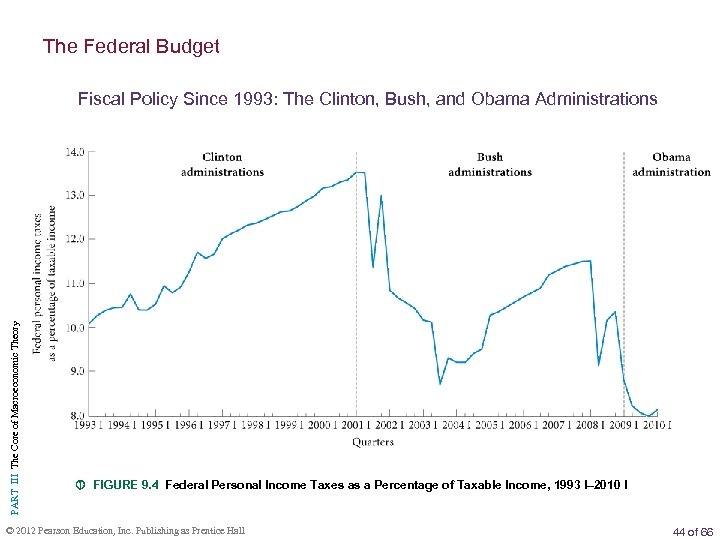 The Federal Budget PART III The Core of Macroeconomic Theory Fiscal Policy Since 1993: The Clinton, Bush, and Obama Administrations FIGURE 9. 4 Federal Personal Income Taxes as a Percentage of Taxable Income, 1993 I– 2010 I © 2012 Pearson Education, Inc. Publishing as Prentice Hall 44 of 66
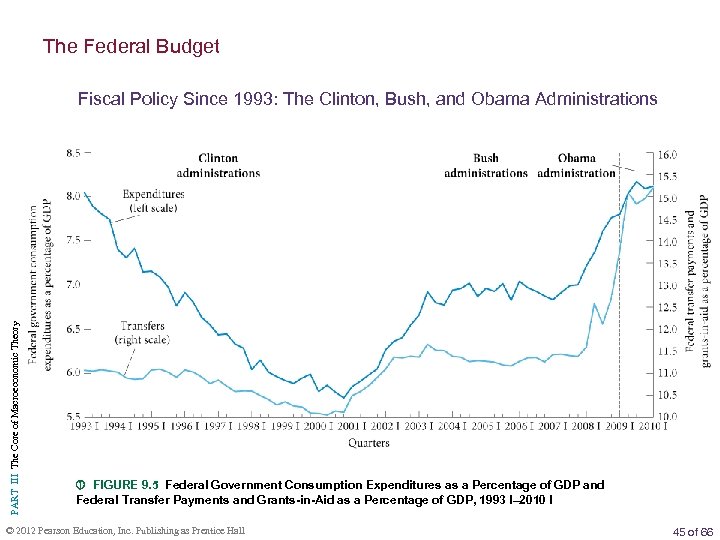 The Federal Budget PART III The Core of Macroeconomic Theory Fiscal Policy Since 1993: The Clinton, Bush, and Obama Administrations FIGURE 9. 5 Federal Government Consumption Expenditures as a Percentage of GDP and Federal Transfer Payments and Grants-in-Aid as a Percentage of GDP, 1993 I– 2010 I © 2012 Pearson Education, Inc. Publishing as Prentice Hall 45 of 66
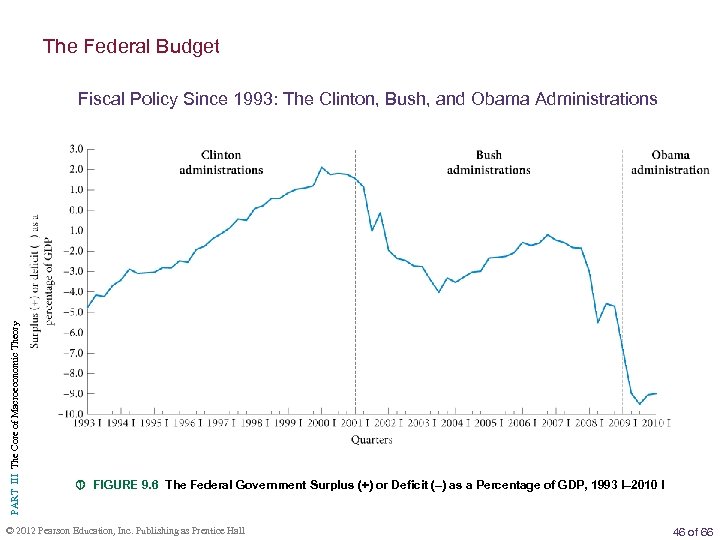 The Federal Budget PART III The Core of Macroeconomic Theory Fiscal Policy Since 1993: The Clinton, Bush, and Obama Administrations FIGURE 9. 6 The Federal Government Surplus (+) or Deficit (–) as a Percentage of GDP, 1993 I– 2010 I © 2012 Pearson Education, Inc. Publishing as Prentice Hall 46 of 66
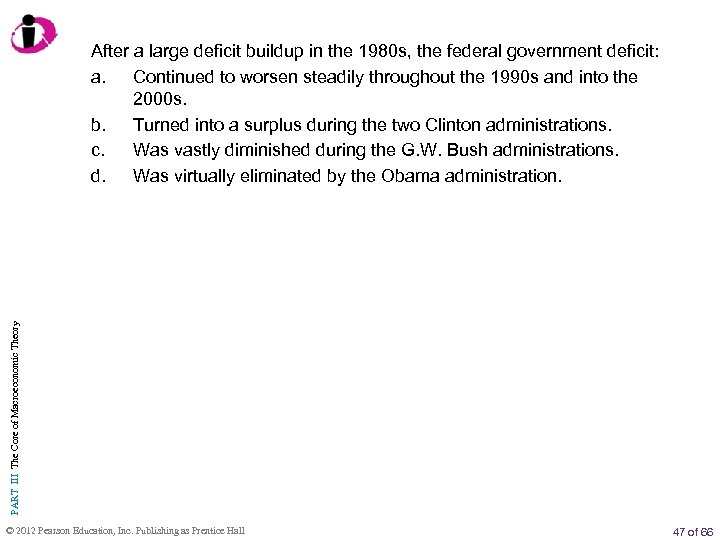 PART III The Core of Macroeconomic Theory After a large deficit buildup in the 1980 s, the federal government deficit: a. Continued to worsen steadily throughout the 1990 s and into the 2000 s. b. Turned into a surplus during the two Clinton administrations. c. Was vastly diminished during the G. W. Bush administrations. d. Was virtually eliminated by the Obama administration. © 2012 Pearson Education, Inc. Publishing as Prentice Hall 47 of 66
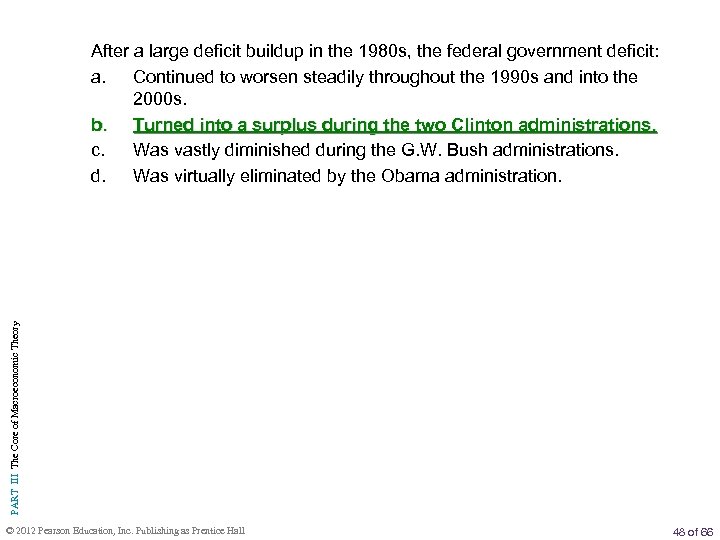 PART III The Core of Macroeconomic Theory After a large deficit buildup in the 1980 s, the federal government deficit: a. Continued to worsen steadily throughout the 1990 s and into the 2000 s. b. Turned into a surplus during the two Clinton administrations. c. Was vastly diminished during the G. W. Bush administrations. d. Was virtually eliminated by the Obama administration. © 2012 Pearson Education, Inc. Publishing as Prentice Hall 48 of 66
 The Federal Budget The Federal Government Debt federal debt The total amount owed by the federal government. PART III The Core of Macroeconomic Theory privately held federal debt The privately held (non-governmentowned) debt of the U. S. government. © 2012 Pearson Education, Inc. Publishing as Prentice Hall 49 of 66
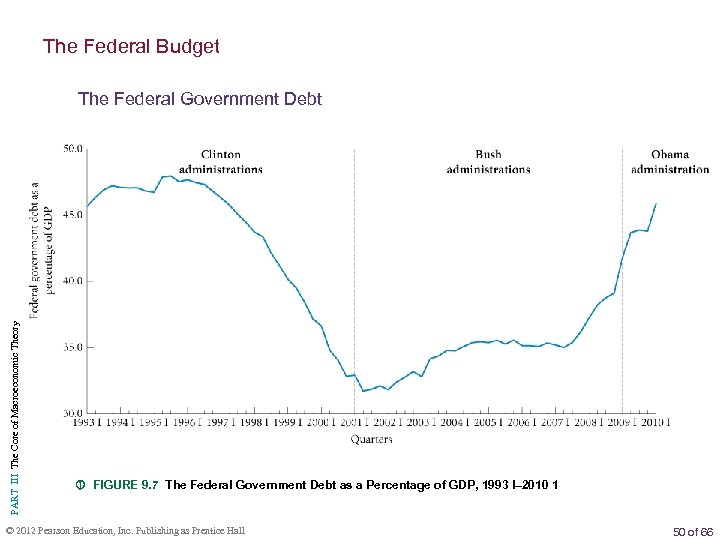 The Federal Budget PART III The Core of Macroeconomic Theory The Federal Government Debt FIGURE 9. 7 The Federal Government Debt as a Percentage of GDP, 1993 I– 2010 1 © 2012 Pearson Education, Inc. Publishing as Prentice Hall 50 of 66
 The Economy’s Influence on the Government Budget Automatic Stabilizers and Destabilizers automatic stabilizers Revenue and expenditure items in the federal budget that automatically change with the state of the economy in such a way as to stabilize GDP. PART III The Core of Macroeconomic Theory automatic destabilizer Revenue and expenditure items in the federal budget that automatically change with the state of the economy in such a way as to destabilize GDP. fiscal drag The negative effect on the economy that occurs when average tax rates increase because taxpayers have moved into higher income brackets during an expansion. © 2012 Pearson Education, Inc. Publishing as Prentice Hall 51 of 66
 PART III The Core of Macroeconomic Theory Which of the following statements is correct about the government’s control over its budget? a. The government has complete control over the revenue side of the budget, but not complete control over the expenditure side. b. The government has complete control over the expenditure side of the budget, but not complete control over the revenue side. c. The government does not have complete control of either the revenue side or the expenditure side of the budget. d. The size of the government budget, and whether it is in surplus or deficit, is controlled entirely by Congress, not by the economy. © 2012 Pearson Education, Inc. Publishing as Prentice Hall 52 of 66
 PART III The Core of Macroeconomic Theory Which of the following statements is correct about the government’s control over its budget? a. The government has complete control over the revenue side of the budget, but not complete control over the expenditure side. b. The government has complete control over the expenditure side of the budget, but not complete control over the revenue side. c. The government does not have complete control of either the revenue side or the expenditure side of the budget. d. The size of the government budget, and whether it is in surplus or deficit, is controlled entirely by Congress, not by the economy. © 2012 Pearson Education, Inc. Publishing as Prentice Hall 53 of 66
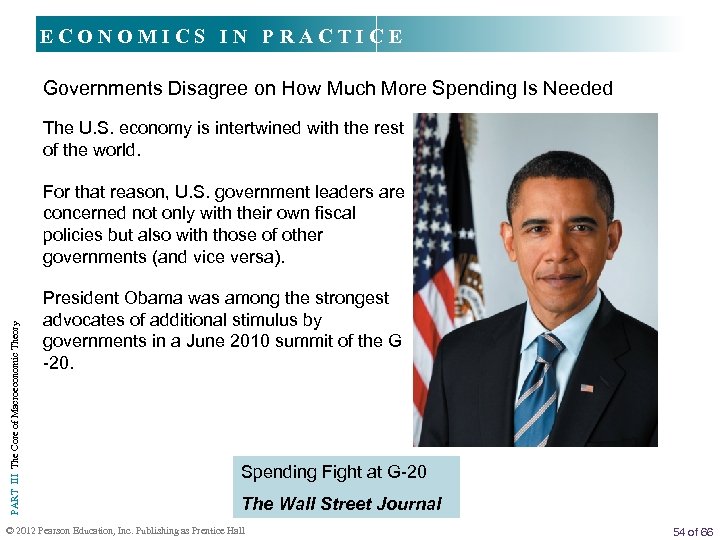 ECONOMICS IN PRACTICE Governments Disagree on How Much More Spending Is Needed The U. S. economy is intertwined with the rest of the world. PART III The Core of Macroeconomic Theory For that reason, U. S. government leaders are concerned not only with their own fiscal policies but also with those of other governments (and vice versa). President Obama was among the strongest advocates of additional stimulus by governments in a June 2010 summit of the G -20. Spending Fight at G-20 The Wall Street Journal © 2012 Pearson Education, Inc. Publishing as Prentice Hall 54 of 66
 The Economy’s Influence on the Government Budget Full-Employment Budget full-employment budget What the federal budget would be if the economy were producing at the full-employment level of output. PART III The Core of Macroeconomic Theory structural deficit The deficit that remains at full employment. cyclical deficit The deficit that occurs because of a downturn in the business cycle. © 2012 Pearson Education, Inc. Publishing as Prentice Hall 55 of 66
 PART III The Core of Macroeconomic Theory When the economy reaches full employment, the budget deficit is: a. A combination of cyclical and structural deficits. b. Zero. c. Equal to the cyclical deficit. d. Equal to the structural deficit. © 2012 Pearson Education, Inc. Publishing as Prentice Hall 56 of 66
 PART III The Core of Macroeconomic Theory When the economy reaches full employment, the budget deficit is: a. A combination of cyclical and structural deficits. b. Zero. c. Equal to the cyclical deficit. d. Equal to the structural deficit. © 2012 Pearson Education, Inc. Publishing as Prentice Hall 57 of 66
 Looking Ahead We have now seen how households, firms, and the government interact in the goods market, how equilibrium output (income) is determined, and how the government uses fiscal policy to influence the economy. PART III The Core of Macroeconomic Theory In the following two chapters, we analyze the money market and monetary policy—the government’s other major tool for influencing the economy. © 2012 Pearson Education, Inc. Publishing as Prentice Hall 58 of 66
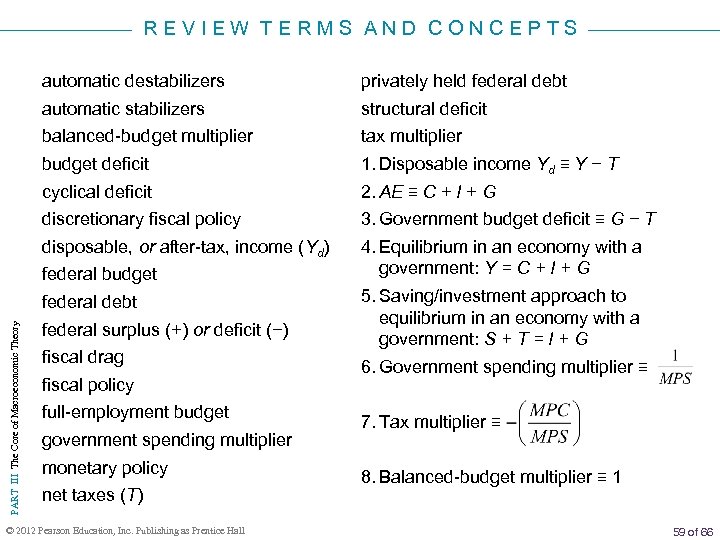 REVIEW TERMS AND CONCEPTS automatic destabilizers privately held federal debt automatic stabilizers structural deficit balanced-budget multiplier tax multiplier budget deficit 1. Disposable income Yd ≡ Y − T cyclical deficit 2. AE ≡ C + I + G discretionary fiscal policy 3. Government budget deficit ≡ G − T disposable, or after-tax, income (Yd) 4. Equilibrium in an economy with a government: Y = C + I + G federal budget PART III The Core of Macroeconomic Theory federal debt federal surplus (+) or deficit (−) fiscal drag fiscal policy full-employment budget government spending multiplier monetary policy net taxes (T) © 2012 Pearson Education, Inc. Publishing as Prentice Hall 5. Saving/investment approach to equilibrium in an economy with a government: S + T = I + G 6. Government spending multiplier ≡ 7. Tax multiplier ≡ 8. Balanced-budget multiplier ≡ 1 59 of 66
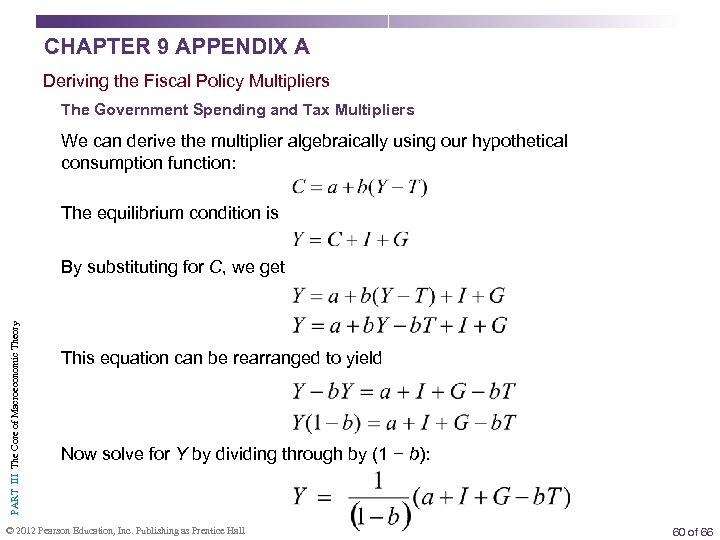 CHAPTER 9 APPENDIX A Deriving the Fiscal Policy Multipliers The Government Spending and Tax Multipliers We can derive the multiplier algebraically using our hypothetical consumption function: The equilibrium condition is PART III The Core of Macroeconomic Theory By substituting for C, we get This equation can be rearranged to yield Now solve for Y by dividing through by (1 − b): © 2012 Pearson Education, Inc. Publishing as Prentice Hall 60 of 66
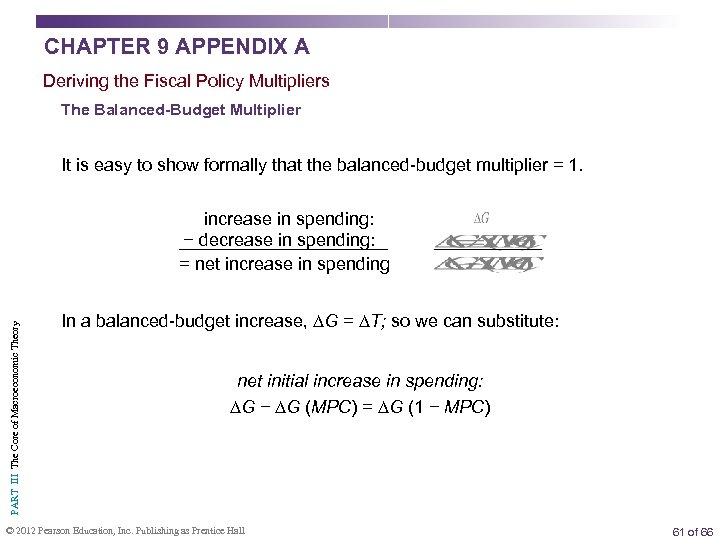 CHAPTER 9 APPENDIX A Deriving the Fiscal Policy Multipliers The Balanced-Budget Multiplier It is easy to show formally that the balanced-budget multiplier = 1. PART III The Core of Macroeconomic Theory increase in spending: − decrease in spending: = net increase in spending In a balanced-budget increase, G = T; so we can substitute: net initial increase in spending: G − G (MPC) = G (1 − MPC) © 2012 Pearson Education, Inc. Publishing as Prentice Hall 61 of 66
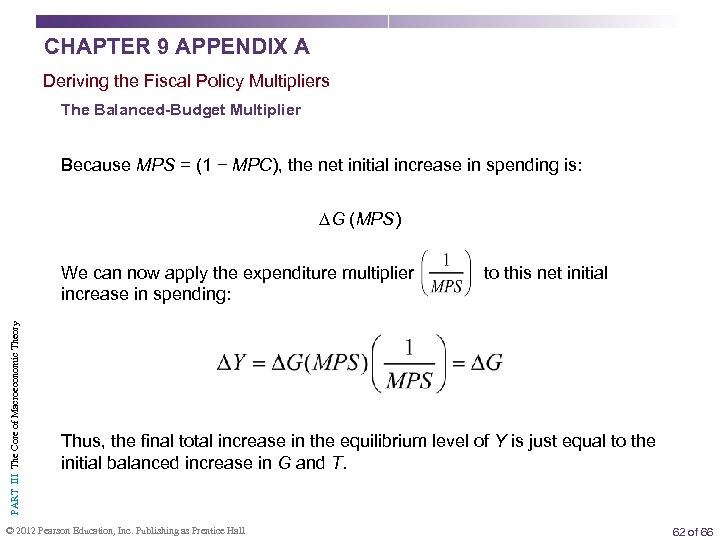 CHAPTER 9 APPENDIX A Deriving the Fiscal Policy Multipliers The Balanced-Budget Multiplier Because MPS = (1 − MPC), the net initial increase in spending is: G (MPS) PART III The Core of Macroeconomic Theory We can now apply the expenditure multiplier increase in spending: to this net initial Thus, the final total increase in the equilibrium level of Y is just equal to the initial balanced increase in G and T. © 2012 Pearson Education, Inc. Publishing as Prentice Hall 62 of 66
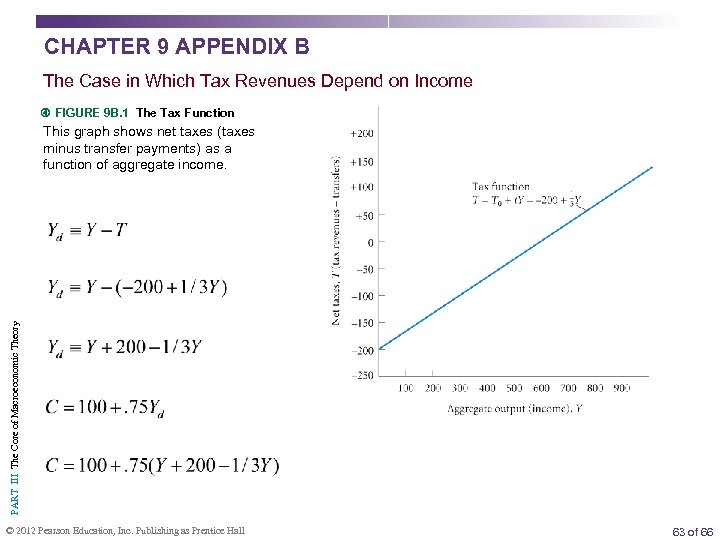 CHAPTER 9 APPENDIX B The Case in Which Tax Revenues Depend on Income FIGURE 9 B. 1 The Tax Function PART III The Core of Macroeconomic Theory This graph shows net taxes (taxes minus transfer payments) as a function of aggregate income. © 2012 Pearson Education, Inc. Publishing as Prentice Hall 63 of 66
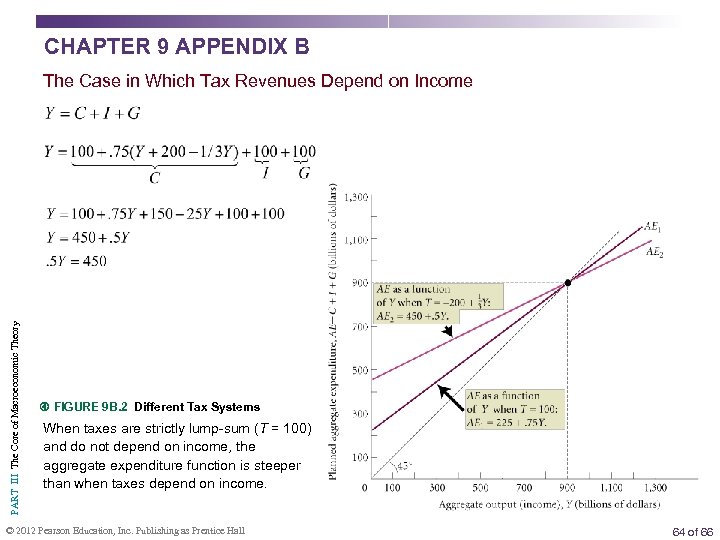 CHAPTER 9 APPENDIX B PART III The Core of Macroeconomic Theory The Case in Which Tax Revenues Depend on Income FIGURE 9 B. 2 Different Tax Systems When taxes are strictly lump-sum (T = 100) and do not depend on income, the aggregate expenditure function is steeper than when taxes depend on income. © 2012 Pearson Education, Inc. Publishing as Prentice Hall 64 of 66
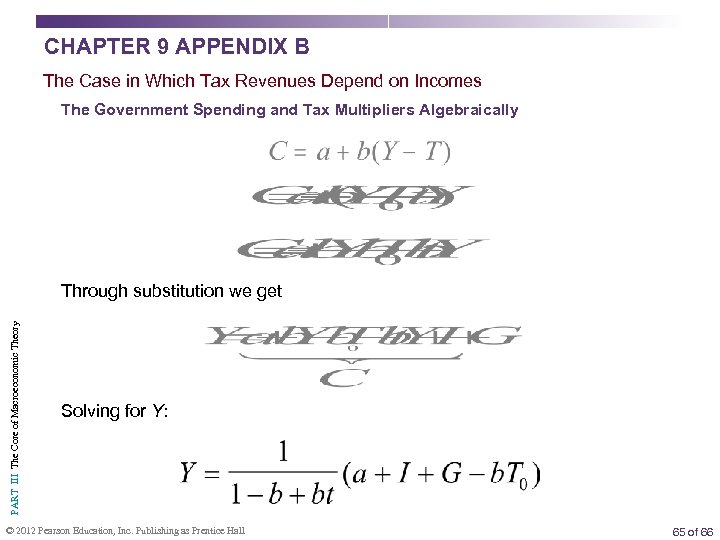 CHAPTER 9 APPENDIX B The Case in Which Tax Revenues Depend on Incomes The Government Spending and Tax Multipliers Algebraically PART III The Core of Macroeconomic Theory Through substitution we get Solving for Y: © 2012 Pearson Education, Inc. Publishing as Prentice Hall 65 of 66
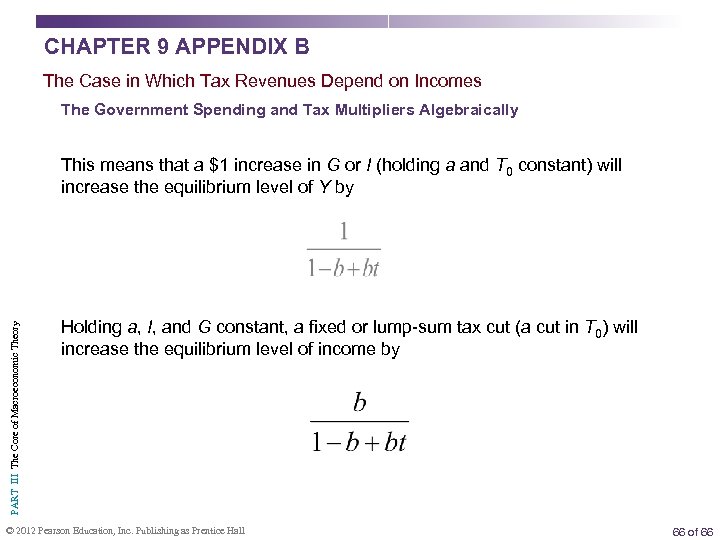 CHAPTER 9 APPENDIX B The Case in Which Tax Revenues Depend on Incomes The Government Spending and Tax Multipliers Algebraically PART III The Core of Macroeconomic Theory This means that a $1 increase in G or I (holding a and T 0 constant) will increase the equilibrium level of Y by Holding a, I, and G constant, a fixed or lump-sum tax cut (a cut in T 0) will increase the equilibrium level of income by © 2012 Pearson Education, Inc. Publishing as Prentice Hall 66 of 66