


 Скачать презентацию Principles of Information Security 2 nd Edition
124e40f405199e2069c8694ac92c808d.ppt
- Количество слайдов: 51
 Principles of Information Security, 2 nd Edition
 Learning Objectives Upon completion of this material, you should be able to: § Understand why maintenance of the information security program is needed on an ongoing basis § Recognize recommended security management models § Define a model for a full maintenance program § Identify the key factors involved in monitoring the external and internal environment Principles of Information Security, 2 nd Edition 2
 Learning Objectives (continued) § Understand how planning and risk assessment tie into information security maintenance § Understand how vulnerability assessment and remediation tie into information security maintenance § Understand how to build readiness and review procedures into information security maintenance Principles of Information Security, 2 nd Edition 3
 Introduction § Organization should avoid overconfidence after implementation of improved information security profile § Organizational changes that may occur include: new assets acquired; new vulnerabilities emerge; business priorities shift; partnerships form or dissolve; organizational divestiture and acquisition; employee hire and turnover § If program does not adjust, may be necessary to begin cycle again § More expensive to reengineer information Principles of Informationprofile again and again security Security, 2 nd Edition 4
 Security Management Models § Management model must be adopted to manage and operate ongoing security program § Models are frameworks that structure tasks of managing particular set of activities or business functions Principles of Information Security, 2 nd Edition 5
 The ISO Network Management Model § Five-layer approach that provides structure to administration and management of networks and systems § Addresses management and operation thorough five areas: fault management; configuration and name management; accounting management; performance management; and security management Principles of Information Security, 2 nd Edition 6
 The ISO Network Management Model (continued) § Five areas of ISO model transformed into five areas of security management: § Fault management § Configuration and change management § Accounting and auditing management § Performance management § Security program management Principles of Information Security, 2 nd Edition 7
 Fault Management § Identifying, tracking, diagnosing, and resolving faults in system § Vulnerability assessment most often accomplished with penetration testing (simulated attacks exploiting documented vulnerabilities) § Another aspect is monitoring and resolution of user complaints § Help desk personnel must be trained to recognize security problem as distinct from other system problems Principles of Information Security, 2 nd Edition 8
 Configuration and Change Management § Configuration management: administration of the configuration of security program components § Change management: administration of changes in strategy, operation, or components § Each involve non-technical as well as technical changes: § Non-technical changes impact procedures and people § Technical changes impact the technology Principles of Information Security, 2 nd Edition 9
 Nontechnical Change Management § Changes to information security may require implementing new policies and procedures § Document manager should maintain master copy of each document; record and archive revisions made; and keep copies of revisions § Policy revisions not implemented and enforceable until they have been disseminated, read, understood, and agreed to § Software available to make creation, modification, dissemination, and agreement documentation processes more manageable Principles of Information Security, 2 nd Edition 10
 Technical Configuration and Change Management § Terms associated with management of technical configuration and change: configuration item; version; build § Four steps associated with configuration management § Configuration identification § Configuration control § Configuration status accounting § Configuration audit Principles of Information Security, 2 nd Edition 11
 Accounting and Auditing Management § Chargeback accounting enables organizations to internally charge for system use § Some resource usage is commonly tracked § Accounting management involves monitoring use of particular component of a system § Auditing is process of reviewing use of a system, not to check performance, but to determine misuse or malfeasance; automated tools can assist Principles of Information Security, 2 nd Edition 12
 Performance Management § Important to monitor performance of security systems and underlying IT infrastructure to determine if they are working effectively § Common metrics are applicable in security, especially when components being managed are associated with network traffic § To evaluate ongoing performance of security system, performance baselines are established Principles of Information Security, 2 nd Edition 13
 Security Program Management § ISO five-area-based framework supports a structured management model by ensuring various areas are addressed § Two standards are designed to assist in this effort § Part 2 of the British Standard (BS) 7799 introduces process model: plan; do; check; act Principles of Information Security, 2 nd Edition 14
 The Maintenance Model § Designed to focus organizational effort on maintaining systems § Recommended maintenance model based on five subject areas § External monitoring § Internal monitoring § Planning and risk assessment § Vulnerability assessment and remediation § Readiness and review Principles of Information Security, 2 nd Edition 15
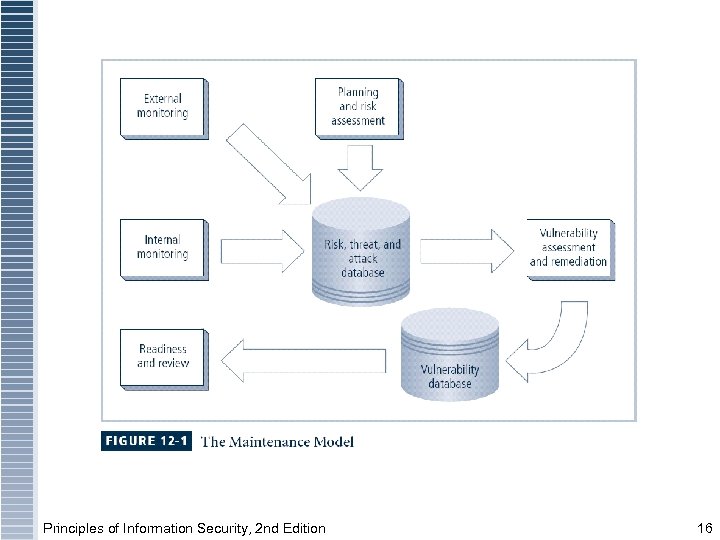 Figure 12 -1 - The Maintenance Model Principles of Information Security, 2 nd Edition 16
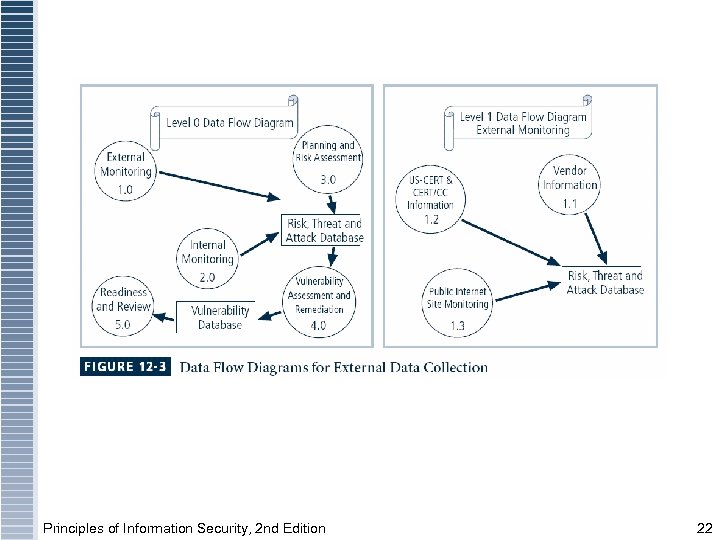
 Monitoring the External Environment § Objective to provide early awareness of new threats, threat agents, vulnerabilities, and attacks that is needed to mount an effective defense § Entails collecting intelligence from data sources and giving that intelligence context and meaning for use by organizational decision makers Principles of Information Security, 2 nd Edition 17
 Principles of Information Security, 2 nd Edition 18
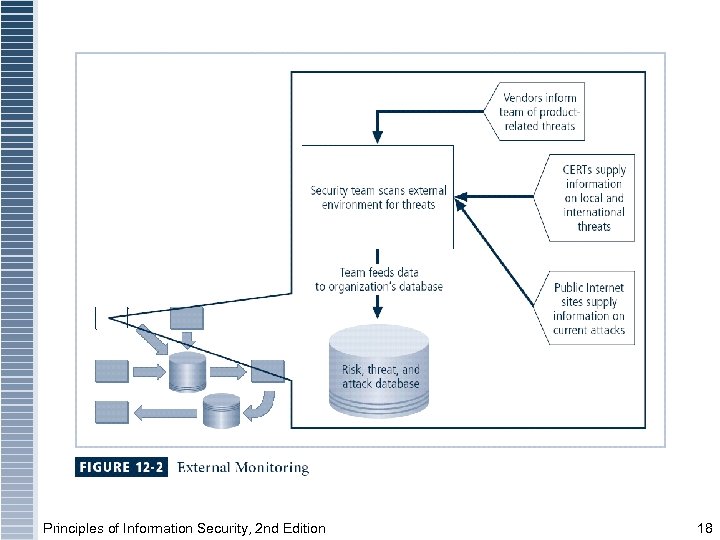
 Data Sources § Acquiring threat and vulnerability data is not difficult § Turning data into information decision makers can use is the challenge § External intelligence comes from three classes of sources: vendors; computer emergency response teams (CERTs); public network sources § Regardless of where or how external monitoring data is collected, must be analyzed in context of organization’s security environment to be useful Principles of Information Security, 2 nd Edition 19
 Monitoring, Escalation, and Incident Response § Function of external monitoring process is to monitor activity, report results, and escalate warnings § Monitoring process has three primary deliverables § Specific warning bulletins issued when developing threats and specific attacks pose measurable risk to organization § Periodic summaries of external information Principles of Information Security, 2 nd Edition 20
 Data Collection and Management § Over time, external monitoring processes should capture knowledge about external environment in appropriate formats § External monitoring collects raw intelligence, filters for relevance, assigns a relative risk impact, and communicates to decision makers in time to make a difference Principles of Information Security, 2 nd Edition 21
 Principles of Information Security, 2 nd Edition 22
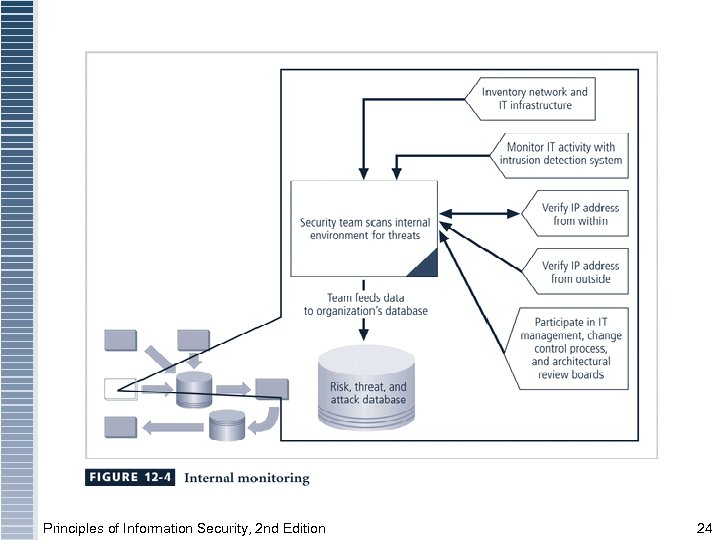
 Monitoring the Internal Environment § Maintain informed awareness of state of organization’s networks, systems, and defenses by maintaining inventory of IT infrastructure and applications § Internal monitoring accomplished by: § Active participation in, or leadership of, IT governance process § Real-time monitoring of IT activity using intrusion detection systems § Automated difference detection methods that identify variances introduced to network or system hardware and software Principles of Information Security, 2 nd Edition 23
 Principles of Information Security, 2 nd Edition 24
 Network Characterization and Inventory § Organizations should have carefully planned and fully populated inventory for network devices, communication channels, and computing devices § Once characteristics identified, they must be carefully organized and stored using a mechanism (manual or automated) that allows timely retrieval and rapid integration of disparate facts Principles of Information Security, 2 nd Edition 25
 The Role of IT Governance § Primary value is increased awareness of the impact of change § Awareness must be translated into description of risk that is caused by change through operational risk assessment § Awareness of change based on two primary activities within IT governance process § Architecture review boards Principles of Information Security, 2 nd Edition 26
 Making Intrusion Detection Systems Work § The most important value of raw intelligence provided by intrusion detection systems (IDS) is providing indicators of current or imminent vulnerabilities § Log files from IDS engines can be mined for information § Another IDS monitoring element is traffic analysis § Analyzing attack signatures for unsuccessful Principles of Information Security, 2 nd Edition 27
 Detecting Differences § Difference analysis: procedure that compares current state of network segment against known previous state of same segment § Differences between the current state and the baseline state that are unexpected could be a sign of trouble and need investigation Principles of Information Security, 2 nd Edition 28
 Planning and Risk Assessment § Primary objective to keep lookout over entire information security program § Accomplished by identifying and planning ongoing information security activities that further reduce risk Principles of Information Security, 2 nd Edition 29
 Planning and Risk Assessment (continued) § Primary objectives § Establishing a formal information security program review § Instituting formal project identification, selection, planning and management processes § Coordinating with IT project teams to introduce risk assessment and review for all IT projects § Integrating a mindset of risk assessment across organization Principles of Information Security, 2 nd Edition 30
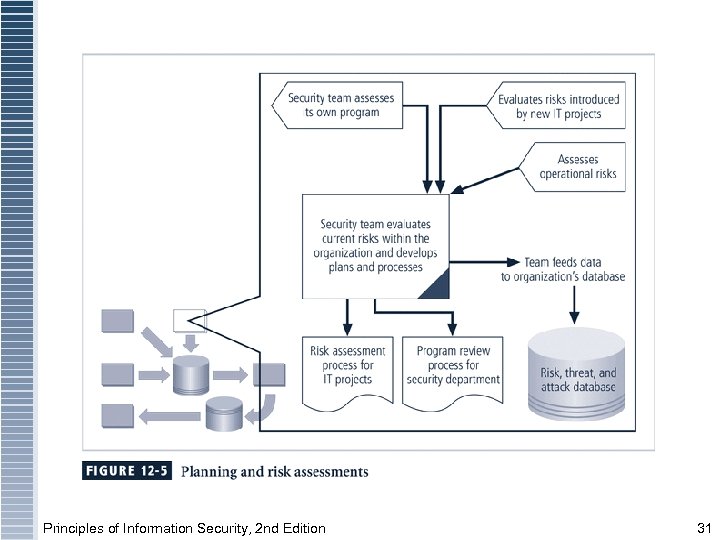 Principles of Information Security, 2 nd Edition 31
 Information Security Program Planning and Review § Periodic review of ongoing information security program coupled with planning for enhancements and extensions is recommended § Should examine IT needs of future organization and impact those needs have on information security § A recommended approach takes advantage of the fact most organizations have annual capital budget planning cycles and manage security Principles of Information Security, 2 nd Edition 32
 Information Security Program Planning and Review (continued) § Large projects should broken into smaller projects for several reasons § Smaller projects tend to have more manageable impacts on networks and users § Larger projects tend to complicate change control process in implementation phase § Shorter planning, development, and implementation schedules reduce uncertainty § Most large projects can easily be broken down into smaller projects, giving more opportunities to change direction and gain flexibility Principles of Information Security, 2 nd Edition 33
 Security Risk Assessments § A key component for driving security program change is information security operational risk assessment (RA) § RA identifies and documents risk that project, process, or action introduces to organization and offers suggestions for controls § Information security group coordinates preparation of many types of RA documents Principles of Information Security, 2 nd Edition 34
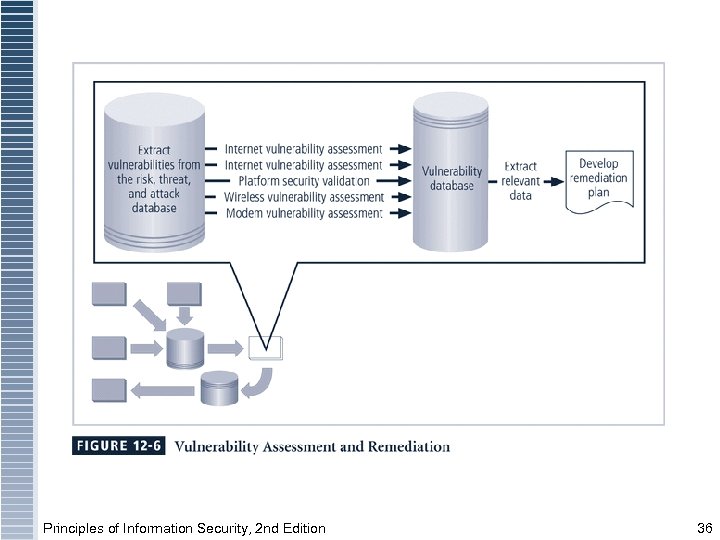
 Vulnerability Assessment and Remediation § Primary goal is identification of specific, documented vulnerabilities and their timely remediation § Accomplished by: § Using vulnerability assessment procedures § Documenting background information and providing tested remediation procedures for reported vulnerabilities § Tracking vulnerabilities from when they are identified Principles of Information Security, 2 nd Edition 35
 Principles of Information Security, 2 nd Edition 36
 Vulnerability Assessment § Process of identifying and documenting specific and provable flaws in organization’s information asset environment § Five vulnerability assessment processes that follow can serve many organizations as they attempt to balance intrusiveness of vulnerability assessment with need for stable and productive production environment Principles of Information Security, 2 nd Edition 37
 Internet Vulnerability Assessment § Designed to find and document vulnerabilities present in organization’s public-facing network § Steps in the process include: § § § Planning, scheduling and notification Target selection Test selection Scanning Analysis Record keeping Principles of Information Security, 2 nd Edition 38
 Intranet Vulnerability Assessment § Designed to find and document selected vulnerabilities present on the internal network § Attackers often internal members of organization, affiliates of business partners, or automated attack vectors (such as viruses and worms) § This assessment is usually performed against selected critical internal devices with a known, high value by using selective penetration testing § Steps in process almost identical to steps in Internet vulnerability assessment Principles of Information Security, 2 nd Edition 39
 Platform Security Validation § Designed to find and document vulnerabilities that may be present because of misconfigured systems in use within organization § These misconfigured systems fail to comply with company policy or standards § Fortunately, automated measurement systems are available to help with the intensive process of validating compliance of platform configuration with policy Principles of Information Security, 2 nd Edition 40
 Wireless Vulnerability Assessment § Designed to find and document vulnerabilities that may be present in wireless local area networks of organization § Since attackers from this direction are likely to take advantage of any loophole or flaw, assessment is usually performed against all publicly accessible areas using every possible wireless penetration testing approach Principles of Information Security, 2 nd Edition 41
 Modem Vulnerability Assessment § Designed to find and document any vulnerability present on dial-up modems connected to organization’s networks § Since attackers from this direction take advantage of any loophole or flaw, assessment usually performed against all telephone numbers owned by the organization § One elements of this process, often called war dialing, uses scripted dialing attacks against Principles of Information Security, 2 nd Edition pool of phone numbers 42
 Documenting Vulnerabilities § Vulnerability tracking database should provide details as well as a link to the information assets § Low-cost and ease of use makes relational databases a realistic choice § Vulnerability database is an essential part of effective remediation Principles of Information Security, 2 nd Edition 43
 Remediating Vulnerabilities § Objective is to repair flaw causing a vulnerability instance or remove risk associated with vulnerability § As last resort, informed decision makers with proper authority can accept risk § Important to recognize that building relationships with those who control information assets is key to success § Success depends on organization adopting team approach to remediation, in place of cross Principles of Information Security, 2 nd Edition 44
 Acceptance or Transference of Risk § In some instances, risk must simply be acknowledged as part of organization’s business process § Management must be assured that decisions made to assume risk the organization are made by properly informed decision makers § Information security must make sure the right people make risk assumption decisions with complete knowledge of the impact of the decision Principles of Information Security, 2 nd Edition 45
 Threat Removal § In some circumstances, threats can be removed without repairing vulnerability § Vulnerability can no longer be exploited, and risk has been removed § Other vulnerabilities may be amenable to other controls that do not allow an expensive repair and still remove risk from situation Principles of Information Security, 2 nd Edition 46
 Vulnerability Repair § Optimum solution in most cases is to repair vulnerability § Applying patch software or implementing a workaround often accomplishes this § In some cases, simply disabling the service removes vulnerability; in other cases, simple remedies are possible § Most common repair is application of a software patch Principles of Information Security, 2 nd Edition 47
 Readiness and Review § Primary goal to keep information security program functioning as designed and continuously improving § Accomplished by: § Policy review § Program review § Rehearsals Principles of Information Security, 2 nd Edition 48
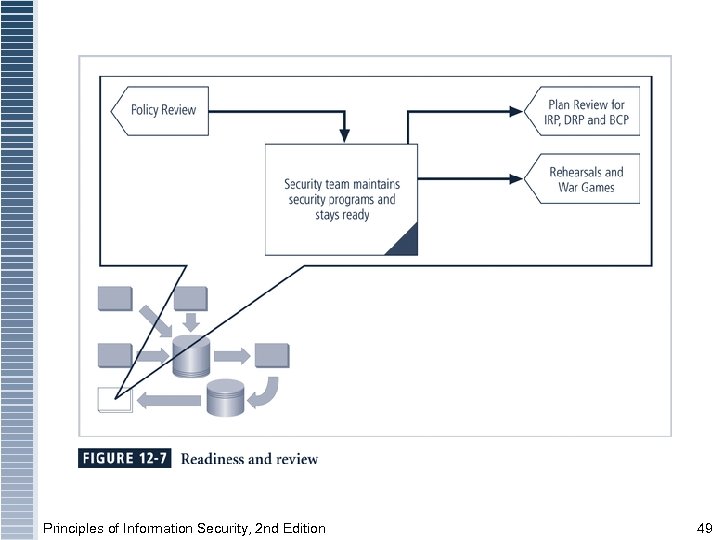 Principles of Information Security, 2 nd Edition 49
 Summary § Maintenance of information security program is essential § Security management models assist in planning for ongoing operations § It is necessary to monitor external and internal environment Principles of Information Security, 2 nd Edition 50
 Summary § Planning and risk assessment essential parts of information security maintenance § Need to understand how vulnerability assessment and remediation tie into information security maintenance § Need to understand how to build readiness and review procedures into information security maintenance Principles of Information Security, 2 nd Edition 51