 Скачать презентацию Principles of Healthcare Reimbursement Third Edition Chapter 2
67007ed8daed28a7072a88496fd56116.ppt
- Количество слайдов: 68



Principles of Healthcare Reimbursement Third Edition Chapter 2 Clinical Coding and Coding Compliance © 2010
Announcement • • • 2 Unit 3 What do you have to do in this unit? Review Key Terms On the Reading page Read Chapter 2 of Principles of Healthcare Reimbursement Attend the Weekly Seminar or complete Option 2 15 Points Respond to the Discussion Board 10 Points Complete the Assignment 40 Points © 2010
Reading • Chapter 2, pp. 23 - 56 • This chapter discusses clinical coding and coding compliance. 3 © 2010

Seminar • This is the lecture portion of the class. The instructor will cover concepts from Chapter 2 and the assigned articles. After the lecture, students will have an opportunity to ask questions. • Option 2: • Submitting Your Work • Put your responses in a Word 97 -2003 document. Save it in a location and with the proper naming convention: username-HI 215 -section- Unit 3 Seminar. doc (username is your Kaplan username, section is your course section). • List all students at the seminar 4 © 2010
Assignment • There are CD workbook questions for Chapter 2 that are assigned in this unit. • From the CD workbook, complete Chapter 2: Application Exercises, questions 1 -3 (40 points). • Complete this assignment as a Word 97 -2003 document. Save it in a location and with the proper naming convention: username-HI 215 - section-Unit 3 Assignment. doc (username is your Kaplan username, section is your course section). • Do not use the Workbook Answer Sheet • Responses to each question should be around 75 words. 5 © 2010
Objectives • To differentiate the different code sets approved by HIPAA • To describe the structure of approved code sets • To examine coding compliance issues that influence reimbursement © 2010
Clinical Coding-Reimbursement Connection • Reimbursement – Payment to healthcare providers and facilities for services delivered to patients – Communication of services is transmitted from providers to third party payers via coded information • Allows for consistent communication • Allows for efficient payment process © 2010
Clinical Coding-Reimbursement Connection (cont’d) • Code sets used to transmit health services are standardized via the Health Insurance Portability and Accountability Act of 1996 (HIPAA) – ICD-9 -CM – HCPCS Coding System • CPT • HCPCS Level II © 2010
Clinical Coding-Reimbursement Connection (cont’d) • Must have baseline understanding of code sets to fully understand the various Medicare prospective payment systems (PPS) • Physicians and facilities must comply with guidelines and conventions published for the approved code sets – To receive accurate reimbursement – To comply with Medicare Conditions of Participation © 2010
ICD • International Classification of Diseases – Maintained by the World Health Organization (WHO) – Used throughout the world for mortality reporting – Updated approximately every 10 years © 2010
ICD-10 • Current international version is ICD-10 • Used by CDC for mortality reporting • Adopted as a HIPAA approved code set by the United States beginning October 1, 2013 © 2010
ICD-9 -CM • International Classification of Diseases, 9 th Revision, Clinical Modification – Diagnoses in all healthcare settings – Procedures for inpatient encounters • Modifications made by the National Center for Health Statistics (NCHS) – Expanded to include morbidity and procedures © 2010
ICD-9 -CM (cont’d) • Uses – Classify morbidity and mortality information for statistical purposes – Classify diagnosis and procedure information for research – Indexing of hospital records by disease and surgical procedure – Report information to various healthcare reimbursement systems – Analyze resource consumption patterns – Analyze adequacy of reimbursement © 2010
ICD-9 -CM (cont’d) • Used in various Medicare PPSs – Hospital inpatient: Medicare Severity Diagnosis Related Groups – Hospital rehabilitation: Case Mix Groups – Long-term care: Long-term Care Medicare Severity Diagnosis Related Groups – Home health: Home Health Resource Groups © 2010
ICD-9 -CM Structure • Volume One – Tabular List of Diseases and Injuries • Classification of Diseases and Injuries • Supplementary Classifications • Appendices • Volume Two – Alphabetic Index to Diseases • Index to Diseases and Injuries • Table of Drugs and Chemicals • Alphabetic Index to External Causes of Injury and Poisoning © 2010
ICD-9 -CM Structure (cont’d) • Volume Three – Classification for Procedures • Alphabetic Index to Procedures • Tabular List for Procedures • Code Structure – Diagnosis 3– 5 digits • Xxx. xx – Procedure 2– 4 digits • Xx. xx © 2010
ICD-9 -CM Maintenance • ICD-9 -CM Coordination and Maintenance Committee – NCHS • Volumes One and Two – CMS • Volume Three • Accepts requests for additions, deletions, and changes to ICD-9 -CM © 2010
ICD-9 -CM Guidelines • Cooperating Parties – – NCHS CMS AHA AHIMA • Publish coding guidelines for ICD-9 -CM – Only official publication of coding guidelines and advice for ICD-9 -CM – Coding Clinic for ICD-9 -CM – Published quarterly © 2010
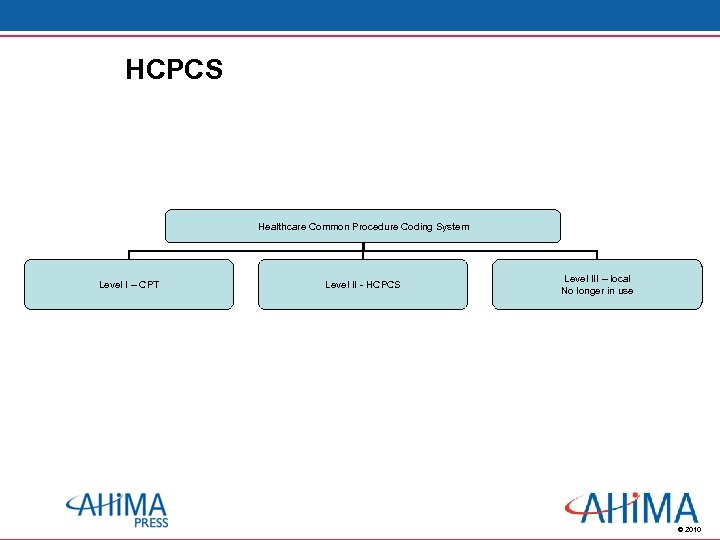
HCPCS Healthcare Common Procedure Coding System Level I – CPT Level II - HCPCS Level III – local No longer in use © 2010
CPT • Current Procedural Terminology – Report diagnostic and surgical procedures and services – Created and published by the AMA in 1966 – Adopted by HCPCS in 1985 and became known as HCPCS Level I for Medicare reporting – Now in the 4 th version © 2010
CPT (cont’d) • Physicians – Inpatient services and procedures – Ambulatory surgery services and procedures – Emergency department services and procedures – Outpatient services and procedures – Office services and procedures • Facilities – Ambulatory surgery services and procedures – Emergency department services and procedures – Clinic services and procedures © 2010
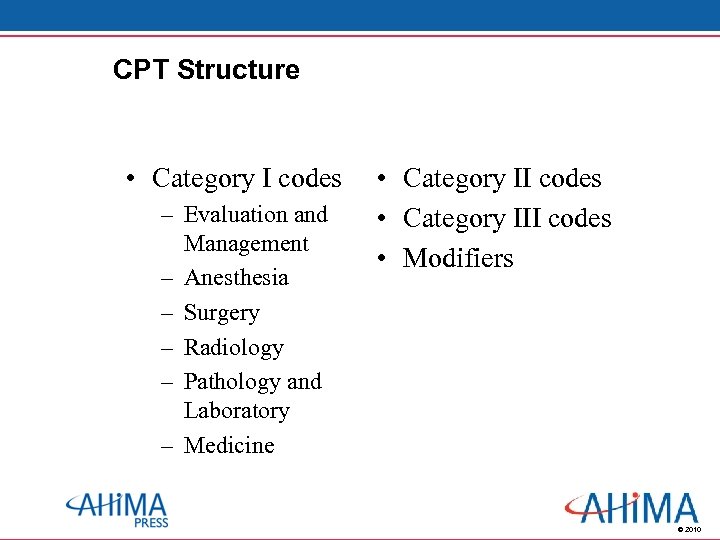
CPT Structure • Category I codes – Evaluation and Management – Anesthesia – Surgery – Radiology – Pathology and Laboratory – Medicine • Category II codes • Category III codes • Modifiers © 2010
CPT Structure (cont’d) • Category I codes – Consistent with contemporary medical practice and performed by many physicians in clinical practice in multiple locations – Five digit numeric codes • Surgeries • Procedures • Services – Ancillary – Lab © 2010
CPT Structure (cont’d) • Category II codes – Optional tracking codes for performance measurement – Facilitate data collection for service and/or test results that contribute to positive health outcomes and quality patient care • Five-digit alphanumeric code • xxxx. F © 2010
CPT Structure (cont’d) • Category III Codes – Represent emerging technologies – Help facilitate data collection and assessment of new services and procedures – Always reported when available rather than an unlisted code • Temporary Codes – May or may not eventually receive a category I code – Automatically archived after 5 years unless it is demonstrated that the temporary code is still needed • New codes released semi-annually via Internet – Full set published each year in code book • Five-digit alphanumeric code • xxxx. T © 2010
CPT Maintenance • CPT Editorial Research and Development Department – Modification process for CPT • CPT Advisory Committee – Performs detailed review of code requests • Categories I and III • Performance Measurement Advisory Group – Performs detailed review of code requests • Category II • CPT Editorial panel – Final decision for all code modification © 2010
CPT Coding Guidelines • AMA – Publishes the official guidelines and advice – CPT Assistant © 2010
HCPCS • Healthcare Common Procedure Coding System – Created in 1983 • National codes developed by CMS • Alphanumeric codes A–V except S (Medicaid) • Represent supplies and services not included in CPT – J-codes are used to report drugs – Durable medical equipment – Supplies © 2010
HCPCS Structure • Permanent Codes – Used by all public and private health insurers • Current Dental Terminology (CDT-4) • Temporary Codes – Meet the intermediate and short-term operational needs of individual insurers, public and private • Temporary for an infinite time period © 2010
HCPCS Maintenance • Permanent – Updated annually – National Panel • America’s Health Insurance Plans • Blue Cross and Blue Shield Association • CMS • Temporary – Updated quarterly – Maintained by individual members of the National Panel • Example – HCPCS workgroup makes the decisions about temporary codes for Medicare © 2010
HCPCS Coding Advice • AHA – Central Office on HCPCS – Coding Clinic for HCPCS • Only official resource for HCPCS Level II reporting for Medicare coverage determinations issued by CMS and its fiscal intermediaries © 2010
Modifiers • A modifier is a two-digit numeric, alphanumeric, or alpha character reported with a HCPCS code (levels I and II), when appropriate • Modifiers are designed to give Medicare and commercial payers additional information needed to process a claim • A modifier provides the means by which a physician or facility can indicate or “flag” a service provided to the patient that has been altered by some special circumstance(s), but for which the basic code description itself has not changed. © 2010
Examples of modifier usage • A service or procedure has been increased or reduced • Only part of a service was performed • A bilateral procedure was performed • A service or procedure was performed more than once • Unusual events occurred during a procedure or service © 2010
Determining correct use • Medical record documentation must support the use of a modifier – Failure to document clearly can result in: • Claim denial for lack of medical necessity • Fraud/abuse penalties • If the service is not documented or the special circumstance is not indicated in the medical record, it is not considered appropriate to report the modifier © 2010
Modifier Examples • Level I Modifiers – 21 Prolonged evaluation and management services – 52 Reduced services – 59 Distinct procedural service – 91 Repeat clinical diagnostic laboratory test • Level II Modifiers – LT Left side – F 4 Left hand, fifth digit – LC Left circumflex coronary artery – QN Ambulance service furnished directly by a provider of services © 2010
Coding Compliance • Compliance – Perform one’s job functions according to the laws, regulations, and guidelines set forth by Medicare and other third party payers – AHIMA Standards of Ethical Coding • Guidelines for coding, billing, and reimbursement professionals © 2010
Coding Compliance (cont’d) • Fraud – “Intentional representation that an individual knows to be false or does not believe to be true and makes, knowing that the representations could result in some unauthorized benefit to himself/herself or some other person” (Medicare) • Billing for a service that was not rendered © 2010
Coding Compliance (cont’d) • Abuse – Unknowing or unintentional submission of an inaccurate claim for payment • Billing for services not furnished as billed • Unbundling or exploding charges © 2010
Legislation • False Claims Act – Prohibits knowingly filing a false or fraudulent claim for payment to the government – Knowingly using a false record or statement to obtain payment on a false or fraudulent claim paid by the government – Conspiring to defraud the government by getting a false or fraudulent claim allowed or paid © 2010
Legislation (cont’d) • False Claims Act Examples – An unlicensed physician utilized the provider numbers of other physicians, without their knowledge, to bill Medicare for services not rendered. The doctor pled guilty in Federal court to money laundering and filing false claims. He was sentenced to 18 months in prison and required to pay the government in excess of $750, 000 – A psychiatrist billed Medicare and private insurers for services which were upcoded or not rendered. He pled guilty in Federal court to mail fraud and filing false claims and was sentenced to 7 ½ months of house arrest and 3 years probation. He was also directed to pay $600, 000 in fines, restitution, and investigative costs. © 2010
Legislation (cont’d) • Civil False Claims Act – Qui tam or whistle-blowing refers to a person acting on behalf of the government who files a lawsuit alleging that there has been a violation of the Civil False Claims Act through the submission of false claims to Medicare. • Successful actions may result in the whistle-blower receiving an award of 15 to 30 percent of the monies recovered © 2010
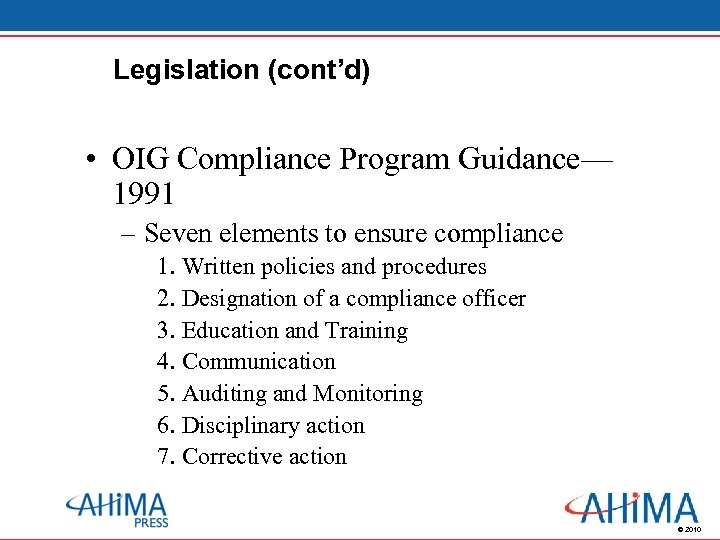
Legislation (cont’d) • OIG Compliance Program Guidance— 1991 – Seven elements to ensure compliance 1. Written policies and procedures 2. Designation of a compliance officer 3. Education and Training 4. Communication 5. Auditing and Monitoring 6. Disciplinary action 7. Corrective action © 2010
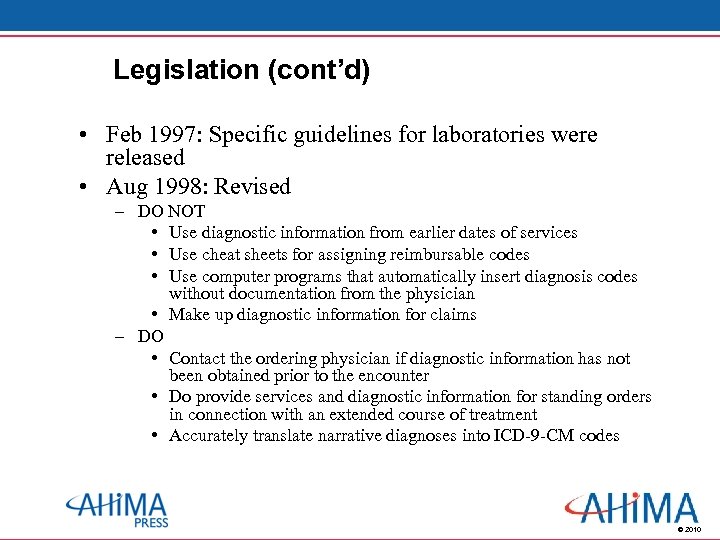
Legislation (cont’d) • Feb 1997: Specific guidelines for laboratories were released • Aug 1998: Revised – DO NOT • Use diagnostic information from earlier dates of services • Use cheat sheets for assigning reimbursable codes • Use computer programs that automatically insert diagnosis codes without documentation from the physician • Make up diagnostic information for claims – DO • Contact the ordering physician if diagnostic information has not been obtained prior to the encounter • Do provide services and diagnostic information for standing orders in connection with an extended course of treatment • Accurately translate narrative diagnoses into ICD-9 -CM codes © 2010
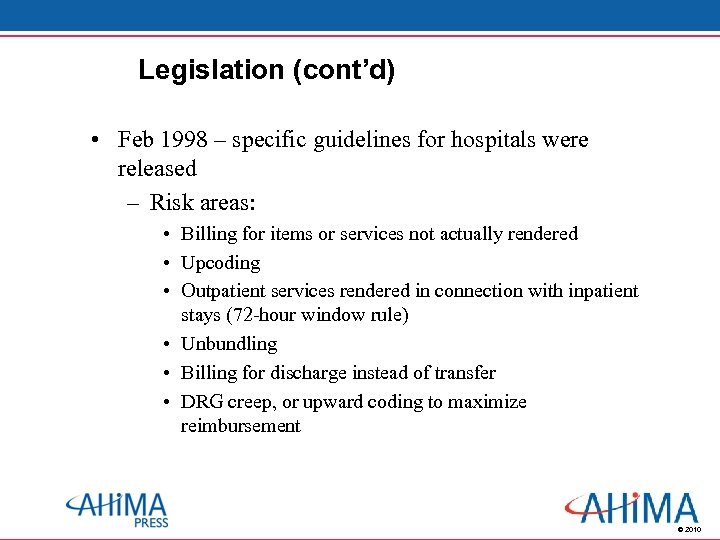
Legislation (cont’d) • Feb 1998 – specific guidelines for hospitals were released – Risk areas: • Billing for items or services not actually rendered • Upcoding • Outpatient services rendered in connection with inpatient stays (72 -hour window rule) • Unbundling • Billing for discharge instead of transfer • DRG creep, or upward coding to maximize reimbursement © 2010
Legislation (cont’d) • Supplemental Compliance Program Guidance for Hospitals – Details about compliance risk areas for outpatient coding, admissions and discharge criteria, supplemental payment consideration, and information technology use – OIG Web site: www. oig. hhs. gov © 2010
Legislation (cont’d) • Operation Restore Trust, 1995 – Joint effort of the DHHS, OIG, CMS, and AOA (Agency on Aging) to target fraud and abuse in healthcare services – Focus— 5 states: • • • California Illinois Florida New York Texas – Within the first two years, Operation Restore Trust spent 7. 9 million dollars and recovered 188 million dollars © 2010
Legislation (cont’d) • Operation Restore Trust, 1995 – Implementation of a national toll-free fraud and abuse hotline – Voluntary disclosure program – Special fraud alerts • Based on audit and investigative findings © 2010
Legislation (cont’d) • Health Insurance Portability and Accountability Act (HIPAA) of 1996 – Large portion of the Act focused on reducing fraud and abuse • Medical necessity • Upcoding • Unbundling • Billing for services not provided © 2010
Legislation (cont’d) • Health Insurance Portability and Accountability Act (HIPAA) of 1996 – Upcoding: The practice of using a code that results in higher payment to the provider than the code that actually reflects the service or item provided. – Unbundling: The practice of using multiple codes that describe individual steps of a procedure rather than an appropriate single code that describes all the steps of the comprehensive procedure performed. © 2010
Legislation (cont’d) • Health Insurance Portability and Accountability Act (HIPAA) of 1996 – Mandated the establishment of fraud and abuse control programs • Medicare Integrity Program – Review of provider activities for potential fraudulent activity – Cost report audits – Payment determinations – Education of providers and beneficiaries on healthcare fraud and abuse © 2010
Legislation (cont’d) • Balanced Budget Act (BBA) of 1997 – One focus was to improve program integrity • Notifying beneficiaries of their right to request copies of detailed bills for healthcare services rendered • Advising beneficiaries to review explanations of benefit and detailed bills for errors and to report these errors to the secretary of DHHS • Initiating the data collection program, as mandated in HIPAA, to collect information on healthcare fraud and abuse • Implementing a toll-free fraud and abuse hotline by DHHS © 2010
Legislation (cont’d) • OIG Work Plans – Provided annually (Oct 1), the OIG publishes the OIG Work Plan, which contains the focus for the following departments: • • Office of Audit Services Office of Evaluation and Inspections Office of Investigations Office of Counsel to the Inspector General © 2010
Legislation (cont’d) • Purpose: – – To focus monitoring and auditing activities Identify problem areas Provide education Develop policies and procedures • Examples: – Present on admission reporting – Hospital readmissions – Reimbursements for diagnostic x-rays in emergency department © 2010
Quality Improvement Organizations • QIOs – Contract every three years with Medicare to monitor hospital performance on a state or regional basis – Guided by the Scope of Work • Currently 9 th Scope of Work which focuses on – Beneficiary protection – Patient Safety – Prevention © 2010
Quality Improvement Organizations (cont’d) • 6 th Scope of Work – Payment Error Prevention Program (PEPP) • Most payment errors were caused by simple mistakes not fraudulent or abusive acts – – Medically unnecessary admissions and/or procedures Incorrect DRG assignment Readmission to facility Inappropriate transfers © 2010
Quality Improvement Organizations (cont’d) • 7 th Scope of Work – Hospital Payment Monitoring Program (HPMP) • Expanded and replaced PEPP – – – One-day stays Same-day readmissions Against Medical Advice discharges Historically problem DRGs Case Mix Index Creep DRG relationship Groups © 2010
Quality Improvement Organizations (cont’d) • Hospital Payment Monitoring Program (HPMP) – Program for Evaluating Payment Patterns Electronic Report (PEPPER) • Hospital-specific data • Still in effect during the 8 th Scope of Work © 2010
Oversight of Claims Payment • Oversight of claims payment transferred to fiscal intermediaries/Medicare administrative contractors in 2008 • Prepayment and post-payment reviews • Provide education via – Medical review – Provider outreach and education © 2010
Recovery Audit Contractor • MMA 2003 – Called for demonstration project – Determine if recovery audit contractors would be a cost effective means of ensuring accurate Medicare payments • Identify underpayments and overpayments for Part A and Part B – Hospital setting – Physician office setting – Medicare as secondary payer © 2010
Recovery Audit Contractor • During the first year of the project RACs were able to recoup 54. 1 million dollars in overpayments • At conclusion of demonstration, RACs had corrected $1. 03 billion in improper payments • First time CMS has recouped overpayments on a contingency basis – RACs keep a percentage of overpayments they identify © 2010
Recovery Audit Contractor • Lessons learned from demonstration – RACs are able to find a large volume of improper payments – Providers do not appeal every overpayment determination – Overpayments collected were significantly greater than the program costs – RACs are willing to spend time on provider outreach activities, developing strong relationships with provider organizations © 2010
Recovery Audit Contractor • Lesson’s learned from demonstration cont. – It is administratively possible to have a RAC work closely with a Medicare claims processing contractor – RAC efforts did not disrupt Medicare or law enforcement anti-fraud activities – It is possible to find companies willing to work on a contingency fee basis © 2010
Recovery Audit Contractor • Permanent RAC program modifications – All new issues a RAC wishes to pursue for overpayments must be validated by CMS or an independent RAC Validation Contractor – Must share the upcoming new issues with provider organizations – Each new RAC must hire a physician medical director as well as certified coders © 2010
Recovery Audit Contractor • Permanent RAC program modifications cont. – RACS must pay back contingency fees when an improper payment determinations is overturned at any level of appeal – Changed from a 4 -year look-back period to a 3 -year look-back period – Added a maximum look-back date of October 1, 2007 – Added a Web-based application that will allow providers to look up the status of medical record reviews © 2010
Coding Compliance Plan • Component of the HIM Compliance Plan • Core areas – Policies and procedures – Education and training – Auditing and monitoring © 2010
Coding Compliance Plan (cont’d) • Policies and procedures – Physician query process – Coding diagnoses not supported by medical record documentation – Upcoding – Unbundling – Assignment of discharge destination codes – Correct use of encoding software © 2010
Coding Compliance Plan (cont’d) • Education and training – – – – Public and private payer guidelines Local coverage determinations (LCD) National coverage determinations (NCD) Official coding guidelines Quarterly and yearly code changes Quarterly and yearly PPS changes OIG Workplan issues National Correct Coding Initiative (NCCI) © 2010
Coding Compliance Plan (cont’d) • Auditing and Monitoring – Internal benchmarking – External benchmarking • Correspond with highlighted policies and procedures, and education and training sessions • Problem areas identified during routine internal and external audits • Review focus areas and examples provided in text © 2010
Скачать презентацию Principles of Healthcare Reimbursement Third Edition Chapter 2
67007ed8daed28a7072a88496fd56116.ppt