


 Скачать презентацию Principles of Engineering System Design Dr T Asokan
148a0fbc74bbd5b263c2faed047b90a6.ppt
- Количество слайдов: 35
 Principles of Engineering System Design Dr T Asokan asok@iitm. ac. in
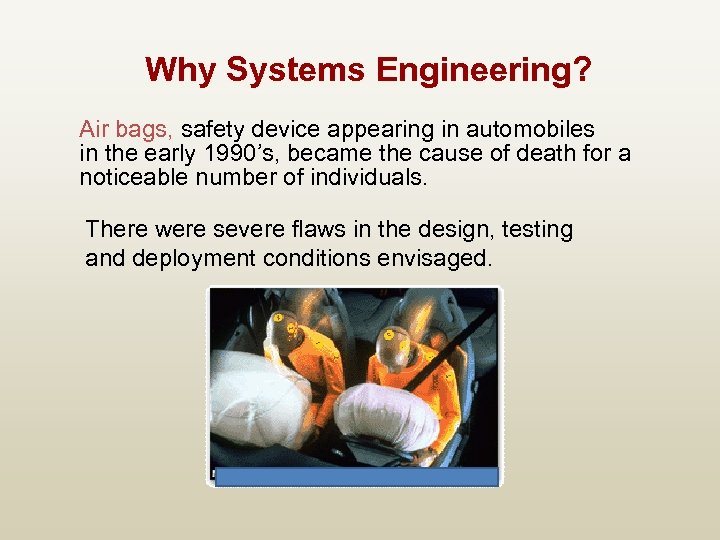 Why Systems Engineering? Air bags, safety device appearing in automobiles in the early 1990’s, became the cause of death for a noticeable number of individuals. There were severe flaws in the design, testing and deployment conditions envisaged.
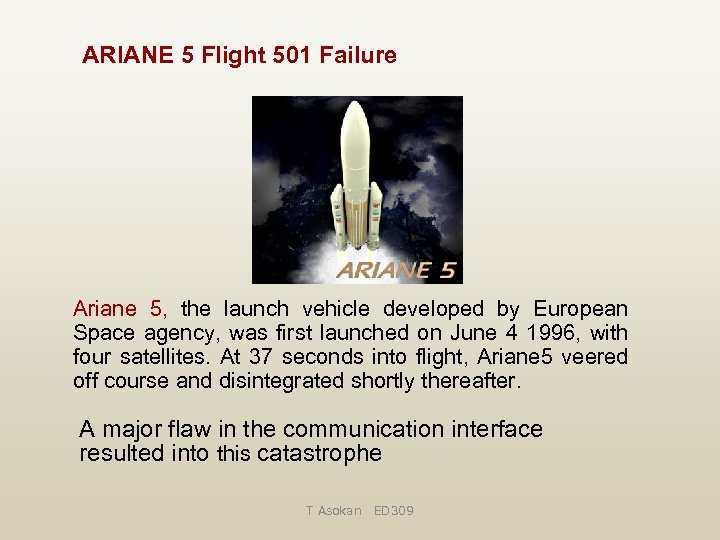 ARIANE 5 Flight 501 Failure Ariane 5, the launch vehicle developed by European Space agency, was first launched on June 4 1996, with four satellites. At 37 seconds into flight, Ariane 5 veered off course and disintegrated shortly thereafter. A major flaw in the communication interface resulted into this catastrophe T Asokan ED 309
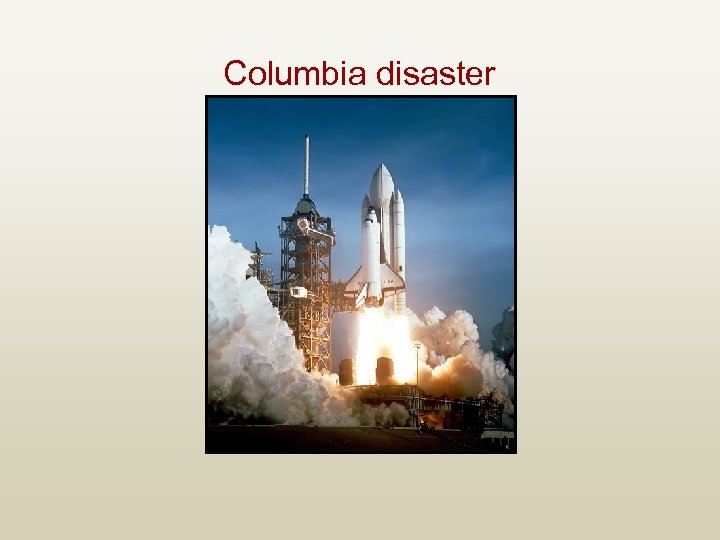 Columbia disaster
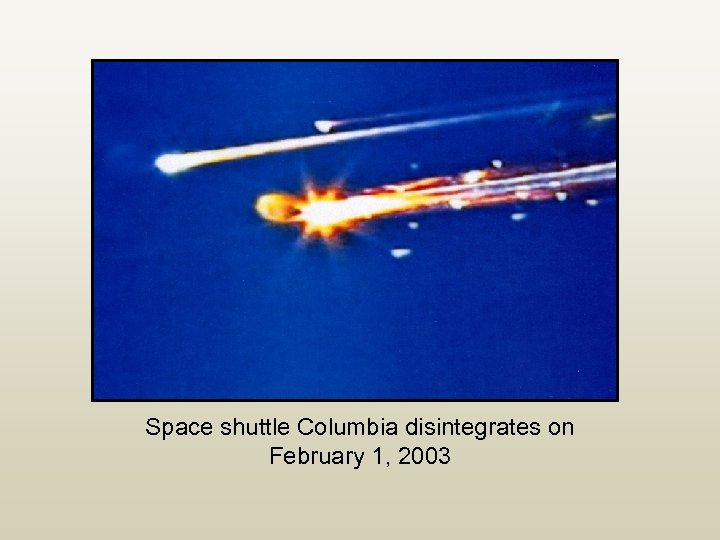 Space shuttle Columbia disintegrates on February 1, 2003
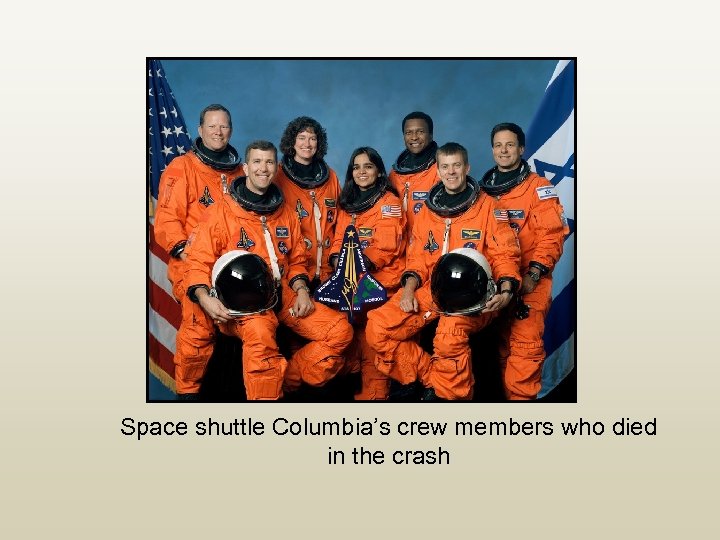 Space shuttle Columbia’s crew members who died in the crash
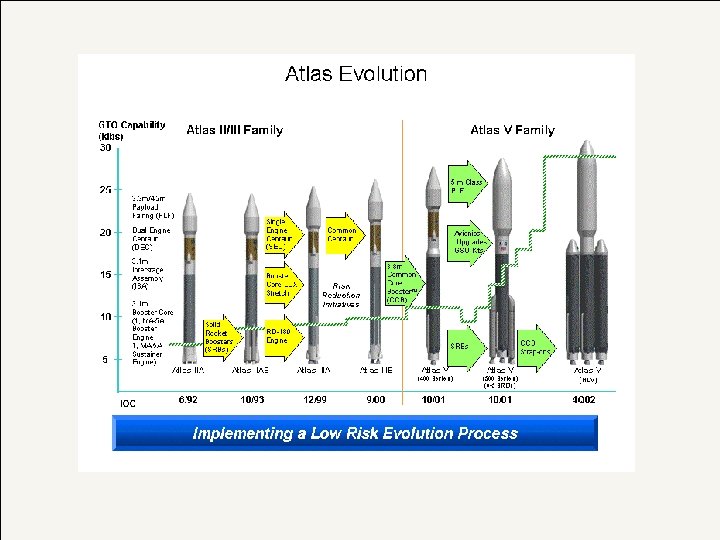 The First ICBM Project: ATLAS The SM-65 Atlas was a missile designed by the Air Force Ballistic Missile Division and built by the Convair Division of General Dynamics. Originally designed as an ICBM in the late 1950 s, Atlas was the foundation for a family of successful space launch vehicles now built by United Launch Alliance. The Atlas rocket family is today used as a launch platform for commercial and military satellites, and other space vehicles. 18000 scientists and engineers 17 contractors 200 subcontractors 200, 000 suppliers
 System Engineering Systems Engineering is a top-down, life-cycle approach to the design, development, and deployment of large-scale systems, processes, or operations to meet the effective needs of users and stakeholders in a cost-effective, high-quality way. • An organised and systematic way of design • Considers all the factors involved in the design • Integrates all the disciplines and specialty groups into a team effort • Ensures the business and customer needs of all stakeholders and ensures a system that meets the user needs
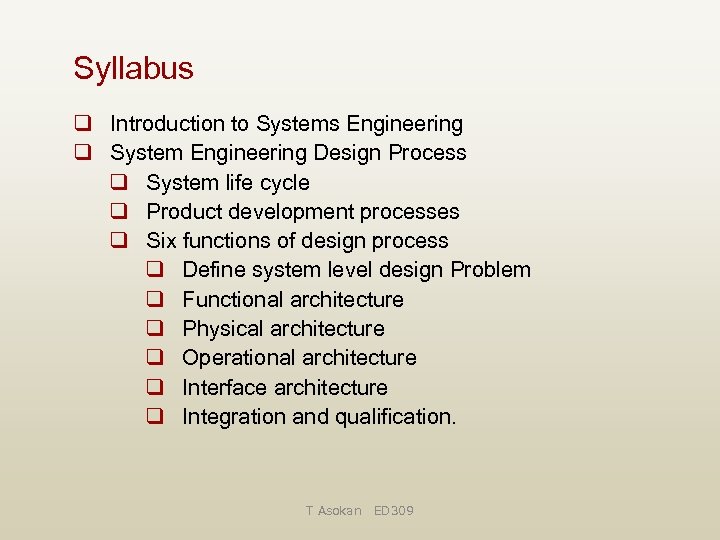 Syllabus q Introduction to Systems Engineering q System Engineering Design Process q System life cycle q Product development processes q Six functions of design process q Define system level design Problem q Functional architecture q Physical architecture q Operational architecture q Interface architecture q Integration and qualification. T Asokan ED 309
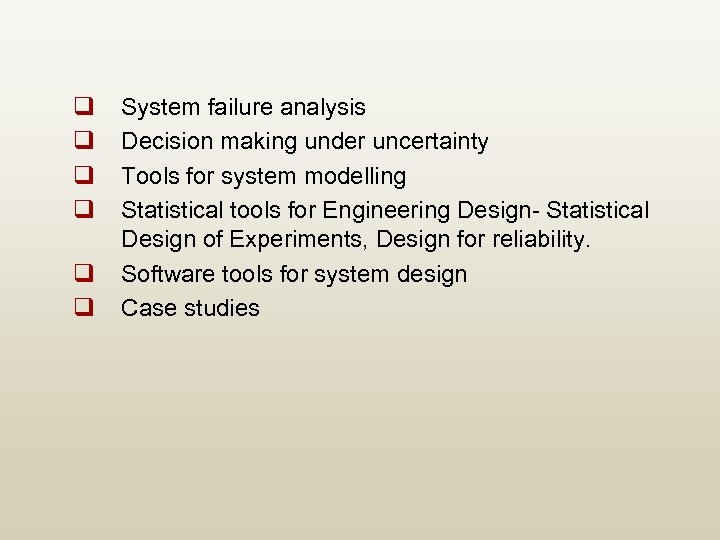 q q q System failure analysis Decision making under uncertainty Tools for system modelling Statistical tools for Engineering Design- Statistical Design of Experiments, Design for reliability. Software tools for system design Case studies
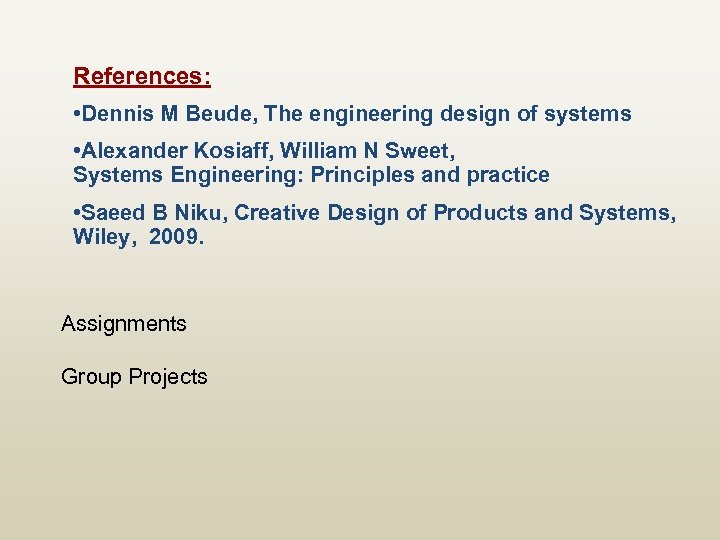 References: • Dennis M Beude, The engineering design of systems • Alexander Kosiaff, William N Sweet, Systems Engineering: Principles and practice • Saeed B Niku, Creative Design of Products and Systems, Wiley, 2009. Assignments Group Projects
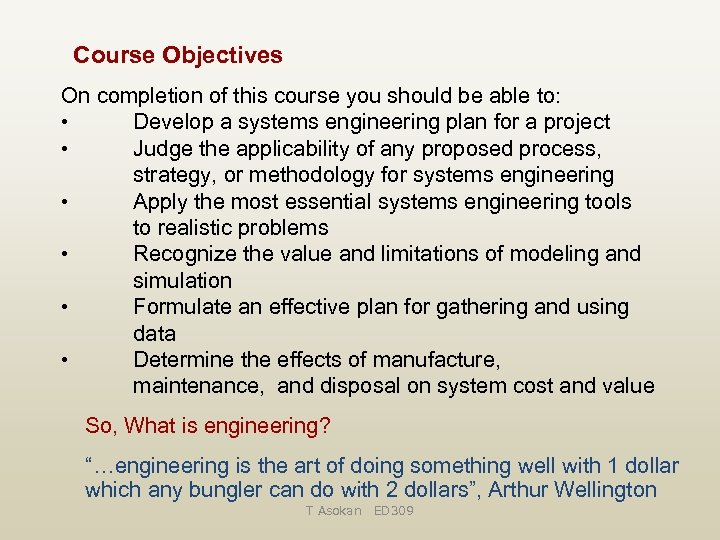 Course Objectives On completion of this course you should be able to: • Develop a systems engineering plan for a project • Judge the applicability of any proposed process, strategy, or methodology for systems engineering • Apply the most essential systems engineering tools to realistic problems • Recognize the value and limitations of modeling and simulation • Formulate an effective plan for gathering and using data • Determine the effects of manufacture, maintenance, and disposal on system cost and value So, What is engineering? “…engineering is the art of doing something well with 1 dollar which any bungler can do with 2 dollars”, Arthur Wellington T Asokan ED 309
 Engineering The process of devising a system, component, or process to meet desired needs. It is a decisionmaking process (often iterative) in which the basic sciences, mathematics, and engineering sciences are applied to convert resources optimally to meet a stated objective. –Accreditation Board for Engineering and Technology T Asokan ED 309
 Then, What is a System? a. b. c. d. e. f. A group of interacting, interrelated, or interdependent elements forming a complex whole. A functionally related group of elements, : The human body regarded as a functional physiological unit. An organism as a whole, especially with regard to its vital processes or functions. A group of physiologically or anatomically complementary organs or parts: the nervous system; the skeletal system. A group of interacting mechanical or electrical components. A network of related computer software, hardware, and data transmission devices.
 A system is commonly defined to be a collection of hardware, software, people, facilities, and procedures organised to accomplish some common objectives.
 • Definition of a System (NASA Systems Engineering Handbook) q. A system is a set of interrelated components which interact with one another in an organized fashion toward a common purpose. • System components may be quite diverse q. Persons and Organizations q. Software and Data q. Equipment and Hardware q. Facilities and Materials q. Services and Techniques
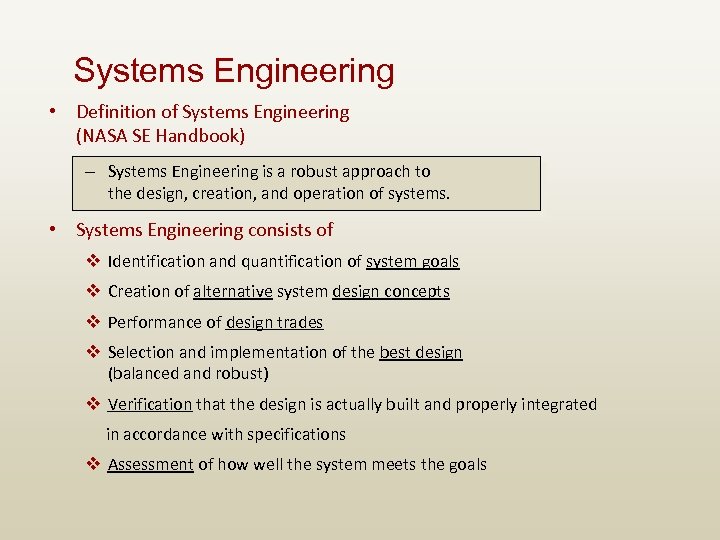 Systems Engineering • Definition of Systems Engineering (NASA SE Handbook) – Systems Engineering is a robust approach to the design, creation, and operation of systems. • Systems Engineering consists of v Identification and quantification of system goals v Creation of alternative system design concepts v Performance of design trades v Selection and implementation of the best design (balanced and robust) v Verification that the design is actually built and properly integrated in accordance with specifications v Assessment of how well the system meets the goals
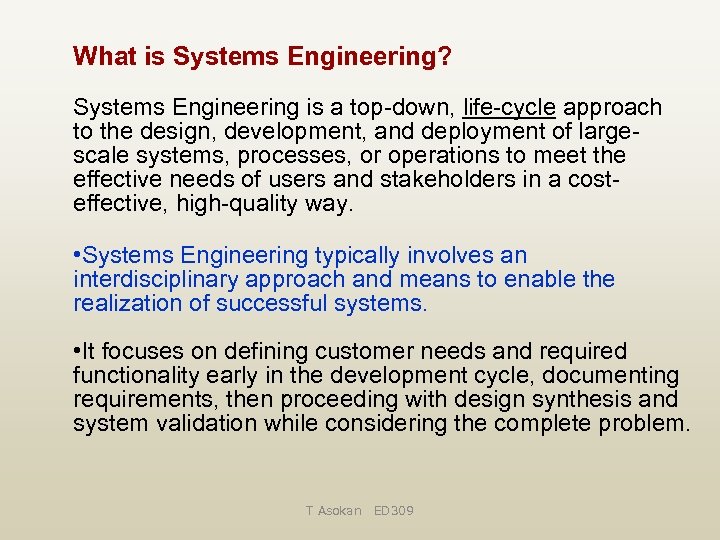 What is Systems Engineering? Systems Engineering is a top-down, life-cycle approach to the design, development, and deployment of largescale systems, processes, or operations to meet the effective needs of users and stakeholders in a costeffective, high-quality way. • Systems Engineering typically involves an interdisciplinary approach and means to enable the realization of successful systems. • It focuses on defining customer needs and required functionality early in the development cycle, documenting requirements, then proceeding with design synthesis and system validation while considering the complete problem. T Asokan ED 309
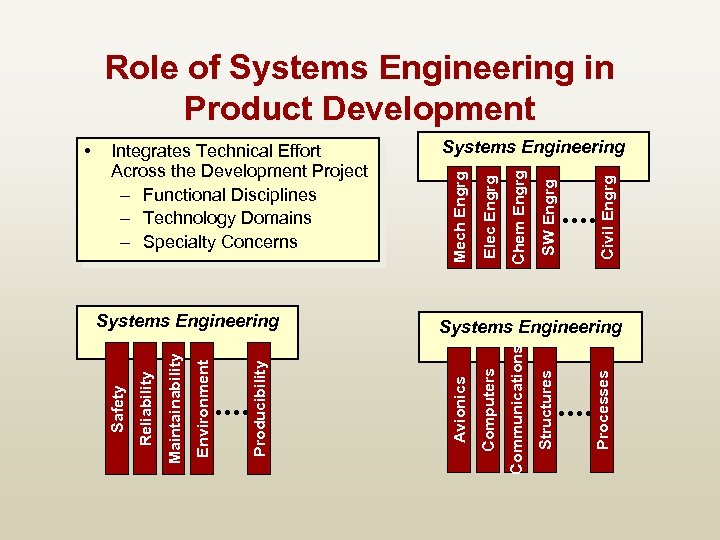 Role of Systems Engineering in Product Development Civil Engrg SW Engrg Chem Engrg Elec Engrg Mech Engrg Processes Structures Communications Systems Engineering Computers Producibility Environment Maintainability Reliability Systems Engineering Avionics Integrates Technical Effort Across the Development Project – Functional Disciplines – Technology Domains – Specialty Concerns Safety •
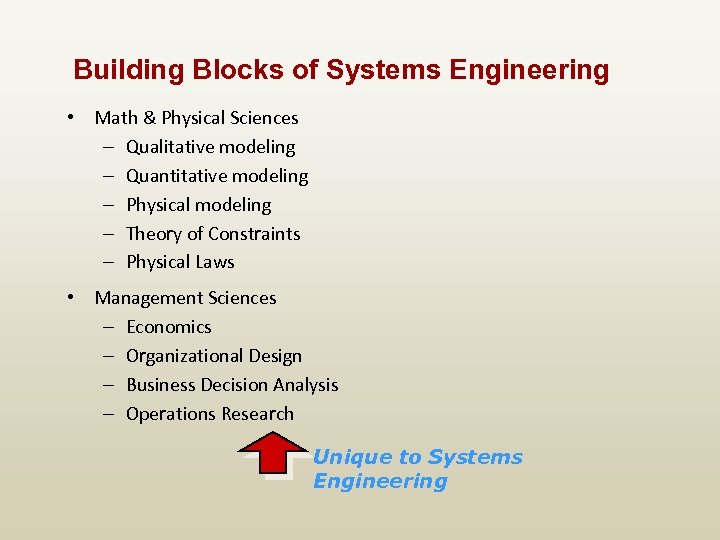 Building Blocks of Systems Engineering • Math & Physical Sciences – Qualitative modeling – Quantitative modeling – Physical modeling – Theory of Constraints – Physical Laws • Management Sciences – Economics – Organizational Design – Business Decision Analysis – Operations Research Unique to Systems Engineering
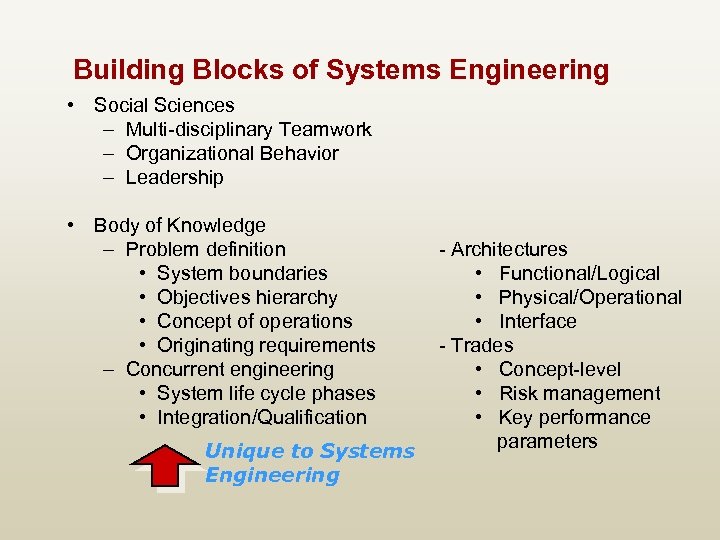 Building Blocks of Systems Engineering • Social Sciences – Multi-disciplinary Teamwork – Organizational Behavior – Leadership • Body of Knowledge – Problem definition • System boundaries • Objectives hierarchy • Concept of operations • Originating requirements – Concurrent engineering • System life cycle phases • Integration/Qualification Unique to Systems Engineering - Architectures • Functional/Logical • Physical/Operational • Interface - Trades • Concept-level • Risk management • Key performance parameters
 Other Considerations • Achieving balance between inherent conflicts – System functionality and performance – Development cost and recurring cost – Development schedule (Time to Market) – Development risk (Probability of Success) – Business viability and success
 • System Optimization – Subsystems often suboptimal to achieve best balance at system level – Ultimate system purpose must prevail against conflicting considerations – Long-term considerations (e. g. , disposal) may drive technical decisions • Customer Interface – Often must act as “honest broker” – Carries burden of educating customer on hard choices – Must think ahead to the next customer and next application – Must “challenge” all requirements
 Systems Engineering Heritage • Water distribution systems in Mesopotamia 4000 BC • Irrigation systems in Egypt 3300 BC • Urban systems such as Athens, Greece 400 BC • Roman highway systems 300 BC • Water transportation systems like Erie Canal 1800 s • Telephone systems 1877 • Electrical power distribution systems 1880
 Modern Origins of the Systems Approach • British multi-disciplined team formed (1937) to analyze Air Defense System • Bell Labs supported Nike development (1939 -1945) • SAGE Air defense system defined and managed by MIT (1951 -1980) • ATLAS Intercontinental Ballistic Missile Program managed by systems contractor, Ramo-Wooldridge Corp (1954 -1964)
 Spread of the Systems Approach 1 • Early Proponents – Research and Development Corporation (RAND) – Robert Mc. Namara (Secretary of Defense) – Jay Forrester (Modeling Urban Systems at MIT) • Growth in systems engineering citations (Engineering Index) – Nil in 1964 – One Page in 1966 – Eight Pages in 1969 • Nine Universities Offered Systems Engineering Programs in 1964 1) Hughes, Thomas P. , Rescuing Prometheus, Chapter 4, pps. 141 -195, Pantheon Books, New York, 1998.
 Teaching SE Included in 1971 Do. D Acquisition Reforms • Study group chaired by David Packard, co-founder of Hewlett Packard – Recommended formal training for Department of Defense (Do. D) program managers • Defense Systems Management College (DMSC) Established in 1971 • DSMC charged with teaching program managers how to direct complex projects • Systems Engineering a core curriculum course
![Government Publications • USAF Systems Engineering Handbook 375 -5 [1966] • MIL-STD-499 (USAF), Systems](https://present5.com/presentation/148a0fbc74bbd5b263c2faed047b90a6/image-29.jpg "Government Publications • USAF Systems Engineering Handbook 375 -5 [1966] • MIL-STD-499 (USAF), Systems") Government Publications • USAF Systems Engineering Handbook 375 -5 [1966] • MIL-STD-499 (USAF), Systems Engineering Management [1969] • U. S. Army Field Manual 770 -78, Systems Engineering [1979] • Defense Systems Management College, Systems Engineering Management Guides [1983, 1990] • NASA Systems Engineering Handbook [1995]
Government Publications • USAF Systems Engineering Handbook 375 -5 [1966] • MIL-STD-499 (USAF), Systems Engineering Management [1969] • U. S. Army Field Manual 770 -78, Systems Engineering [1979] • Defense Systems Management College, Systems Engineering Management Guides [1983, 1990] • NASA Systems Engineering Handbook [1995]
 Discipline Maturation • “Explosive growth in computing power is profoundly changing the systems, themselves, and, consequently, systems engineering as practiced over the last half century” --- Eberhardt Rechtin, July 1993 • Steady growth in commercial computer tools that automate and improve execution of systems engineering process • Increasing world wide reports of systems engineering applications
 Expanding Horizons • Collaboration with other technical societies • Development of systems engineering standards (National & International) • Encouraging international membership (Now 27% Outside United States) • Nurturing emerging SE Applications – Commercial – Environmental • Fostering SE education and research
 SE Standards: Product of INCOSE Collaborative Efforts • Current SE Standards – Electronics Industry Association (EIA - 632) • Processes for Engineering a System (12/98) – EIA/Interim Standard - 731 • Systems Engineering Capability Model (12/98) – IEEE 1220 • Application and Management of the SE Process, (1998) – European Cooperation for Space Standardization (ECSS-E-10 A) • System Engineering, (5/96) • SE Standards Under Development – ISO 15288, ISO SPICE, Systems Engineering for Space Systems, SE Data Exchange, Capability Maturity Model Integration, System Architecture (IEEE P 1471)
 Products • Symposium Proceedings in Book & CD • Systems Engineering Journal • Quarterly Newsletter - INSIGHT • Organization Website - www. incose. org • Technical Committee Papers • Member Books & Textbooks • Regional Conferences
 Systems Engineering: Relevance to India • Indigenous development of defence systems: Systems engineering principles are widely used • Large Infrastructure Projects: Systems engineering approach will improve quality and ensure prompt delivery • Large scale social projects like health care, literacy, UID, etc.
 Conclusions • Elements of systems engineering are embedded in all engineering endeavors • Successes, and failures, in producing complex systems continues to create advocates for the value of systems engineering THANK YOU