 Скачать презентацию Principles of Bioinorganic Chemistry Final papers are due
d9fb921fc3ad1450fdd400ff6d1bfde2.ppt
- Количество слайдов: 36



Principles of Bioinorganic Chemistry Final papers are due Thursday. The oral presentations will be held in research conference style at MIT's Endicott House estate in Dedham, MA, on Saturday, October 18. Please meet in Kresge parking lot no later than 7: 50 AM on Sat. AM. Be sure that Amy has your cell or other phone number.
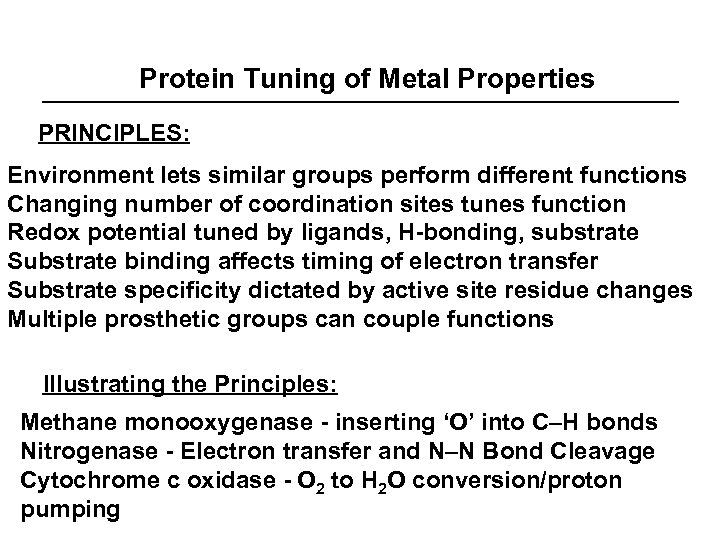
Protein Tuning of Metal Properties PRINCIPLES: Environment lets similar groups perform different functions Changing number of coordination sites tunes function Redox potential tuned by ligands, H-bonding, substrate Substrate binding affects timing of electron transfer Substrate specificity dictated by active site residue changes Multiple prosthetic groups can couple functions Illustrating the Principles: Methane monooxygenase - inserting ‘O’ into C–H bonds Nitrogenase - Electron transfer and N–N Bond Cleavage Cytochrome c oxidase - O 2 to H 2 O conversion/proton pumping
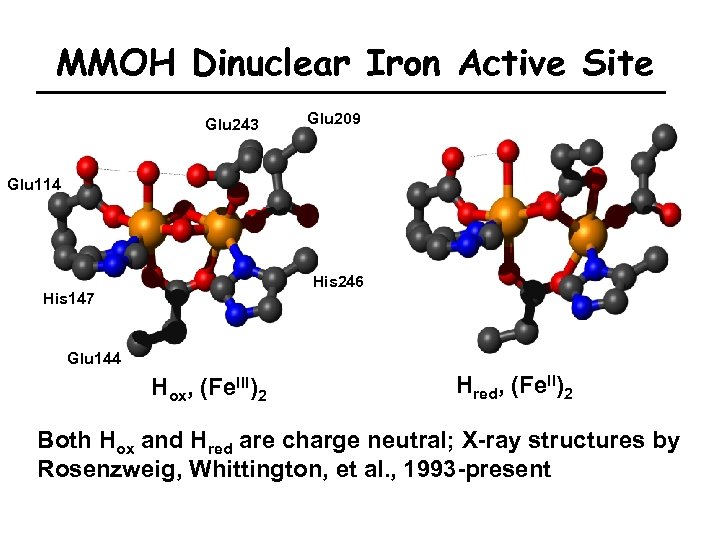
MMOH Dinuclear Iron Active Site Glu 243 Glu 209 Glu 114 His 246 His 147 Glu 144 Hox, (Fe. III)2 Hred, (Fe. II)2 Both Hox and Hred are charge neutral; X-ray structures by Rosenzweig, Whittington, et al. , 1993 -present

Reminder
Reminder
Reaction of Hperoxo with Other Substrates Hperoxo reacts with olefins to give epoxides; the ether products decompose in aqueous solution
Hperoxo and Q Reactions with Ethyl Vinyl Ether l 705 or 720 nm l 420 nm Conditions: T = 20 ºC, [H]red = 51. 5 m. M, [B] = 103 m. M Ether concentration in excess and variable, 3 - 70 m. M
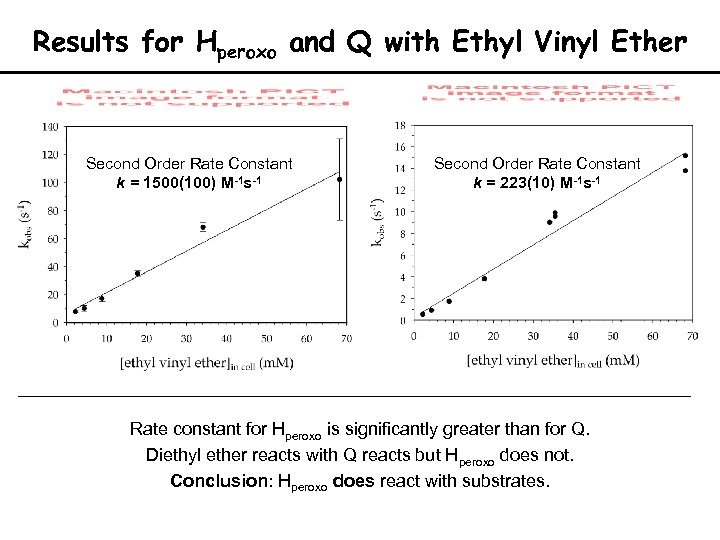
Results for Hperoxo and Q with Ethyl Vinyl Ether Second Order Rate Constant k = 1500(100) M-1 s-1 Second Order Rate Constant k = 223(10) M-1 s-1 Rate constant for Hperoxo is significantly greater than for Q. Diethyl ether reacts with Q reacts but Hperoxo does not. Conclusion: Hperoxo does react with substrates.
Reactions of the Q Intermediate in the s. MMO Catalytic Cycle
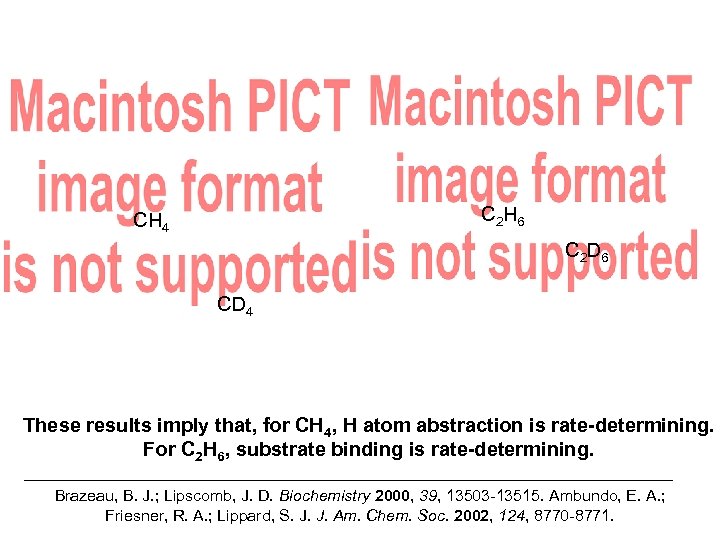
Reactions of Q with CH 4 and C 2 H 6 Reveal Complexities C 2 H 6 CH 4 C 2 D 6 CD 4 These results imply that, for CH 4, H atom abstraction is rate-determining. For C 2 H 6, substrate binding is rate-determining. Brazeau, B. J. ; Lipscomb, J. D. Biochemistry 2000, 39, 13503 -13515. Ambundo, E. A. ; Friesner, R. A. ; Lippard, S. J. J. Am. Chem. Soc. 2002, 124, 8770 -8771.
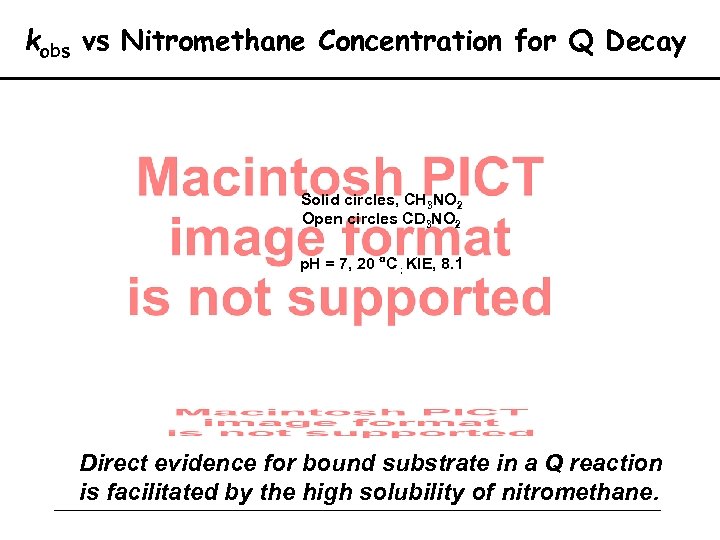
kobs vs Nitromethane Concentration for Q Decay Solid circles, CH 3 NO 2 Open circles CD 3 NO 2 p. H = 7, 20 C ; KIE, 8. 1 Direct evidence for bound substrate in a Q reaction is facilitated by the high solubility of nitromethane.
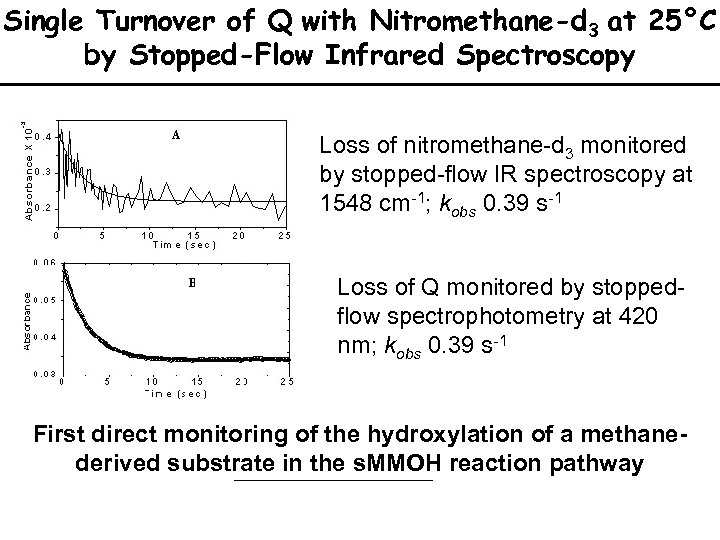
Single Turnover of Q with Nitromethane-d 3 at 25°C by Stopped-Flow Infrared Spectroscopy Loss of nitromethane-d 3 monitored by stopped-flow IR spectroscopy at 1548 cm-1; kobs 0. 39 s-1 Loss of Q monitored by stoppedflow spectrophotometry at 420 nm; kobs 0. 39 s-1 First direct monitoring of the hydroxylation of a methanederived substrate in the s. MMOH reaction pathway
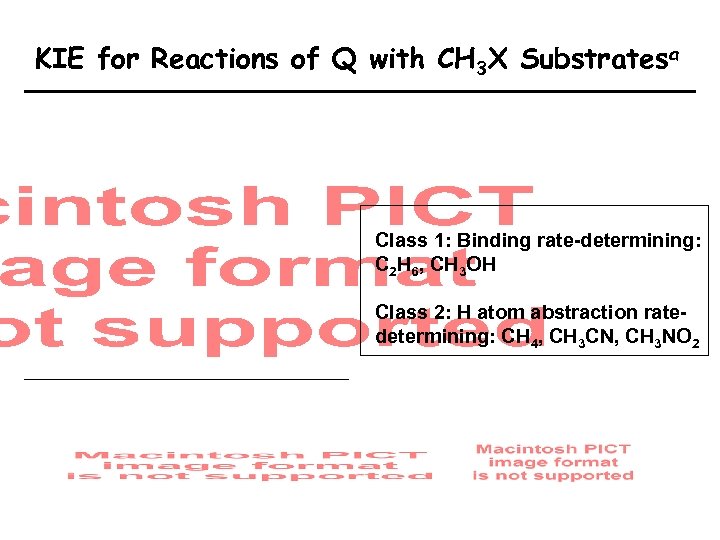
KIE for Reactions of Q with CH 3 X Substratesa Class 1: Binding rate-determining: C 2 H 6, CH 3 OH Class 2: H atom abstraction ratedetermining: CH 4, CH 3 CN, CH 3 NO 2

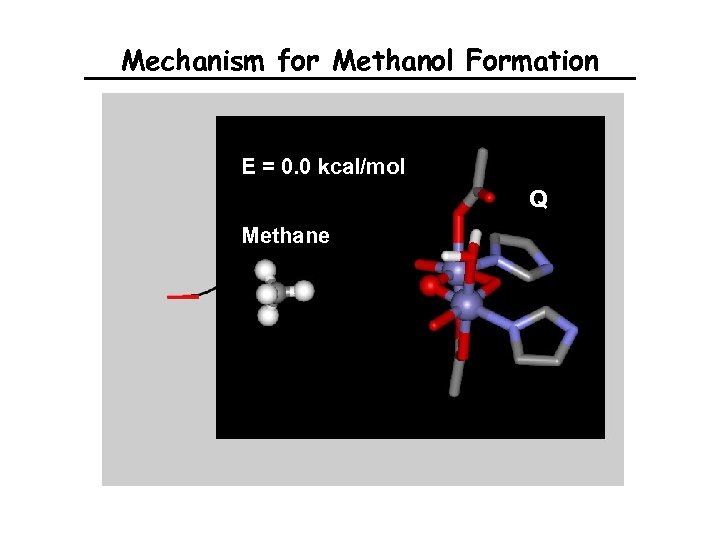
Mechanism for Methanol Formation E = 0. 0 kcal/mol Q Methane
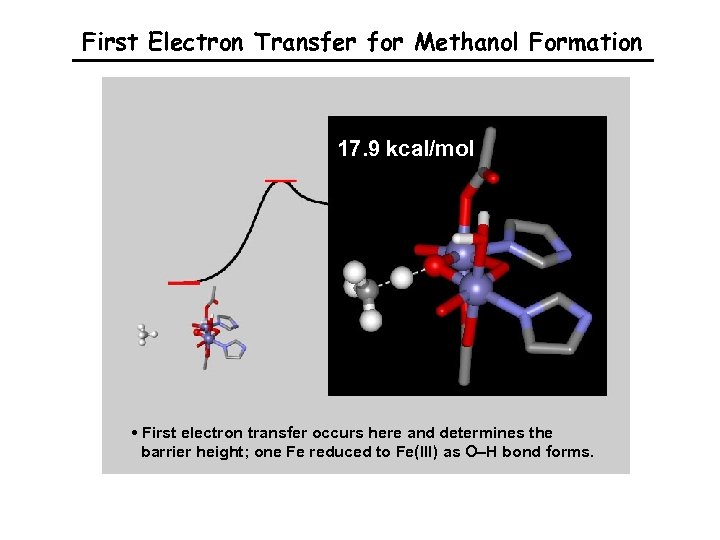
First Electron Transfer for Methanol Formation 17. 9 kcal/mol • First electron transfer occurs here and determines the barrier height; one Fe reduced to Fe(III) as O–H bond forms.
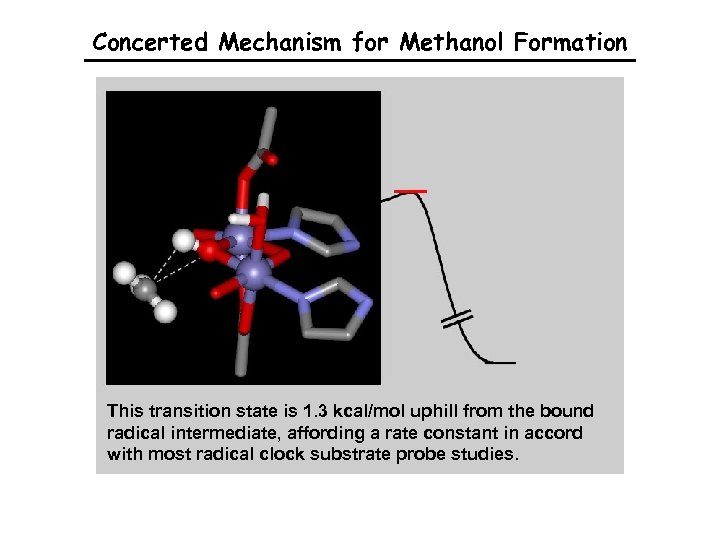
Concerted Mechanism for Methanol Formation This transition state is 1. 3 kcal/mol uphill from the bound radical intermediate, affording a rate constant in accord with most radical clock substrate probe studies.
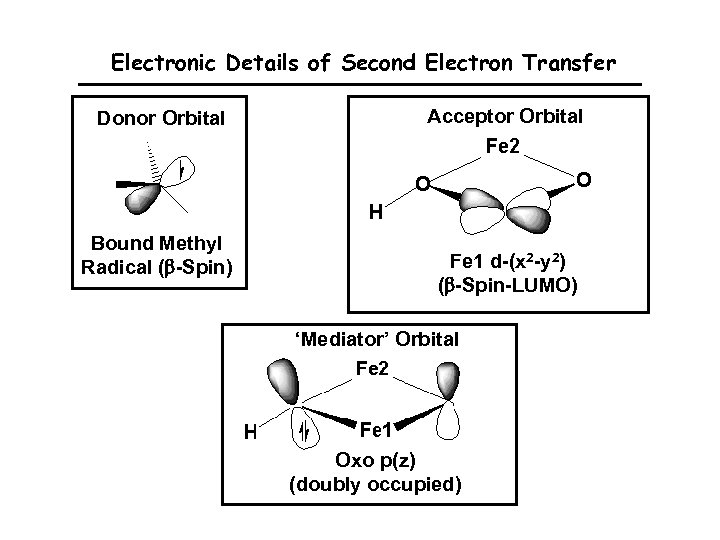
Electronic Details of Second Electron Transfer Donor Orbital Bound Methyl Radical (b-Spin) Acceptor Orbital Fe 1 d-(x 2 -y 2) (b-Spin-LUMO) ‘Mediator’ Orbital Oxo p(z) (doubly occupied)
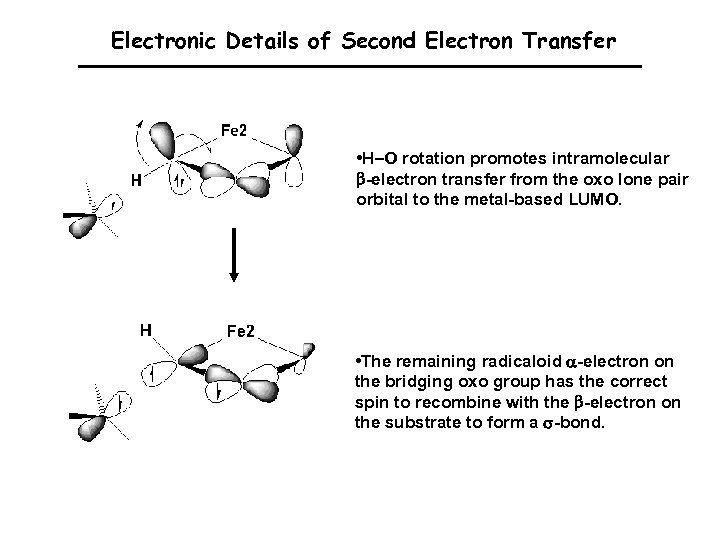
Electronic Details of Second Electron Transfer • H–O rotation promotes intramolecular b-electron transfer from the oxo lone pair orbital to the metal-based LUMO. • The remaining radicaloid a-electron on the bridging oxo group has the correct spin to recombine with the b-electron on the substrate to form a s-bond.
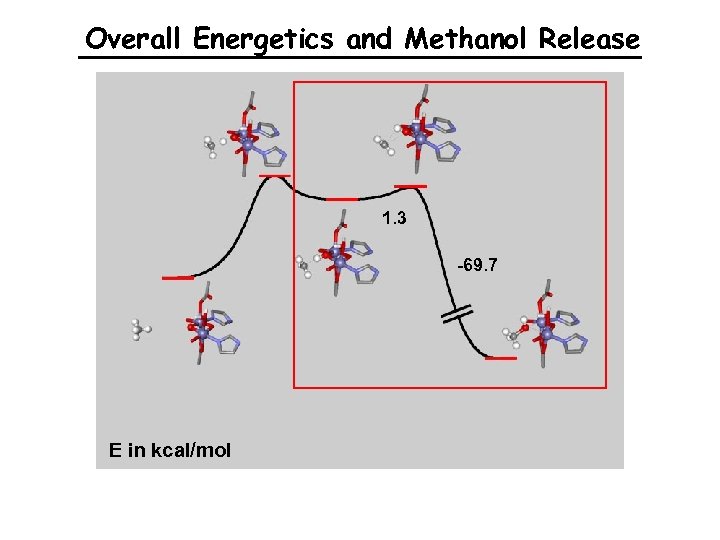
Overall Energetics and Methanol Release 1. 3 -69. 7 E in kcal/mol
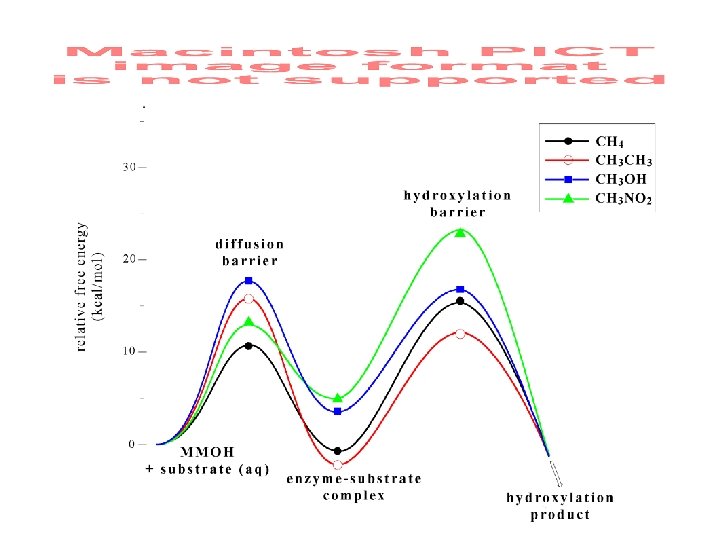
QM/MM Summary for Q Hydroxylation of CH 3 X: Substrate Diffusion Barriers • Substrate diffusion barriers cannot be calculated within the QM/MM framework, but can be inferred from experimental data and QM/MM calculations. • Results for cases where KIE = 1 Ethane 12. 15 kcal/mol; methanol 16. 67 kcal/mol • For methane, barrier should be less than ethane, since MMOB tunes the substrate access channel preferentially to methane as a substrate (Lipscomb and co-workers). • For CH 3 CN, barrier is less than 13. 5 kcal/mol. • For CH 3 NO 2, barrier is approximately that of acetonitrile.
Nitrogenase - The P Cluster reduced state oxidized state bridging 6 -coord. S bridging
Nitrogenase Fe-Mo Protein
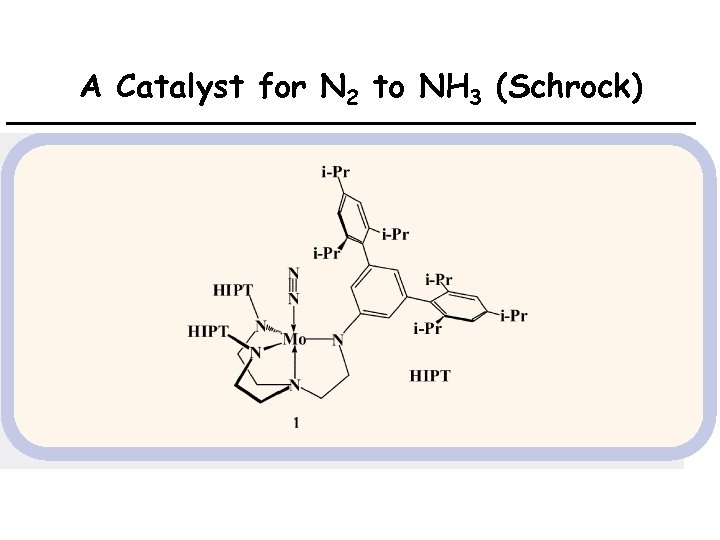
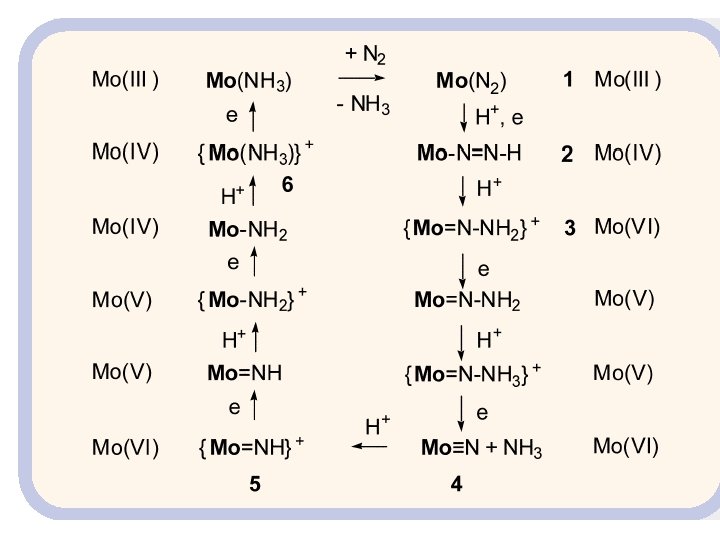
A Catalyst for N 2 to NH 3 (Schrock)
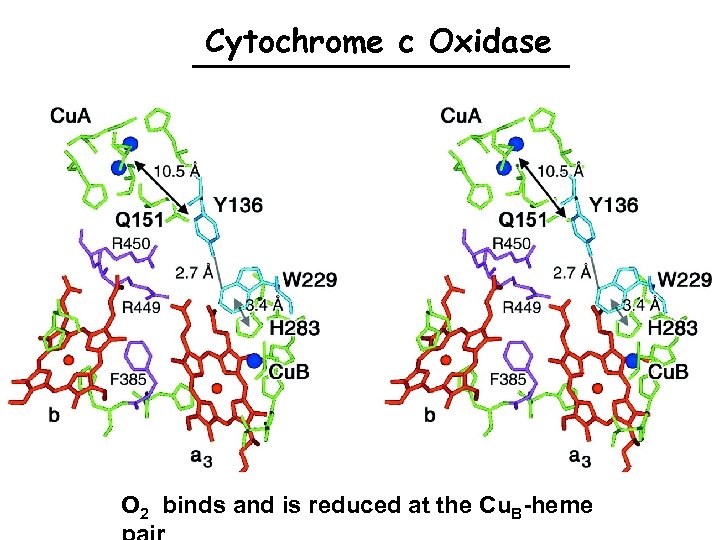
Cytochrome c Oxidase O 2 binds and is reduced at the Cu. B-heme
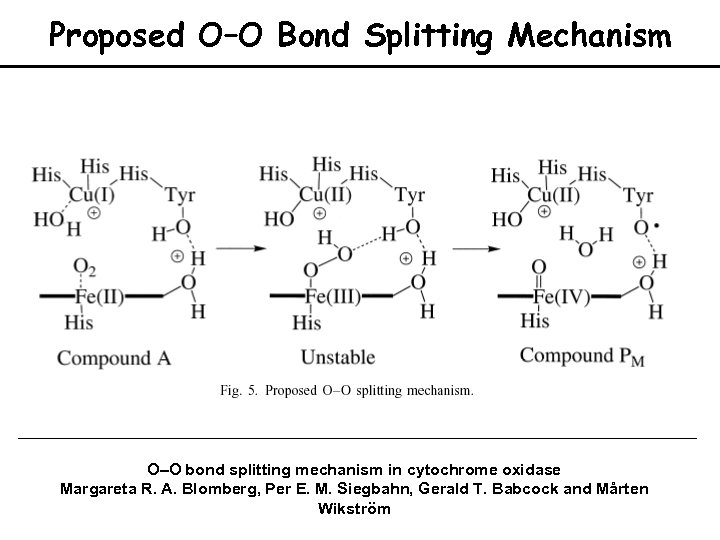
Proposed O–O Bond Splitting Mechanism O–O bond splitting mechanism in cytochrome oxidase Margareta R. A. Blomberg, Per E. M. Siegbahn, Gerald T. Babcock and Mårten Wikström
Скачать презентацию Principles of Bioinorganic Chemistry Final papers are due
d9fb921fc3ad1450fdd400ff6d1bfde2.ppt