


 Скачать презентацию Principles of Anatomy and Physiology 14 th Edition
66903034f7fa28f3126b0b7e469636f1.ppt
- Количество слайдов: 119
 Principles of Anatomy and Physiology 14 th Edition CHAPTER 29 Development and Inheritance Copyright © 2014 John Wiley & Sons, Inc. All rights
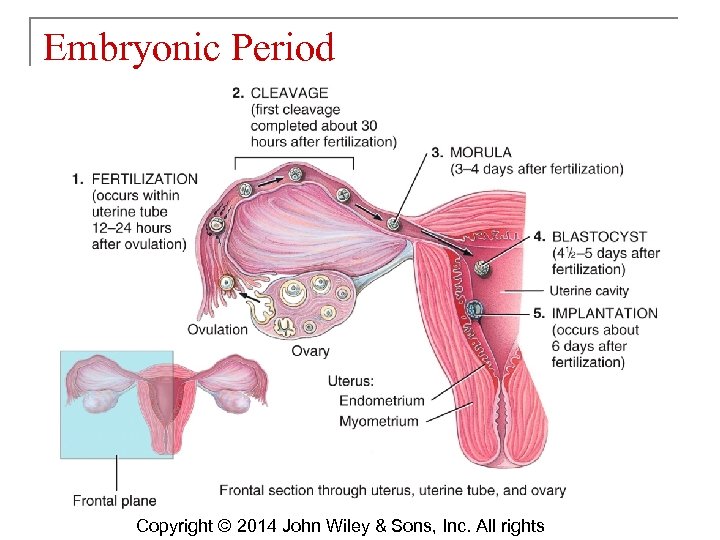
 Embryonic Period § The embryonic period extends from fertilization through the eighth week of development. § Fertilization—merging of genetic information from sperm and secondary oocyte. § Sperm swim from the vagina to the cervix using their tails. § Sperm pass through the uterus and uterine tubes mainly due to contraction of the walls of these John Wiley & Sons, Inc. All rights Copyright © 2014 structures.
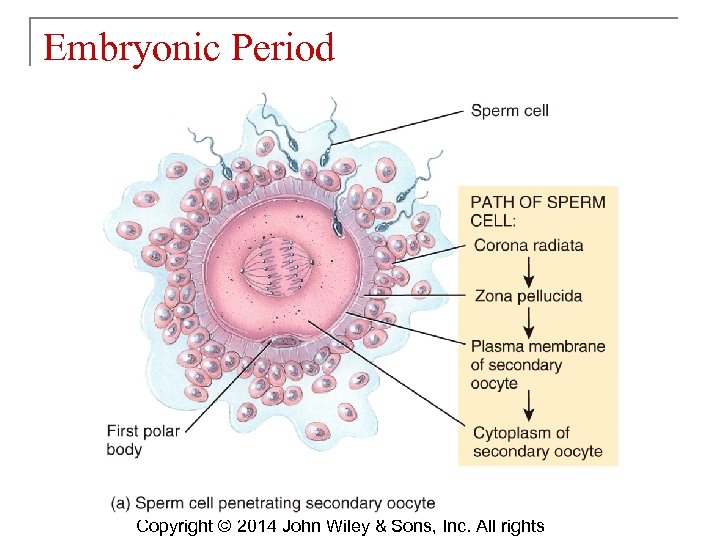
 Embryonic Period § To fertilize an egg, sperm must penetrate the corona radiata (granulosa cells) and the zona pellucida (glycoprotein layer outside of the oocyte’s plasma membrane). Copyright © 2014 John Wiley & Sons, Inc. All rights
 Embryonic Period Copyright © 2014 John Wiley & Sons, Inc. All rights
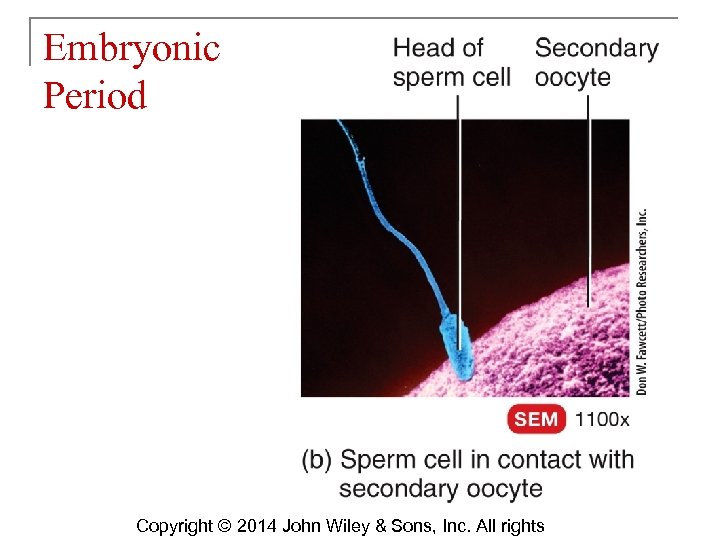
 Embryonic Period § The enzymes of the sperm’s acrosome, along with tail movement, allow the sperm to penetrate the corona radiata. § Glycoprotein ZP 3 in the zona pellucida is a receptor for the sperm. § Membrane proteins in the sperm head bind to ZP 3 and acrosomal enzymes are released to digest a path in the zona pellucida. Copyright © 2014 John Wiley & Sons, Inc. All rights
 Embryonic Period Copyright © 2014 John Wiley & Sons, Inc. All rights
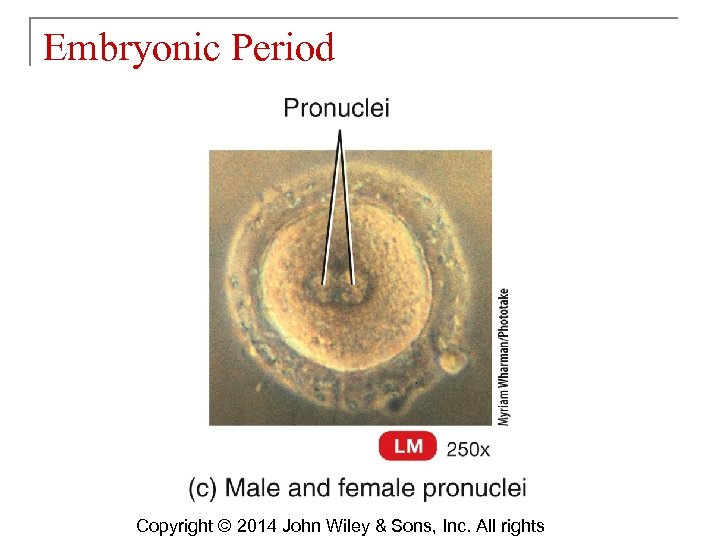
 Embryonic Period § The haploid nucleus in the head of the sperm becomes the male pronucleus. § The haploid nucleus of the fertilized ovum becomes the female pronucleus. § When the two merge (syngamy), the diploid zygote is formed. Copyright © 2014 John Wiley & Sons, Inc. All rights
 Embryonic Period Copyright © 2014 John Wiley & Sons, Inc. All rights
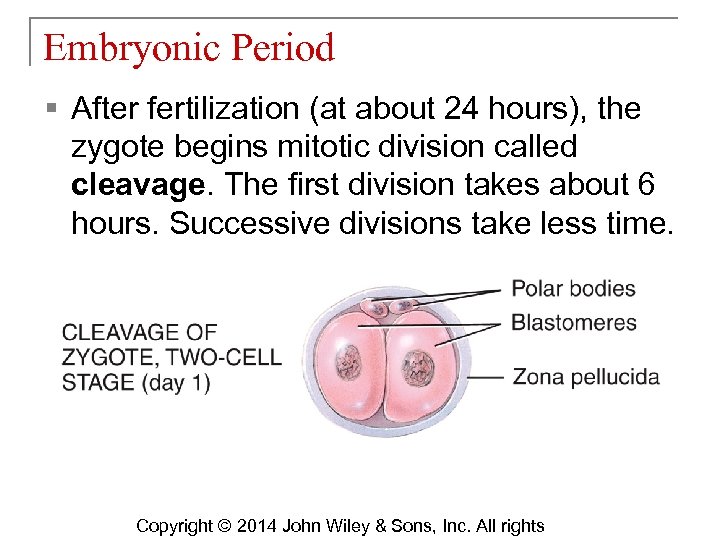 Embryonic Period § After fertilization (at about 24 hours), the zygote begins mitotic division called cleavage. The first division takes about 6 hours. Successive divisions take less time. Copyright © 2014 John Wiley & Sons, Inc. All rights
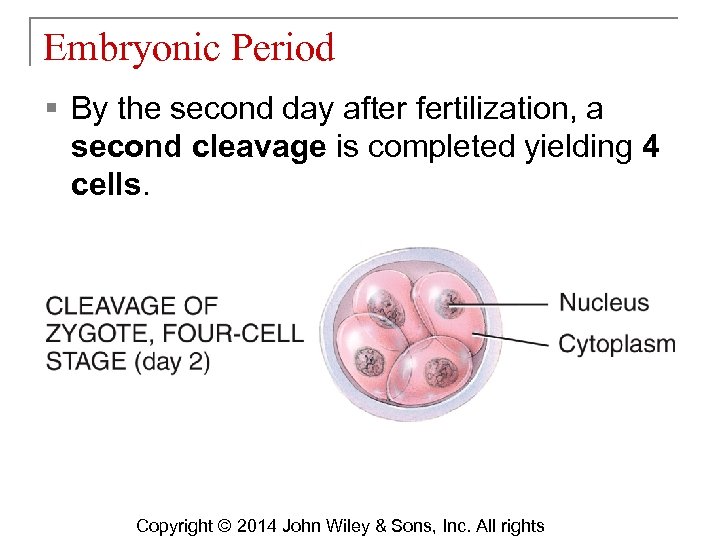 Embryonic Period § By the second day after fertilization, a second cleavage is completed yielding 4 cells. Copyright © 2014 John Wiley & Sons, Inc. All rights
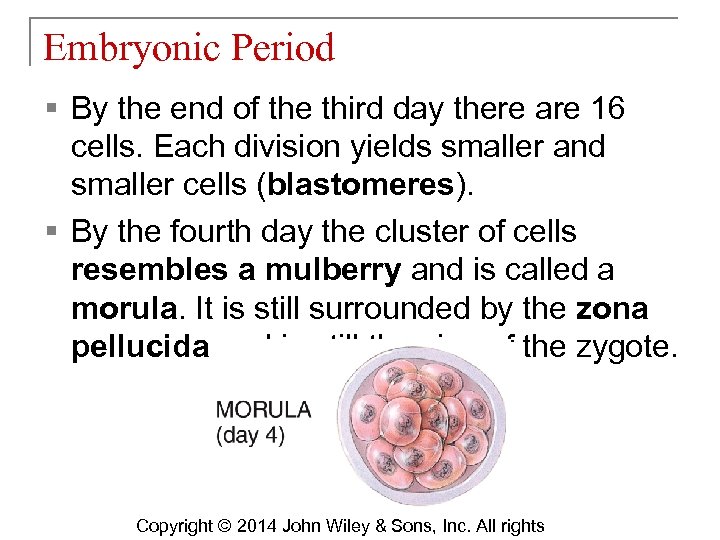 Embryonic Period § By the end of the third day there are 16 cells. Each division yields smaller and smaller cells (blastomeres). § By the fourth day the cluster of cells resembles a mulberry and is called a morula. It is still surrounded by the zona pellucida and is still the size of the zygote. Copyright © 2014 John Wiley & Sons, Inc. All rights
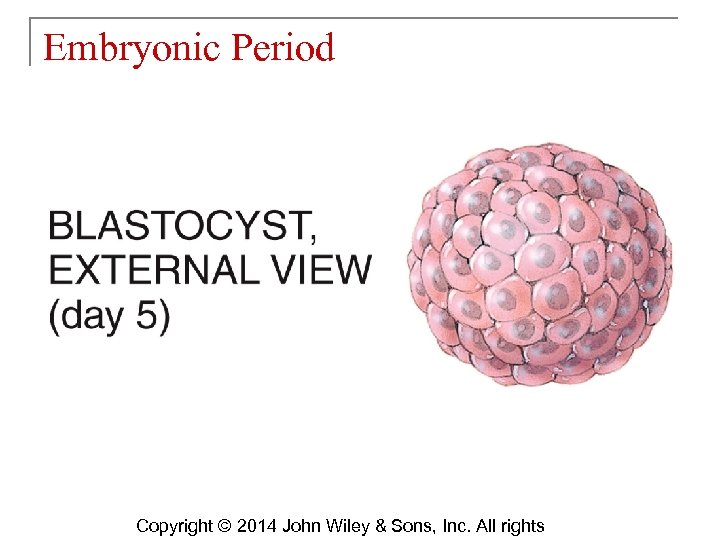
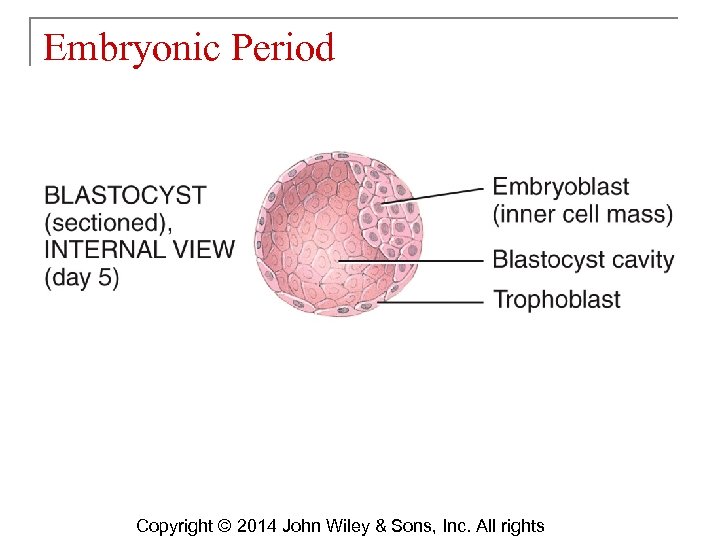
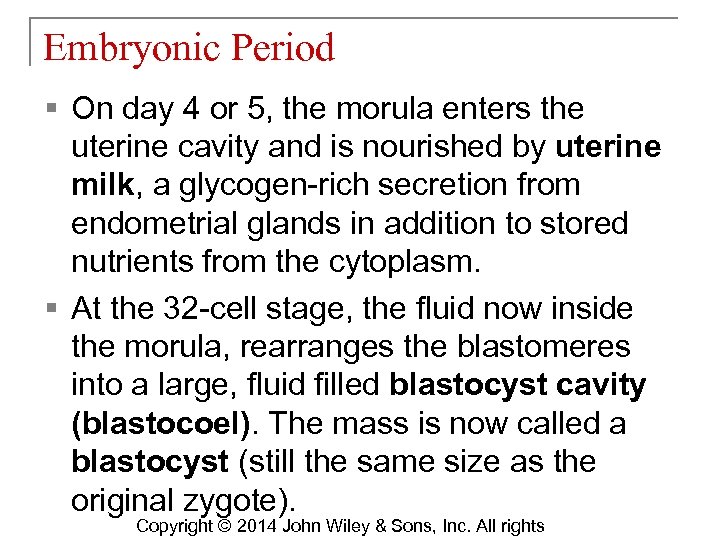 Embryonic Period § On day 4 or 5, the morula enters the uterine cavity and is nourished by uterine milk, a glycogen-rich secretion from endometrial glands in addition to stored nutrients from the cytoplasm. § At the 32 -cell stage, the fluid now inside the morula, rearranges the blastomeres into a large, fluid filled blastocyst cavity (blastocoel). The mass is now called a blastocyst (still the same size as the original zygote). Copyright © 2014 John Wiley & Sons, Inc. All rights
 Embryonic Period Copyright © 2014 John Wiley & Sons, Inc. All rights
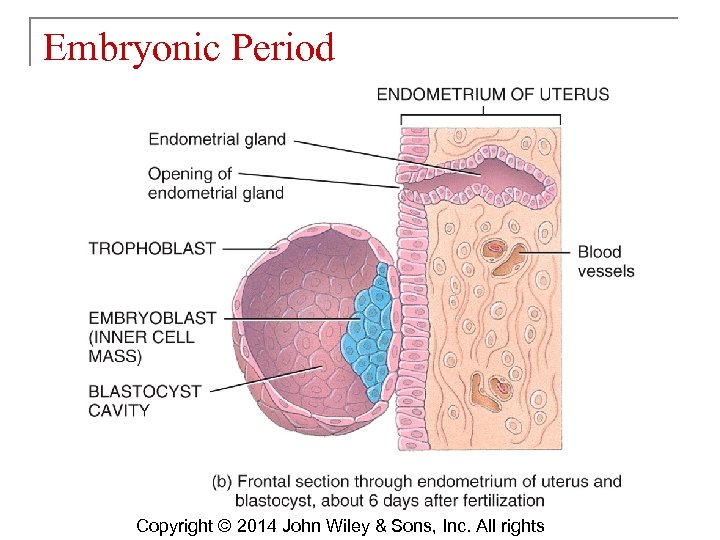
 Embryonic Period § As the blastocyst formed, two different cell populations arose: § The embryoblast (inner cell mass) will develop into the embryo. § The trophoblast (outer cell mass) will develop into the outer chorionic sac surrounding the fetus, and the fetal portion of the placenta. Copyright © 2014 John Wiley & Sons, Inc. All rights
 Embryonic Period Copyright © 2014 John Wiley & Sons, Inc. All rights
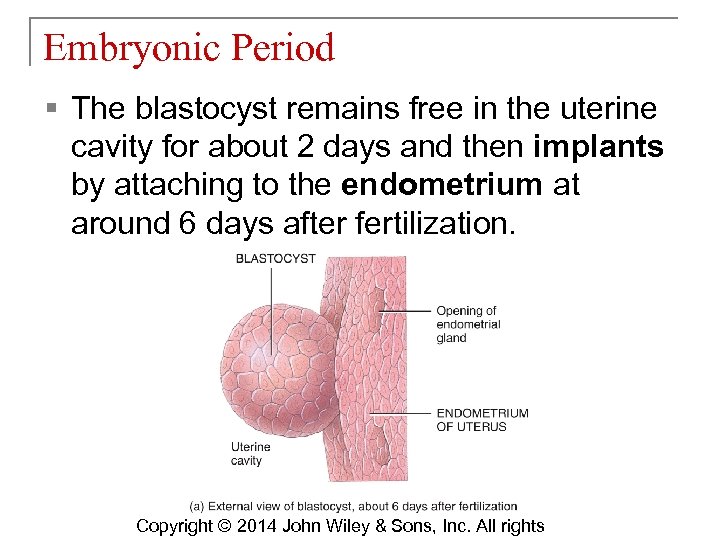 Embryonic Period § The blastocyst remains free in the uterine cavity for about 2 days and then implants by attaching to the endometrium at around 6 days after fertilization. Copyright © 2014 John Wiley & Sons, Inc. All rights
 Embryonic Period § Implantation usually occurs in either the posterior portion of the fundus or the body of the uterus. § The inner cell mass orients toward the endometrium. Copyright © 2014 John Wiley & Sons, Inc. All rights
 Embryonic Period Copyright © 2014 John Wiley & Sons, Inc. All rights
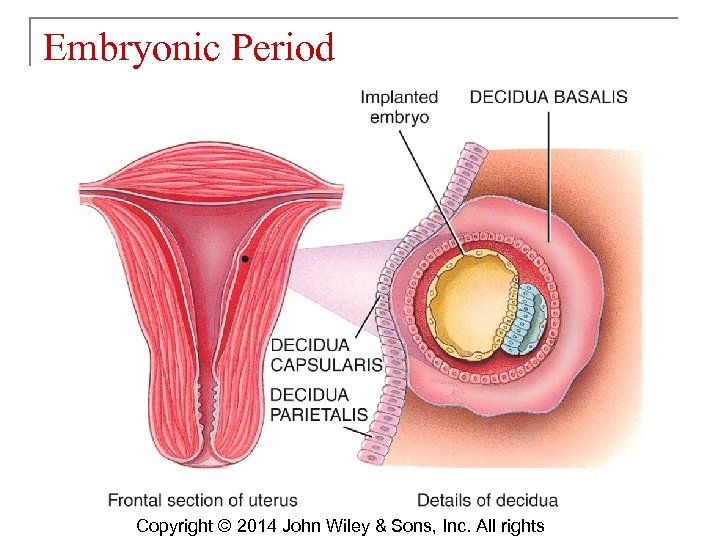
 Embryonic Period § After implantation, the endometrium is called the decidua. It separates from the endometrium after the fetus is delivered. § The decidua has different regions named based on their positions relative to the site of the implanted blastocyst. Copyright © 2014 John Wiley & Sons, Inc. All rights
 Embryonic Period Copyright © 2014 John Wiley & Sons, Inc. All rights
 Embryonic Period Copyright © 2014 John Wiley & Sons, Inc. All rights
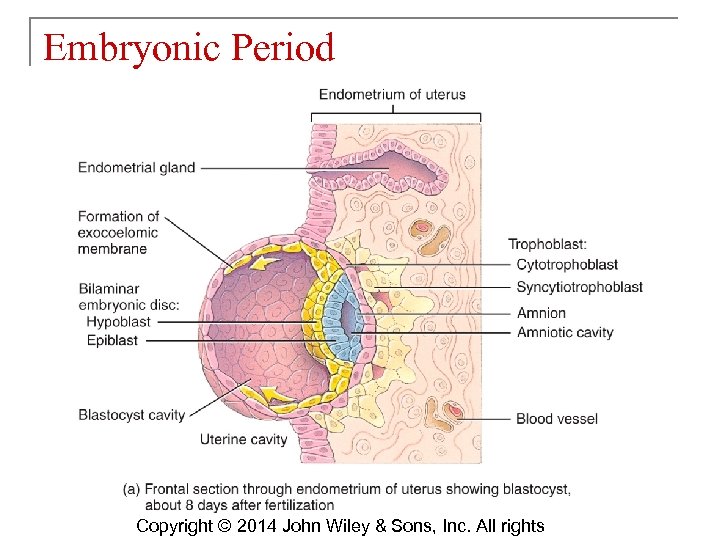
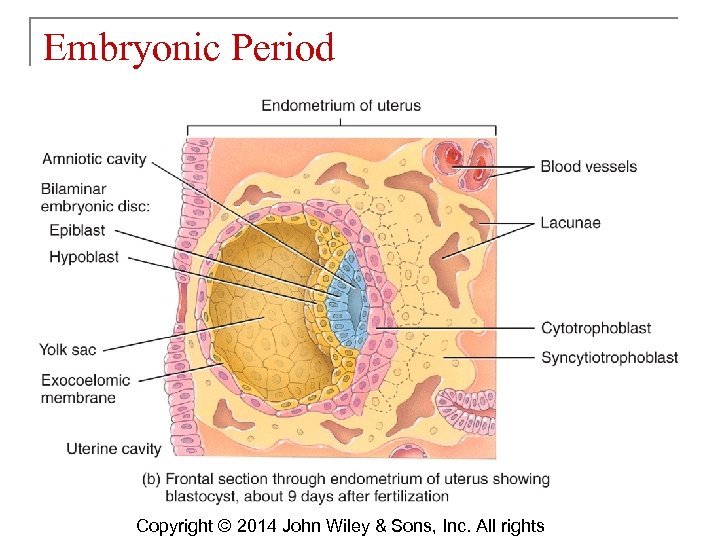
 Embryonic Period § About 8 days after implantation, the trophoblast develops into the syncytiotrophoblast and cytotrophoblast. § At around 8 days, the embryoblast also develops into two layers: the hypoblast (primitive endoderm) and epiblast (primitive ectoderm). § Cells of these structures form a flat disc called the bilaminar embryonic disc. Copyright © 2014 John Wiley & Sons, Inc. All rights
 Embryonic Period Copyright © 2014 John Wiley & Sons, Inc. All rights
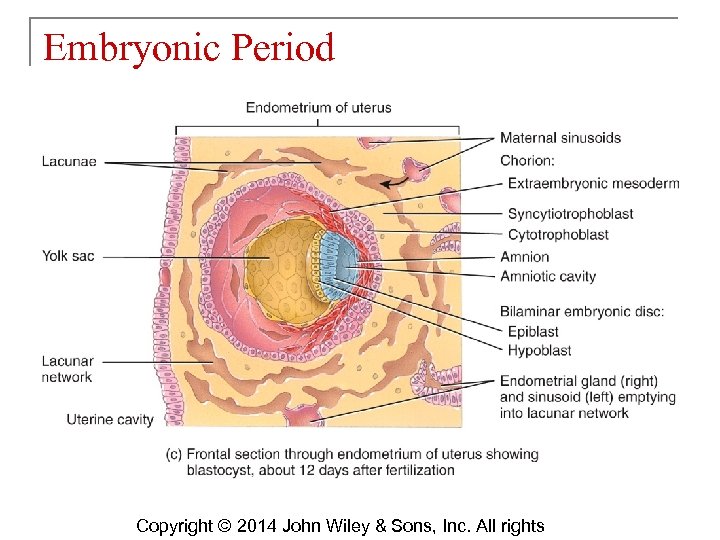
 Embryonic Period § The amnion forms from the roof of the amniotic cavity. § Eventually, it surrounds the entire embryo and fills with amniotic fluid. § Also on the 8 th day, the exocoelomic membrane forms that, together with the hypoblast forms the yolk sac. § On the 9 th day, small spaces called lacunae form. § By the 12 th day, they fuse to form lacunar Copyright networks. © 2014 John Wiley & Sons, Inc. All rights
 Embryonic Period Copyright © 2014 John Wiley & Sons, Inc. All rights
 Embryonic Period Copyright © 2014 John Wiley & Sons, Inc. All rights
 Embryonic Period § About the 12 th day after fertilization, the extraembryonic mesoderm develops. § The cells form a connective tissue layer around the amnion and yolk sac. § Large cavities develop that fuse and form the extraembryonic coelom. Copyright © 2014 John Wiley & Sons, Inc. All rights
 Embryonic Period § The extraembryonic mesoderm together with the trophoblast forms the chorion which surrounds the embryo and, later, the fetus. The chorion § Blocks antibody production by the mother § Promotes production of T lymphocytes to suppress the immune response in the uterus § Produces human chorionic gonadotropin (h. CG) Copyright © 2014 John Wiley & Sons, Inc. All rights
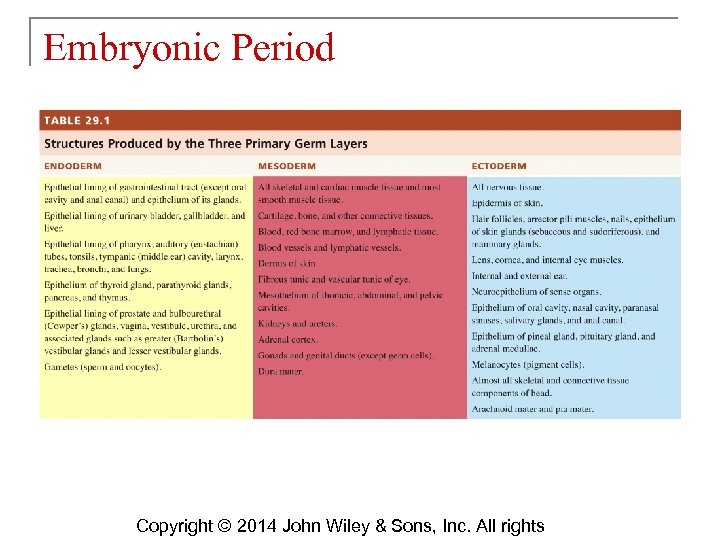
 Embryonic Period § The first major even of the 3 rd week of development is gastrulation. § The two-layered embryonic disc transforms into a trilaminar (threelayered) embryonic disc (ectoderm, mesoderm, endoderm) § Gastrulation is associated with the rearrangement and migration of cells from the epiblast. § The first step in gastrulation is formation of the primitive streak. & Sons, Inc. All rights Copyright © 2014 John Wiley
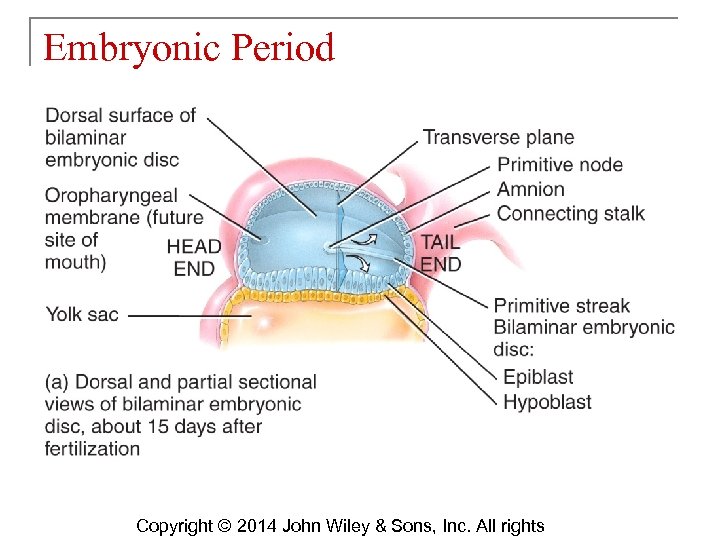 Embryonic Period Copyright © 2014 John Wiley & Sons, Inc. All rights
 Embryonic Period § The primitive streak establishes the head and tail ends of the embryo. § Next, cells of the epiblast move inward below the primitive streak and undergo invagination. § Following this, the three germ layers form. Copyright © 2014 John Wiley & Sons, Inc. All rights
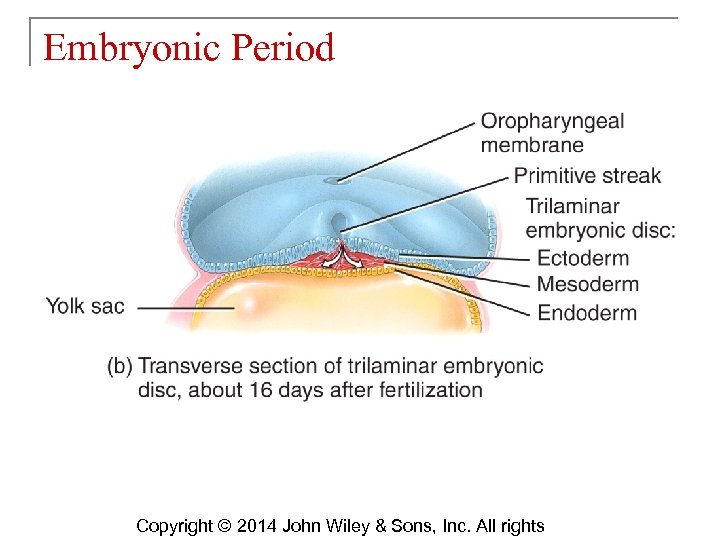 Embryonic Period Copyright © 2014 John Wiley & Sons, Inc. All rights
 Embryonic Period Copyright © 2014 John Wiley & Sons, Inc. All rights
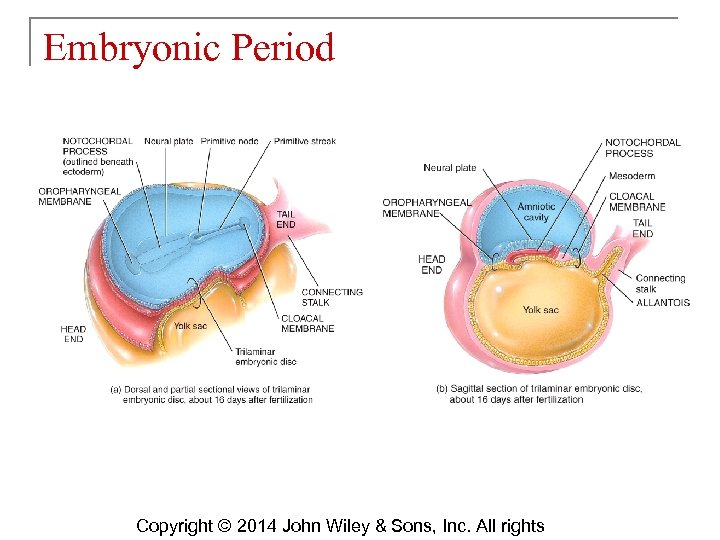
 Embryonic Period § About 16 days after fertilization, the notochordal process forms. § By days 22– 24, the process becomes the solid cylinder called the notochord. § The notochord is important for induction, the process whereby the inducing tissue stimulates development of a responding tissue to develop into a specific structure. § The notochord induces the development of vertebral bodies and the nucleus pulposus © 2014 John Wiley & Sons, Inc. All rights Copyright of vertebral discs.
 Embryonic Period Copyright © 2014 John Wiley & Sons, Inc. All rights
 Embryonic Period § Also during the 3 rd week of development, the following structures form: § Oropharyngeal membrane § Cloacal membrane § Allantois Copyright © 2014 John Wiley & Sons, Inc. All rights
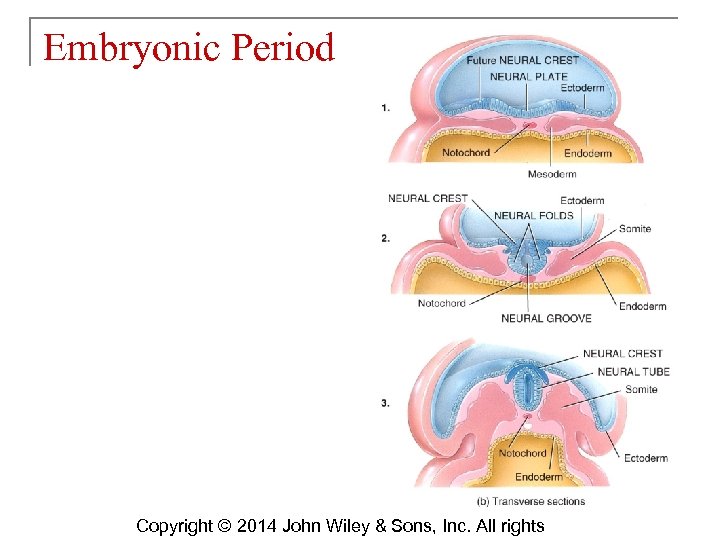
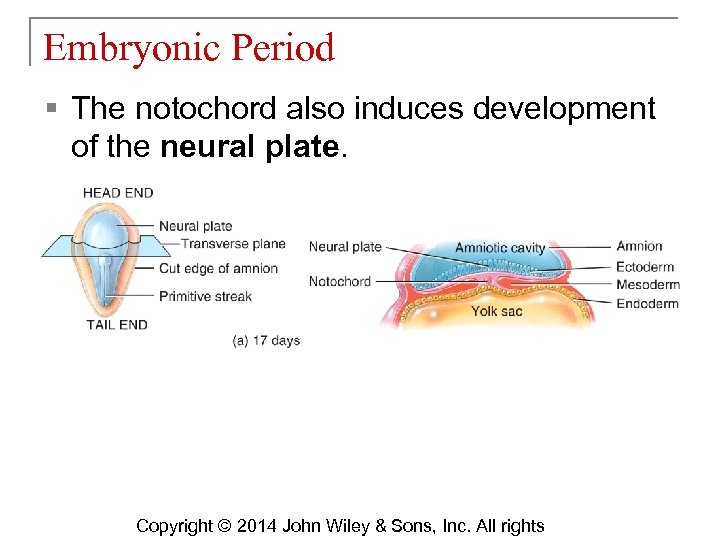 Embryonic Period § The notochord also induces development of the neural plate. Copyright © 2014 John Wiley & Sons, Inc. All rights
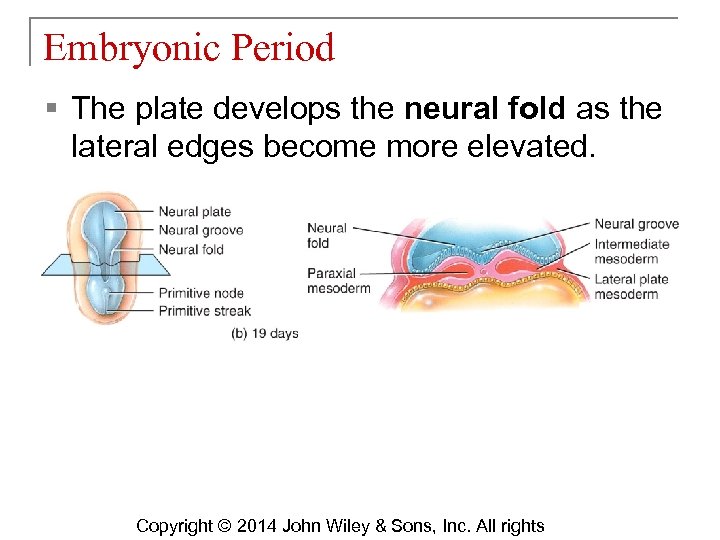 Embryonic Period § The plate develops the neural fold as the lateral edges become more elevated. Copyright © 2014 John Wiley & Sons, Inc. All rights
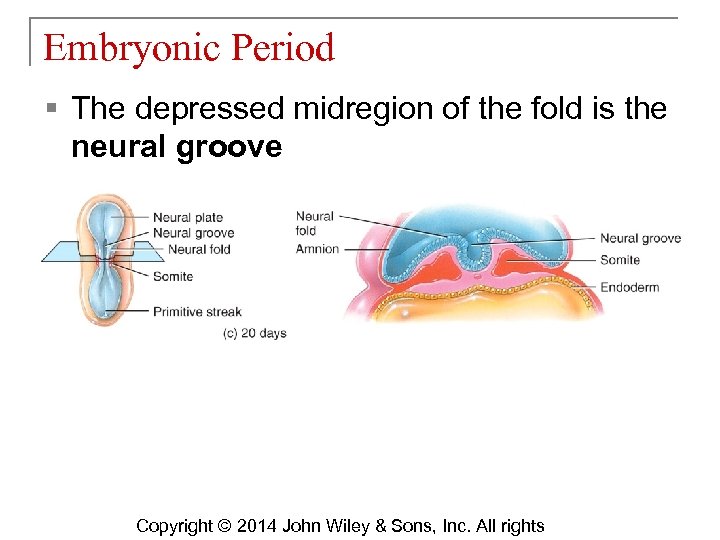 Embryonic Period § The depressed midregion of the fold is the neural groove Copyright © 2014 John Wiley & Sons, Inc. All rights
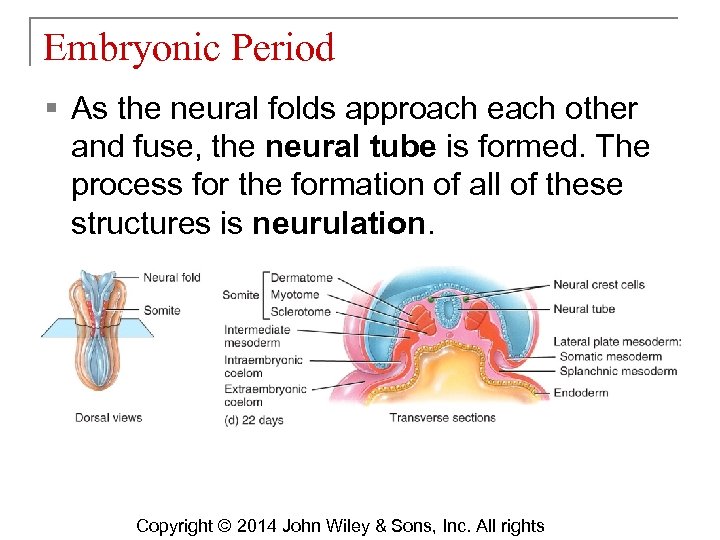 Embryonic Period § As the neural folds approach each other and fuse, the neural tube is formed. The process for the formation of all of these structures is neurulation. Copyright © 2014 John Wiley & Sons, Inc. All rights
 Embryonic Period § As the neural tube forms, some of the ectodermal cells from the tube migrate to form several layers of cells called the neural crest. Copyright © 2014 John Wiley & Sons, Inc. All rights
 Embryonic Period Copyright © 2014 John Wiley & Sons, Inc. All rights
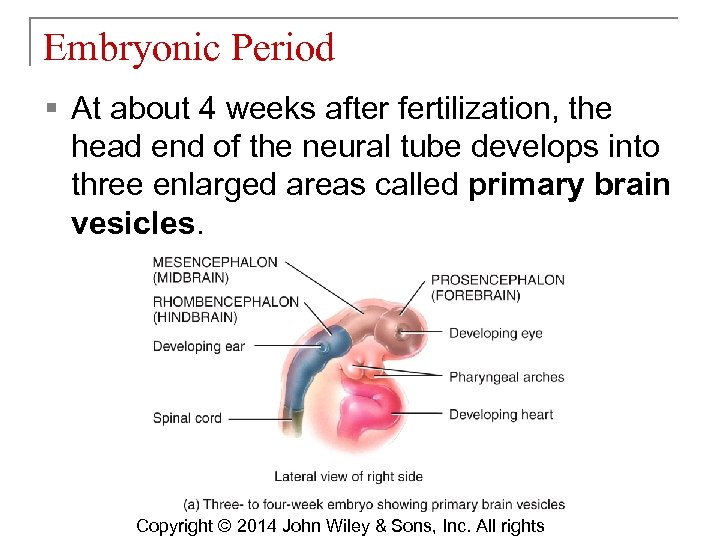 Embryonic Period § At about 4 weeks after fertilization, the head end of the neural tube develops into three enlarged areas called primary brain vesicles. Copyright © 2014 John Wiley & Sons, Inc. All rights
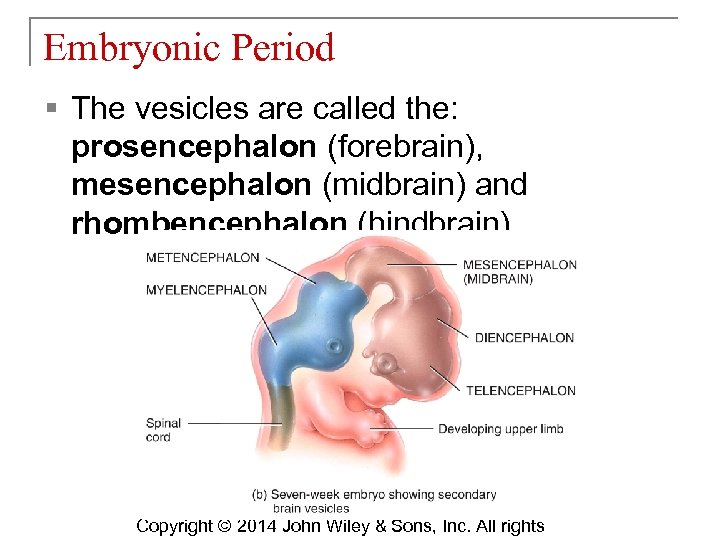 Embryonic Period § The vesicles are called the: prosencephalon (forebrain), mesencephalon (midbrain) and rhombencephalon (hindbrain). Copyright © 2014 John Wiley & Sons, Inc. All rights
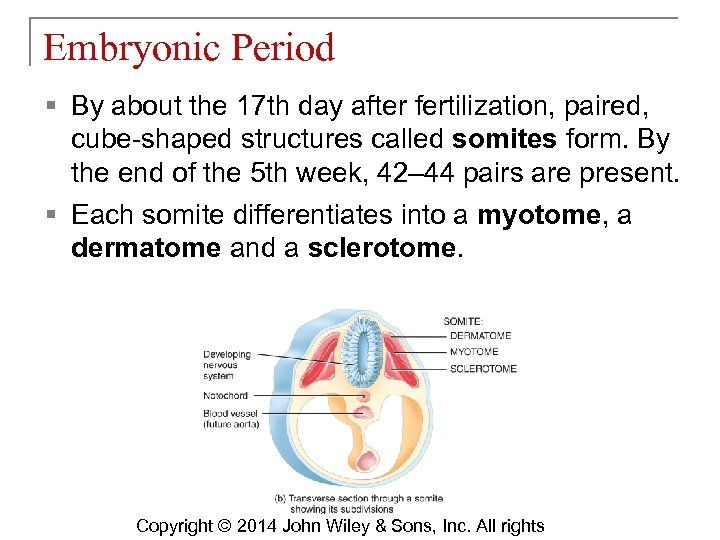 Embryonic Period § By about the 17 th day after fertilization, paired, cube-shaped structures called somites form. By the end of the 5 th week, 42– 44 pairs are present. § Each somite differentiates into a myotome, a dermatome and a sclerotome. Copyright © 2014 John Wiley & Sons, Inc. All rights
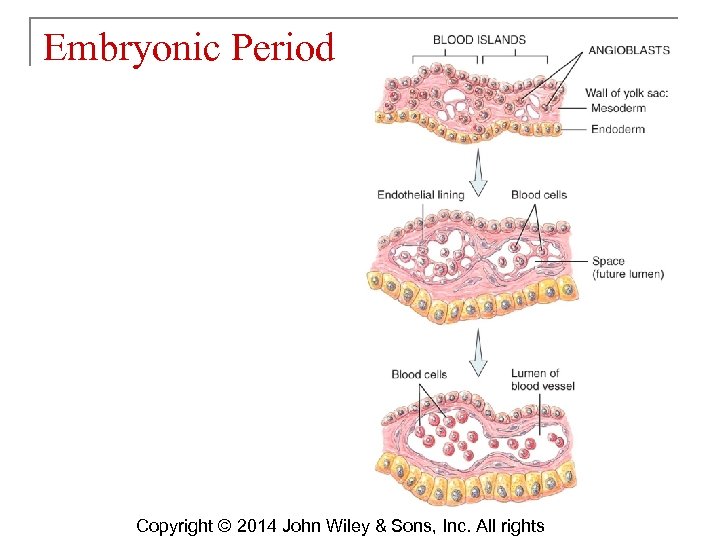
 Embryonic Period § At the beginning of the 3 rd week, the formation of blood vessels (angiogenesis) begins with the development of blood islands. Copyright © 2014 John Wiley & Sons, Inc. All rights
 Embryonic Period Copyright © 2014 John Wiley & Sons, Inc. All rights
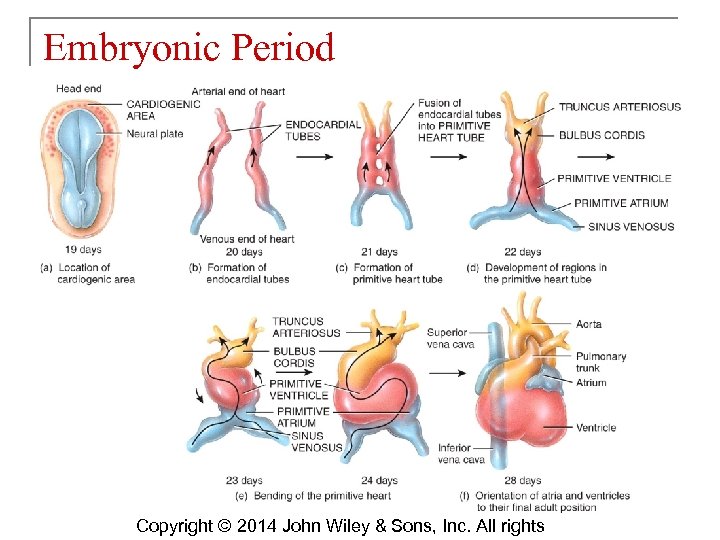
 Embryonic Period § On days 18 and 19, the heart begins to develop in the head end of the embryo. It begins in a region of mesodermal cells called the cardiogenic area. § A pair of endocardial tubes forms. § The tubes fuse to form a primitive heart tube. Copyright © 2014 John Wiley & Sons, Inc. All rights
 Embryonic Period Copyright © 2014 John Wiley & Sons, Inc. All rights
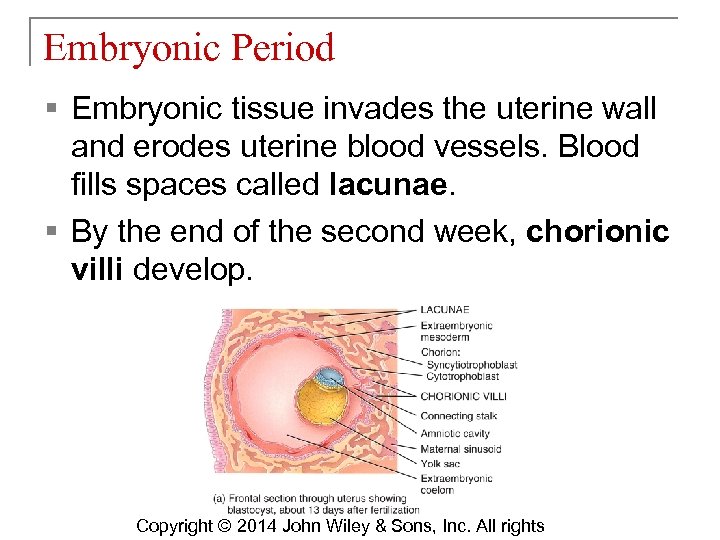 Embryonic Period § Embryonic tissue invades the uterine wall and erodes uterine blood vessels. Blood fills spaces called lacunae. § By the end of the second week, chorionic villi develop. Copyright © 2014 John Wiley & Sons, Inc. All rights
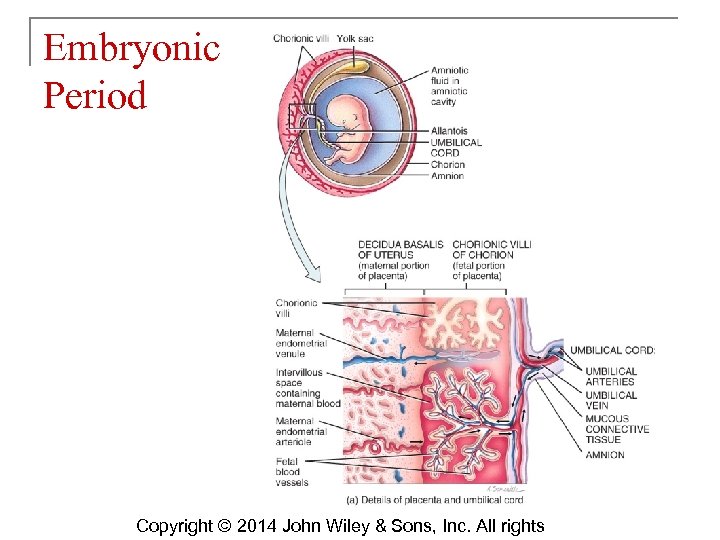
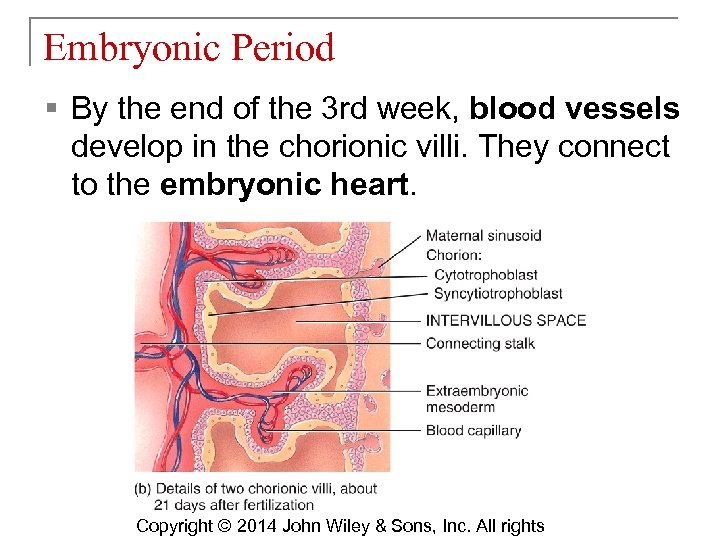 Embryonic Period § By the end of the 3 rd week, blood vessels develop in the chorionic villi. They connect to the embryonic heart. Copyright © 2014 John Wiley & Sons, Inc. All rights
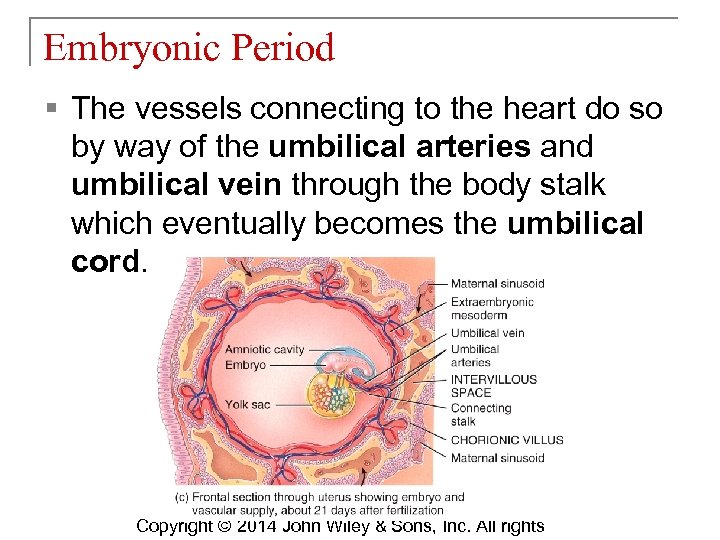 Embryonic Period § The vessels connecting to the heart do so by way of the umbilical arteries and umbilical vein through the body stalk which eventually becomes the umbilical cord. Copyright © 2014 John Wiley & Sons, Inc. All rights
 Embryonic Period § Placentation is the process of forming the placenta. This structure is the site of exchange of nutrients and wastes between the mother and fetus. § The placenta produces hormones used to sustain the pregnancy. Copyright © 2014 John Wiley & Sons, Inc. All rights
 Embryonic Period § By the beginning of the 12 th week, the placenta has two parts: 1. The fetal portion (chorionic villi) 2. The maternal portion (decidua basalis of the endometrium) Copyright © 2014 John Wiley & Sons, Inc. All rights
 Embryonic Period Copyright © 2014 John Wiley & Sons, Inc. All rights
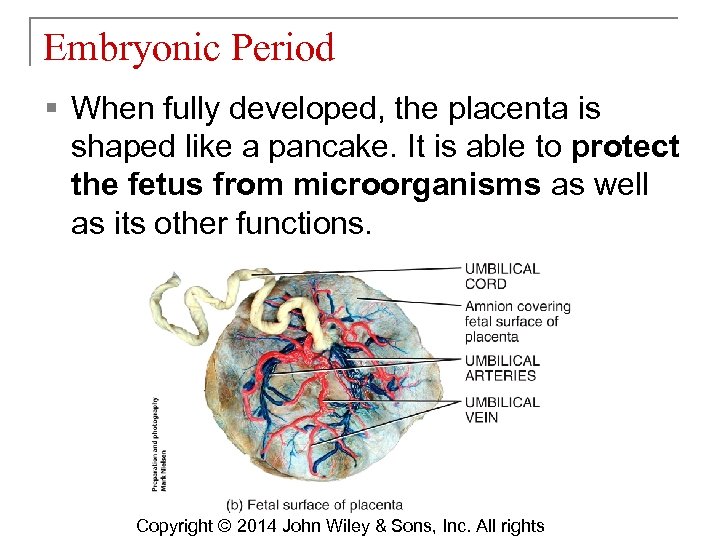 Embryonic Period § When fully developed, the placenta is shaped like a pancake. It is able to protect the fetus from microorganisms as well as its other functions. Copyright © 2014 John Wiley & Sons, Inc. All rights
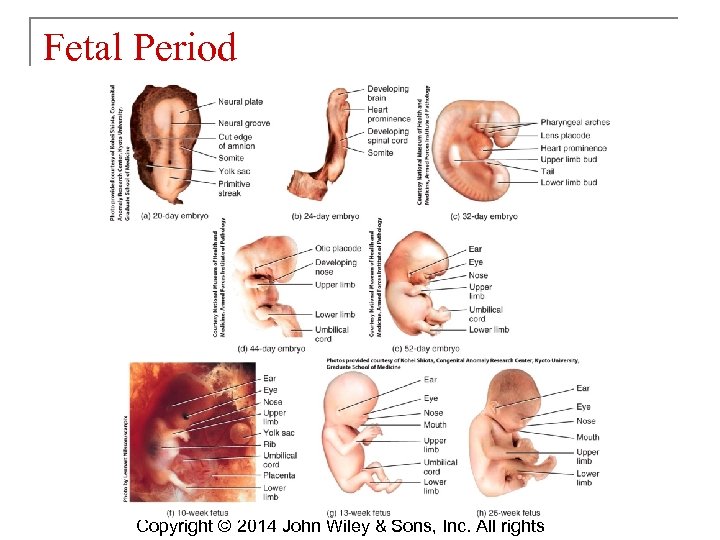
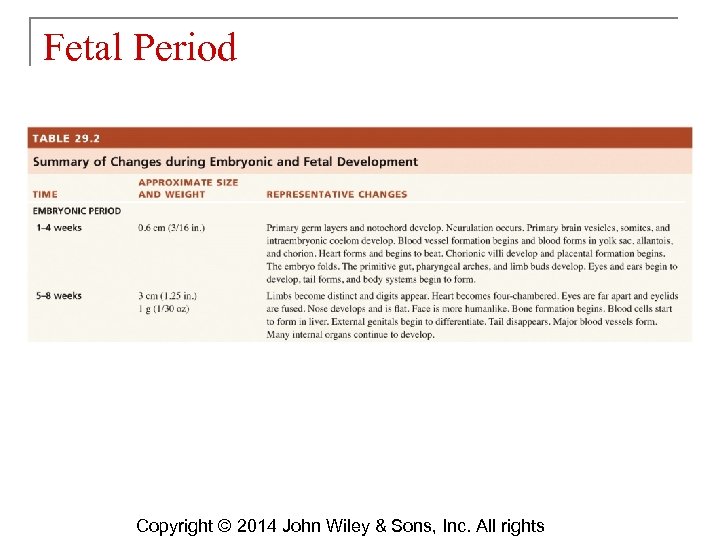
 Embryonic Period § All major organs develop between the 4 th through 8 th weeks (organogenesis). § Embryonic folding occurs during the 4 th week. This involves the flat embryo folding into a three-dimensional cylinder. Copyright © 2014 John Wiley & Sons, Inc. All rights
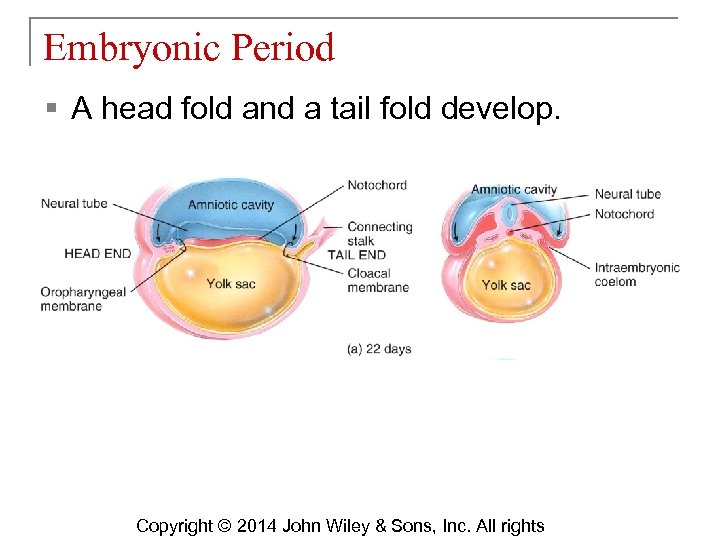 Embryonic Period § A head fold and a tail fold develop. Copyright © 2014 John Wiley & Sons, Inc. All rights
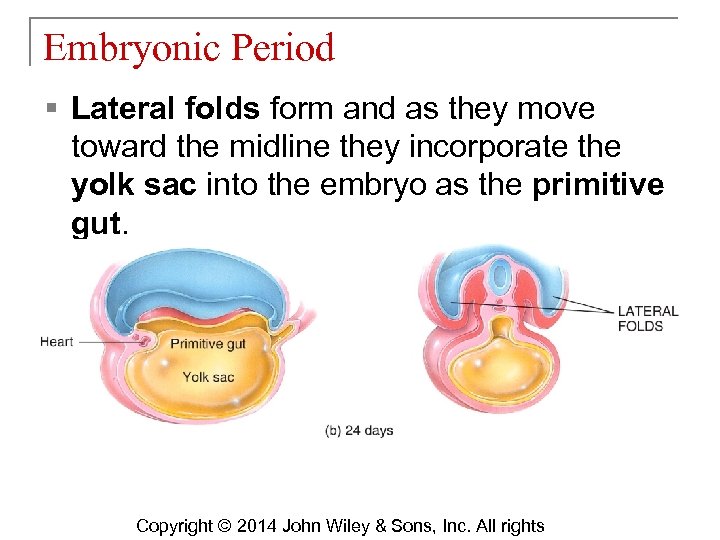 Embryonic Period § Lateral folds form and as they move toward the midline they incorporate the yolk sac into the embryo as the primitive gut. Copyright © 2014 John Wiley & Sons, Inc. All rights
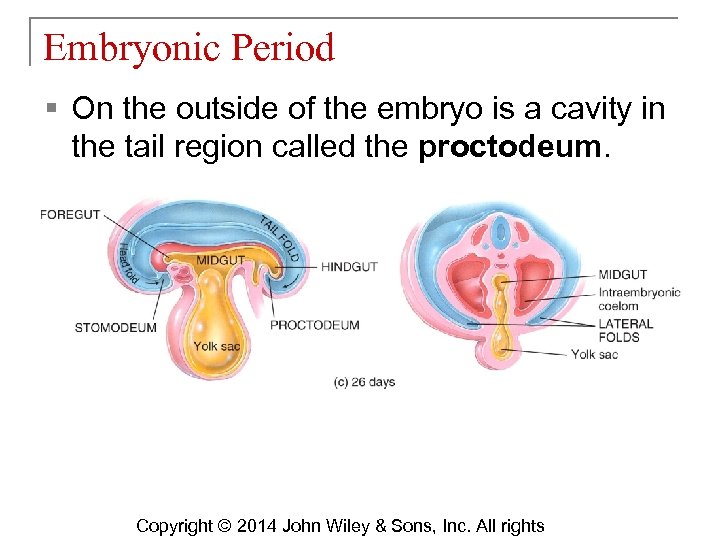 Embryonic Period § On the outside of the embryo is a cavity in the tail region called the proctodeum. Copyright © 2014 John Wiley & Sons, Inc. All rights
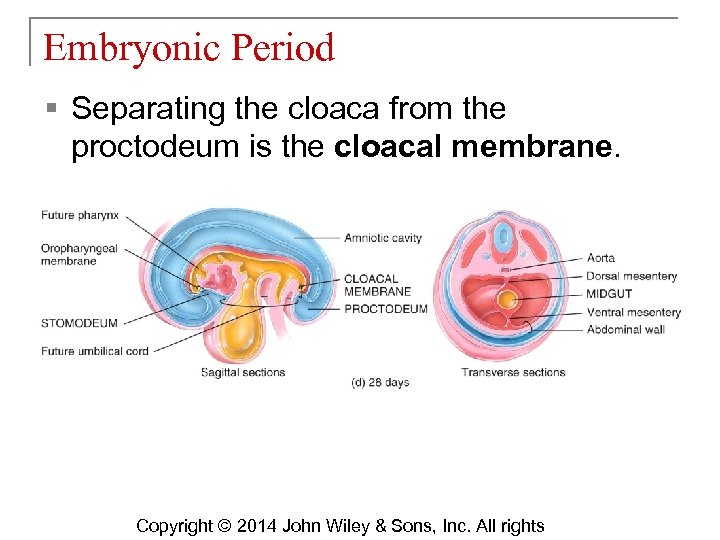 Embryonic Period § Separating the cloaca from the proctodeum is the cloacal membrane. Copyright © 2014 John Wiley & Sons, Inc. All rights
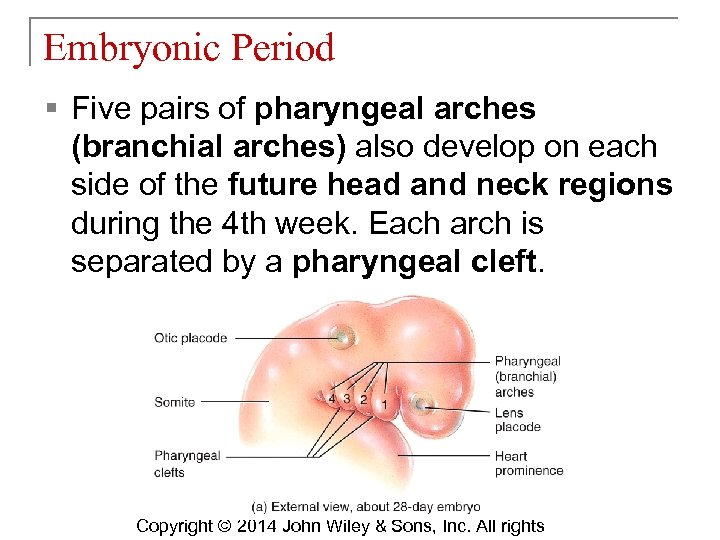 Embryonic Period § Five pairs of pharyngeal arches (branchial arches) also develop on each side of the future head and neck regions during the 4 th week. Each arch is separated by a pharyngeal cleft. Copyright © 2014 John Wiley & Sons, Inc. All rights
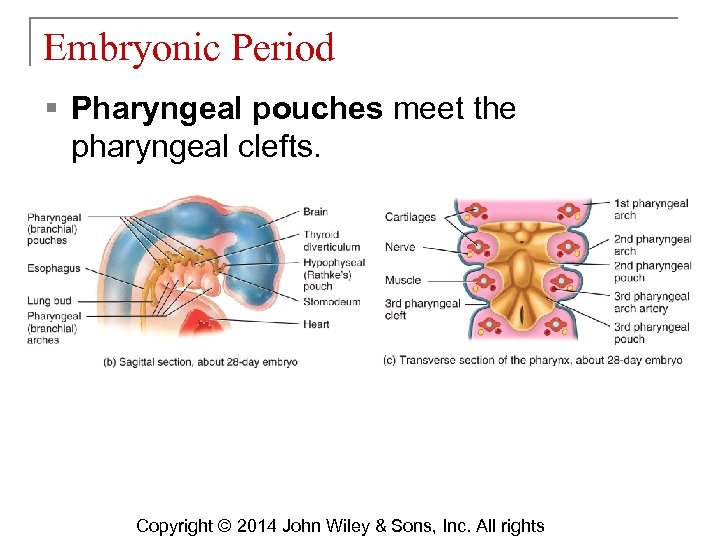 Embryonic Period § Pharyngeal pouches meet the pharyngeal clefts. Copyright © 2014 John Wiley & Sons, Inc. All rights
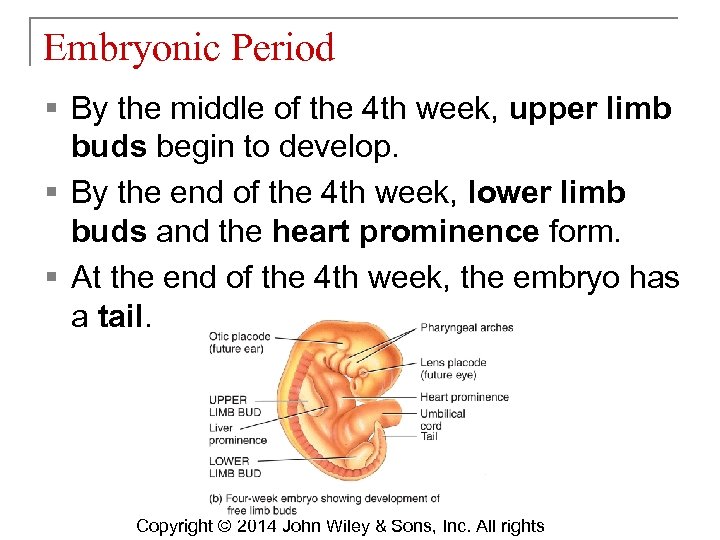 Embryonic Period § By the middle of the 4 th week, upper limb buds begin to develop. § By the end of the 4 th week, lower limb buds and the heart prominence form. § At the end of the 4 th week, the embryo has a tail. Copyright © 2014 John Wiley & Sons, Inc. All rights
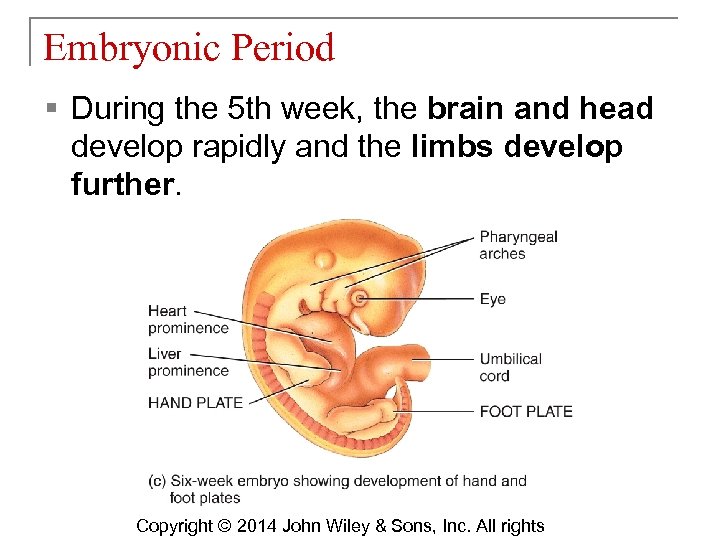 Embryonic Period § During the 5 th week, the brain and head develop rapidly and the limbs develop further. Copyright © 2014 John Wiley & Sons, Inc. All rights
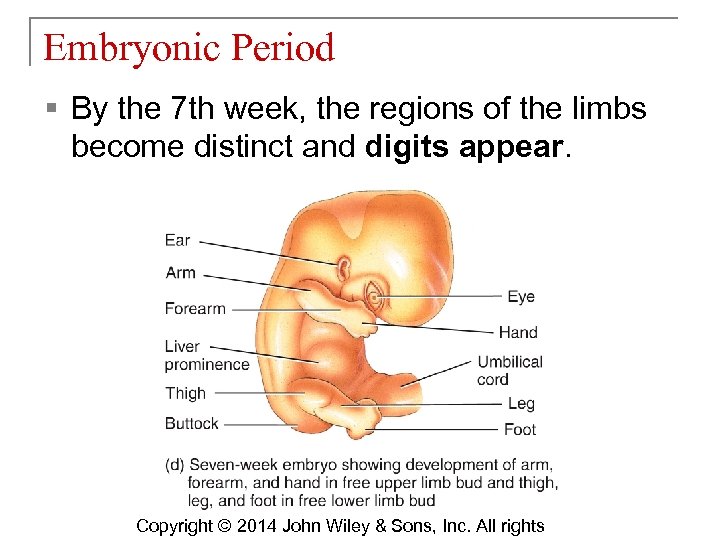 Embryonic Period § By the 7 th week, the regions of the limbs become distinct and digits appear. Copyright © 2014 John Wiley & Sons, Inc. All rights
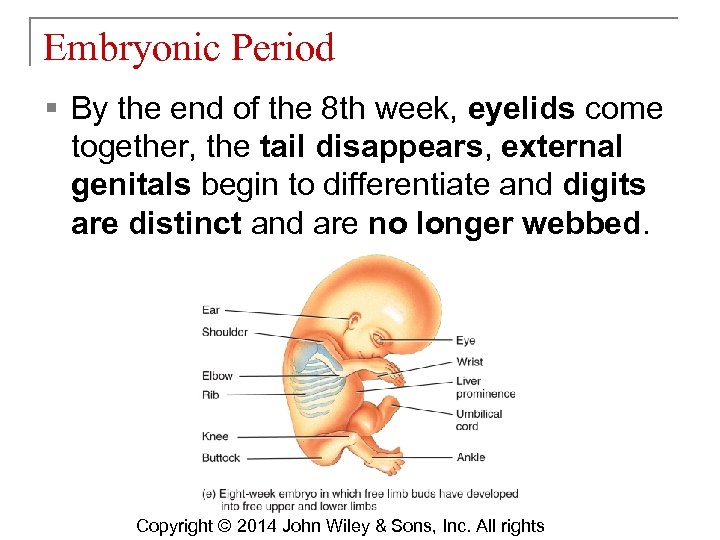 Embryonic Period § By the end of the 8 th week, eyelids come together, the tail disappears, external genitals begin to differentiate and digits are distinct and are no longer webbed. Copyright © 2014 John Wiley & Sons, Inc. All rights
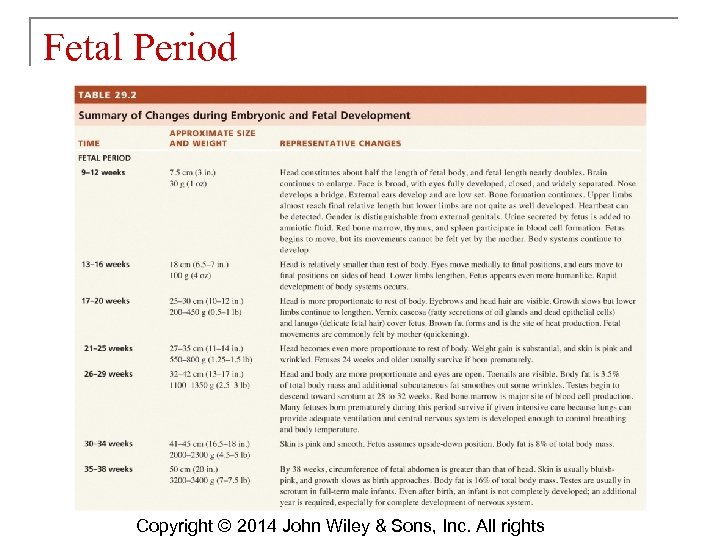
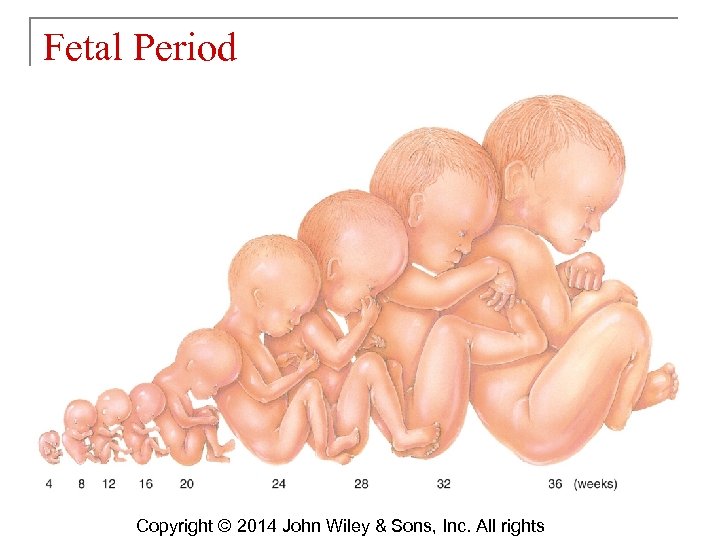
 Fetal Period § The fetal period begins at the 9 th week after fertilization. § Tissues and organs that developed during the embryonic period grow and differentiate. § Very few new structures appear during this period. Copyright © 2014 John Wiley & Sons, Inc. All rights
 Fetal Period Copyright © 2014 John Wiley & Sons, Inc. All rights
 Fetal Period Copyright © 2014 John Wiley & Sons, Inc. All rights
 Fetal Period Copyright © 2014 John Wiley & Sons, Inc. All rights
 Fetal Period Copyright © 2014 John Wiley & Sons, Inc. All rights
 Fertilization and Development Interactions Animation: n Fertilization and Development You must be connected to the Internet and in Slideshow Mode to run this animation. Copyright © 2014 John Wiley & Sons, Inc. All rights
 Teratogens § Any agent or influence that is able to cause developmental defects in an embryo or fetus is a teratogen. § Any number of chemicals and drugs may be considered teratogens. Alcohol is the most common (fetal alcohol syndrome). § Others include viruses, industrial chemicals, some hormones, antibiotics, cocaine and many others. Copyright © 2014 John Wiley & Sons, Inc. All rights
 Teratogens § Cigarette smoking during pregnancy has also been implicated as a cause of low infant birth weight, cardiac abnormalities, anencephaly and higher infant and fetal mortality rates. § Ionizing radiation in many forms is also teratogenic. Exposure of the mother to xrays or radioactive isotopes during pregnancy may cause microcephaly (small head), mental retardation and skeletal deformities. Copyright © 2014 John Wiley & Sons, Inc. All rights
 Prenatal Diagnostic Tests § During pregnancy, several medical tests are used to detect fetal abnormalities, genetic disorders and well-being. § Fetal ultrasonography is used to determine a more accurate fetal age when the date of conception is in doubt. § It is also used to confirm pregnancy, determine fetal position, identify multiple pregnancies and other uses. Copyright © 2014 John Wiley & Sons, Inc. All rights
 Prenatal Diagnostic Tests § Amniocentesis involves removing some amniotic fluid surrounding the developing fetus and analyzing it and fetal cells for genetic abnormalities. It is usually performed between 14– 18 weeks. § The needle used to collect the fluid is guided by ultrasound to avoid damage to the fetus or umbilical cord. Copyright © 2014 John Wiley & Sons, Inc. All rights
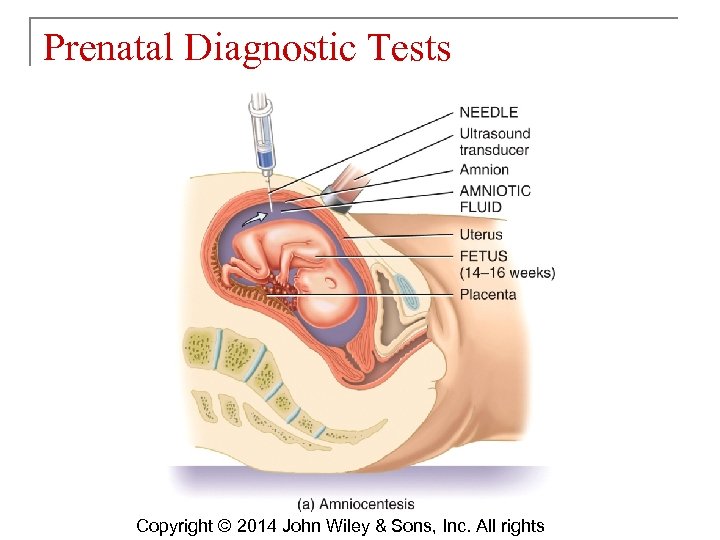 Prenatal Diagnostic Tests Copyright © 2014 John Wiley & Sons, Inc. All rights
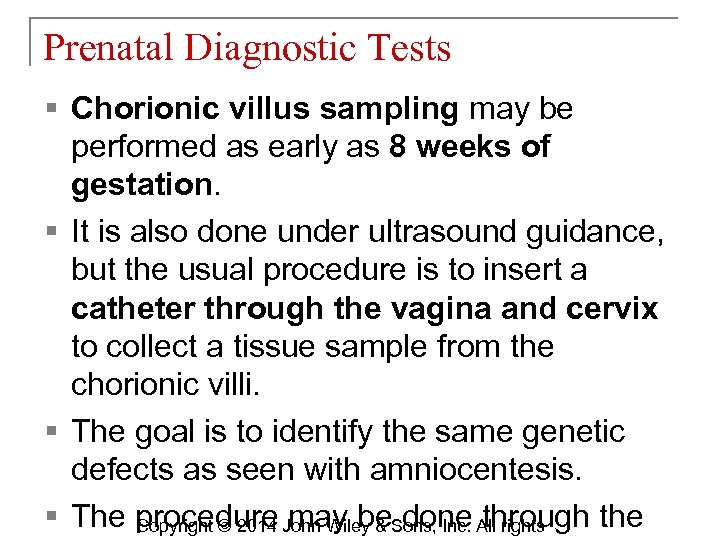 Prenatal Diagnostic Tests § Chorionic villus sampling may be performed as early as 8 weeks of gestation. § It is also done under ultrasound guidance, but the usual procedure is to insert a catheter through the vagina and cervix to collect a tissue sample from the chorionic villi. § The goal is to identify the same genetic defects as seen with amniocentesis. § The procedure John Wiley & Sons, Inc. All rights Copyright © 2014 may be done through the
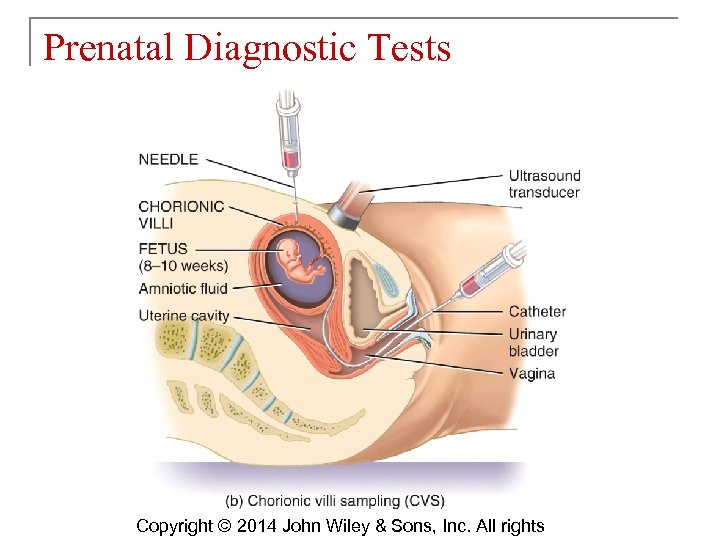 Prenatal Diagnostic Tests Copyright © 2014 John Wiley & Sons, Inc. All rights
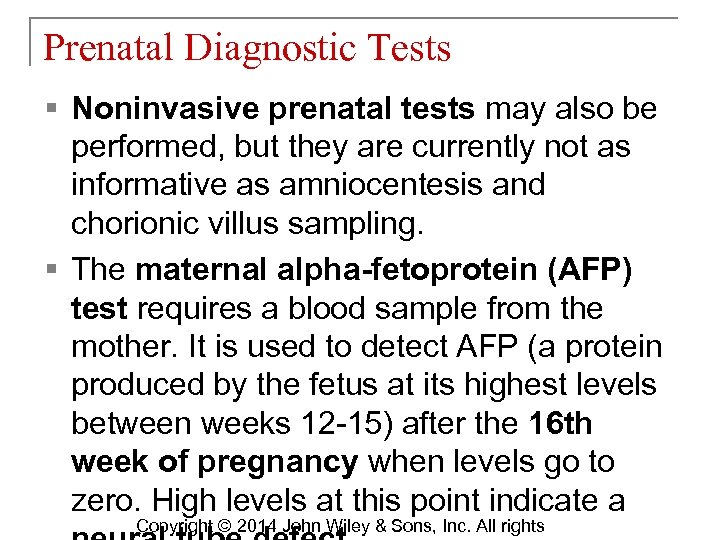 Prenatal Diagnostic Tests § Noninvasive prenatal tests may also be performed, but they are currently not as informative as amniocentesis and chorionic villus sampling. § The maternal alpha-fetoprotein (AFP) test requires a blood sample from the mother. It is used to detect AFP (a protein produced by the fetus at its highest levels between weeks 12 -15) after the 16 th week of pregnancy when levels go to zero. High levels at this point indicate a Copyright © 2014 John Wiley & Sons, Inc. All rights
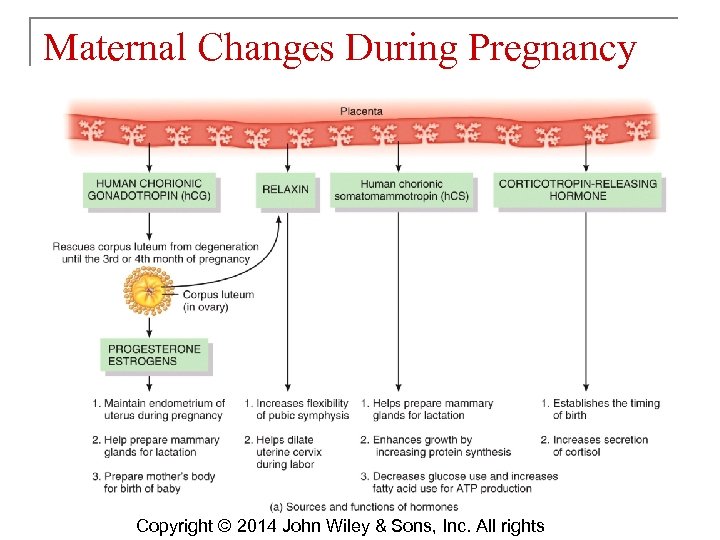
 Maternal Changes During Pregnancy § During the first 3 to 4 months of pregnancy, the corpus luteum secretes progesterone and estrogens in low levels. § From the 3 rd month to the end of the pregnancy, the placenta produces high levels of these hormones. § The chorion secretes human chorionic gonadotropin (h. CG) to stimulate the corpus luteum to produce estrogens and progesterone to inhibit menstruation until Copyright © 2014 John Wiley & Sons, Inc. All rights
 Maternal Changes During Pregnancy Copyright © 2014 John Wiley & Sons, Inc. All rights
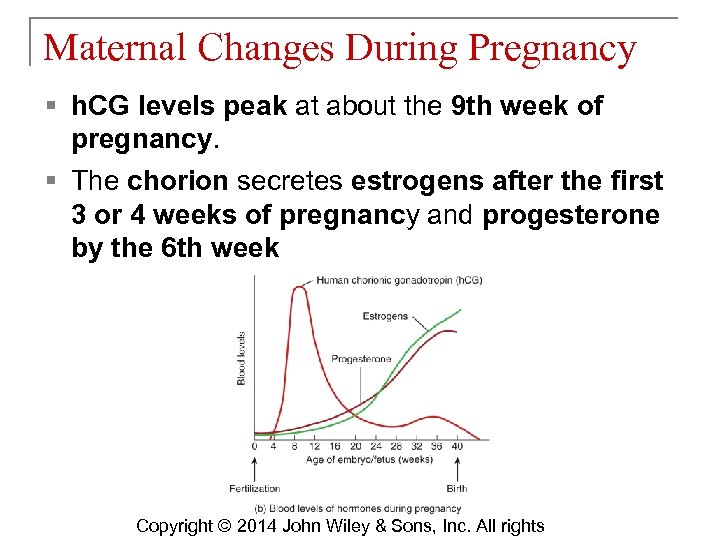 Maternal Changes During Pregnancy § h. CG levels peak at about the 9 th week of pregnancy. § The chorion secretes estrogens after the first 3 or 4 weeks of pregnancy and progesterone by the 6 th week Copyright © 2014 John Wiley & Sons, Inc. All rights
 Maternal Changes During Pregnancy § Relaxin is secreted by the corpus luteum and later by the placenta. It increases flexibility of the pubic symphysis and ligaments of the sacroiliac and sacrococcygeal joints and also helps dilate cervix during labor. § Human chorionic somatomammotropin (h. CS), also known as human placental lactogen (h. PL), probably helps prepare the mammary glands for lactation, helps Copyright © 2014 John Wiley & Sons, Inc. All rights
 Maternal Changes During Pregnancy § The hormone recently discovered to be secreted by the placenta is corticotropinreleasing hormone (CRH). It is secreted in nonpregnant people by the hypothalamus. It is involved in the timing of birth. § CRH is also needed to increase secretion of cortisol which is needed for maturation of fetal lungs and production of surfactant. Copyright © 2014 John Wiley & Sons, Inc. All rights
 Maternal Changes During Pregnancy § The uterus continues to expand throughout the pregnancy moving upward into the abdominal cavity until it almost fills it. § The organs are pushed out of the way and pressure on the stomach may cause food to be displaced causing heartburn. Copyright © 2014 John Wiley & Sons, Inc. All rights
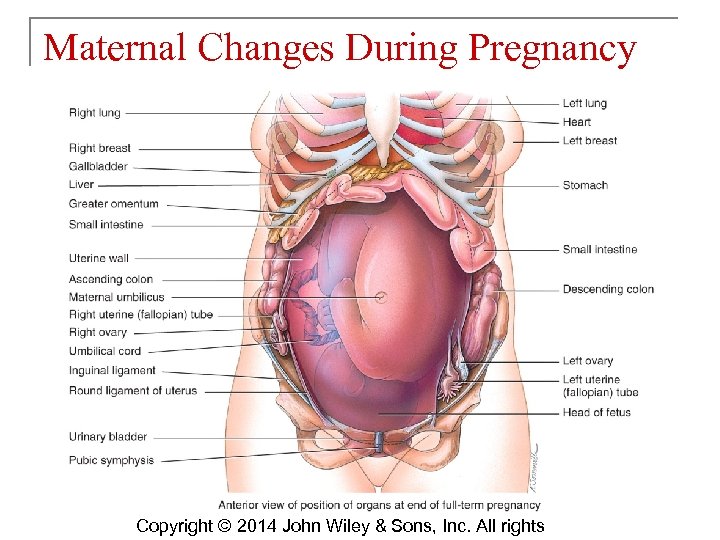 Maternal Changes During Pregnancy Copyright © 2014 John Wiley & Sons, Inc. All rights
 Hormonal Regulation of Pregnancy and Childbirth Interactions Animation: n Hormonal Regulation of Pregnancy and Childbirth You must be connected to the Internet and in Slideshow Mode to run this animation. Copyright © 2014 John Wiley & Sons, Inc. All rights
 Exercise and Pregnancy § Different factors during pregnancy may interfere with the ability to exercise. § In early pregnancy, the mother tires easily and may suffer from morning sickness. § Weight increases and posture changes as the pregnancy continues. § Increased relaxin levels cause a change in gait. Copyright © 2014 John Wiley & Sons, Inc. All rights
 Labor § Labor is the process that expels the fetus from the uterus through the vagina. § Labor is initiated by the interaction of several hormones. § Control of contractions occurs via a positive feedback cycle. Copyright © 2014 John Wiley & Sons, Inc. All rights
 Labor § True labor begins when uterine contractions occur at regular intervals. § False labor is associated with irregular contractions and no “show” (a discharge of blood with mucus). § True labor is divided into three stages: 1. Stage of dilation 2. Stage of expulsion 3. Placental stage Copyright © 2014 John Wiley & Sons, Inc. All rights
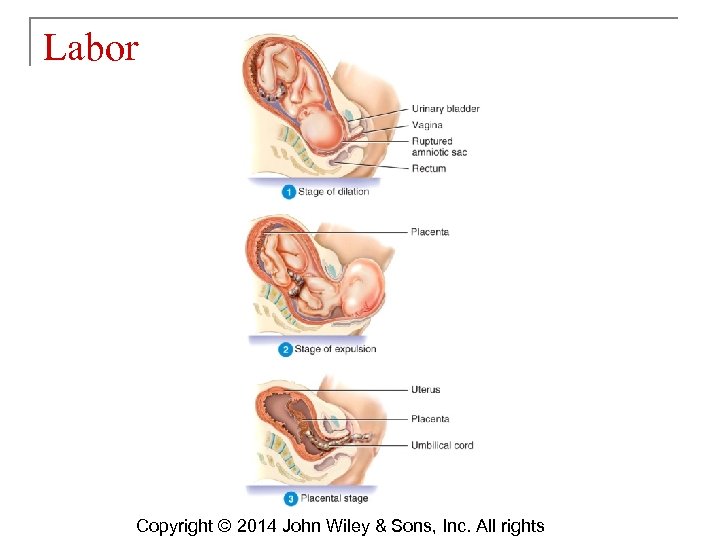 Labor Copyright © 2014 John Wiley & Sons, Inc. All rights
 Labor § Following delivery, it takes about 6 weeks for the maternal reproductive organs and physiology to return to the prepregnancy state. This period is the puerperium. § The reduction in size of the uterus is involution. Copyright © 2014 John Wiley & Sons, Inc. All rights
 Adjustments of the Infant at Birth § During development, the baby is totally dependent on the mother for survival. § At birth, the fully developed newborn body begins to function independently. § At birth, the lungs are able to exchange oxygen and carbon dioxide thanks to surfactant that began to develop by the end of the 6 th month. § The respiratory rate & Sons, Inc. All rights breaths at birth is 45 Copyright © 2014 John Wiley
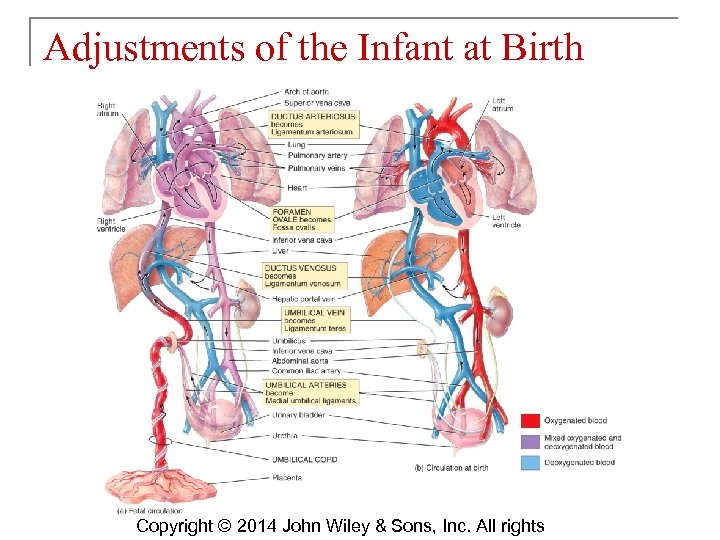
 Adjustments of the Infant at Birth After the baby’s first breath, many changes must be made in the cardiovascular system over time. § The foramen ovale closes to become the fossa ovalis. § The ductus arteriosus closes to become the ligamentum arteriosum. § The umbilical arteries fill with connective tissue. § The umbilical vein becomes the Copyright © 2014 John Wiley Sons, Inc. All rights ligamentum teres of&the liver.
 Adjustments of the Infant at Birth Copyright © 2014 John Wiley & Sons, Inc. All rights
 The Physiology of Lactation § Lactation is the production and ejection of milk from the mammary glands. § Prolactin (PRL) (secreted by the anterior pituitary gland) is the main hormone in stimulating milk production. § Oxytocin causes release of milk into the mammary ducts via the milk ejection reflex. Copyright © 2014 John Wiley & Sons, Inc. All rights
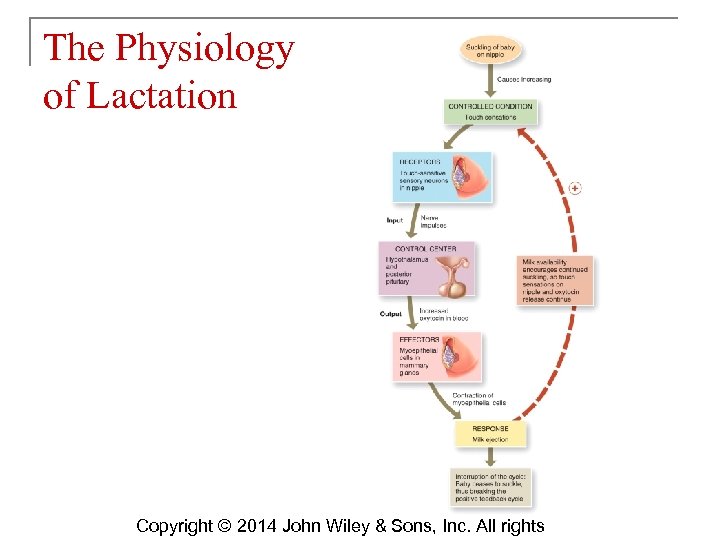 The Physiology of Lactation Copyright © 2014 John Wiley & Sons, Inc. All rights
 The Physiology of Lactation § There are benefits associated with breast feeding an infant: § The chemical composition of mother’s milk is ideal for the baby’s brain development, growth and digestion. § Several types of white blood cells (for immunity) are in the milk. § Antibodies are present. § Breast feeding supports optimal infant growth. § Breast feeding leads to a reduction in several Copyright © 2014 John Wiley & Sons, Inc. All rights
 Inheritance § Inheritance is the passage of hereditary traits from one generation to the next. Genetics is the study of inheritance. § Humans have 23 pairs of homologous chromosomes; one in each pair from the father and one from the mother. § Genes for the same trait that are in the same location on each homologue are alleles. § A mutation is a permanent heritable change in © 2014 John Wiley & Sons, Inc. All rights Copyright an allele.
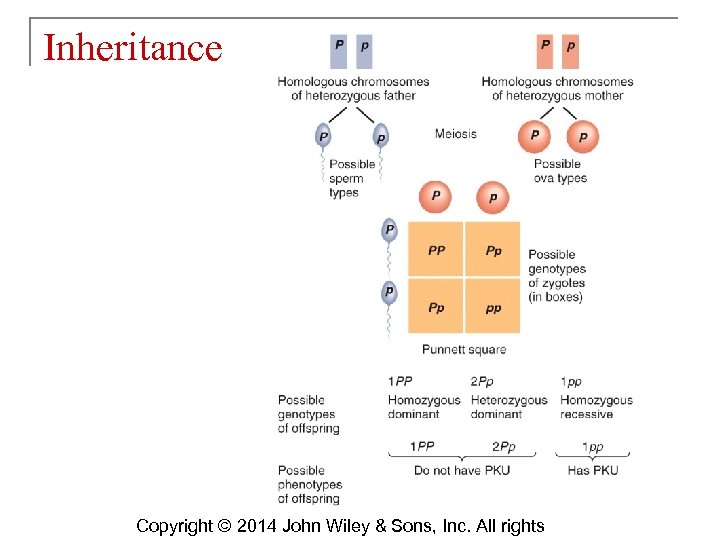
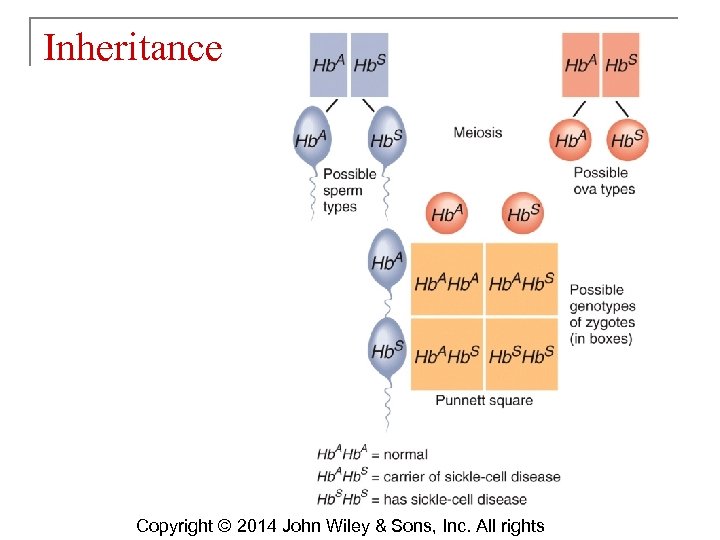
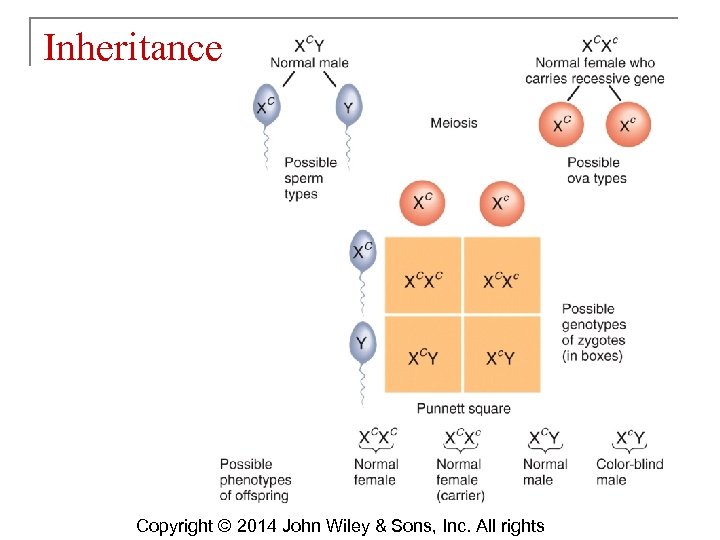
 Inheritance § One genetic disorder caused by a mutation is phenylketonuria (PKU). § People with PKU cannot make the enzyme phenylalanine hydroxylase which is needed to break down phenylalanine. § A Punnett square is used to show the possible genes inherited from two parents. Copyright © 2014 John Wiley & Sons, Inc. All rights
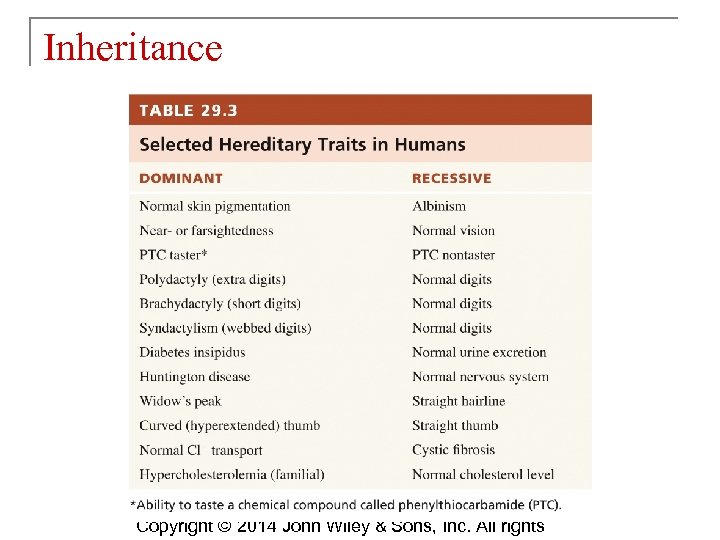
 Inheritance § The genotype is the actual genetic makeup relating to a trait. § An allele that dominates or masks the presence of another allele is a dominant allele (represented by an upper case letter) § The allele whose presence is completely masked is the recessive allele (represented by a lower case letter). § Phenotype is the physical expression of the genotype. John Wiley & Sons, Inc. All rights Copyright © 2014
 Inheritance Copyright © 2014 John Wiley & Sons, Inc. All rights
 Inheritance Copyright © 2014 John Wiley & Sons, Inc. All rights
 Inheritance § Most patterns of inheritance don’t conform to the simple dominant-recessive inheritance pattern. § Incomplete dominance is a situation where neither member of the pair of alleles is dominant over the other. § An example of incomplete dominance is the inheritance of sickle cell anemia. Copyright © 2014 John Wiley & Sons, Inc. All rights
 Inheritance Copyright © 2014 John Wiley & Sons, Inc. All rights
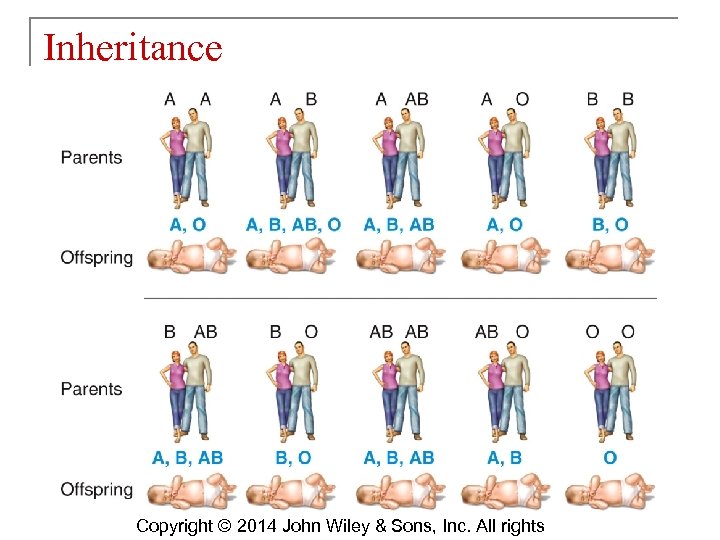
 Inheritance § Multiple-allele inheritance occurs when genes have more than two alternative forms. § Inheritance of the ABO blood group is an example of this. § Within this inheritance pattern there is also codominance. In this case, two genes (type A and type B blood) are expressed equally. Copyright © 2014 John Wiley & Sons, Inc. All rights
 Inheritance Copyright © 2014 John Wiley & Sons, Inc. All rights
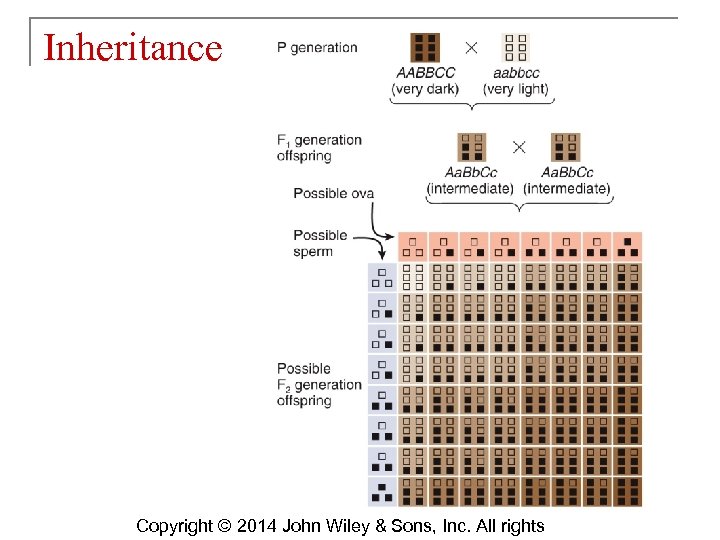
 Inheritance § Polygenic inheritance is seen when a trait is controlled by the combined effects of two or more genes. § Complex inheritance is seen when a trait occurs due to the combined effects of many genes and environmental factors. Copyright © 2014 John Wiley & Sons, Inc. All rights
 Inheritance § Examples of complex traits include: § § § Skin color Hair color Eye color Height Metabolic rate Body build Copyright © 2014 John Wiley & Sons, Inc. All rights
 Inheritance Copyright © 2014 John Wiley & Sons, Inc. All rights
 Inheritance § The 46 human chromosomes (23 pairs) are identified by their size, shape and staining pattern. § An entire set of chromosomes arranged in decreasing size order and according to the position of the centromere, is called a karyotype. Copyright © 2014 John Wiley & Sons, Inc. All rights
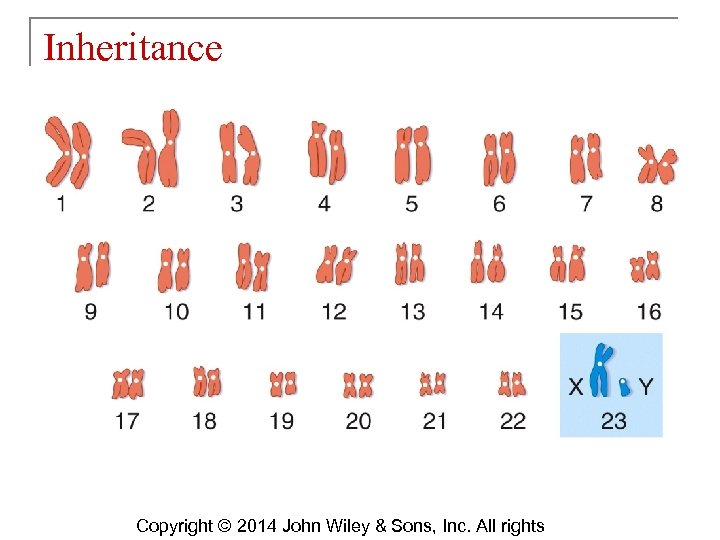 Inheritance Copyright © 2014 John Wiley & Sons, Inc. All rights
 Inheritance § The 23 pairs of human chromosomes include 22 pairs of autosomes and one pair of sex chromosomes (X and Y). § Males have an X and a Y chromosome. § Females have two X chromosomes (one is automatically inactivated—Xchromosome inactivation—and becomes a Barr body). § Whether the sperm that will fertilize an egg is carrying ©an X or. Wiley. Y Sons, Inc. All rights will Copyright 2014 John a & chromosome
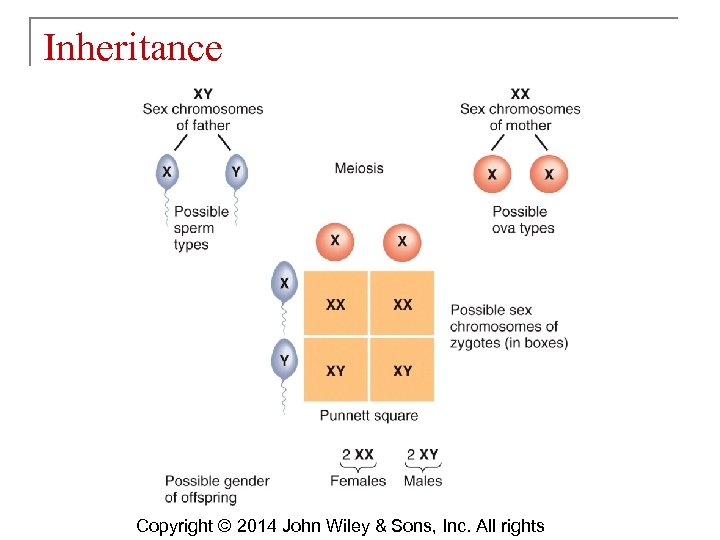 Inheritance Copyright © 2014 John Wiley & Sons, Inc. All rights
 Inheritance § Some non-sexual traits are inherited on the X chromosome. These are called sexlinked traits. § Red-green color blindness is an example of a sex-linked trait. Copyright © 2014 John Wiley & Sons, Inc. All rights
 Inheritance Copyright © 2014 John Wiley & Sons, Inc. All rights
 End of Chapter 29 § Copyright 2014 John Wiley & Sons, Inc. § All rights reserved. Reproduction or translation of this work beyond that permitted in section 117 of the 1976 United States Copyright Act without express permission of the copyright owner is unlawful. Request for further information should be addressed to the Permission Department, John Wiley & Sons, Inc. The Copyright © 2014 John Wiley & Sons, Inc. All rights