


 Скачать презентацию Principles and Parameters II Rajat Kumar Mohanty rkm cse
07cf951b1f5eb3ef278fa995250e78ab.ppt
- Количество слайдов: 27
 Principles and Parameters (II) Rajat Kumar Mohanty rkm@cse. iitb. ac. in Department of Computer Science and Engineering Indian Institute of Technology Bombay
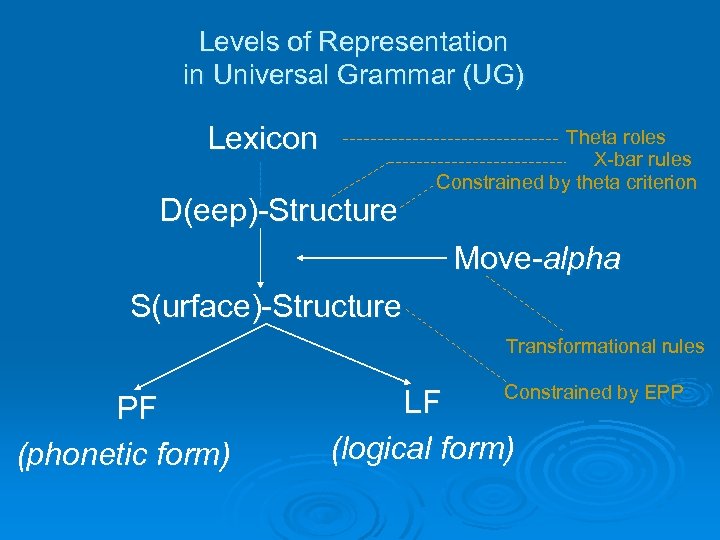 Levels of Representation in Universal Grammar (UG) Lexicon D(eep)-Structure Theta roles X-bar rules Constrained by theta criterion Move-alpha S(urface)-Structure Transformational rules PF (phonetic form) Constrained by EPP LF (logical form)
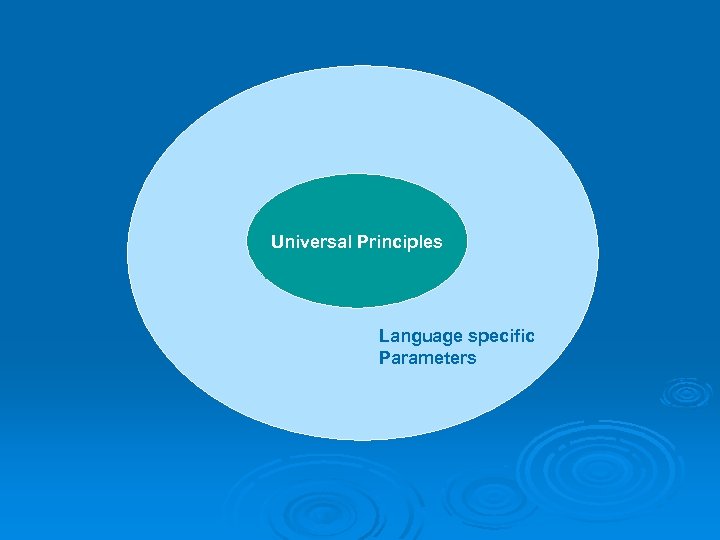 Universal Principles Language specific Parameters
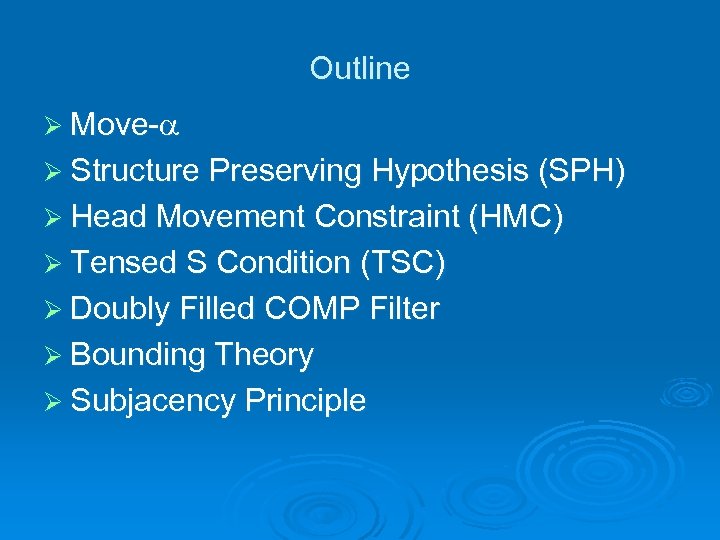 Outline Ø Move- Ø Structure Preserving Hypothesis (SPH) Ø Head Movement Constraint (HMC) Ø Tensed S Condition (TSC) Ø Doubly Filled COMP Filter Ø Bounding Theory Ø Subjacency Principle
 D-structure to S-structure Ø Move- : Move any constituent anywhere (subject to other constraints) Ø S-structure: the actual word order in a sentence Ø D-structure is mapped onto S-structure by the function Move-
 Move- Ø Movement: Bounded / Unbounded Ø Bounded movement rearranges the argument structure of a verb and is confined to a minimal clause. Ø Unbounded movement does not affect the argument structure.
 Move- Ø Types of movement l l Ø NP-movement Wh-movement V-raising I-raising Restrictions l l l Only maximal or zero-level categories can move For maximal categories, movement must be from an Aposition. It must be to a position that is not -marked. For zero-level categories, Head Movement Constraint must be satisfied.
 Structure Preserving Hypothesis (SPH) Ø SPH forces head categories to move to head positions and maximal projections to maximal (spec) positions. Ø Examples l l Which car will John fix? *Will which car John fix?
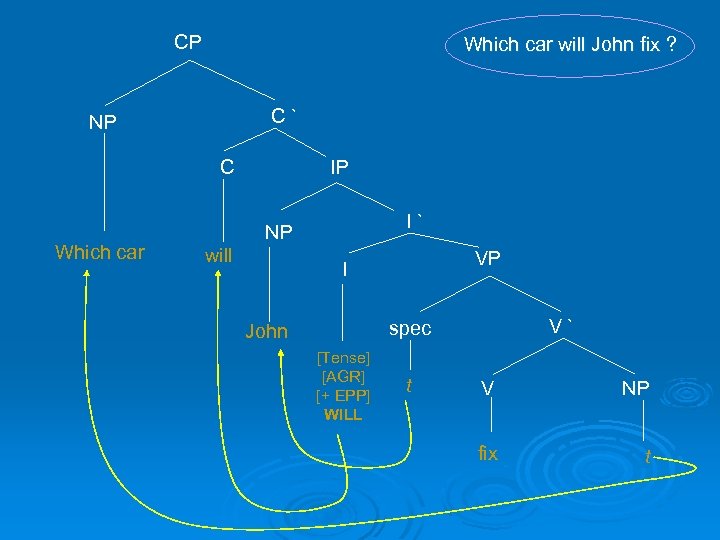 CP Which car will John fix ? C` NP IP C Which car I` NP will VP I V` spec John [Tense] [AGR] [+ EPP] WILL t V NP fix t
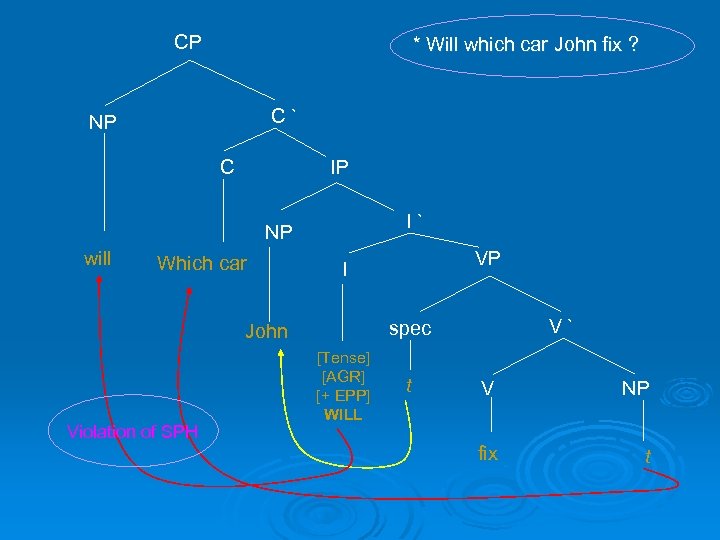 CP * Will which car John fix ? C` NP IP C I` NP will Which car V` spec John Violation of SPH VP I [Tense] [AGR] [+ EPP] WILL t V NP fix t
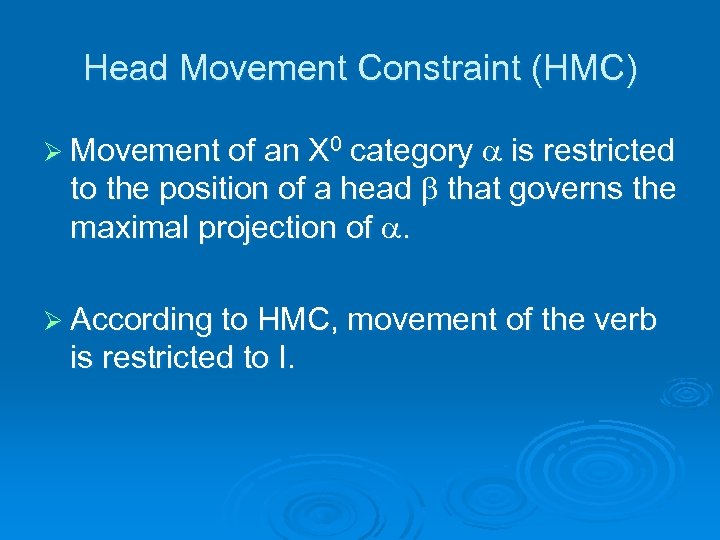 Head Movement Constraint (HMC) category is restricted to the position of a head that governs the maximal projection of . Ø Movement of an X 0 Ø According to HMC, movement of the verb is restricted to I.
![The ship sank IP I` NP The ship VP I [Tense] [AGR] [+ EPP]](https://present5.com/presentation/07cf951b1f5eb3ef278fa995250e78ab/image-12.jpg "The ship sank IP I` NP The ship VP I [Tense] [AGR] [+ EPP]") The ship sank IP I` NP The ship VP I [Tense] [AGR] [+ EPP] V` V-raising V sink Unaccusative Movement NP ti
The ship sank IP I` NP The ship VP I [Tense] [AGR] [+ EPP] V` V-raising V sink Unaccusative Movement NP ti
![IP I` NP N` John seems to be happy. I spec N [Tense] [AGR]](https://present5.com/presentation/07cf951b1f5eb3ef278fa995250e78ab/image-13.jpg "IP I` NP N` John seems to be happy. I spec N [Tense] [AGR]") IP I` NP N` John seems to be happy. I spec N [Tense] [AGR] [+ EPP] Tensed S Condition (TSC): Move an NP to an empty position provided the NP is not contained in a tensed S. VP V` V IP John e seem I` ti I [Tense] [AGR] [+ EPP] TO VP V` ti V be AP happy
IP I` NP N` John seems to be happy. I spec N [Tense] [AGR] [+ EPP] Tensed S Condition (TSC): Move an NP to an empty position provided the NP is not contained in a tensed S. VP V` V IP John e seem I` ti I [Tense] [AGR] [+ EPP] TO VP V` ti V be AP happy
![IP I` NP N` It seems that John is happy. I spec N [Tense]](https://present5.com/presentation/07cf951b1f5eb3ef278fa995250e78ab/image-14.jpg "IP I` NP N` It seems that John is happy. I spec N [Tense]") IP I` NP N` It seems that John is happy. I spec N [Tense] [AGR] [+ EPP] Tensed S Condition (TSC): Move an NP to an empty position provided the NP is not contained in a tensed S. VP V` V CP It e seem C` spec C IP that John is happy
IP I` NP N` It seems that John is happy. I spec N [Tense] [AGR] [+ EPP] Tensed S Condition (TSC): Move an NP to an empty position provided the NP is not contained in a tensed S. VP V` V CP It e seem C` spec C IP that John is happy
![The ball was kicked IP I` NP The ball VP I [Tense] [AGR] [+](https://present5.com/presentation/07cf951b1f5eb3ef278fa995250e78ab/image-15.jpg "The ball was kicked IP I` NP The ball VP I [Tense] [AGR] [+") The ball was kicked IP I` NP The ball VP I [Tense] [AGR] [+ EPP] BE + -EN V` V kick Passivization NP ti
The ball was kicked IP I` NP The ball VP I [Tense] [AGR] [+ EPP] BE + -EN V` V kick Passivization NP ti
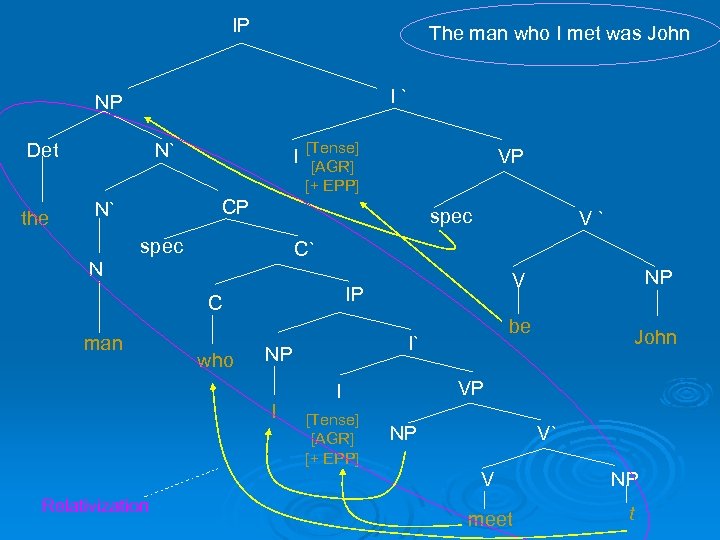 IP The man who I met was John I` NP Det the N` I [Tense] [AGR] [+ EPP] VP CP N` spec C` N who I be I` NP NP V` V Relativization John VP I [Tense] [AGR] [+ EPP] NP V IP C man V` meet NP t
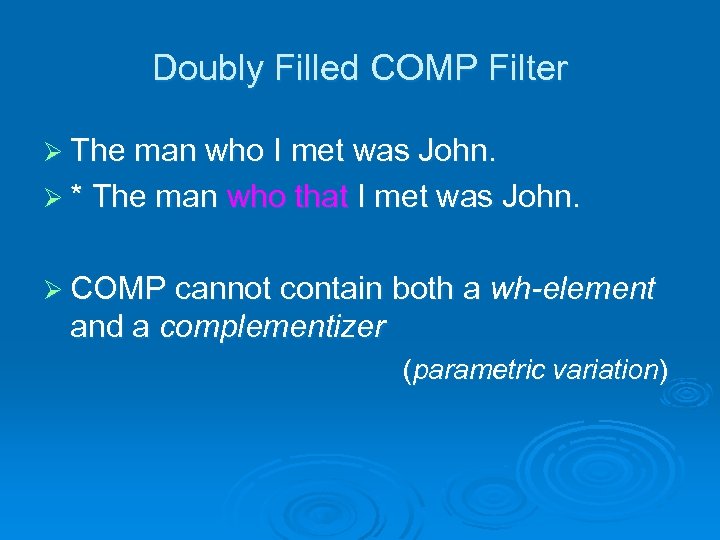 Doubly Filled COMP Filter Ø The man who I met was John. Ø * The man who that I met was John. Ø COMP cannot contain both a wh-element and a complementizer (parametric variation)
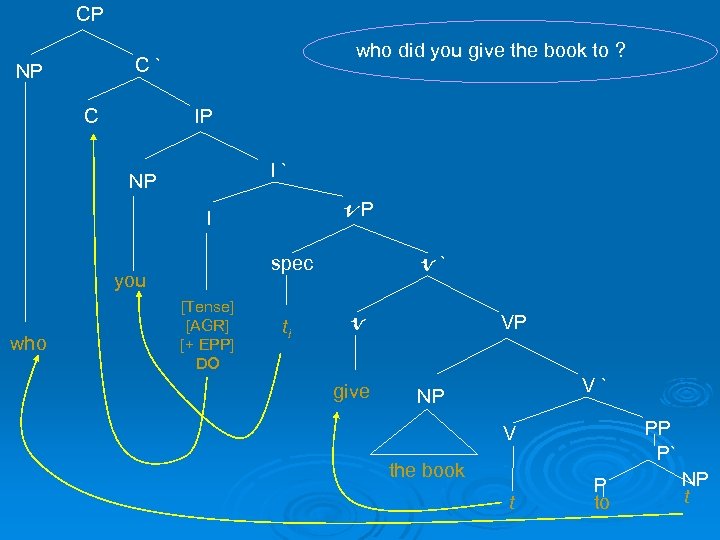 CP who did you give the book to ? C` NP IP C I` NP v. P I you who v` spec [Tense] [AGR] [+ EPP] DO ti v give VP V` NP PP P` V the book t P to NP t
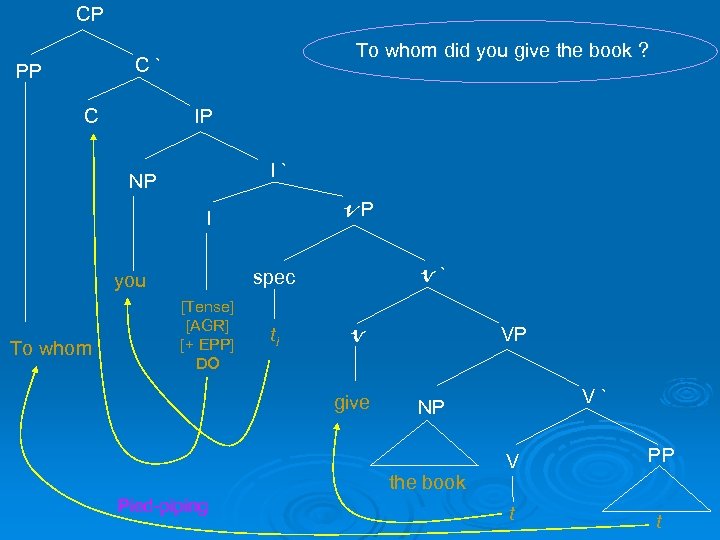 CP To whom did you give the book ? C` PP IP C I` NP v. P I To whom v` spec you [Tense] [AGR] [+ EPP] DO ti v give VP the book Pied-piping V` NP V PP t t
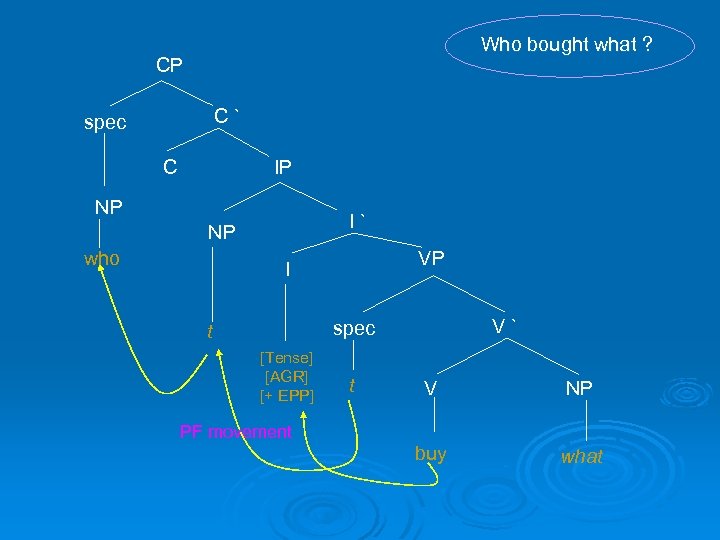 Who bought what ? CP C` spec IP C NP I` NP who VP I V` spec t [Tense] [AGR] [+ EPP] PF movement t V NP buy what
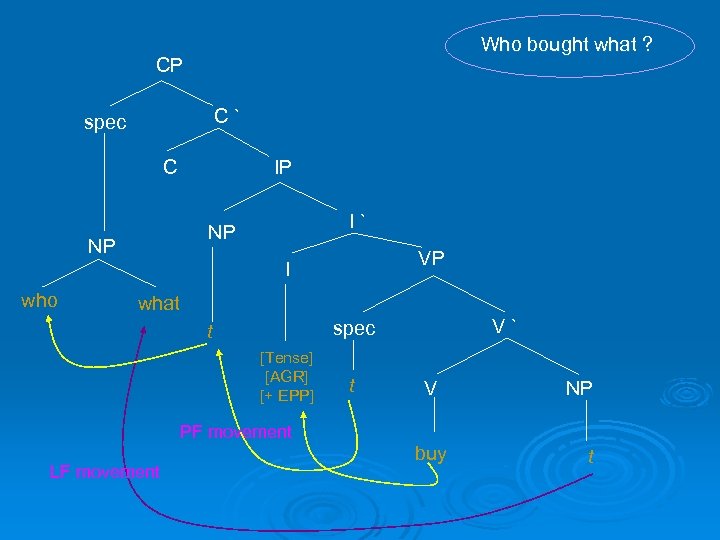 Who bought what ? CP C` spec IP C I` NP NP VP I who what [Tense] [AGR] [+ EPP] PF movement LF movement V` spec t t V buy NP t
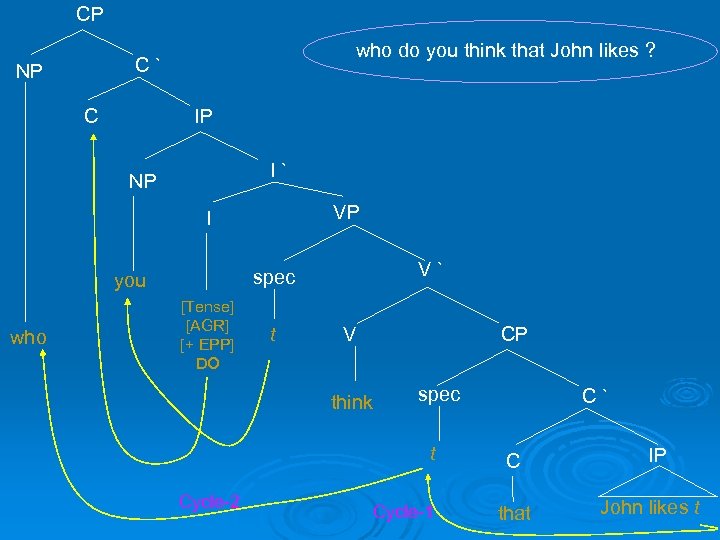 CP who do you think that John likes ? C` NP IP C I` NP VP I who V` spec you [Tense] [AGR] [+ EPP] DO t CP V think spec t Cycle-2 Cycle-1 C` C that IP John likes t
![[CP who do [IP you think [CP t that [IP John likes t ]](https://present5.com/presentation/07cf951b1f5eb3ef278fa995250e78ab/image-23.jpg "[CP who do [IP you think [CP t that [IP John likes t ]") [CP who do [IP you think [CP t that [IP John likes t ] Violation of subjacency principle
[CP who do [IP you think [CP t that [IP John likes t ] Violation of subjacency principle
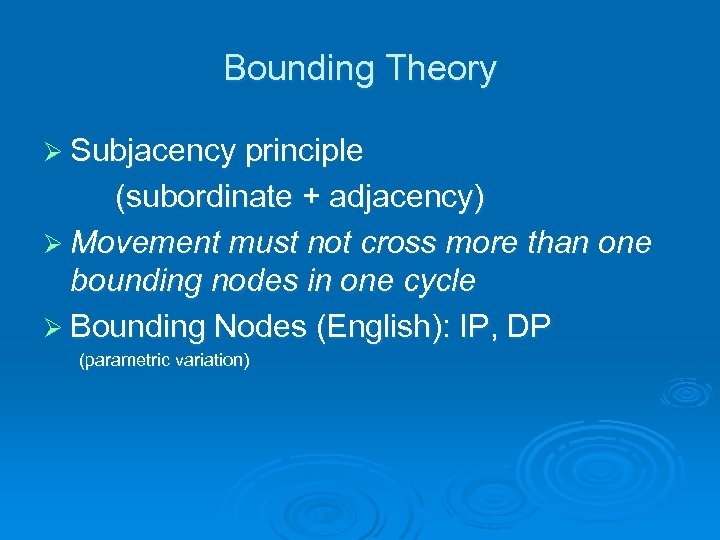 Bounding Theory Ø Subjacency principle (subordinate + adjacency) Ø Movement must not cross more than one bounding nodes in one cycle Ø Bounding Nodes (English): IP, DP (parametric variation)
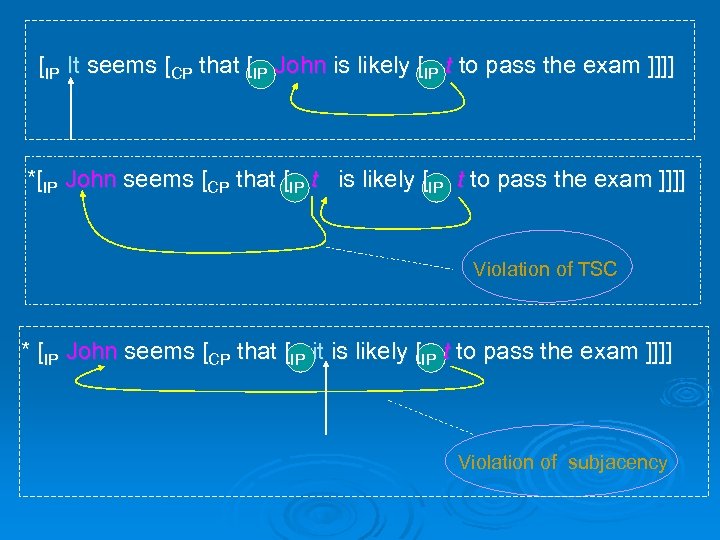 [IP It seems [CP that [IP John is likely [IP t to pass the exam ]]]] *[IP John seems [CP that [IP t is likely [IP t to pass the exam ]]]] Violation of TSC * [IP John seems [CP that [IP it is likely [IP t to pass the exam ]]]] Violation of subjacency
 Sources and further readings Comsky, Noam. 1965. Aspects of the Theory of Syntax. CUP, Cambridge. Ø Comsky, Noam. 1981. Lectures on Government and Binding. Foris, Dordrecht. Ø Ouhalla, Jamal. 1994. Introducing Transformational grammar. Arnold, London. Ø
 THANK YOU