


 Скачать презентацию Primary health care in the developing part of
49d6ee7aaa9419eacdb5b3499a6c092a.ppt
- Количество слайдов: 24
 Primary health care in the developing part of Europe Changes and development in the former Eastern block countries that joined the European Union following 2004 Imre RURIK & László KALABAY Department of Family and Occupational Medicine Department of Family Medicine Faculty of Public Health Faculty of Medicine Medical and Health Science Center Semmelweis University of Debrecen Budapest Hungary The Future of Primary Care in Europe III. 30 -31 August, 2010 Pisa 1
 The Declaration of Alma Ata • “Health for all by the year of 2000”. ambitious vision of the Alma Ata Declaration (AAD) 1978 • WHO promoted the orientation toward primary health care • Coherence between • Primary, secondary and tertiary care, • Curative and preventive services, • Somatic and mental health care more difficult to maintain. Rurik I, Kalabay L. Primary health care in the developing part of Europe. Med Sci Monit 2009; 15(7): PH 78 -84. 2
 Transition • from a system of hospital services • medical specialisation toward a GP/ FM (General Practice/Family Medicine) - based health care system • to implementing cost-effectiveness and prevention. • strong primary care is associated with reduced risks of hospitalisation, shorter length of stay in hospital and decreased costs • sharp divide in life expectancy between Western Europe and the former socialist countries of C & E Europe • this gap largely developed in the past two or three decades • high rate of tobacco and alcohol consumption, • poor nutrition and increasing social inequalities 3
 Health sytem history until the end of 1980 s • Strongly influenced by the policy and the economy of the Soviet Union • Health care was a public responsibility • Organization, management and delivery of care were undertaken by state authorities • All inhabitants were entitled to have access to health care free of charge • Health care was financed from general taxation by the state • Patients had easy or even unlimited access to most outpatient clinical specialists. • Finances were regulated by central and regional state administration • Health care was delivered by public service providers • Informal payment (tipping) was widespread to obtain better access or higher quality services • Excessive prescription of pharmaceuticals, multiple referrals, 4 overcrowding in hospitals, and increasing costs
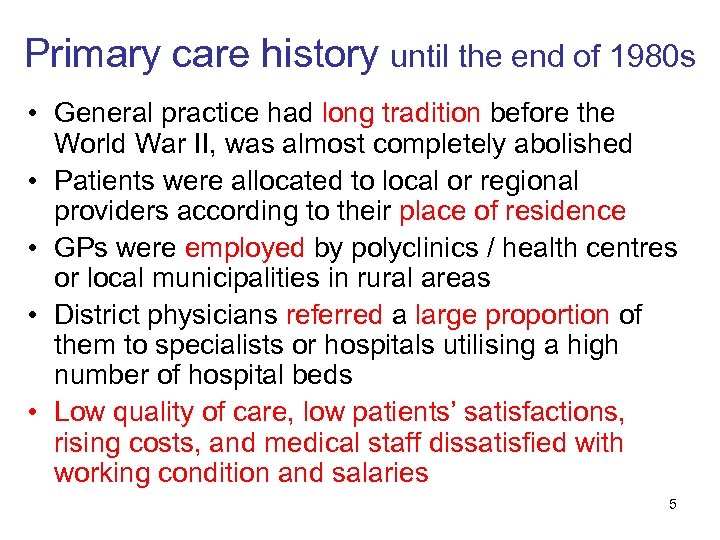 Primary care history until the end of 1980 s • General practice had long tradition before the World War II, was almost completely abolished • Patients were allocated to local or regional providers according to their place of residence • GPs were employed by polyclinics / health centres or local municipalities in rural areas • District physicians referred a large proportion of them to specialists or hospitals utilising a high number of hospital beds • Low quality of care, low patients’ satisfactions, rising costs, and medical staff dissatisfied with working condition and salaries 5
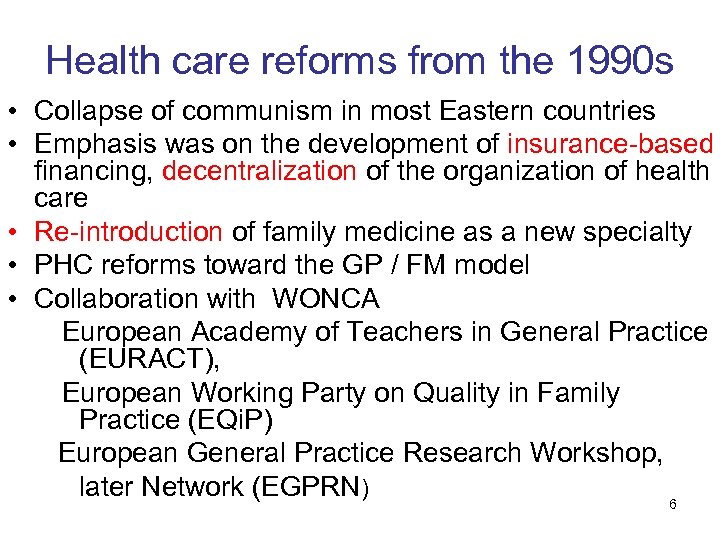 Health care reforms from the 1990 s • Collapse of communism in most Eastern countries • Emphasis was on the development of insurance-based financing, decentralization of the organization of health care • Re-introduction of family medicine as a new specialty • PHC reforms toward the GP / FM model • Collaboration with WONCA European Academy of Teachers in General Practice (EURACT), European Working Party on Quality in Family Practice (EQi. P) European General Practice Research Workshop, later Network (EGPRN) 6
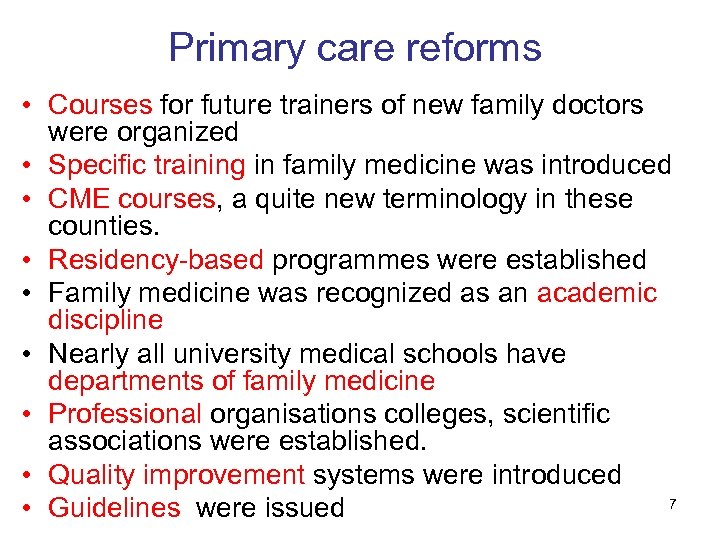 Primary care reforms • Courses for future trainers of new family doctors were organized • Specific training in family medicine was introduced • CME courses, a quite new terminology in these counties. • Residency-based programmes were established • Family medicine was recognized as an academic discipline • Nearly all university medical schools have departments of family medicine • Professional organisations colleges, scientific associations were established. • Quality improvement systems were introduced 7 • Guidelines were issued
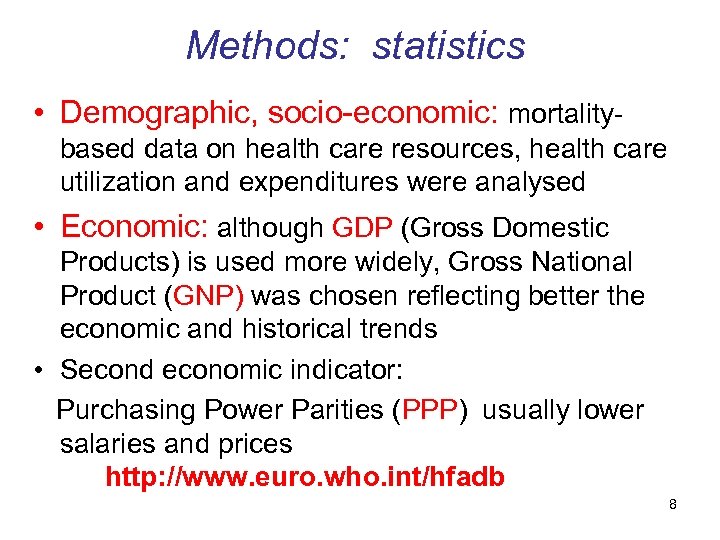 Methods: statistics • Demographic, socio-economic: mortalitybased data on health care resources, health care utilization and expenditures were analysed • Economic: although GDP (Gross Domestic Products) is used more widely, Gross National Product (GNP) was chosen reflecting better the economic and historical trends • Second economic indicator: Purchasing Power Parities (PPP) usually lower salaries and prices http: //www. euro. who. int/hfadb 8
 Methods: Literature search • Scientific publications from peer reviewed, indexed journals, where PC / FM and the name of the respective country were both found among keywords or Pub. Med Me. SH terms. Personal experience • Short and easy to manage questionnaire for personal experiences of FPs were asked. • They are all : - practising GPs, many of them in academic job (EGPRN) - well informed and active contributors of other international scientific PC organisations, within the respective countries • English language questionnaire was constructed, to avoid linguistic errors during translation. 9
 Questions • Are there in your country Department(s) of Family Medicine? • Is it an opportunity in your country to be qualified in FM? • Are there in your country compulsory CME courses for GPs? • Have the GPs a real gate-keeper function in your health system? • Are your personal living conditions better than 15 y before? 10
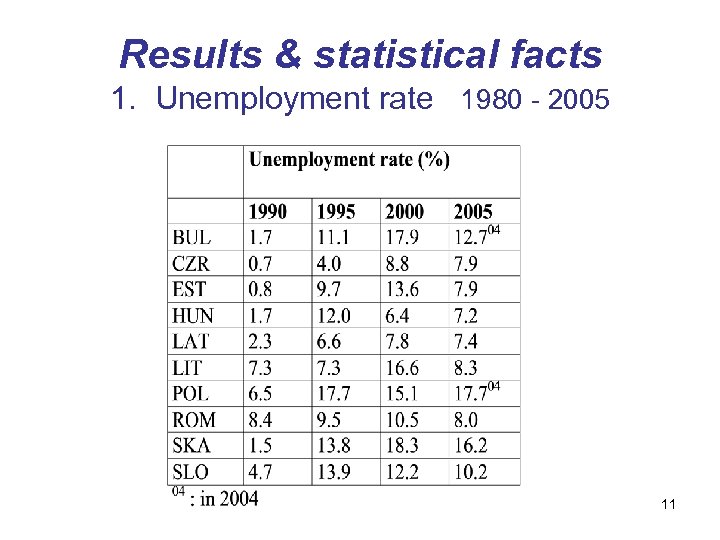 Results & statistical facts 1. Unemployment rate 1980 - 2005 11
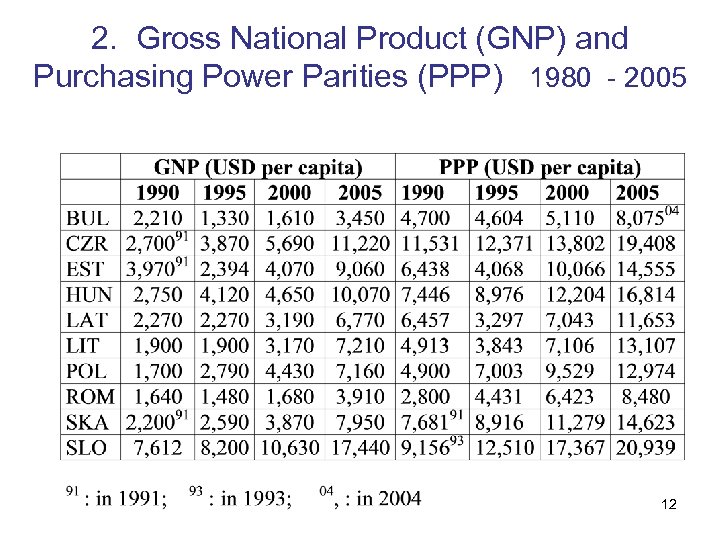 2. Gross National Product (GNP) and Purchasing Power Parities (PPP) 1980 - 2005 12
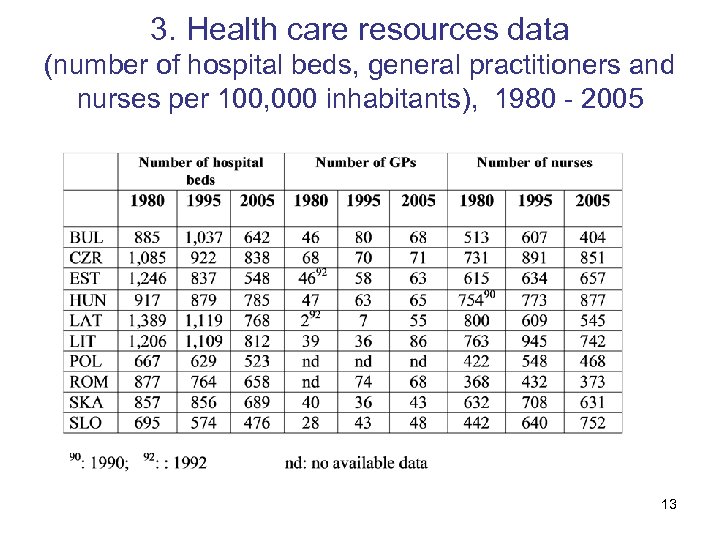 3. Health care resources data (number of hospital beds, general practitioners and nurses per 100, 000 inhabitants), 1980 - 2005 13
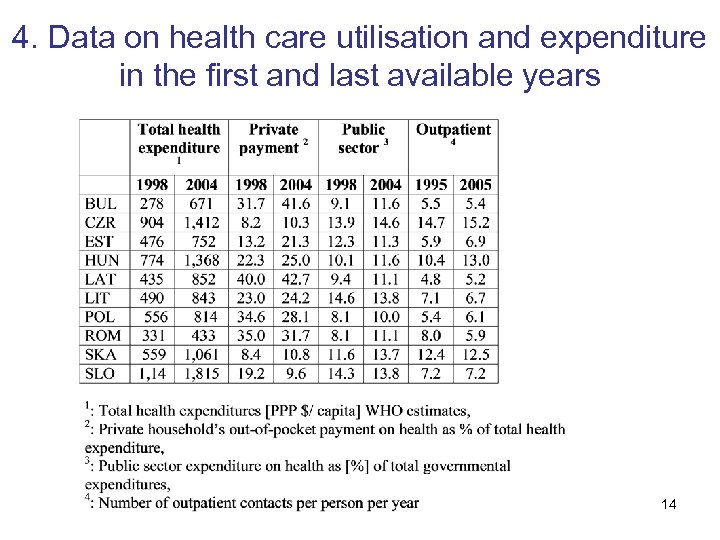 4. Data on health care utilisation and expenditure in the first and last available years 14
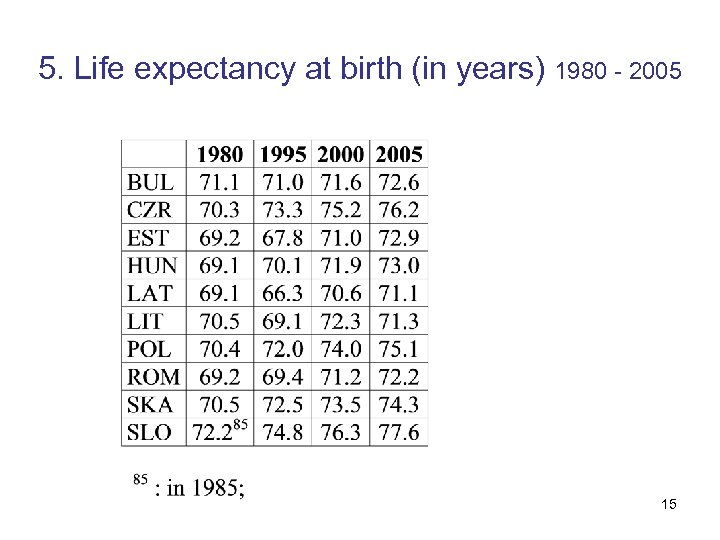 5. Life expectancy at birth (in years) 1980 - 2005 15
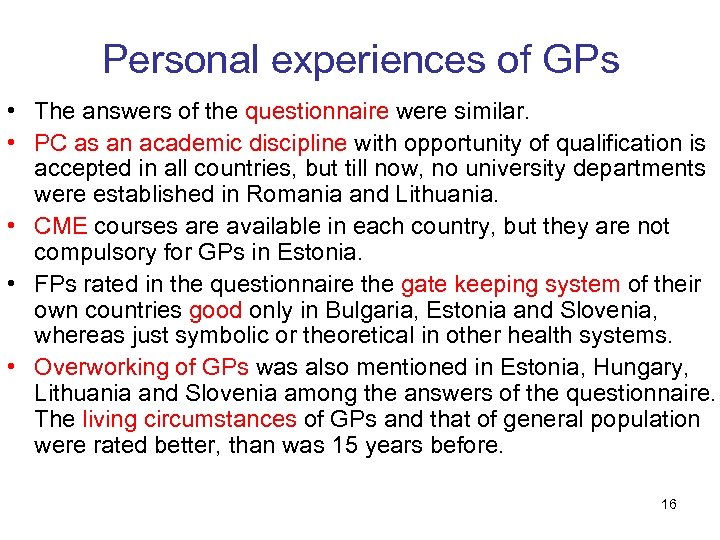 Personal experiences of GPs • The answers of the questionnaire were similar. • PC as an academic discipline with opportunity of qualification is accepted in all countries, but till now, no university departments were established in Romania and Lithuania. • CME courses are available in each country, but they are not compulsory for GPs in Estonia. • FPs rated in the questionnaire the gate keeping system of their own countries good only in Bulgaria, Estonia and Slovenia, whereas just symbolic or theoretical in other health systems. • Overworking of GPs was also mentioned in Estonia, Hungary, Lithuania and Slovenia among the answers of the questionnaire. The living circumstances of GPs and that of general population were rated better, than was 15 years before. 16
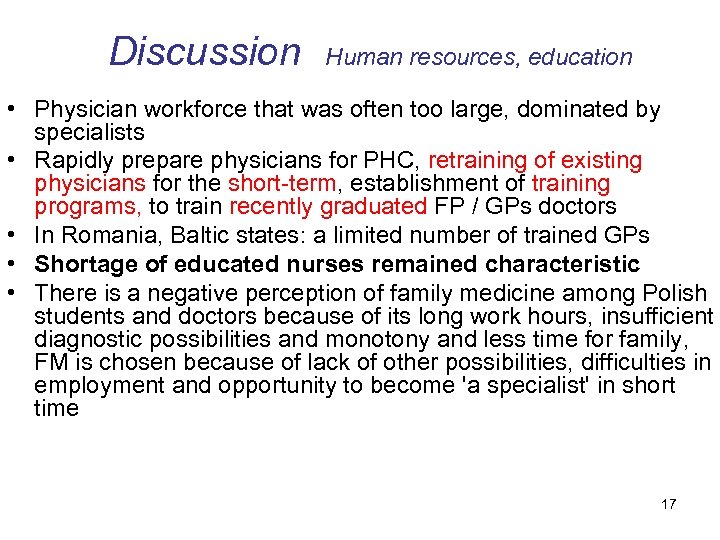 Discussion Human resources, education • Physician workforce that was often too large, dominated by specialists • Rapidly prepare physicians for PHC, retraining of existing physicians for the short-term, establishment of training programs, to train recently graduated FP / GPs doctors • In Romania, Baltic states: a limited number of trained GPs • Shortage of educated nurses remained characteristic • There is a negative perception of family medicine among Polish students and doctors because of its long work hours, insufficient diagnostic possibilities and monotony and less time for family, FM is chosen because of lack of other possibilities, difficulties in employment and opportunity to become 'a specialist' in short time 17
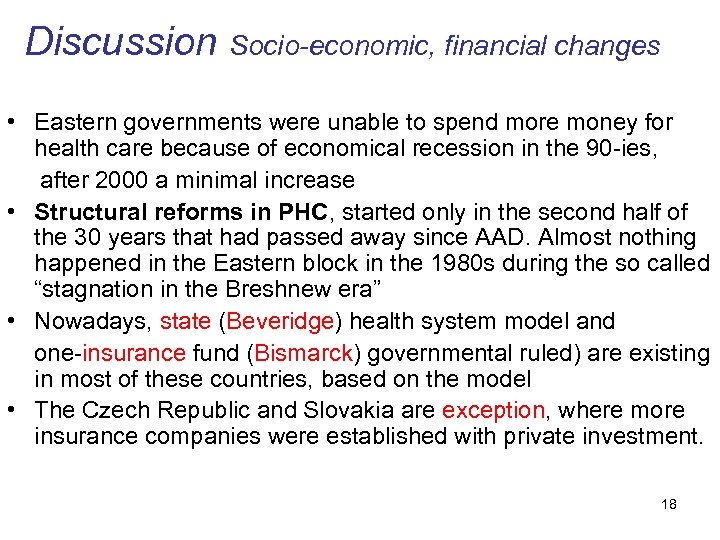 Discussion Socio-economic, financial changes • Eastern governments were unable to spend more money for health care because of economical recession in the 90 -ies, after 2000 a minimal increase • Structural reforms in PHC, started only in the second half of the 30 years that had passed away since AAD. Almost nothing happened in the Eastern block in the 1980 s during the so called “stagnation in the Breshnew era” • Nowadays, state (Beveridge) health system model and one-insurance fund (Bismarck) governmental ruled) are existing in most of these countries, based on the model • The Czech Republic and Slovakia are exception, where more insurance companies were established with private investment. 18
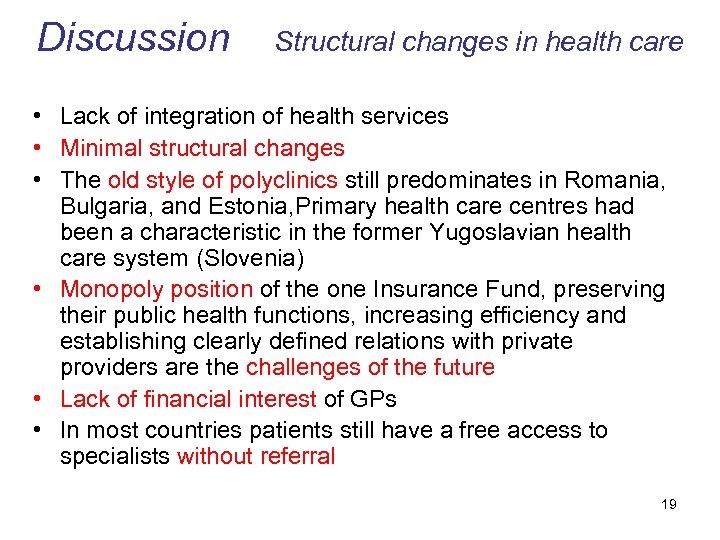 Discussion Structural changes in health care • Lack of integration of health services • Minimal structural changes • The old style of polyclinics still predominates in Romania, Bulgaria, and Estonia, Primary health care centres had been a characteristic in the former Yugoslavian health care system (Slovenia) • Monopoly position of the one Insurance Fund, preserving their public health functions, increasing efficiency and establishing clearly defined relations with private providers are the challenges of the future • Lack of financial interest of GPs • In most countries patients still have a free access to specialists without referral 19
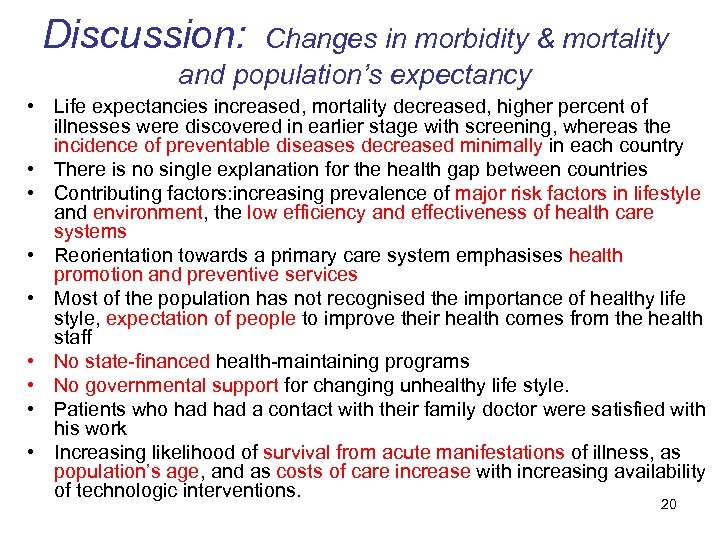 Discussion: Changes in morbidity & mortality and population’s expectancy • Life expectancies increased, mortality decreased, higher percent of illnesses were discovered in earlier stage with screening, whereas the incidence of preventable diseases decreased minimally in each country • There is no single explanation for the health gap between countries • Contributing factors: increasing prevalence of major risk factors in lifestyle and environment, the low efficiency and effectiveness of health care systems • Reorientation towards a primary care system emphasises health promotion and preventive services • Most of the population has not recognised the importance of healthy life style, expectation of people to improve their health comes from the health staff • No state-financed health-maintaining programs • No governmental support for changing unhealthy life style. • Patients who had a contact with their family doctor were satisfied with his work • Increasing likelihood of survival from acute manifestations of illness, as population’s age, and as costs of care increase with increasing availability of technologic interventions. 20
 Discussion: Governmental initiatives • Obviously, less effort in the Eastern than in the Western Europe has been made to follow the suggestions of the AAD to modify the health structures. • Although there are differences between countries, it is general that the implementation of family medicine as part of health care reform is not an absolute priority for decision makers • It is rather a tool for more effective use of resources and not to increase the quality of care • Unstable political situation and frequent change of decision makers create a long series of problems 21
 Conclusions • similar key areas of concern; • HR problems: there is still a struggle to have a physician workforce with the • right numbers, the right specialty mix, and practicing in the right locations, lack of trained nurses • atomisation of practices, there is no teamwork in PC, praxis communities, group practices practically do not exist • lack of academic infrastructures and unsatisfactory continuous professional development • the reform was introduced through the creation of a new funding system for primary care services, without significant increasing of financing, unsatisfactory payment system, • GPs became self-employed because of more rational use of economical budgeting • health care reform rarely evaluated systematically • “Health for all by 2000”. these countries, had short time and few resources to change their health system, most of them are still 22 in the midst of transition.
 23
23
 Rurik I, Kalabay L. Primary health care in the developing part of Europe. Med Sci Monit 2009; 15(7): PH 78 -84. 24