


 Скачать презентацию Pricing Strategies and Tactics Luiz Afonso dos Santos
597368ddf8ec6aba0db2ab1f4a252511.ppt
- Количество слайдов: 146
 Pricing Strategies and Tactics Luiz Afonso dos Santos Senna, Ph. D lsenna@producao. ufrgs. br Luiz Afonso dos Santos Senna - Ph. D
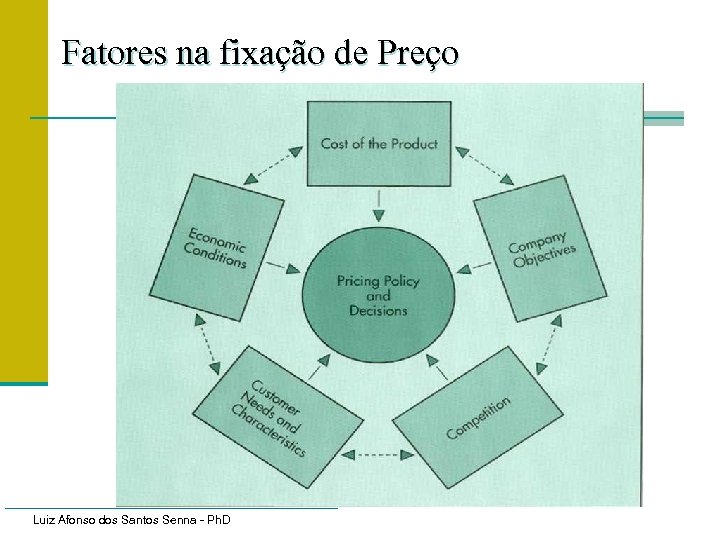 Fatores na fixação de Preço Luiz Afonso dos Santos Senna - Ph. D
 Fatores Externos afetando as decisões de preços Fatores Externos incluem a natureza do mercado e da demanda, competição e outros elementos ambientais n Mercado e demanda n Custos definem o limite inferior e a demanda define o limite de preço. n As relações preço-demanda são fuindamentais par aos teomadres de decisão em transportes Luiz Afonso dos Santos Senna - Ph. D
 Preço em diferentes tipos de mercados n Mercados de Competição Pura n n n Bens/serviços uniformes Não existe um único vendedor ou comprador com efeito significativo sobre o preço de mercado Marketing mix possui pouco impacto Luiz Afonso dos Santos Senna - Ph. D
 Preço em diferentes tipos de mercados n Competição Monopolística n n n Compradores e vendedores trocam sobre uma gama de preços Ênfase em diferenças por meio de diferenciação através de marketing mix Competição Oligopolística n Poucos vendedores altamente sensíveis aos preços de cada um e de estratégias de marketing Luiz Afonso dos Santos Senna - Ph. D
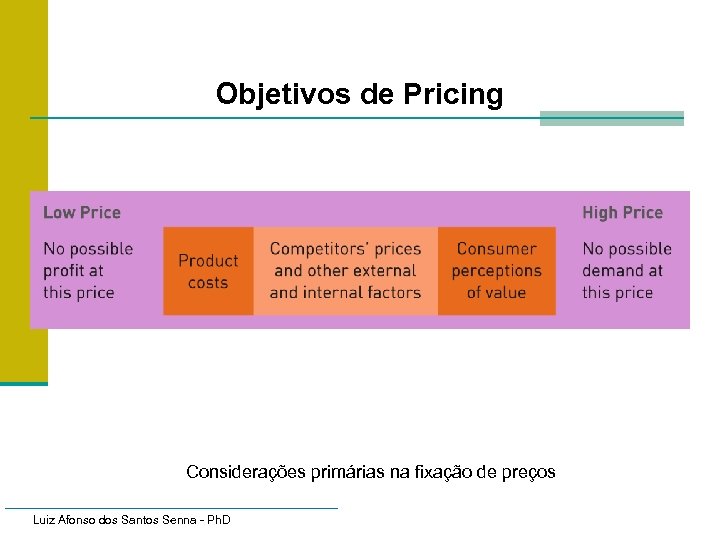 Objetivos de Pricing Considerações primárias na fixação de preços Luiz Afonso dos Santos Senna - Ph. D
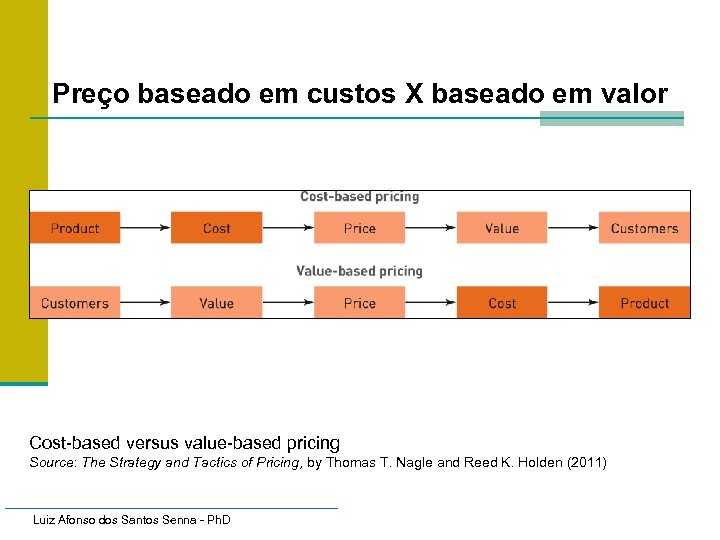 Preço baseado em custos X baseado em valor Cost-based versus value-based pricing Source: The Strategy and Tactics of Pricing, by Thomas T. Nagle and Reed K. Holden (2011) Luiz Afonso dos Santos Senna - Ph. D
 Pricing, Competição e Estrutura de Mercado
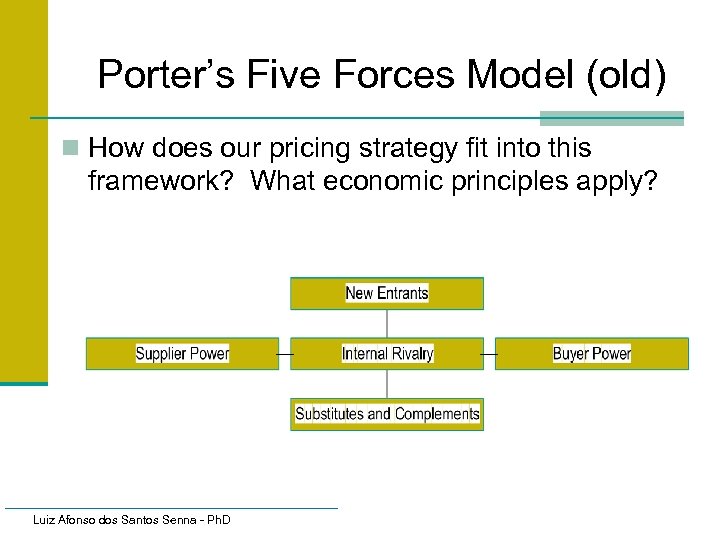 Porter’s Five Forces Model (old) n How does our pricing strategy fit into this framework? What economic principles apply? Luiz Afonso dos Santos Senna - Ph. D
 Market Structure – Internal rivalry Ø Market structure and pricing decisions are closely related. But how to define the market? Ø The degree to which the firm gets to choose price is determined in large part by market structure Ø There are two extreme cases: perfect competition and monopoly Luiz Afonso dos Santos Senna - Ph. D
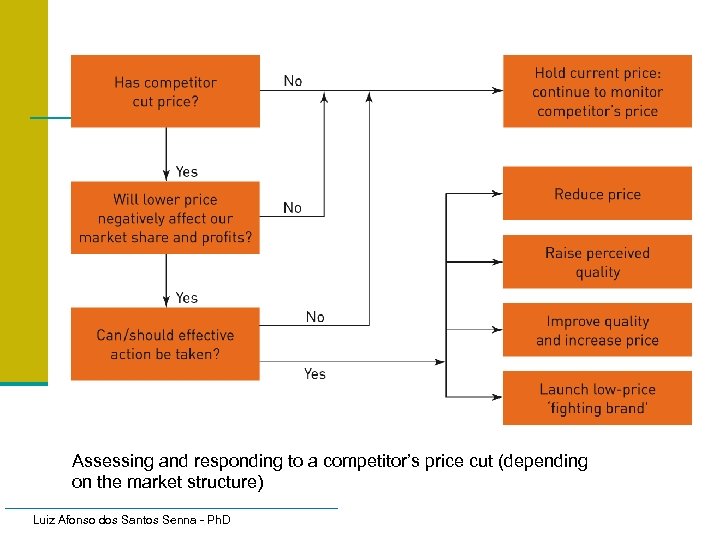 Assessing and responding to a competitor’s price cut (depending on the market structure) Luiz Afonso dos Santos Senna - Ph. D
 Perfect Competition Ø Conditions necessary: Ø Large numbers of buyers and sellers Ø Homogeneous Ø Free product entry and exit Ø Perfect Luiz Afonso dos Santos Senna - Ph. D information
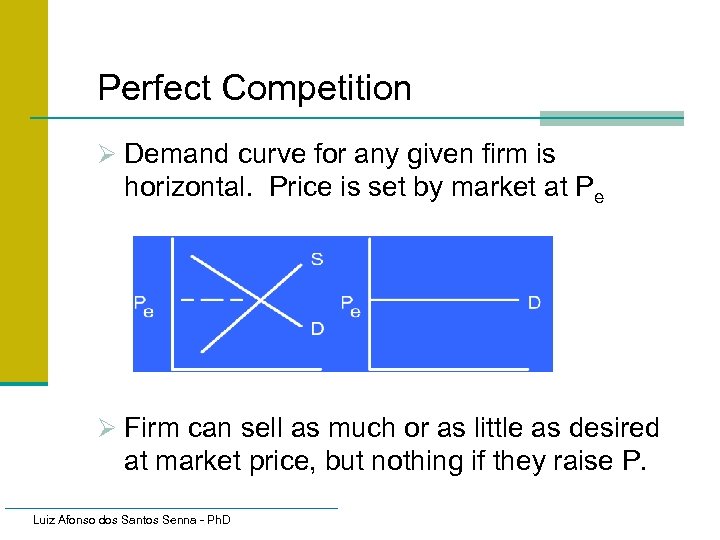 Perfect Competition Ø Demand curve for any given firm is horizontal. Price is set by market at Pe Ø Firm can sell as much or as little as desired at market price, but nothing if they raise P. Luiz Afonso dos Santos Senna - Ph. D
 Monopoly Ø Conditions necessary Ø Single seller of product Ø No close substitutes Ø Significant barriers to entry Ø There are few examples of perfect competition and pure monopoly. Ø Most firms have a differentiated product, and there are substitutes. Luiz Afonso dos Santos Senna - Ph. D
 Pricing in Perfect Competition Ø Do not choose price. Ø Choose output quantity. TC includes opportunity cost of capital invested. Ø What will be our profit (loss) from our output decision? Ø Should we produce now? (SR) Ø Should we stay in the industry? (LR) Luiz Afonso dos Santos Senna - Ph. D
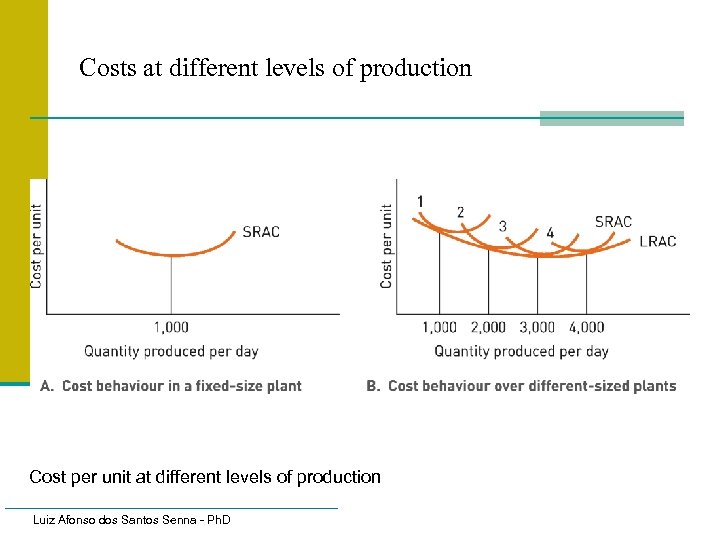 Costs at different levels of production Cost per unit at different levels of production Luiz Afonso dos Santos Senna - Ph. D
 Pricing in a Monopoly Ø Profit maximization will be achieved by setting price so that MC=MR. Ø It is not reached by setting price as “high as possible. ” Ø Like any firm, the monopolist is constrained by their demand curve. Ø One cannot choose both P and Q. Luiz Afonso dos Santos Senna - Ph. D
 The Shut-Down Rule Ø At what point should the firm cease production of a certain item? Ø When might it pay to produce at a loss? Ø In SR, many costs are fixed. Just because a firm is making losses, it does not necessarily mean it should shut down (short run), or even go out of business (long-run). Luiz Afonso dos Santos Senna - Ph. D
 The Shut-Down Rule cont. Ø Profit = TR – TC; TR=P*Q, TC = VC + FC Ø (TR - VC) - FC = [(P - AVC)Q] – FC Ø Separate out fixed costs, focus on variable elements Ø As long as P>AVC, there is a positive contribution to fixed costs. Ø If firm shuts down (Q = 0), then Profit = - FC Ø If shut down: Firm has a loss of fixed costs. Luiz Afonso dos Santos Senna - Ph. D
 The Shut-Down Rule cont. Ø In SR, firm may minimize losses by continuing to produce. Ø If losses are expected permanently, get out. Ø Case of multiple products: Ø C = FC + VC 1 + VC 2 Luiz Afonso dos Santos Senna - Ph. D
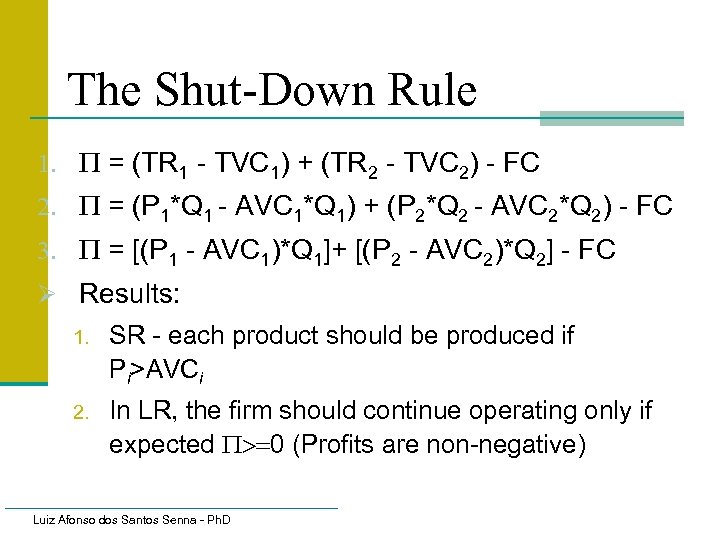 The Shut-Down Rule 1. P = (TR 1 - TVC 1) + (TR 2 - TVC 2) - FC 2. P = (P 1*Q 1 - AVC 1*Q 1) + (P 2*Q 2 - AVC 2*Q 2) - FC 3. P = [(P 1 - AVC 1)*Q 1]+ [(P 2 - AVC 2)*Q 2] - FC Ø Results: 1. SR - each product should be produced if Pi>AVCi 2. In LR, the firm should continue operating only if expected P>=0 (Profits are non-negative) Luiz Afonso dos Santos Senna - Ph. D
 Price Discrimination Ø Selling the same good to different people at different prices Ø Conditions necessary: Ø Identifiable customer groups with differing price elasticities Ø Maintain separation of groups--prevent resale. Luiz Afonso dos Santos Senna - Ph. D
 Types of Price Discrimination Ø First degree Ø Identify and charge each customer what they are willing to pay Ø Limit: D = MR, no consumer surplus. Ø Second degree Ø Quantity discounts. Volume purchases are given lower prices. Need to measure goods and services bought by consumers. Luiz Afonso dos Santos Senna - Ph. D
 Types of Price Discrimination Ø Third degree Ø Segment markets in some way. Charge all in the segment the same prices. Ø Treat each segment as a separate market– then do MR=MC in each Ø Are coupons as a price discrimination mechanism? Luiz Afonso dos Santos Senna - Ph. D
 Oligopoly Strategies Ø Common theme - Rivalrous behavior Ø Pricing - limit pricing - set prices low as signal to possible entrants or other competitors your willingness and ability to defend your market share. Ø Must have credibility. Ø Trading SR profit for more profits later Luiz Afonso dos Santos Senna - Ph. D
 Oligopoly Strategies Ø Use the legal / regulatory systems Ø File patent application Ø Challenge business charter application Ø File regulatory challenge Ø Pre-emptive entry - Wal-Mart Luiz Afonso dos Santos Senna - Ph. D
 Oligopoly Strategies Ø Capacity and production Ø Announce capacity expansion Ø Revise/modify products - more difficult to copy Ø Advertising Ø Raise cost of entry for others Luiz Afonso dos Santos Senna - Ph. D
 Oligopoly and Monopolistic Competition Ø Oligopoly Ø Few sellers - usually large ones Ø Recognized interdependence in pricing and output decisions Ø Need to consider response of rivals in pricing decisions Ø Typically significant barriers to entry Luiz Afonso dos Santos Senna - Ph. D
 Oligopoly and Monopolistic Competition Ø Large number of interdependent sellers Ø Differentiated product Ø Good substitutes Ø Easy entry and exit Luiz Afonso dos Santos Senna - Ph. D
 Oligopoly and Monopolistic Competition Ø Most industries are one or the other Ø Oligopoly: many heavy manufacturing Ø Ø Autos, steel, chemicals, pharmaceuticals Monopolistic Competition Ø Ø Service companies, retail stores, large corporations (Mc. Donald’s, Wendy’s) The important point is that demand is downward sloping Luiz Afonso dos Santos Senna - Ph. D
 Cartels Ø Illegal in most countries – but encouraged in others Ø Conditions helpful: Ø Small number of firms Ø Homogeneous product Ø Entry barriers Ø Similarity of members Luiz Afonso dos Santos Senna - Ph. D
 Cartels Ø Problems with cartels: Ø Cheating on agreement Ø Price cutting behaviour Ø Tend to fall apart Ø Note: When might firms in an industry ask for (demand) regulation? Luiz Afonso dos Santos Senna - Ph. D
 Pricing Strategies Ø Profit maximizing rule: Ø Set production at level where MR = MC Ø Non - Maximizing pricing rules Ø there a variety of these Luiz Afonso dos Santos Senna - Ph. D
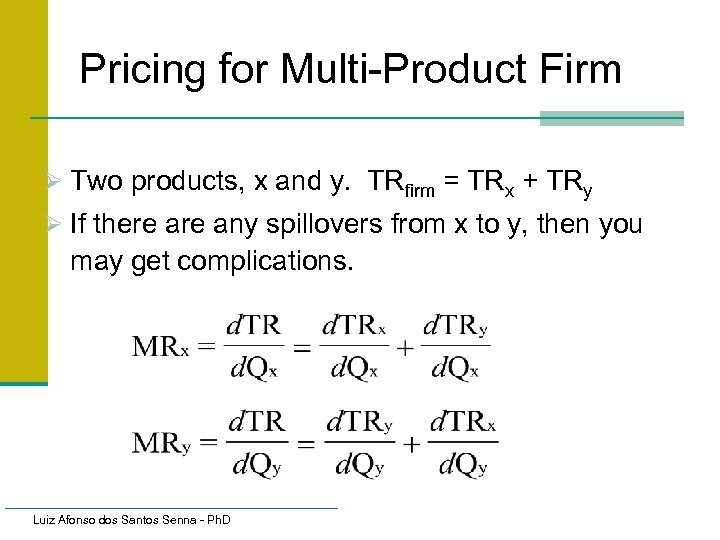 Pricing for Multi-Product Firm Ø Two products, x and y. TRfirm = TRx + TRy Ø If there any spillovers from x to y, then you may get complications. Luiz Afonso dos Santos Senna - Ph. D
 Multi-Product Firm cont. Ø The two terms on the right side of the equation represent interactions. They can be either positive or negative. Ø If x and y are complementary goods, the effect is positive. Ø If x and y are substitutes, the effect is negative. One unit’s gain is the other’s loss. Luiz Afonso dos Santos Senna - Ph. D
 Two part pricing n Charge P = MC n charge a fixed fee to extract some of the “consumer surplus” n Examples: country clubs n health clubs n electricity providers n Luiz Afonso dos Santos Senna - Ph. D
 Declining block pricing n Charging different prices according to how much is purchased n Attempt to extract consumer surplus and transfer value to company Luiz Afonso dos Santos Senna - Ph. D
 Auction pricing models n Standard auction model n n multiple bidders compete with each other start at some low price, then successive bids raise price until someone “wins” n Dutch auction model n n start at a high price, lower it until someone bids ex: dutch flower auctions n How to extract consumer surplus? Luiz Afonso dos Santos Senna - Ph. D
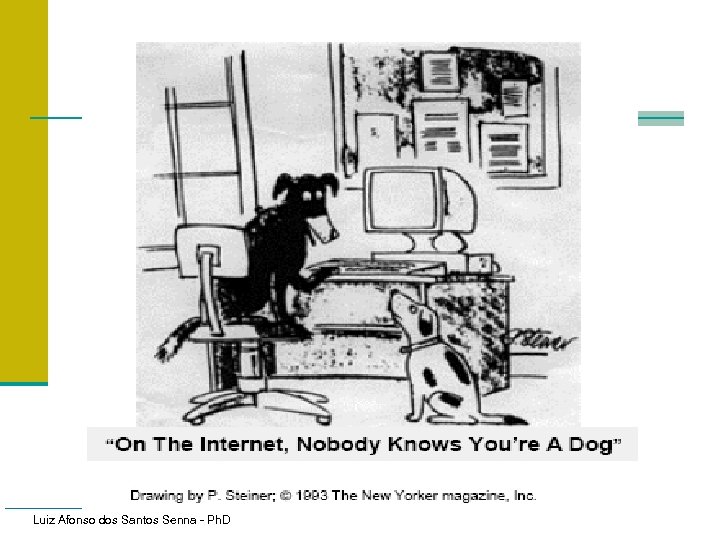
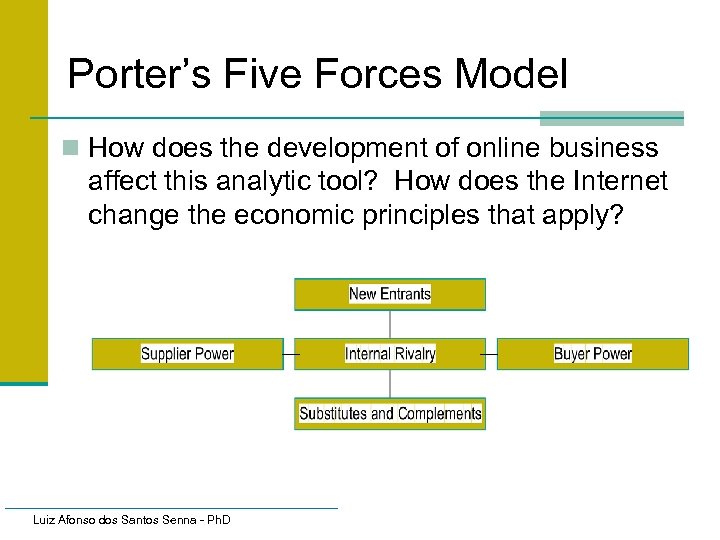 Porter’s Five Forces Model n How does the development of online business affect this analytic tool? How does the Internet change the economic principles that apply? Luiz Afonso dos Santos Senna - Ph. D
 Market structure and the Internet n Traditional industry structure paradigm? n Structure, time and place? n Firm size, customer access and service? n Pricing, and reputation online n Who is competing with whom? Luiz Afonso dos Santos Senna - Ph. D
 Luiz Afonso dos Santos Senna - Ph. D
 Internet and demand issues n Role of customer service and customer loyalty online: e-loyalty? n Consumer demand issues - which goods to buy online, which in person? n How to price online? n Does this signal the end of the Brand? Luiz Afonso dos Santos Senna - Ph. D
 Pricing and the Internet n Traditional pricing paradigm? n Access to demand data…. . . n Measurement of demand elasticities? n Ability to conduct pricing “experiments” n Ability to spot market changes - and move quickly (perhaps) n Access to bigger customer base n Will prices be lower online? Luiz Afonso dos Santos Senna - Ph. D
 Firm structure and the Internet n Are traditional firm structure concepts now irrelevant? n Economies of scale? Scope? n How does this affect firm incentives to vertically integrate (or de-integrate)? n Central role of transaction costs…. . . Luiz Afonso dos Santos Senna - Ph. D
 The Determinants of Demand n Demand The relationship between the quantity of a good desired by people in a market and the factors that affect that the quantity desired is referred to as the demand for the product. We can express the demand for a product in the form n We have some precise definitions related to how income and prices of other goods affect the demand for a good/service Luiz Afonso dos Santos Senna - Ph. D
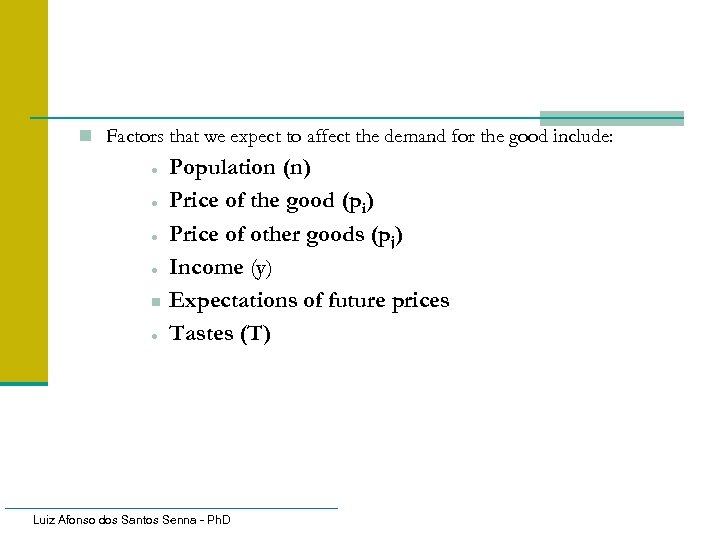 n Factors that we expect to affect the demand for the good include: · · n · Population (n) Price of the good (pi) Price of other goods (pj) Income (y) Expectations of future prices Tastes (T) Luiz Afonso dos Santos Senna - Ph. D
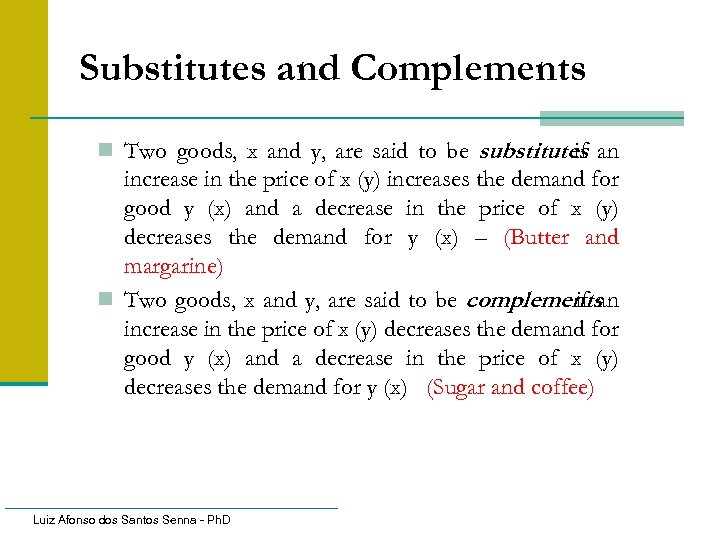 Substitutes and Complements n Two goods, x and y, are said to be substitutes an if increase in the price of x (y) increases the demand for good y (x) and a decrease in the price of x (y) decreases the demand for y (x) – (Butter and margarine) n Two goods, x and y, are said to be complements if an increase in the price of x (y) decreases the demand for good y (x) and a decrease in the price of x (y) decreases the demand for y (x) (Sugar and coffee) Luiz Afonso dos Santos Senna - Ph. D
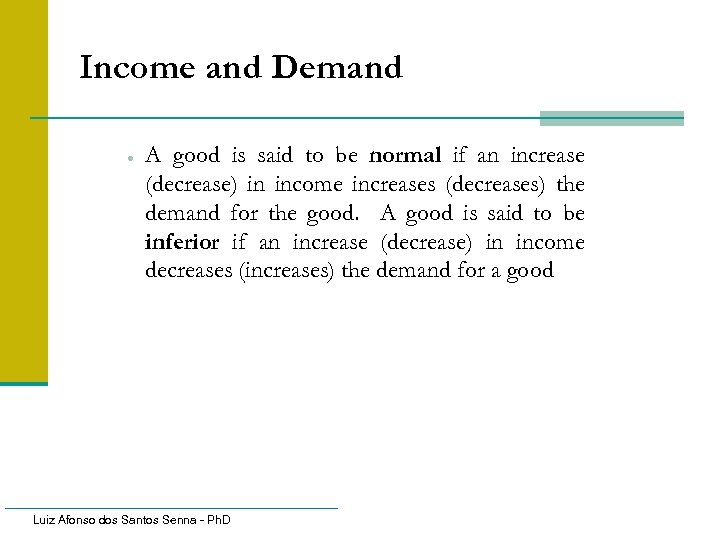 Income and Demand · A good is said to be normal if an increase (decrease) in income increases (decreases) the demand for the good. A good is said to be inferior if an increase (decrease) in income decreases (increases) the demand for a good Luiz Afonso dos Santos Senna - Ph. D
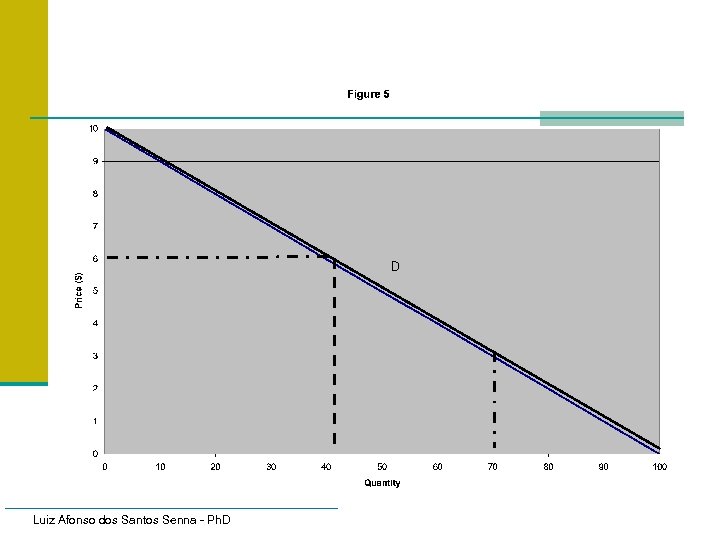
 The Demand Curve n The relationship between the quantity demanded of a good and the price of that good is referred to as the demand curve. Luiz Afonso dos Santos Senna - Ph. D
 Luiz Afonso dos Santos Senna - Ph. D
 · The demand curve gives the relationship between price and the quantity consumers will desire to purchase at that price · Note the demand curve is drawn given that no other factors affecting the demand for the product, such as income, population, or tastes, change · Demand for the product is based on specific, unchanging values for the other factors that affect demand Luiz Afonso dos Santos Senna - Ph. D
 The Law of Demand n As the price of a good decreases (increases), more (less) of it will be purchased n That is, the demand curve is downward sloping n There are two relationship: n As the price of a good increases, consumers will substitute into other goods (substitution effect); . As the price of a good increases, consumers will have less real income to purchase all goods (income effect). n Luiz Afonso dos Santos Senna - Ph. D factors that explain this
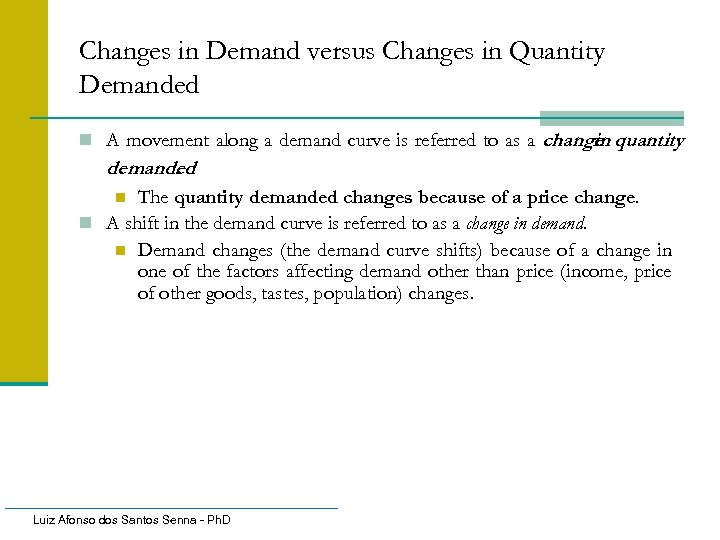 Changes in Demand versus Changes in Quantity Demanded n A movement along a demand curve is referred to as a change quantity in demanded. The quantity demanded changes because of a price change. n A shift in the demand curve is referred to as a change in demand. n Demand changes (the demand curve shifts) because of a change in one of the factors affecting demand other than price (income, price of other goods, tastes, population) changes. n Luiz Afonso dos Santos Senna - Ph. D
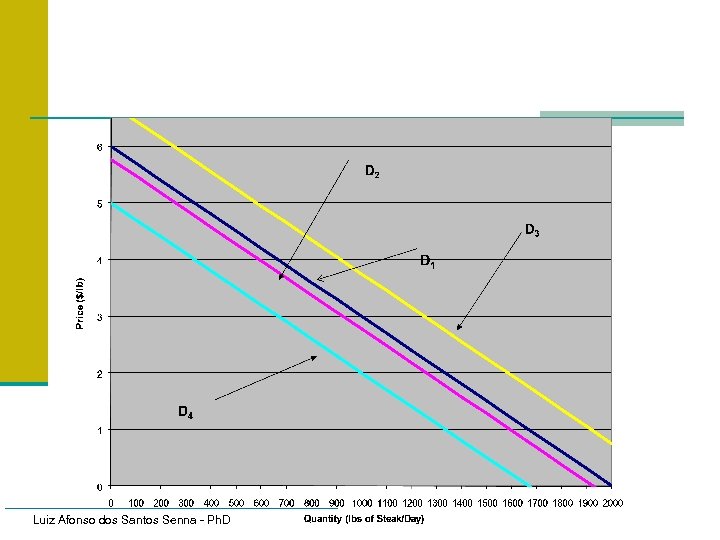
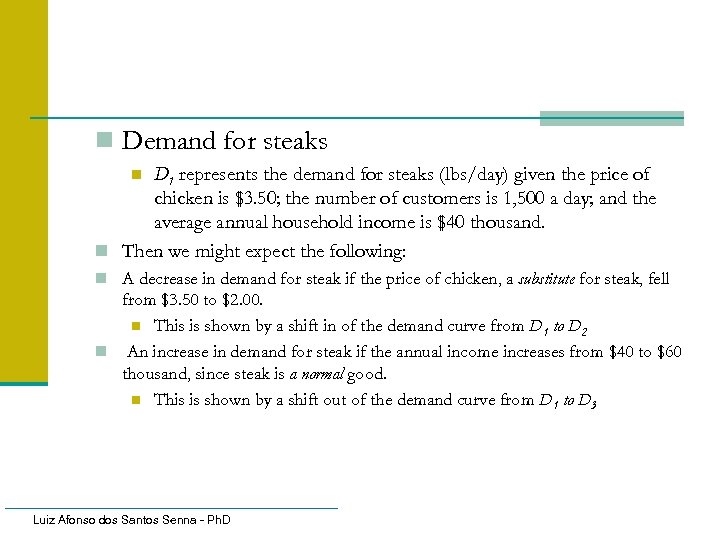 n Demand for steaks D 1 represents the demand for steaks (lbs/day) given the price of chicken is $3. 50; the number of customers is 1, 500 a day; and the average annual household income is $40 thousand. n Then we might expect the following: n n A decrease in demand for steak if the price of chicken, a substitute for steak, fell from $3. 50 to $2. 00. n This is shown by a shift in of the demand curve from D 1 to D 2 n An increase in demand for steak if the annual income increases from $40 to $60 thousand, since steak is a normal good. n This is shown by a shift out of the demand curve from D 1 to D 3 Luiz Afonso dos Santos Senna - Ph. D
 Luiz Afonso dos Santos Senna - Ph. D
 Luiz Afonso dos Santos Senna - Ph. D
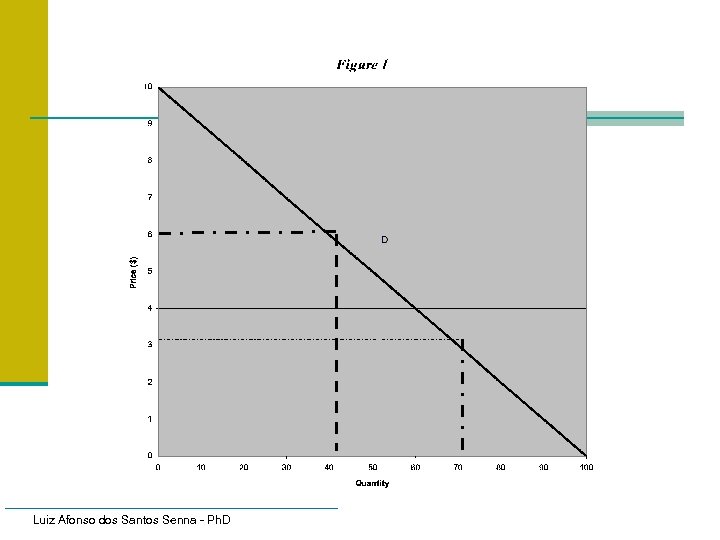
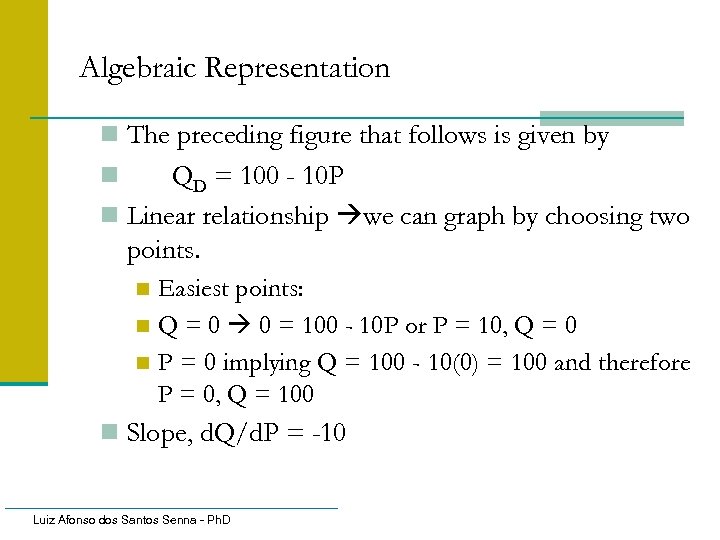 Algebraic Representation n The preceding figure that follows is given by QD = 100 - 10 P n Linear relationship we can graph by choosing two points. n Easiest points: n Q = 0 0 = 100 - 10 P or P = 10, Q = 0 n P = 0 implying Q = 100 - 10(0) = 100 and therefore P = 0, Q = 100 n n Slope, d. Q/d. P = -10 Luiz Afonso dos Santos Senna - Ph. D
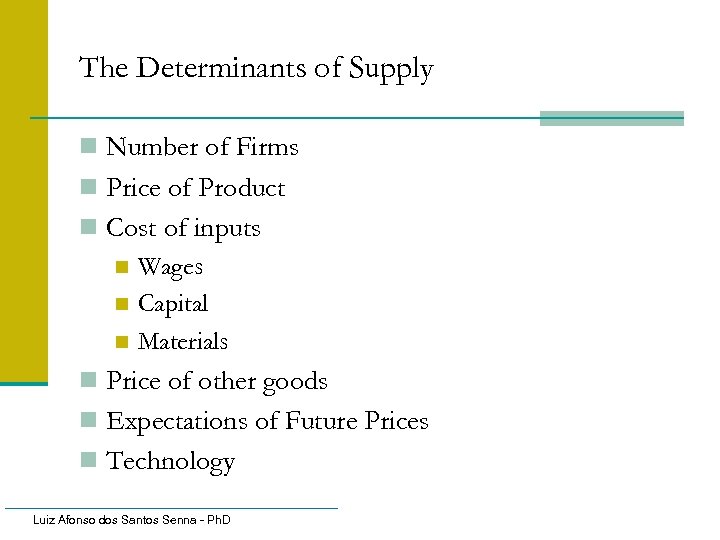 The Determinants of Supply n Number of Firms n Price of Product n Cost of inputs n Wages n Capital n Materials n Price of other goods n Expectations of Future Prices n Technology Luiz Afonso dos Santos Senna - Ph. D
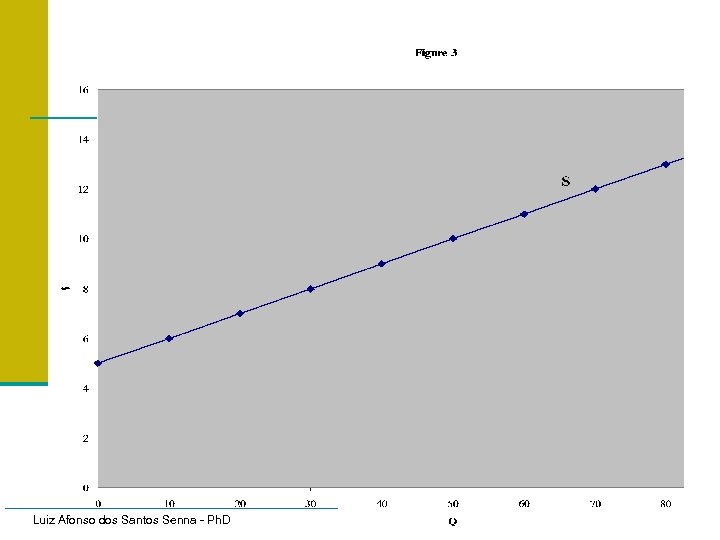
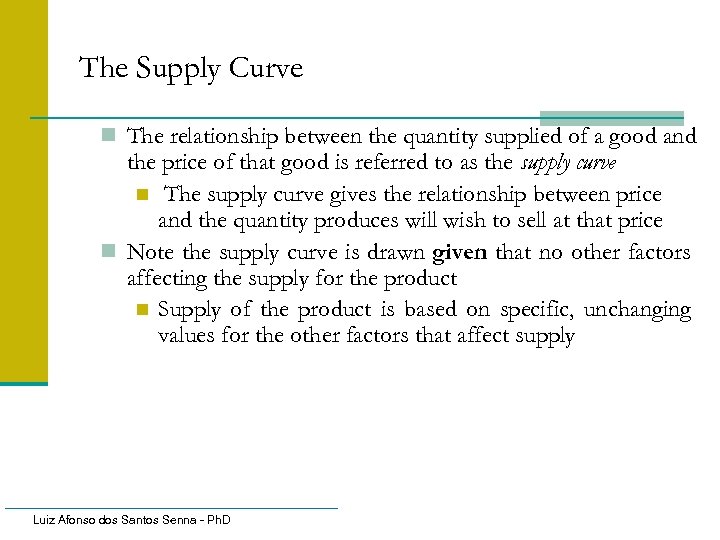 The Supply Curve n The relationship between the quantity supplied of a good and the price of that good is referred to as the supply curve n The supply curve gives the relationship between price and the quantity produces will wish to sell at that price n Note the supply curve is drawn given that no other factors affecting the supply for the product n Supply of the product is based on specific, unchanging values for the other factors that affect supply Luiz Afonso dos Santos Senna - Ph. D
 Luiz Afonso dos Santos Senna - Ph. D
 The Law of Supply n As the price of a good increases (decreases), more (less) of it will be produced and offered for sale. n The supply curve is upward sloping. n This is explained by the assumption that marginal (incremental) cost increases as output increases. Luiz Afonso dos Santos Senna - Ph. D
 Changes in Supply versus Changes in Quantity Supplied n A movement along a supply curve is referred to as a change in quantity supplied. n The quantity supplied changes because of a price change. n A shift in the supply curve is referred to as a change in supply. n Supply changes (the supply curve shifts) because of a change in one of the factors affecting supply other than price changes. Luiz Afonso dos Santos Senna - Ph. D
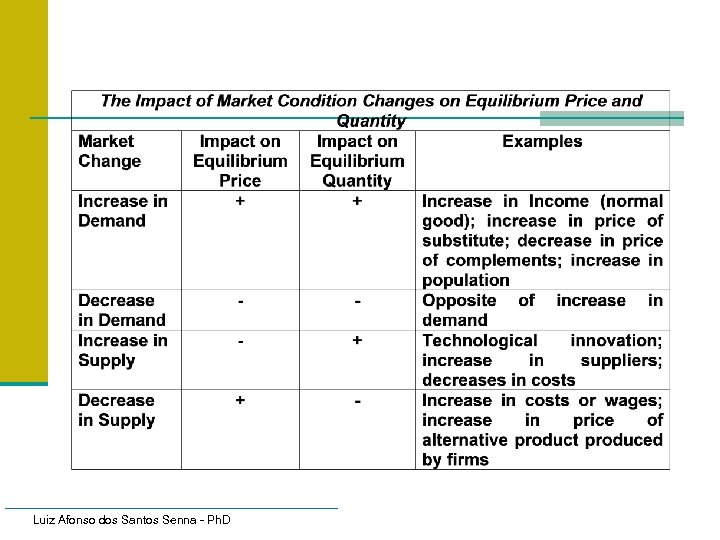
 Comparisons n What happens to Price & Quantity when: Incomes increase n Wages fall n Prices of other goods change n Making predictions of the impact on the market of these types of changes is referred to as Comparative Statics n Luiz Afonso dos Santos Senna - Ph. D
 Comparisons n These changes are all changes in demand or changes in supply n Shifts in demand or supply curve n 4 possibilities: n Increase in demand (shift out demand curve) n Decrease in demand (shift in demand curve) n Increase in supply (shift out supply curve) n Decrease in supply (shift in supply curve) Luiz Afonso dos Santos Senna - Ph. D
 Luiz Afonso dos Santos Senna - Ph. D
 Pricing Strategy n How does a company decide what price to charge for its products and services? n What is “the price” anyway? doesn’t price vary across situations and over time? n Some firms have to decide what to charge different customers and in different situations n They must decide whether discounts are to be offered, to whom, when, and for what reason Luiz Afonso dos Santos Senna - Ph. D
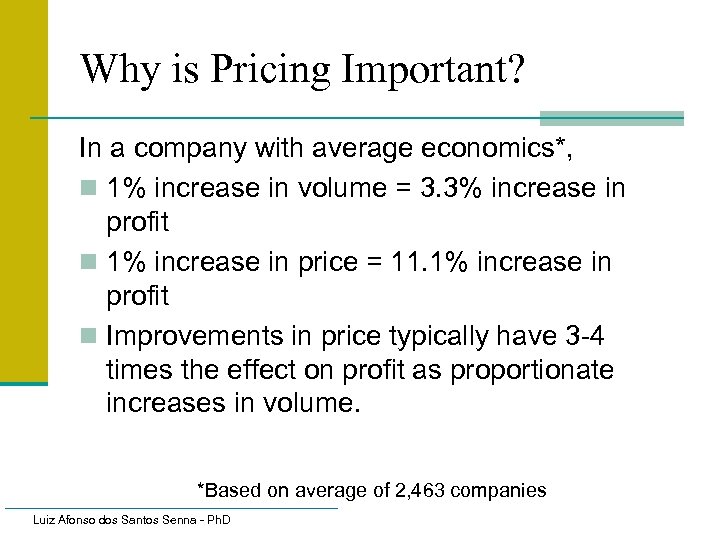 Why is Pricing Important? In a company with average economics*, n 1% increase in volume = 3. 3% increase in profit n 1% increase in price = 11. 1% increase in profit n Improvements in price typically have 3 -4 times the effect on profit as proportionate increases in volume. *Based on average of 2, 463 companies Luiz Afonso dos Santos Senna - Ph. D
 Price vs. Nonprice Competition n In price competition, a seller regularly offers products priced as low as possible and accompanied by a minimum of services n In non price competition, a seller has stable competition prices and stresses other aspects of marketing n With value pricing, firms strive for more pricing benefits at lower costs to consumer n With relationship pricing, customers have incentives to be loyal-- get price incentive if you do more business with one firm Luiz Afonso dos Santos Senna - Ph. D
 Nonprice Competition n Some firms feel price is the main competitive tool, that customers always want low prices n Other firms are looking for ways to add value, thereby being able to avoid low prices n Sometimes prices have to be changed in response to competitive actions n Many firms would prefer to engage in non price competition by building brand equity and relationships with customers Luiz Afonso dos Santos Senna - Ph. D
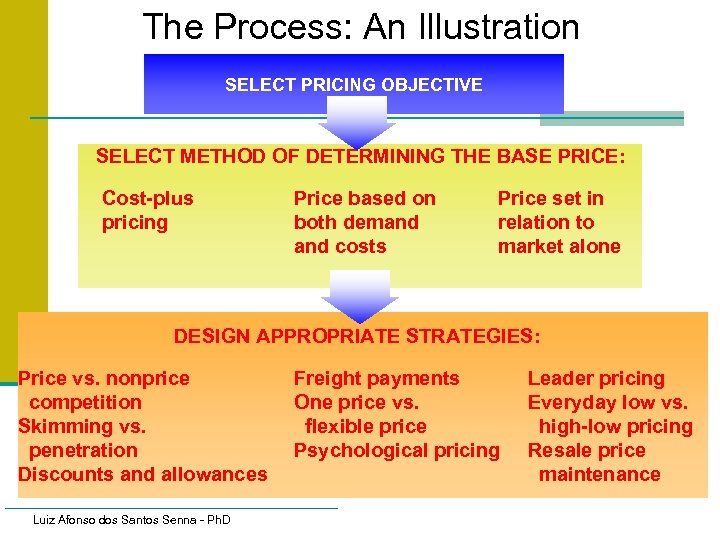 The Process: An Illustration SELECT PRICING OBJECTIVE SELECT METHOD OF DETERMINING THE BASE PRICE: Cost-plus pricing Price based on both demand costs Price set in relation to market alone DESIGN APPROPRIATE STRATEGIES: Price vs. nonprice competition Skimming vs. penetration Discounts and allowances Luiz Afonso dos Santos Senna - Ph. D Freight payments One price vs. flexible price Psychological pricing Leader pricing Everyday low vs. high-low pricing Resale price maintenance
 Steps for Determining Prices n Establish Pricing Objectives Increase sales volume? n Prestigious image? n Increase market share? n Luiz Afonso dos Santos Senna - Ph. D
 Steps for Determining Prices n Study Costs n Can you make a profit? n Can you reduce costs without affecting quality or image? Luiz Afonso dos Santos Senna - Ph. D
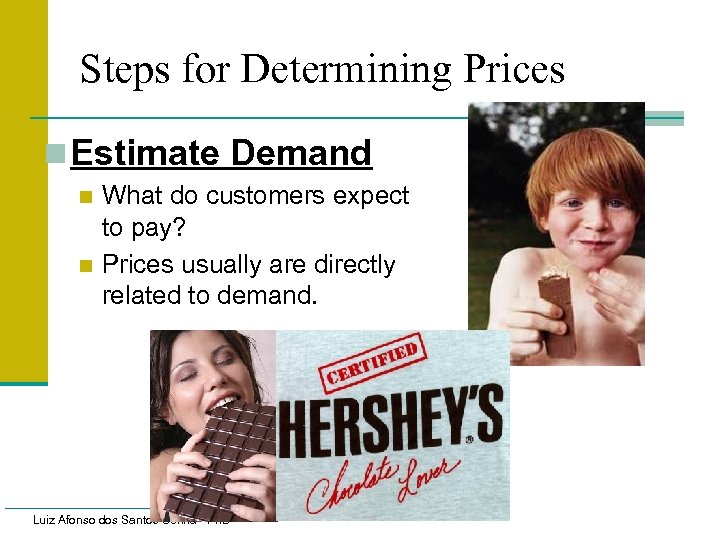 Steps for Determining Prices n Estimate Demand What do customers expect to pay? n Prices usually are directly related to demand. n Luiz Afonso dos Santos Senna - Ph. D
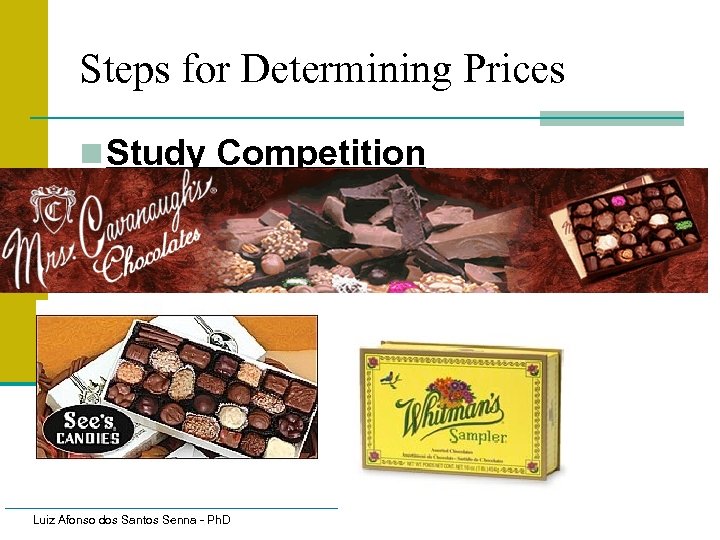 Steps for Determining Prices n Study Competition Luiz Afonso dos Santos Senna - Ph. D
 Steps for Determining Prices n Decide on a Pricing Strategy Price higher than the competition because your product is superior n Price lower, then raise it once your product is accepted n Luiz Afonso dos Santos Senna - Ph. D
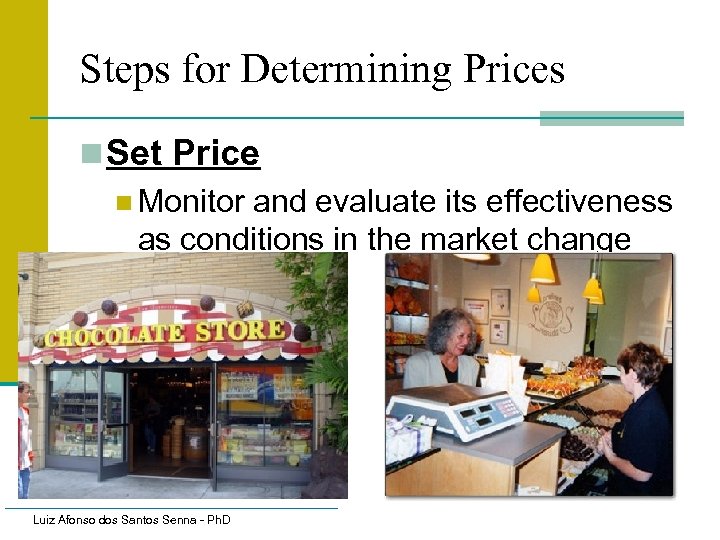 Steps for Determining Prices n Set Price n Monitor and evaluate its effectiveness as conditions in the market change Luiz Afonso dos Santos Senna - Ph. D
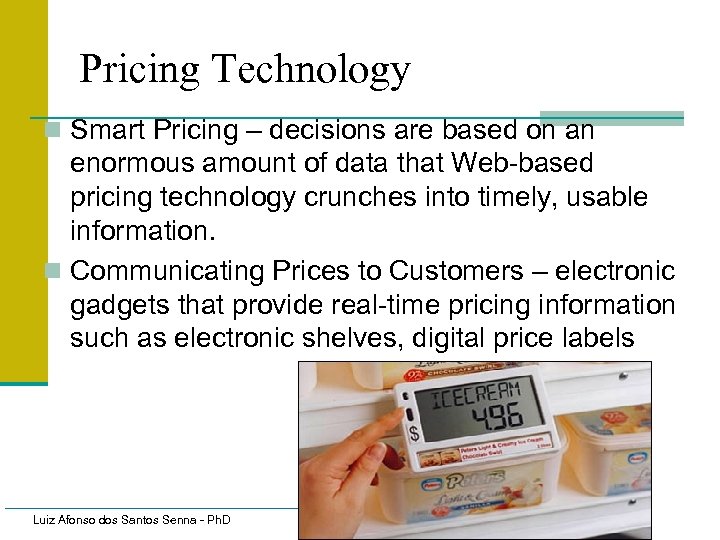 Pricing Technology n Smart Pricing – decisions are based on an enormous amount of data that Web-based pricing technology crunches into timely, usable information. n Communicating Prices to Customers – electronic gadgets that provide real-time pricing information such as electronic shelves, digital price labels Luiz Afonso dos Santos Senna - Ph. D
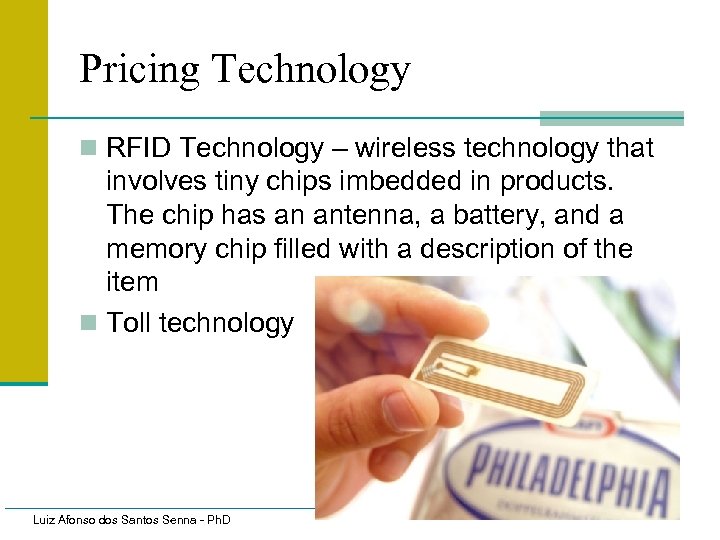 Pricing Technology n RFID Technology – wireless technology that involves tiny chips imbedded in products. The chip has an antenna, a battery, and a memory chip filled with a description of the item n Toll technology Luiz Afonso dos Santos Senna - Ph. D
 Geographic Considerations n FOB (free on board) plant or FOB origin: origin Price quotation that does not include shipping charges. Buyer pays all freight charges to transport the product from the manufacturer n Freight absorption: system for handling absorption transportation costs under which the buyer may deduct shipping expenses from the costs of goods Luiz Afonso dos Santos Senna - Ph. D
 n n n Uniform-delivered price: system for handling price transportation costs under which all buyers are quoted with the same price, including transportation expenses Zone pricing: system for handling transportation pricing costs under which the market is divided into geographic regions and a different price is set in each region Basing-point system: system for handling system transportation costs in which the buyer’s costs included the factory price plus freight charges from the basing-point city nearest the buyer. Seeks to equalize competition between distant marketers Luiz Afonso dos Santos Senna - Ph. D
 Product and Pricing Strategies
 Product Characteristics Types of Products Stages of Products Luiz Afonso dos Santos Senna - Ph. D
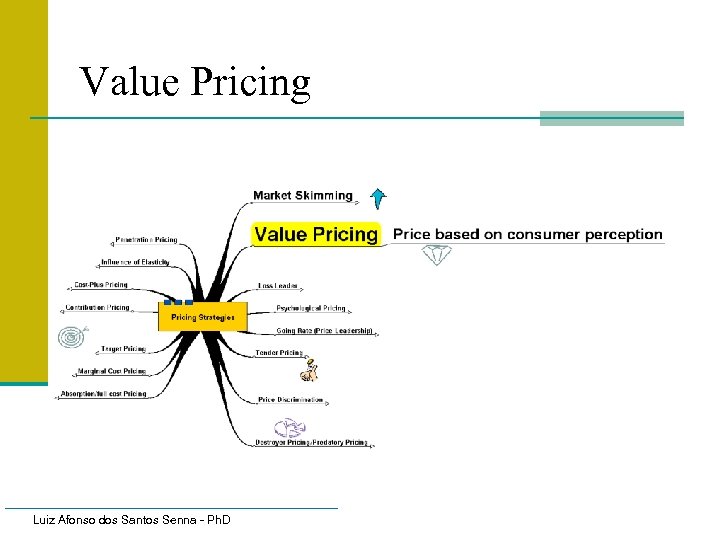
 Other Pricing Strategies Price-Based Optimization Skimming Penetration Luiz Afonso dos Santos Senna - Ph. D
 Price Adjustment Strategies Discount Pricing Bundling Dynamic Pricing Luiz Afonso dos Santos Senna - Ph. D
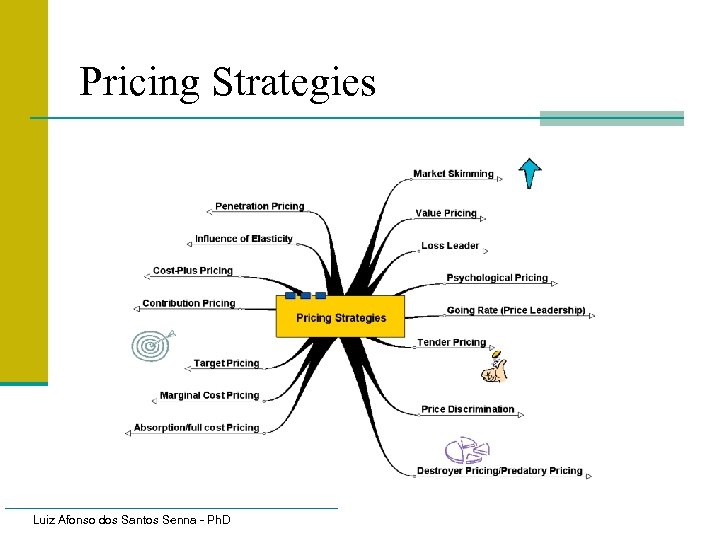 Pricing Strategies Luiz Afonso dos Santos Senna - Ph. D
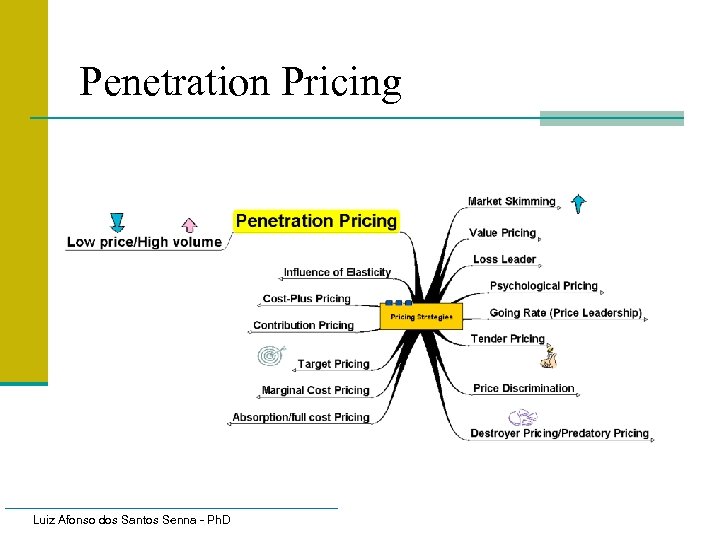 Penetration Pricing Luiz Afonso dos Santos Senna - Ph. D
 Penetration Pricing n Price set to ‘penetrate the market’ n ‘Low’ price to secure high volumes n Typical in mass market products – chocolate bars, food stuffs, household goods, etc. n Suitable for products with long anticipated life cycles n May be useful if launching into a new market Luiz Afonso dos Santos Senna - Ph. D
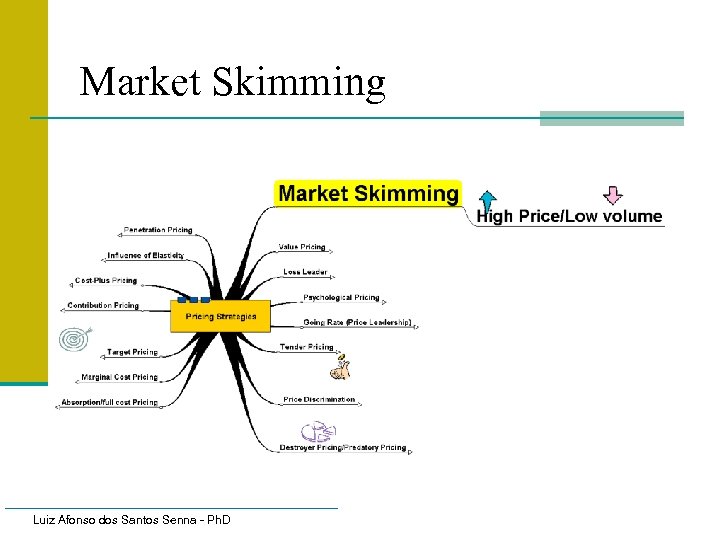 Market Skimming Luiz Afonso dos Santos Senna - Ph. D
 Market Skimming n High price, Low volumes n Skim the profit from the market n Suitable for products that have short life cycles or which will face competition at some point in the future (e. g. after a patent runs out) n Examples include: Playstation, jewellery, digital technology, new DVDs, etc. Luiz Afonso dos Santos Senna - Ph. D
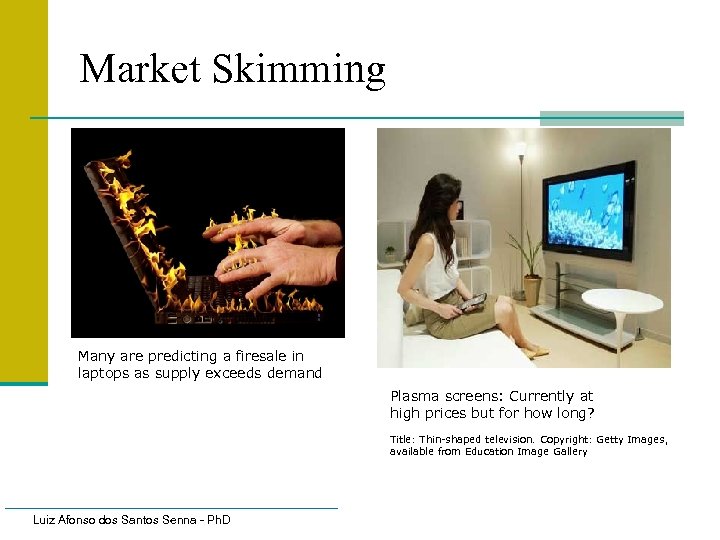 Market Skimming Many are predicting a firesale in laptops as supply exceeds demand Plasma screens: Currently at high prices but for how long? Title: Thin-shaped television. Copyright: Getty Images, available from Education Image Gallery Luiz Afonso dos Santos Senna - Ph. D
 Value Pricing Luiz Afonso dos Santos Senna - Ph. D
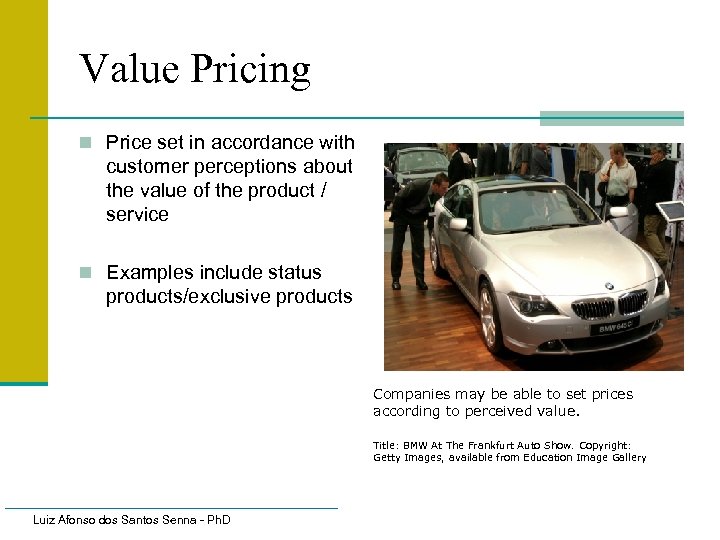 Value Pricing n Price set in accordance with customer perceptions about the value of the product / service n Examples include status products/exclusive products Companies may be able to set prices according to perceived value. Title: BMW At The Frankfurt Auto Show. Copyright: Getty Images, available from Education Image Gallery Luiz Afonso dos Santos Senna - Ph. D
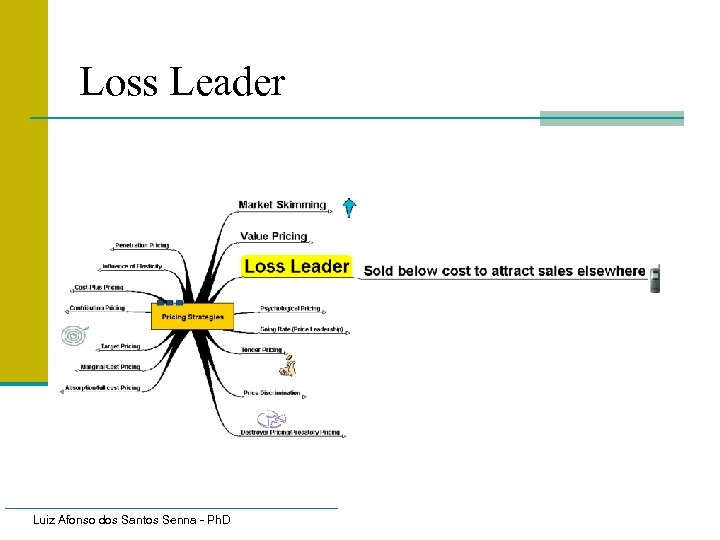 Loss Leader Luiz Afonso dos Santos Senna - Ph. D
 Loss Leader n Goods/services deliberately sold below cost to encourage sales elsewhere n Typical in supermarkets, e. g. at Christmas, selling bottles of gin at £ 3 in the hope that people will be attracted to the store and buy other things n Purchases of other items more than covers ‘loss’ on item sold n e. g. ‘Free’ mobile phone when taking on contract package Luiz Afonso dos Santos Senna - Ph. D
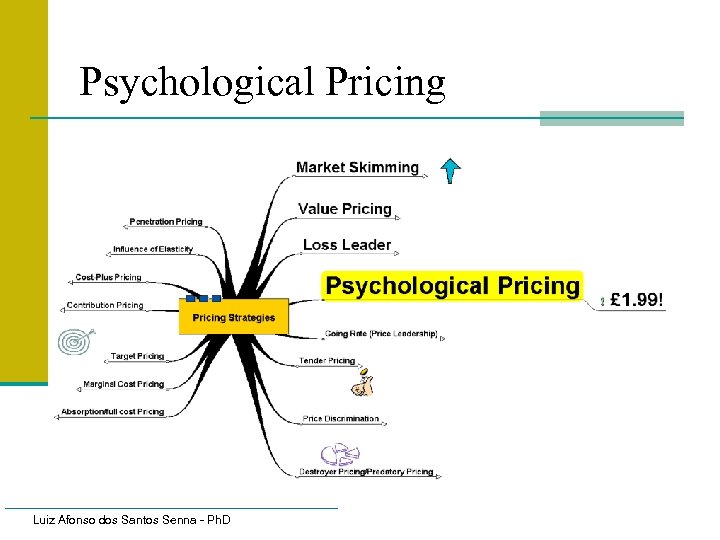 Psychological Pricing Luiz Afonso dos Santos Senna - Ph. D
 Psychological Pricing n Used to play on consumer perceptions n Classic example - $9. 99 instead of $10. 00! n Odd-even: $5. 95, $. 79, $699 OR $12, $50 n Multiple Unit-3 for !1. 00 better than $. 34 each Luiz Afonso dos Santos Senna - Ph. D
 Psychological Pricing n Odd-Even Pricing n Odd numbers convey a bargain image -- $. 79, $9. 99, $699 n Even numbers convey a quality image -- $10, $50, $100 Luiz Afonso dos Santos Senna - Ph. D
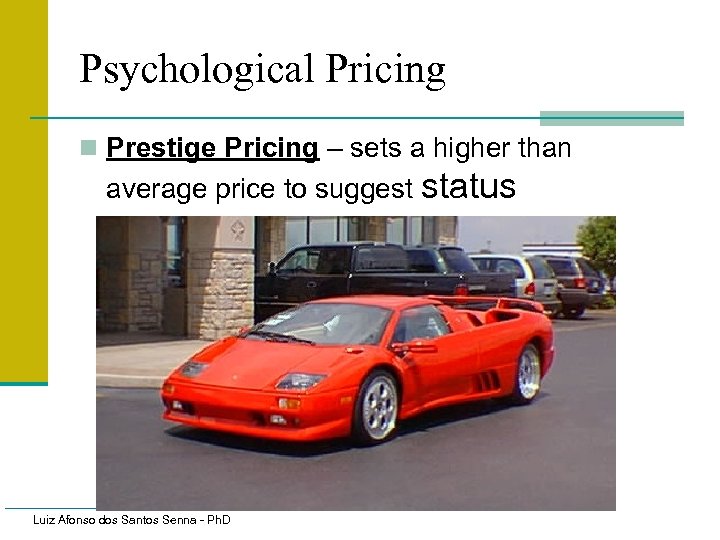 Psychological Pricing n Prestige Pricing – sets a higher than average price to suggest status Luiz Afonso dos Santos Senna - Ph. D
 Psychological Pricing n Multiple-Unit Pricing – 3 for $. 99 n Suggests a bargain and helps increase sales volume. n Better than selling the same items at $. 33 each. Luiz Afonso dos Santos Senna - Ph. D
 Psychological Pricing n. Everyday Low Prices (EDLP) – set on a consistent basis Luiz Afonso dos Santos Senna - Ph. D
 Going Rate (Price Leadership) Luiz Afonso dos Santos Senna - Ph. D
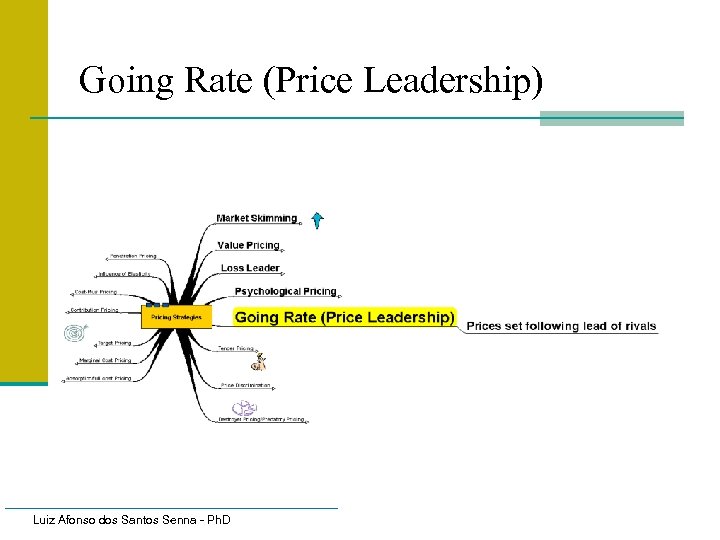
 Going Rate (Price Leadership) n In case of price leader, rivals have difficulty in competing on price – too high and they lose market share, too low and the price leader would match price and force smaller rival out of market n May follow pricing leads of rivals especially where those rivals have a clear dominance of market shar n Where competition is limited, ‘going rate’ pricing may be applicable – banks, petrol, supermarkets, electrical goods – find very similar prices in all outlets Luiz Afonso dos Santos Senna - Ph. D
 Tender Pricing Luiz Afonso dos Santos Senna - Ph. D
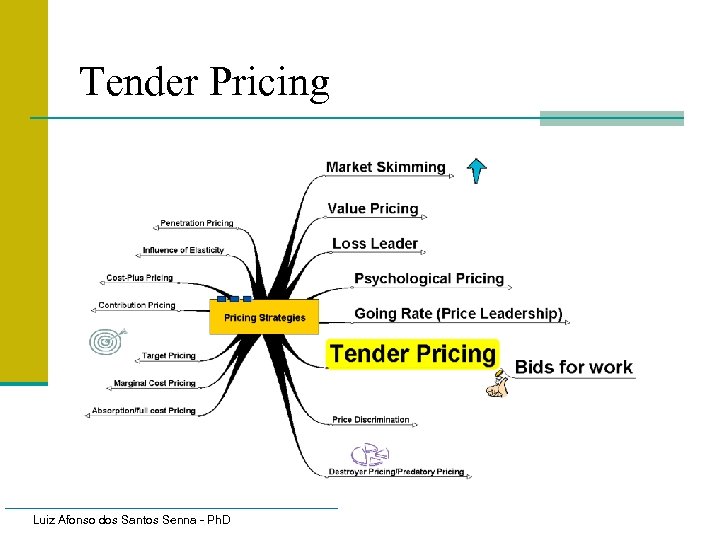
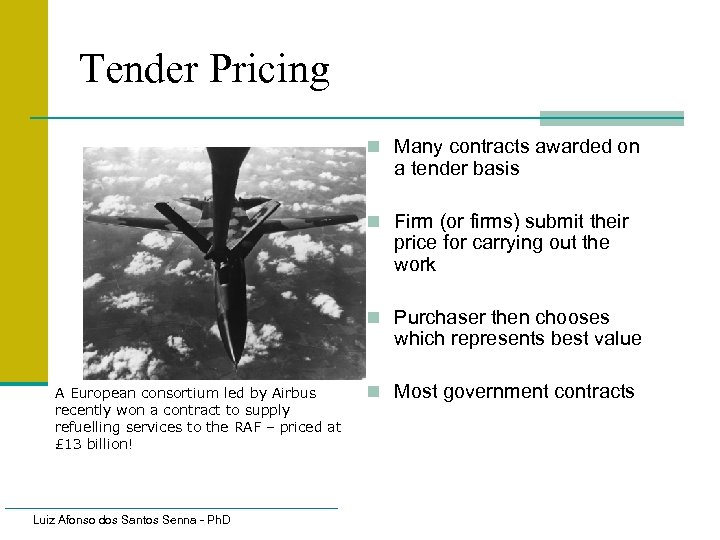 Tender Pricing n Many contracts awarded on a tender basis n Firm (or firms) submit their price for carrying out the work n Purchaser then chooses which represents best value A European consortium led by Airbus recently won a contract to supply refuelling services to the RAF – priced at £ 13 billion! Luiz Afonso dos Santos Senna - Ph. D n Most government contracts
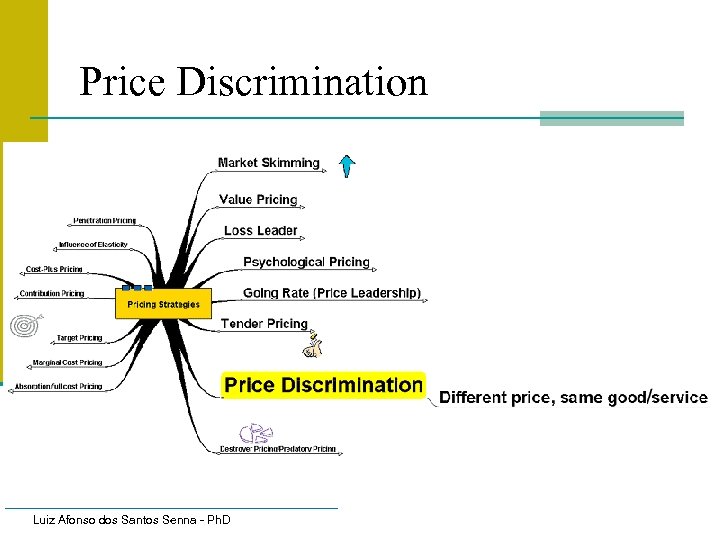 Price Discrimination Luiz Afonso dos Santos Senna - Ph. D
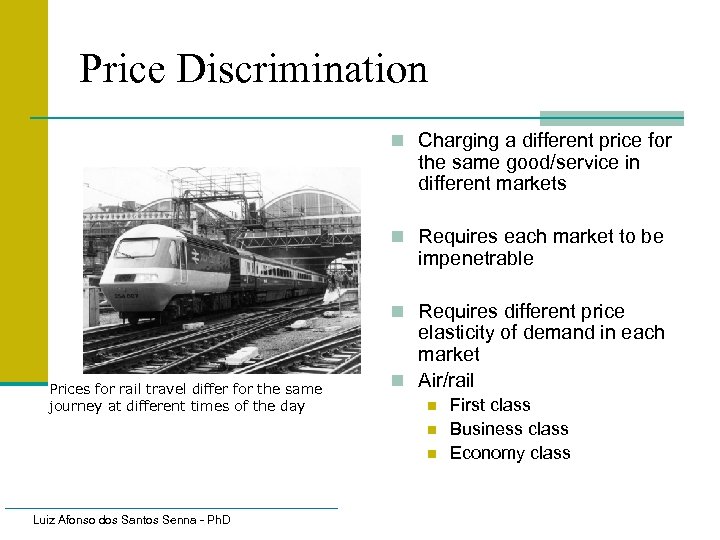 Price Discrimination n Charging a different price for the same good/service in different markets n Requires each market to be impenetrable n Requires different price Prices for rail travel differ for the same journey at different times of the day elasticity of demand in each market n Air/rail n n n Luiz Afonso dos Santos Senna - Ph. D First class Business class Economy class
 Discounts and Allowances n Cash Discounts – offered to buyers to encourage them to pay their bills quickly. n 2/10, net 30 n Quantity Discounts – offered for placing large orders n Trade Discounts – the way manufacturers quote prices to wholesalers and retailers. Luiz Afonso dos Santos Senna - Ph. D
 Promotional Pricing -- Used with sales promotion n Loss Leader Pricing – offering very popular items for sale at below-cost prices n Special-Event n Back-to-school specials n Dollar days n Anniversary sales n Rebates and Coupons Luiz Afonso dos Santos Senna - Ph. D
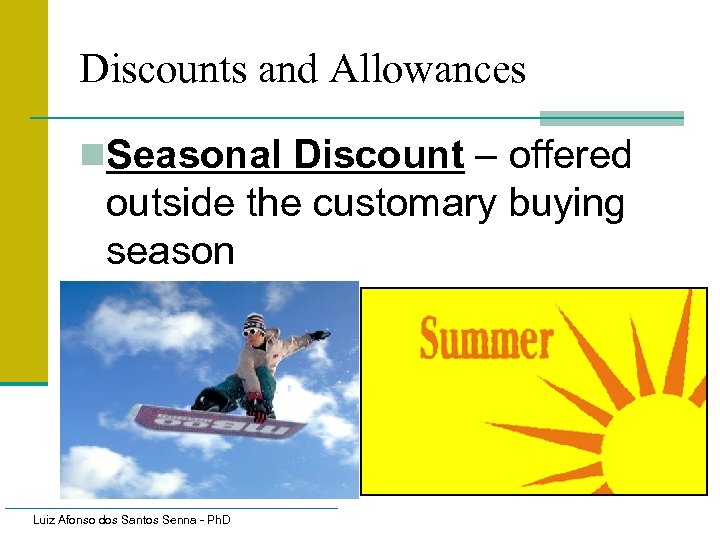 Discounts and Allowances n. Seasonal Discount – offered outside the customary buying season Luiz Afonso dos Santos Senna - Ph. D
 Discounts and Allowances n Allowances – go directly to the buyer. Customers are offered a price reduction if they sell back an old model of the product they are purchasing Luiz Afonso dos Santos Senna - Ph. D
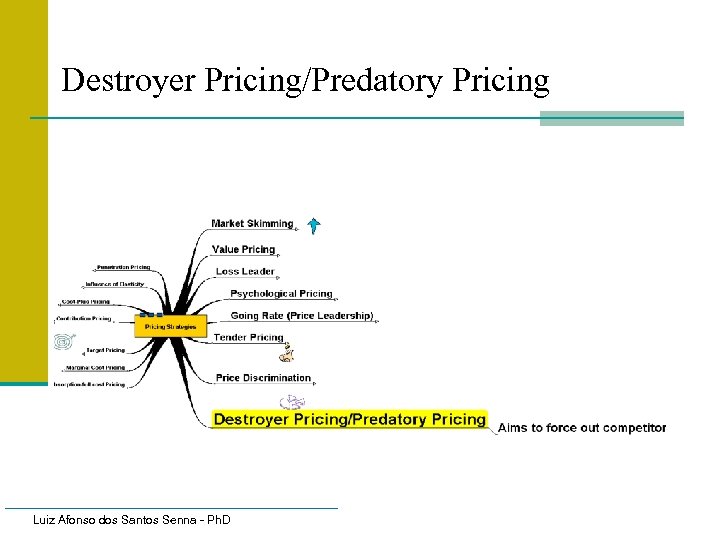 Destroyer Pricing/Predatory Pricing Luiz Afonso dos Santos Senna - Ph. D
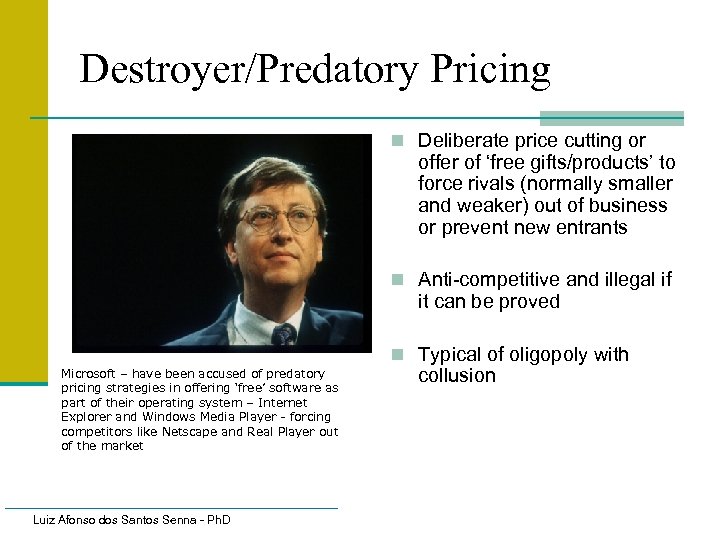 Destroyer/Predatory Pricing n Deliberate price cutting or offer of ‘free gifts/products’ to force rivals (normally smaller and weaker) out of business or prevent new entrants n Anti-competitive and illegal if it can be proved n Typical of oligopoly with Microsoft – have been accused of predatory pricing strategies in offering ‘free’ software as part of their operating system – Internet Explorer and Windows Media Player - forcing competitors like Netscape and Real Player out of the market Luiz Afonso dos Santos Senna - Ph. D collusion
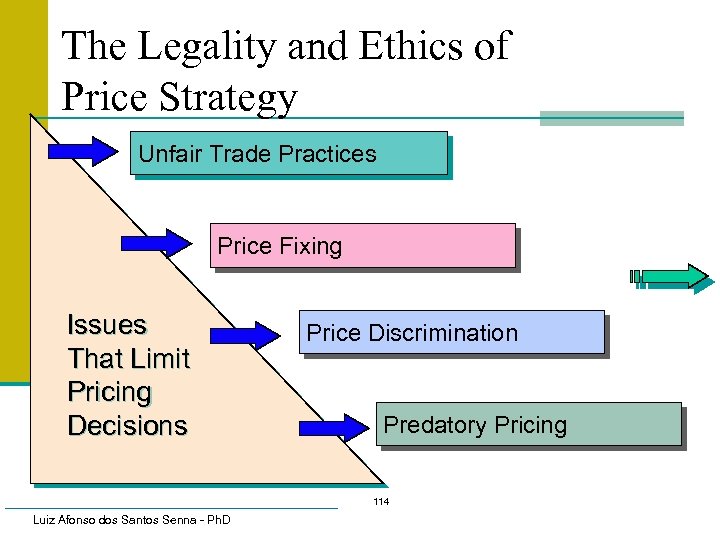 The Legality and Ethics of Price Strategy Unfair Trade Practices Price Fixing Issues That Limit Pricing Decisions Price Discrimination Predatory Pricing 114 Luiz Afonso dos Santos Senna - Ph. D
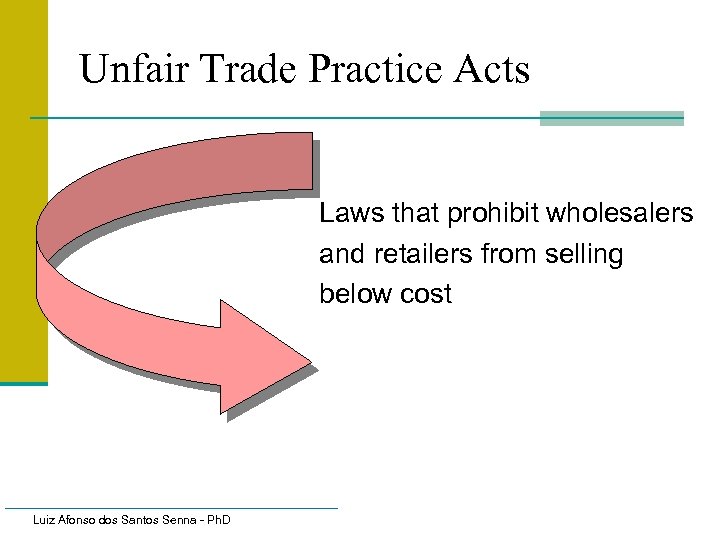 Unfair Trade Practice Acts Laws that prohibit wholesalers and retailers from selling below cost Luiz Afonso dos Santos Senna - Ph. D
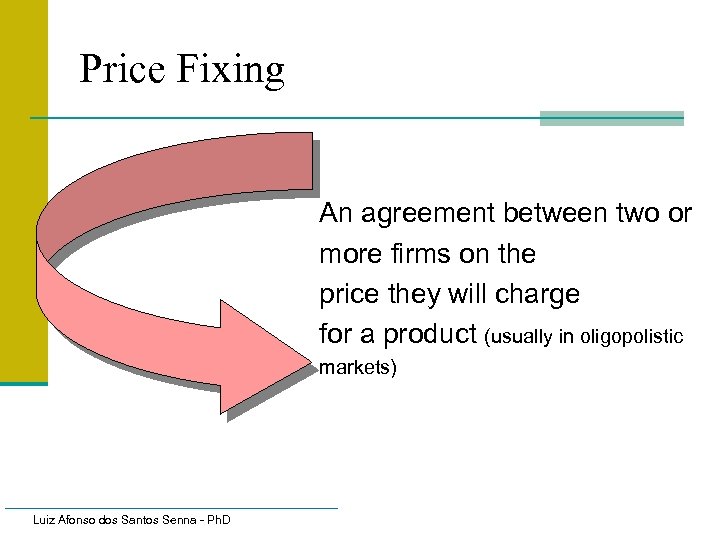 Price Fixing An agreement between two or more firms on the price they will charge for a product (usually in oligopolistic markets) Luiz Afonso dos Santos Senna - Ph. D
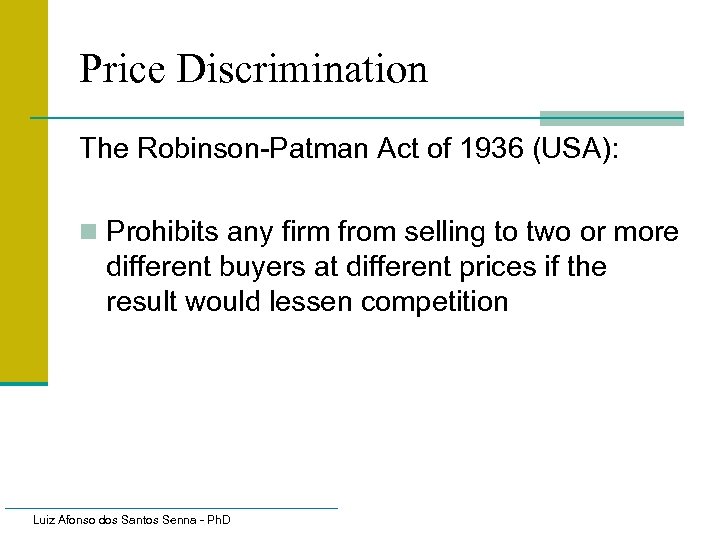 Price Discrimination The Robinson-Patman Act of 1936 (USA): n Prohibits any firm from selling to two or more different buyers at different prices if the result would lessen competition Luiz Afonso dos Santos Senna - Ph. D
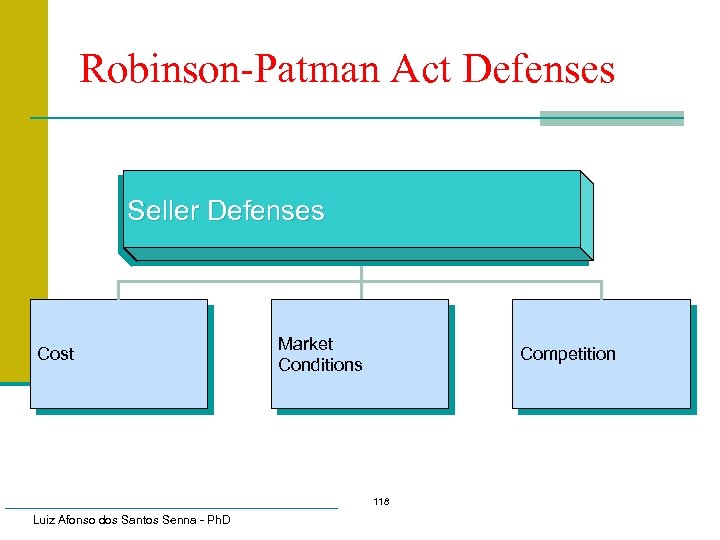 Robinson-Patman Act Defenses Seller Defenses Cost Market Conditions Competition 118 Luiz Afonso dos Santos Senna - Ph. D
 Predatory Pricing The practice of charging a very low price for a product with the intent of driving competitors out of business or out of a market. Luiz Afonso dos Santos Senna - Ph. D
 Discussion: Impact of Ethics on Pricing n How should you price if your product is a life- saving drug? n What are the ethical considerations? Customers have no choice n Need to pay for the research n When cheaper options doesn’t work n Competition decides n 120 Luiz Afonso dos Santos Senna - Ph. D
 Some other pricing strategies n These all involve the use of some numerical understanding…. Luiz Afonso dos Santos Senna - Ph. D
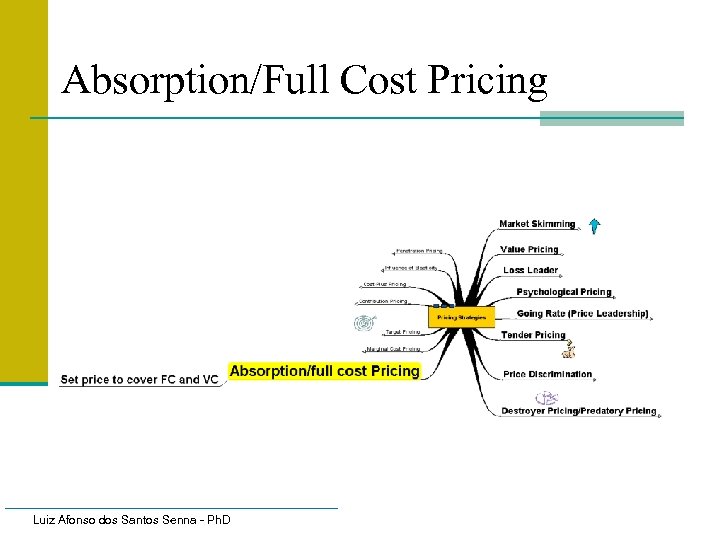 Absorption/Full Cost Pricing Luiz Afonso dos Santos Senna - Ph. D
 Absorption/Full Cost Pricing n Full Cost Pricing – attempting to set price to cover both fixed and variable costs n Absorption Cost Pricing – Price set to ‘absorb’ some of the fixed costs of production Luiz Afonso dos Santos Senna - Ph. D
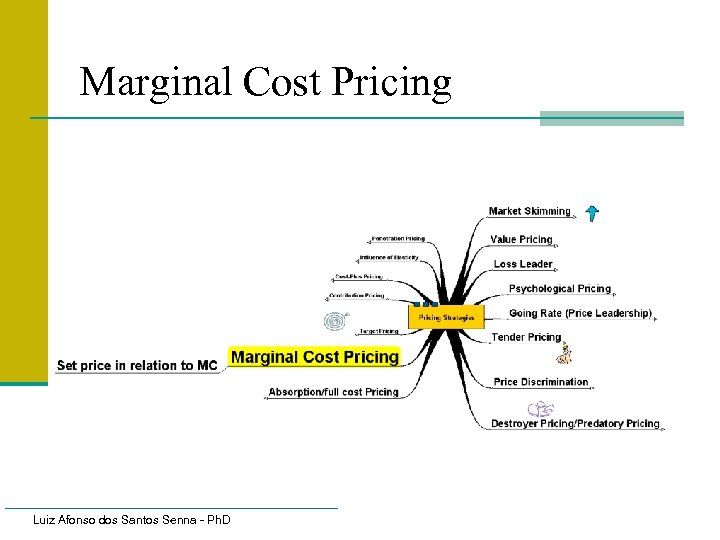 Marginal Cost Pricing Luiz Afonso dos Santos Senna - Ph. D
 Marginal Cost Pricing n Marginal cost – the cost of producing ONE extra or ONE fewer item of production n MC pricing – allows flexibility n Particularly relevant in transport where fixed costs may be relatively high n Allows variable pricing structure – e. g. on a flight from London to New York – providing the cost of the extra passenger is covered, the price could be varied a good deal to attract customers and fill the aircraft Luiz Afonso dos Santos Senna - Ph. D
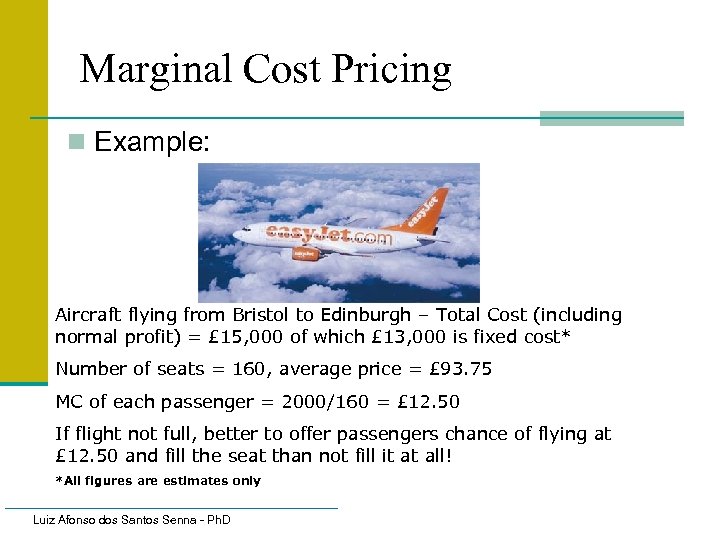 Marginal Cost Pricing n Example: Aircraft flying from Bristol to Edinburgh – Total Cost (including normal profit) = £ 15, 000 of which £ 13, 000 is fixed cost* Number of seats = 160, average price = £ 93. 75 MC of each passenger = 2000/160 = £ 12. 50 If flight not full, better to offer passengers chance of flying at £ 12. 50 and fill the seat than not fill it at all! *All figures are estimates only Luiz Afonso dos Santos Senna - Ph. D
 Contribution Pricing Luiz Afonso dos Santos Senna - Ph. D
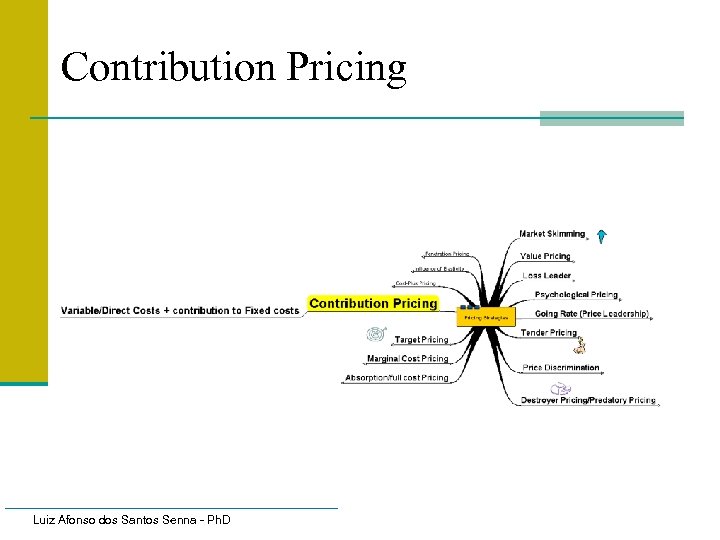
 Contribution Pricing n Contribution = Selling Price – Variable (direct costs) n Prices set to ensure coverage of variable costs and a ‘contribution’ to the fixed costs n Similar in principle to marginal cost pricing n Break-even analysis might be useful in such circumstances Luiz Afonso dos Santos Senna - Ph. D
 Target Pricing Luiz Afonso dos Santos Senna - Ph. D
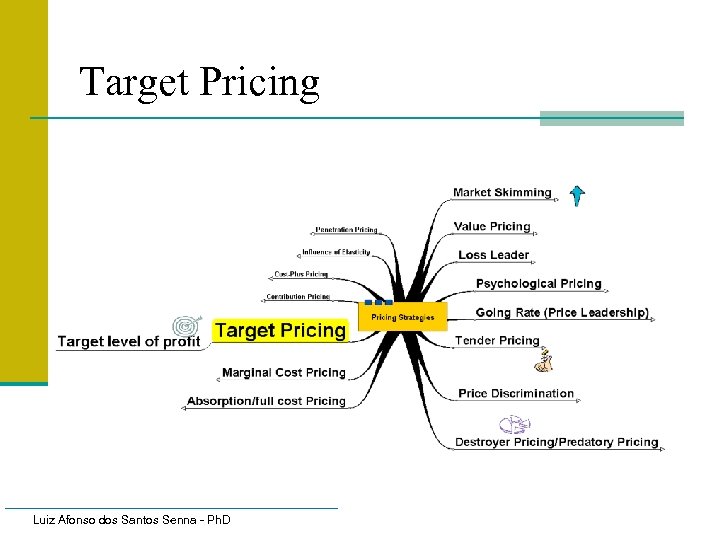
 Target Pricing n Setting price to ‘target’ a specified profit level n Estimates of the cost and potential revenue at different prices, and thus the break-even have to be made, to determine the mark-up n Mark-up = Profit/Cost x 100 n This strategy is used by many clothes retailers where they can add upto 60% markup on the basic cost of the clothes. So even with a 50% sales offer they still make a profit! Luiz Afonso dos Santos Senna - Ph. D
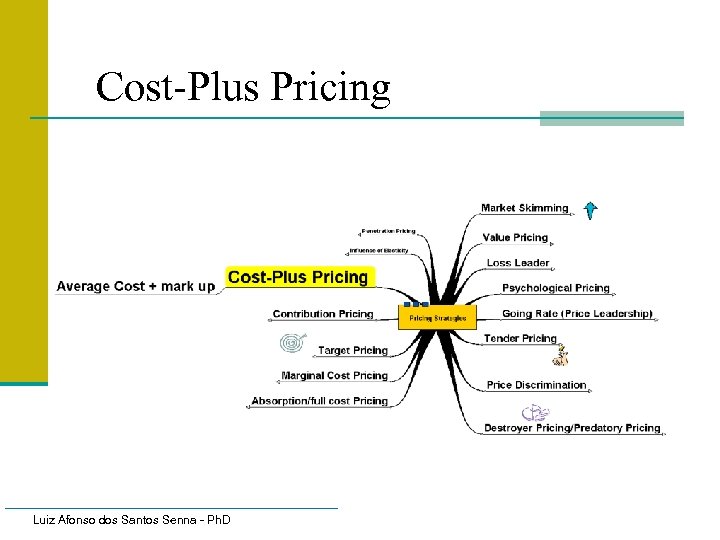 Cost-Plus Pricing Luiz Afonso dos Santos Senna - Ph. D
 Cost-Plus Pricing n Calculation of the average cost (AC) plus a mark up n AC = Total Cost/Output Luiz Afonso dos Santos Senna - Ph. D
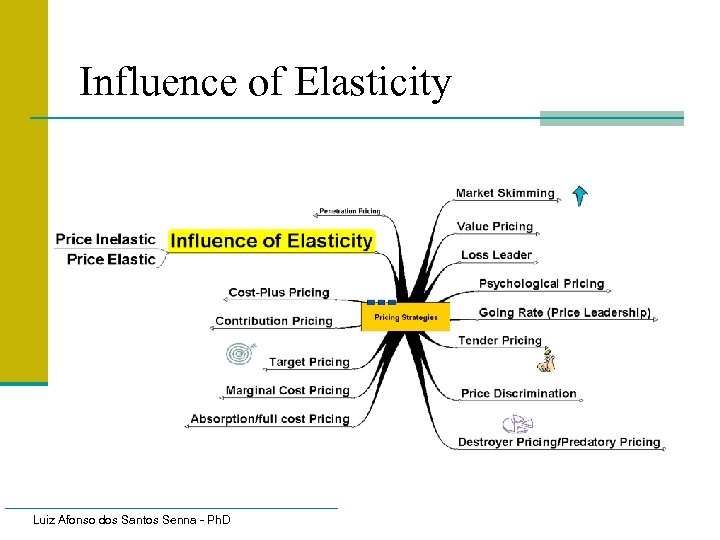 Influence of Elasticity Luiz Afonso dos Santos Senna - Ph. D
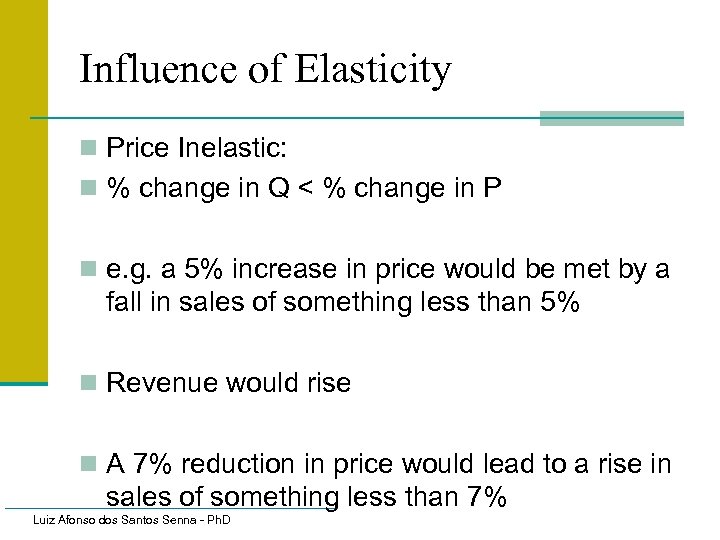 Influence of Elasticity n Price Inelastic: n % change in Q < % change in P n e. g. a 5% increase in price would be met by a fall in sales of something less than 5% n Revenue would rise n A 7% reduction in price would lead to a rise in sales of something less than 7% Luiz Afonso dos Santos Senna - Ph. D
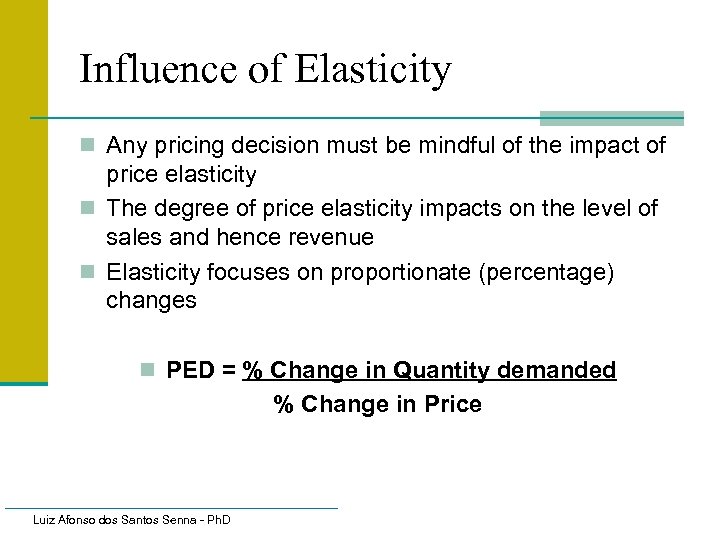 Influence of Elasticity n Any pricing decision must be mindful of the impact of price elasticity n The degree of price elasticity impacts on the level of sales and hence revenue n Elasticity focuses on proportionate (percentage) changes n PED = % Change in Quantity demanded % Change in Price Luiz Afonso dos Santos Senna - Ph. D
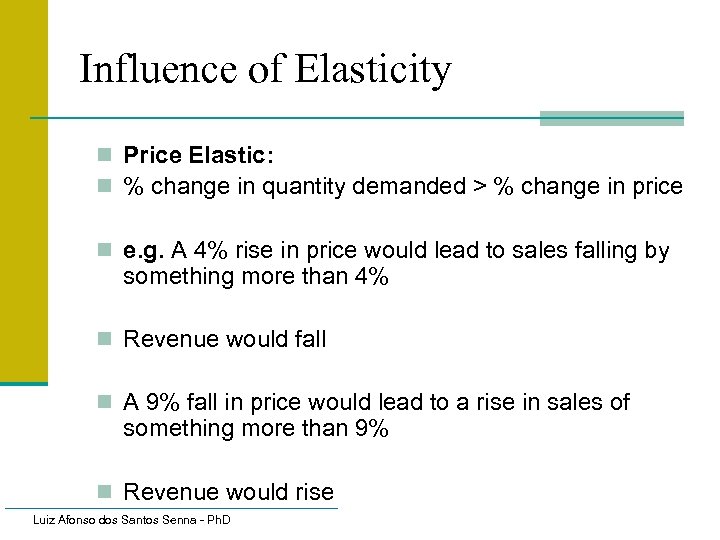 Influence of Elasticity n Price Elastic: n % change in quantity demanded > % change in price n e. g. A 4% rise in price would lead to sales falling by something more than 4% n Revenue would fall n A 9% fall in price would lead to a rise in sales of something more than 9% n Revenue would rise Luiz Afonso dos Santos Senna - Ph. D
 Select a Pricing Method n Mark-up Pricing - “Cost Plus” n Target Return Pricing n Perceived Value Pricing 137 Luiz Afonso dos Santos Senna - Ph. D
 Device Pricing vs. Whole Product Pricing n Value of any product to its market is strongly influenced by prices of competitive products n Competitive “devices” are analyzed, but “products” are priced n Product “features” have different values: n n n Customer service Warranties Distribution channels (e. g. , convenience) n The “sum” of the features makes up the “product” Luiz Afonso dos Santos Senna - Ph. D
 Determining Perceived Value n What value is placed on the end result? n The cost of alternative solutions to the customer. n A function of: n Prices of comparable (though not identical) products n The “value” (+/-) of the product’s differences vs. the competitive offering n The value of the “Whole Product” Luiz Afonso dos Santos Senna - Ph. D
 Economic Value Analysis n n Identify the cost of the competitive product or process (i. e. , the reference value) Identify all the factors that differentiate the product. Determine the value to the customer of these differentiating factors (i. e. , the differentiation value) Sum the reference value and the differentiation value to determine the total economic value. Luiz Afonso dos Santos Senna - Ph. D
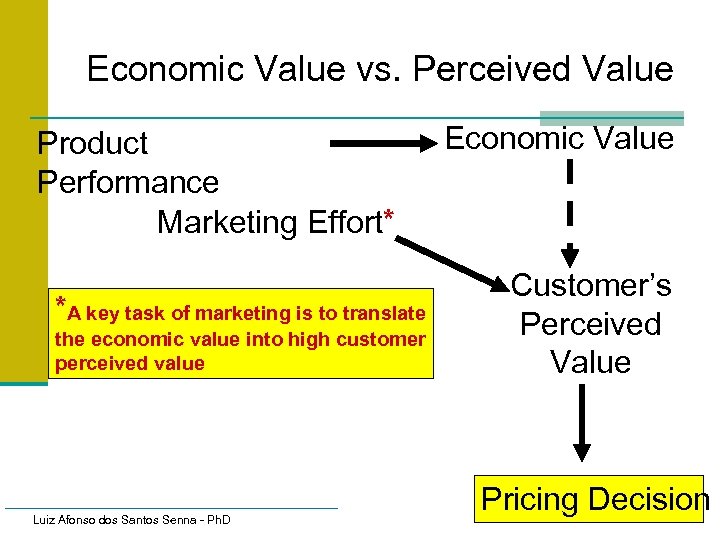 Economic Value vs. Perceived Value Product Performance Marketing Effort* *A key task of marketing is to translate the economic value into high customer perceived value Luiz Afonso dos Santos Senna - Ph. D Economic Value Customer’s Perceived Value Pricing Decision
 Select a Pricing Method n Mark-up Pricing - “Cost Plus” n Target Return Pricing n Perceived Value Pricing n Going Rate Pricing (market price) n Reference Pricing (comparison w/substitutes) n Sealed-Bid Pricing 142 Luiz Afonso dos Santos Senna - Ph. D
 Select the Final Price n Desired/Required Distributor Margins n Psychological pricing n Influence of other marketing mix elements n Company pricing policies n Impact of price on others 5 7 00. 3 $ Luiz Afonso dos Santos Senna - Ph. D 10 $ 00 , 0 2, 0 $ 000 00,
 Conjoint Analysis Stated Preference Methods Trade-off Analysis and Behavioural models Luiz Afonso dos Santos Senna - Ph. D
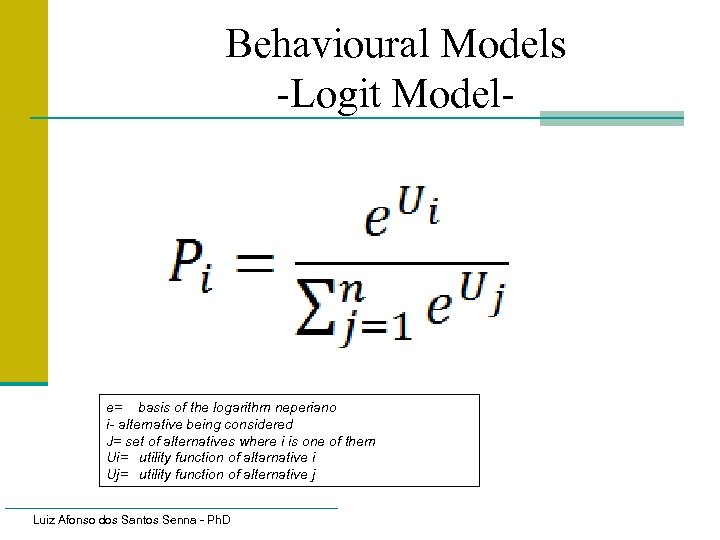 Behavioural Models -Logit Model- e= basis of the logarithm neperiano i- alternative being considered J= set of alternatives where i is one of them Ui= utility function of altarnative i Uj= utility function of alternative j Luiz Afonso dos Santos Senna - Ph. D
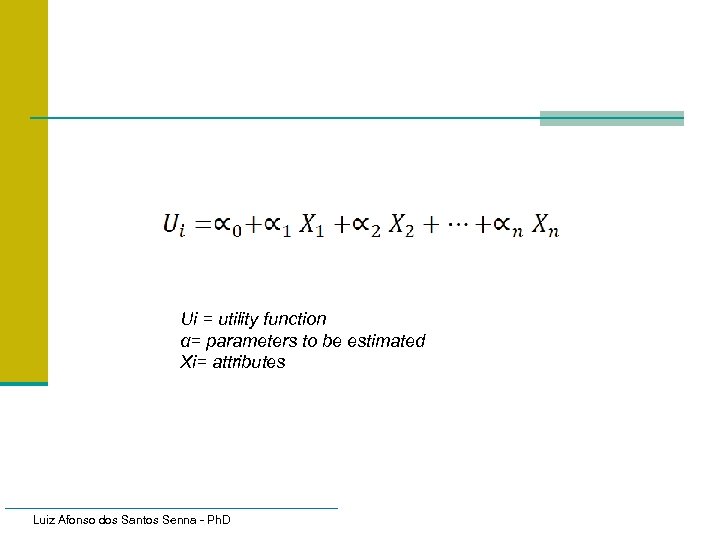 Ui = utility function α= parameters to be estimated Xi= attributes Luiz Afonso dos Santos Senna - Ph. D
 Data Collection n Revealed Preference n Data gained from experience n Good to know about previous experience and existing products/services n Stated preference n Data gainded from hipothetical questions in selected scenarios n Good to gain information about new services/products Luiz Afonso dos Santos Senna - Ph. D