 Скачать презентацию Pricing Math Chapter 27 Basic Pricing Concepts
ca49850005c0fce258dc5b3a3c9e31db.ppt
- Количество слайдов: 24



Pricing Math Chapter 27
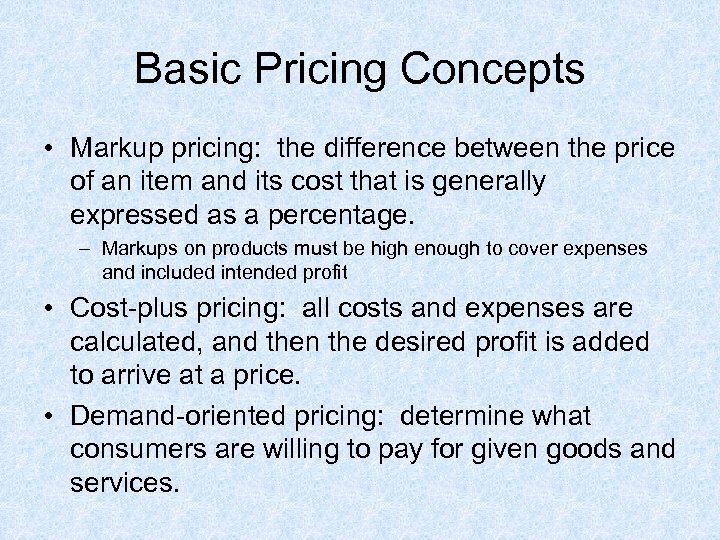
Basic Pricing Concepts • Markup pricing: the difference between the price of an item and its cost that is generally expressed as a percentage. – Markups on products must be high enough to cover expenses and included intended profit • Cost-plus pricing: all costs and expenses are calculated, and then the desired profit is added to arrive at a price. • Demand-oriented pricing: determine what consumers are willing to pay for given goods and services.
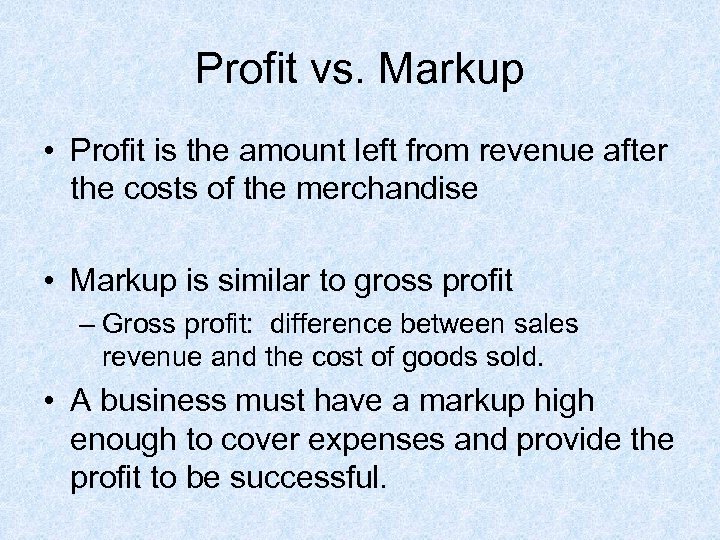
Profit vs. Markup • Profit is the amount left from revenue after the costs of the merchandise • Markup is similar to gross profit – Gross profit: difference between sales revenue and the cost of goods sold. • A business must have a markup high enough to cover expenses and provide the profit to be successful.
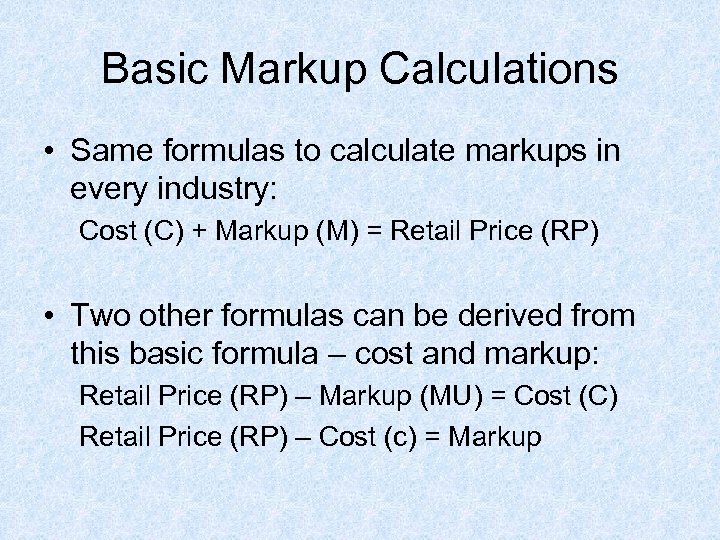
Basic Markup Calculations • Same formulas to calculate markups in every industry: Cost (C) + Markup (M) = Retail Price (RP) • Two other formulas can be derived from this basic formula – cost and markup: Retail Price (RP) – Markup (MU) = Cost (C) Retail Price (RP) – Cost (c) = Markup
Practice 1 • Use the retail price formula and its variations to do the following problems: 1. A calculator costs AB Products $15, and the markup is $10. What is its retail price? 2. A tennis racket retails for $175, and its markup is $85. What is its cost?
Percentage Markup • Companies choose to base the markup on retail price for three reasons: 1. The markup on the retail price sounds like a smaller amount. 2. Future markdowns and discounts are calculated on a retail basis. 3. Profits are generally calculated on sales revenue.
Steps used to Calculate Percentage Markup • Assume you want to calculate the percentage markup on a pair of bookends from Target: – Cost is $49. 50 and sells for $82. 50 Steps: 1. Determine the dollar markup (RP-C=MU ($) $82. 50 -$49. 50 = $33. 00 2. To change the dollar markup to the percentage markup, divide it by the retail price. MU ($)/RP=MU (%) on retail $33. 00/$82. 40 =. 40 3. Change the decimal to a percentage. This figure is percentage markup on retail. . 40 = 40%
Percentage Markup on Cost Steps: 1. Determine the dollar markup RP-C=MU($) $82. 50 -$49. 50=$33. 00 2. To change the dollar markup to the percentage markup, divide by cost. MU($)/C=MU(%) on cost $33. 00/$49. 50=. 6667 3. Change the decimal to the percentage. This is the percentage markup on cost. . 6667=66. 67% **Do practice 2 problem on page 486
Markup Equivalents Table • Page 487 – do problems.
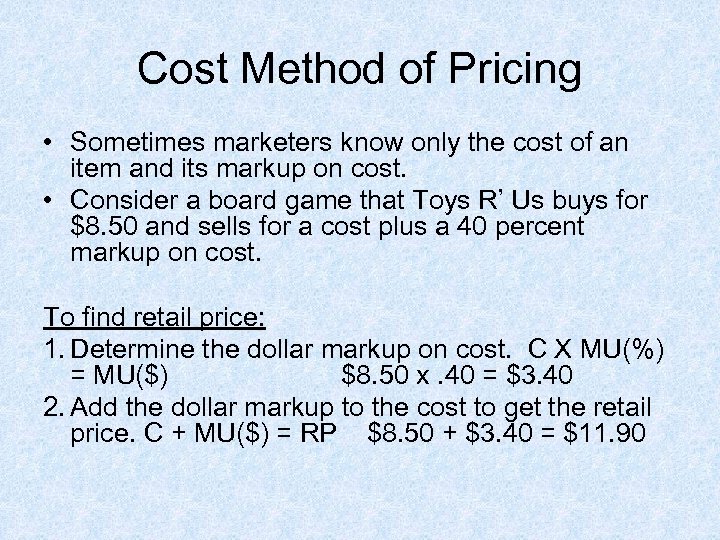
Cost Method of Pricing • Sometimes marketers know only the cost of an item and its markup on cost. • Consider a board game that Toys R’ Us buys for $8. 50 and sells for a cost plus a 40 percent markup on cost. To find retail price: 1. Determine the dollar markup on cost. C X MU(%) = MU($) $8. 50 x. 40 = $3. 40 2. Add the dollar markup to the cost to get the retail price. C + MU($) = RP $8. 50 + $3. 40 = $11. 90
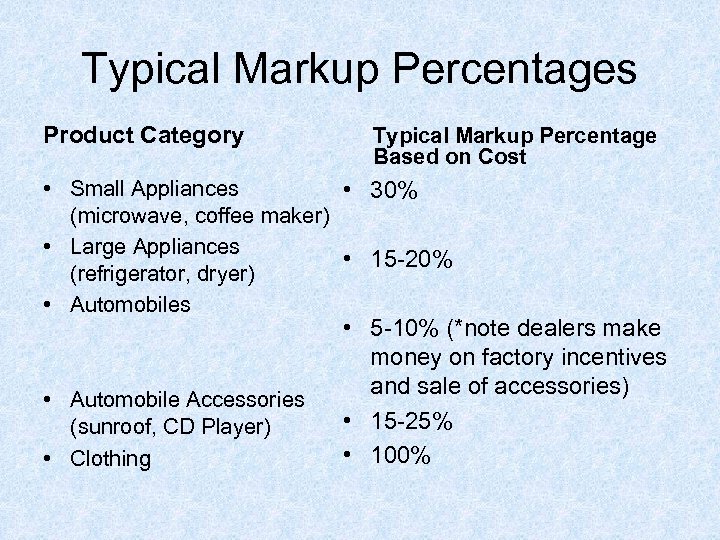
Typical Markup Percentages Product Category Typical Markup Percentage Based on Cost • Small Appliances • 30% (microwave, coffee maker) • Large Appliances • 15 -20% (refrigerator, dryer) • Automobiles • Automobile Accessories (sunroof, CD Player) • Clothing • 5 -10% (*note dealers make money on factory incentives and sale of accessories) • 15 -25% • 100%
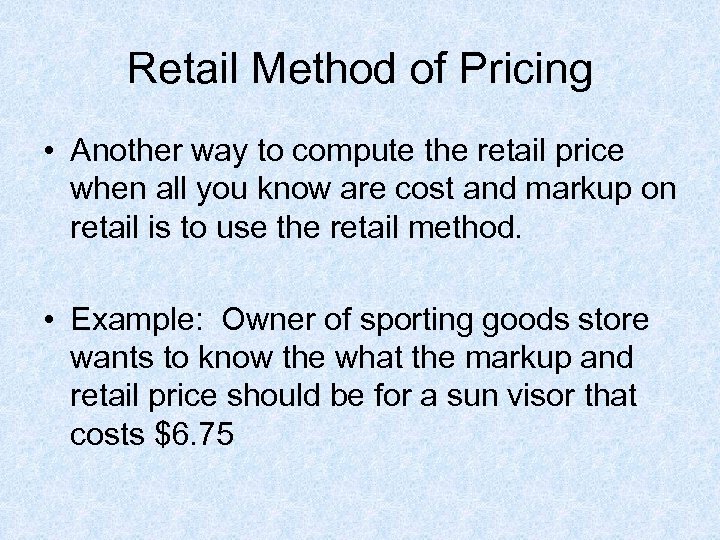
Retail Method of Pricing • Another way to compute the retail price when all you know are cost and markup on retail is to use the retail method. • Example: Owner of sporting goods store wants to know the what the markup and retail price should be for a sun visor that costs $6. 75
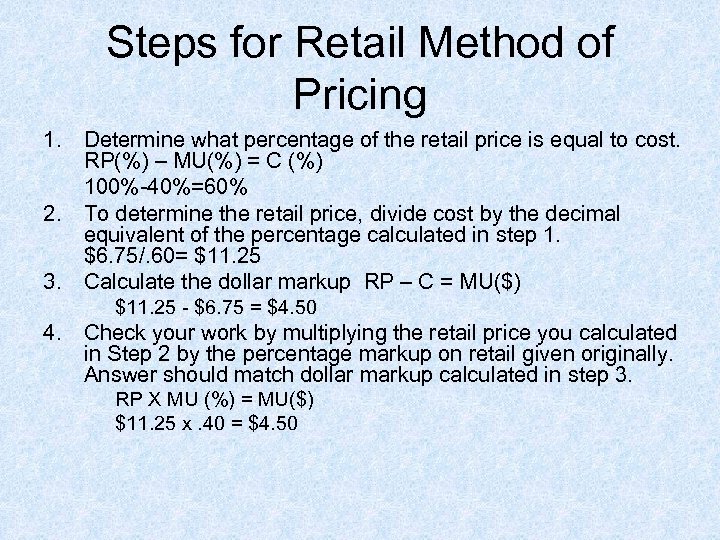
Steps for Retail Method of Pricing 1. Determine what percentage of the retail price is equal to cost. RP(%) – MU(%) = C (%) 100%-40%=60% 2. To determine the retail price, divide cost by the decimal equivalent of the percentage calculated in step 1. $6. 75/. 60= $11. 25 3. Calculate the dollar markup RP – C = MU($) $11. 25 - $6. 75 = $4. 50 4. Check your work by multiplying the retail price you calculated in Step 2 by the percentage markup on retail given originally. Answer should match dollar markup calculated in step 3. RP X MU (%) = MU($) $11. 25 x. 40 = $4. 50
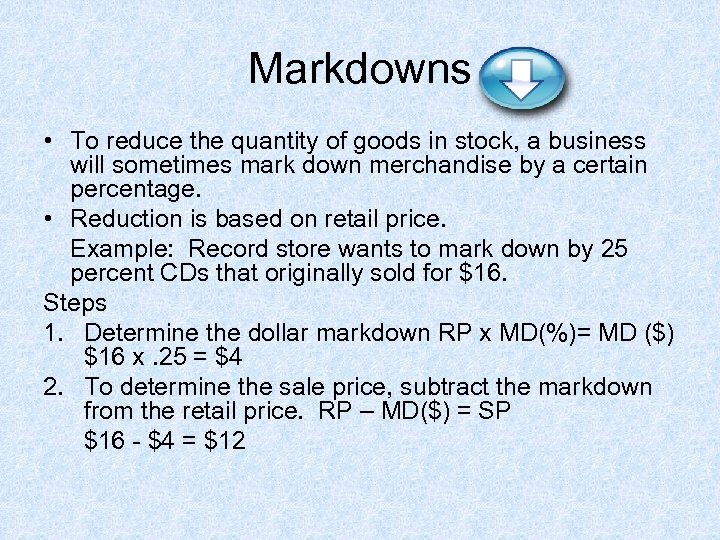
Markdowns • To reduce the quantity of goods in stock, a business will sometimes mark down merchandise by a certain percentage. • Reduction is based on retail price. Example: Record store wants to mark down by 25 percent CDs that originally sold for $16. Steps 1. Determine the dollar markdown RP x MD(%)= MD ($) $16 x. 25 = $4 2. To determine the sale price, subtract the markdown from the retail price. RP – MD($) = SP $16 - $4 = $12
Practice Problem • Calculate the sale price: A suit that sells for $225 is to be marked down 40 percent. What is its new price?
Answer is… • $135 100%-40% = 60%; $225 x. 60 = $135
Maintained Markup • When a marketer marks down goods, the markup and markup percentage change. • The difference between an item's final sale price and its cost is called the maintained markup. • Reductions in the original retail price include employee discounts, damaged goods allowances and special sales events.
Example of Maintained Markup • Assume that a cassette recorder that cost Best Buy $25 and originally sold for $50 is marked down 20 percent. Maintained Markup is calculated as follows: 1. Calculate the new sale price 100%-20%=80% $50 x. 80 = $40 2. To determine the maintained markup in dollars (MM$), subtract cost from sale price (SP) SP – C = MM($) $40 - $25 = $15 3. To determined (MM%) divide (MM$) by Sale price (SP) MM($) / SP = MM(%) $15/$40=. 375 37. 5 percent
Discounts • Discount is a reduction in the price of goods and services sold to customers. • Ways to discount: – Retailers offer discounts to their employees as a job benefit – Manufacturers and distributors offer discounts to their customers to encourage prompt payment and stimulate business.
Steps To Calculate Discounts 1. Multiply Price (P) by the discount percentage D(%) to get the dollar amount of the discount D($) P x D(%) = D($) 2. Subtract the discount from the price to get the net price (NP) or the amount that customer will actually pay. P – D($) = NP
Example • A business is offering a 35 percent discount on an item that sells for $150
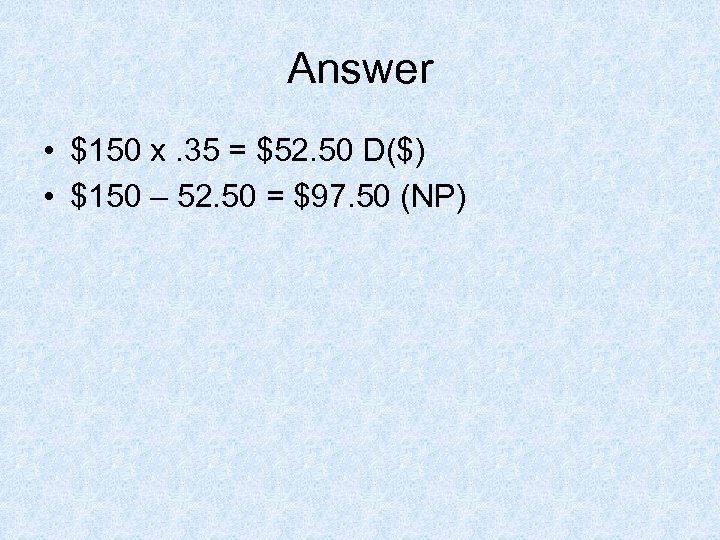
Answer • $150 x. 35 = $52. 50 D($) • $150 – 52. 50 = $97. 50 (NP)
Employee Discounts • Encourages workers to buy the products they sell or manufacture. • Employees who buy and use their company’s products project confidence in and enthusiasm about the products. • Discounts range from 10 percent to 30 percent for entry level employees • Can be from 50 percent and higher to top level executives
Look at calculations of discounts • Page 493 -495
Скачать презентацию Pricing Math Chapter 27 Basic Pricing Concepts
ca49850005c0fce258dc5b3a3c9e31db.ppt