 Скачать презентацию Price of Stability for Network Design with Fair
46b5b319f5a983c10bc0825b6ac95990.ppt
- Количество слайдов: 10




Price of Stability for Network Design with Fair Cost Allocation [Anshellevich, Dasgupta, Kleinberg, Tardos, Wexler, Roughgarden : FOCS ’ 04] Presented by Mangesh Gupte
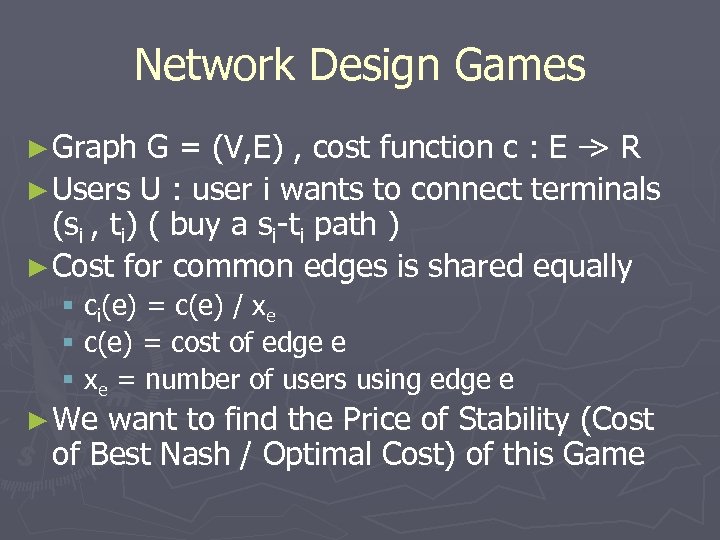
Network Design Games ► Graph G = (V, E) , cost function c : E > R ► Users U : user i wants to connect terminals (si , ti) ( buy a si-ti path ) ► Cost for common edges is shared equally § ci(e) = c(e) / xe § c(e) = cost of edge e § xe = number of users using edge e ► We want to find the Price of Stability (Cost of Best Nash / Optimal Cost) of this Game
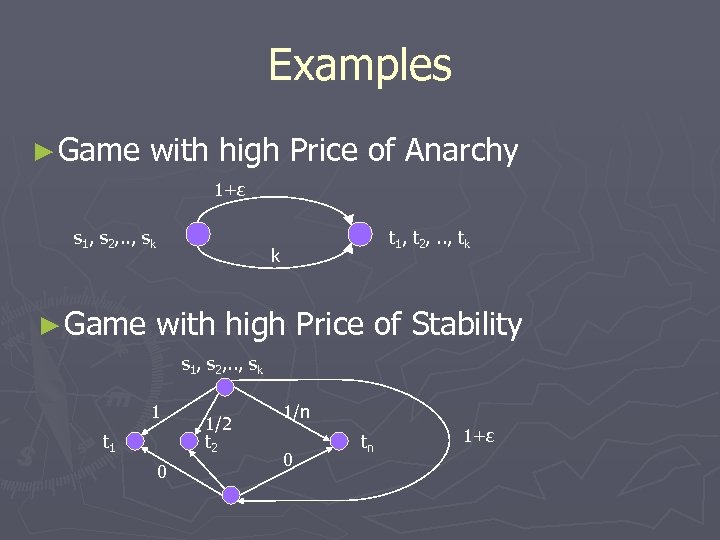
Examples ► Game with high Price of Anarchy 1+ε s 1, s 2, . . , sk ► Game t 1, t 2, . . , tk k with high Price of Stability s 1, s 2, . . , sk 1 t 1 0 1/2 t 2 1/n 0 tn 1+ε
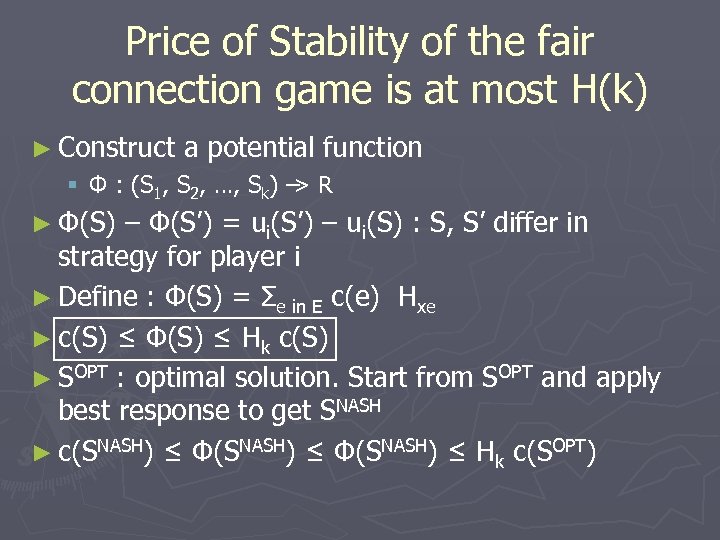
Price of Stability of the fair connection game is at most H(k) ► Construct a potential function § Φ : (S 1, S 2, …, Sk) > R ► Φ(S) – Φ(S’) = ui(S’) – ui(S) : S, S’ differ in strategy for player i ► Define : Φ(S) = Σe in E c(e) Hxe ► c(S) ≤ Φ(S) ≤ Hk c(S) ► SOPT : optimal solution. Start from SOPT and apply best response to get SNASH ► c(SNASH) ≤ Φ(SNASH) ≤ Hk c(SOPT)
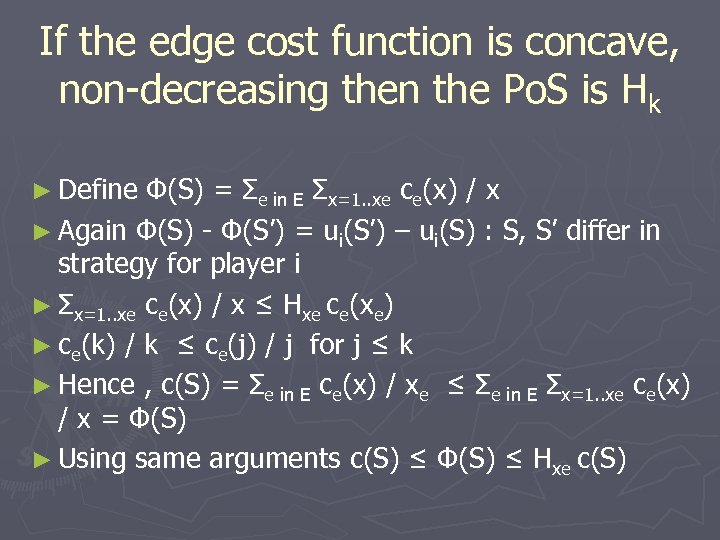
If the edge cost function is concave, non-decreasing then the Po. S is Hk ► Define Φ(S) = Σe in E Σx=1. . xe ce(x) / x ► Again Φ(S) - Φ(S’) = ui(S’) – ui(S) : S, S’ differ in strategy for player i ► Σx=1. . xe ce(x) / x ≤ Hxe ce(xe) ► ce(k) / k ≤ ce(j) / j for j ≤ k ► Hence , c(S) = Σe in E ce(x) / xe ≤ Σe in E Σx=1. . xe ce(x) / x = Φ(S) ► Using same arguments c(S) ≤ Φ(S) ≤ Hxe c(S)
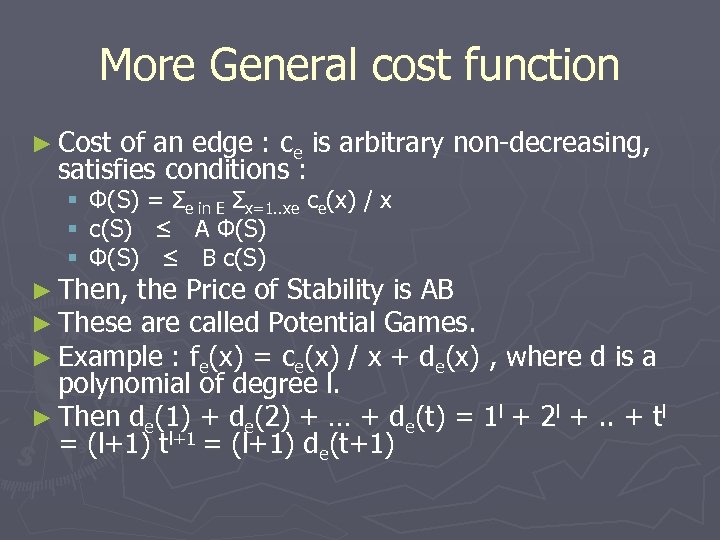
More General cost function ► Cost of an edge : ce is arbitrary non-decreasing, satisfies conditions : § Φ(S) = Σe in E Σx=1. . xe ce(x) / x § c(S) ≤ A Φ(S) § Φ(S) ≤ B c(S) ► Then, the Price of Stability is AB ► These are called Potential Games. ► Example : fe(x) = ce(x) / x + de(x) , where d is a polynomial of degree l. ► Then de(1) + de(2) + … + de(t) = 1 l + 2 l +. . + tl = (l+1) tl+1 = (l+1) de(t+1)
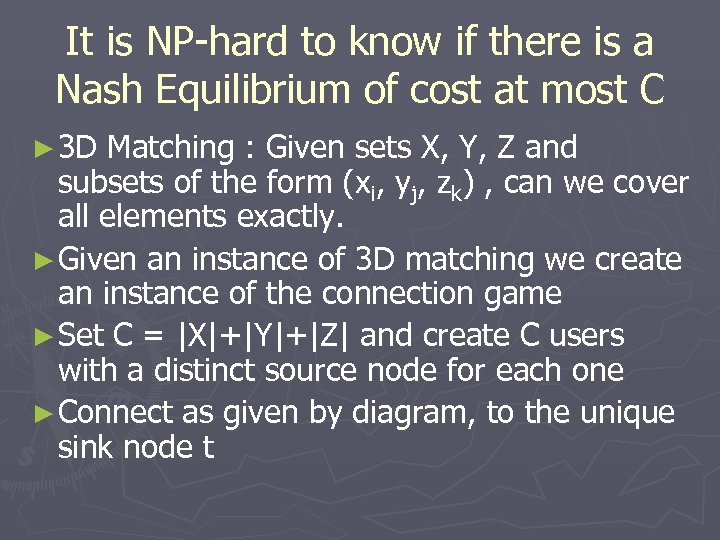
It is NP-hard to know if there is a Nash Equilibrium of cost at most C ► 3 D Matching : Given sets X, Y, Z and subsets of the form (xi, yj, zk) , can we cover all elements exactly. ► Given an instance of 3 D matching we create an instance of the connection game ► Set C = |X|+|Y|+|Z| and create C users with a distinct source node for each one ► Connect as given by diagram, to the unique sink node t
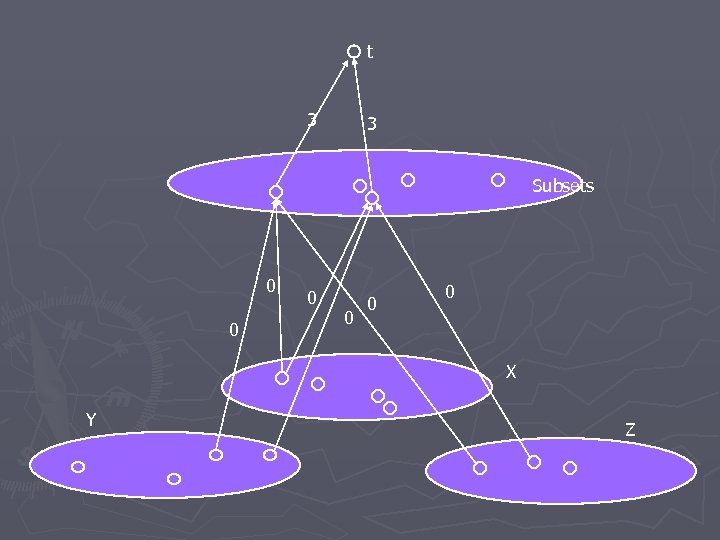
t 3 3 Subsets 0 0 0 X Y Z
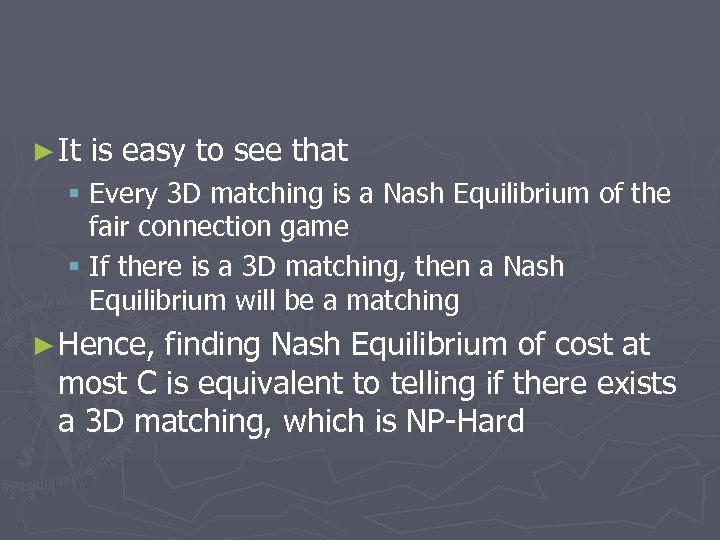
► It is easy to see that § Every 3 D matching is a Nash Equilibrium of the fair connection game § If there is a 3 D matching, then a Nash Equilibrium will be a matching ► Hence, finding Nash Equilibrium of cost at most C is equivalent to telling if there exists a 3 D matching, which is NP-Hard

Thank You
Скачать презентацию Price of Stability for Network Design with Fair
46b5b319f5a983c10bc0825b6ac95990.ppt