


 Скачать презентацию Prevention Research Intervention Strategies in Early Childhood and
fea2ec4d1fb02bafc65cd52e5efece96.ppt
- Количество слайдов: 73
 Prevention Research Intervention Strategies in Early Childhood and Education Richard Fiene, Ph. D. Associate Professor Human Development & Family Studies October 31, 2007 Most of the research studies reported in this presentation are available at the following website http: //ecti. hbg. psu. edu/publications/index. htm
 Organization of Research Presentation • • • Past Research Present Research Future Research and Evaluation Service and Outreach Training and Technical Assistance
 Research and Evaluation • • Early Childhood Education Quality Study REACH Evaluation—Harrisburg Preschool HOPE Project—Preschool PATHS Safe Schools Healthy Students Program Lycoming Mentoring Evaluation Carlisle ITERS Evaluation Quantum Evaluation Keystone STARS Evaluation
 Service and Outreach • Regional Key • Student Intern Placement • Working with College’s faculty on specific research projects in Harrisburg and South Central Pennsylvania • FOCUS • Urban Community Partnership
 Training and Technical Assistance • • • Regional Key SDA Training STA Technical Assistance Mind in the Making Intervention Family Communications Certificate Programs
 Training and Technical Assistance • Capital Area Early Childhood Training Institute (CAECTI) • Mind in the Making Intervention • Hanen Language Program • Regional Key • Family Communications
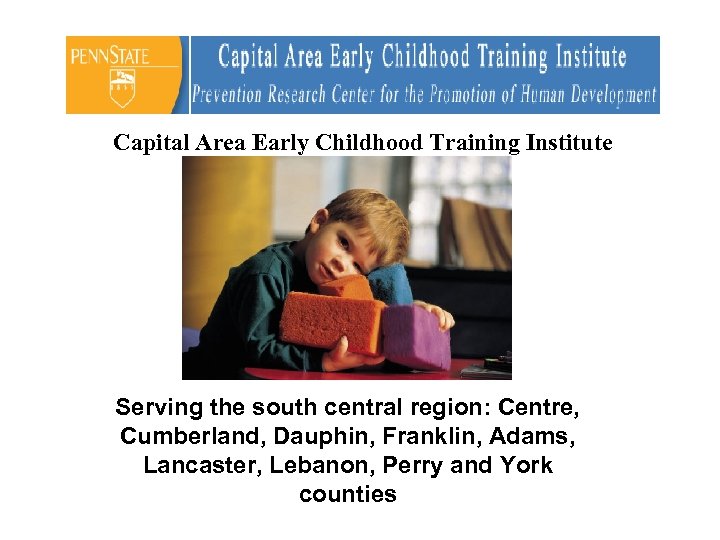 Capital Area Early Childhood Training Institute Serving the south central region: Centre, Cumberland, Dauphin, Franklin, Adams, Lancaster, Lebanon, Perry and York counties
 The Capital Area Early Childhood Training Institute is a community-based initiative to provide training and information to parents and care providers of children birth to five years of age. CAECTI’s main office is located in Harrisburg, with satellite offices in State College and York.
 CAECTI Mission Statement The four primary goals are: • Develop training opportunities. • Disseminate training information. • Advocate for high-quality early childhood programs. • Serve as regional center for early childhood information.
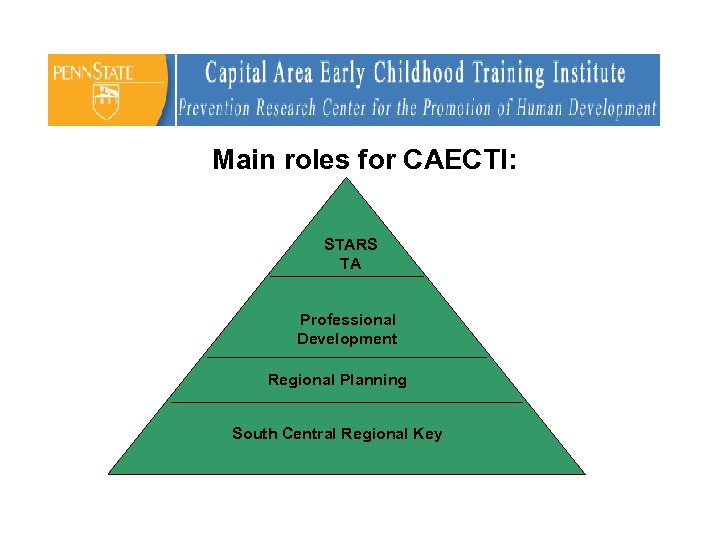 Main roles for CAECTI: STARS TA Professional Development Regional Planning South Central Regional Key
 South Central Regional Key • Partners with Child Care Consultants in York • One of six Regional Keys • Responsibilities include Leadership, Professional Development, STARS Technical Assistance, Regional Planning • Report to PA Key/Office of Child Development
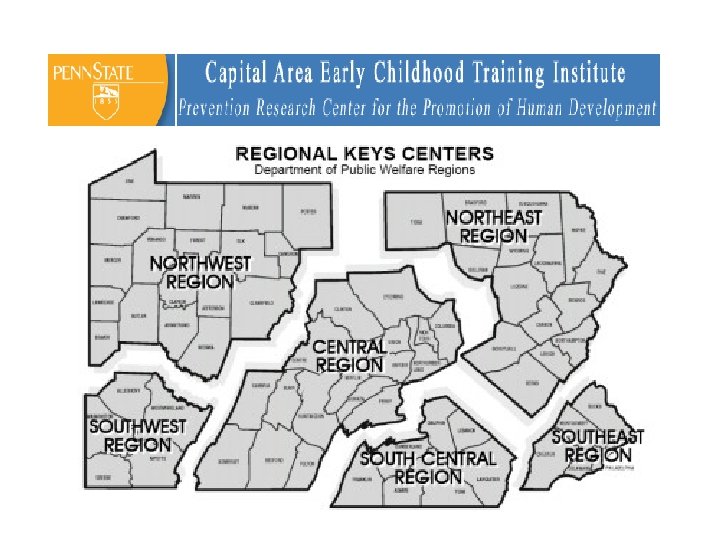
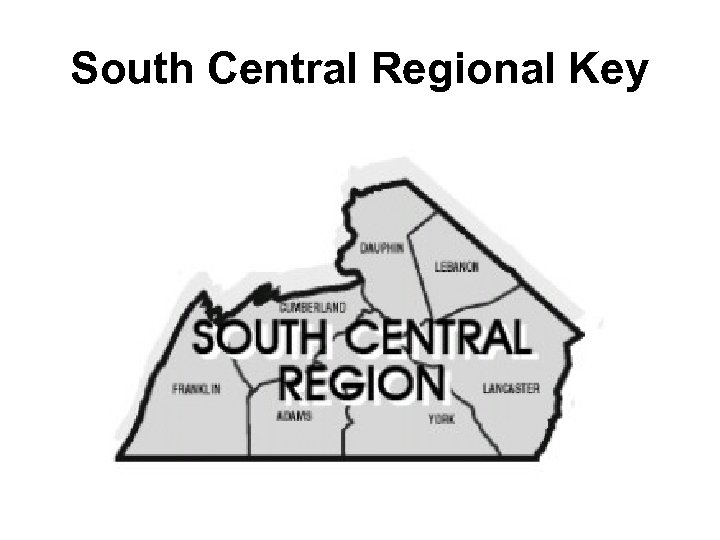 South Central Regional Key
 Regional Key Planning • Gather information through focus groups, surveys, state databases and reports. • Convene Leadership council. • Develop regional plan that addresses the administration of professional development, STARS and the outreach and coordination of early childhood education programs that impact ECE professionals, parents, and community stakeholders.
 Regional Key Professional Development • Coordinate and deliver training events with regional training organizations. • Convene regional Professional Development meetings. • Monitor quality of trainers/training events. • Prepare training event calendar twice annually. • Assess/training needs of providers in region.
 Regional Key STARS Technical Assistance (TA) • STARS TA Coordinator for the SC Regional Key • On-site consultation services to child care providers with a Star One designation or higher. • Support providers’ achievement of a higher star rating. • Services available at no cost to Keystone Stars providers.
 CAECTI Professional Development Programs Credit Courses Infant/Toddler Curriculum Program Administration Program Evaluation Inclusive Practices Home-Based Provider Noncredit Certificate Programs/CDA Programs Infant/Toddler Preschool Inclusive Practices Language Development Home-Based Provider Director Core Certificate
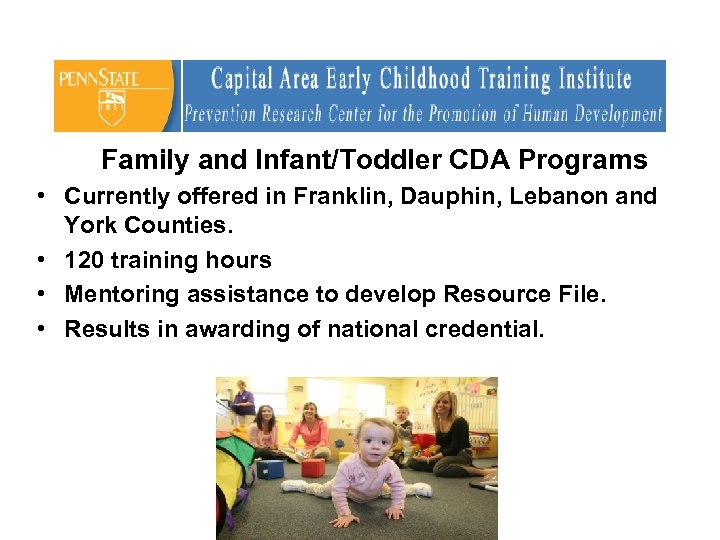 Family and Infant/Toddler CDA Programs • Currently offered in Franklin, Dauphin, Lebanon and York Counties. • 120 training hours • Mentoring assistance to develop Resource File. • Results in awarding of national credential.
 Director’s Core Certificate • Credit or non-credit coursework • Program Administration, Curriculum and Program Evaluation • 135 hours of training or 9 credit hours • Results in state-approved certificate for child care directors.
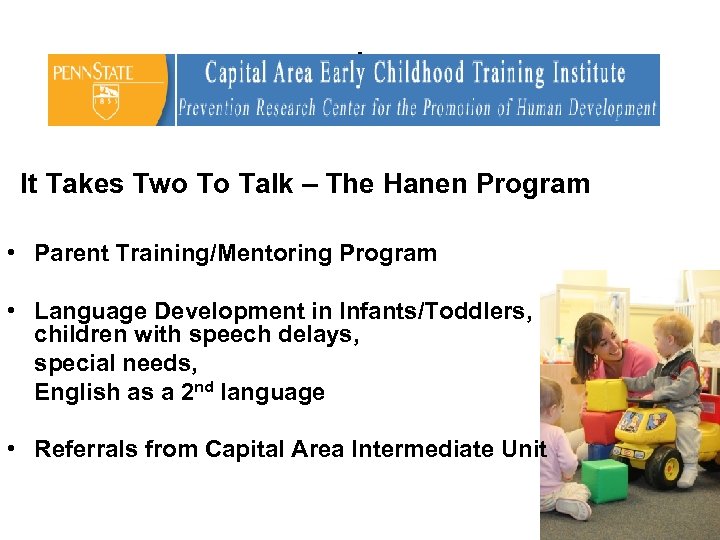 I It Takes Two To Talk – The Hanen Program • Parent Training/Mentoring Program • Language Development in Infants/Toddlers, children with speech delays, special needs, English as a 2 nd language • Referrals from Capital Area Intermediate Unit
 Mind in the Making • Developed by Family and Work Institute • Explores link between social, emotional and cognitive development. • Directors trained to facilitate training with their staff. • 12 modules – 24 hours of training for staff. • 36 hours of training for directors.
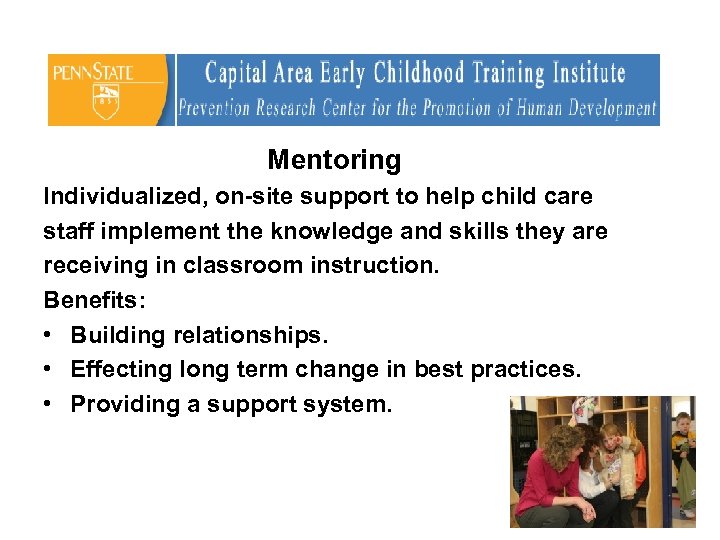 Mentoring Individualized, on-site support to help child care staff implement the knowledge and skills they are receiving in classroom instruction. Benefits: • Building relationships. • Effecting long term change in best practices. • Providing a support system.
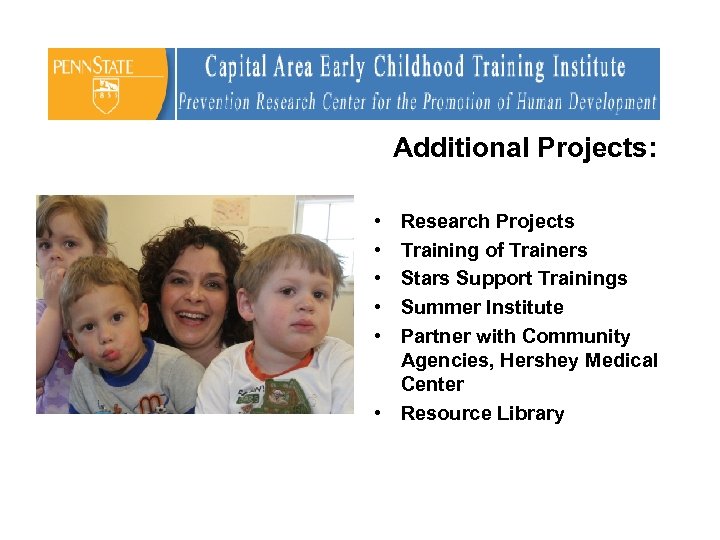 Additional Projects: • • • Research Projects Training of Trainers Stars Support Trainings Summer Institute Partner with Community Agencies, Hershey Medical Center • Resource Library
 Pennsylvania MAPS Project Family Communications, Inc
 Previous History • This was the fourth year of dissemination of the “Mad Feelings” & “Challenging Behaviors” workshops sponsored by the Substance Abuse Mental Health Services Administration of the US Dept of Health & Human Services. • Previous projects were done in Pennsylvania and Mississippi (2001/02), California (2003), Iowa and Ohio (2004). • The first 2 yrs & the 3 rd yr Ohio project included only the “Mad” workshop. The 3 rd yr Iowa project included the “Challenging” workshop.
 Mad Feelings Workshop “Value” or “Importance” • Rated as Very Important: – FY 02 = 88. 8% – FY 03 = 85. 3% – FY 04 = 86% (Iowa); 90% (Ohio)
 Mad Feelings Workshop Understandability • Rated as “Very Understandable”: – FY 02 = 95. 9% – FY 03 = 93% – FY 04 = 91% (Iowa); 96% (Ohio)
 Mad Feelings Workshop Recommended to Others • Responded “Definitely Yes” or “Yes”: – FY 02 = 96. 2% – FY 03 = 93. 3% – FY 04 = 95% (Iowa); 97% (Ohio)
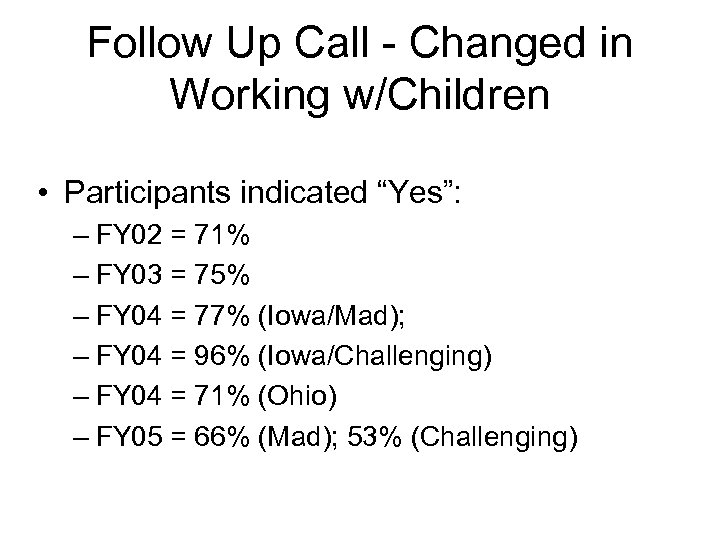 Follow Up Call - Changed in Working w/Children • Participants indicated “Yes”: – FY 02 = 71% – FY 03 = 75% – FY 04 = 77% (Iowa/Mad); – FY 04 = 96% (Iowa/Challenging) – FY 04 = 71% (Ohio) – FY 05 = 66% (Mad); 53% (Challenging)
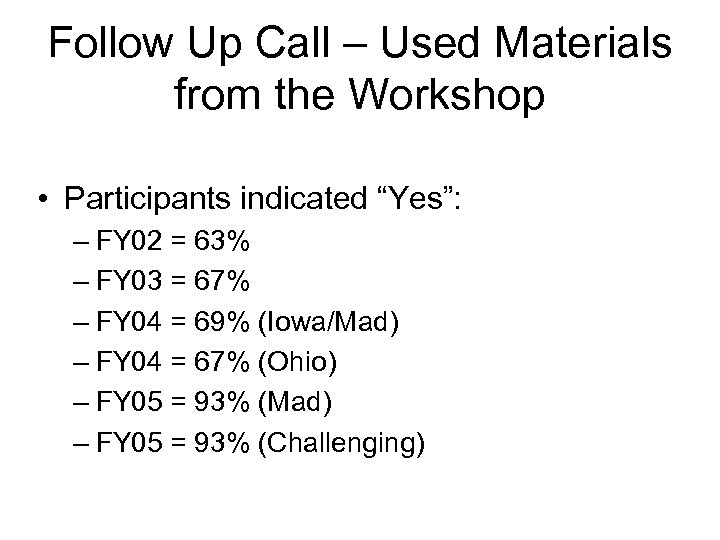 Follow Up Call – Used Materials from the Workshop • Participants indicated “Yes”: – FY 02 = 63% – FY 03 = 67% – FY 04 = 69% (Iowa/Mad) – FY 04 = 67% (Ohio) – FY 05 = 93% (Mad) – FY 05 = 93% (Challenging)
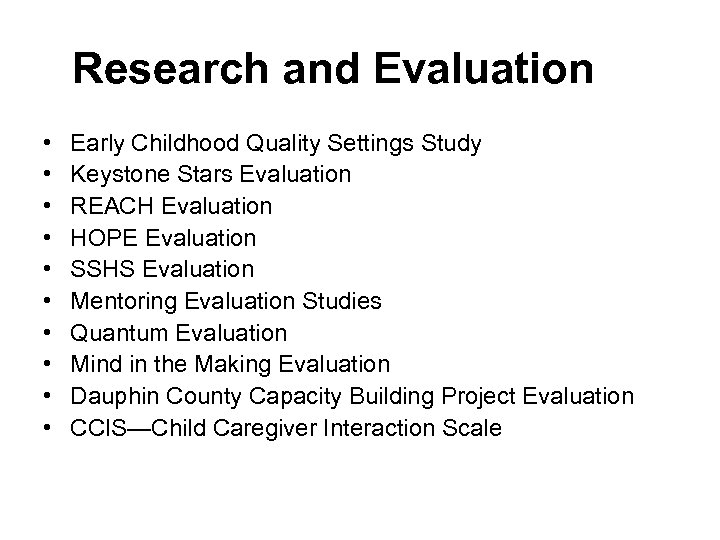 Research and Evaluation • • • Early Childhood Quality Settings Study Keystone Stars Evaluation REACH Evaluation HOPE Evaluation SSHS Evaluation Mentoring Evaluation Studies Quantum Evaluation Mind in the Making Evaluation Dauphin County Capacity Building Project Evaluation CCIS—Child Caregiver Interaction Scale
 Investing in Quality Early Care and Education The Pennsylvania Early Childhood Settings Study
 Historical trends affect children • Rise in number of two-wage earner families – Nearly 100% rise in number of mothers of young children who are employed over last three decades – Concomitant rise in number of families using nonfamilial care for their young children • Rise in number of children living in single parent homes • Persistence of poverty for many young children • Growing gap between poor and wealthy in access to educational services • Significant differences in school readiness between affluent and low-income children
 First, child care does not threaten family influence on the child. • NICHD Study of Early Child care study shows that! • Whether children were in many hours of child care or none at all, family influences were high. • Children in nonparental child care did not have lower or more insecure attachment to their mothers than children not in nonparental child care.
 Second, low quality care is risky for children. • Poor quality programs are related to: – Lower school readiness and school achievement – Increased risk for behavioral problems
 Quality early childhood programs for low-income children can: • Promote school readiness and school performance • Higher math scores and school achievement • Less grade retention, • Reduced use of special education • Higher graduation rates • Increased employment after graduation • Less use of welfare after graduation • Reduce antisocial behavior – Fewer behavioral problems – Less delinquency and crime
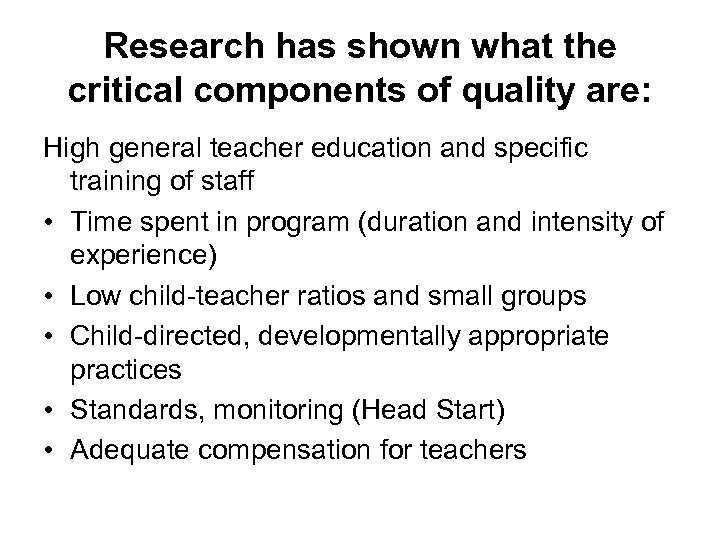 Research has shown what the critical components of quality are: High general teacher education and specific training of staff • Time spent in program (duration and intensity of experience) • Low child-teacher ratios and small groups • Child-directed, developmentally appropriate practices • Standards, monitoring (Head Start) • Adequate compensation for teachers
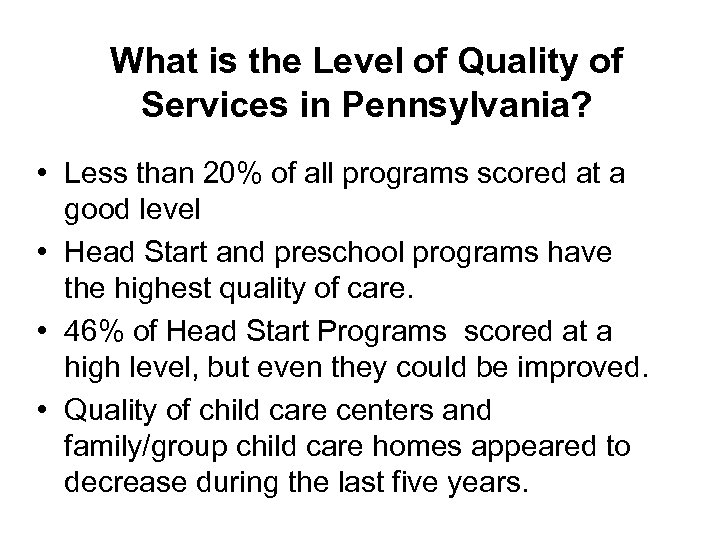 What is the Level of Quality of Services in Pennsylvania? • Less than 20% of all programs scored at a good level • Head Start and preschool programs have the highest quality of care. • 46% of Head Start Programs scored at a high level, but even they could be improved. • Quality of child care centers and family/group child care homes appeared to decrease during the last five years.
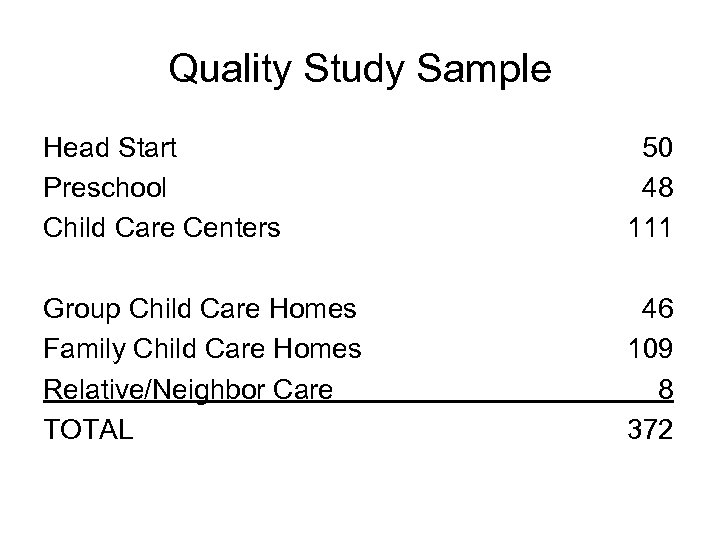 Quality Study Sample Head Start Preschool Child Care Centers 50 48 111 Group Child Care Homes Family Child Care Homes Relative/Neighbor Care TOTAL 46 109 8 372
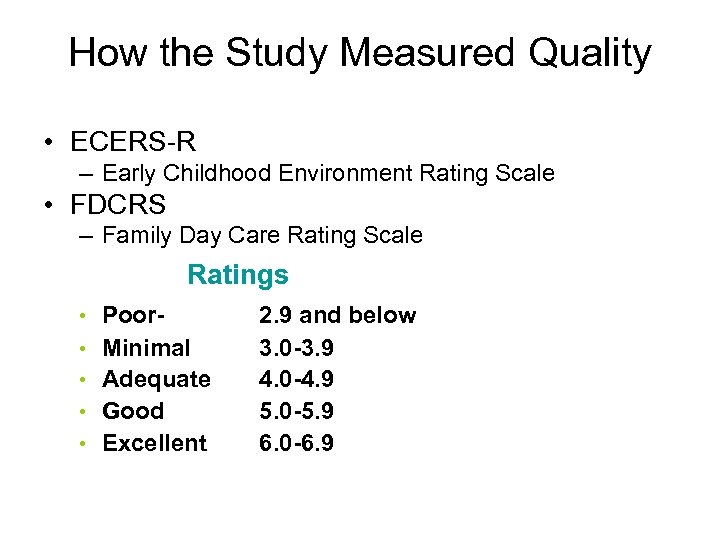 How the Study Measured Quality • ECERS-R – Early Childhood Environment Rating Scale • FDCRS – Family Day Care Rating Scale Ratings • Poor • Minimal • Adequate • Good • Excellent 2. 9 and below 3. 0 -3. 9 4. 0 -4. 9 5. 0 -5. 9 6. 0 -6. 9
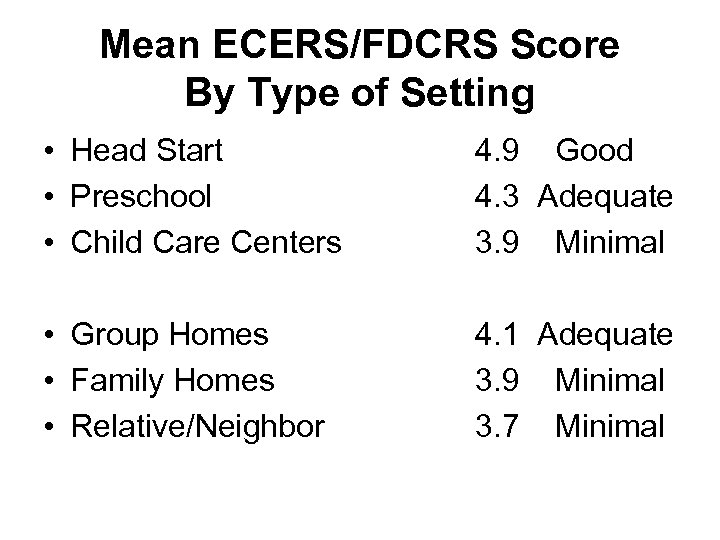 Mean ECERS/FDCRS Score By Type of Setting • Head Start • Preschool • Child Care Centers 4. 9 Good 4. 3 Adequate 3. 9 Minimal • Group Homes • Family Homes • Relative/Neighbor 4. 1 Adequate 3. 9 Minimal 3. 7 Minimal
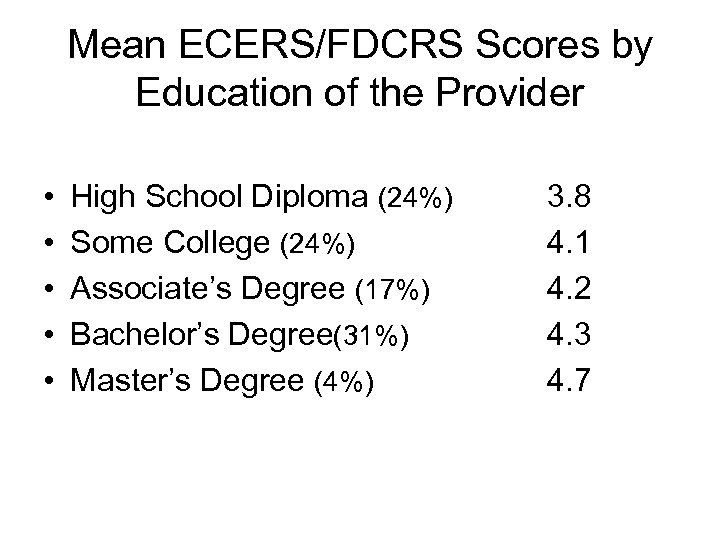 Mean ECERS/FDCRS Scores by Education of the Provider • • • High School Diploma (24%) Some College (24%) Associate’s Degree (17%) Bachelor’s Degree(31%) Master’s Degree (4%) 3. 8 4. 1 4. 2 4. 3 4. 7
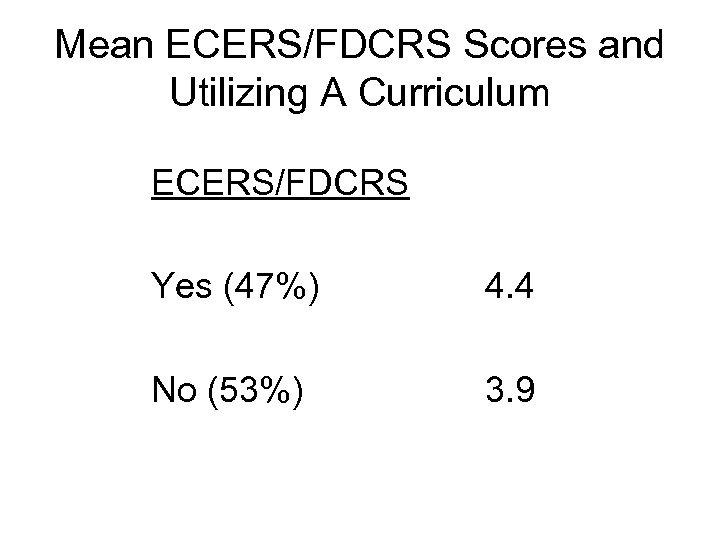 Mean ECERS/FDCRS Scores and Utilizing A Curriculum ECERS/FDCRS Yes (47%) 4. 4 No (53%) 3. 9
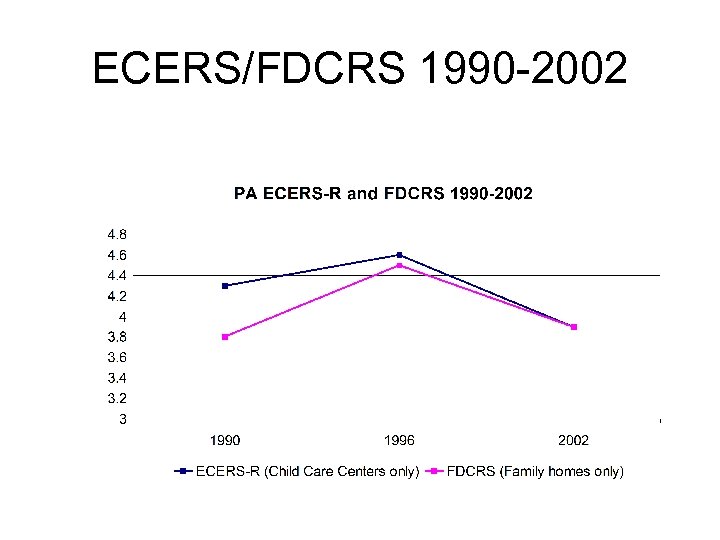 ECERS/FDCRS 1990 -2002
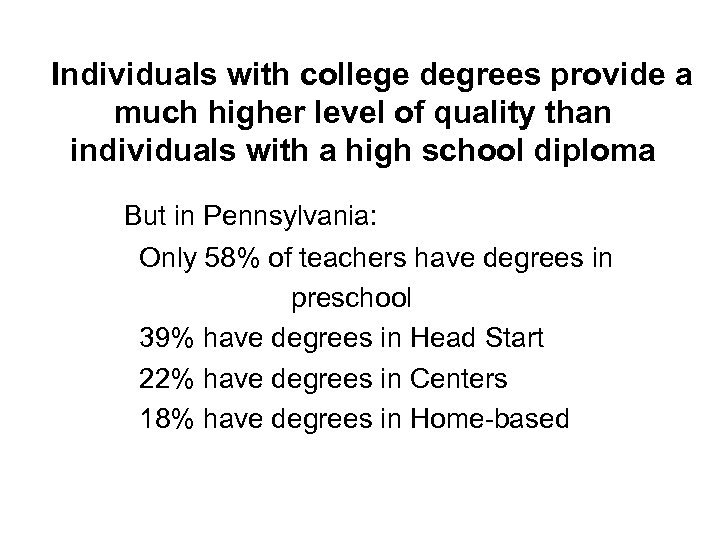 Individuals with college degrees provide a much higher level of quality than individuals with a high school diploma But in Pennsylvania: Only 58% of teachers have degrees in preschool 39% have degrees in Head Start 22% have degrees in Centers 18% have degrees in Home-based
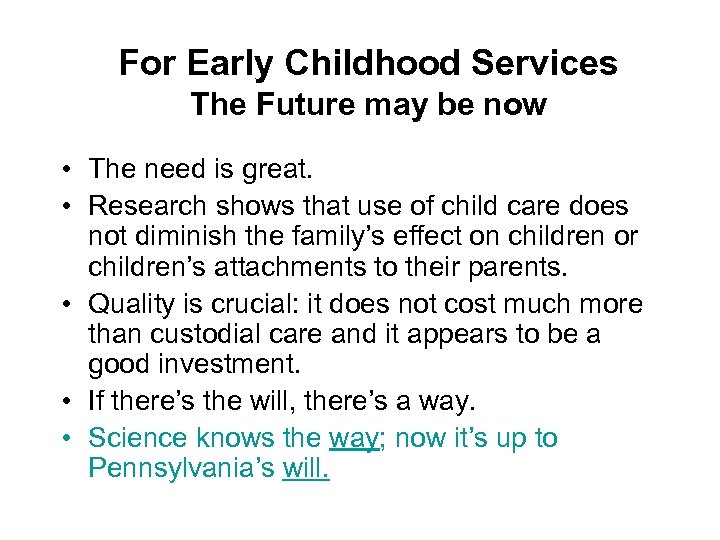 For Early Childhood Services The Future may be now • The need is great. • Research shows that use of child care does not diminish the family’s effect on children or children’s attachments to their parents. • Quality is crucial: it does not cost much more than custodial care and it appears to be a good investment. • If there’s the will, there’s a way. • Science knows the way; now it’s up to Pennsylvania’s will.
 Research Projects in Harrisburg • Harrisburg Preschool Project (REACH) • Safe Schools/Healthy Students (SSHS) • HOPE (Harrisburg Opportunity for PATHS Expansion)
 Harrisburg Preschool Program (HPP) • Evaluation of innovative preschool partnership between Harrisburg School District and Capital Area Head Start • Focus on long term systems change • Funded by W. K. Kellogg Foundation • Comprehensive evaluation plan
 Harrisburg Preschool Program (HPP) • Evaluation both Quantitative and Qualitative • Three Pronged Approach – Child level assessments following 300 original enrolled 3 and 4 year olds for six years (Led by Celene Domitrovich) – Qualitative assessment of HPP on attitudes and behaviors of teachers and parents (Led by Linda Burton from the Center for Human Development and Family Studies in Diverse Contexts) – Assessment of broader systems changes (Led by Barbara Carl)
 Harrisburg Preschool Program (HPP) • Both summative and formative evaluation • Evaluation used to shape development of the program • Allows Harrisburg School District to be responsive to the needs of students, families and the larger community – Examples: Increased focus on family involvement; targeted engagement with minority communities
 Safe Schools/Healthy Students • Provides technical assistance and evaluation • Partnership with Harrisburg School District • Federally funded • Systems change focus – Expand prevention efforts – Expand mental health treatment – Improve academic outcomes
 Safe Schools/Healthy Students • Comprehensive Evaluation – Student level surveys (Led by Laura Ferrer. Redder) – Systems level change (Led by Meg Small) – Process components (Led by Barbara Carl) • Development of new models for assessing and tracking student’s social and academic function (Alexa) (Led by Ty Ridenour
 Harrisburg Outreach for PATHS Expansion (HOPE) • Collaborative partnership with Dauphin County Mental Health, Harrisburg School District, and Hempfield Behavioral Health • Federally funded • Comprehensive evaluation – Student level outcomes – Programmatic outcomes – Systems change evaluation
 Harrisburg Outreach for PATHS Expansion (HOPE) • Goals: – Expand PATHS to all K-5 classrooms in HSD – Adapt PATHS for Behavioral Health Providers • Training • Consultation • Create common language for BHRS Providers, schools and families – Community Education • Importance of social/emotional health
 Harrisburg Outreach for PATHS Expansion (HOPE) • Community Education – Development and distribution of Little Turtle Activity Kit • Community Partners: – – Dauphin County Library System Harrisburg Housing Authority Harrisburg YWCA Hamilton Health Center – Social marketing Campaign • Have you given a child HOPE today?
 Mentoring Based Evaluations • Cumberland County Success by Six ECERS-R Mentoring Training • Lycoming County Early Childhood Quality Research Project (ECERS-R Mentoring Training) • Lycoming Clinton Head Start Family Childcare Mentoring Evaluation (FDCRS Mentoring Training)
 Governor’s Institute on Parental Involvement 2005 • Partnership with Center for Schools and Communities (CSC) and PDE • Assess levels of family involvement in schools participating in the 2005 GIPI • Will allow CSC to target future training and technical assistance efforts • Define baseline data for potential future funding
 Dauphin County Capacity Building Project Evaluation • Partnership with Dauphin County Collaborative Board • Focus on local, grassroots organizations in Dauphin County – Training and Technical Assistance on Program Logic Model – Coaching Model – Increase capacity to write solid grant proposals to secure future funding
 Quantum Opportunities Project • Partnership with York YWCA • QOP focuses on – Developing basic academic and life skills – Strengthening social skills – Broaden cultural experiences • Comprehensive Evaluation – Student level outcomes – Process level outcomes relating to board and systems functioning • Technical Assistance – Growth and Development of Community Prevention Board
 Mind in the Making – Statewide Evaluation of Mind in the Making Curriculum • Caregiver training on how to increase social/emotional development of young children – Randomized Control Group Design of 21 sites, 42 classrooms – Measures include • Environmental Rating Scales • Modification of Arnett Caregiver Interaction Scale • Participant Reflections
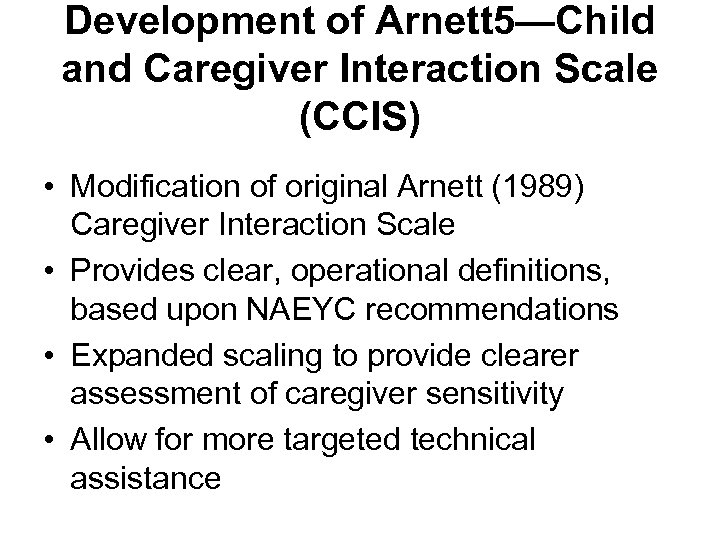 Development of Arnett 5—Child and Caregiver Interaction Scale (CCIS) • Modification of original Arnett (1989) Caregiver Interaction Scale • Provides clear, operational definitions, based upon NAEYC recommendations • Expanded scaling to provide clearer assessment of caregiver sensitivity • Allow for more targeted technical assistance
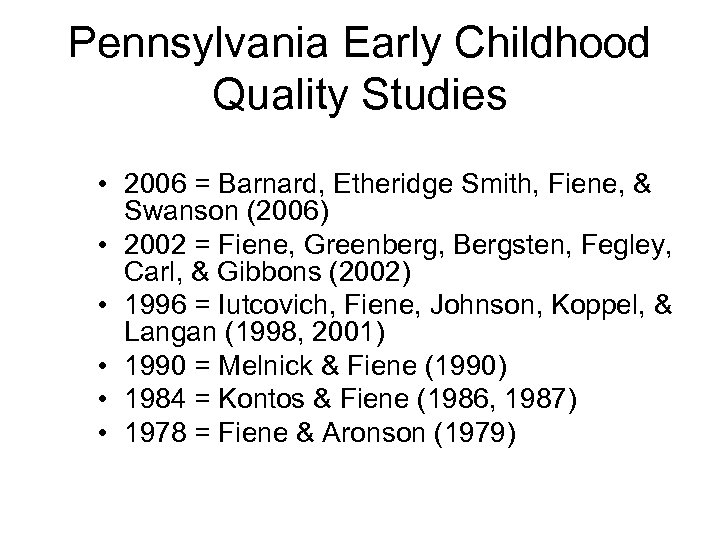 Pennsylvania Early Childhood Quality Studies • 2006 = Barnard, Etheridge Smith, Fiene, & Swanson (2006) • 2002 = Fiene, Greenberg, Bergsten, Fegley, Carl, & Gibbons (2002) • 1996 = Iutcovich, Fiene, Johnson, Koppel, & Langan (1998, 2001) • 1990 = Melnick & Fiene (1990) • 1984 = Kontos & Fiene (1986, 1987) • 1978 = Fiene & Aronson (1979)
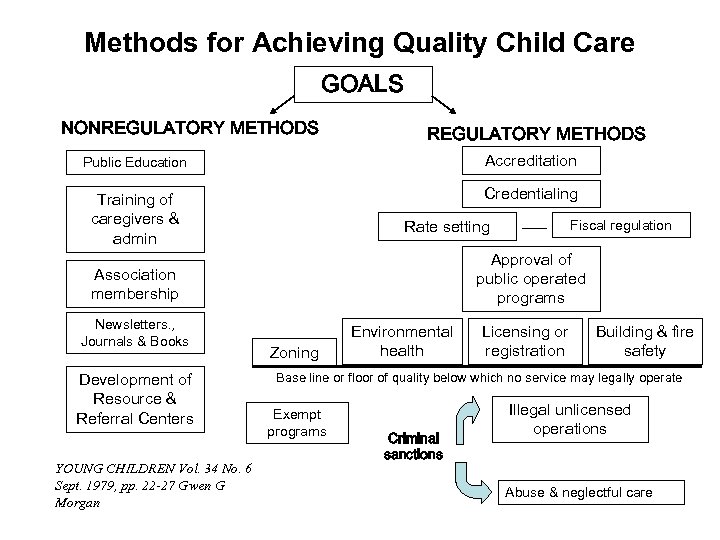 Methods for Achieving Quality Child Care GOALS NONREGULATORY METHODS Public Education Accreditation Training of caregivers & admin Credentialing Rate setting Approval of public operated programs Association membership Newsletters. , Journals & Books Development of Resource & Referral Centers YOUNG CHILDREN Vol. 34 No. 6 Sept. 1979, pp. 22 -27 Gwen G Morgan Fiscal regulation Zoning Environmental health Licensing or registration Building & fire safety Base line or floor of quality below which no service may legally operate Exempt programs Criminal sanctions Illegal unlicensed operations Abuse & neglectful care
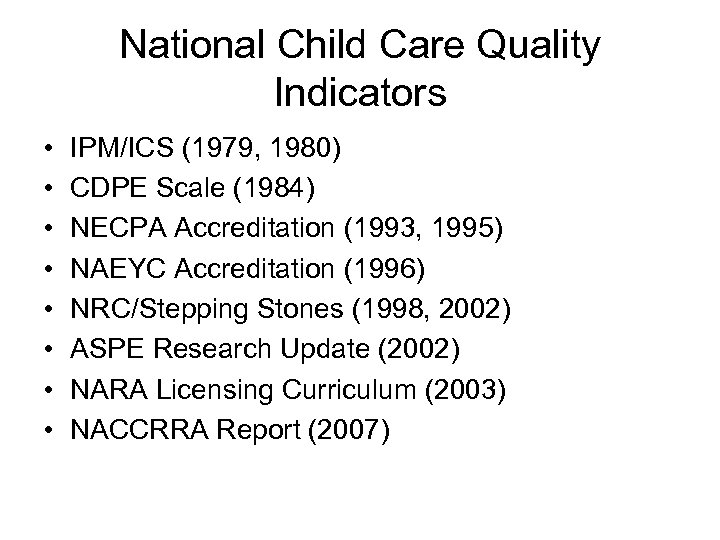 National Child Care Quality Indicators • • IPM/ICS (1979, 1980) CDPE Scale (1984) NECPA Accreditation (1993, 1995) NAEYC Accreditation (1996) NRC/Stepping Stones (1998, 2002) ASPE Research Update (2002) NARA Licensing Curriculum (2003) NACCRRA Report (2007)
 Universities Children’s Policy Collaborative Research team for the Governor’s Task Force on Early Childhood Care and Education
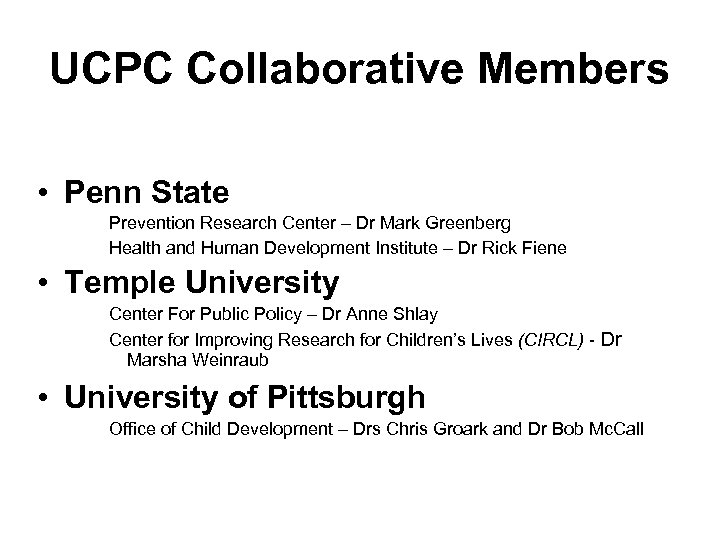 UCPC Collaborative Members • Penn State Prevention Research Center – Dr Mark Greenberg Health and Human Development Institute – Dr Rick Fiene • Temple University Center For Public Policy – Dr Anne Shlay Center for Improving Research for Children’s Lives (CIRCL) - Dr Marsha Weinraub • University of Pittsburgh Office of Child Development – Drs Chris Groark and Dr Bob Mc. Call
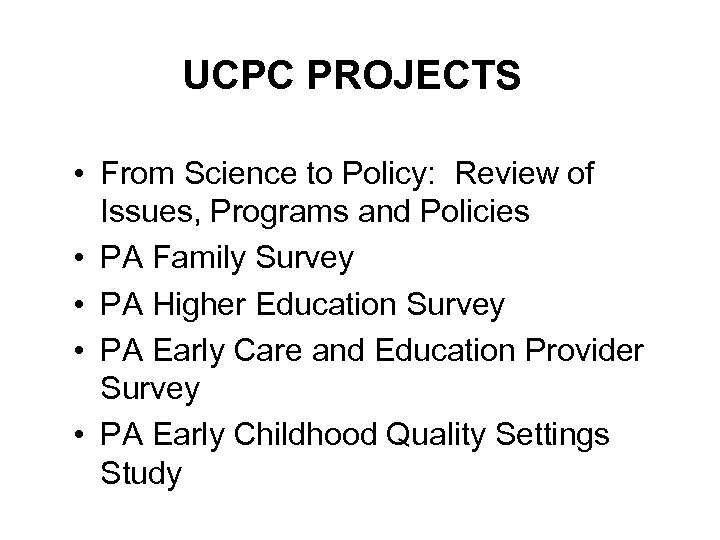 UCPC PROJECTS • From Science to Policy: Review of Issues, Programs and Policies • PA Family Survey • PA Higher Education Survey • PA Early Care and Education Provider Survey • PA Early Childhood Quality Settings Study
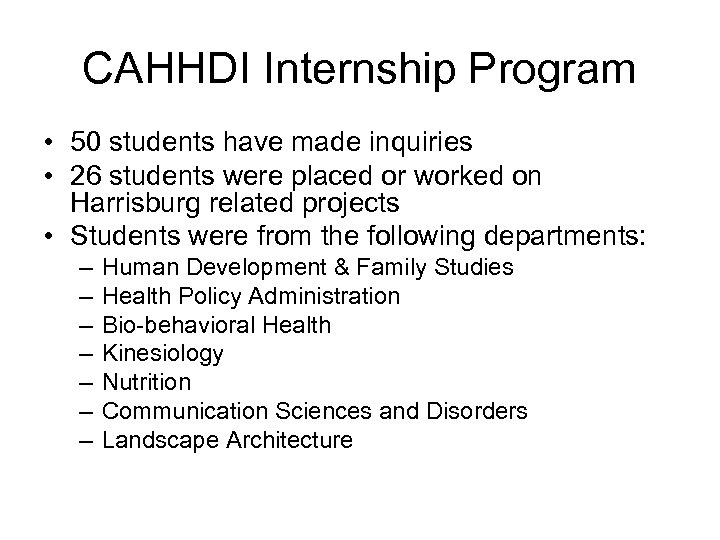 CAHHDI Internship Program • 50 students have made inquiries • 26 students were placed or worked on Harrisburg related projects • Students were from the following departments: – – – – Human Development & Family Studies Health Policy Administration Bio-behavioral Health Kinesiology Nutrition Communication Sciences and Disorders Landscape Architecture
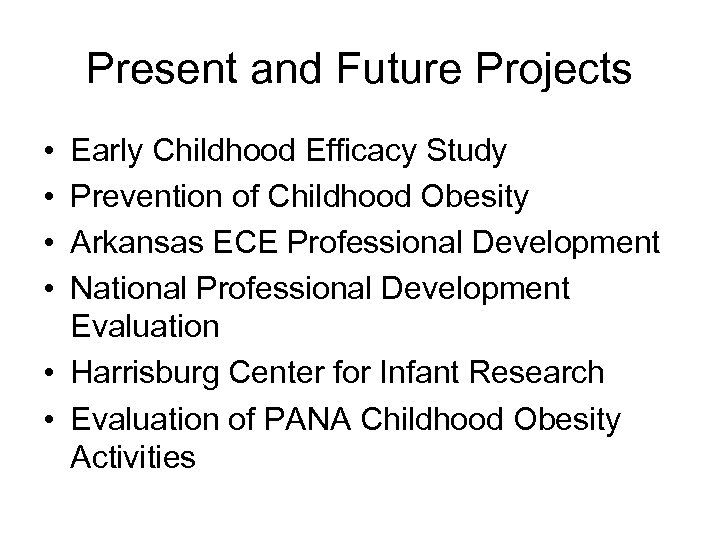 Present and Future Projects • • Early Childhood Efficacy Study Prevention of Childhood Obesity Arkansas ECE Professional Development National Professional Development Evaluation • Harrisburg Center for Infant Research • Evaluation of PANA Childhood Obesity Activities
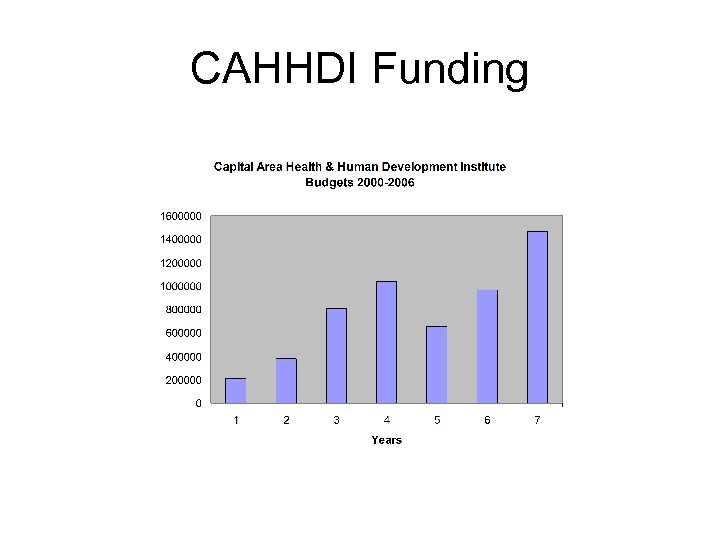 CAHHDI Funding
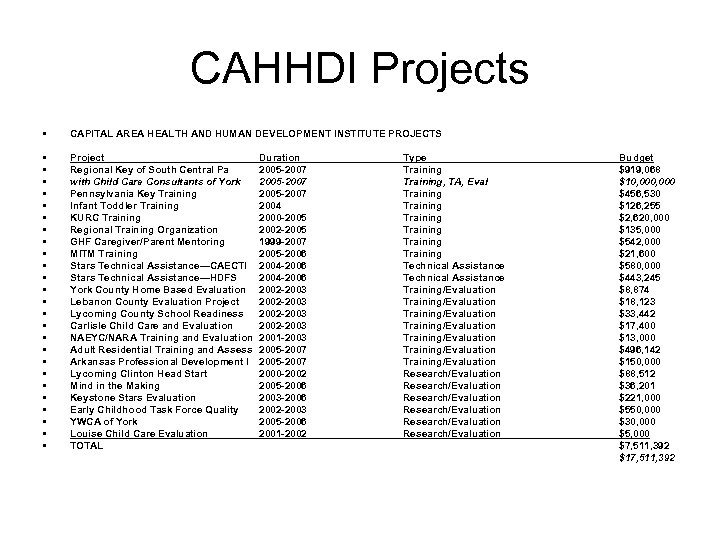 CAHHDI Projects • CAPITAL AREA HEALTH AND HUMAN DEVELOPMENT INSTITUTE PROJECTS • • • • • • • Project Regional Key of South Central Pa with Child Care Consultants of York Pennsylvania Key Training Infant Toddler Training KURC Training Regional Training Organization GHF Caregiver/Parent Mentoring MITM Training Stars Technical Assistance—CAECTI Stars Technical Assistance—HDFS York County Home Based Evaluation Lebanon County Evaluation Project Lycoming County School Readiness Carlisle Child Care and Evaluation NAEYC/NARA Training and Evaluation Adult Residential Training and Assess Arkansas Professional Development l Lycoming Clinton Head Start Mind in the Making Keystone Stars Evaluation Early Childhood Task Force Quality YWCA of York Louise Child Care Evaluation TOTAL Duration 2005 -2007 2004 2000 -2005 2002 -2005 1999 -2007 2005 -2006 2004 -2006 2002 -2003 2001 -2003 2005 -2007 2000 -2002 2005 -2006 2003 -2006 2002 -2003 2005 -2006 2001 -2002 Type Training, TA, Eval Training Training Technical Assistance Training/Evaluation Training/Evaluation Research/Evaluation Research/Evaluation Budget $919, 068 $10, 000 $456, 530 $126, 255 $2, 620, 000 $135, 000 $542, 000 $21, 600 $580, 000 $443, 245 $8, 874 $18, 123 $33, 442 $17, 400 $13, 000 $496, 142 $150, 000 $88, 512 $36, 201 $221, 000 $550, 000 $30, 000 $5, 000 $7, 511, 392 $17, 511, 392
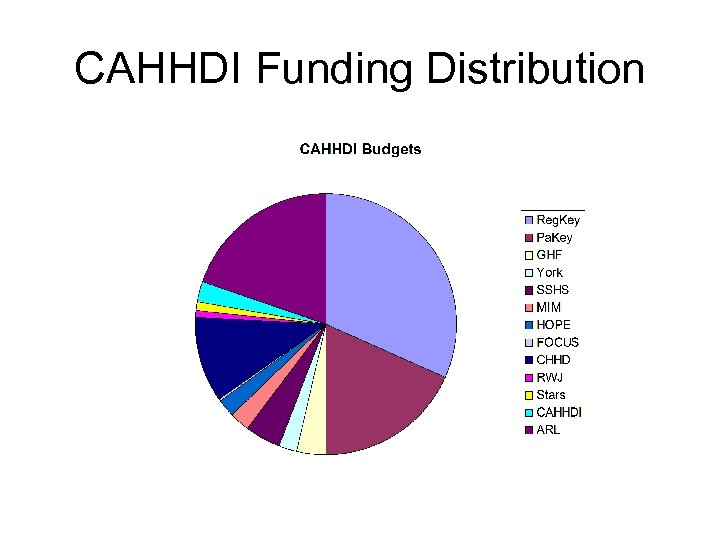 CAHHDI Funding Distribution
 For Additional Information: Richard Fiene, Ph. D. , Associate Professor Human Development & Family Studies W-311 B Olmsted Building School of Behavioral Sciences & Education Penn State University – Harrisburg 777 West Harrisburg Pike Middletown, Pennsylvania 17057 rjf 8@psu. edu http: //www. hbg. psu. edu/bsed http: //www. hhdev. psu. edu/hdfs 717 -948 -6061