


 Скачать презентацию Prevention or Diversion Achieving change in older
3f7dec0ad8835d9724a6a431bbf9a317.ppt
- Количество слайдов: 13
 Prevention or Diversion? – Achieving change in older people’s service use Report authors and core team: Karen Windle, Richard Wagland, Julien Forder, Francesco D’Amico, Dirk Janssen, Gerald Wistow Wider national evaluation team: Roger Beech, Ann Bowling, Angela Dickinson, Kate Ellis, Catherine Henderson, Emily Knapp, Martin Knapp, Kathryn Lord, Brenda Roe
 Locating prevention • Definitional division between health and social care – context is all (Curry 2006, Wistow 2003, Godfrey, 2000) • Health: Primary, secondary and tertiary prevention (Hollander 2001). • Social care perceptions of prevention: • To prevent or delay ill-health or disability consequent on ageing • To promote and/ or improve quality of life • To create health and supportive environments (Wistow and Lewis 1997) • Our first priority should be to restore an individual’s independence and autonomy. (DH 2010) • Continuum of preventatives services • Underlying rationale, early and timely services will lead to a reduction in consumption of expensive services in the future. 19/03/2018 2
 POPP Programme • £ 60 million ring-fenced funding for council-based partnerships to lead locally innovative pilot projects for older people. • Overall aim was to improve the health, well-being and independence of older people through: • Provide person centred and integrated responses for older people • Encourage investment in approaches that promote health, wellbeing and independence for older people and • Prevent or delay the need for high intensity or institutionalised care. • 19 pilot sites funded May 2006 – 2008 (extended to 2009) • 10 further pilot sites May 2007 – 2009
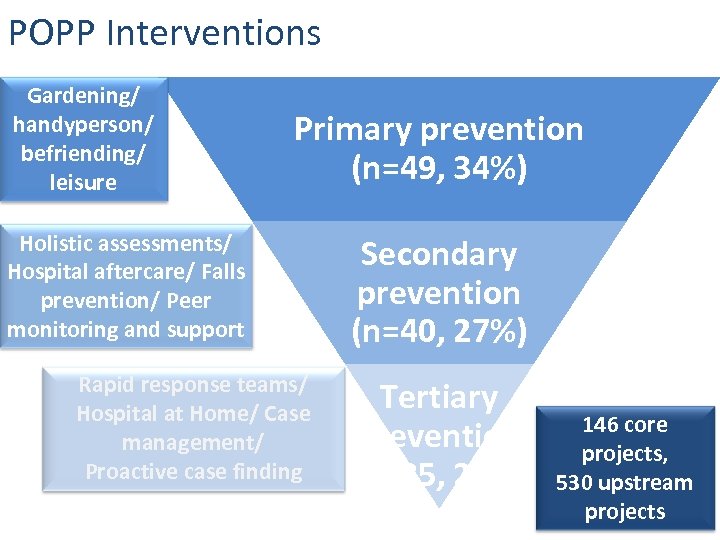 POPP Interventions Gardening/ handyperson/ befriending/ leisure Primary prevention (n=49, 34%) Holistic assessments/ Hospital aftercare/ Falls prevention/ Peer monitoring and support Rapid response teams/ Hospital at Home/ Case management/ Proactive case finding Secondary prevention (n=40, 27%) Tertiary prevention (n=35, 24%) 146 core projects, 530 upstream projects
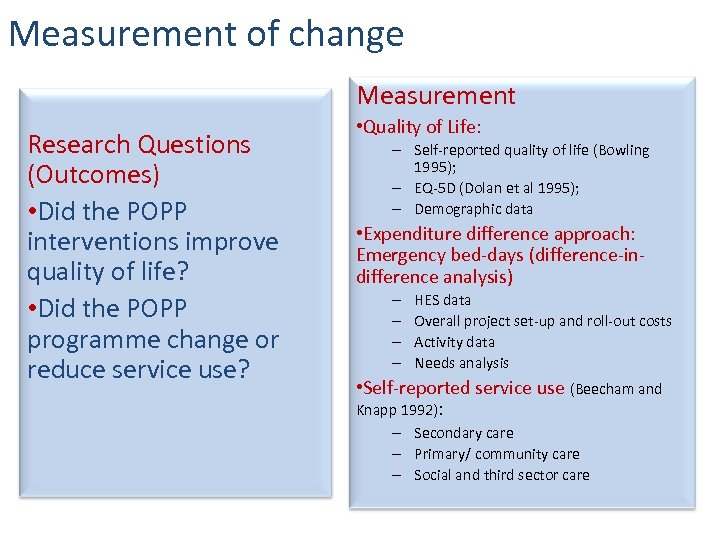 Measurement of change Measurement Research Questions (Outcomes) • Did the POPP interventions improve quality of life? • Did the POPP programme change or reduce service use? • Quality of Life: – Self-reported quality of life (Bowling 1995); – EQ-5 D (Dolan et al 1995); – Demographic data • Expenditure difference approach: Emergency bed-days (difference-indifference analysis) – – HES data Overall project set-up and roll-out costs Activity data Needs analysis • Self-reported service use (Beecham and Knapp 1992): – Secondary care – Primary/ community care – Social and third sector care
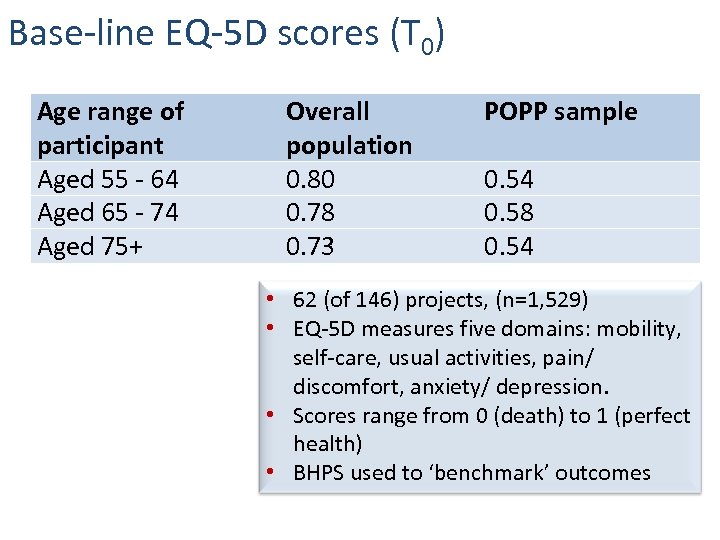 Base-line EQ-5 D scores (T 0) Age range of participant Aged 55 - 64 Aged 65 - 74 Aged 75+ Overall population 0. 80 0. 78 0. 73 POPP sample 0. 54 0. 58 0. 54 • 62 (of 146) projects, (n=1, 529) • EQ-5 D measures five domains: mobility, self-care, usual activities, pain/ discomfort, anxiety/ depression. • Scores range from 0 (death) to 1 (perfect health) • BHPS used to ‘benchmark’ outcomes
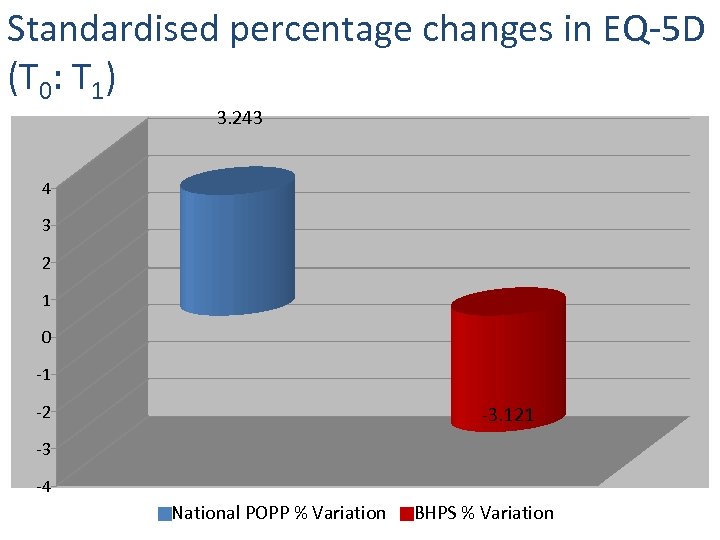 Standardised percentage changes in EQ-5 D (T 0: T 1) 3. 243 4 3 2 1 0 -1 -2 -3. 121 -3 -4 National POPP % Variation BHPS % Variation
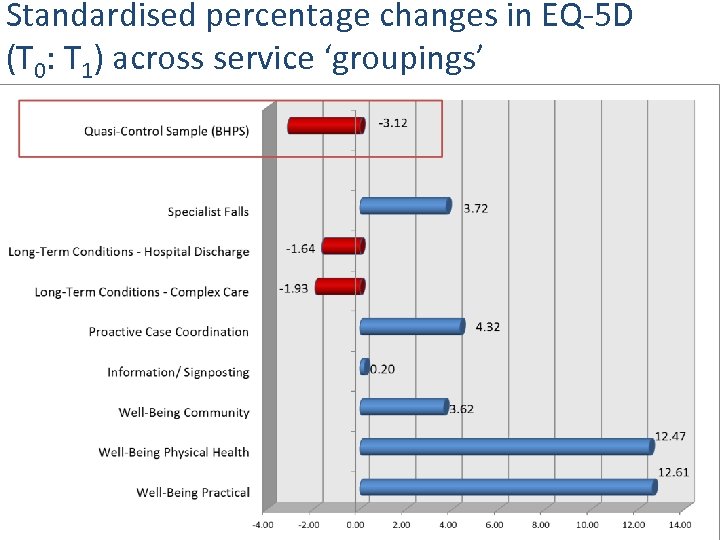 Standardised percentage changes in EQ-5 D (T 0: T 1) across service ‘groupings’
 Impact of project structure and processes – Home from hospital • Voluntary organisations facilitated safe and timely discharge (two projects within the category of ‘Long Term Conditions – Hospital Discharge’). • Both concentrated on a practical response: preparing the house prior to discharge, providing short-term assistance • Differences: within pilot site 88 the voluntary organisation was integrated within a multidisciplinary team - pilot site 15 operated ‘independently’.
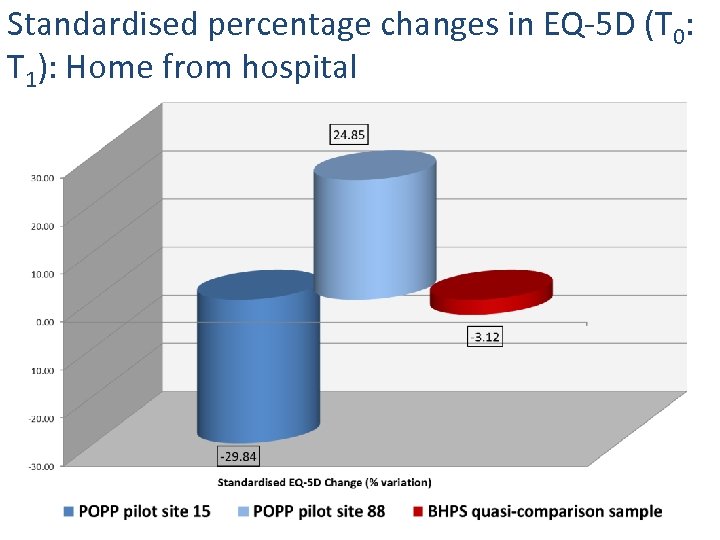 Standardised percentage changes in EQ-5 D (T 0: T 1): Home from hospital
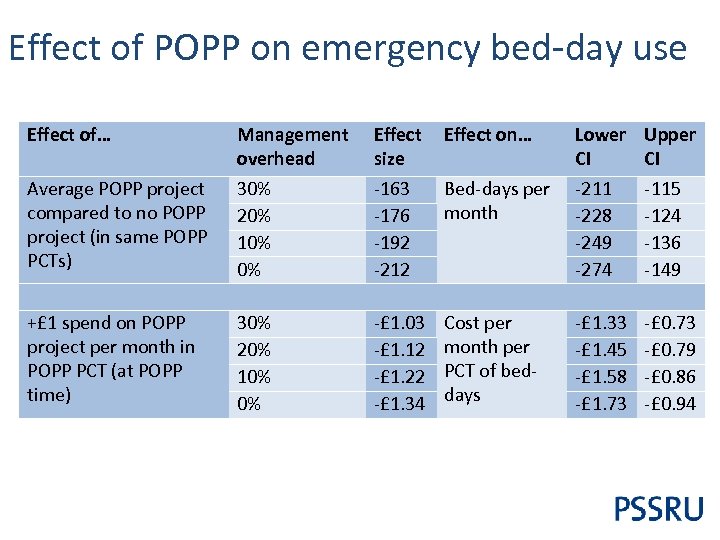 Effect of POPP on emergency bed-day use Effect of… Effect size -163 -176 -192 -212 Effect on… Average POPP project compared to no POPP project (in same POPP PCTs) Management overhead 30% 20% 10% 0% Bed-days per month Lower CI -211 -228 -249 -274 Upper CI -115 -124 -136 -149 +£ 1 spend on POPP project per month in POPP PCT (at POPP time) 30% 20% 10% 0% -£ 1. 03 -£ 1. 12 -£ 1. 22 -£ 1. 34 Cost per month per PCT of beddays -£ 1. 33 -£ 1. 45 -£ 1. 58 -£ 1. 73 -£ 0. 79 -£ 0. 86 -£ 0. 94
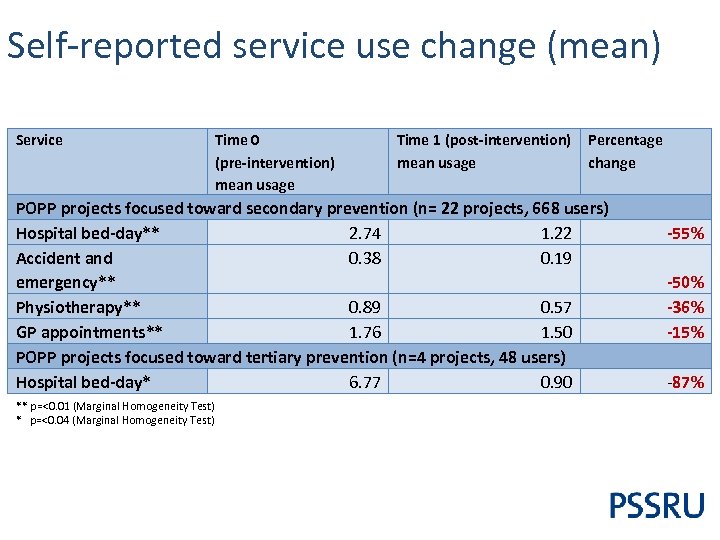 Self-reported service use change (mean) Service Time 0 (pre-intervention) mean usage Time 1 (post-intervention) mean usage Percentage change POPP projects focused toward secondary prevention (n= 22 projects, 668 users) Hospital bed-day** 2. 74 1. 22 Accident and 0. 38 0. 19 emergency** Physiotherapy** 0. 89 0. 57 GP appointments** 1. 76 1. 50 POPP projects focused toward tertiary prevention (n=4 projects, 48 users) Hospital bed-day* 6. 77 0. 90 ** p=<0. 01 (Marginal Homogeneity Test) * p=<0. 04 (Marginal Homogeneity Test) -55% -50% -36% -15% -87%
 Prevention or diversion? • Prevented deterioration in reported health-related quality of life for some users (e. g. , younger old) in some projects (e. g. , integrated co-located multidisciplinary teams, single-line management, ‘flagwavers’, appropriate skill levels). • Changed some service use – reduction in secondary and primary care. • But, short or long-term change? Did the POPP programme prevent on-going deterioration? • Or, service diversion and increased family support? Some evidence increase in social care and that family support increases following the POPP intervention – mean (hrs, mns, pw) 3. 47 at T 0, to 13. 49 at T 1 (p=<0. 03).