


 Скачать презентацию Prevention of Accidental Exposures to Patients Undergoing Radiation
660961617e4221f2f5fdbe94c660c0e7.ppt
- Количество слайдов: 44
 Prevention of Accidental Exposures to Patients Undergoing Radiation Therapy INTERNATIONAL COMMISSION ON RADIOLOGICAL PROTECTION ———————————————————
 International Commission on Radiological Protection Information abstracted from ICRP Publication 86 Available at www. icrp. org Task Group: P. Ortiz, P. Andreo, J-M. Cosset, A. Dutreix, T. Landberg, L. V. Pinillos, W. Yin, P. J. Biggs INTERNATIONAL COMMISSION ON RADIOLOGICAL PROTECTION ———————————————————
 Use and disclaimer l This is a Power. Point file l It may be downloaded free of charge l It is intended for teaching and not for commercial purposes l This slide set is intended to be used with the complete text provided in ICRP Publication 86 INTERNATIONAL COMMISSION ON RADIOLOGICAL PROTECTION ———————————————————
 Contents l Case histories of major accidental exposure in radiotherapy l Clinical consequences of accidental exposures l Recommendations for prevention INTERNATIONAL COMMISSION ON RADIOLOGICAL PROTECTION ———————————————————
 Case Histories of Major Accidental Exposures of Patients in Radiotherapy DOM 07/PP, lp
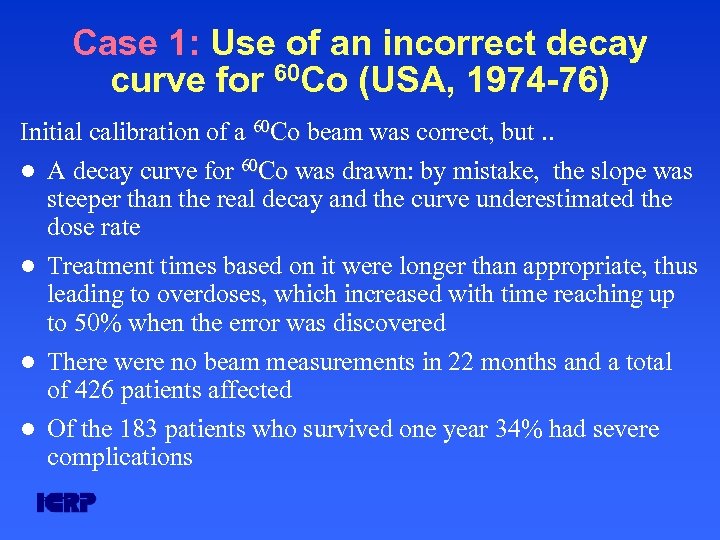 Case 1: Use of an incorrect decay curve for 60 Co (USA, 1974 -76) Initial calibration of a 60 Co beam was correct, but. . Co A decay curve for 60 Co was drawn: by mistake, the slope was Co steeper than the real decay and the curve underestimated the dose rate l Treatment times based on it were longer than appropriate, thus leading to overdoses, which increased with time reaching up to 50% when the error was discovered l There were no beam measurements in 22 months and a total of 426 patients affected l l Of the 183 patients who survived one year 34% had severe complications DOM 07/PP, lp
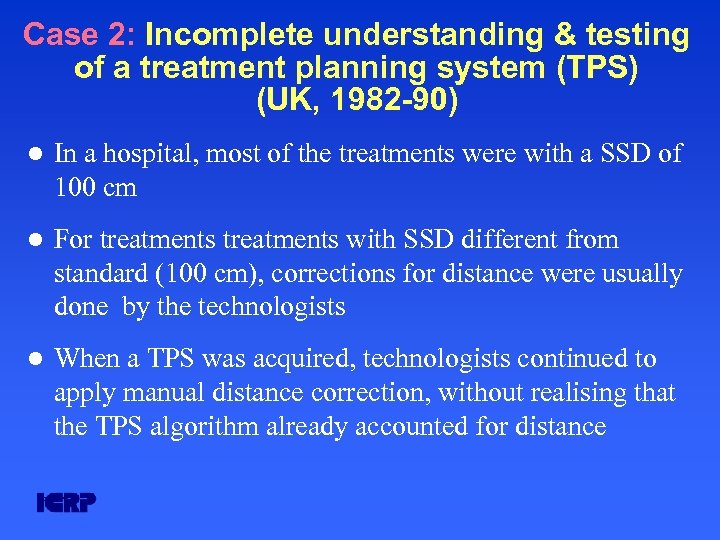 Case 2: Incomplete understanding & testing of a treatment planning system (TPS) (UK, 1982 -90) l In a hospital, most of the treatments were with a SSD of 100 cm l For treatments with SSD different from standard (100 cm), corrections for distance were usually done by the technologists l When a TPS was acquired, technologists continued to apply manual distance correction, without realising that the TPS algorithm already accounted for distance DOM 07/PP, lp
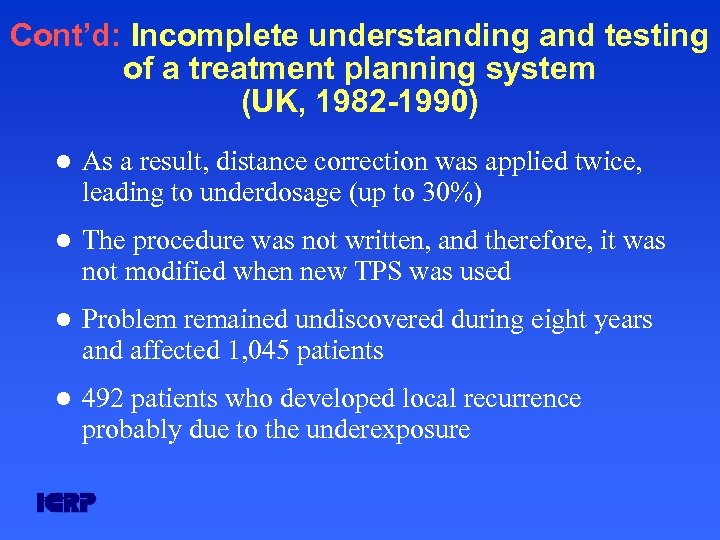 Cont’d: Incomplete understanding and testing of a treatment planning system (UK, 1982 -1990) l As a result, distance correction was applied twice, leading to underdosage (up to 30%) l The procedure was not written, and therefore, it was not modified when new TPS was used l Problem remained undiscovered during eight years and affected 1, 045 patients l 492 patients who developed local recurrence probably due to the underexposure DOM 07/PP, lp
 Case 3: Untested change of procedure for data entry into TPS (Panama, 2000) l A TPS allowed entry of four shielding blocks for isodose calculations, one block at a time l Need for five shielding blocks led to deviation from standard procedure for block data entry: several blocks were entered in one step l Instructions for users had some ambiguity with respect to shielding block data entry l TPS computer calculated treatment time, which was double the normal one (leading to 100% overdose) DOM 07/PP, lp
 Cont’d: Untested change of procedure for data entry into TPS (Panama, 2000) l There was no written procedure for the use of TPS, and therefore, a change of procedure was neither written nor tested for validity l Computer output was not checked for treatment time with manual calculations l The error affected 28 patients l One year after the event, at least five had died from the overexposure DOM 07/PP, lp
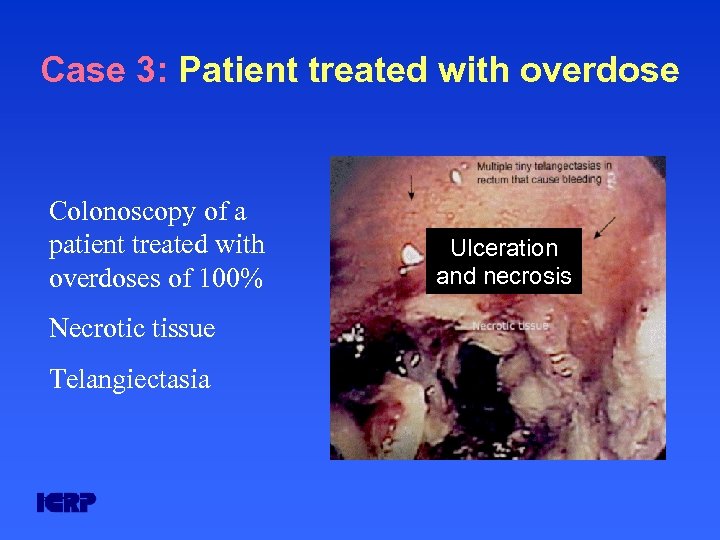 Case 3: Patient treated with overdose Colonoscopy of a patient treated with overdoses of 100% Necrotic tissue Telangiectasia DOM 07/PP, lp Ulceration and necrosis
 Case 4: Accelerator software problems (USA & Canada, 1985 -87) l Software from an older accelerator design was used for a new, substantially different, design l Software flaws were later identified in the software used to enter treatment parameters, such as type of radiation and energy l Six accidental exposures occurred in different hospitals and three patients died from overexposure DOM 07/PP, lp
 Case 5: Reuse of outdated computer file for 60 Co treatments (USA, 1987 -88) l After source change, TPS computer files were updated… l Except a computer file, which was no longer in use (this was intended for brain treatments with trimmer bars) l The computer file was not removed although no longer in use DOM 07/PP, lp
 Cont’d: Reuse of outdated computer file for 60 Co treatments (USA, 1987 -88) l A new radiation oncologist decided to treat with trimmer bars and took the file corresponding to the prior 60 Co source Co l There was no double or manual check for dose calculation l 33 patients received 75% higher overexposure DOM 07/PP, lp
 Case 6: Incorrect accelerator repair & communication problems (Spain, 1990) l Accelerator fault followed by an attempt to repair it l Electron beam was restored but electron energy was misadjusted l Accelerator delivered 36 Me. V electrons, regardless of energy selected l Treatments resumed without notifying physicists for beam checks DOM 07/PP, lp
 Cont’d: Incorrect accelerator repair & communication problems (Spain, 1990) l There was a discrepancy between energy displayed and energy selected, which was attributed to a faulty indicator, instead of investigating the reason for the discrepancy l A total of 27 patients were affected with massive overdoses and by distorted dose distribution due to wrong electron energy l At least 15 of these patients died from the accidental overexposure and two more died with overexposure as major contributor DOM 07/PP, lp
 Case 7: Malfunction of HDR brachytherapy equipment (USA, 1992) l HDR brachytherapy source detached from the driving mechanism while still inside the patient l While the console display indicated that the source was in retracted to the shielded position, an external radiation monitor was indicating that there was radiation l Staff failed to investigate the discrepancy with available portable monitor l The source remained in the patient for several days and the patient died from overexposure DOM 07/PP, lp
 Case 8: Beam miscalibration of 60 Co (Costa Rica, 1996) l Radioactive source of a teletherapy unit was exchanged l During beam calibration, reading of the timer was confused, leading to underestimation of the dose rate l Subsequent treatment times were calculated with the wrong dose rate and were about 60% longer than required l 115 patients were affected; two years after the event, at least 17 patients had died from the overexposure DOM 07/PP, lp
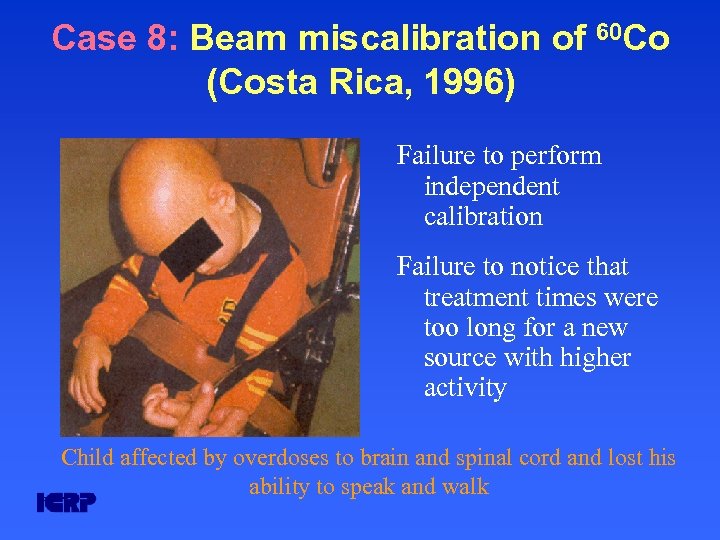 Case 8: Beam miscalibration of 60 Co (Costa Rica, 1996) Failure to perform independent calibration Failure to notice that treatment times were too long for a new source with higher activity Child affected by overdoses to brain and spinal cord and lost his ability to speak and walk DOM 07/PP, lp
 Clinical Consequences DOM 07/PP, lp
 Side effects and complications in radiotherapy l Side effects are usually minor and transient e. g : xerostomia and localised subcutaneous fibrosis Relatively high frequency acceptable to achieve cure l Complications are more severe and long lasting e. g : radiation myelitis Expected only at very low frequency DOM 07/PP, lp
 Impact of accidental underexposure l Accidental underdosage may jeopardise tumour control probability l They are difficult to discover, may only be detected after relatively long time and, therefore, may involve a large number of patients DOM 07/PP, lp
 Impact of overdoses on early (or acute) complications l Usually observed in tissues with rapid cell turnover (skin, mucosa, bone marrow …) l Overexposure may increase the frequency and severity (up to necrosis) DOM 07/PP, lp
 Early (acute) complications l Determinant factors for acute complications are: 1) total delivered dose 2) total duration (protraction) 3) size and location of irradiated volume l DOM 07/PP, lp Little correlation of early complications with fraction size and dose rate (except if the latter is very high)
 Late complications l Mainly observed in tissues with slowly proliferating cells (arteriolar narrowing which occurs with a time delay) l Can also become manifest in rapidly proliferating cells (in addition to and after acute effects) l Manifest more than six months after irradiation and even much later l Usually irreversible and often slowly progressive DOM 07/PP, lp
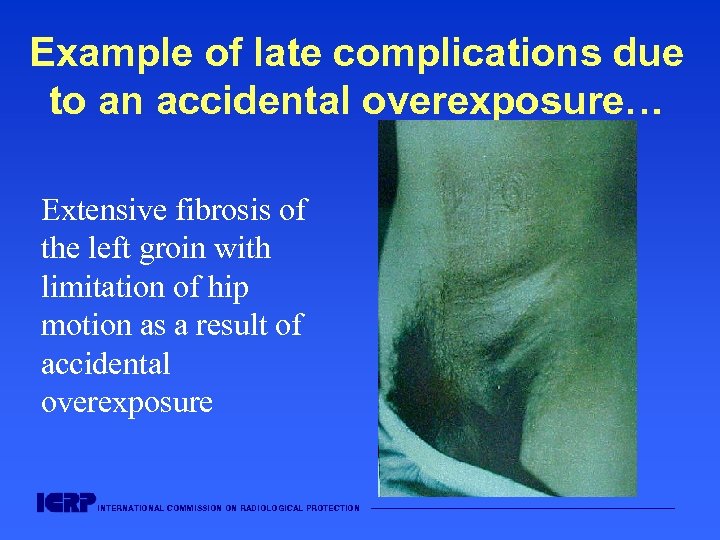 Example of late complications due to an accidental overexposure… Extensive fibrosis of the left groin with limitation of hip motion as a result of accidental overexposure INTERNATIONAL COMMISSION ON RADIOLOGICAL PROTECTION ———————————————————
 Impact of overexposure on late complications (cont’d) l Determinant factors: 1) total delivered dose 2) fraction size and dose rate l DOM 07/PP, lp In the case of accidental exposure, increased fraction size may amplify the effects (as occurred in some accidents)
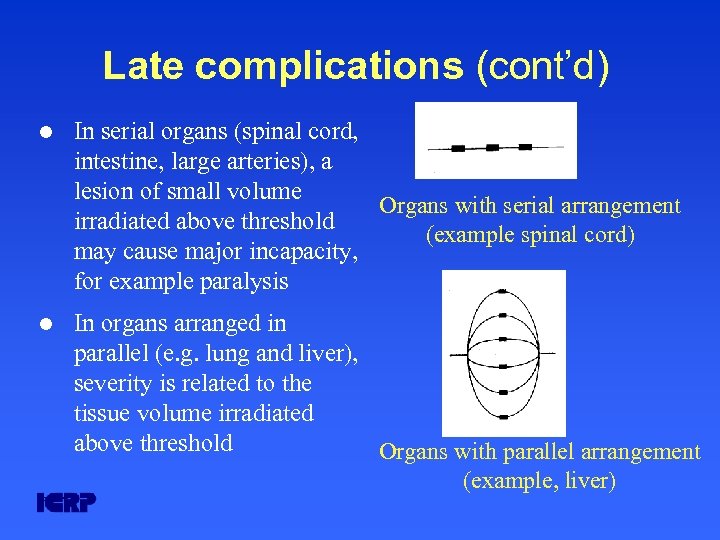 Late complications (cont’d) l In serial organs (spinal cord, intestine, large arteries), a lesion of small volume Organs with serial arrangement irradiated above threshold (example spinal cord) may cause major incapacity, for example paralysis l In organs arranged in parallel (e. g. lung and liver), severity is related to the tissue volume irradiated above threshold Organs with parallel arrangement (example, liver) DOM 07/PP, lp
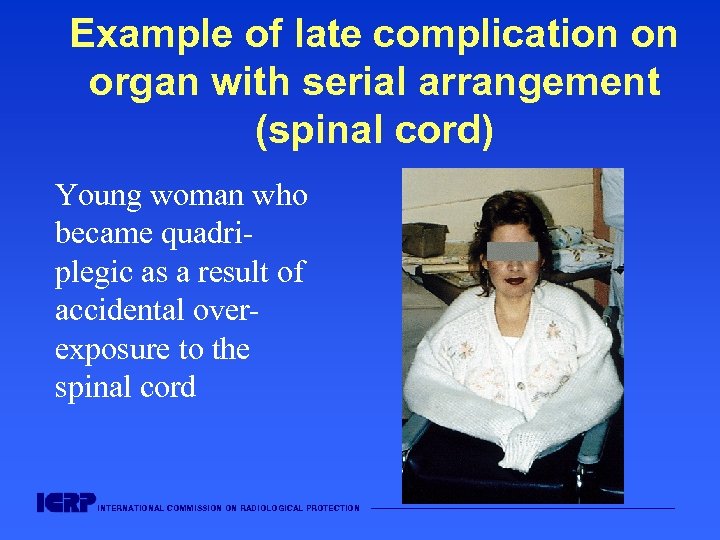 Example of late complication on organ with serial arrangement (spinal cord) Young woman who became quadriplegic as a result of accidental overexposure to the spinal cord INTERNATIONAL COMMISSION ON RADIOLOGICAL PROTECTION ———————————————————
 Clinical detection of accidental medical exposure Careful clinical follow-up may lead to detect accidental overdose through early enhanced reactions l Experienced radiation oncologists can detect overdoses of 10 % during regular weekly consultations l Some overdoses may cause late severe effects without abnormal early effects l DOM 07/PP, lp
 Clinical detection of accidental medical exposure (cont’d) In the case of unusual reactions in a single patient, other patients treated in the same period may need to be recalled DOM 07/PP, lp
 Recommendations for Prevention DOM 07/PP, lp
 List of Recommendations for prevention Overall preventive measure: a Quality Assurance Programme, involving – – – – DOM 07/PP, lp Organisation Education and training Acceptance testing and commissioning Follow-up of equipment faults Communication Patient identification and patient charts Specific recommendations for teletherapy Specific recommendations for brachytherapy
 Quality Assurance Programme for Radiation Therapy (QART) l Quality assurance programmes have evolved from equipment verifications to include the entire process, from the prescription to delivery and post treatment follow-up l Major accidental exposures occurred in the absence of written procedures and checks (QART); either because a QART did not exist or it was not fully implemented (checks omitted) DOM 07/PP, lp
 Organisation l Comprehensive QA is crucial in prevention and involve clinical, physical and safety components: l Its implementation requires – – DOM 07/PP, lp complex multi-professional team work clear allocation of functions and responsibilities understood number of qualified staff, commensurate to workload
 Education and training l The most important component of QA is qualified personnel, including radiation oncologists, medical physicists, technologists and maintenance engineers l Comprehensive education together with specific training on – procedures and responsibilities – everyone’s role in the QART programme – lessons from typical accidents with a description of methods for prevention – additional training when new equipment and techniques are being introduced DOM 07/PP, lp
 Acceptance testing & commissioning l Errors in these phases may affect many patients l Acceptance testing: Should include test of safety interlocks, verification of equipment specifications, as well as understanding and testing TPS l Commissioning: Should includes measuring and entering all basic data for future treatments into computer l Systematic acceptance and commissioning, including a cross check and independent verification, form a major part of accident prevention DOM 07/PP, lp
 Follow-up on equipment faults l Experience has shown that some equipment faults are difficult to isolate and to correct l If an equipment fault or malfunction has not been fully understood and corrected, there is a need for – communication and follow-up with manufacturer – dissemination of information and experience to other maintenance engineers DOM 07/PP, lp
 Communication and repairs l Need for a written communication policy, including: – Reporting of unusual equipment behaviour – Notification to the physicist and clearance by before resuming treatments (because of possible need for control checks after repairs) – Reporting of unusual patient reactions DOM 07/PP, lp
 Patient identification and patient chart l Effective patient identification procedures and treatment charts (consideration of photographs for identification …) l Double check of chart data at the beginning of treatment, before changes in the course of treatment (for example, a new field) and once a week at least DOM 07/PP, lp
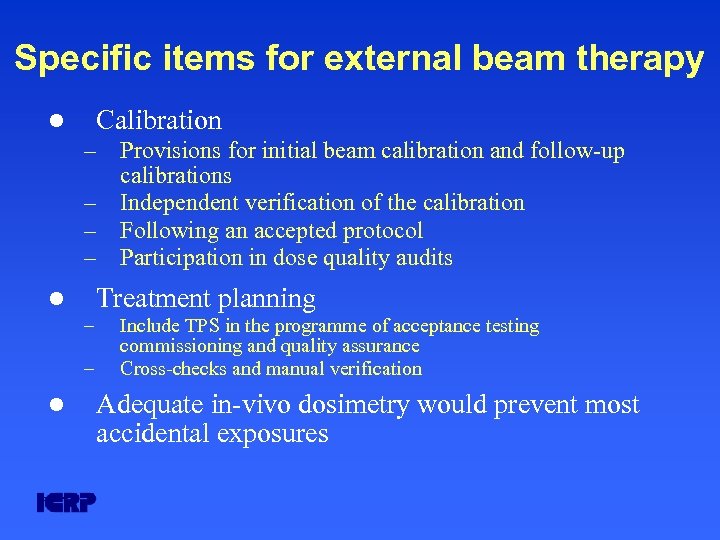 Specific items for external beam therapy Calibration l – Provisions for initial beam calibration and follow-up calibrations – Independent verification of the calibration – Following an accepted protocol – Participation in dose quality audits Treatment planning l – – l DOM 07/PP, lp Include TPS in the programme of acceptance testing commissioning and quality assurance Cross-checks and manual verification Adequate in-vivo dosimetry would prevent most accidental exposures
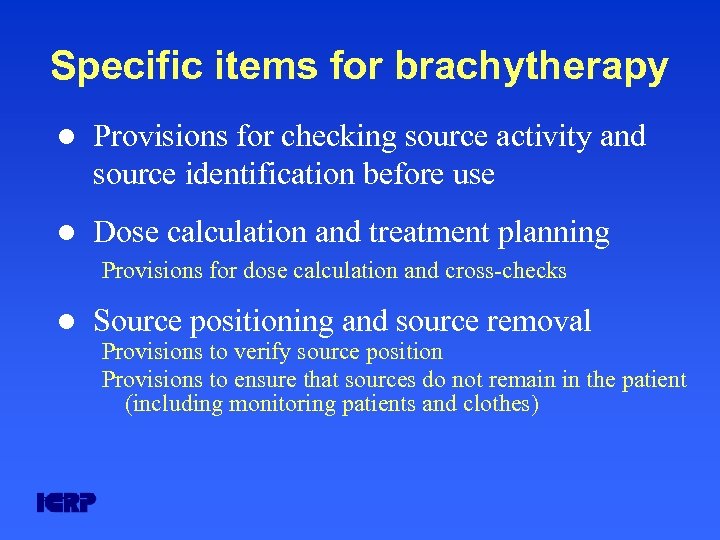 Specific items for brachytherapy l Provisions for checking source activity and source identification before use l Dose calculation and treatment planning Provisions for dose calculation and cross-checks l Source positioning and source removal Provisions to verify source position Provisions to ensure that sources do not remain in the patient (including monitoring patients and clothes) DOM 07/PP, lp
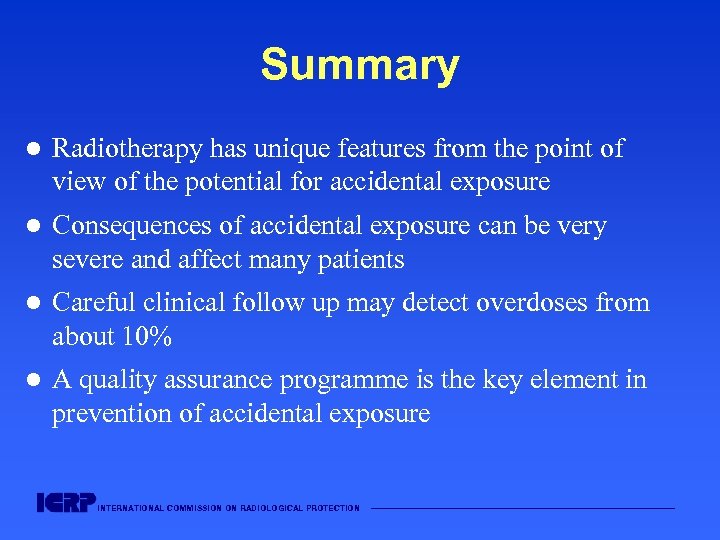 Summary l Radiotherapy has unique features from the point of view of the potential for accidental exposure l Consequences of accidental exposure can be very severe and affect many patients l Careful clinical follow up may detect overdoses from about 10% l A quality assurance programme is the key element in prevention of accidental exposure INTERNATIONAL COMMISSION ON RADIOLOGICAL PROTECTION ———————————————————
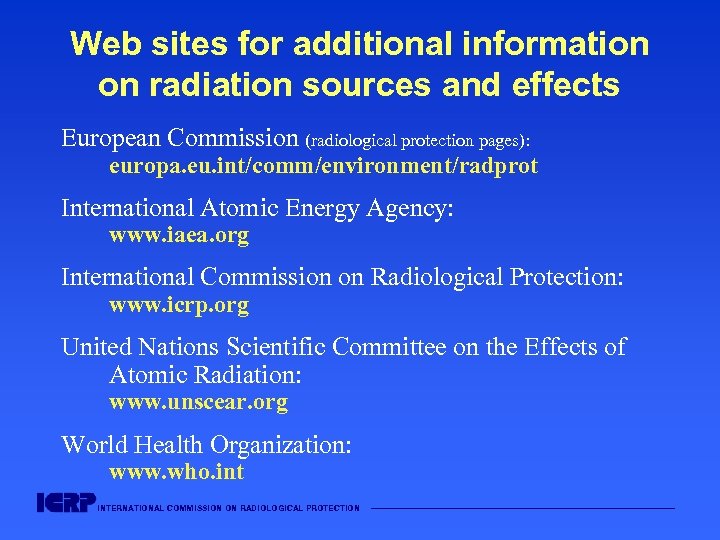 Web sites for additional information on radiation sources and effects European Commission (radiological protection pages): europa. eu. int/comm/environment/radprot International Atomic Energy Agency: www. iaea. org International Commission on Radiological Protection: www. icrp. org United Nations Scientific Committee on the Effects of Atomic Radiation: www. unscear. org World Health Organization: www. who. int INTERNATIONAL COMMISSION ON RADIOLOGICAL PROTECTION ———————————————————