


 Скачать презентацию Preventing the Next Enron Lessons Learned Presented
92440d971c14bc2f7154b76cb4a703c7.ppt
- Количество слайдов: 41
 Preventing the Next Enron … Lessons Learned Presented to the Florida West Coast Chapter IIA December 2, 2003 - Thomas L. Richardson
 IIA Standard - Deterrence, Detection, Investigation and Reporting of Fraud • • Evaluate the indicators Know the fraud indicators – Characteristics of fraud – Techniques used to commit fraud – Types of fraud associated with activity Notify the appropriate authorities and recommend investigation Take Action (Due prof’l care; follow-up)
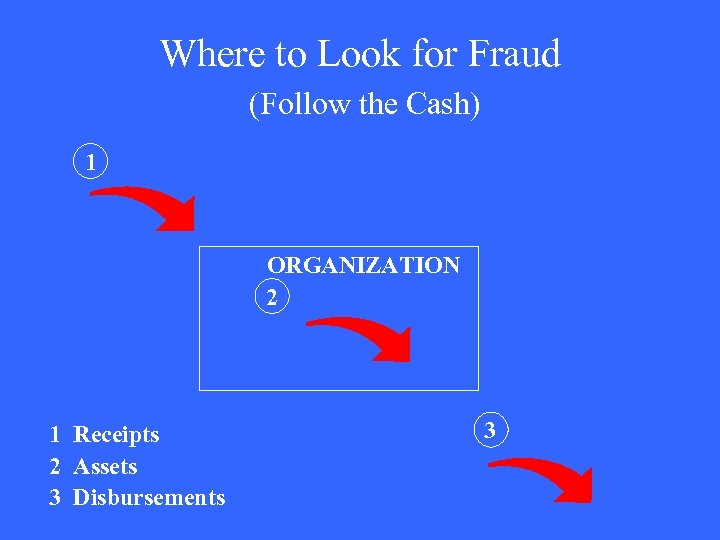 Where to Look for Fraud (Follow the Cash) 1 ORGANIZATION 2 1 Receipts 2 Assets 3 Disbursements 3
 Situational Pressures (Motive) Red Flags • • • High personal debts Severe illness in family Inadequate income / living beyond means Stock market speculation Loan shark involvement
 Situational Pressures (Motive) Red Flags (Cont’d. ) • Excessive gambling • Involvement with other men/women • Undue family, peer, company, community expectations • Excessive use of alcohol or drugs
 Revenge Motives • Perceived inequities – Underpaid – Poor job assignments • Resentment of superiors • Frustration, usually with job
 Personally Developed Opportunities Red Flags • Very familiar with operations (including cover -up opportunities) • In a position of trust • Close association with cohorts, suppliers, and other key people
 Firm Environments Which Foster and /or Create Opportunities Red Flags • • • Rule of conduct/discipline not disseminated Rapid turnover of key personnel (quit or fired) No annual vacations of key personnel/execs No rotations or turnover of key personnel Not using adequate personnel
 Firm Environments Which Foster and /or Create Opportunities Red Flags (Cont’d. ) • • • Absence of explicit and uniform personnel policies No record of dishonest acts or disciplinary actions No documented Code of Ethics
 History of Enron • July 1985 - Houston Natural Gas merged with Inter. North to form Enron, a natural gas pipeline company • 1989 - Begins trading natural gas • 1994 - Begins trading electricity • 1997 - Announces first transaction using weather derivatives products • 1999 - Launches Enron. Online, global commodity trading web site
 Besides energy contracts Enron traded industrial commodities. . . • • • Steel and wool fiber Financial derivatives such as default insurance Broadcast time for advertising Hedges against bad weather Internet bandwidth capacity
 History of Enron (cont’d. ) • 1990 - Jeffrey Skilling joins Enron • 1996 - He becomes President & COO • 2000 - Enron stock hit an all-time high of $90. 56 • Feb 2001 - Mr. Skilling becomes CEO. Former CEO Ken Lay becomes chairman
 History of Enron (cont’d. ) • Aug 14, 2001 - Mr. Skilling resigns abruptly citing personal reasons; Lay becomes CEO again • Aug 15, 2001 - Sharon Watkins, VP warns Lay that the company’s accounting practices would lead the company to “implode in a wave of accounting scandals” (Anonymously) • Oct 2001 - Reports a $618 m (1 st qtr’ly) loss and $1. 2 bn reduction of shareholder equity.
 History of Enron (cont’d. ) • Oct 2001 - Enron admits SEC investigation for COI between Enron and its partnerships. Enron shares lose a fifth of their value • Nov 2001 - Enron says that it overstated profits dating back to 1997 by $600 m • Dec 2, 2001 - Enron files for bankruptcy, the largest in US history. • Jan 2002 - Justice Department announces criminal investigation of Enron
 Jeffrey Keith Skilling • Attended SMU (over Princeton) on an engineering scholarship • Graduated with a BS in Applied Science • Worked in asset and liability management at First City National Bank • Grad School Harvard; MBA, top 5% • Mc. Kinsey & Co. , consulting firm, advising Houston Natural Gas and Internorth (Enron)
 The Gas Bank • Skilling realized immediate profits with his Gas Bank concept in 1989 • Industrial customers and power plants paid a premium for guaranteed gas supply • Gas fired plants became attractive; more business for pipelines and trading business • Created a futures market in natural gas
 Mark-to-Market Accounting • Mark-to-market accounting was Skilling’s brainchild. The SEC approved mark-to-market with Enron Gas Services on natural gas trading • Enron became the first non-financial company to use mark-to-market accounting • Enron implemented mark-to-market accounting a full year earlier than the SEC expected • Used mark-to-market accounting in every part of the business, not just Enron Gas Services
 Enron Online • The toast of cyberspace • Sold electricity, natural gas, coal, plastics, oil, paper, petrochemicals, and clean air credits among over 800 products • Traded over the web instead of fax and phone • Largest energy marketer in the world; made the rules
 Material Adverse Change Clause • Created protection in derivative contracts • If counterparty experienced material adverse change to its business, collateral could be demanded • It worked both ways; Enron couldn’t lose • Rich Kinder: Enron was “smoking its own dope”
 The Exemption • Board was asked to waive the Ethics Policy • Fastow reported that each transaction would be approved by CAO and CRO • Also, Board Audit Committee would review all transactions annually • Arthur Andersen had objected; relented if Board and CEO approved each transaction • Board was told that Andersen approved
 Deregulation of Securities and Investments Market • Glass-Steagall Act of 1933 kept banks, ins cos and brokerage houses from merging • In 1999 Graham-Leach-Bliley Services Modernization Act repealed Glass-Steagall • J. P. Morgan offered an array of services to Enron – – Advisor (Merger talks with Dynergy - $45 m) Lender (Helped raise $1 B in loans) Investor (Invested in Fastow’s LJM 2 scheme) Source of Research (Guided investors)
 Operating Near the Edge • Off-balance-sheet entities - created to eliminate losses • Rather than face write-offs, they tried to hide them with accounting • Related-party transactions (suspended COI policy) • Off-balance-sheet loans collateralized by Enron stock • Inaccurate, incomplete or misleading disclosures • Aggressive, questionable accounting methods
 Operating Near the Edge (cont’d. ) • Complex, high-risk trading activities (derivatives, special purpose entities, hedging, etc. ) • Form over substance reporting • Arrogant corporate culture - took big risks
 Where Was Management? • • Ken Lay - CEO and Chairman Jeff Skilling - President and COO Accounting staff came from Andersen Questions raised by Enron executive was referred to and cleared by in-house counsel • Enron’s executives were dumping stock while encouraging employees to buy • Employees could not sell during “blackout” • (Michael Kopper plead guilty to conspiracy to commit money laundering and wire fraud. 8/21)
 Where Were the External Auditors? • Andersen decided to maintain Enron as a client • Andersen collected $25 M for year-end auditing services and $27 M for consulting • Andersen provided internal auditing services • Difficult to distinguish between Andersen’s external and internal audit services
 Where Were the External Auditors? • • Local partner did not stand up to the client Concurring partner overridden Allegations that documents were destroyed Andersen was ultimately convicted for obstruction of justice • (Chicago firm was on probation re Waste Mgt) – Waste Mgt inflated profits by $1. 4 bn – Andersen paid $700 m to settle charges; no further wrongdoing • (David Duncan, former Andersen Partner, admitted to obstruction of justice, 5/13/02)
 Where Were the Internal Auditors? • Enron outsourced internal audit to Andersen – First major organization to totally outsource its internal audit services (same people, now paid by Andersen) – About 40 auditors went to Andersen – The CAE was made an Andersen partner • Enron began to bring in internal audit – – CAE was from Pw. C; reported to CAO at HQ Internal auditors were housed in the business units CAE did not control performance or compensation Sensitive issues were left to external auditors
 Where Were the Internal Auditors? • CAE developed a risk assessment process – CAE identified some high risk areas – CAE questioned some transactions in high risk – Mgmt told CAE that these were being handled by the financial auditors. CAE chose not to audit - it would be redundant
 Where Was the Audit Committee? • Some members of the audit committee were also members of the Finance team • BOD waived the COI policy, thus allowing insider trading • Audit committee had 5 main meetings lasting only one hour each, regardless of the topic • Compensation - > $400 K
 Where Was the Audit Committee? • Meetings with the Internal Auditors were joint with Andersen Consultants • Only executive summaries or reports were read by the audit committee
 Wendy Graham • Wife of Senator Phil Graham (Chr Banking Cmte) • Exempted energy derivatives contracts from federal oversight • Shortly thereafter, joined Enron’s Board • Enron contributed to think tank at Geo. Mason Univ, where Graham was Dir. of regulatory studies • Attorney advise Graham that she could have a material conflict of interest • Discontinued stock options; accepted cash • Other directors were consultants and vendors
 Oh, By the Way • Wendy Lee Graham, former chair of the Commodity Futures Trading Commission – Exempted energy derivative contracts from federal regulation – Lame duck chairman with 2 vacancies of 5 person commission – Enron did not have to get a securities license, register with the SEC or report to anyone (cash supporting derivatives)
 Board Members • Joe Foy was a retired partner in law firm which did legal work for Enron • Lord John Wakeham received $6, 000 per month for consulting in addition to salary – Chartered accountant, had served as Britain’s secretary of state for energy – Member of Audit Committee • Robert Belfer gained a seat after selling the family’s oil and gas exploration business to Enron
 Board Members (cont’d. ) • John Mendelsohn and Charles Le. Maistre, two medical doctors’ M. D. Anderson Cancer Center received millions in donations from Enron • Three other members were employees of the company (Ken Lay, Jeff Skilling, Rebecca Mark)
 Items of Interest for Boards? • Off balance sheet transactions • Treatment of related-party transactions • Related partnership issues, derivatives and other complex issues • Risk management policies (ERM) • Adequacy of internal and external auditing • Independence issues for external auditors (amount of consulting fees)
 Others Have Joined the Mix • Tyco – Spent $8 bn on over 700 acquisitions in 3 years – May have spent $135 m to enrich former CEO • World. Com – Reported $4 bn in improper accounting – Internal Auditors found another $3. 8 bn • Adelphia – Inflated number of subscribers – Owners used company as their personal piggybank and were charged with fraud (Dad/Son led off in handcuffs)
 Common Themes • Sacrifice of long-term strategy to buttress shortterm strategy • Conflicts of Interest - personal enrichment • “Specific deniability” by top management • Attempt to inflate stock prices • Some are now charged with tax evasion • Common denominator - GREED!
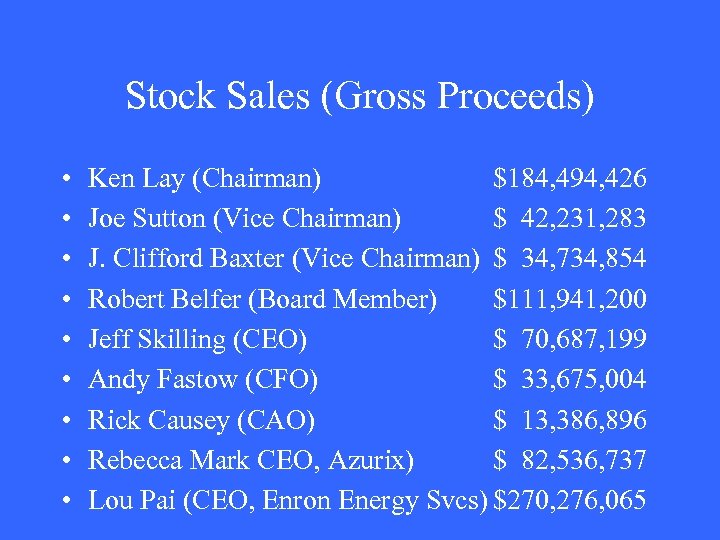 Stock Sales (Gross Proceeds) • • • Ken Lay (Chairman) $184, 494, 426 Joe Sutton (Vice Chairman) $ 42, 231, 283 J. Clifford Baxter (Vice Chairman) $ 34, 734, 854 Robert Belfer (Board Member) $111, 941, 200 Jeff Skilling (CEO) $ 70, 687, 199 Andy Fastow (CFO) $ 33, 675, 004 Rick Causey (CAO) $ 13, 386, 896 Rebecca Mark CEO, Azurix) $ 82, 536, 737 Lou Pai (CEO, Enron Energy Svcs) $270, 276, 065
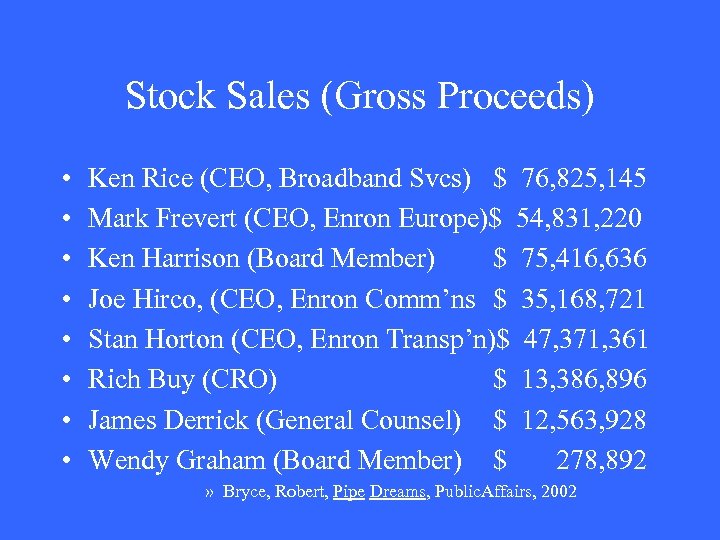 Stock Sales (Gross Proceeds) • • Ken Rice (CEO, Broadband Svcs) $ 76, 825, 145 Mark Frevert (CEO, Enron Europe)$ 54, 831, 220 Ken Harrison (Board Member) $ 75, 416, 636 Joe Hirco, (CEO, Enron Comm’ns $ 35, 168, 721 Stan Horton (CEO, Enron Transp’n)$ 47, 371, 361 Rich Buy (CRO) $ 13, 386, 896 James Derrick (General Counsel) $ 12, 563, 928 Wendy Graham (Board Member) $ 278, 892 » Bryce, Robert, Pipe Dreams, Public. Affairs, 2002
 Greed Excessive desire for getting or having, esp. wealth; desire for more than one needs or deserves; avarice; cupidity
 Epilog “Fish rot at the head”