 Скачать презентацию PREVENTING DISEASE THROUGH SAFE WASTE MANAGEMENT A Contribution
937a40c0c001a8f72efbc23f7b984280.ppt
- Количество слайдов: 15



PREVENTING DISEASE THROUGH SAFE WASTE MANAGEMENT A Contribution to Public Health MENA Healthcare Infrastructure Investment & Finance Summit 2010 Cairo, 27 -28. 10. 2010 Katharina Kummer Peiry, Executive Secretary Secretariat of the Basel Convention, UNEP
SUB-TOPICS v Introduction – Hazardous Waste and Health v How Can We Promote ‘Green’ Health-Care? v Basel Convention at a Glance v Biomedical & Healthcare Wastes under BC v BC Technical Guidelines on the ESM of Biomedical and Healthcare Wastes 2
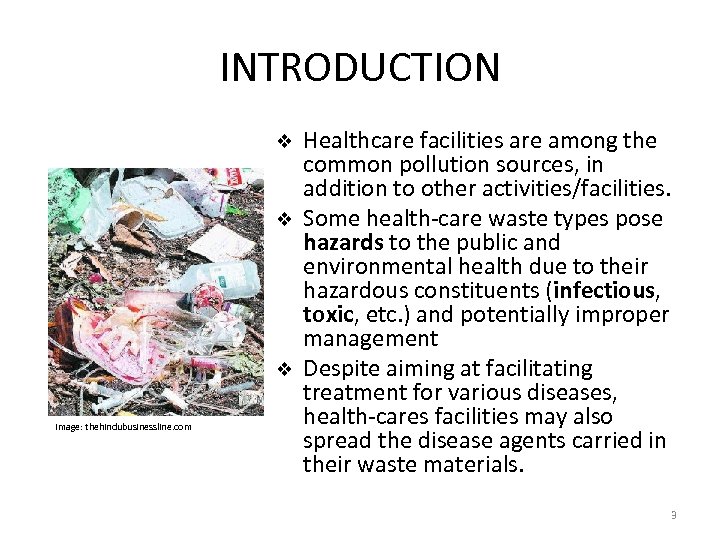
INTRODUCTION v v v Image: thehindubusinessline. com Healthcare facilities are among the common pollution sources, in addition to other activities/facilities. Some health-care waste types pose hazards to the public and environmental health due to their hazardous constituents (infectious, toxic, etc. ) and potentially improper management Despite aiming at facilitating treatment for various diseases, health-cares facilities may also spread the disease agents carried in their waste materials. 3
Introduction (2) Health-care waste issue on newsmedia (1) “ 50% Mumbai hospitals cut corners; sell off bio-medical waste” … Over 50% of the hospitals sell off their bio-medical waste such as worn out disposable syringes, saline bottles, suction pipes used for blood transfusion and glucose, scissors and urine bags to scrap dealers. … “This is a white-collar crime. Indulging in it can put several lives at risk. Public awareness has to be generated to stop such a trade, ” said Anup Nilawar, director SMS Envoclean. Published: Tuesday, Oct 12, 2010, 2: 08 IST, By Priyanka Sharma (www. dnaindia. com) 4
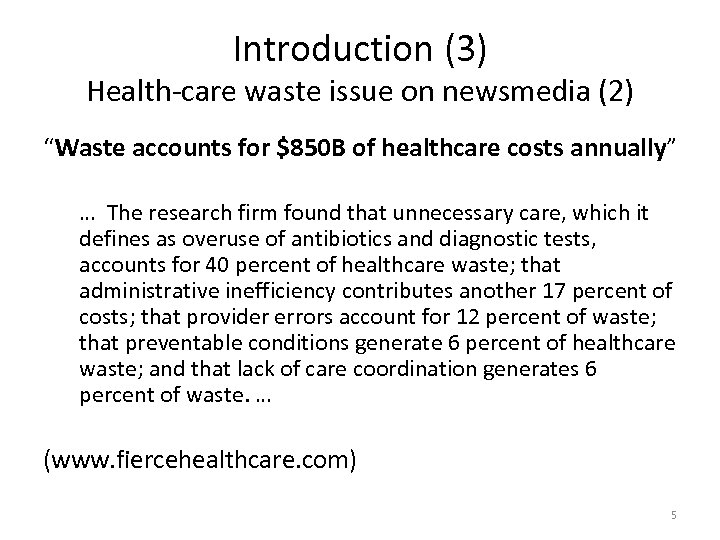
Introduction (3) Health-care waste issue on newsmedia (2) “Waste accounts for $850 B of healthcare costs annually” … The research firm found that unnecessary care, which it defines as overuse of antibiotics and diagnostic tests, accounts for 40 percent of healthcare waste; that administrative inefficiency contributes another 17 percent of costs; that provider errors account for 12 percent of waste; that preventable conditions generate 6 percent of healthcare waste; and that lack of care coordination generates 6 percent of waste. … (www. fiercehealthcare. com) 5
HOW TO PROMOTE ‘GREEN’ HEALTH-CARE? v Your investment in health-care establishments certainly will support public health infrastructure. But, how would it ultimately turn out? § Profit, reputation? § Liability? v Experience shows that with core expertise and safe & proper waste management, many health-care establishments can support public health: § Curative (to patients) § Preventive (to the environment) v Public health & environmental problems from health-care waste can be prevented, a. o. , with proper waste management (haz waste minimisation, safe disposal, etc. ) 6
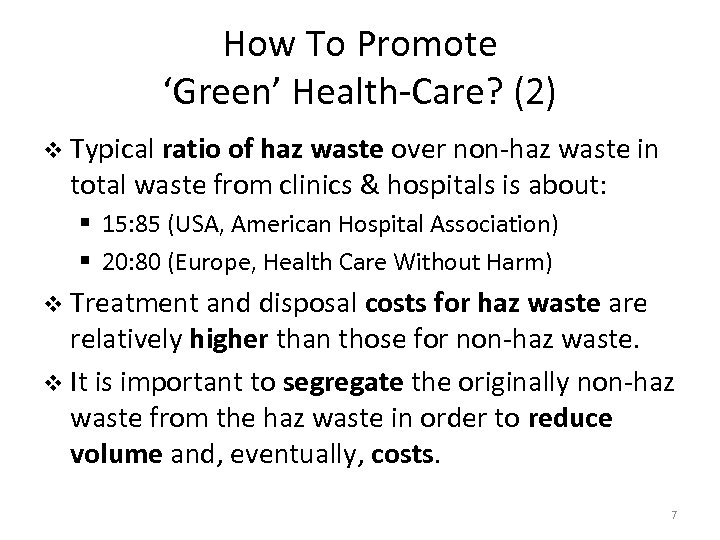
How To Promote ‘Green’ Health-Care? (2) v Typical ratio of haz waste over non-haz waste in total waste from clinics & hospitals is about: § 15: 85 (USA, American Hospital Association) § 20: 80 (Europe, Health Care Without Harm) v Treatment and disposal costs for haz waste are relatively higher than those for non-haz waste. v It is important to segregate the originally non-haz waste from the haz waste in order to reduce volume and, eventually, costs. 7
How To Promote ‘Green’ Health-Care? (3) v It is important for investors to ensure that the management take all Occupational Health & Safety and Environmental issues be addressed at all stages of activity. § § Planning Construction Operation Closure v Make use of available standards, guidelines, best managemen practices such as those of the Basel Convention. 8
BASEL CONVENTION AT A GLANCE v Basel Convention (BC) on the control of transboundary movement of hazardous wastes and their disposal § The most comprehensive global environmental agreement on hazardous and other wastes § Adopted on 22 March 1989 in Basel, Switzerland § Entered into force on 5 May 1992, currently >170 Parties § Governed by Conference of Parties (COP), the last COP theme was “Waste Management for Human Health and Livelihood” at which the “Bali Declaration” was launched (refer to brochures) v Main Goal § To protect, by strict control, human health and the environment against the adverse effects which may result from the generation and management of hazardous wastes and other wastes 9
Basel Convention at a Glance (2) v Mechanism for Achieving the Goal § The control of the transboundary movement of hazardous wastes and other wastes § Environmentally Sound Management (ESM) of hazardous wastes and other wastes v v ESM means addressing the waste management issue through strict controls from the generation of a hazardous waste to its storage, transport, treatment, reuse, recycling, recovery and final disposal The Secretariat of the Basel Convention (SBC) facilitates Parties in the development of a range of projects, guidelines, mechanisms and strategies for minimizing wastes and ensuring their ESM, incl. the BM&HC waste 10
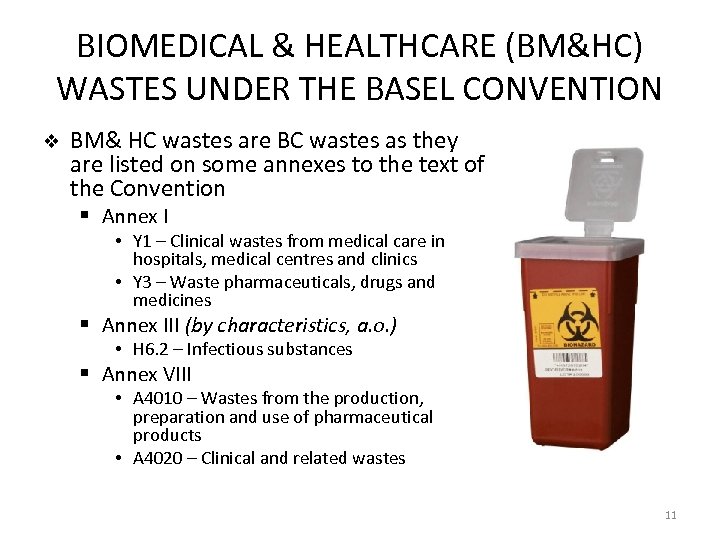
BIOMEDICAL & HEALTHCARE (BM&HC) WASTES UNDER THE BASEL CONVENTION v BM& HC wastes are BC wastes as they are listed on some annexes to the text of the Convention § Annex I • Y 1 – Clinical wastes from medical care in hospitals, medical centres and clinics • Y 3 – Waste pharmaceuticals, drugs and medicines § Annex III (by characteristics, a. o. ) • H 6. 2 – Infectious substances § Annex VIII • A 4010 – Wastes from the production, preparation and use of pharmaceutical products • A 4020 – Clinical and related wastes 11
BC TECHNICAL GUIDELINES (TGs) FOR BM&HC WASTE MANAGEMENT v v One of the TGs provided to Parties as a tool for managing the BM&HC waste which is classified as hazardous wastes under the BC. Basis: § National guidelines from developed and developing countries; § Publication from WHO (World Health Organisation); § Paper by CEN (European Committee for Standardisation) v To be used with other considerations, esp. : § TGs for Incineration on Land; § TGs for Specially Engineered Landfill; § Legal frameworks and responsibilities of relevant CAs. 12
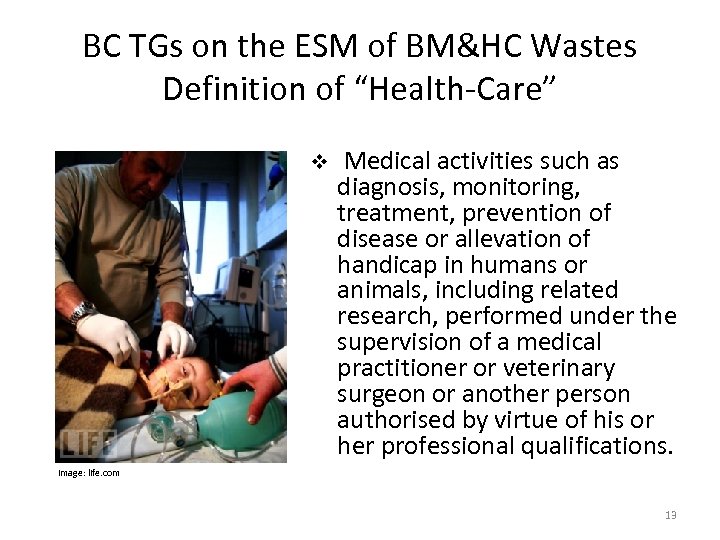
BC TGs on the ESM of BM&HC Wastes Definition of “Health-Care” v Medical activities such as diagnosis, monitoring, treatment, prevention of disease or allevation of handicap in humans or animals, including related research, performed under the supervision of a medical practitioner or veterinary surgeon or another person authorised by virtue of his or her professional qualifications. Image: life. com 13
BC TGs on the ESM of BM and HCW Contents (for details, please refer to http: //www. basel. int/pub/techguid/tech-biomedical. pdf) v v v v v Introduction Purpose and scope of the guidelines General definition of biomedical and health-care waste Hazards of biomedical and health-care waste Field of application/source identification Waste identification and classification/waste groups Applicable state-of-the-art management, treatment and disposal technologies Waste management auditing Capacity-building Annexes 14
THANK YOU For Further Information on Biomedical & Health-Care Waste Management Programme: SECRETARIAT OF THE BASEL CONVENTION International Environment House 15 Chemin des Anémones Chatelaine CH-1219 Geneva, Switzerland Website: www. basel. int E-mail: sbc@unep. org, dadan. wardhana@unep. org
Скачать презентацию PREVENTING DISEASE THROUGH SAFE WASTE MANAGEMENT A Contribution
937a40c0c001a8f72efbc23f7b984280.ppt