 Скачать презентацию PREVALENCE AVAILABILITY AND ACCESSABILITY OF IUD IN HUNGARY
e578875e18c541eaf08d748a2376287c.ppt
- Количество слайдов: 12



PREVALENCE, AVAILABILITY AND ACCESSABILITY OF IUD IN HUNGARY I. Batár Department of Obstetrics and Gynecology University of Debrecen, Hungary 7 th ESC SEMINAR, September 12 - 13, 2003 Budapest, Hungary Sept 2003 I. B. * 7 th ESC Seminar, Budapest 1
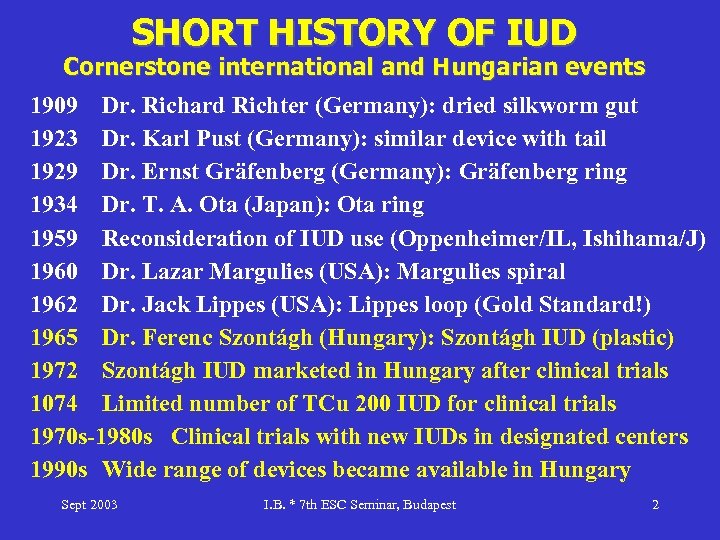
SHORT HISTORY OF IUD Cornerstone international and Hungarian events 1909 Dr. Richard Richter (Germany): dried silkworm gut 1923 Dr. Karl Pust (Germany): similar device with tail 1929 Dr. Ernst Gräfenberg (Germany): Gräfenberg ring 1934 Dr. T. A. Ota (Japan): Ota ring 1959 Reconsideration of IUD use (Oppenheimer/IL, Ishihama/J) 1960 Dr. Lazar Margulies (USA): Margulies spiral 1962 Dr. Jack Lippes (USA): Lippes loop (Gold Standard!) 1965 Dr. Ferenc Szontágh (Hungary): Szontágh IUD (plastic) 1972 Szontágh IUD marketed in Hungary after clinical trials 1074 Limited number of TCu 200 IUD for clinical trials 1970 s-1980 s Clinical trials with new IUDs in designated centers 1990 s Wide range of devices became available in Hungary Sept 2003 I. B. * 7 th ESC Seminar, Budapest 2
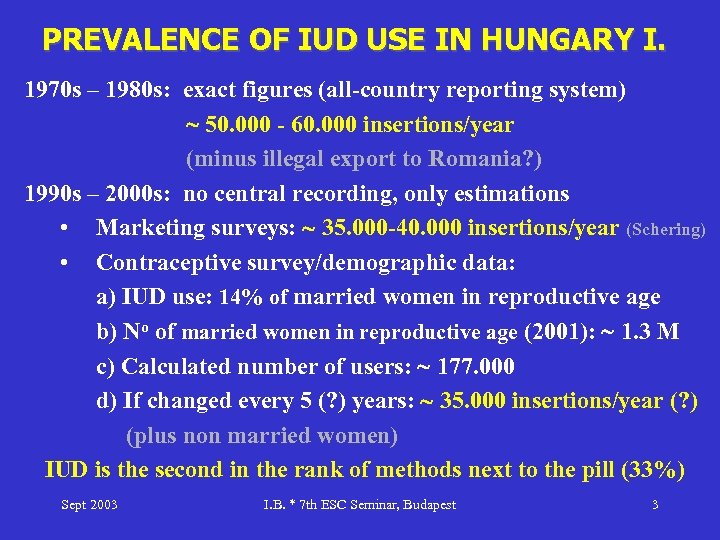
PREVALENCE OF IUD USE IN HUNGARY I. 1970 s – 1980 s: exact figures (all-country reporting system) 50. 000 - 60. 000 insertions/year (minus illegal export to Romania? ) 1990 s – 2000 s: no central recording, only estimations • Marketing surveys: 35. 000 -40. 000 insertions/year (Schering) • Contraceptive survey/demographic data: a) IUD use: 14% of married women in reproductive age b) No of married women in reproductive age (2001): 1. 3 M c) Calculated number of users: 177. 000 d) If changed every 5 (? ) years: 35. 000 insertions/year (? ) (plus non married women) IUD is the second in the rank of methods next to the pill (33%) Sept 2003 I. B. * 7 th ESC Seminar, Budapest 3
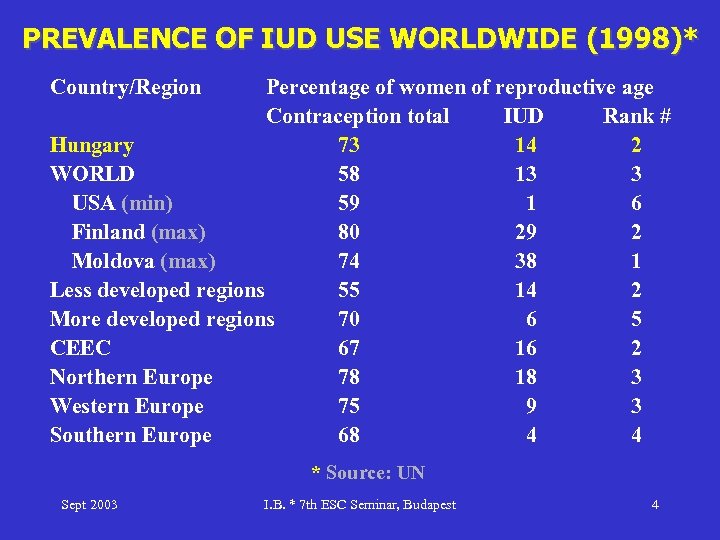
PREVALENCE OF IUD USE WORLDWIDE (1998)* Country/Region Percentage of women of reproductive age Contraception total IUD Rank # Hungary 73 14 2 WORLD 58 13 3 USA (min) 59 1 6 Finland (max) 80 29 2 Moldova (max) 74 38 1 Less developed regions 55 14 2 More developed regions 70 6 5 CEEC 67 16 2 Northern Europe 78 18 3 Western Europe 75 9 3 Southern Europe 68 4 4 * Source: UN Sept 2003 I. B. * 7 th ESC Seminar, Budapest 4
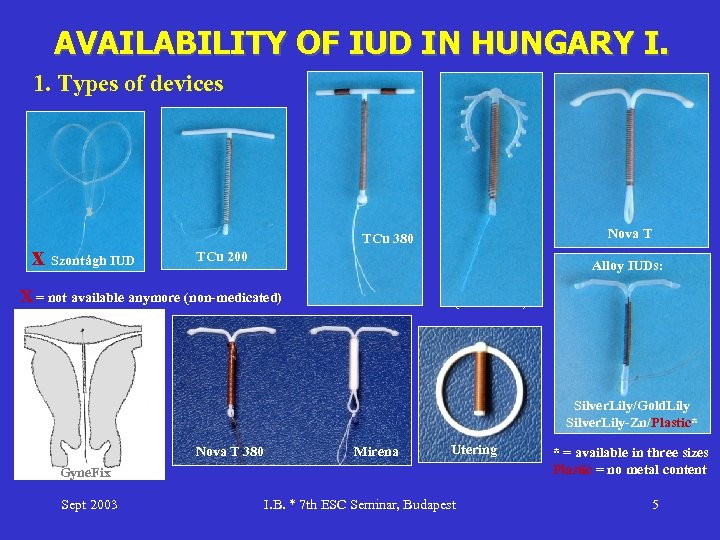
AVAILABILITY OF IUD IN HUNGARY I. 1. Types of devices x Szontágh IUD Nova T TCu 380 TCu 200 Alloy IUDs: MLCu 250/375 (Mona Lisa) X = not available anymore (non-medicated) Silver. Lily/Gold. Lily Silver. Lily-Zn/Plastic* Nova T 380 Mirena Utering Gyne. Fix Sept 2003 I. B. * 7 th ESC Seminar, Budapest * = available in three sizes Plastic = no metal content 5
AVAILABILITY OF IUD IN HUNGARY II. 2. Where to get it? • pharmacies (Mirena is exclusively available here) • company sales (directly or through distributors) • physician’s office (mainly in private praxis) 3. When to insert? • interval (usually on cycle days 1 -7) • post abortion (not everywhere accepted) • post partum (6 -8 weeks following delivery) • post placental (limited number of cases in clinical trials; no suitable devices are available) • post coital (emergency contraception: not well known) Sept 2003 I. B. * 7 th ESC Seminar, Budapest 6
ACCESSABILITY OF IUD IN HUNGARY I. 1. Legal restrictions • nulligravidas (sometimes neglected) • only gynecologists are allowed to insert • insertion in centers with lying-in background (? ) (nowadays neglected) Sept 2003 I. B. * 7 th ESC Seminar, Budapest 7
ACCESSABILITY OF IUD IN HUNGARY II. 2. Medical (ob/gyn) limitations • „optimal for those with completed family size” • „suggested after the second child” • side effects/problems are more publicized than benefits • not widely known as emergency contraception Sept 2003 I. B. * 7 th ESC Seminar, Budapest 8
ACCESSABILITY OF IUD IN HUNGARY III. 3. Financial limitations • not subsidized by the health insurance (since 1993) • high price (compared to salary; the cheapest!) • not exempted for VAT (12% 25%!) “punishment” instead of support • indirect effect (IUD use has not been a medical indication for abortion since 1993) Sept 2003 I. B. * 7 th ESC Seminar, Budapest 9
CONCLUSIONS I. • Hungary was pioneer for IUD use in the 1960 s, and has a good position even nowadays as for inventions (see alloy devices) • Prevalence: although acceptable (14%), but it could further be increased through eliminating or decreasing the restrictive and limiting factors Sept 2003 I. B. * 7 th ESC Seminar, Budapest 10
CONCLUSIONS II. • Availability: - market has a wide choice of IUDs, but new types are welcomed - devices are easy to get (pharmacies, clinics) - positive attitude needs to be increased (correct information, postabortal insertion, emergency contraception) Sept 2003 I. B. * 7 th ESC Seminar, Budapest 11
CONCLUSIONS III. • Accessibility: - eliminating legal restrictions (gravidity/parity, who/where to insert) - decreasing medical barriers through CME - modifying health care, social and taxation policy to reduce prices Sept 2003 I. B. * 7 th ESC Seminar, Budapest 12
Скачать презентацию PREVALENCE AVAILABILITY AND ACCESSABILITY OF IUD IN HUNGARY
e578875e18c541eaf08d748a2376287c.ppt