 Скачать презентацию Preterit-present verbs Presented by Mishonova and Diachkina УТ-13
preterit-present verbs.ppt
- Количество слайдов: 13



Preterit-present verbs Presented by Mishonova and Diachkina УТ-13 -01
Preterit-present verbs The so-called preterite-present verbs are a small group of anomalous verbs in the Germanic languages in which the present tense shows the form of the strong preterite.
Explanation Some Germanic verbs underwent a shift whereby their strong preterite-tense forms became reinterpreted as their present-tense forms. New "weak" endings were then used to form the new preterite tense. The present tenses of these verbs therefore resemble the preterite tense forms of strong verbs, below.
Source The perfect of Indo-European originally signified a current state of being rather than any particular tense; in the sense that the preterite-present verbs are non-past and still largely signify current states (temporalized as present tense), they constitute a partial retention of the originally non-past perfect of Indo-European.
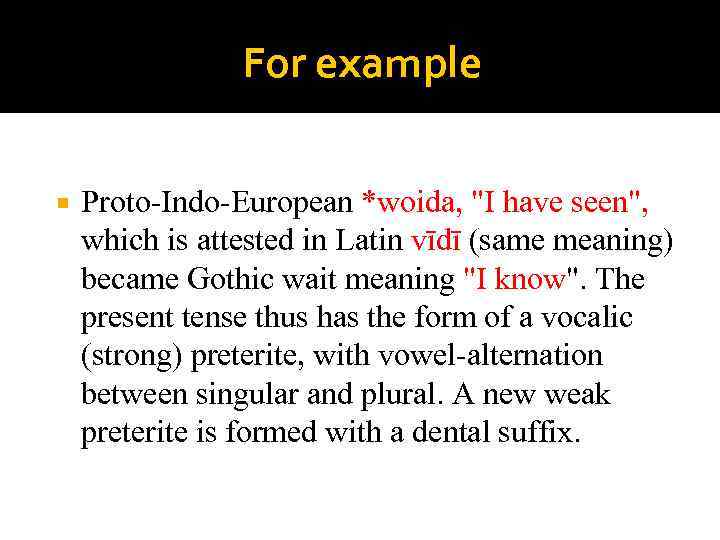
For example Proto-Indo-European *woida, "I have seen", which is attested in Latin vīdī (same meaning) became Gothic wait meaning "I know". The present tense thus has the form of a vocalic (strong) preterite, with vowel-alternation between singular and plural. A new weak preterite is formed with a dental suffix.
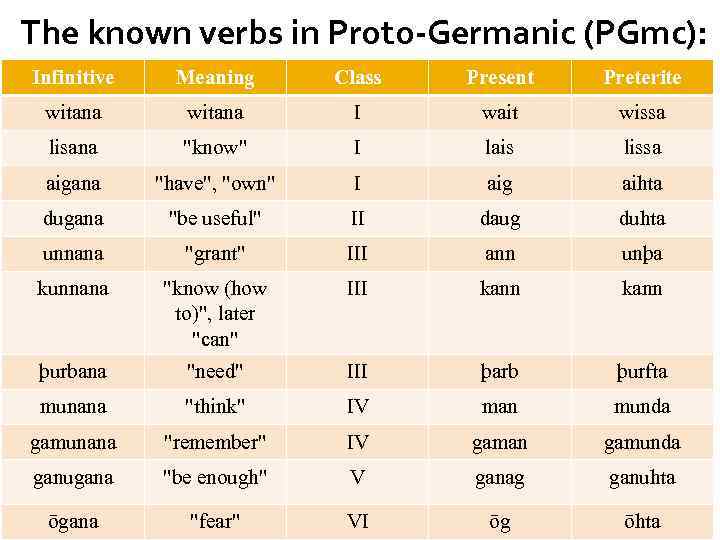
The known verbs in Proto-Germanic (PGmc): Infinitive Meaning Class Present Preterite witana I wait wissa lisana "know" I lais lissa aigana "have", "own" I aig aihta dugana "be useful" II daug duhta unnana "grant" III ann unþa kunnana "know (how to)", later "can" III kann þurbana "need" III þarb þurfta munana "think" IV man munda gamunana "remember" IV gaman gamunda ganugana "be enough" V ganag ganuhta ōgana "fear" VI ōg ōhta
Ablaut The present tense has the form of a vocalic (strong) preterite, with vowel-alternation between singular and plural. A new weak preterite is formed with a dental suffix. The root shape of the preterite (in zero-grade) serves as the basis for the infinitive and past passive participle.
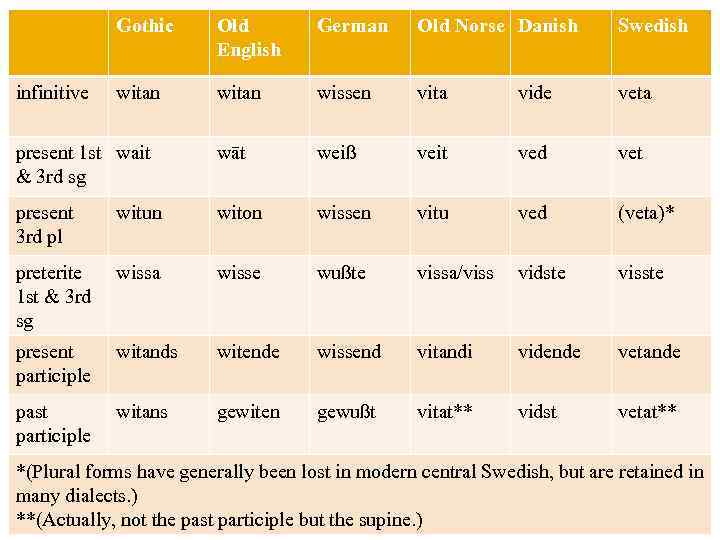
Gothic Old English German Old Norse Danish Swedish witan wissen vita vide veta present 1 st wait & 3 rd sg wāt weiß veit ved vet present 3 rd pl witun witon wissen vitu ved (veta)* preterite 1 st & 3 rd sg wissa wisse wußte vissa/viss vidste visste present participle witands witende wissend vitandi vidende vetande past participle witans gewiten gewußt vitat** vidst vetat** infinitive *(Plural forms have generally been lost in modern central Swedish, but are retained in many dialects. ) **(Actually, not the past participle but the supine. )
Personal endings For the most part, the personal endings of the strong preterite are used for the present tense. In West Germanic the endings of the present tense of preterite-present verbs represent the original IE perfect endings better than that subgroup's strong preterite verbs do. The endings of the preterite (except for *kunnana) are the same as the endings of the first weak class.
Subsequent developments In modern English, preterite-present verbs are identifiable by the absence of an -s suffix on the 3 rd person singular present tense form, for instance, he can with he sings (pret. he sang); the present paradigm of can is thus parallel with the past tense of a strong verb.
Subsequent developments In modern German there is also an ablaut shift between singular ich kann (I can) and plural wir können (we can). In the older stages of the Germanic languages (Old English, Middle High German) the past tense of strong verbs also showed different ablaut grades in singular and plural.
Subsequent developments Many of the preterite-present verbs function as modal verbs (auxiliaries which are followed by a bare infinitive, without "to") and indeed most of the traditional modal verbs are preteritepresents. Examples are English must and shall/should, German dürfen (may), sollen (ought), mögen (like), and müssen (must).
Thank you for your attention!
Скачать презентацию Preterit-present verbs Presented by Mishonova and Diachkina УТ-13
preterit-present verbs.ppt