


 Скачать презентацию Presidential Progressivism The legacy of Theodore Roosevelt 1858
befaf072e63a2fc567e2c676a3260735.ppt
- Количество слайдов: 38
 Presidential Progressivism The legacy of Theodore Roosevelt, 1858 -1919 By Jeremy Lewis, Ph. D, for Dean Fedler’s Colloquy, Huntingdon College, 15 Feb. 2010
 What shaped the young “Teedy”? n n Childhood asthma, young man with heart problems Studied natural history at home n n But unbalanced home curriculum Civil war? n Father supported Lincoln n Mother Southern belle, GA plantation n n Switched from Democrat to Republican Young TR observed Lincoln’s funeral 2 of TR’s uncles in Confederate navy Happy childhood in close family
 Reasons to see TR as hypermasculine model? n n Harvard: rower, boxer, DKE, Porcellians, magazine Adult sports, risk taking: n n Dakota cowboy, rough rider, deputy sheriff, captured 3 thieves alone Expeditions in Africa, Latin America n n n n n boxing, tennis, hiking, rowing, polo, horseback riding, singlestick and judo Shot big game, including elephants Explored Rio Roosevelt, almost at cost of life “Bully!” Left Columbia law school to run for NY assembly Completed 90 minute speech after being shot in chest Took up judo after he lost retina to boxing Wrote 18 books, mostly on war and outdoorsman skills Honored for support of Boy Scouts Skinny dipped in Potomac, regularly Argued frontier had created a new “race” of assimilated Americans But praised ‘both masculine and feminine’ qualities in Thee n n TR wrote many tender letters TR read 4 books a day, in multiple languages
 How was “Teddy” shaped by loss? n Close to Thee, father, who consoled and strengthened him n n Alice, first wife, re-nicknamed him n n Deeply bereaved Alice died of kidney failure in childbirth TR, grieving, never mentioned her again Dropped from Episcopalian Sunday school for rewarding a fighting boy Lost herd in SD, came 3 rd for Mayor of NYC n Remarried Ethel, summitted Mont Blanc, had 5 kids
 How did “Teddy” develop his early career? n n 1880 Graduated from Harvard U, PBK 1882 book, The Naval War of 1812 1882 -4 NY Assemblyman, energetic reformer 1884 R national convention, Mugwumps v. Stalwarts n n TR neither for Blaine (R) nor Cleveland (D) 1884 -87 deputy sheriff in Badlands, till lost stock 1887 Oyster Bay, NY, but ‘cowboy’ only 3 rd for Mayor Climbed Mont Blanc, fellow of Royal Society
 Roosevelt’s national career n 1888 -1895 Civil Service Commissioner, vigorously pro-merit n n n 1895 -97 NY police commissioner (anti-corrupt’n) 1897 -98 Asst Sec US Navy, but resigned for … 1898 Spanish war, Rough Riders cavalry Kettle & San Juan Hill assault, despite malaria n n Appointed by Harrison (R) and then Cleveland (D) Medal of Honor disapproved (till 2001) 1899 -1900 Gov. of NY, then campaigned VP
 What provoked the progressive movement? n Reaction to large organizations: n n n 1883 Pendleton Act, merit-based service Muck-raking journalism exposed: n n n monopolies, labor unions, boss-machine system Child labor, meat packing, plundering public lands, newly rich and powerful, corrupt police, brothels Indignation of new, professional, middle class 1896, conflictual, sectional election: n Mc. Kinley N+E, Bryan S+W (Burns, 1978, 198)
 How did TR ascend to the Presidency? n n Boss Platt foisted TR on Mark Hanna, as VP 1900 landslide re-election of Mc. Kinley over Bryan n n Gold std & prosperity, victory v. Free silver TR defended Philippine colony March-Sep 1901, VPUS , for Mc. Kinley (R) Sep 1901 Assassination of Mc. Kinley n n n VP TR became youngest POTUS, at 42 Continued cabinet and policies (Cowboy quote, consultant Mark Hanna)
 TR’s first term, 1901 -05 n 1902, UMW PA coal strike settled n n n Newlands conservation Act (taxes to regulate land developm’t) E. O. s for parks & forests 1903 Dept of Commerce & Labor 1904 Court upheld Sherman Act v. Northern Securities Foreign Policy n n n 1902 Cuban Republic recognized w/ sugar imports Venezuelan debts settled (with Europeans) Got Panama Canal zone; settled Alaska boundary Immigration Act banned anarchists 1904 TR corollary to Monroe doctrine
 TR’s second term, 1905 -09 n 1904 Landslide re-election, 7. 5 M – 5 M votes n n n n Foreign policy: n n n 1906 Meat Inspection Act; Pure Food and Drug Act 1906 Hepburn Act, strengthened ICC; “Square Deal” – but negotiated with JP Morgan in 1907 panic 1909 first narcotic prohibition West wing; WH press room and press conferences Appointed record 75 federal judges, including 3 SCt TR’s corollary to Monroe Doctrine, US to "exercise international policy power" to help small Latin countries Russo-Japanese peace treaty & Nobel peace prize 1907 Gentleman’s Agreement with Japan (immigration) Sent Great White Fleet around world, without Congress 1909 retired, supporting Taft over VP Fairbanks
 TR’s Post-presidency, 1909 -11 n African safari (Modern) Kenya, Congo, Sudan n 11, 397 animals, 591 big game n Social as well as scientific n n Taft’s moderation split R party Less trust-busting rhetoric, but legislation n Compromised on lowering tariffs n Preferred judicial solutions n La. Follette formed Progressive R League n
 TR rides again: 1912 n n n n Taft had rolled up R support during 1911 La. Follette suffered nervous breakdown TR picked up progressives’ support TR campaigned against judiciary TR won public + some of new primaries Taft won most caucus and convention votes TR exited, to create Progressive party
 What did TR’s Progressive Party stand for? n n “Healthy as a Bull Moose” [personal faction] Democratization and purification of party (Burns) n n Against regional monopolies of party (Burns) n n n n Onward Christian Soldiers & TR’s Confession of Faith (Link, 16) More democracy Direct primary election Initiative, recall, referendum Removal of straight ticket box Non-partisan ballot Personal factions or responsible parties? Urge to rise above self-interest for societal good (Hof. ) Divided between anti-organization and building counterorganizations (Hofstadter)
 How can we judge success of reform? n Reform leaders always torn between Transformational ideas [TR, WW, Obama? ] and n Transactional process [FDR, LBJ, WJC] n (Burns, 1978, 200) Expression of ideas versus achievements q Preparation, achievement, consolidation q q Achievements compared to political support (Hargrove and Nelson, 1984)
 What were TR’s achievements in office, 1901 -1909? n n n n Trust-busting (first address to Congress) Increased regulation of businesses "Square Deal" domestic agenda for average citizen Promoted the conservation movement "Speak softly and carry a big stick” Completed Panama Canal Sent ‘Great White Fleet’ Negotiated end to Russo-Japanese War n won the Nobel Peace Prize
 Was TR really a reformer? “TR was keeping one foot in the ranks of the old guard, the other in the reform movement. He was impartial at least in his hatreds: hardly a day passed that he did not rail at the mossbacks among the old guard or at the fools and idiots among the reformers, and he played each off against the other. ” (Burns, JM, 1978, 195)
![Was TR really a reformer? (2) “Although by [1910] Roosevelt had committed himself to](https://present5.com/presentation/befaf072e63a2fc567e2c676a3260735/image-17.jpg "Was TR really a reformer? (2) “Although by [1910] Roosevelt had committed himself to") Was TR really a reformer? (2) “Although by [1910] Roosevelt had committed himself to the progressive cause, he tried hard to maintain an air of impartiality, and he labored sincerely during the fall of 1910 to bring the warring factions together…. But [in NY] Taft had … aligned himself with the reactionary bosses in the state. Rebuffed and resentful, Roosevelt … amid wildly cheering crowds [in the West] enunciated the … New Nationalism. ” (Link, 1954, 6)
Was TR really a reformer? (2) “Although by [1910] Roosevelt had committed himself to the progressive cause, he tried hard to maintain an air of impartiality, and he labored sincerely during the fall of 1910 to bring the warring factions together…. But [in NY] Taft had … aligned himself with the reactionary bosses in the state. Rebuffed and resentful, Roosevelt … amid wildly cheering crowds [in the West] enunciated the … New Nationalism. ” (Link, 1954, 6)
 TR & Taft agreed on reform, but differed on role of President n n What to do when powers of Constitution do not give clear answer? Federal land purposes case, Sec. of Interior n n n TR: Stewardship theory n n n “protecting the public domain” Forestry, irrigation, water power or other … act for people, unless Constitution forbids Match for his vigorous character Taft: Restricted theory n n judiciary limits the presidency Match for his agreeable character
 TR’s Stewardship Theory “I did not usurp power, but I did greatly broaden the use of executive power. In other words, I acted for the public welfare, I acted for the common well-being of all our people, … unless prevented by direct constitutional or legislative prohibition…. ” [Rationalized as Jackson-Lincoln view] (Autobiography of TR, p. 197)
![Taft’s restricted theory: “[T]he president can exercise no power which cannot be reasonably and](https://present5.com/presentation/befaf072e63a2fc567e2c676a3260735/image-20.jpg "Taft’s restricted theory: “[T]he president can exercise no power which cannot be reasonably and") Taft’s restricted theory: “[T]he president can exercise no power which cannot be reasonably and fairly traced to some specific grant of power or justly implied and included … as proper and necessary to its exercise. ” [Rationalized as Madison or Buchanan view] (Taft, 1913, 138. )
Taft’s restricted theory: “[T]he president can exercise no power which cannot be reasonably and fairly traced to some specific grant of power or justly implied and included … as proper and necessary to its exercise. ” [Rationalized as Madison or Buchanan view] (Taft, 1913, 138. )
 Taft sided with reactionaries over insurgents n n 1909 TR installs Taft as successor, leaves on Safari 1909 -10 Taft upheld R old guard over insurgent reformers n n n n To keep House Speaker Cannon (R) In Senate, against HR’s lower tariff bill Summer: Taft booed by R across Mid. West 1909 -10 upheld Sec. Interior Ballinger over Pinchot & conservationists in irrigation of federal land Spring 1910, Taft sends money and orators to mid. West primaries to defeat R Progressives -- unsuccessfully reformers captured R in CA, WA & NH Taft’s machine defeated TR in NY convention 1910 elections, Dem landslide in Congress and Governors (Link, 1954, 6)
 TR forms Progressive party n TR returned from Africa, outraged by Taft’s devolution (Link), called for social reforms
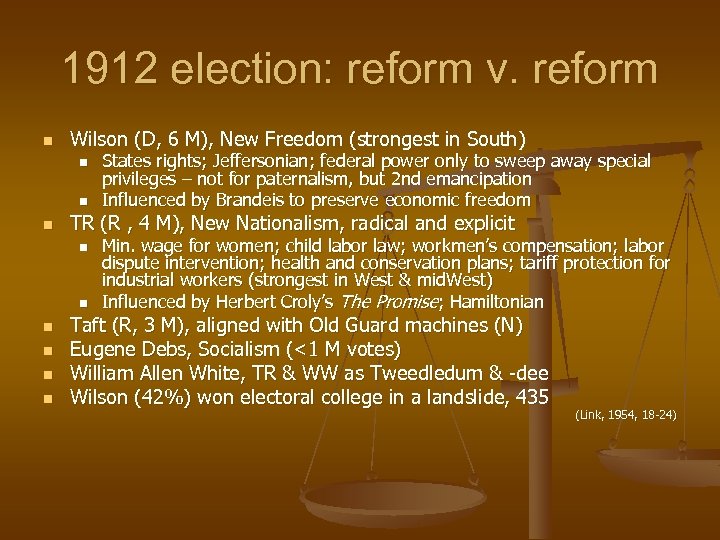 1912 election: reform v. reform n Wilson (D, 6 M), New Freedom (strongest in South) n n n TR (R , 4 M), New Nationalism, radical and explicit n n n States rights; Jeffersonian; federal power only to sweep away special privileges – not for paternalism, but 2 nd emancipation Influenced by Brandeis to preserve economic freedom Min. wage for women; child labor law; workmen’s compensation; labor dispute intervention; health and conservation plans; tariff protection for industrial workers (strongest in West & mid. West) Influenced by Herbert Croly’s The Promise; Hamiltonian Taft (R, 3 M), aligned with Old Guard machines (N) Eugene Debs, Socialism (<1 M votes) William Allen White, TR & WW as Tweedledum & -dee Wilson (42%) won electoral college in a landslide, 435 (Link, 1954, 18 -24)
 What are the elements of TR’s legacy? n n First attempted activist, modern presidency First press conferences, WH press corps n n n n n 1912, among first recorded speeches character as campaign issue trust-busting and regulation conservationism interventionism and imperialism Renovated but split Republican party Created personal faction – but not a true Progressive party Race relations: dinners with BTW, manservant – but TX troops Personal n n n Teddy bear TR jr’s Medal of Honor, D-Day Inspiration to Franklin
 Themes of TR’s legacy that cascade on recent presidencies? n n n Populist campaign against Trusts Environmental awareness New forms of party and faction At ease with race relations (BTW) Vigor and optimism, active-positive ‘both masculine and feminine’ qualities? n Sporting and family man?
 How do political historians rank TR? n 1948, 1962 and subsequent polls: n n n Best: George Washington, Abraham Lincoln, and Franklin D. Roosevelt Close: Thomas Jefferson and Theodore Roosevelt Also Top 10: James Madison, Andrew Jackson, James K. Polk, Woodrow Wilson, and Harry S. Truman. Worst: Millard Fillmore, Franklin Pierce, James Buchanan, Andrew Johnson, and Warren G. Harding. Are political historians biased by ideology? n n Polls show few differences (except over W. Bush) (See tables of historians and public polls compiled in Diclerico (1995) or at WKP)
 How does the public rank TR? n Public ranks TR slightly higher (some in top 5) n Public opinion polls since 1960 s n n than do political historians (between 5 and 10) n Since Schlesingers, 1948 and 1962 n
 How could political historians begin to categorize presidents? n Satan, Savior, Samson or Seraph? Schlesinger’s biographies of Jackson, FDR & Kennedy (portrayed as saviors? ) n after LBJ & RMN: Schlesinger, “imperial presidency” n Cronin, paradoxes of presidency n Hodgson, expectations excessive n Then Reagan exceeded expectations … n
 How does the public approve presidential performance? n n Approval in office starts well above vote % First year: eroded to 60% (Bushes) n n n Lose 6 points per year in approval Bump 10 -20% in foreign /military crisis n n n 50 s% others – but 49% Obama H. Bush 84%, W. Bush 90%, a record Drop 10 -20 % in scandal, or slowly in weakness Lows during economic stagnation (JEC 19%) Re-election boost But always 6 points above the wretched Congress (low 13%)
 How do journalists evaluate presidents? n Study 1948 -78 of Time & NY Times: n n n CBS news: 6 x favorable stories Nixon claimed bias against n n n 34 x favorable stories on presidents But he also had hugely favorable balance Cycles of honeymoon, adversarial & disengagement phases (Grossman & Kumar) Post Watergate: distrust of authority, institutions and presidents
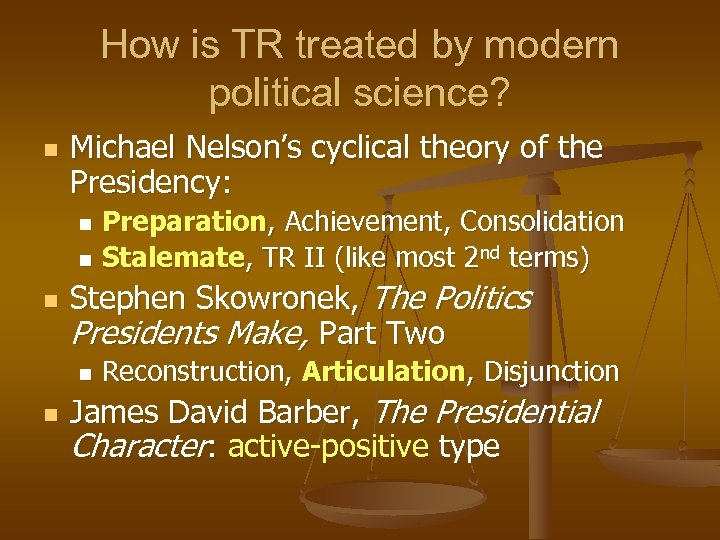 How is TR treated by modern political science? n Michael Nelson’s cyclical theory of the Presidency: Preparation, Achievement, Consolidation n Stalemate, TR II (like most 2 nd terms) n n Stephen Skowronek, The Politics Presidents Make, Part Two n n Reconstruction, Articulation, Disjunction James David Barber, The Presidential Character: active-positive type
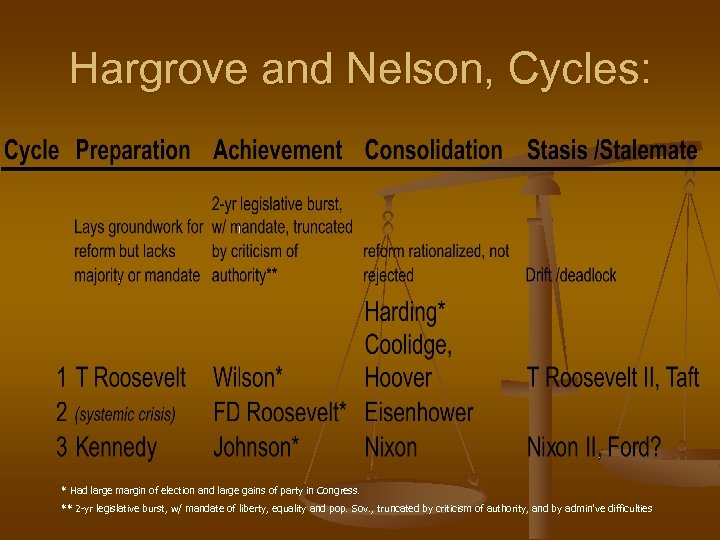 Hargrove and Nelson, Cycles: * Had large margin of election and large gains of party in Congress. ** 2 -yr legislative burst, w/ mandate of liberty, equality and pop. Sov. , truncated by criticism of authority, and by admin've difficulties
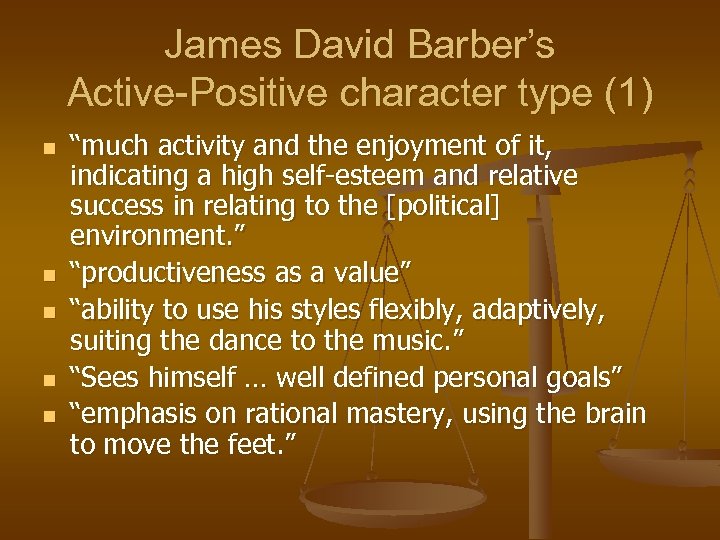 James David Barber’s Active-Positive character type (1) n n n “much activity and the enjoyment of it, indicating a high self-esteem and relative success in relating to the [political] environment. ” “productiveness as a value” “ability to use his styles flexibly, adaptively, suiting the dance to the music. ” “Sees himself … well defined personal goals” “emphasis on rational mastery, using the brain to move the feet. ”
 James David Barber’s Active-Positive character type (2) n But “he may fail to take account of the irrational in politics. ”
 James David Barber’s other character types (ch. 1) n n n Active-Negative: intense effort with low emotional reward. Compulsive, ambitious, aggressive, struggling, hampered by criticism Passive-Positive: receptive, compliant, searching for affection by being agreeable and cooperative. Low self-esteem with superficial optimism. Passive-Negative: low self-esteem doing useless service, but called by duty & civic virtue
 Barber’s types among the first four Presidents (ch. 1) n n n Washington: aloof, dignified, fits passivenegative John Adams: irascible, partisan, fits activenegative Jefferson: Reasoned, adaptable, fits activepositive Madison: irresolute, compromiser, compliant, fits passive-positive President is “a man with a memory in a system with a history”
 Limits of psychological analysis “For a mentally unbalanced person, Wilson had a remarkable career. Somehow he managed to make distinguished contributions to four separate fields of scholarship, higher education, domestic politics and diplomacy. ” -- Arthur Link [sarcastically] Quoted by Barber, ch. 2
 Selected Sources n n n Abrams, Richard. 1984. “Theodore Roosevelt” in Henry Graff ( ed) The Presidents, pp. 385 -411. Barber, James David. 1985. The Presidential Character. Bailey, Harry (ed). 1980. Classics of the American Presidency. Bose, Meena (ed). 2009. The NY Times on the Presidency, 1853 - 2008. Burns, James Mc. Gregor. 1978. Leadership. Diclerico, Robert. 1995. The American President. Hargrove, Erwin and Michael Nelson. 1984. Presidents, Politics and Policy. Link, Arthur. 1954. Woodrow Wilson and the Progressive Era. Mowry, George. 1958. The Era of Theodore Roosevelt. Nelson, Michael (ed). 1984. The Presidency and the Political System. Skowronek, Stephen. 1997. The Politics Presidents Make. (This presentation did not use the Edmund Morris biography of TR. )