


 Скачать презентацию Presidential Election Process in the United States Stephen
2bee552f31eec06a162566ed4f0c95df.ppt
- Количество слайдов: 18
 Presidential Election Process in the United States Stephen Marty 28 May 2012
 Disclaimer
 Overview • • • Eligibility Candidate Nominations (Primaries) General Election Final Thoughts Questions
 Eligibility • U. S. Presidential Candidates Must Be – At least 35 years old – Born in the United States – Resident of the United States for at least 14 years • Normally Candidates – Have Served or are already serving in government • Vice President, U. S. House of Representatives, U. S. Senators, or State Governors • Former Military Officers • Usually wealthy or have the ability to raise money – – 2008 Obama raised~ $750 M Primary estimates $100+M Senate Race: ~$8. 5 M House Race: ~$2 M • US Presidents limited to a maximum of two 4 -year terms
 Candidate Nominations • Process: Primaries – Purpose: Voting for a candidate to represent the Republican and Democratic Parties – Rules governed by the political parties and individual state laws (not covered in the Constitution). Complex, varies from state to state, each election year – Two Parts: • Individual State Primaries: January to July. Determine the number of delegates each candidate receives • Republican and Democratic Nominating Conventions: August/September: Candidates chosen
 Candidate Nominations • Two types of delegates: – Pledged (or Bound): Must vote for the candidate determined at the primary/caucus vote – Unpledged (or Super-Delegates): Free to vote for any candidate they choose at the convention – Normally current and former elected officials and party leaders – Democrats have more super-delegates • Voting in primaries can be: – Proportional: A candidate wins a percent of delegates based upon the percent of the popular vote they receive – Winner take all: Winner of the popular vote gets all the delegates – Closed: only voters registered with a party can vote in that party’s primary – Semi-closed: independent voters can chose any party’s primary – Open: any voter may vote in any party’s primary • (most states are closed or semi closed)
 Candidate Nominations • Primaries are staggered by state, instead of all at once – Iowa always 1 st followed by New Hampshire • Advantage: Candidates can concentrate their resources in each state, meet with individuals, communities, corporations • Disadvantage: States who hold primaries later in the season are at a disadvantage because the races are normally over by that time. Thus, more states vie for earlier primaries to claim a greater influence in the outcome • In order to win the primary a candidate needs a majority of their party’s delegates (51%) – Winner determined at the party conventions (Aug/Sep) – 2012 Primary: • Republicans need 1, 144 delegates (Romney) • Democrats 2, 025 delegates (Obama) – Once candidate is selected, they announce their running mate for Vice President. This forms the Presidential team or “ticket”
 Candidate Nominations • Important notes about primaries – Choice of Vice President is very important • Highlight/compliment the candidates strengths/weakness • 2008 perfect example (Joe Biden & Sarah Palin). – Incumbents: Presidents seeking re-election normally face little to no opposition during primary. • Franklin Pierce, in 1857, was the only elected and sitting President to loose the nomination of his party • 2012 Obama won easily – Primary’s normally focused on the core base of each party’s ideals – Unlike the general election, voters in the U. S. territories participate (e. g. , Guam, Puerto Rico, Virgin Islands, etc)
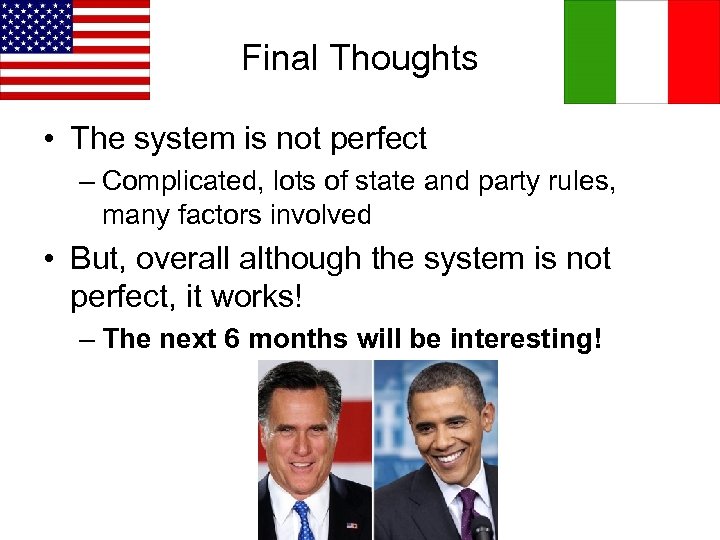
 General Election • Primaries concluded, candidates chosen – – 2012: Republicans Mitt Romney vs. Barack Obama Campaign/Debate until the general election day: • • • – Voting is not compulsory • • 6 November 2012 Not staggered like primaries U. S. territories excluded Min age 18, cannot be imprisoned or a convicted felon Foundation for general election: U. S. Constitution – – Designed to be a mixture of state-based and population-based government. Indirect Vote: • – Voters choose the electors, the electors vote for the candidates Establishes an Electoral College
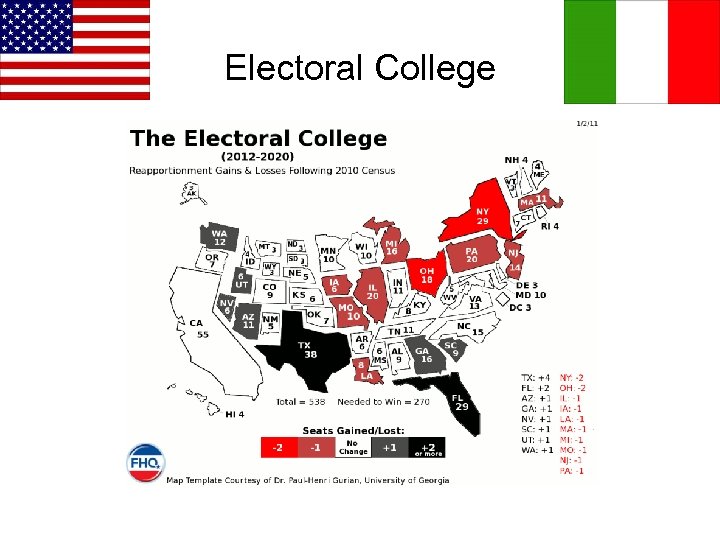
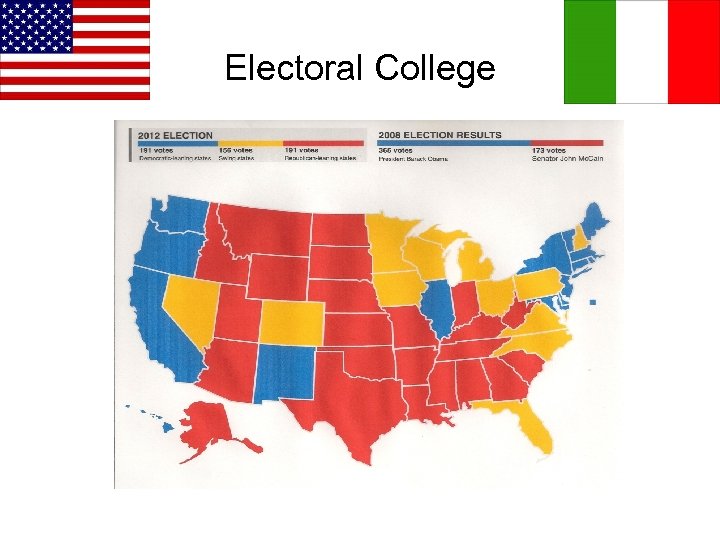
 General Election • Electoral College – Each state is given electors equal to the number of Senators (100) and Representatives (435) in the U. S. Congress. Washington, D. C. is given the number of electors equal to smallest state (3). – Total of 538 electors – Winner must receive 270 electoral votes
 General Election • Most states are winner take all – The President/Vice President team (or “ticket”) that gets the majority of the states votes (51%) receive all that state’s electoral votes – Maine and Nebraska exceptions • 2 electoral votes to the state winner, one to the winner of each congressional district (9 total) – Must have 270 to win • If 270 are not received the Presidency is decided by a vote of the House of Representatives & the Senate votes on the Vice President • Only happened twice (1800 & 1824), leading to Constitutional Amendments
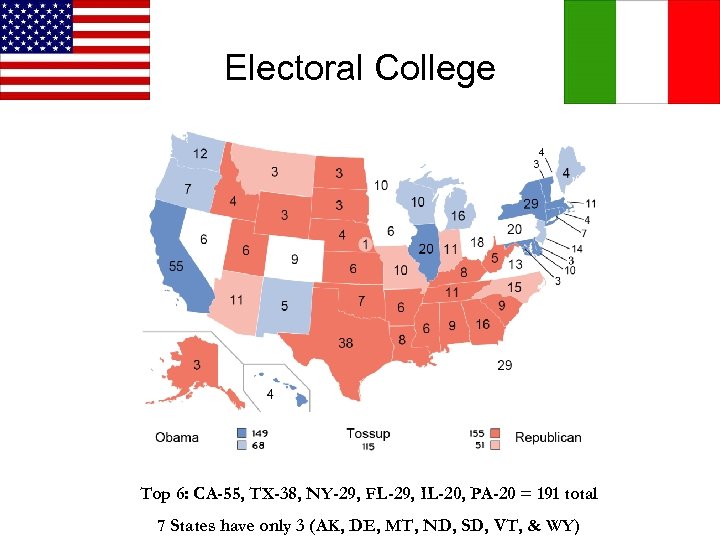 Electoral College Top 6: CA-55, TX-38, NY-29, FL-29, IL-20, PA-20 = 191 total 7 States have only 3 (AK, DE, MT, ND, SD, VT, & WY)
 Electoral College
 Electoral College
 Electoral College • Do not need popular vote to win – A candidate could lose the popular vote in 35+ states and still win – Rare • In 52 of 56 Presidential elections (93%) the winner has won the popular vote • Exceptions: – 2000 (George HW Bush vs. Al Gore) Bush lost the popular vote by 0. 5% (~500 k) but won the electoral college vote 271 -266 – Others: 1824 (Andrew Jackson), 1876 (Rutherford Hayes), 1888 (Grover Cleveland) – After the election, Congress confirms the vote and the President is inaugurated on 20 January 2013
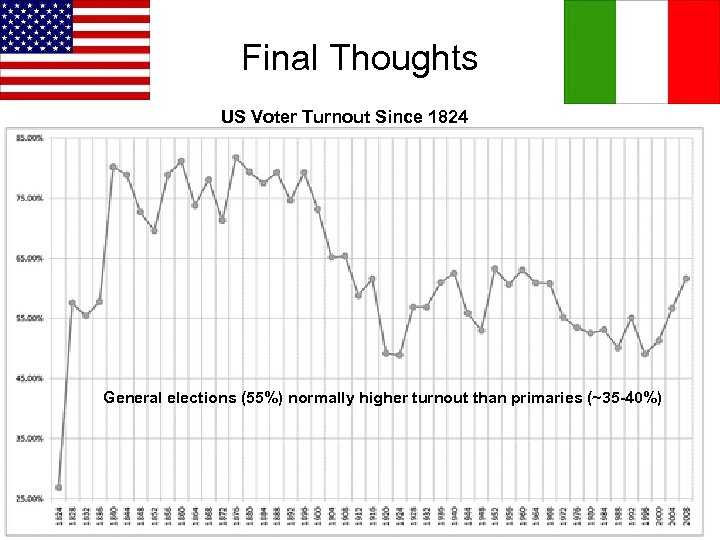 Final Thoughts US Voter Turnout Since 1824 • General elections (55%) normally higher turnout than primaries (~35 -40%)
 Final Thoughts • The system is not perfect – Complicated, lots of state and party rules, many factors involved • But, overall although the system is not perfect, it works! – The next 6 months will be interesting!
 Questions? ?