


 Скачать презентацию Presents C 4 Critical Care Crisis Communication
722d96997867a832a27218b95a066947.ppt
- Количество слайдов: 23
 Presents C 4 : Critical Care Crisis Communication A program for improving multi-directional team communication and crisis decision making skills Dr. Kenneth P. Green Commander, US Navy Naval Hospital, Jacksonville, FL & Managing Director Counte. Risk Technologies, Inc. Preconference Symposia 21 August 2005 THE QUALITY COLLOQUIUM Harvard University
 C 4: Critical Care Crisis Communication Personal background: Commander, United States Navy – Current assignment to the Naval Hospital at the Naval Air Station Jacksonville, Florida – Trained in Aviation Safety, Anesthesiology, Dentistry and Bioengineering – Original Navy career was as an Aerospace Physiologist and Aeromedical Safety Officer: • Human Factor Analysis of (US Navy) Aircraft Mishaps • Aircrew Coordination Instructor for Fighter Aircraft Aircrew / Helicopter Aircrews – Founder Counte. Risk Technologies, Inc. (January 2000) • Using aviation safety principles to train any team or group be it in aviation, medicine or business, in communication, decision making and mishap prevention. – Currently member of Naval Hospital Jacksonville – – – Hospital Patient Safety Committee Perinatal Advisory Committee Perinatal Team Training Coordinator Dr. Kenneth P. Green Commander, US Navy Naval Hospital, Jacksonville, FL & Managing Director Counte. Risk Technologies, Inc. Preconference Symposia 21 August 2005 THE QUALITY COLLOQUIUM Harvard University
 C 4: Critical Care Crisis Communication • Part I: The Operating Room as a Cockpit v. Program Rationale and History • Part II: C 4: Critical Care Crisis Communication v. Program Design • Part III: Goals and Benefits v. Summary/Q&A Dr. Kenneth P. Green Commander, US Navy Naval Hospital, Jacksonville, FL & Managing Director Counte. Risk Technologies, Inc. Preconference Symposia 21 August 2005 THE QUALITY COLLOQUIUM Harvard University
 The Operating Room as a Cockpit Human factor and aviations’ lessons learned for improving crisis communication and decision making in high risk critical care situations. Copyright 2005 Taylor & Francis Group plc, London, UK Published in the Proceedings of the International Conference HEPS 2005, Florence, Italy, 30 th March – 2 nd April 2005 Healthcare Systems Ergonomics and Patient Safety Human Factor, a bridge between care and cure Ed. Tartaglia, Bagnara, Bellandi, Albolino Dr. Kenneth P. Green Commander, US Navy Naval Hospital, Jacksonville, FL & Managing Director Counte. Risk Technologies, Inc. Preconference Symposia 21 August 2005 THE QUALITY COLLOQUIUM Harvard University
 The Operating Room as a Cockpit Ø Purpose of Brief ü To investigate, as well as give a historical perspective, of how two dissimilar fields, aviation and medicine, can be linked through the issue of performance skills. ü How the performance skills of both fields are influenced by certain human factor behaviors, known as Human Factors (HF), which can either be modified or altered through team training programs, to reduce error commission, and lessen mishaps or other incidents, which would adversely affect the planned outcomes of either endeavor. ü Understanding of one specific program for improving communication and decision making, during high risk scenarios, will be discussed. Dr. Kenneth P. Green Commander, US Navy Naval Hospital, Jacksonville, FL & Managing Director Counte. Risk Technologies, Inc. Preconference Symposia 21 August 2005 THE QUALITY COLLOQUIUM Harvard University
 The Operating Room as a Cockpit I. Aviation’s Safety History & Human Factor Threats Aviation Mishap Events Q § § No defined recognition or training in ‘human factors’ pre-1980 Mishaps reach epidemic levels worldwide – – – Eastern Airlines 401 (1972) United Airlines 173 (1978) Air Florida 90 (1982) Dr. Kenneth P. Green Commander, US Navy Naval Hospital, Jacksonville, FL & Managing Director Counte. Risk Technologies, Inc. Preconference Symposia 21 August 2005 THE QUALITY COLLOQUIUM Harvard University
 The Operating Room as a Cockpit Q Aviations’ Lessons Learned: – include programs to combat performance threats and establish a Culture of Safety : Ø CRM (Crew Resource Management) § Originally introduced by United Airlines in 1980, their human factor awareness training became known as Cockpit Resource Management. § To reflect a team concept, CRM is now defined as CREW Resource Management, and is now a requirement for all airline operations o (FAA Advisory Circular 120 -51 E, 22 January 2004) Ø ACT (Aircrew Coordination Training) § United States Marine Corps /Navy version started in 1990’s training aircrew from multiseat transport and helicopters, then expanded to include single seat fighter aircrews. – Pre-Flight Briefings – Post Flight Debriefs – Mishap Investigations § Analysis § Reporting § Includes Near Misses! Dr. Kenneth P. Green Commander, US Navy Naval Hospital, Jacksonville, FL & Managing Director Counte. Risk Technologies, Inc. Preconference Symposia 21 August 2005 THE QUALITY COLLOQUIUM Harvard University
 The Operating Room as a Cockpit II. Medicine’s Safety History & Human Factor Threats Y Medical Mishap Events § Institute of Medicine Report “To Err is Human” (1999) − Potentially 44, 000 – 98, 000 deaths from medical errors √ Duke University Hospital Heart-Lung Transplant Blood Type Mis-match Error Dr. Kenneth P. Green Commander, US Navy Naval Hospital, Jacksonville, FL & Managing Director Counte. Risk Technologies, Inc. Preconference Symposia 21 August 2005 THE QUALITY COLLOQUIUM Harvard University
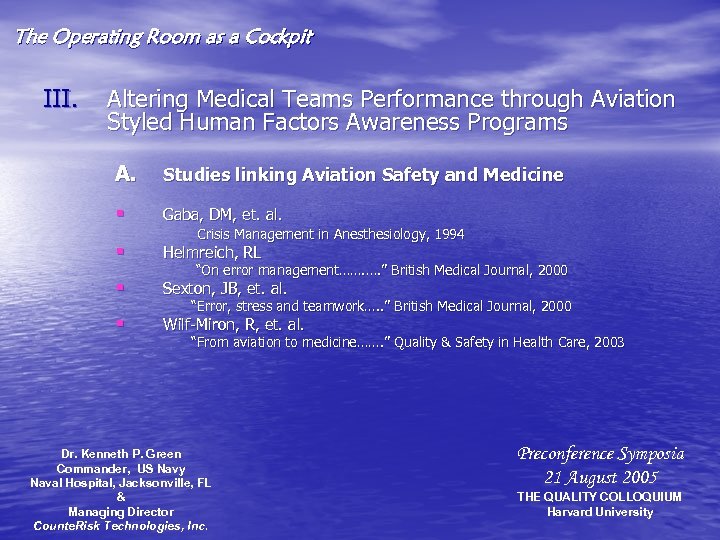 The Operating Room as a Cockpit III. Altering Medical Teams Performance through Aviation Styled Human Factors Awareness Programs A. Studies linking Aviation Safety and Medicine § Gaba, DM, et. al. Crisis Management in Anesthesiology, 1994 § Helmreich, RL § Sexton, JB, et. al. § Wilf-Miron, R, et. al. “On error management……. …. ” British Medical Journal, 2000 “Error, stress and teamwork…. . ” British Medical Journal, 2000 “From aviation to medicine……. ” Quality & Safety in Health Care, 2003 Dr. Kenneth P. Green Commander, US Navy Naval Hospital, Jacksonville, FL & Managing Director Counte. Risk Technologies, Inc. Preconference Symposia 21 August 2005 THE QUALITY COLLOQUIUM Harvard University
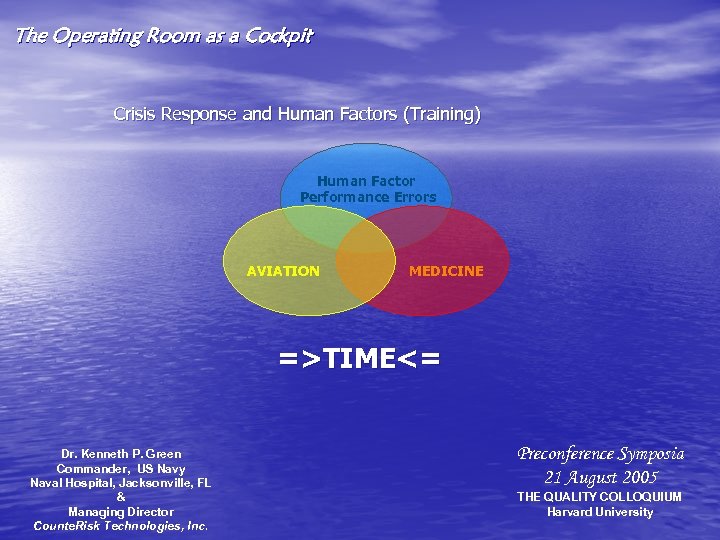 The Operating Room as a Cockpit Crisis Response and Human Factors (Training) Human Factor Performance Errors AVIATION MEDICINE =>TIME<= Dr. Kenneth P. Green Commander, US Navy Naval Hospital, Jacksonville, FL & Managing Director Counte. Risk Technologies, Inc. Preconference Symposia 21 August 2005 THE QUALITY COLLOQUIUM Harvard University
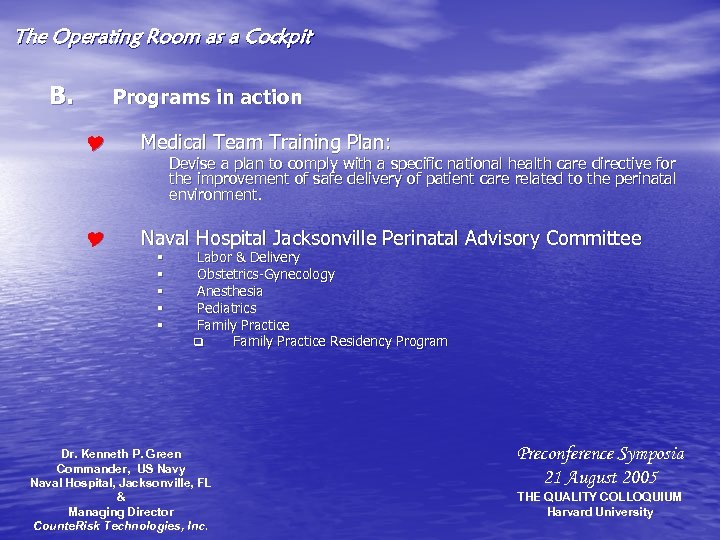 The Operating Room as a Cockpit B. Programs in action Y Medical Team Training Plan: Y Naval Hospital Jacksonville Perinatal Advisory Committee Devise a plan to comply with a specific national health care directive for the improvement of safe delivery of patient care related to the perinatal environment. § § § Labor & Delivery Obstetrics-Gynecology Anesthesia Pediatrics Family Practice q Family Practice Residency Program Dr. Kenneth P. Green Commander, US Navy Naval Hospital, Jacksonville, FL & Managing Director Counte. Risk Technologies, Inc. Preconference Symposia 21 August 2005 THE QUALITY COLLOQUIUM Harvard University
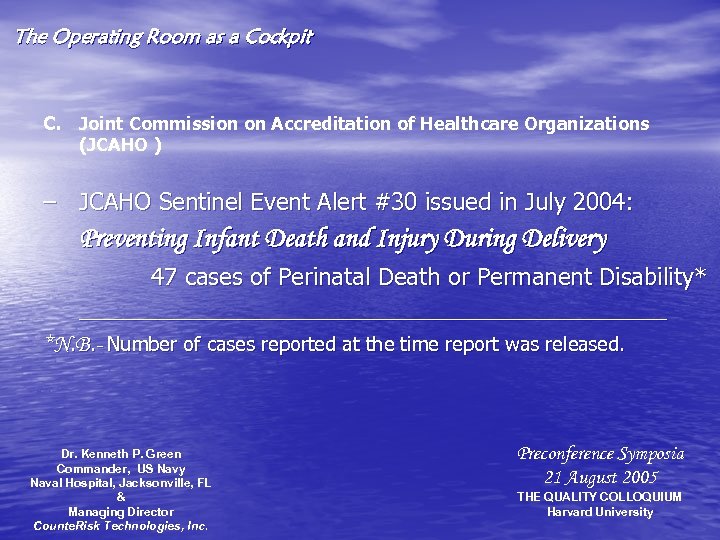 The Operating Room as a Cockpit C. Joint Commission on Accreditation of Healthcare Organizations (JCAHO ) – JCAHO Sentinel Event Alert #30 issued in July 2004: Preventing Infant Death and Injury During Delivery 47 cases of Perinatal Death or Permanent Disability* _________________________ *N. B. - Number of cases reported at the time report was released. Dr. Kenneth P. Green Commander, US Navy Naval Hospital, Jacksonville, FL & Managing Director Counte. Risk Technologies, Inc. Preconference Symposia 21 August 2005 THE QUALITY COLLOQUIUM Harvard University
 The Operating Room as a Cockpit D. Root Cause Analysis (RCA) of 47 Reported Cases listed the following Causal Factors: – Communication (72%) – Organizational Culture as a Barrier to Effective Communication & Teamwork (55%) – – – – Staff Competency (47%) Orientation & Training Process (40%) Inadequate (Fetal) Monitoring (34%) Unavailable Monitoring Equipment and/or Drugs (30%) Credentialing/Privileging/Supervision Issues for Physicians & Nurse Midwives (30%) Staffing Issues (25%) Physician Unavailable or Delayed (19%) Unavailability of Pre-Natal Information (11%) Dr. Kenneth P. Green Commander, US Navy Naval Hospital, Jacksonville, FL & Managing Director Counte. Risk Technologies, Inc. Preconference Symposia 21 August 2005 THE QUALITY COLLOQUIUM Harvard University
 The Operating Room as a Cockpit E. Risk Reduction Strategies Reported (from RCAs): – – Revise Communication Protocols Reinforce Chain-of-Communication Policies Conduct Team Training Revise Conflict Resolution Policies Dr. Kenneth P. Green Commander, US Navy Naval Hospital, Jacksonville, FL & Managing Director Counte. Risk Technologies, Inc. Preconference Symposia 21 August 2005 THE QUALITY COLLOQUIUM Harvard University
 The Operating Room as a Cockpit F. JCAHO Recommendations: – Conduct Team Training in Perinatal Areas to Teach Staff to Work Together and Communicate More Effectively. – For High Risk Events, Conduct Drills to Help Staff Prepare for When Such Events Occur, and Conduct Debriefings to Evaluate Team Performance and Identify Areas for Improvement. Dr. Kenneth P. Green Commander, US Navy Naval Hospital, Jacksonville, FL & Managing Director Counte. Risk Technologies, Inc. Preconference Symposia 21 August 2005 THE QUALITY COLLOQUIUM Harvard University
 C 4: Critical Care Crisis Communication G. Utilize a joint training program for all departments together: – Counte. Risk’s program utilizes an aviation human factors based training model for improving team performance. Dr. Kenneth P. Green Commander, US Navy Naval Hospital, Jacksonville, FL & Managing Director Counte. Risk Technologies, Inc. Preconference Symposia 21 August 2005 THE QUALITY COLLOQUIUM Harvard University
 C 4: Critical Care Crisis Communication H. Train Each Group as a Working Team – Each team session consists of a group composed of each of the sub-specialty departments, as well as the strata of leadership and expertise within each of those departments! – Therefore each training unit will have the range of Physician to Nurse to Medical Assistant/Technologist, as well as counterparts from the interdisciplinary members of this (perinatal) group. Dr. Kenneth P. Green Commander, US Navy Naval Hospital, Jacksonville, FL & Managing Director Counte. Risk Technologies, Inc. Preconference Symposia 21 August 2005 THE QUALITY COLLOQUIUM Harvard University
 C 4: Critical Care Crisis Communication I. Training Program AM: Didactic Training Program Lecture intensive with forum discussion. Some topics include: • • • Leadership Hierarchal Team Arrangements Situational Awareness Communication Skills Human Factors The Decision Making Process Responsibility vs. Protocol The Moment of Truth Risk Reduction Strategies Cockpit Coordination and You Accident Chains Outcomes & Summary PM: Mock Scenario Drills in our L&D OR with videotaping and review. Dr. Kenneth P. Green Commander, US Navy Naval Hospital, Jacksonville, FL & Managing Director Counte. Risk Technologies, Inc. Preconference Symposia 21 August 2005 THE QUALITY COLLOQUIUM Harvard University
 Program Goals and Benefits IV. Program Goals = Establish a Culture of Safety in Medicine – RECOMMENDATION: All medical treatment teams, ESPECIALLY those involved in critical care scenarios, should receive team training to improve team communication skills and increase awareness of individual human error. • Training is already mandatory throughout the civilian and military aviation communities, because the aviators: both pilots and aircrew, all have accepted these principles as worthy. • Requirement for standardization of requirement for similar initial and annual refresher training for medical teams, will require an acceptance curve that aviation has already experienced. Dr. Kenneth P. Green Commander, US Navy Naval Hospital, Jacksonville, FL & Managing Director Counte. Risk Technologies, Inc. Preconference Symposia 21 August 2005 THE QUALITY COLLOQUIUM Harvard University
 Program Goals and Benefits V. RATIONALE The aviation model for human factor awareness training, improved crisis communication and decision making skills, and mishap analysis and reporting, has raised the Culture of Safety in Aviation. – Benefit #1: • Improvement of Communication between established medical teams to include multidirectional pathways of communication UNINCUMBERED by hierarchal constraints. – Benefit #2: • As a result of Improved Communication there will be more Accurate Decision Making in time sensitive scenarios, leading to the achievement of predictable, successful, Planned Outcomes, reduced morbidity and mortality, and lower Mishap Rates. – Benefit #3: • Final result of Improved Communication, Accurate Decision Making and Predictable Outcomes is => Improve Patient Care and Reduced Costs due to fewer litigations of malpractice claims! Dr. Kenneth P. Green Commander, US Navy Naval Hospital, Jacksonville, FL & Managing Director Counte. Risk Technologies, Inc. Preconference Symposia 21 August 2005 THE QUALITY COLLOQUIUM Harvard University
 Suggested Readings 102 Minutes: The Untold Story of the Flight to Survive Inside the Twin Towers Jim Dwyer, Kevin Flynn New York: Times Books; 2005 Into Thin Air Jon Krakauer New York: Villard Books; 1997 The 9/11 Commission Report National Commission on Terrorist Attacks Upon the United States. New York: W. W. Norton & Co. , 2004. Why teams don’t work: what went wrong and how to make it right Harvey Robbins and Michael Finley Princeton: Peterson’s/Pacesetter Books, 1995 Dr. Kenneth P. Green Commander, US Navy Naval Hospital, Jacksonville, FL & Managing Director Counte. Risk Technologies, Inc. Preconference Symposia 21 August 2005 THE QUALITY COLLOQUIUM Harvard University
 www. counterisk. com
 Kenneth. Green@sar. med. navy. mil counterisk@clearwire. net info@counterisk. com