


 Скачать презентацию Presents an Overview of the ISO 9000 2000
ad199becb04d09795deba3db0c4d24b3.ppt
- Количество слайдов: 61
 Presents an Overview of the ISO 9000: 2000 Revisions to the ISO 9000: 1994 Standards “ the Move from Conformance to Performance “ Presented by: Date: Visit us at www. isoqual. net for more great products 1
 Outline • Why Changes are Needed • Principles and Approaches Driving the Changes • Clause by Clause Review of New Requirements • Transition Guidance • Audit Implications Visit us at www. isoqual. net for more great products 2
 Current ISO 9000 Standards are Successful … Why Change a Good Thing? • ISO 9000 is the most successful standard in ISO history and is accepted world-wide 4 Nearly 400, 000 registrations world-wide with registrants in over 150 countries from all continents • Being applied in a wide variety of organizations 4 Over 40 “sectors” or industry classifications - led by: electrical/optical equipment, metal products, construction, machinery, wholesale/retail trade - but growing in acceptance by many others, including: engineering, information technology, health/social work, utilities, transportation, public administration, education, Visit us at www. isoqual. net for more great products other services. 3
 Current ISO 9000 Standards Need Revision. . . • Bias 4 Wording/terms biased towards manufacturing • Problems with the 20 element model 4 Difficult for small businesses to adapt 4 “Flow” incompatible with how companies do business 4 Incompatible with other models (ISO 14000 EMS e. g. ) • Not sufficiently “forward looking” 4 Does not smoothly facilitate the move from “baseline” (effective) quality management to “performance excellence” models (like MBNQA) required by evolvingatuser and customer needs) Visit us www. isoqual. net for more great products 4
 “One World … One Quality System” • Current standards contain “loopholes” 4 Too many companies have only sought to meet “minimum requirements” and then only by “twisting the intent” of the existing standards • There is a growing demand for “performance” excellence 4 ISO 9001: 1994 does not require continual improvement 4 ISO 9001: 2000 is process/performance oriented and does require continual improvement of the QMS, but by itself is not viewed as a “performance excellence” Visit us at www. isoqual. net for more 5 model great products
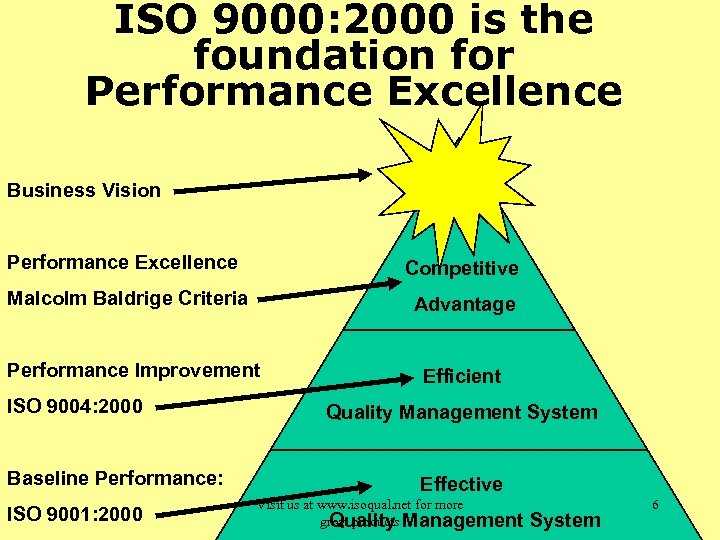 ISO 9000: 2000 is the foundation for Performance Excellence Business Vision Performance Excellence Competitive Malcolm Baldrige Criteria Advantage Performance Improvement ISO 9004: 2000 Baseline Performance: ISO 9001: 2000 Efficient Quality Management System Effective Visit us at www. isoqual. net for more great products Management Quality System 6
 EXERCISE #1 • List your organization’s three most significant challenges or business needs over the next 2 -3 years (consider any external changes that will affect your organization): 1. _____________________________ 2. _____________________________ 3. _____________________________ • What are your organization’s goals and objectives? 1. _____________________________ 2. _____________________________ 3. _____________________________ • How can you use ISO 9001: 2000 to help deal with business needs and external challenges? ___________________________________________________________ Visit us at www. isoqual. net for more great products 7
 ISO 9000: 2000 is based on Eight Quality Management Principles • • Customer Focus Leadership Involvement of People Process Approach System Approach Continual Improvement Factual Approach to Decision Making Mutually Beneficial Supplier Relationships Visit us at www. isoqual. net for more great products 8
 Customer Focus • Organizations depend on their customers and therefore should: 4 understand current and future customer needs, 4 meet customer requirements, and 4 strive to exceed customer expectations. Visit us at www. isoqual. net for more great products 9
 Leadership • Leaders should: 4 establish unity of purpose and direction of the organization, and 4 create and maintain the internal environment in which people can become fully involved in achieving the organization’s objectives. Visit us at www. isoqual. net for more great products 10
 Involvement of People • People at all levels are the essence of an organization, and 4 their full involvement enables their abilities to be used for the organization’s benefit. Visit us at www. isoqual. net for more great products 11
 Process Approach • Organizations need to do more than simply monitor process outputs, (typically through inspection activities) 4 they must also control all process inputs, (people, facilities/equipment, material and methods) 4 and, they must establish appropriate controls over the transformation activities (if desired results are to be achieved consistently and efficiently) Visit us at www. isoqual. net for more great products 12
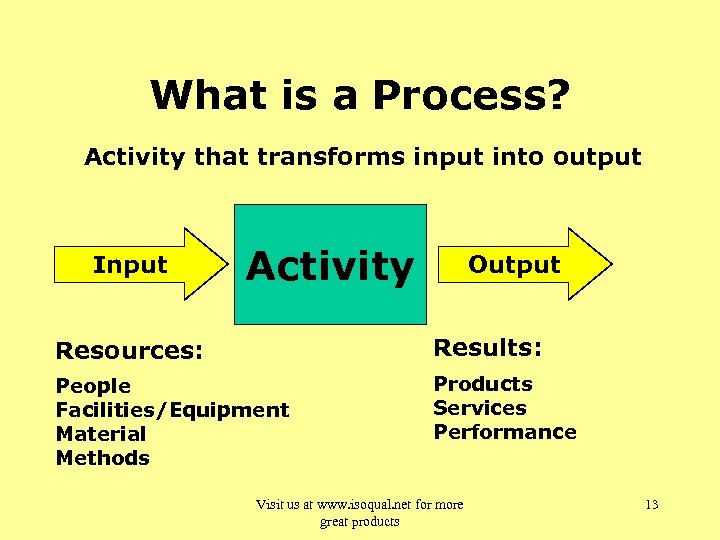 What is a Process? Activity that transforms input into output Input Activity Output Resources: Results: People Facilities/Equipment Material Methods Products Services Performance Visit us at www. isoqual. net for more great products 13
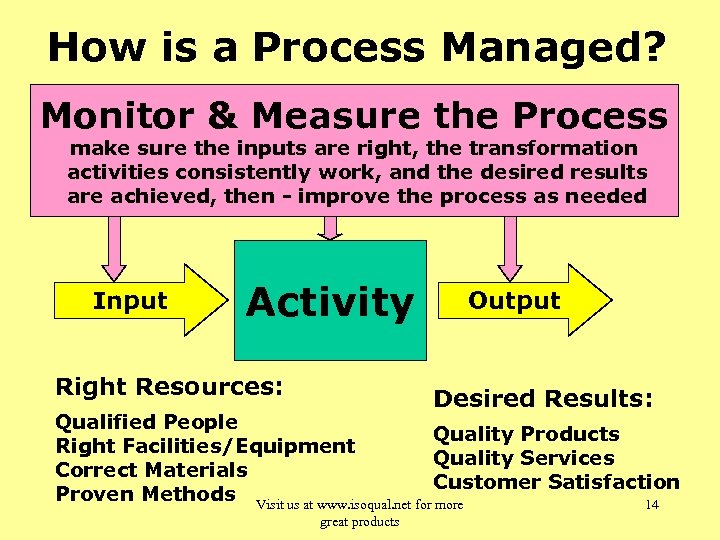 How is a Process Managed? Monitor & Measure the Process make sure the inputs are right, the transformation activities consistently work, and the desired results are achieved, then - improve the process as needed Input Activity Right Resources: Output Desired Results: Qualified People Quality Products Right Facilities/Equipment Quality Services Correct Materials Customer Satisfaction Proven Methods Visit us at www. isoqual. net for more 14 great products
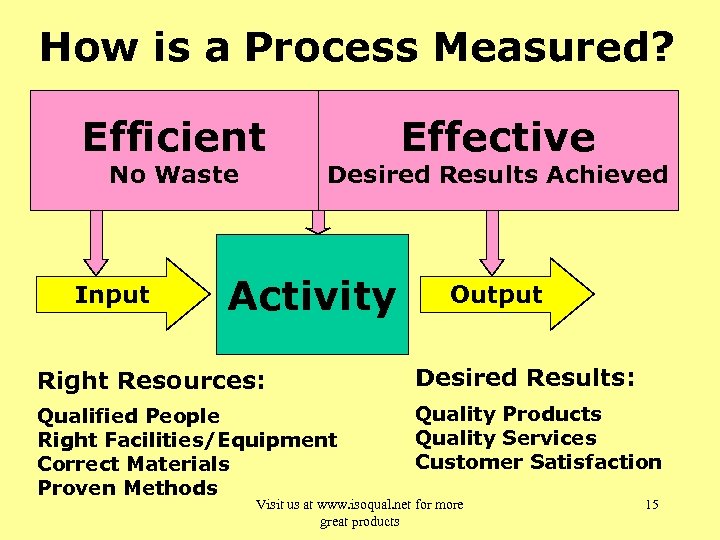 How is a Process Measured? Efficient No Waste Input Effective Desired Results Achieved Activity Output Right Resources: Desired Results: Qualified People Right Facilities/Equipment Correct Materials Proven Methods Quality Products Quality Services Customer Satisfaction Visit us at www. isoqual. net for more great products 15
 System Approach • Organizations must understand a system is a set of interrelated processes, and 4 the output of one process is the input to one or more subsequent processes, so. . . 4 It is critical to manage the “white space” (or interface) between processes to ensure that the overall system is effective Visit us at www. isoqual. net for more great products 16
 Continual Improvement • Continual improvement of the organization’s overall performance should be a permanent objective: 4 improvement must be a planned activity if the organization desires to improve overall performance and capabilities. Visit us at www. isoqual. net for more great products 17
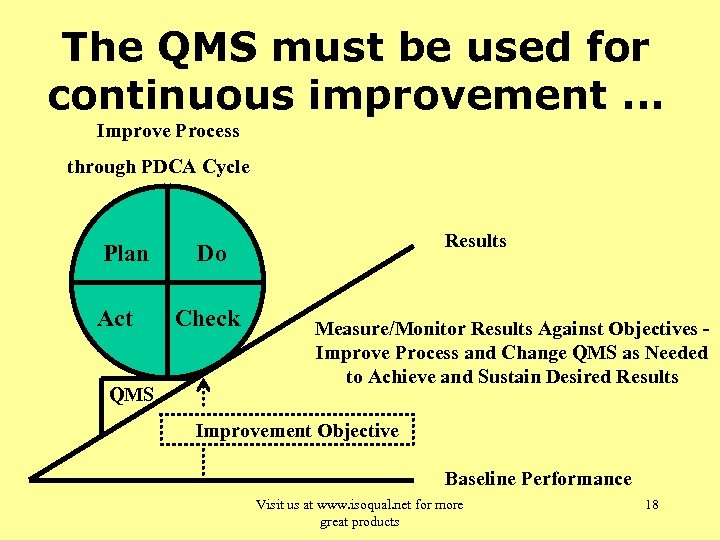 The QMS must be used for continuous improvement. . . Improve Process through PDCA Cycle Plan Act QMS Results Do Check Measure/Monitor Results Against Objectives Improve Process and Change QMS as Needed to Achieve and Sustain Desired Results Improvement Objective Baseline Performance Visit us at www. isoqual. net for more great products 18
 Factual Approach to Decision Making • Effective decisions are: 4 based on the analysis of data and information. Visit us at www. isoqual. net for more great products 19
 Mutually Beneficial Supplier Relationships • An organization and its suppliers are truly inter-dependent, and 4 a mutually beneficial relationship enhances the ability of both to create value. Visit us at www. isoqual. net for more great products 20
 EXERCISE #2 • Pick one of the eight quality management principles and list three of the most important actions you think an organization should take in applying this principle. 1. _____________________________ 2. _____________________________ 3. _____________________________ • How well does your organization do each of the actions identified above? 1. _____________________________ 2. _____________________________ 3. _____________________________ • What can your organization do to more fully utilize the principle? 1. _____________________________ 2. _____________________________ Visit us at www. isoqual. net for more 21 3. _____________________________ great products
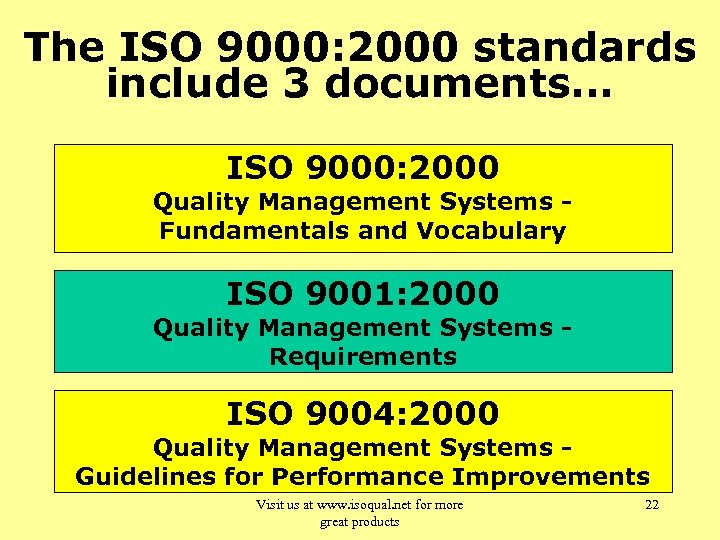 The ISO 9000: 2000 standards include 3 documents. . . ISO 9000: 2000 Quality Management Systems Fundamentals and Vocabulary ISO 9001: 2000 Quality Management Systems Requirements ISO 9004: 2000 Quality Management Systems Guidelines for Performance Improvements Visit us at www. isoqual. net for more great products 22
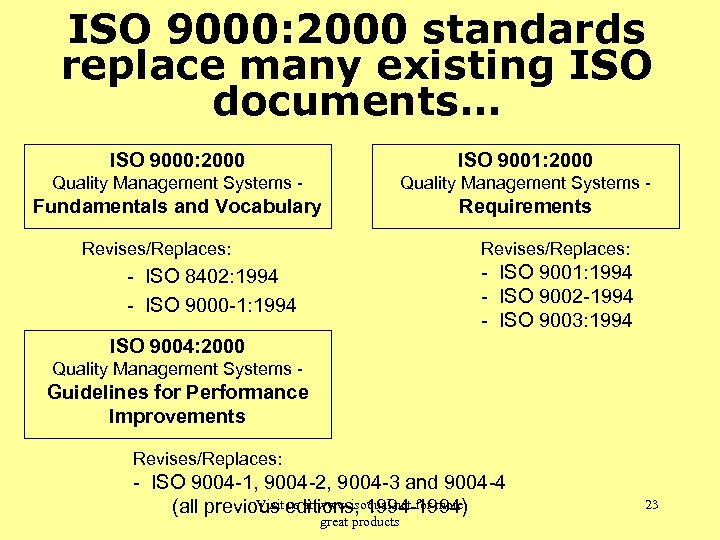 ISO 9000: 2000 standards replace many existing ISO documents. . . ISO 9000: 2000 ISO 9001: 2000 Quality Management Systems - Fundamentals and Vocabulary Requirements Revises/Replaces: - ISO 9001: 1994 - ISO 9002 -1994 - ISO 9003: 1994 - ISO 8402: 1994 - ISO 9000 -1: 1994 ISO 9004: 2000 Quality Management Systems - Guidelines for Performance Improvements Revises/Replaces: - ISO 9004 -1, 9004 -2, 9004 -3 and 9004 -4 Visit us at www. isoqual. net for more (all previous editions, 1994 -1994) great products 23
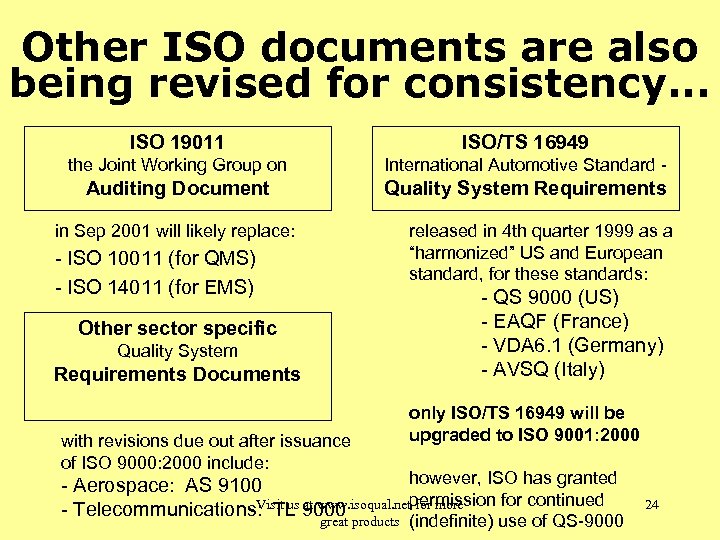 Other ISO documents are also being revised for consistency. . . ISO 19011 ISO/TS 16949 the Joint Working Group on International Automotive Standard - Auditing Document Quality System Requirements in Sep 2001 will likely replace: - ISO 10011 (for QMS) - ISO 14011 (for EMS) Other sector specific Quality System Requirements Documents with revisions due out after issuance of ISO 9000: 2000 include: released in 4 th quarter 1999 as a “harmonized” US and European standard, for these standards: - QS 9000 (US) - EAQF (France) - VDA 6. 1 (Germany) - AVSQ (Italy) only ISO/TS 16949 will be upgraded to ISO 9001: 2000 however, ISO has granted - Aerospace: AS 9100 Visit us at www. isoqual. netpermission for continued - Telecommunications: TL 9000 products for more great (indefinite) use of QS-9000 24
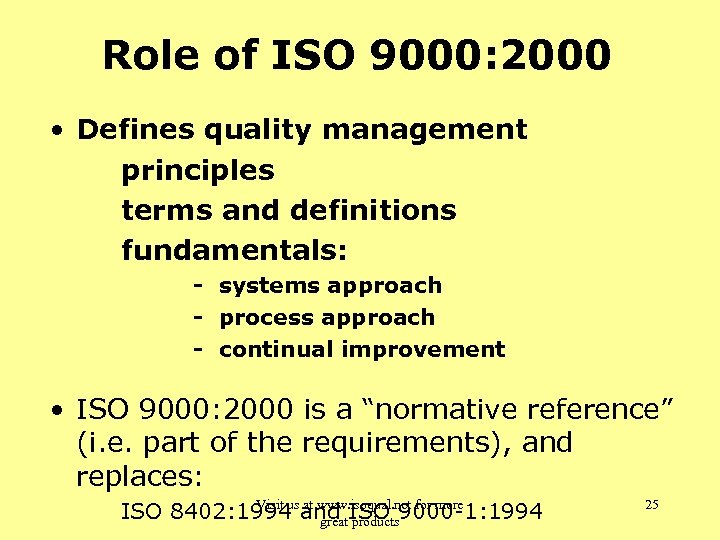 Role of ISO 9000: 2000 • Defines quality management principles terms and definitions fundamentals: - systems approach - process approach - continual improvement • ISO 9000: 2000 is a “normative reference” (i. e. part of the requirements), and replaces: Visit us at www. isoqual. net for more ISO 8402: 1994 and ISO 9000 -1: 1994 great products 25
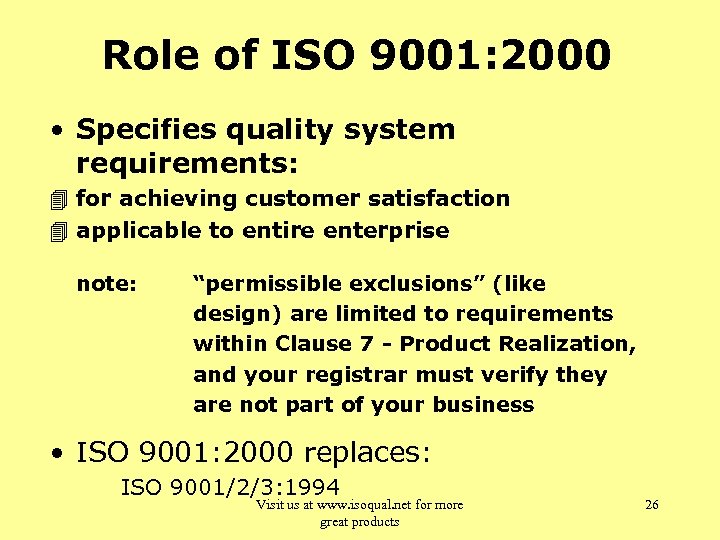 Role of ISO 9001: 2000 • Specifies quality system requirements: 4 for achieving customer satisfaction 4 applicable to entire enterprise note: “permissible exclusions” (like design) are limited to requirements within Clause 7 - Product Realization, and your registrar must verify they are not part of your business • ISO 9001: 2000 replaces: ISO 9001/2/3: 1994 Visit us at www. isoqual. net for more great products 26
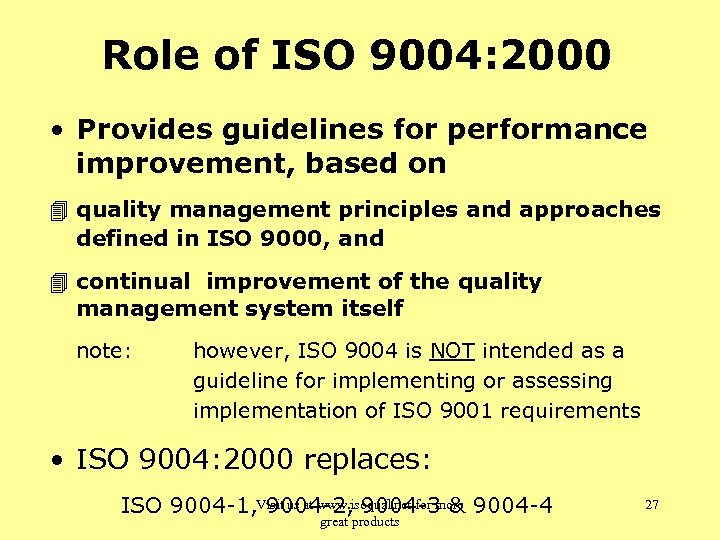 Role of ISO 9004: 2000 • Provides guidelines for performance improvement, based on 4 quality management principles and approaches defined in ISO 9000, and 4 continual improvement of the quality management system itself note: however, ISO 9004 is NOT intended as a guideline for implementing or assessing implementation of ISO 9001 requirements • ISO 9004: 2000 replaces: ISO 9004 -1, Visit us at www. isoqual. net for more 9004 -4 9004 -2, 9004 -3 & great products 27
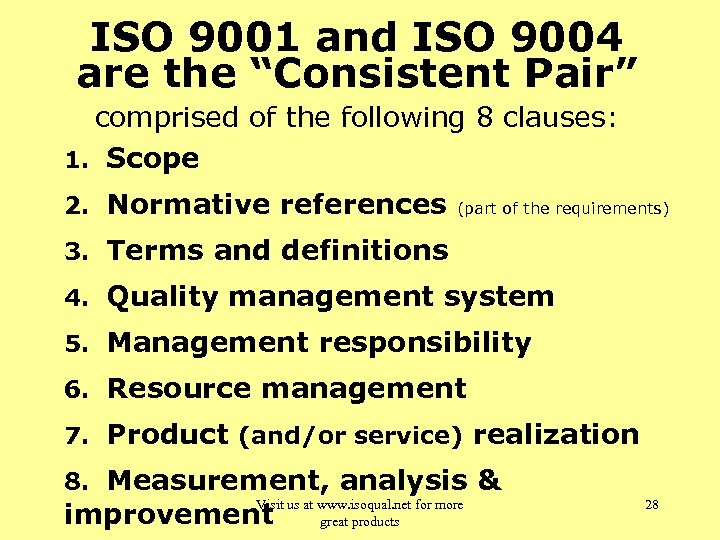 ISO 9001 and ISO 9004 are the “Consistent Pair” comprised of the following 8 clauses: 1. Scope 2. Normative references (part of the requirements) 3. Terms and definitions 4. Quality management system 5. Management responsibility 6. Resource management 7. Product (and/or service) realization 8. Measurement, analysis & improvement Visit us at www. isoqual. net for more great products 28
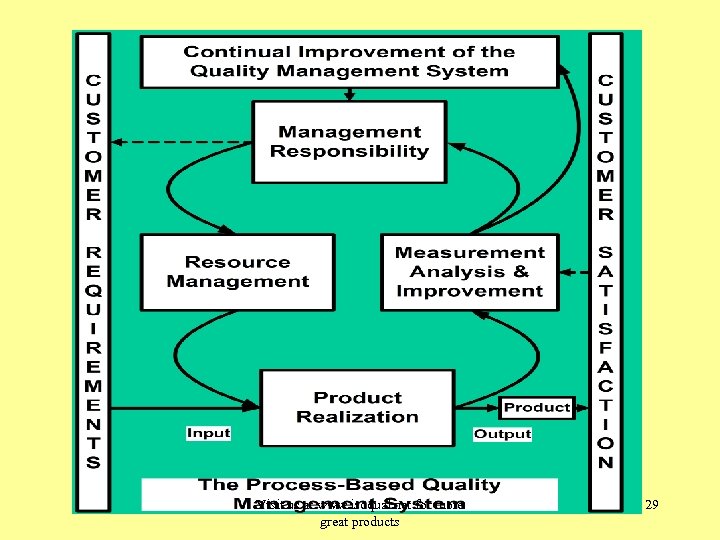 Visit us at www. isoqual. net for more great products 29
 ISO 9001: 2000 implements the PDCA improvement cycle • Plan Clause 5. Management responsibility everything flows from Management who define the requirements for the system Clause 6. Resource management - from these requirements the resources will be identified and management must ensure they are provided and applied within the system • Do Clause 7. Product (and/or service) realization - the necessary process are Visit us at www. isoqual. net established and carried out for more great products 30
 ISO 9001: 2000 implements the PDCA improvement cycle • Check Clause 8. Measurement, analysis and improvement - processes and products will be monitored and measured against policies, objectives and requirements for the product and results/opportunity for improvement reported • Act Clause 8. Measurement, analysis and improvement - acting upon data reported in the check cycle, improvement actions can be taken directly, or as an output of the Management Review process (Clause 5. 6)for more Visit us at www. isoqual. net 31 great products
 Clause 4 - Quality management system • 4. 1 General requirements - New: must define processes to be managed (including out-sourced processes - which typically include design, training, calibration, heat treat, etc. ); determine the sequence and interaction of these processes; determine the criteria and methods needed to ensure these processes are effective; and take actions to improve these processes • 4. 2 Documentation requirements - New: documentation requirements less prescriptive; however, at a minimum must include a quality manual and the following six documented procedures: Control of Documents (Clause 4. 2. 3), Control of Quality Records (Clause 4. 2. 4), Internal Audits (Clause 8. 2. 2), Control of Nonconforming Product (Clause 8. 3), Corrective Action (Clause 8. 5. 2), and Preventive Action (Clause 8. 5. 3). Visit us at www. isoqual. net for more 32 great products
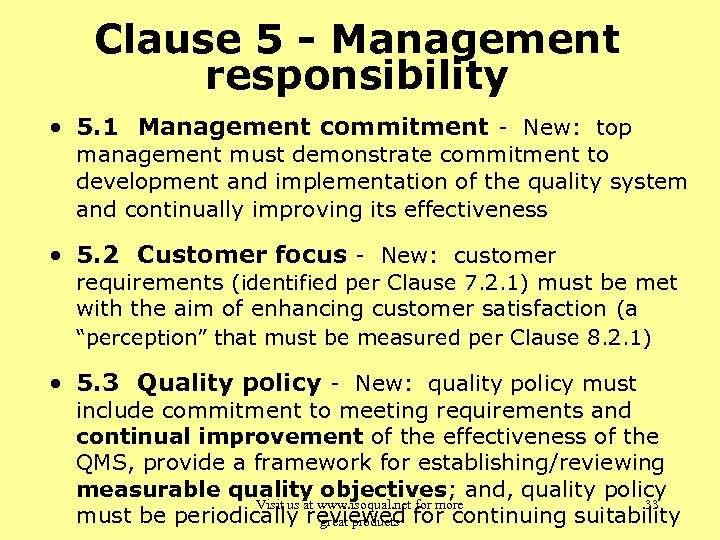 Clause 5 - Management responsibility • 5. 1 Management commitment - New: top management must demonstrate commitment to development and implementation of the quality system and continually improving its effectiveness • 5. 2 Customer focus - New: customer requirements (identified per Clause 7. 2. 1) must be met with the aim of enhancing customer satisfaction (a “perception” that must be measured per Clause 8. 2. 1) • 5. 3 Quality policy - New: quality policy must include commitment to meeting requirements and continual improvement of the effectiveness of the QMS, provide a framework for establishing/reviewing measurable quality objectives; and, quality policy Visit us at www. isoqual. net for more 33 must be periodically reviewed for continuing suitability great products
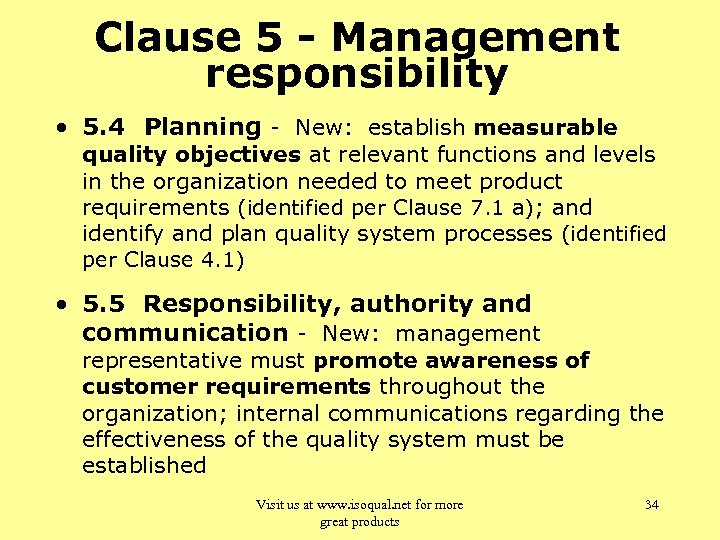 Clause 5 - Management responsibility • 5. 4 Planning - New: establish measurable quality objectives at relevant functions and levels in the organization needed to meet product requirements (identified per Clause 7. 1 a); and identify and plan quality system processes (identified per Clause 4. 1) • 5. 5 Responsibility, authority and communication - New: management representative must promote awareness of customer requirements throughout the organization; internal communications regarding the effectiveness of the quality system must be established Visit us at www. isoqual. net for more great products 34
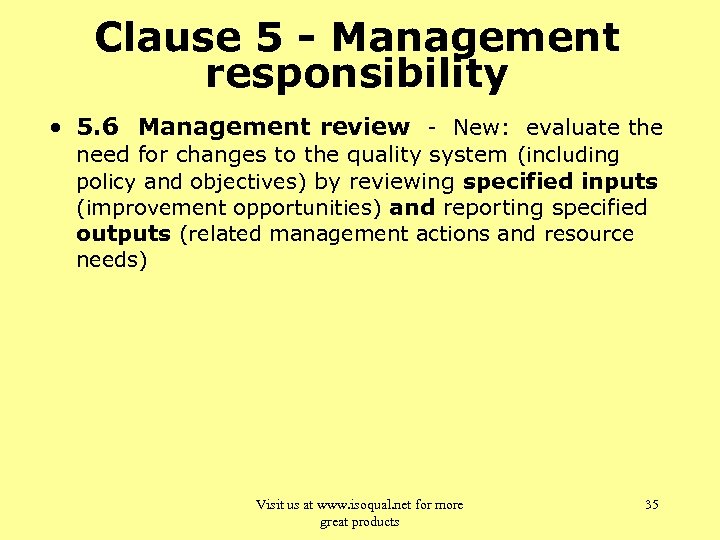 Clause 5 - Management responsibility • 5. 6 Management review - New: evaluate the need for changes to the quality system (including policy and objectives) by reviewing specified inputs (improvement opportunities) and reporting specified outputs (related management actions and resource needs) Visit us at www. isoqual. net for more great products 35
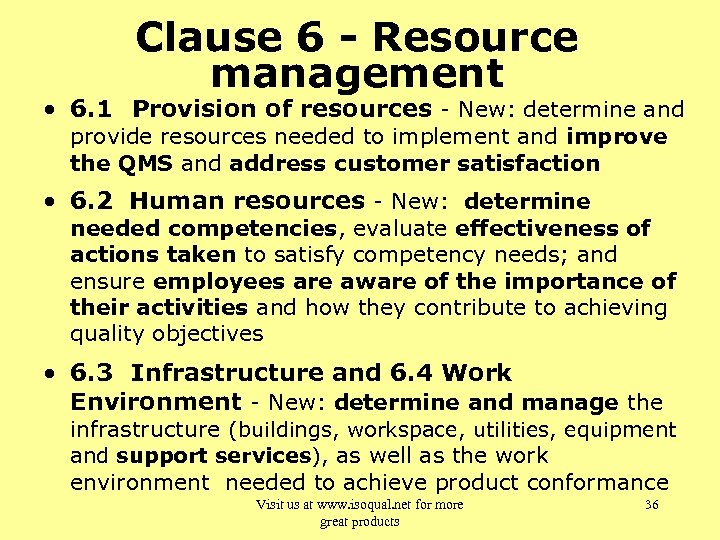 Clause 6 - Resource management • 6. 1 Provision of resources - New: determine and provide resources needed to implement and improve the QMS and address customer satisfaction • 6. 2 Human resources - New: determine needed competencies, evaluate effectiveness of actions taken to satisfy competency needs; and ensure employees are aware of the importance of their activities and how they contribute to achieving quality objectives • 6. 3 Infrastructure and 6. 4 Work Environment - New: determine and manage the infrastructure (buildings, workspace, utilities, equipment and support services), as well as the work environment needed to achieve product conformance Visit us at www. isoqual. net for more great products 36
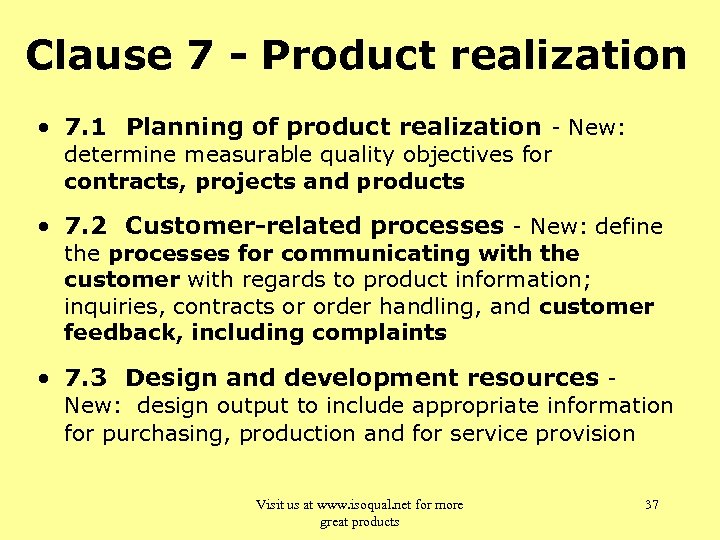 Clause 7 - Product realization • 7. 1 Planning of product realization - New: determine measurable quality objectives for contracts, projects and products • 7. 2 Customer-related processes - New: define the processes for communicating with the customer with regards to product information; inquiries, contracts or order handling, and customer feedback, including complaints • 7. 3 Design and development resources - New: design output to include appropriate information for purchasing, production and for service provision Visit us at www. isoqual. net for more great products 37
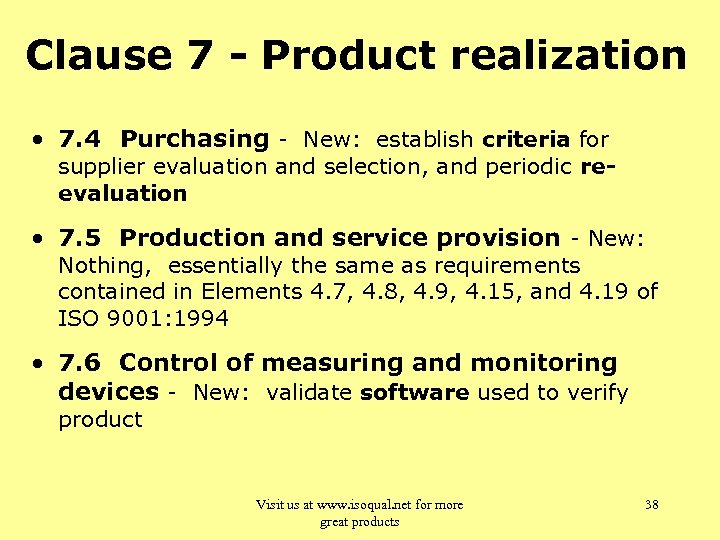 Clause 7 - Product realization • 7. 4 Purchasing - New: establish criteria for supplier evaluation and selection, and periodic reevaluation • 7. 5 Production and service provision - New: Nothing, essentially the same as requirements contained in Elements 4. 7, 4. 8, 4. 9, 4. 15, and 4. 19 of ISO 9001: 1994 • 7. 6 Control of measuring and monitoring devices - New: validate software used to verify product Visit us at www. isoqual. net for more great products 38
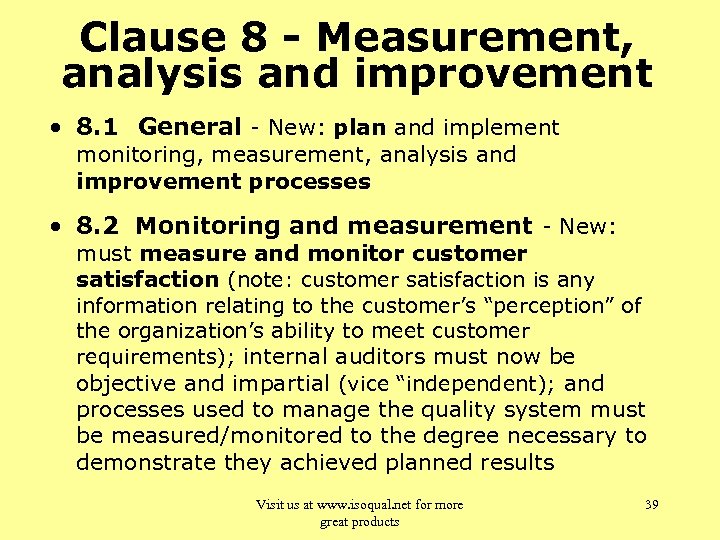 Clause 8 - Measurement, analysis and improvement • 8. 1 General - New: plan and implement monitoring, measurement, analysis and improvement processes • 8. 2 Monitoring and measurement - New: must measure and monitor customer satisfaction (note: customer satisfaction is any information relating to the customer’s “perception” of the organization’s ability to meet customer requirements); internal auditors must now be objective and impartial (vice “independent); and processes used to manage the quality system must be measured/monitored to the degree necessary to demonstrate they achieved planned results Visit us at www. isoqual. net for more great products 39
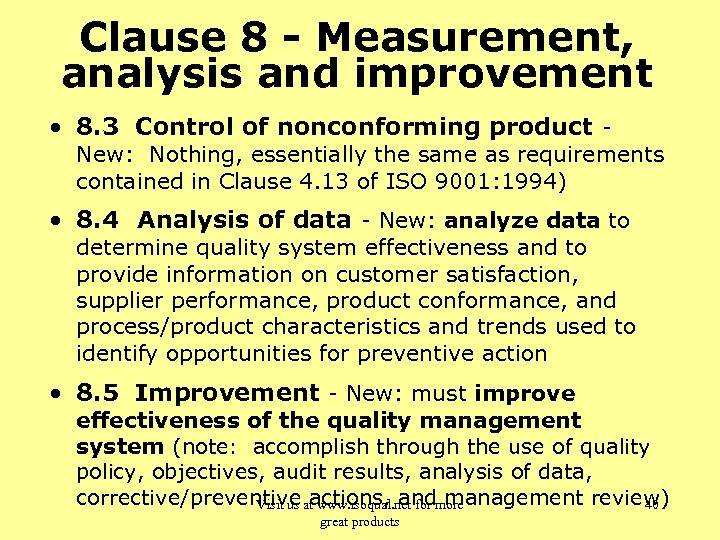 Clause 8 - Measurement, analysis and improvement • 8. 3 Control of nonconforming product - New: Nothing, essentially the same as requirements contained in Clause 4. 13 of ISO 9001: 1994) • 8. 4 Analysis of data - New: analyze data to determine quality system effectiveness and to provide information on customer satisfaction, supplier performance, product conformance, and process/product characteristics and trends used to identify opportunities for preventive action • 8. 5 Improvement - New: must improve effectiveness of the quality management system (note: accomplish through the use of quality policy, objectives, audit results, analysis of data, corrective/preventive at www. isoqual. net for more Visit us actions, and management review) 40 great products
 ISO 9000: 2000 standards released December 2000 • The final International Standard (IS) was released 15 December 2000 and is available now • Sector specific schemes are under review and ISO 9000: 2000 based revisions will be issued soon: 4 Automotive: ISO/TS 16949 4 Aerospace: AS 9100 4 Telecommunications: TL 9000 Visit us at www. isoqual. net for more great products 41
 Essentially, you’ll have 3 years to transition to the new standards • Accredited registrations to ISO 9001/2/3: 1994 may continue for up to 3 years (through 12/03) 4 Allows transition time for those “in progress” • Both new registrations and continuations of current registrations based on 1994 standards will expire on or before the end of CY 2003 4 Allows time for accredited organizations, registrars, and training activities/consultants Visit us at www. isoqual. net for more great products 42
 So … what should organizations do NOW? • Obtain assistance from qualified sources 4 Obtain/conduct Management and Employee Awareness Training, Internal Auditor Training, and Process Management Training 4 Obtain/conduct a “Gap Analysis” • Obtain guidance from your Registrar 4 Obtain their transition plan, including provisions related to any sector specific schemes applicable to your organization (QS 9000 e. g. ) • Develop/implement your transition plan Visit us at www. isoqual. net for more great products 43
 Answers to FAQs. . . • Do I have to change my system? Not at the moment … HOWEVER, it would be beneficial to look at the new standards as soon as possible so you can get an idea of what new requirements are forthcoming … • Do I have to re-write my documents? NO … HOWEVER, at a minimum, some adjustments will have to be made to address new requirements and cross reference quality system documentation to ISO 9001: 2000 Visit us at www. isoqual. net for more great products 44
 Answers to FAQs (continued). . . • Will the changes affect my current registration / certification? Yes. A transition plan will need to be approved by your registrar and incorporated into their regular audit routine • I am not yet registered. Should I pursue registration to the 1994 standards first? Only if “timing” is an issue … either way your system design should be based on the new standards … consult with your Registrar to discuss options Visit us at www. isoqual. net for more great products 45
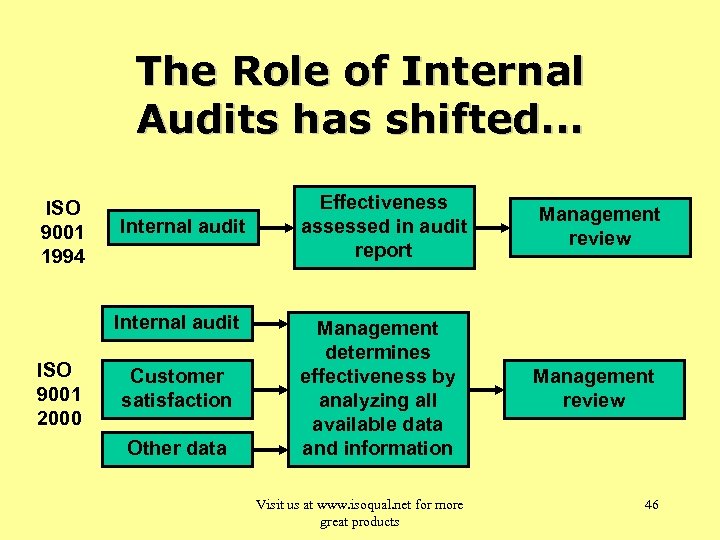 The Role of Internal Audits has shifted. . . ISO 9001 1994 Internal audit ISO 9001 2000 Customer satisfaction Other data Effectiveness assessed in audit report Management determines effectiveness by analyzing all available data and information Visit us at www. isoqual. net for more great products Management review 46
 Audit Methodologies. . . • Audit Planning • Evaluating QMS Documentation • Conducting Process Audits • Using Internal Audits to: 4 Verify QMS Effectiveness 4 Identify Opportunities for Improvement Visit us at www. isoqual. net for more great products 47
 Audit Planning • The Shift to Process Audits 4 “Element” Audits, or Departmental Audits should give way to process audits - i. e. audit (from start to finish) key processes the organization has defined as critical to meeting the overall objectives of the organization Note: The processes selected, as well as their sequence and interrelation, must make sense to the organization; however, they must address all requirements of ISO 9001: 2000 and the policy and objectives of the organization. • Use Internal Audits for Improvement 4 Audit scope should clearly state if/when the purpose of the internal audit will “go beyond compliance audits” and be used to identify additional opportunities for improvement Visit us at www. isoqual. net for more 48 great products
 Evaluating QMS Documentation • Documentation requirements are less prescriptive 4 ISO 9001: 2000 only “requires” a handful of “documented procedures” be in place 4 All QMS processes, however, must be controlled by either a documented procedure or well defined “system” • Evaluating System Adequacy 4 Assess organization’s compliance with documented procedures and/or other well defined responsibilities associated with the process under review (conformance) 4 Verify that the system is achieving the desired results (performance) Visit us at www. isoqual. net for more 49 great products
 Conducting Process Audits • Identify QMS Process “Owners” 4 Tools like “Deployment Flowcharts” can be invaluable in defining the sequence, interrelationship and responsibilities associated with QMS Processes • Evaluate “Conformance” 4 Tools like our “Checklist and Audit Guide” can be invaluable in verifying that the documented procedure or process complies with ISO 9001: 2000 requirements • Evaluate “Performance” 4 Verify that the organization is collecting and using process performance data to monitor, measure and improve processes us at www. isoqual. net for more Visit great products 50
 Conducting Top Management Interviews • The expanded role of top management requires more time be spent with them during internal audits to collect evidence of their commitment to: 4 Communicating importance of meeting requirements, 4 Establishing quality policy and objectives, 4 Conducting management reviews, and 4 Ensuring availability of necessary resources. Visit us at www. isoqual. net for more great products 51
 Interviewing “Process Owners” • Other managers (i. e. “Process Owners”) should be interviewed to collect evidence that: 4 Processes and improvement objectives are documented and planned, 4 Processes and needed resources are deployed, 4 Processes are monitored and measured, and 4 Actions are taken, as warranted by analysis of process data. Note: Auditors should look for evidence that process sequence and interrelationships are known and interfaces are effectively managed to 52 Visit us at www. isoqual. net for more achieve the great products objectives. desired
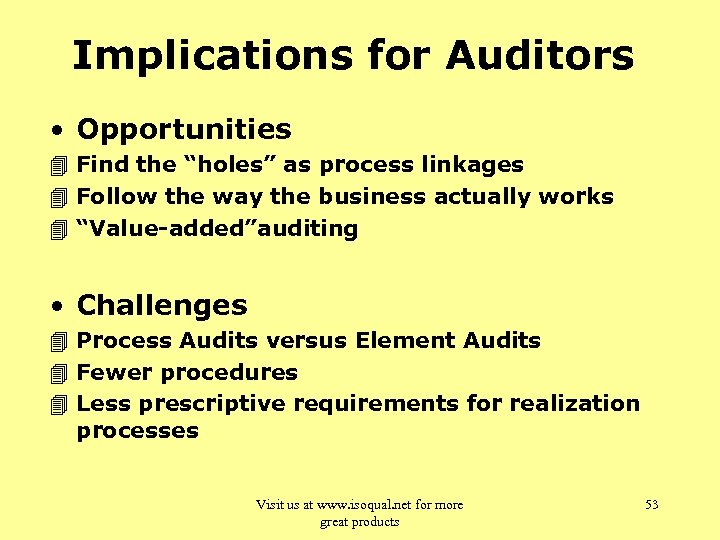 Implications for Auditors • Opportunities 4 Find the “holes” as process linkages 4 Follow the way the business actually works 4 “Value-added”auditing • Challenges 4 Process Audits versus Element Audits 4 Fewer procedures 4 Less prescriptive requirements for realization processes Visit us at www. isoqual. net for more great products 53
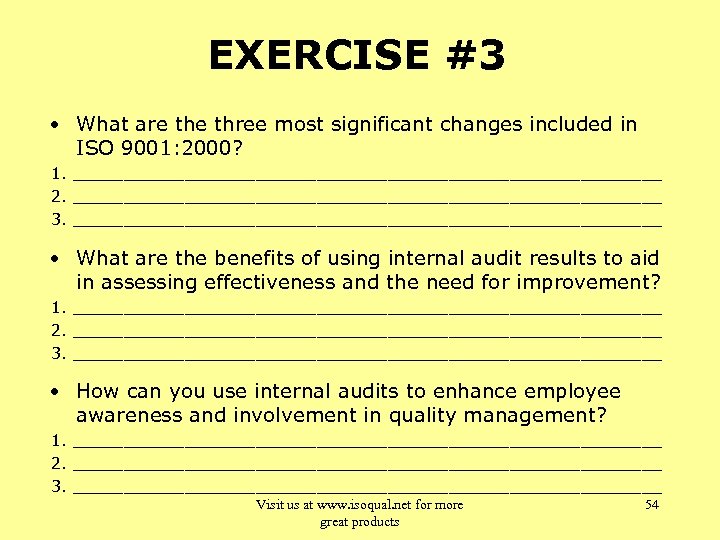 EXERCISE #3 • What are three most significant changes included in ISO 9001: 2000? 1. _____________________________ 2. _____________________________ 3. _____________________________ • What are the benefits of using internal audit results to aid in assessing effectiveness and the need for improvement? 1. _____________________________ 2. _____________________________ 3. _____________________________ • How can you use internal audits to enhance employee awareness and involvement in quality management? 1. _____________________________ 2. _____________________________ 3. _____________________________ Visit us at www. isoqual. net for more great products 54
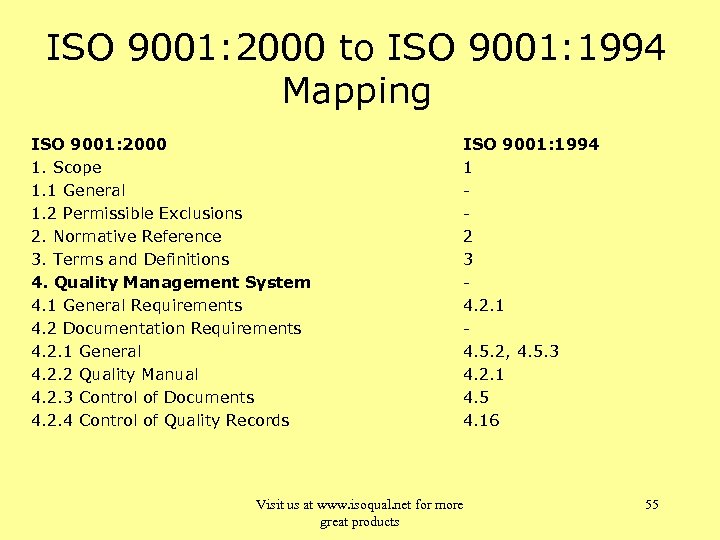 ISO 9001: 2000 to ISO 9001: 1994 Mapping ISO 9001: 2000 1. Scope 1. 1 General 1. 2 Permissible Exclusions 2. Normative Reference 3. Terms and Definitions 4. Quality Management System 4. 1 General Requirements 4. 2 Documentation Requirements 4. 2. 1 General 4. 2. 2 Quality Manual 4. 2. 3 Control of Documents 4. 2. 4 Control of Quality Records ISO 9001: 1994 1 2 3 4. 2. 1 4. 5. 2, 4. 5. 3 4. 2. 1 4. 5 4. 16 Visit us at www. isoqual. net for more great products 55
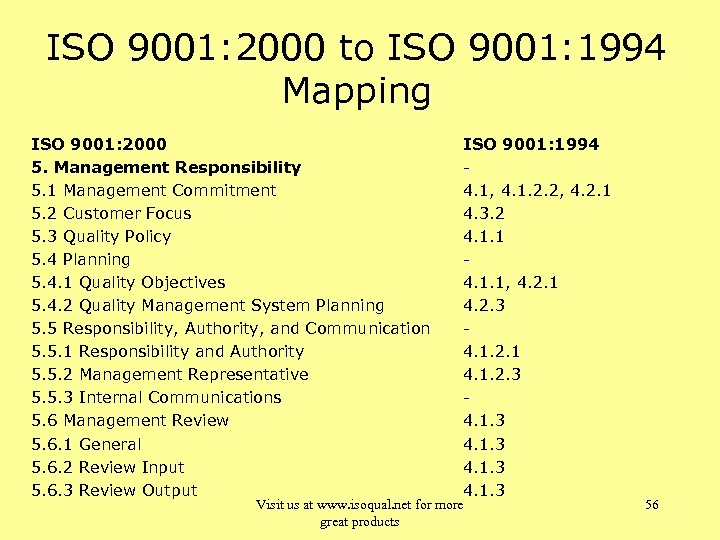 ISO 9001: 2000 to ISO 9001: 1994 Mapping ISO 9001: 2000 5. Management Responsibility 5. 1 Management Commitment 5. 2 Customer Focus 5. 3 Quality Policy 5. 4 Planning 5. 4. 1 Quality Objectives 5. 4. 2 Quality Management System Planning 5. 5 Responsibility, Authority, and Communication 5. 5. 1 Responsibility and Authority 5. 5. 2 Management Representative 5. 5. 3 Internal Communications 5. 6 Management Review 5. 6. 1 General 5. 6. 2 Review Input 5. 6. 3 Review Output ISO 9001: 1994 4. 1, 4. 1. 2. 2, 4. 2. 1 4. 3. 2 4. 1. 1, 4. 2. 1 4. 2. 3 4. 1. 2. 1 4. 1. 2. 3 4. 1. 3 Visit us at www. isoqual. net for more great products 56
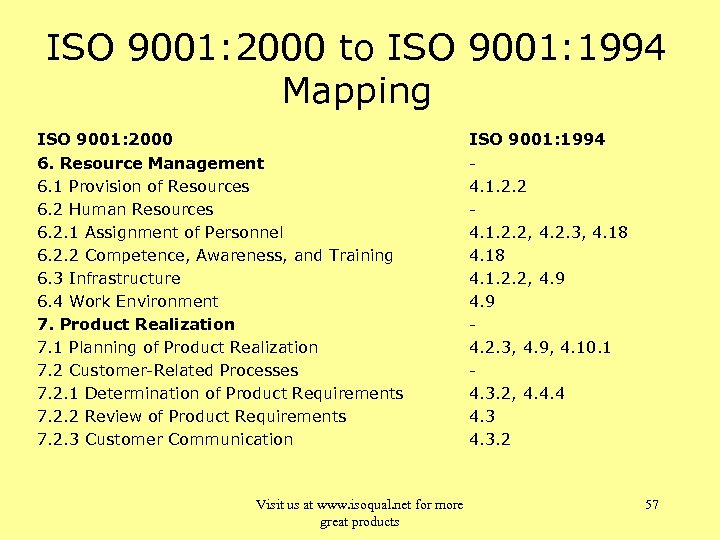 ISO 9001: 2000 to ISO 9001: 1994 Mapping ISO 9001: 2000 6. Resource Management 6. 1 Provision of Resources 6. 2 Human Resources 6. 2. 1 Assignment of Personnel 6. 2. 2 Competence, Awareness, and Training 6. 3 Infrastructure 6. 4 Work Environment 7. Product Realization 7. 1 Planning of Product Realization 7. 2 Customer-Related Processes 7. 2. 1 Determination of Product Requirements 7. 2. 2 Review of Product Requirements 7. 2. 3 Customer Communication Visit us at www. isoqual. net for more great products ISO 9001: 1994 4. 1. 2. 2, 4. 2. 3, 4. 18 4. 1. 2. 2, 4. 9 4. 2. 3, 4. 9, 4. 10. 1 4. 3. 2, 4. 4. 4 4. 3. 2 57
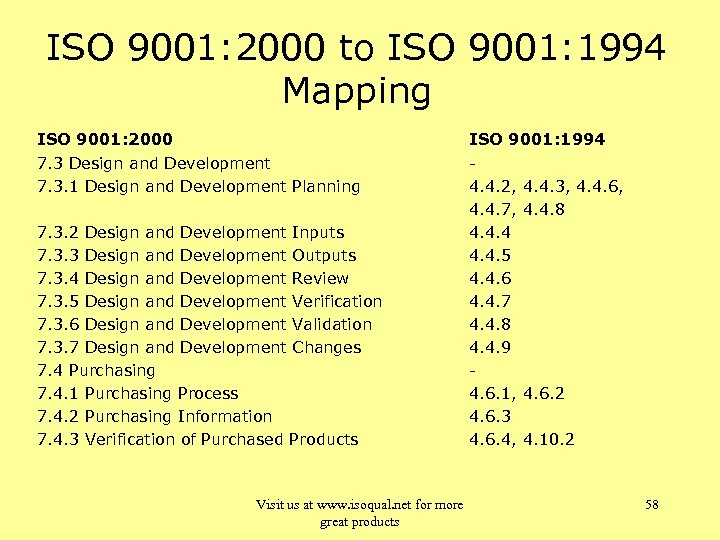 ISO 9001: 2000 to ISO 9001: 1994 Mapping ISO 9001: 2000 7. 3 Design and Development 7. 3. 1 Design and Development Planning 7. 3. 2 Design and Development Inputs 7. 3. 3 Design and Development Outputs 7. 3. 4 Design and Development Review 7. 3. 5 Design and Development Verification 7. 3. 6 Design and Development Validation 7. 3. 7 Design and Development Changes 7. 4 Purchasing 7. 4. 1 Purchasing Process 7. 4. 2 Purchasing Information 7. 4. 3 Verification of Purchased Products Visit us at www. isoqual. net for more great products ISO 9001: 1994 4. 4. 2, 4. 4. 3, 4. 4. 6, 4. 4. 7, 4. 4. 8 4. 4. 4. 5 4. 4. 6 4. 4. 7 4. 4. 8 4. 4. 9 4. 6. 1, 4. 6. 2 4. 6. 3 4. 6. 4, 4. 10. 2 58
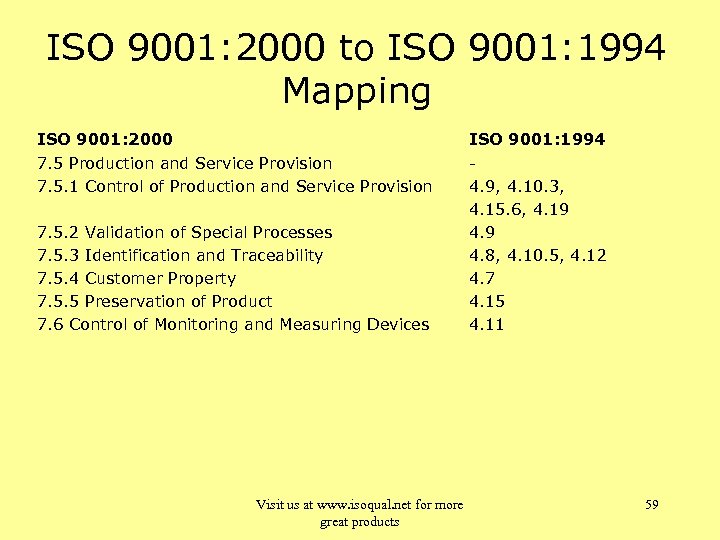 ISO 9001: 2000 to ISO 9001: 1994 Mapping ISO 9001: 2000 7. 5 Production and Service Provision 7. 5. 1 Control of Production and Service Provision 7. 5. 2 Validation of Special Processes 7. 5. 3 Identification and Traceability 7. 5. 4 Customer Property 7. 5. 5 Preservation of Product 7. 6 Control of Monitoring and Measuring Devices Visit us at www. isoqual. net for more great products ISO 9001: 1994 4. 9, 4. 10. 3, 4. 15. 6, 4. 19 4. 8, 4. 10. 5, 4. 12 4. 7 4. 15 4. 11 59
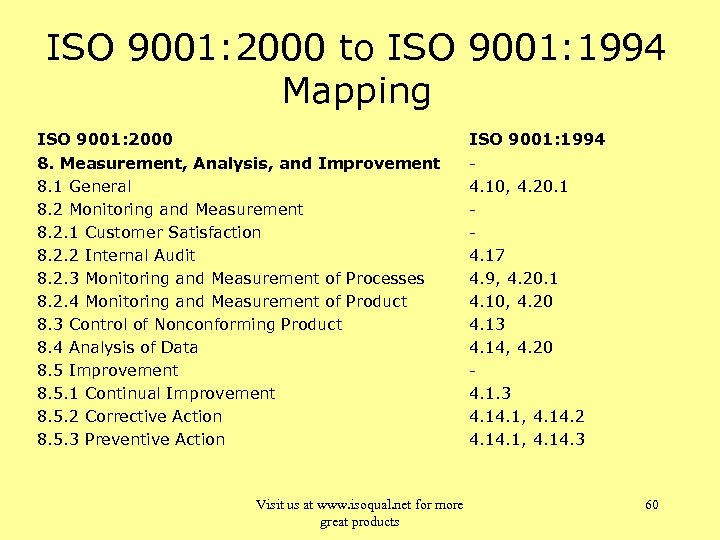 ISO 9001: 2000 to ISO 9001: 1994 Mapping ISO 9001: 2000 8. Measurement, Analysis, and Improvement 8. 1 General 8. 2 Monitoring and Measurement 8. 2. 1 Customer Satisfaction 8. 2. 2 Internal Audit 8. 2. 3 Monitoring and Measurement of Processes 8. 2. 4 Monitoring and Measurement of Product 8. 3 Control of Nonconforming Product 8. 4 Analysis of Data 8. 5 Improvement 8. 5. 1 Continual Improvement 8. 5. 2 Corrective Action 8. 5. 3 Preventive Action Visit us at www. isoqual. net for more great products ISO 9001: 1994 4. 10, 4. 20. 1 4. 17 4. 9, 4. 20. 1 4. 10, 4. 20 4. 13 4. 14, 4. 20 4. 1. 3 4. 1, 4. 14. 2 4. 1, 4. 14. 3 60
 Where can I obtain more information? • On the world-wide web: ISO web site TC 176 web site ASQ web site ISO-ONLINE web site www. iso. ch www. bsi. org. uk/iso-176 -sc 2 www. asq. org www. isoqual. net • Other questions? ISO-ONLINE Email: isoqual@isoqual. net or call (502) 244 -6183 Visit us at www. isoqual. net for more great products 61