


 Скачать презентацию Presented to AMSC One SAF Workshop Missile Model
f3ded577e668b745aca657316afa1e71.ppt
- Количество слайдов: 14
 Presented to: AMSC One. SAF Workshop Missile Model Development Presented by: Gene Shreve January 17 th 2008 Sr. Software Engineer Science Applications International Corporation (SAIC) Supporting the Aviation and Missile Research, Development and Engineering Center Approved for public release; distribution unlimited. Review completed by the AMRDEC Public Affairs Office (DATE and FN#).
 Agenda • • 2 AMRDEC-SSDD Introduction RDA Domain Needs AMRDEC-SSDD Current Methods One. SAF Transition Yourfilename. ppt
 RDA Domain Needs • • 3 Example – Extended Area Protection & Survivability (EAPS) – Monte-Carlo – multiple repetitions – Complex analysis – Deep dives into output data/results Need representations in One. SAF that are appropriate for purpose: – Appropriate fidelity – Valid – Re-usable and distributable – PM-sanctioned Yourfilename. ppt
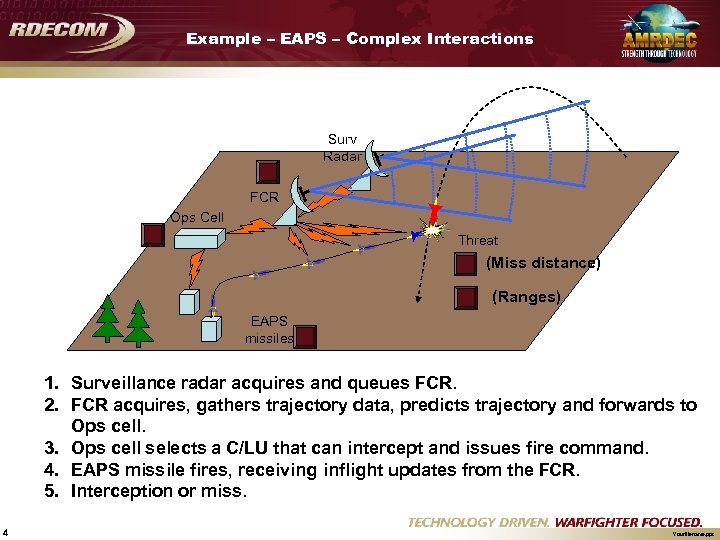 Example – EAPS – Complex Interactions Surv Radar FCR Ops Cell Threat (Miss distance) (Ranges) EAPS missiles 1. Surveillance radar acquires and queues FCR. 2. FCR acquires, gathers trajectory data, predicts trajectory and forwards to Ops cell. 3. Ops cell selects a C/LU that can intercept and issues fire command. 4. EAPS missile fires, receiving inflight updates from the FCR. 5. Interception or miss. 4 Yourfilename. ppt
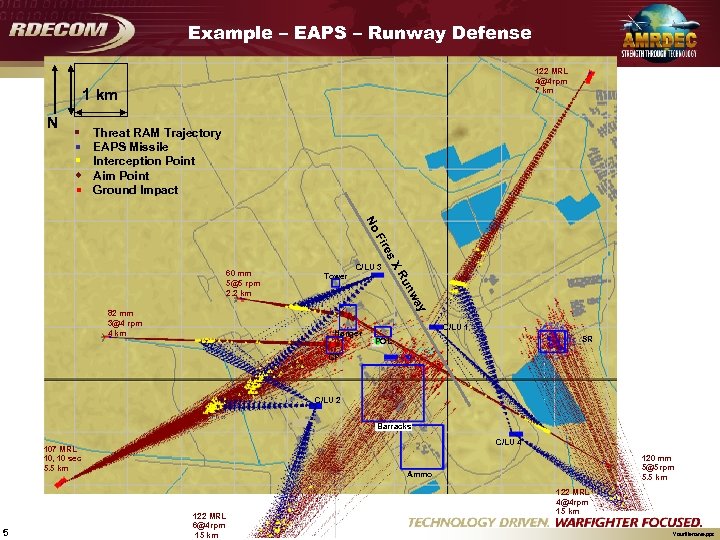 Example – EAPS – Runway Defense 122 MRL 4@4 rpm 7 km 1 km N Threat RAM Trajectory EAPS Missile Interception Point Aim Point Ground Impact No es Fir Tower C/LU 3 un XR y wa 60 mm 5@5 rpm 2. 2 km 82 mm 3@4 rpm 4 km Hanger C/LU 1 SR POL CP C/LU 2 Barracks C/LU 4 107 MRL 10, 10 sec 5. 5 km 5 120 mm 5@5 rpm 5. 5 km Ammo 122 MRL 6@4 rpm 15 km 122 MRL 4@4 rpm 15 km Yourfilename. ppt
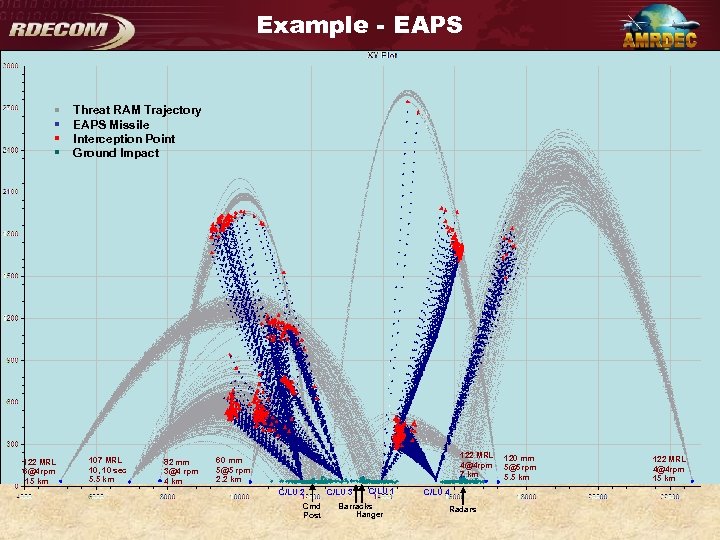 Example - EAPS Threat RAM Trajectory EAPS Missile Interception Point Ground Impact 122 MRL 6@4 rpm 15 km 107 MRL 10, 10 sec 5. 5 km 82 mm 3@4 rpm 4 km 122 MRL 4@4 rpm 7 km 60 mm 5@5 rpm 2. 2 km C/LU 2 Cmd Post 6 C/LU 3 C/LU 1 Barracks Hanger 120 mm 5@5 rpm 5. 5 km 122 MRL 4@4 rpm 15 km C/LU 4 Radars Yourfilename. ppt
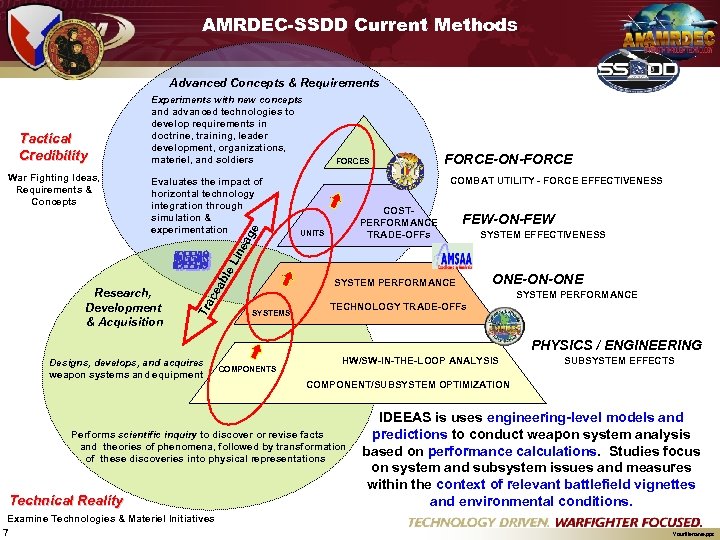 AMRDEC-SSDD Current Methods Advanced Concepts & Requirements Tactical Credibility Evaluates the impact of horizontal technology integration through simulation & experimentation FORCES FORCE-ON-FORCE COMBAT UTILITY - FORCE EFFECTIVENESS COSTPERFORMANCE TRADE-OFFs UNITS FEW-ON-FEW SYSTEM EFFECTIVENESS ble Lin ea ge War Fighting Ideas, Requirements & Concepts Experiments with new concepts and advanced technologies to develop requirements in doctrine, training, leader development, organizations, materiel, and soldiers ea Tr ac Research, Development & Acquisition SYSTEM PERFORMANCE ONE-ON-ONE SYSTEM PERFORMANCE SYSTEMS TECHNOLOGY TRADE-OFFs PHYSICS / ENGINEERING Designs, develops, and acquires weapon systems and equipment COMPONENTS HW/SW-IN-THE-LOOP ANALYSIS COMPONENT/SUBSYSTEM OPTIMIZATION Performs scientific inquiry to discover or revise facts and theories of phenomena, followed by transformation of these discoveries into physical representations Technical Reality Examine Technologies & Materiel Initiatives 7 SUBSYSTEM EFFECTS IDEEAS is uses engineering-level models and predictions to conduct weapon system analysis based on performance calculations. Studies focus on system and subsystem issues and measures within the context of relevant battlefield vignettes and environmental conditions. Yourfilename. ppt
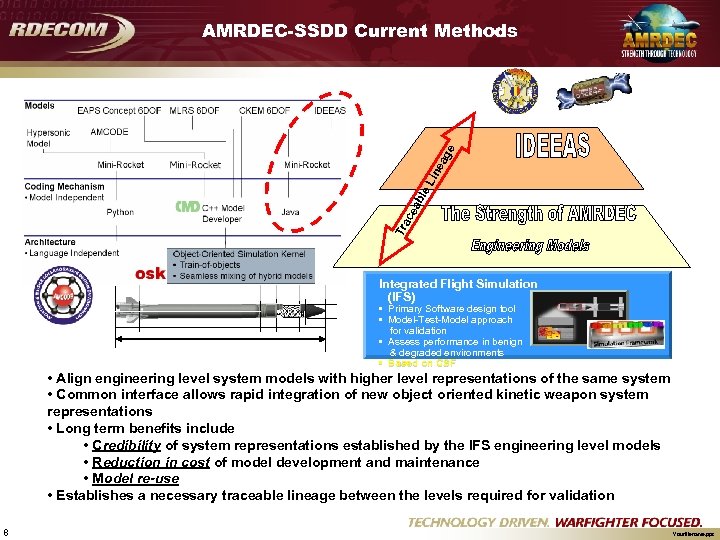 Tr ac ea ble Lin ea ge AMRDEC-SSDD Current Methods Integrated Flight Simulation (IFS) • Primary Software design tool • Model-Test-Model approach for validation • Assess performance in benign & degraded environments • Based on CSF • Align engineering level system models with higher level representations of the same system • Common interface allows rapid integration of new object oriented kinetic weapon system representations • Long term benefits include • Credibility of system representations established by the IFS engineering level models • Reduction in cost of model development and maintenance • Model re-use • Establishes a necessary traceable lineage between the levels required for validation 8 Yourfilename. ppt
 Mission Needs Statement for One. SAF • • • Reduce duplication of M&S investments Foster interoperability and reuse across M&S domains Meet M&S requirements of the future force. Mission Needs Statement for One. SAF, approved May 1997 by the Deputy Commanding General, Training and Doctrine Command (TRADOC) 9 Yourfilename. ppt
 Reduce Duplication • 10 AMRDEC-SSDD as One. SAF co-developer for missile system representations creates a single source for… – Missile and Aviation subject matter expertise – Model development – A repository of missile models that are: • PM-sanctioned • Traceable, Valid • Configuration Managed Yourfilename. ppt
 Interoperability, Re-Use, Future Force • • 11 Calls for higher-fidelity missile representations across domains – Battle Labs (ACR) – Redstone Technical Test Center (TEMO) supporting FCS Future Force – Future Combat Systems Simulation Environment (FSE) AMRDEC-SSDD currently provides Missile Server The way ahead… – Transition AMRDEC-SSDD models to One. SAF – Design for interoperability – similar to Missile Server Yourfilename. ppt
 NLOS-LS • • • 12 Precision Attack Missile (PAM) One. SAF currently provides a single low-fidelity model Integrating higher-fidelity model – Developed by AMRDEC-SSDD – Lineage to hi-fi engineering simulation Yourfilename. ppt
 Points of Contact • Laurie Fraser Chief, Advanced Experimentation System Simulation & Development Directorate AMRDEC, RDECOM laurie. fraser@us. army. mil 256 -876 -1353 • Gene J. Shreve Sr. Software Engineer Science Applications International Corporation (SAIC) gene. shreve@us. army. mil 256 -842 -0409 Office 256 -876 -8041 FAX 13 Yourfilename. ppt
 AMRDEC SSDD supports the complimentary use of both CMD and CSF is used for detailed design of systems involving or requiring such things as tactical software, scene generation, tracking algorithms, and integrated flight simulation. CSF is often required in prime contractor scopes of work to ensure a common environment for simulation supporting acquisition. CMD is used as a tool for tech base or early design, providing quick and easy analysis and supporting design trade studies, as well as integration into battlefield effectiveness analysis. A study was conducted by Aegis Research which showed that the similar approaches of the two architectures allowed easy transition from CMD to CSF in the event that a contractor or lab used CMD for early design and needed to evolve to CSF as the design matured. Likewise, SSDD has demonstrated an abstraction process to take "Accredited" CSF models that are approved by the project office, and generate CMD-based data and models for use in realtime and fast-running applications. SSDD will continue to support these two products and services, and will look for opportunities to develop tools and automated processes to ease transition between the two, as needed. ^*^ Greg B. Tackett, SES Director, SSDD 10/26/2006 14 Yourfilename. ppt