


 Скачать презентацию Presentations AS 90374 Internal Assessment 3 Credits
aec510733adb6a6280973d65a9656967.ppt
- Количество слайдов: 26
 Presentations AS 90374 Internal Assessment 3 Credits
 Deliver a presentation using oral and visual language techniques
 Learners are expected to; ·deliver a presentation directed at a specific audience and purpose ·use appropriate oral and visual language techniques
 Important Information 1. This presentation is predominately an oral presentation, using verbal and visual techniques to enhance the presentation. This presentation must be prepared by the learner. 2. Developed ideas means to expand or clarify ideas by adding detail with explanations, examples and evidence. 3. Oral presentation techniques include variation in voice (tone, volume, pace, stress) 4. Visual presentation techniques may include some of the following: ·Body language: stance, gesture, facial expression; ·static image, e. g. poster, visual display material ·moving/electronic image, e. g. video, Power. Point display, web page, website; ·dramatic presentation, e. g. role play, performance of a poem, or a scene of a play ·props, costume, demonstration materials/items. 5. Audience suggests a number of people, e. g. a class or group of peers. The delivery of the presentation should be formal. Its length needs to be appropriate to the purpose and sufficient to provide evidence of meeting the grade criteria. 6. Alternative languages may be used as an effect, e. g. a greeting, but the presentation is to be mainly in English to demonstrate a command of the spoken English language. 7. The main focus is your spoken words. You should speak for at least four minutes so you can demonstrate enough skills a quality to pass this Achievement Standard. 8. Your presentation is to be filmed.
 To gain Achievement you will be required to: ·Communicate straightforward ideas; ·use appropriate visual and oral language and presentation techniques for a specific audience and purpose; ·present material clearly
 To gain Achievement with Merit you will be required to: ·Communicate developed ideas; ·Combine appropriate visual and oral language and presentation techniques for a specific audience and purpose; ·present material confidently and coherently
 To gain Achievement with Excellence you will be required to: ·Communicate fully developed ideas; ·Integrate appropriate visual and oral language and presentation techniques for a specific audience and purpose; ·Present material coherently and confidently in ways that are striking and/or innovative
 Your Achieving in English 2 Text book is the most valuable resource you have for this unit. Pages 142 - 163 These must be completed both in-class and as home-learning. Guidance, direction and group discussion time will occur in class. You must take responsibility for ensuring all class activities and home-learning is completed, in-order to allow you the best preparation possible before you do your presentation.
 Our classes focus for these presentations is as follows; I kno w where your coming from. . .
 Context/setting: In this activity learners prepare and deliver a presentation to the class about an aspect in their history that has had a significant influence in shaping their lives, such as a place, an event, their culture, traditions, beliefs, ancestors, family, role models. The topic is deliberately general to give all learners the opportunity to select details they feel comfortable in sharing with their class. To ensure that learners are familiar with what is appropriate material and language in this context, please feel free to discuss any questions, issues or queries with me. It is very important that you are fully aware of anything that is not appropriate for this kind of presentation. You should also ensure that you feel comfortable with sharing the material you have prepared and understand that an atmosphere of safety and respect is expected, established and respected by all.
 Please understand you will need resources to complete this activity. All materials worked on when creating your presentation must be kept and handed in. Resource requirements: Learners will need: ·copies of the annotated transcripts of students work included in this activity ·copies of the peer and self evaluation templates ·access to a video camera and TV for self evaluation (optional) ·access to research materials ·access to audio and visual resources such as Data. Shows, whiteboards, smartboard etc, as appropriate to their delivery. If you need anything, please ensure adequate time for appropriate and necessary organisation, such as bookings to be made etc. . .
 Learners Instructions; This activity requires you to prepare and deliver a presentation of at least four minutes to your class and teacher. Your presentation will be about an important aspect of your history such as a place, your culture, traditions, beliefs, ancestors, family, or your role models. You will need to prepare and deliver your presentation so that it: ·gives the audience important information about this aspect of your history ·shows the effect it has had on your life. You will be assessed on how well you: ·develop and organise ideas about your topic ·integrate visual and verbal delivery techniques to communicate your ideas to your audience.
 Introduction Our lives are shaped by many different things: our culture, beliefs, ancestors, family, the people we come to know, places and events, have all helped make us who are we today. Sometimes we don't really realise how important some of these events, places and people have been in shaping/influencing our lives until we reflect. Don't make a rash decision regarding your presentation. Talk to family and peers, as well as myself. Complete all brainstorm activities and think outside the square regarding the normal expectations.
 Getting Started Brainstorm some oral history topics - about particular people, places, and events - from your ‘history’ that have helped make you into the person you are today. One of these topics could form the basis for the oral history you will present to the class. Choose one topic from your brainstorm that you wish to focus on and could talk about. It should be a topic that you are interested in, that your classmates would find interesting and informative, and one which you would feel comfortable sharing with your class. You should try to incorporate anecdotes linked to your topic. Some television documentaries focus on people and their stories to bring a subject to life. You should try the same approach to interest your audience. The oral history you present will be more than a list of facts. Think about the stories you could focus on. Get into pairs. Talk to your partner for one minute. You could start by telling them a story or anecdote linked to your oral history topic. If you run out of things to say your partner could ask you some clarifying questions like: ·”Why did she want to leave her home country? ” ·“Could you describe what she looked like? ” ·“What happened to him when he got older? ” ·“Could you explain what you meant when you said…. ? ”. Swap roles and repeat the activity. Write on your topic for about 30 minutes. Try to get your ideas down on paper as fast as you can. This is just a first draft so don’t worry too much about the organisation, or correctness of your writing. Make a final decision on your topic. Be sure that your oral history topic is broad enough to allow you to speak for at least four minutes, that it will be informative and interesting to your class, and that you feel comfortable about sharing it with your class. Briefly discuss your topic with your teacher before developing it any further.
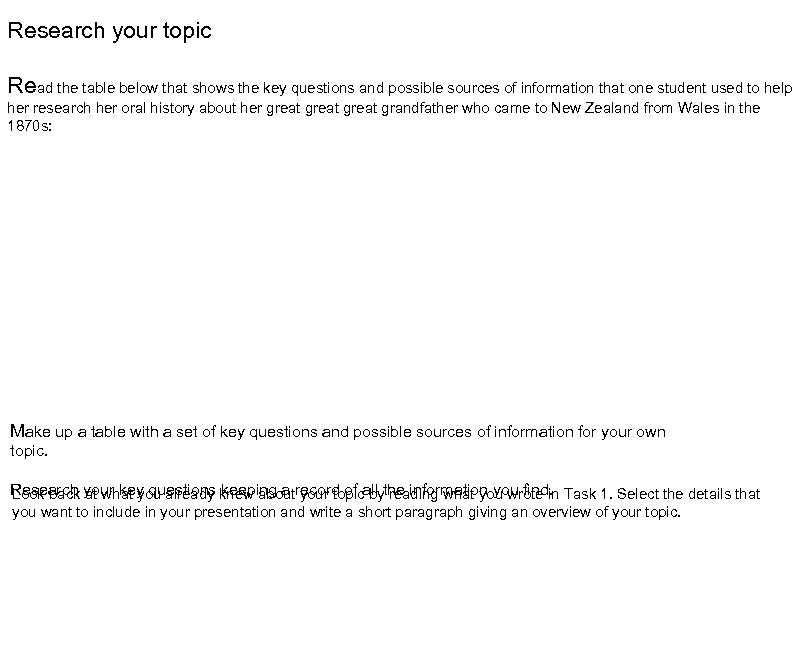 Research your topic Read the table below that shows the key questions and possible sources of information that one student used to help her research her oral history about her great grandfather who came to New Zealand from Wales in the 1870 s: Make up a table with a set of key questions and possible sources of information for your own topic. Research your key questions knew aboutrecord of all the information you find. Task 1. Select the details that Look back at what you already keeping a your topic by reading what you wrote in you want to include in your presentation and write a short paragraph giving an overview of your topic.
 Choosing a presentation style Choose a creative, interesting and appropriate way to present your material. Some possibilities are: ·presenting a teaching seminar incorporating audio-visual materials such as music, OHPs, photographs, or posters. ·taking on the role of a character(s) in the oral history by speaking in the first person. If you decide to present your oral history in this way, you may need to step out of role to introduce your character or move to a different part of the story. ·using an interview format where you prepare the questions and give them to another class member to ask you while you are in role. You could adapt this question/answer format as a type of ‘This is Your Life’ special. Another student could take the host role and read your prepared questions while you answer them as a character(s) in your oral history. Your speaking role should be at least four minutes long. ·including an object (like an item of clothing, a photo, a letter) as part of your presentation. If you plan to bring a valuable item to school you should talk about this first with your family and your teacher. The style of your presentation must be appropriate to your material and purpose, and should help make your material clear to the audience. You must gain your teacher’s approval for your oral history topic and presentation method before you continue with the other activities. If I am not present please email me and wait for a reply.
 Organising your ideas and writing The presentation method you use will affect the way you organise your oral history. There are two following examples. Please read them clearly to gain the best possible understanding you can to different styles of presentations you can Complete.
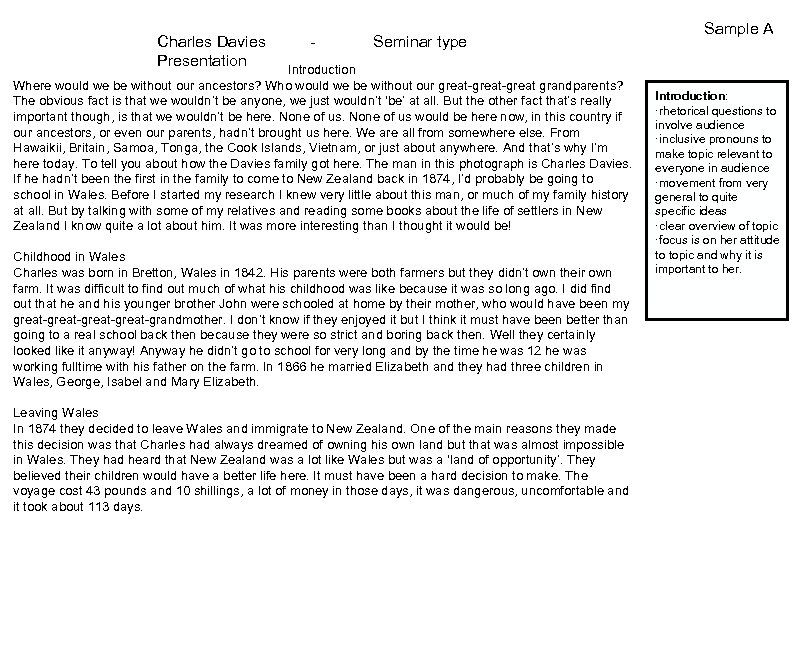 Charles Davies Presentation - Seminar type Introduction Where would we be without our ancestors? Who would we be without our great-great grandparents? The obvious fact is that we wouldn’t be anyone, we just wouldn’t ‘be’ at all. But the other fact that’s really important though, is that we wouldn’t be here. None of us would be here now, in this country if our ancestors, or even our parents, hadn’t brought us here. We are all from somewhere else. From Hawaikii, Britain, Samoa, Tonga, the Cook Islands, Vietnam, or just about anywhere. And that’s why I’m here today. To tell you about how the Davies family got here. The man in this photograph is Charles Davies. If he hadn’t been the first in the family to come to New Zealand back in 1874, I’d probably be going to school in Wales. Before I started my research I knew very little about this man, or much of my family history at all. But by talking with some of my relatives and reading some books about the life of settlers in New Zealand I know quite a lot about him. It was more interesting than I thought it would be! Childhood in Wales Charles was born in Bretton, Wales in 1842. His parents were both farmers but they didn’t own their own farm. It was difficult to find out much of what his childhood was like because it was so long ago. I did find out that he and his younger brother John were schooled at home by their mother, who would have been my great-great-grandmother. I don’t know if they enjoyed it but I think it must have been better than going to a real school back then because they were so strict and boring back then. Well they certainly looked like it anyway! Anyway he didn’t go to school for very long and by the time he was 12 he was working fulltime with his father on the farm. In 1866 he married Elizabeth and they had three children in Wales, George, Isabel and Mary Elizabeth. Leaving Wales In 1874 they decided to leave Wales and immigrate to New Zealand. One of the main reasons they made this decision was that Charles had always dreamed of owning his own land but that was almost impossible in Wales. They had heard that New Zealand was a lot like Wales but was a ‘land of opportunity’. They believed their children would have a better life here. It must have been a hard decision to make. The voyage cost 43 pounds and 10 shillings, a lot of money in those days, it was dangerous, uncomfortable and it took about 113 days. Sample A Introduction: ·rhetorical questions to involve audience ·inclusive pronouns to make topic relevant to everyone in audience ·movement from very general to quite specific ideas ·clear overview of topic ·focus is on her attitude to topic and why it is important to her.
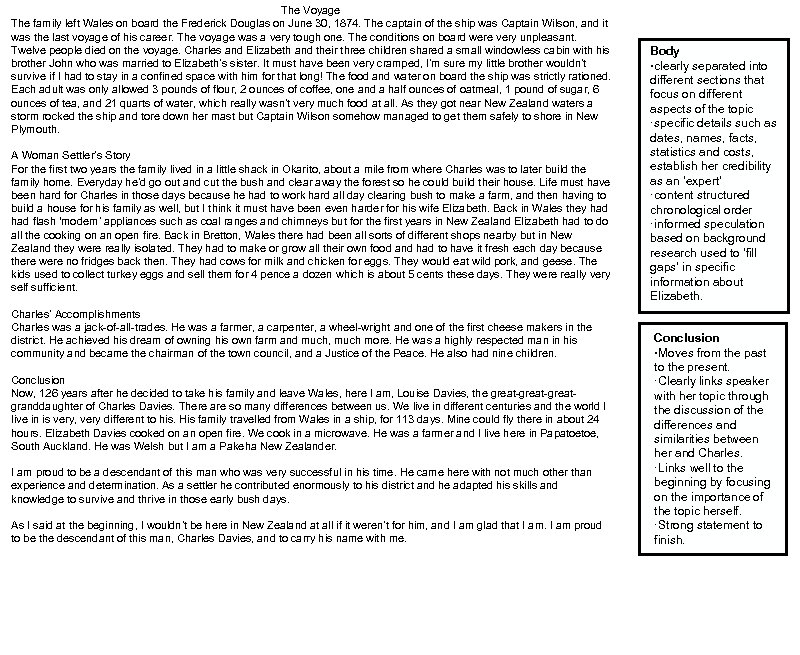 The Voyage The family left Wales on board the Frederick Douglas on June 30, 1874. The captain of the ship was Captain Wilson, and it was the last voyage of his career. The voyage was a very tough one. The conditions on board were very unpleasant. Twelve people died on the voyage. Charles and Elizabeth and their three children shared a small windowless cabin with his brother John who was married to Elizabeth’s sister. It must have been very cramped, I’m sure my little brother wouldn’t survive if I had to stay in a confined space with him for that long! The food and water on board the ship was strictly rationed. Each adult was only allowed 3 pounds of flour, 2 ounces of coffee, one and a half ounces of oatmeal, 1 pound of sugar, 6 ounces of tea, and 21 quarts of water, which really wasn’t very much food at all. As they got near New Zealand waters a storm rocked the ship and tore down her mast but Captain Wilson somehow managed to get them safely to shore in New Plymouth. A Woman Settler’s Story For the first two years the family lived in a little shack in Okarito, about a mile from where Charles was to later build the family home. Everyday he’d go out and cut the bush and clear away the forest so he could build their house. Life must have been hard for Charles in those days because he had to work hard all day clearing bush to make a farm, and then having to build a house for his family as well, but I think it must have been even harder for his wife Elizabeth. Back in Wales they had flash ‘modern’ appliances such as coal ranges and chimneys but for the first years in New Zealand Elizabeth had to do all the cooking on an open fire. Back in Bretton, Wales there had been all sorts of different shops nearby but in New Zealand they were really isolated. They had to make or grow all their own food and had to have it fresh each day because there were no fridges back then. They had cows for milk and chicken for eggs. They would eat wild pork, and geese. The kids used to collect turkey eggs and sell them for 4 pence a dozen which is about 5 cents these days. They were really very self sufficient. Charles’ Accomplishments Charles was a jack-of-all-trades. He was a farmer, a carpenter, a wheel-wright and one of the first cheese makers in the district. He achieved his dream of owning his own farm and much, much more. He was a highly respected man in his community and became the chairman of the town council, and a Justice of the Peace. He also had nine children. Conclusion Now, 126 years after he decided to take his family and leave Wales, here I am, Louise Davies, the great-greatgranddaughter of Charles Davies. There are so many differences between us. We live in different centuries and the world I live in is very, very different to his. His family travelled from Wales in a ship, for 113 days. Mine could fly there in about 24 hours. Elizabeth Davies cooked on an open fire. We cook in a microwave. He was a farmer and I live here in Papatoetoe, South Auckland. He was Welsh but I am a Pakeha New Zealander. I am proud to be a descendant of this man who was very successful in his time. He came here with not much other than experience and determination. As a settler he contributed enormously to his district and he adapted his skills and knowledge to survive and thrive in those early bush days. As I said at the beginning, I wouldn’t be here in New Zealand at all if it weren’t for him, and I am glad that I am proud to be the descendant of this man, Charles Davies, and to carry his name with me. Body ·clearly separated into different sections that focus on different aspects of the topic ·specific details such as dates, names, facts, statistics and costs, establish her credibility as an ‘expert’ ·content structured chronological order ·informed speculation based on background research used to ‘fill gaps’ in specific information about Elizabeth. Conclusion ·Moves from the past to the present. ·Clearly links speaker with her topic through the discussion of the differences and similarities between her and Charles. ·Links well to the beginning by focusing on the importance of the topic herself. ·Strong statement to finish.
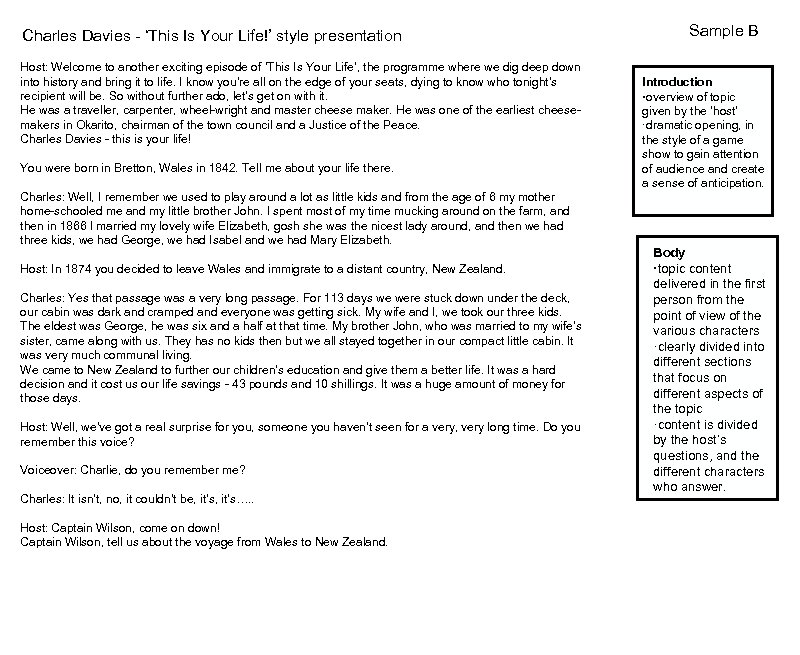 Charles Davies - ‘This Is Your Life!’ style presentation Host: Welcome to another exciting episode of ‘This Is Your Life’, the programme where we dig deep down into history and bring it to life. I know you’re all on the edge of your seats, dying to know who tonight’s recipient will be. So without further ado, let’s get on with it. He was a traveller, carpenter, wheel-wright and master cheese maker. He was one of the earliest cheesemakers in Okarito, chairman of the town council and a Justice of the Peace. Charles Davies - this is your life! You were born in Bretton, Wales in 1842. Tell me about your life there. Charles: Well, I remember we used to play around a lot as little kids and from the age of 6 my mother home-schooled me and my little brother John. I spent most of my time mucking around on the farm, and then in 1866 I married my lovely wife Elizabeth, gosh she was the nicest lady around, and then we had three kids, we had George, we had Isabel and we had Mary Elizabeth. Host: In 1874 you decided to leave Wales and immigrate to a distant country, New Zealand. Charles: Yes that passage was a very long passage. For 113 days we were stuck down under the deck, our cabin was dark and cramped and everyone was getting sick. My wife and I, we took our three kids. The eldest was George, he was six and a half at that time. My brother John, who was married to my wife’s sister, came along with us. They has no kids then but we all stayed together in our compact little cabin. It was very much communal living. We came to New Zealand to further our children’s education and give them a better life. It was a hard decision and it cost us our life savings - 43 pounds and 10 shillings. It was a huge amount of money for those days. Host: Well, we’ve got a real surprise for you, someone you haven’t seen for a very, very long time. Do you remember this voice? Voiceover: Charlie, do you remember me? Charles: It isn’t, no, it couldn’t be, it’s…. . Host: Captain Wilson, come on down! Captain Wilson, tell us about the voyage from Wales to New Zealand. Sample B Introduction ·overview of topic given by the ‘host’ ·dramatic opening, in the style of a game show to gain attention of audience and create a sense of anticipation. Body ·topic content delivered in the first person from the point of view of the various characters ·clearly divided into different sections that focus on different aspects of the topic ·content is divided by the host’s questions, and the different characters who answer.
 Captain Wilson: We left Wales bound for New Zealand on June 30, 1874, on the Frederick Douglas. The voyage was a very tough one. As we got near New Zealand waters a storm rocked the ship and tore down her mast. I felt very sorry for the people on board because they didn’t have much food and all these people started dying. Twelve people died on the voyage. On that ship each adult had 3 pounds of flour, 2 ounces of coffee, one and a half ounces of oatmeal, 1 pound of sugar, 6 ounces of tea, and 21 quarts of water. That really wasn’t much food at all. I remember the Davies family well, those three little kids tearing around the ship, all excited about everything. It was the last voyage of my career. Host: Thank you Captain Wilson. Well Charles, here’s someone you had better remember. Come on down Elizabeth Davies. Elizabeth, tell me about the first few years in this new country. Elizabeth: To begin with I had a very good impression of the country. It was very green with lots of bush and native trees. It was beautiful. With my three children we lived in a shack about a mile from where Charles was to build our country house. Everyday he’d go out and cut the bush and clear away the forest so he could build our house. The cooking was hard in those times because we had nothing but an open fire. There were no stoves like back in Wales and all our meat and food had to be fresh each day. We had cows for milk and chickens for eggs. We’d eat wild pork, and geese. The kids used to collect turkey eggs and sell them for 4 pence a dozen which is about 5 cents these days. We were really very self sufficient. Charles became a well known cheese maker in the district and we used to have all this cheese sitting round in our living room. It would get pretty smelly sometimes, but I guess it was all profit for the family. All in all, the move to New Zealand was the best thing we ever did. Host: Now we have the great-great-granddaughter of Charles Davies, Louise Davies. Me: Well, yes, this is me, here in Papatoetoe, South Auckland. I am a descendant of this man who was very successful in his time. My great-great-grandfather brought with him experience and determination to share with his community. As a settler he contributed enormously to his district and he adapted his skills and knowledge to survive and thrive in those early bush days. His large family of 9 children spanned 23 years and he laid a foundation for the future of his family with hard work. Each of his children received the encouragement needed to be independent and successful and I am really proud and glad to be the descendant of this man, Charles Davies, and to carry his name with me. Body (cont) ·content structured in chronological order ·clear details such as dates, names, facts ·characters have a ‘personal voice’ created through appropriate dialogue, colloquial language, catchphrases, accents. Conclusion ·final character is the student as herself ·moves from past to present ·student explains importance of topic to herself ·general summary of his accomplishments ·strong statement to end.
 a) Organise all the details you have chosen to include in your presentation under three or four subheadings. If you have chosen a question and answer style of presentation you should organise your material under different questions. b) Refer back to Sample A and Sample B for possible subheadings and questions. c) Write an introduction for your presentation. This should grab the attention of your audience and give them an overview of your topic. d) Now write the body of your presentation by developing the ideas you listed under the subheadings in above. Expand your ideas with anecdotes, facts, dates, quotations, names of people and places. Clearly separate each section with a topic sentence or topic question at the beginning. e) Write a conclusion. This should briefly sum up your main ideas, and explain how these factors have influenced you, how you feel about them, and how you think they will affect you in the future.
 Planning your delivery Choose some audio/visual aids to enhance your presentation. For a seminar presentation these could include: photographs, illustrations, maps, diagrams, family trees, music, video, and Power. Point. A monologue or ‘This is Your Life’ style of presentation could use costume, props, make up, and music. Consider how you will present these materials, taking into account factors such as the size of your audience, the venue for your presentation, and what resources are available to you. Be prepared. ·Check with me before your presentation so that I can book any relevant equipment. Check that all equipment is working, and cue up any audio or video tapes before you begin your delivery. · ·Make sure everyone in your audience can see the materials you bring. In some instances it may be appropriate to pass a photograph or object around the class but it will usually be better to enlarge it somehow. Feel free to use the digital resources at school to support your presentation. ·If you wish to use the smartboard, ensure you are completely organised an have back ups of your presentation before you deliver your presentation. ·Use audio/visual aids selectively. Sometimes using too many aids, or using them inappropriately, can distract your audience so be careful that they really will help make your presentation clearer. Ensure your delivery is completely planned, and you are completely aware of what support material you are going to use and when in your planning. This should be written into your material as a 'prompt'. It is very important that you are completely organised. It will affect your presentation, and of course your grading if you do not appear to be organised with your delivery.
 Before delivering your speech, look at the exemplars on the NCEA Level 2 Speeches and Performances video issued to schools by the Ministry of Education and available through www. vislearn. co. nz. Discuss their strengths and areas they could be improved. You may not use this material in your own presentation.
 Rehearsal and presentation Rehearse your presentation. Make sure that ·your voice is loud and clear ·you use eye contact ·you are not too reliant on your notes. To help prepare for your delivery to the class, you could video yourself delivering your presentation to a small group. Each person in your group will complete the peer and self review template and give back to you. Watch the video and complete the peer and self review template yourself. Use the suggestions on the templates to help you improve your presentation. Peer and Self Review Template
 Remember to keep the below points in mind constantly. You must be aware of the Assessment focus in order to give you the biggest chance of success! To gain Achievement you will be required to: ·Communicate straightforward ideas; ·use appropriate visual and oral language and presentation techniques for a specific audience and purpose; ·present material clearly To gain Achievement with Merit you will be required to: ·Communicate developed ideas; ·Combine appropriate visual and oral language and presentation techniques for a specific audience and purpose; ·present material confidently and coherently To gain Achievement with Excellence you will be required to: ·Communicate fully developed ideas; ·Integrate appropriate visual and oral language and presentation techniques for a specific audience and purpose; ·Present material coherently and confidently in ways that are striking and/or innovative