


 Скачать презентацию Presentations and Conferences Helen C Harton University of
b055e0b5e84895f5f2809b21a82e57dc.ppt
- Количество слайдов: 29
 Presentations and Conferences Helen C. Harton University of Northern Iowa Collaborators: Anyone and everyone
 General Info n n n Where should you present? How should you present (poster vs. paper)? Can you present something more than once? What should you put in the abstract? (follow directions, use completed data, # words) Read the instructions for abstracts and presentations
 Why present? It’s fun! n It’s important! n Types of presentations n – – – Addresses Symposia Invited talks Presentations Posters Submit abstract n Some possible conferences for you n
 General conference tips Consider going to conferences alone n Dress professionally n – And not too weird or sexy Consider your audience n Be on time (or early) n Stay for the whole session n
 For either n Don’t use acronyms n Bring backups n Don’t use busy backgrounds n Don’t overcaffeinate n Fonts: – San serif for headings, ppt – Serif for text people will be reading close up n Try to show, rather than tell
 Mostly Posters n Make it big and friendly/readable n Make it one or several pages n Don’t leave poster un-personed n Use pictures/graphs IF they add n Use black text on white/light background, avoid patterned backgrounds
 n Keep font size and color scheme consistent (and not distracting) n Don’t overtext n Have references somewhere n Prepare your “talk”
 Mostly Presentations n Move just enough, stand up, watch leaning n Speak to audience, not computer n Consider humor and enthusiasm n Make sure you can easily see a watch or clock
 n Don’t write out everything n Don’t carry cards with you if you can avoid it n Identify and try to hide your annoying habits n Know whether you practice slow or fast n Check out the room ahead of time
 Power. Point Hints n Don’t be too fancy (e. g. , sound, photos, videos) n Don’t be cutsy n Keep points short n Only use things that help make your points (e. g. , sounds, animation, backgrounds, effects)
 n Label your graphs and everything else n Cite things! n Think about copyright issues (photos, sound) n Consider your audience
 n Keep things parallel n For PPT, use light on dark n Use consistent scheme and font size n Don’t use color blind combos or weak colors (or weird backgrounds) n Keep in mind the 1 -6 -6 rule of thumb
 Research Talks n 10 -15 minutes at conferences n 20 -30 minutes thesis defense n 5 minutes data blitz n Overall, no more than minute a slide (1 -3 min)
 Introduction n Give nice lead in on intro slide n Address theory and some studies directly related to logic of hypo (keep lit review to min) n No more than 5 min til data at conf. (if 15 minute talk). Rule of less than 1/3 n Cite things that should be cited
 Models of Racism n Symbolic or modern racism (Mc. Conahay, Sears) n Aversive racism (Dovidio & Gaertner) n Ambivalent racism (Katz)
 Integrated Model of Racism n Dovidio & Gaertner, 1986, 1998 n Political conservatives—modern racism n Political liberals—aversive racism
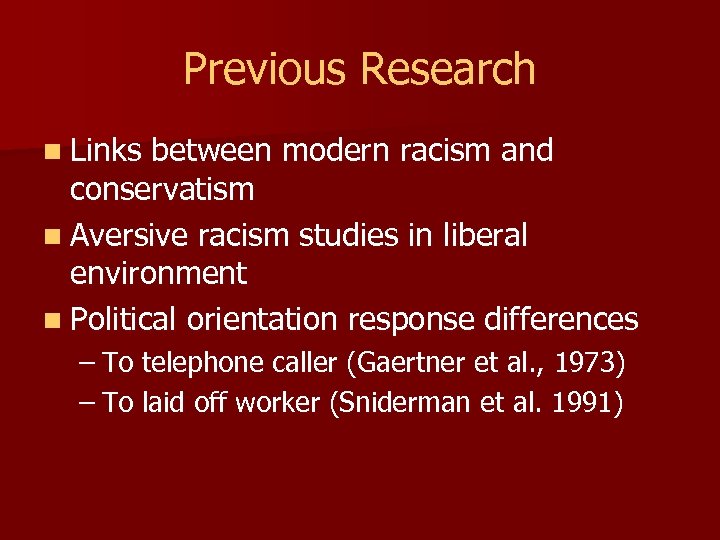 Previous Research n Links between modern racism and conservatism n Aversive racism studies in liberal environment n Political orientation response differences – To telephone caller (Gaertner et al. , 1973) – To laid off worker (Sniderman et al. 1991)
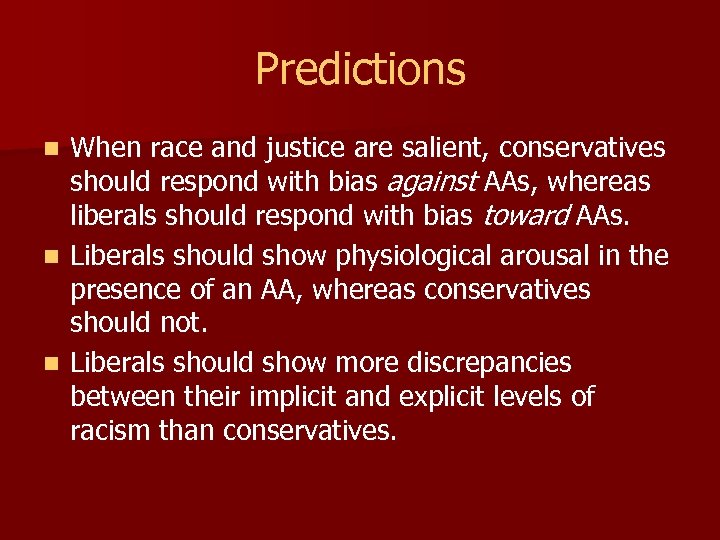 Predictions When race and justice are salient, conservatives should respond with bias against AAs, whereas liberals should respond with bias toward AAs. n Liberals should show physiological arousal in the presence of an AA, whereas conservatives should not. n Liberals should show more discrepancies between their implicit and explicit levels of racism than conservatives. n
 More Hints--Method n Go into more detail on method n Number and type of participants n Scales, sample items n General procedure n But still be concise n No less than 24 point font
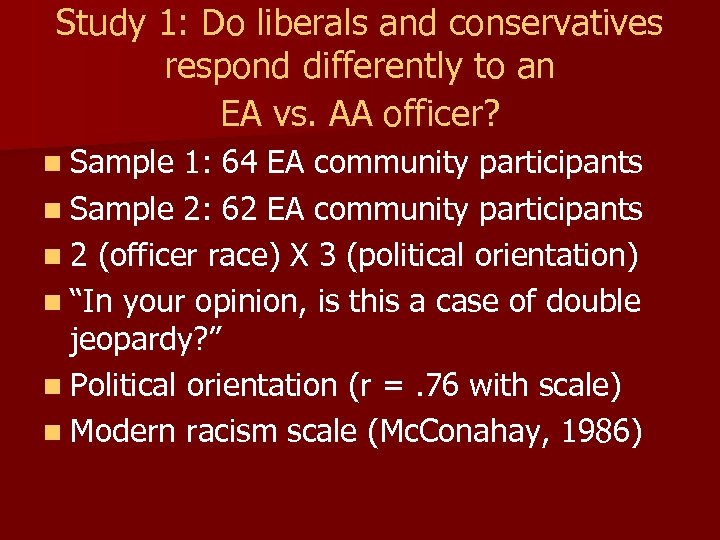 Study 1: Do liberals and conservatives respond differently to an EA vs. AA officer? n Sample 1: 64 EA community participants n Sample 2: 62 EA community participants n 2 (officer race) X 3 (political orientation) n “In your opinion, is this a case of double jeopardy? ” n Political orientation (r =. 76 with scale) n Modern racism scale (Mc. Conahay, 1986)
 More Hints--Results n SHOW DATA n Show variability, effect size, means n Use graphs and tables n Keep graphs simple (no 3 -D, etc. )
 n Label graphs n Point out what you want people to see n Know your graphs and data n Only present the most relevant results
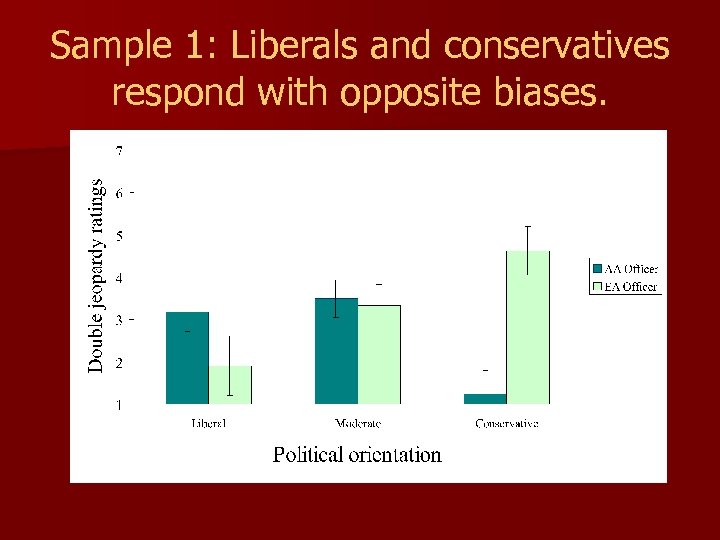 Sample 1: Liberals and conservatives respond with opposite biases.
 More Hints--Discussion n Summarize, tell what it means, explain weird results n Don’t get into “H 1” mode n Tie back to theory n Mention main limitations and ideas for future (briefly) n Talk about implications and end STRONG
 Conclusions n Liberals may have underlying negative feelings toward AAs that, together with a desire to be nonprejudiced, leads to inner conflict and a bias toward AAs in some situations. n Conservatives may have rationalized their negative feelings toward AAs, leading them to display bias against AAs in some situations.
 Further Research n n n Mediation of these effects (responsibility, anger, sympathy) Broader sample (web survey) Conservative reaction to conservative AAs Liberals breaking contact with AAs Liberals discriminating if can be attributed to non -race factors Combining physiological and rating data in one study in new area (dating)
 Implications n Although the results may seem discouraging, they do indicate that we’re moving closer to a “color-blind” society: – Conservatives didn’t always discriminate. – Moderates were fairly balanced. – Liberals’ inner conflict may lead them to be intolerant of prejudice.
 Responding to Questions n Always be nice n Make it sound like what they said makes sense n Don’t be defensive n If nothing else, say “that’s a good question —what do you think? ” n Be careful about attributing to others
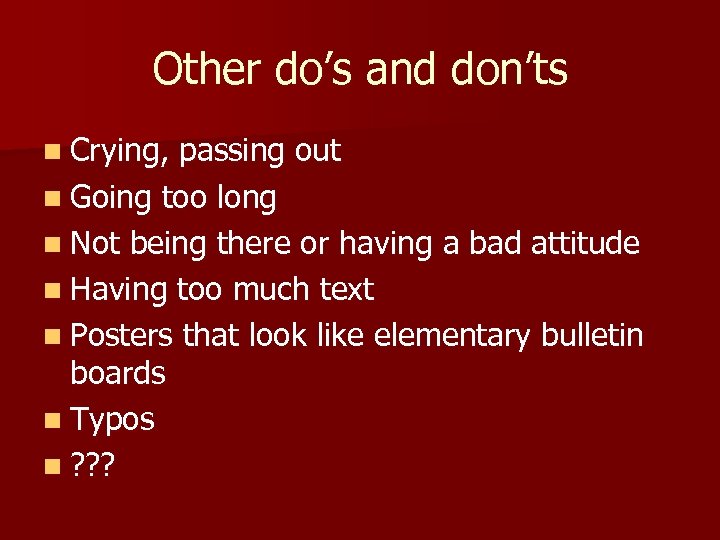 Other do’s and don’ts n Crying, passing out n Going too long n Not being there or having a bad attitude n Having too much text n Posters that look like elementary bulletin boards n Typos n ? ? ?