


 Скачать презентацию Presentation to The Social Development Portfolio Committee Parliament
769aa40ad2af337f162fa7e3c6fc7803.ppt
- Количество слайдов: 26
 Presentation to The Social Development Portfolio Committee Parliament Cape Town 21 November 2007
 STRUCTURE OF THE PRESENTATION 1. Background (CEO) 2. Performance against targets (CEO) 3. Annual Financial Report (CFO) 4. Report of the Auditor-General (CFO) 5. Projects Report (DMD) 6. Human Resources (CEO) 7. Way Forward (CEO) 8. Questions and comments 2
 BACKGROUND 1. Key sections of the Annual Report are: § The Overviews by the Minister; Chairperson of the Board and the CEO § Emphasis by the Minister and Chairperson of the Board included: § The NDA strengthens the second economy by providing grants to Civil Society Organisations (CSOs) and, through its capacity building programme, ensuring that CSOs are equipped with skills required to make them sustainable. § Through the strategic goal of organisational transformation, much emphasis has been placed on governance issues and improving systems and processes. § This resulted in the NDA receiving a clean, unqualified audit with no emphasis of matter from the Auditor-General – a praiseworthy and pleasing achievement. § Much needed stability and focus was brought to the NDA. § The revision of the NDA’s strategy and restructuring of the NDA presented challenges including 29 staff members taking voluntary severance packages. 3
 BACKGROUND continued § Despite the challenges faced, the NDA started to vigorously implement its five year strategic plan. § This has positioned the NDA as a key and relevant contributor to the fight against poverty. § Grant funding was undertaken through two approaches – Requests for proposals and programme formulation. § Funding of 95 projects for R 110, 97 million was approved by the Board and R 49, 5 million was disbursed during the year. § A capacity building programme on which R 25, 7 million will be spent over 2 years was introduced. § The Board’s term of office was drawing to a close and a new Board has been appointed. § The Minister paid tribute to the Board members for the good work they had done in building the NDA. § The Chairperson thanked the Minister for the confidence he had placed in the Board and for his unbridled support § The Chairperson also paid tribute to his fellow Board members, the CEO and the staff. 4
 POVERTY STATISTICS • Levels of Poverty • The current estimates of poverty by HSRC show that the proportion of people living in poverty in South Africa is as follows: - § Approximately 57% of individuals in South Africa were living below the poverty income line in 2001, unchanged from 1996. § This translates into 26 m people being classified as poor. 5
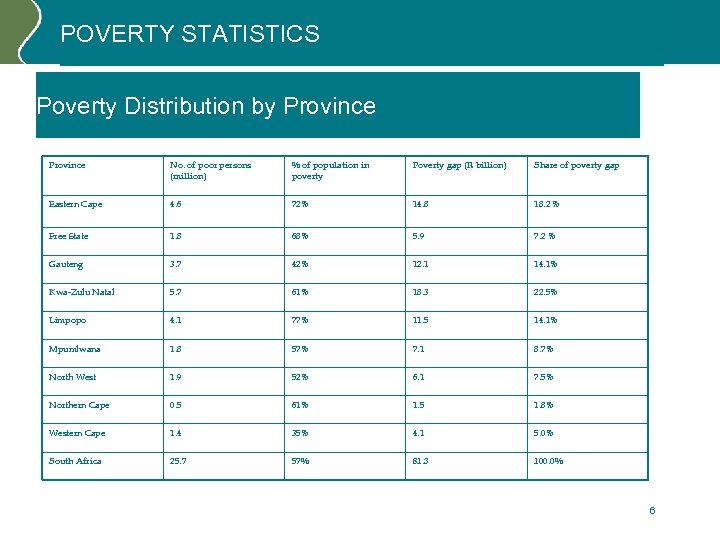 POVERTY STATISTICS Poverty Distribution by Province No. of poor persons (million) % of population in poverty Poverty gap (R billion) Share of poverty gap Eastern Cape 4. 6 72% 14. 8 18. 2 % Free State 1. 8 68% 5. 9 7. 2 % Gauteng 3. 7 42% 12. 1 14. 1% Kwa-Zulu Natal 5. 7 61% 18. 3 22. 5% Limpopo 4. 1 77% 11. 5 14. 1% Mpumlwana 1. 8 57% 7. 1 8. 7% North West 1. 9 52% 6. 1 7. 5% Northern Cape 0. 5 61% 1. 5 1. 8% Western Cape 1. 4 35% 4. 1 5. 0% South Africa 25. 7 57% 81. 3 100. 0% 6
 PERFORMANCE AGAINST TARGETS STRATEGIC FOCUS FOR THE YEAR The strategic goals for the year were: • Organizational transformation • Partnering with strategic stakeholders to accelerate the fight against poverty • Mobilizing resources for community development, • Empowering communities for sustainable development, and • Increasing the communication of credible researched information • The organizational transformation goal received the highest priority and focused on building a performance culture; people competencies; leadership development; improving business processes and systems; good corporate governance; building brand credibility and confidence with our stakeholders. 7
 PERFORMANCE AGAINST TARGETS continued • ACHIEVEMENTS IN THE YEAR • Developed and implemented a performance management system • Restructured the organization in line with organizational goals and objectives • Employed high calibre executives and implemented leadership development training programmes • Conducted competency profiles for executives and senior management for the purpose of development • Deployed a Workplace Skills Programme and published Quality of Work Life policies • Implemented an integrated Enterprise Resource Planning system (ERP) • Established professional corporate governance systems such as the internal audit, and legal and risk units • • Re-branded the organisation and implemented programmes of communications which improved the organisation’s credibility among our stakeholders and the public as a whole • Established partnerships with most of the key Development Finance Institutions (DFI) by actively participating in the DFI forum and its activities 8
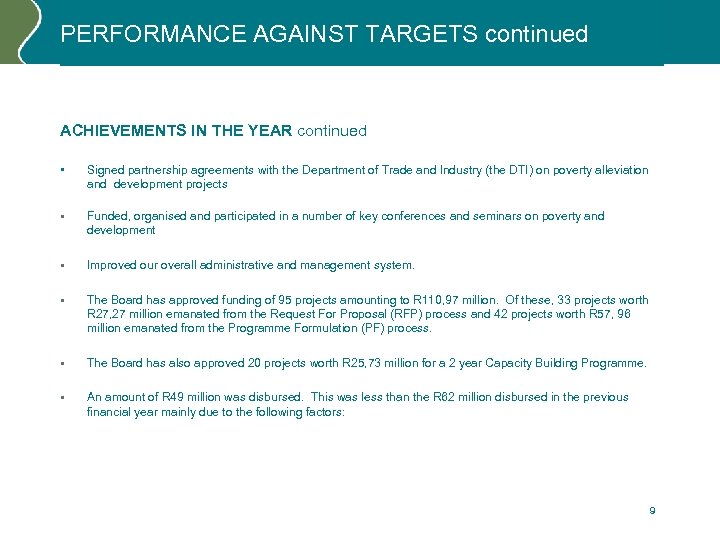 PERFORMANCE AGAINST TARGETS continued ACHIEVEMENTS IN THE YEAR continued • Signed partnership agreements with the Department of Trade and Industry (the DTI) on poverty alleviation and development projects • Funded, organised and participated in a number of key conferences and seminars on poverty and development • Improved our overall administrative and management system. • The Board has approved funding of 95 projects amounting to R 110, 97 million. Of these, 33 projects worth R 27, 27 million emanated from the Request For Proposal (RFP) process and 42 projects worth R 57, 96 million emanated from the Programme Formulation (PF) process. • The Board has also approved 20 projects worth R 25, 73 million for a 2 year Capacity Building Programme. • An amount of R 49 million was disbursed. This was less than the R 62 million disbursed in the previous financial year mainly due to the following factors: 9
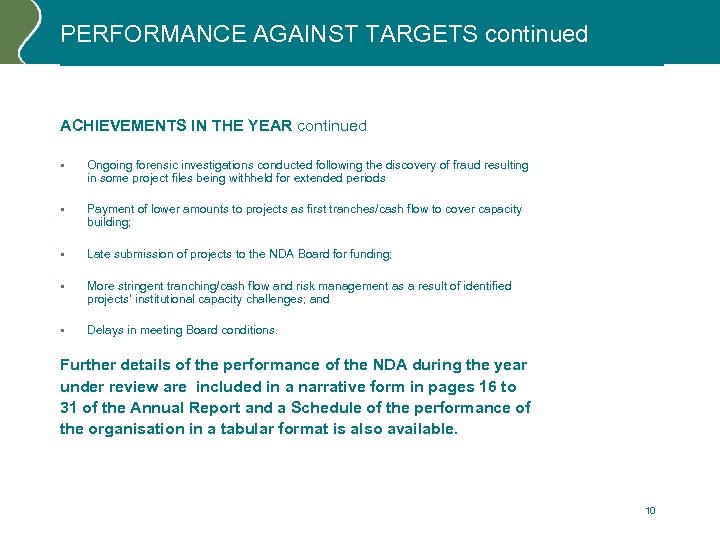 PERFORMANCE AGAINST TARGETS continued ACHIEVEMENTS IN THE YEAR continued • Ongoing forensic investigations conducted following the discovery of fraud resulting in some project files being withheld for extended periods • Payment of lower amounts to projects as first tranches/cash flow to cover capacity building; • Late submission of projects to the NDA Board for funding; • More stringent tranching/cash flow and risk management as a result of identified projects’ institutional capacity challenges; and • Delays in meeting Board conditions. Further details of the performance of the NDA during the year under review are included in a narrative form in pages 16 to 31 of the Annual Report and a Schedule of the performance of the organisation in a tabular format is also available. 10
 ANNUAL FINANCIAL REPORT § The report will cover • Statement of Financial Performance • Statement of Financial Position • Report of the Auditor-General 11
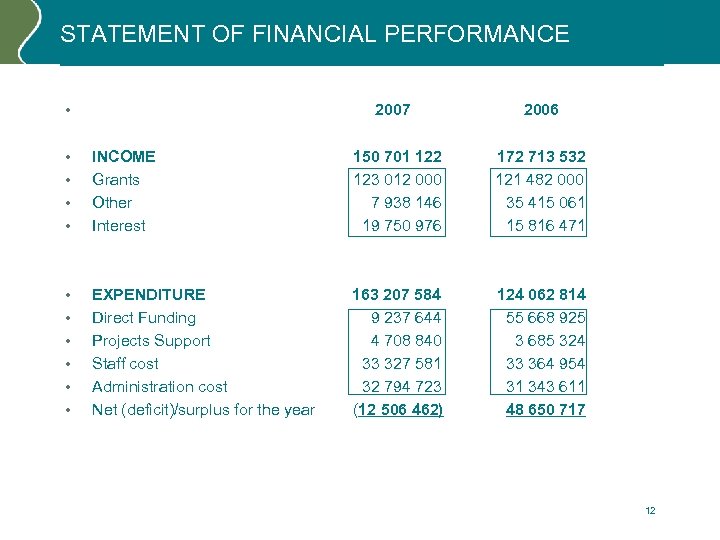 STATEMENT OF FINANCIAL PERFORMANCE 2007 • • • INCOME Grants Other Interest • • • EXPENDITURE 163 207 584 Direct Funding 9 237 644 Projects Support 4 708 840 Staff cost 33 327 581 Administration cost 32 794 723 Net (deficit)/surplus for the year (12 506 462) 2006 150 701 122 172 713 532 123 012 000 121 482 000 7 938 146 35 415 061 19 750 976 15 816 471 124 062 814 55 668 925 3 685 324 33 364 954 31 343 611 48 650 717 12
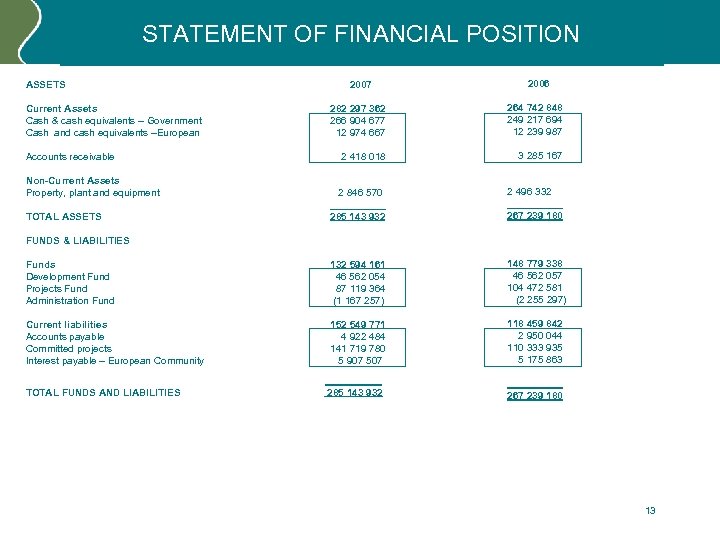 STATEMENT OF FINANCIAL POSITION ASSETS 2006 2007 2 418 018 Current Assets Cash & cash equivalents – Government Cash and cash equivalents –European Accounts receivable Non-Current Assets Property, plant and equipment TOTAL ASSETS 264 742 848 249 217 694 12 239 987 3 285 167 2 846 570 _____ 285 143 932 2 496 332 _____ 267 239 180 148 779 338 46 562 057 104 472 581 (2 255 297) 118 459 842 2 950 044 110 333 935 5 175 863 282 297 362 266 904 677 12 974 667 FUNDS & LIABILITIES Funds Development Fund Projects Fund Administration Fund Current liabilities Accounts payable Committed projects Interest payable – European Community TOTAL FUNDS AND LIABILITIES 132 594 161 46 562 054 87 119 364 (1 167 257) 152 549 771 4 922 484 141 719 780 5 907 507 285 143 932 _____ 267 239 180 13
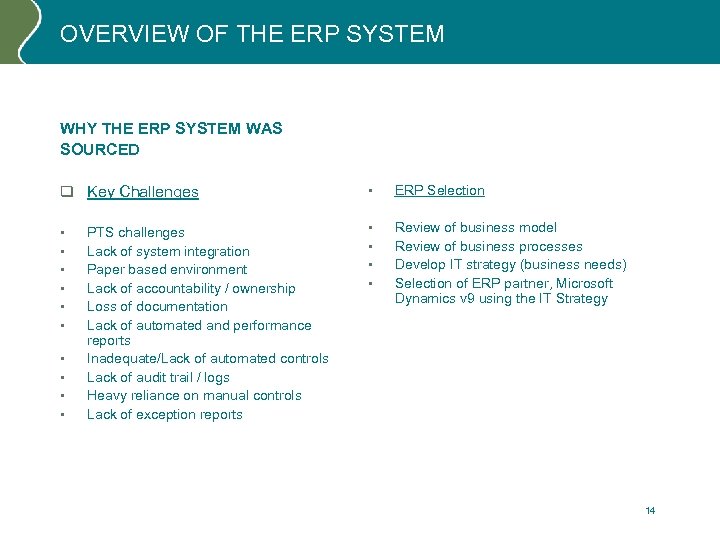 OVERVIEW OF THE ERP SYSTEM WHY THE ERP SYSTEM WAS SOURCED q Key Challenges • • • PTS challenges Lack of system integration Paper based environment Lack of accountability / ownership Loss of documentation Lack of automated and performance reports Inadequate/Lack of automated controls Lack of audit trail / logs Heavy reliance on manual controls Lack of exception reports • ERP Selection • • Review of business model Review of business processes Develop IT strategy (business needs) Selection of ERP partner, Microsoft Dynamics v 9 using the IT Strategy 14
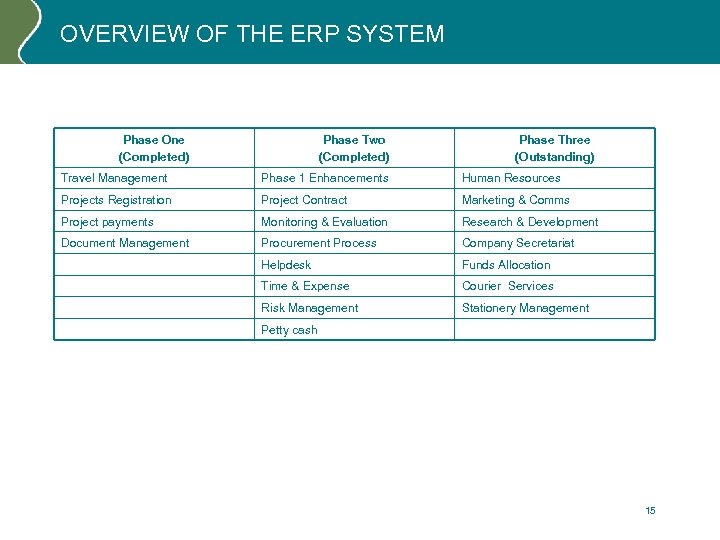 OVERVIEW OF THE ERP SYSTEM Phase One (Completed) Phase Two (Completed) Phase Three (Outstanding) Travel Management Phase 1 Enhancements Human Resources Projects Registration Project Contract Marketing & Comms Project payments Monitoring & Evaluation Research & Development Document Management Procurement Process Company Secretariat Helpdesk Funds Allocation Time & Expense Courier Services Risk Management Stationery Management Petty cash 15
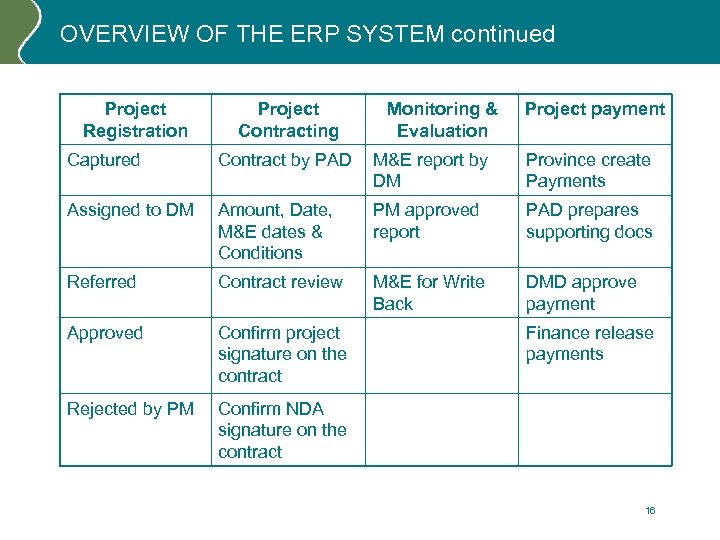 OVERVIEW OF THE ERP SYSTEM continued Project Registration Project Contracting Monitoring & Evaluation Project payment Captured Contract by PAD M&E report by DM Province create Payments Assigned to DM Amount, Date, M&E dates & Conditions PM approved report PAD prepares supporting docs Referred Contract review M&E for Write Back DMD approve payment Approved Confirm project signature on the contract Rejected by PM Confirm NDA signature on the contract Finance release payments 16
 REPORT OF AUDITOR-GENERAL • The NDA received a clean unqualified audit with no emphasis of matter from the Auditor-General • Attention was drawn to the following other matters that are ancillary to the Auditor-General’s responsibilities in the audit of the financial statements: 17
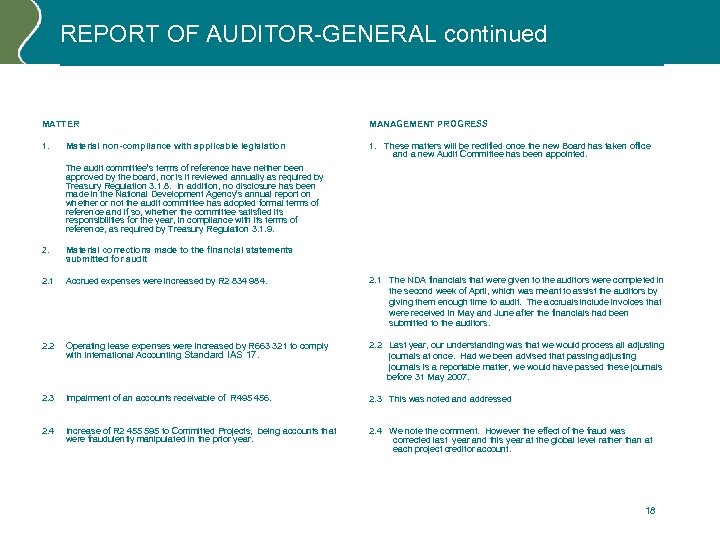 REPORT OF AUDITOR-GENERAL continued MATTER MANAGEMENT PROGRESS 1. These matters will be rectified once the new Board has taken office and a new Audit Committee has been appointed. Material non-compliance with applicable legislation The audit committee’s terms of reference have neither been approved by the board, nor is it reviewed annually as required by Treasury Regulation 3. 1. 8. In addition, no disclosure has been made in the National Development Agency’s annual report on whether or not the audit committee has adopted formal terms of reference and if so, whether the committee satisfied its responsibilities for the year, in compliance with its terms of reference, as required by Treasury Regulation 3. 1. 9. 2. Material corrections made to the financial statements submitted for audit 2. 1 Accrued expenses were increased by R 2 834 984. 2. 1 The NDA financials that were given to the auditors were completed in the second week of April, which was meant to assist the auditors by giving them enough time to audit. The accruals include invoices that were received in May and June after the financials had been submitted to the auditors. 2. 2 Operating lease expenses were increased by R 663 321 to comply with International Accounting Standard IAS 17. 2. 2 Last year, our understanding was that we would process all adjusting journals at once. Had we been advised that passing adjusting journals is a reportable matter, we would have passed these journals before 31 May 2007. 2. 3 Impairment of an accounts receivable of R 495 456. 2. 3 This was noted and addressed 2. 4 Increase of R 2 455 595 to Committed Projects, being accounts that were fraudulently manipulated in the prior year. 2. 4 We note the comment. However the effect of the fraud was corrected last year and this year at the global level rather than at each project creditor account. 18
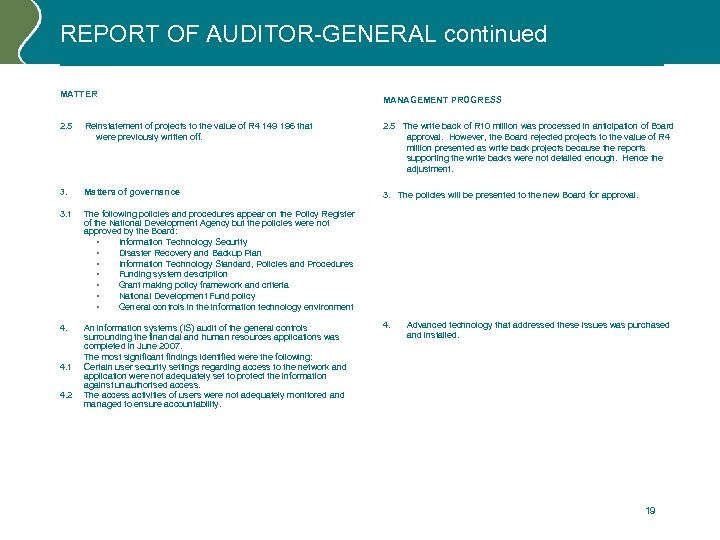 REPORT OF AUDITOR-GENERAL continued MATTER MANAGEMENT PROGRESS 2. 5 Reinstatement of projects to the value of R 4 149 196 that were previously written off. 2. 5 The write back of R 10 million was processed in anticipation of Board approval. However, the Board rejected projects to the value of R 4 million presented as write back projects because the reports supporting the write backs were not detailed enough. Hence the adjustment. 3. Matters of governance 3. The policies will be presented to the new Board for approval. 3. 1 The following policies and procedures appear on the Policy Register of the National Development Agency but the policies were not approved by the Board: • Information Technology Security • Disaster Recovery and Backup Plan • Information Technology Standard, Policies and Procedures • Funding system description • Grant making policy framework and criteria • National Development Fund policy • General controls in the information technology environment 4. An information systems (IS) audit of the general controls surrounding the financial and human resources applications was completed in June 2007. The most significant findings identified were the following: Certain user security settings regarding access to the network and application were not adequately set to protect the information against unauthorised access. The access activities of users were not adequately monitored and managed to ensure accountability. 4. 1 4. 2 4. Advanced technology that addressed these issues was purchased and installed. 19
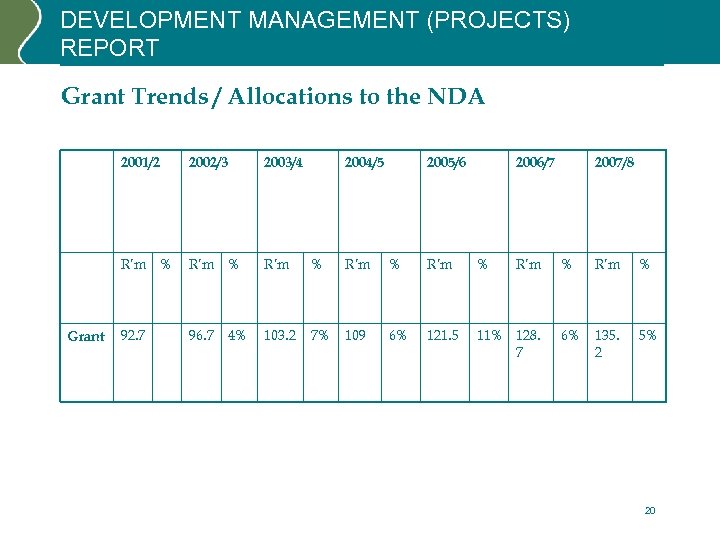 DEVELOPMENT MANAGEMENT (PROJECTS) REPORT Grant Trends / Allocations to the NDA 2001/2 2003/4 R’m % Grant 2002/3 R’m % 92. 7 96. 7 103. 2 7% 109 6% 121. 5 11% 128. 7 4% 2004/5 2005/6 2006/7 R’m 2007/8 % R’m % 6% 135. 2 5% 20
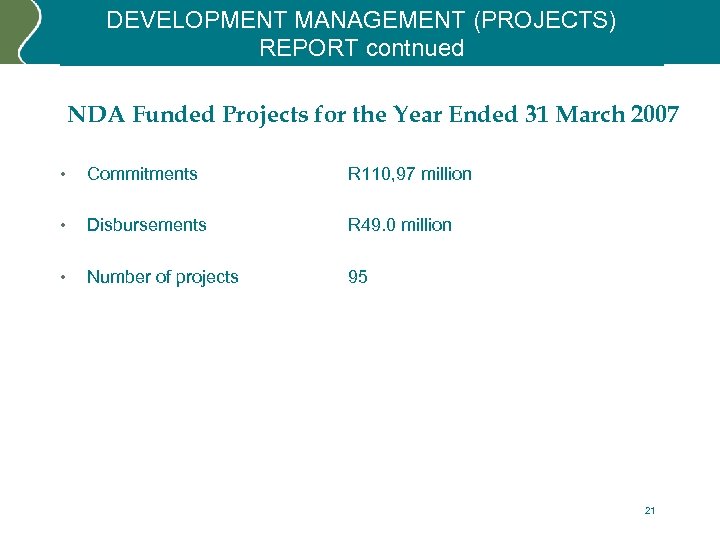 DEVELOPMENT MANAGEMENT (PROJECTS) REPORT contnued NDA Funded Projects for the Year Ended 31 March 2007 • Commitments R 110, 97 million • Disbursements R 49. 0 million • Number of projects 95 21
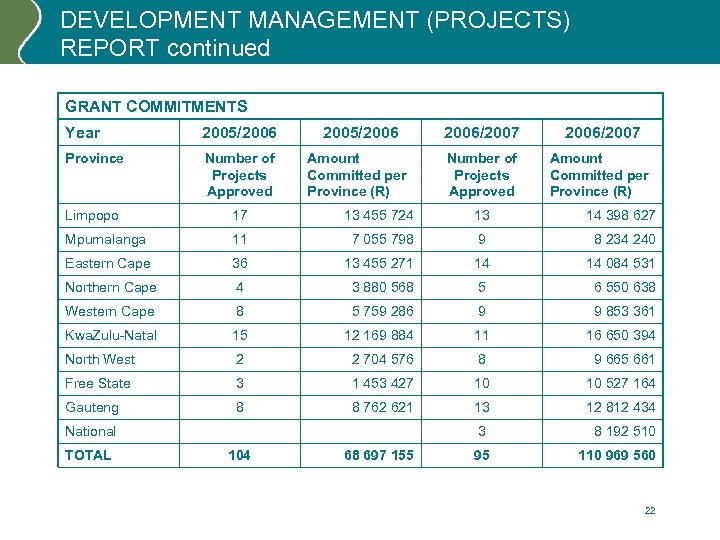 DEVELOPMENT MANAGEMENT (PROJECTS) REPORT continued GRANT COMMITMENTS Year 2005/2006/2007 Province Number of Projects Approved Amount Committed per Province (R) Limpopo 17 13 455 724 13 14 398 627 Mpumalanga 11 7 055 798 9 8 234 240 Eastern Cape 36 13 455 271 14 14 084 531 Northern Cape 4 3 880 568 5 6 550 638 Western Cape 8 5 759 286 9 9 853 361 Kwa. Zulu-Natal 15 12 169 884 11 16 650 394 North West 2 2 704 576 8 9 665 661 Free State 3 1 453 427 10 10 527 164 Gauteng 8 8 762 621 13 12 812 434 3 8 192 510 95 110 969 560 National TOTAL 104 68 697 155 22
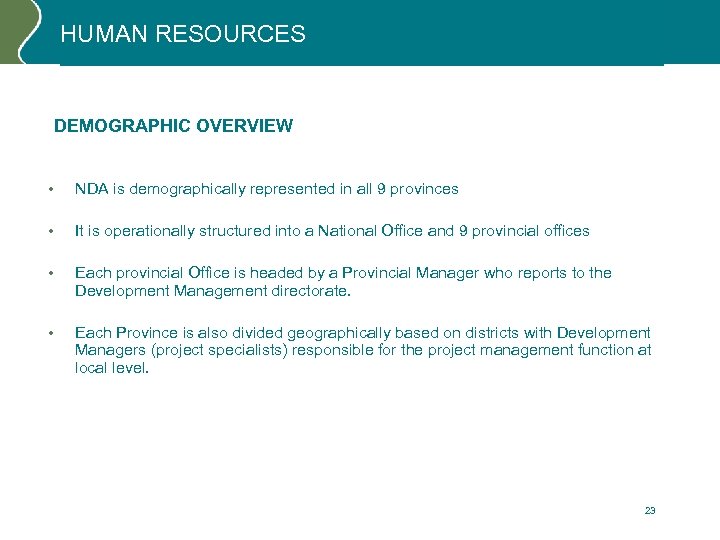 HUMAN RESOURCES DEMOGRAPHIC OVERVIEW • NDA is demographically represented in all 9 provinces • It is operationally structured into a National Office and 9 provincial offices • Each provincial Office is headed by a Provincial Manager who reports to the Development Management directorate. • Each Province is also divided geographically based on districts with Development Managers (project specialists) responsible for the project management function at local level. 23
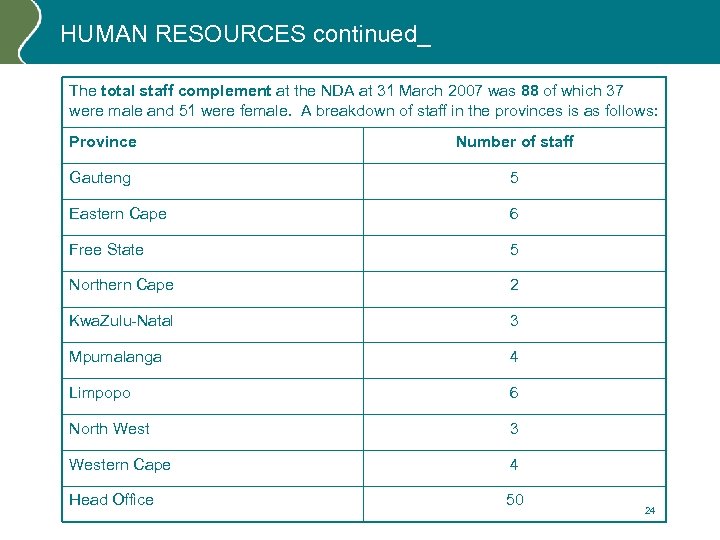 HUMAN RESOURCES continued_ The total staff complement at the NDA at 31 March 2007 was 88 of which 37 were male and 51 were female. A breakdown of staff in the provinces is as follows: Province Number of staff Gauteng 5 Eastern Cape 6 Free State 5 Northern Cape 2 Kwa. Zulu-Natal 3 Mpumalanga 4 Limpopo 6 North West 3 Western Cape 4 Head Office 50 24
 WAY FORWARD • Our challenges for the coming financial year are in the following areas: • Induction of the new Board and its Committees • Revision of the strategy and funding cycle process • Our institutional capacity • Organisational and individual performance • Limited funding sources • • Updated database of civil society organisations Up to date researched information on poverty and development trends at macro and micro levels • An appropriate funding model • A reviewed NDA Act and Delegations of Authority 25
 WAY FORWARD continued • Going forward, we have revised the MTEF Strategy, which contains the following strategic goals: • • • We have plans in place to address the challenges identified above. These include • • • Speeding up organisational transformation for completion by the end of the 2007/2008 financial year Placing greater emphasis on financial resource mobilisation • Improving and increasing the output of our researched information • Completing the establishment of our Civil Society organisations database • Completing the process of establishing an appropriate funding model and delegations • To amend the NDA Act and Delegations of Authority. Organisational transformation Partnering for development Community empowerment for sustainable development Communication of credible and relevant development information. 26