 Скачать презентацию Presentation to the Select Committee on Labour and
da3328339ba645a2e93bc94b849a050b.ppt
- Количество слайдов: 56




Presentation to the Select Committee on Labour and Public Enterprises 10 November 2010 Annual Report: 2009/10 Overall Responsibility Acting Director General: Sam Morotoba
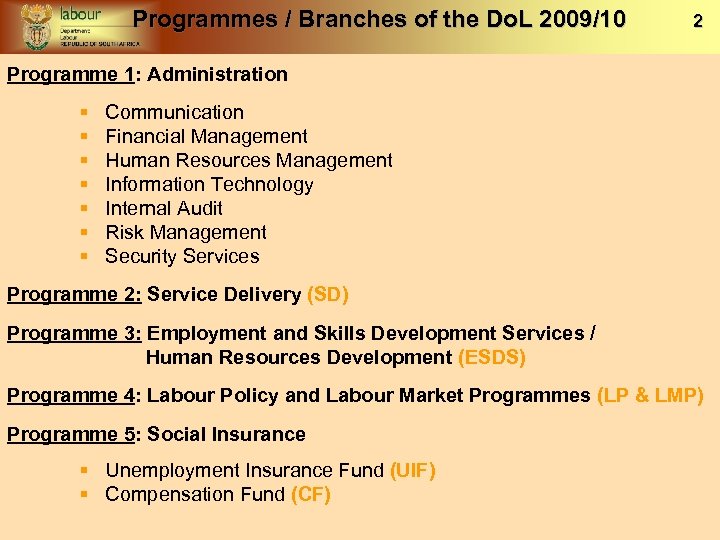
Programmes / Branches of the Do. L 2009/10 2 Programme 1: Administration § Communication § Financial Management § Human Resources Management § Information Technology § Internal Audit § Risk Management § Security Services Programme 2: Service Delivery (SD) Programme 3: Employment and Skills Development Services / Human Resources Development (ESDS) Programme 4: Labour Policy and Labour Market Programmes (LP & LMP) Programme 5: Social Insurance § Unemployment Insurance Fund (UIF) § Compensation Fund (CF)
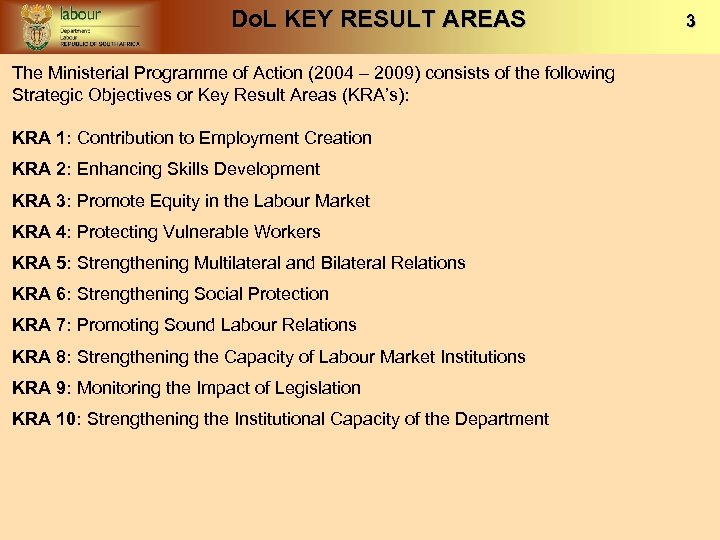
Do. L KEY RESULT AREAS The Ministerial Programme of Action (2004 – 2009) consists of the following Strategic Objectives or Key Result Areas (KRA’s): KRA 1: Contribution to Employment Creation KRA 2: Enhancing Skills Development KRA 3: Promote Equity in the Labour Market KRA 4: Protecting Vulnerable Workers KRA 5: Strengthening Multilateral and Bilateral Relations KRA 6: Strengthening Social Protection KRA 7: Promoting Sound Labour Relations KRA 8: Strengthening the Capacity of Labour Market Institutions KRA 9: Monitoring the Impact of Legislation KRA 10: Strengthening the Institutional Capacity of the Department 3

4 Programme 1: Administration Acting DDG: Corporate Services ADV : N PHASHA
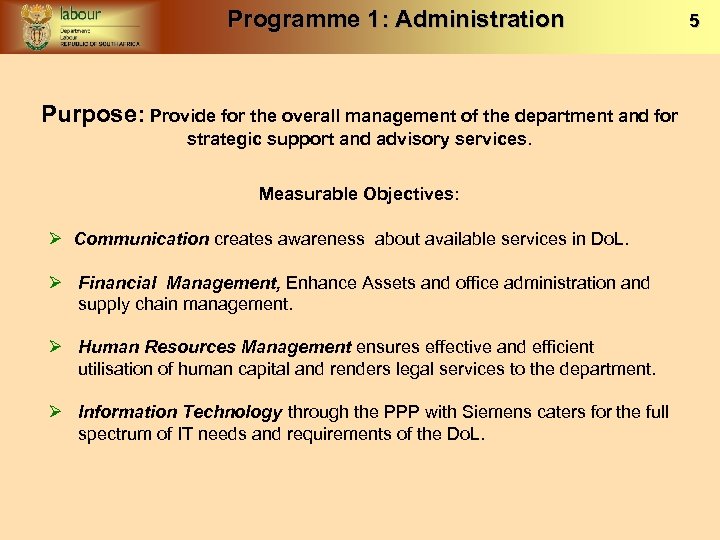
Programme 1: Administration Purpose: Provide for the overall management of the department and for strategic support and advisory services. Measurable Objectives: Ø Communication creates awareness about available services in Do. L. Ø Financial Management, Enhance Assets and office administration and supply chain management. Ø Human Resources Management ensures effective and efficient utilisation of human capital and renders legal services to the department. Ø Information Technology through the PPP with Siemens caters for the full spectrum of IT needs and requirements of the Do. L. 5
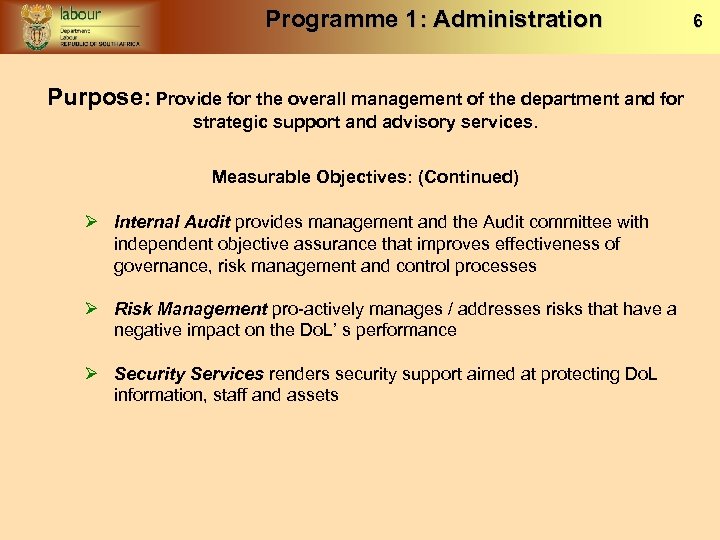
Programme 1: Administration Purpose: Provide for the overall management of the department and for strategic support and advisory services. Measurable Objectives: (Continued) Ø Internal Audit provides management and the Audit committee with independent objective assurance that improves effectiveness of governance, risk management and control processes Ø Risk Management pro-actively manages / addresses risks that have a negative impact on the Do. L’ s performance Ø Security Services renders security support aimed at protecting Do. L information, staff and assets 6
Communication 7 Progress Media Liaison Directorate initiated the media profiling for both the Ministerial events and departmental programmes. Media alerts, media statements and media briefing were utilised to communicate various messages on the offerings of the Department. Marketing and Advertising The period under review was marked by the implementation of 11 advertising campaigns including : – Employment Equity ( EE) Road-shows awareness campaigns. – EE On-line reporting deadline – Worker’s rights and Inspection and Enforcement Services campaign. – World Day for Safety and Health Campaign – Sheltered Employment Factories Awareness – Child Labour – Children Working in Hazardous Conditions. Media Production A total of 707 000 publications of different titles were distributed at various departmental events, provincial offices, and labour centres.
Legal services Progress 1. Litigation- 147 cases handled and court processes are running. 2. Debts - 126 debt collection cases were handed to State Attorneys for recovery. 3. Contracts - 91 contracts finalised. 4. Legal Opinions- 49 opinions finalised. 8
Human Resource Management Progress Employment Equity 1. The department has exceeded the national target of 2% for people with disability. Currently has employed 2. 6%. 2. The Senior Management Services ( SMS levels 13 -16) level is dominated by males (67. 9%). However, in 2009/10 period there has been slight progress from 31% in 2008/9 to 32. 1%. This represent an increase of 1. 1% on female representation. 3. Overall, males are under-represented in lower levels 1 -12 whilst females are over-represented in the same levels. 9
Human Resource Management Progress Establishment 1. The vacancy rate has been reduced by 3. 4% from 17. 2% in 2008/9 to 13. 8% in 2009/10. As at end of Aug 2010, the vacancy rate stood at 11%. During the 2009/10 period, the establishment grew by 4. 7% in comparison to the 2008/9 year. 2. In April 2010, the department has achieved the smooth transfer of Skills Development staff to Department of Higher Education & Training (DHET) in line with National Macro Organisation of State (NMOS). Challenges 1. Pre-employment screening and verification of qualification by SAQA. 2. Organisation structure not adequately funded and does not support the business of the organisation. 10
Risk Management Progress 1. The Risk Management Unit was established in 2009/10 financial year 2. The department developed, reviewed and approved the Risk Management Strategy, Risk Policy and Fraud Prevention Plan and in the process of implementation. 11
Information Technology Progress 1. All governance forums are fully functional and the Director-General exercises oversight on the Public Private Partnership. 2. Deputy Directors-General are responsible and accountable for operational and systems deliverables 3. Enhancements to the Employment Services system went live on 23 March 2010 4. The post of Chief Information Officer (CIO) was advertised and interviews conducted. 5. The structure of the CIO office was reviewed and critical posts identified. 12
Internal Audit 13 Progress 1. 30 audits were planned and 27 (90% ) were finalised and reports issued. 2. 3 (10%) draft reports issued/outstanding audits.
Security Services 14 Services Progress 1. Security strategy as well as security awareness program were implemented in 7 offices: – Eastern Cape/ North West / Gauteng South / KZN / Mpumalanga/ Unemployment Insurance Fund and Head Office 2. Security gave support to Ministerial izimbizos at : – World OHS day in Bloemfontein – Worcester, De Doorns, Ashton, Robertson, Swellendam and; – Zimbabwean Ministerial delegation Challenges The Vetting Unit could not be established due to none allocation by National Treasury.
15 Programme 2: Service Delivery DDG: Service Delivery Ms S Zondeki
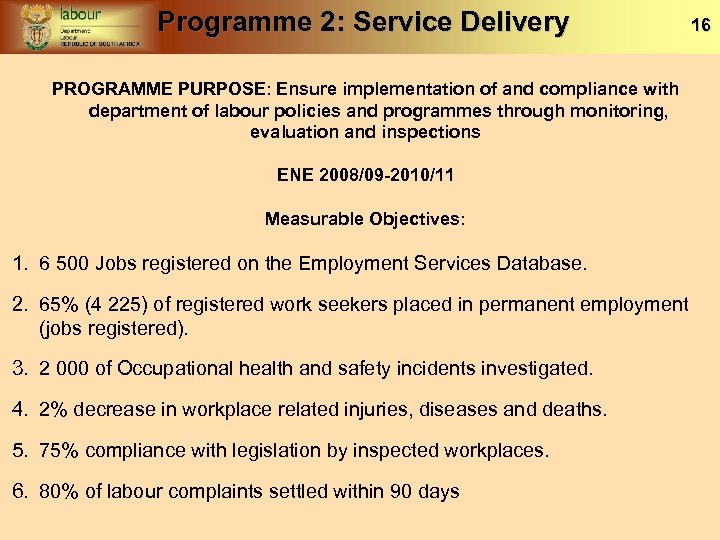
Programme 2: Service Delivery 16 PROGRAMME PURPOSE: Ensure implementation of and compliance with department of labour policies and programmes through monitoring, evaluation and inspections ENE 2008/09 -2010/11 Measurable Objectives: 1. 6 500 Jobs registered on the Employment Services Database. 2. 65% (4 225) of registered work seekers placed in permanent employment (jobs registered). 3. 2 000 of Occupational health and safety incidents investigated. 4. 2% decrease in workplace related injuries, diseases and deaths. 5. 75% compliance with legislation by inspected workplaces. 6. 80% of labour complaints settled within 90 days
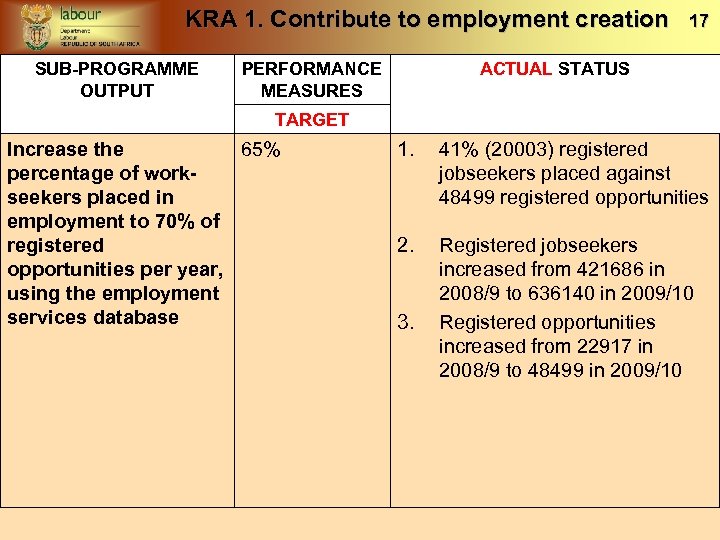
KRA 1. Contribute to employment creation SUB-PROGRAMME OUTPUT PERFORMANCE MEASURES 17 ACTUAL STATUS TARGET Increase the 65% percentage of workseekers placed in employment to 70% of registered opportunities per year, using the employment services database 1. 41% (20003) registered jobseekers placed against 48499 registered opportunities 2. Registered jobseekers increased from 421686 in 2008/9 to 636140 in 2009/10 Registered opportunities increased from 22917 in 2008/9 to 48499 in 2009/10 3.
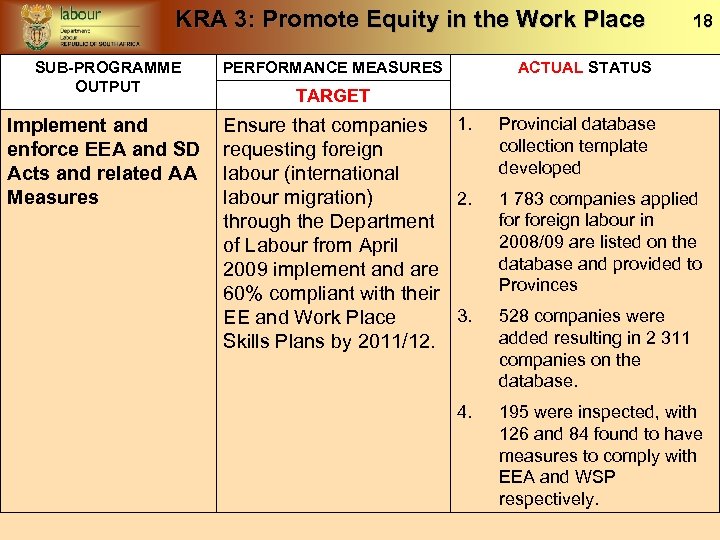
KRA 3: Promote Equity in the Work Place SUB-PROGRAMME OUTPUT Implement and enforce EEA and SD Acts and related AA Measures PERFORMANCE MEASURES 18 ACTUAL STATUS TARGET Ensure that companies 1. requesting foreign labour (international labour migration) 2. through the Department of Labour from April 2009 implement and are 60% compliant with their 3. EE and Work Place Skills Plans by 2011/12. 4. Provincial database collection template developed 1 783 companies applied foreign labour in 2008/09 are listed on the database and provided to Provinces 528 companies were added resulting in 2 311 companies on the database. 195 were inspected, with 126 and 84 found to have measures to comply with EEA and WSP respectively.
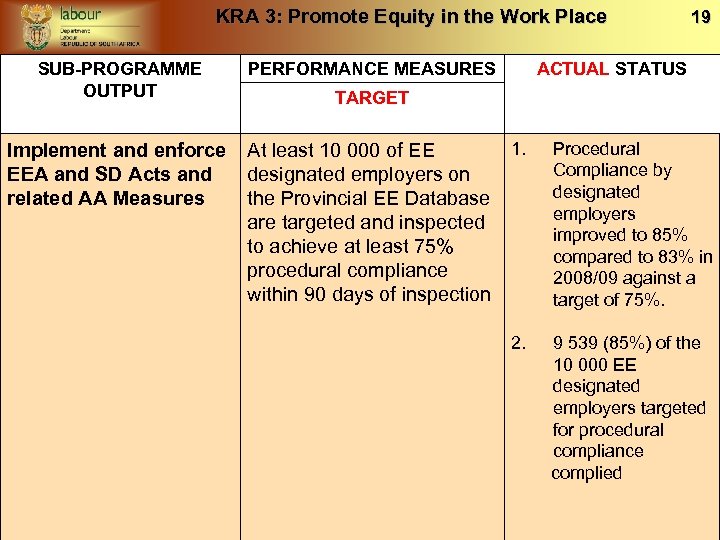
KRA 3: Promote Equity in the Work Place SUB-PROGRAMME OUTPUT Implement and enforce EEA and SD Acts and related AA Measures PERFORMANCE MEASURES 19 ACTUAL STATUS TARGET 1. At least 10 000 of EE designated employers on the Provincial EE Database are targeted and inspected to achieve at least 75% procedural compliance within 90 days of inspection 2. Procedural Compliance by designated employers improved to 85% compared to 83% in 2008/09 against a target of 75%. 9 539 (85%) of the 10 000 EE designated employers targeted for procedural compliance complied
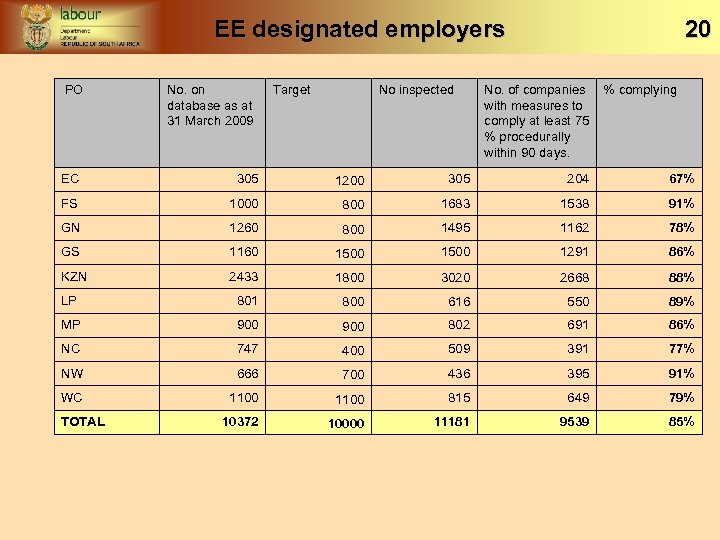
EE designated employers PO No. on database as at 31 March 2009 Target No inspected 20 No. of companies % complying with measures to comply at least 75 % procedurally within 90 days. EC 305 1200 305 204 67% FS 1000 800 1683 1538 91% GN 1260 800 1495 1162 78% GS 1160 1500 1291 86% KZN 2433 1800 3020 2668 88% LP 801 800 616 550 89% MP 900 802 691 86% NC 747 400 509 391 77% NW 666 700 436 395 91% WC 1100 815 649 79% 10372 10000 11181 9539 85% TOTAL
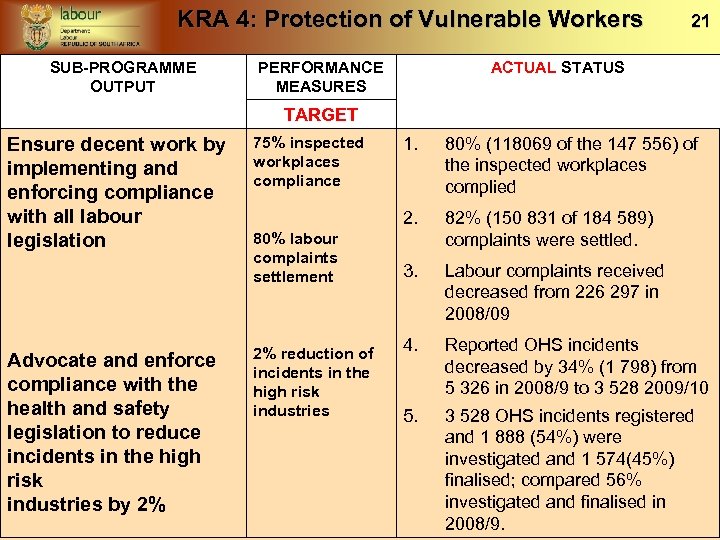
KRA 4: Protection of Vulnerable Workers SUB-PROGRAMME OUTPUT PERFORMANCE MEASURES 21 ACTUAL STATUS TARGET Ensure decent work by implementing and enforcing compliance with all labour legislation Advocate and enforce compliance with the health and safety legislation to reduce incidents in the high risk industries by 2% 80% labour complaints settlement 2% reduction of incidents in the high risk industries 1. 80% (118069 of the 147 556) of the inspected workplaces complied 2. 75% inspected workplaces compliance 82% (150 831 of 184 589) complaints were settled. 3. Labour complaints received decreased from 226 297 in 2008/09 4. Reported OHS incidents decreased by 34% (1 798) from 5 326 in 2008/9 to 3 528 2009/10 5. 3 528 OHS incidents registered and 1 888 (54%) were investigated and 1 574(45%) finalised; compared 56% investigated and finalised in 2008/9.
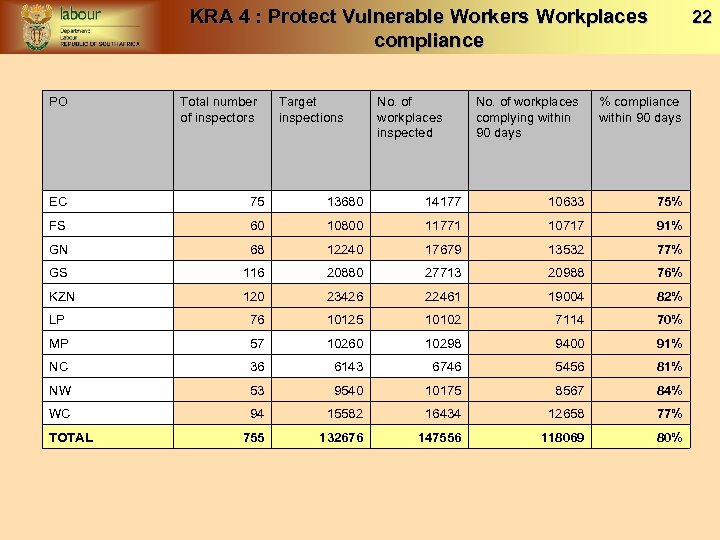
KRA 4 : Protect Vulnerable Workers Workplaces compliance PO Total number of inspectors Target inspections No. of workplaces inspected 22 No. of workplaces complying within 90 days % compliance within 90 days EC 75 13680 14177 10633 75% FS 60 10800 11771 10717 91% GN 68 12240 17679 13532 77% GS 116 20880 27713 20988 76% KZN 120 23426 22461 19004 82% LP 76 10125 10102 7114 70% MP 57 10260 10298 9400 91% NC 36 6143 6746 5456 81% NW 53 9540 10175 8567 84% WC 94 15582 16434 12658 77% 755 132676 147556 118069 80% TOTAL
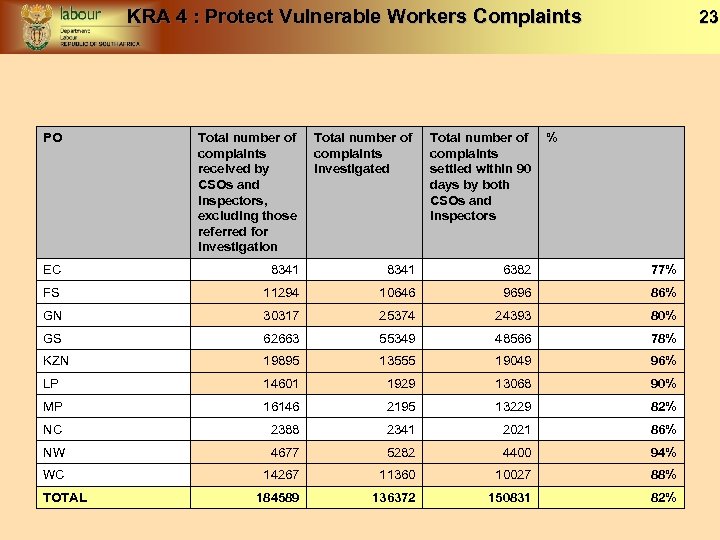
KRA 4 : Protect Vulnerable Workers Complaints 23 PO Total number of complaints received by CSOs and inspectors, excluding those referred for investigation Total number of complaints investigated Total number of complaints settled within 90 days by both CSOs and inspectors EC 8341 6382 77% FS 11294 10646 9696 86% GN 30317 25374 24393 80% GS 62663 55349 48566 78% KZN 19895 13555 19049 96% LP 14601 1929 13068 90% MP 16146 2195 13229 82% NC 2388 2341 2021 86% NW 4677 5282 4400 94% WC 14267 11360 10027 88% 184589 136372 150831 82% TOTAL %
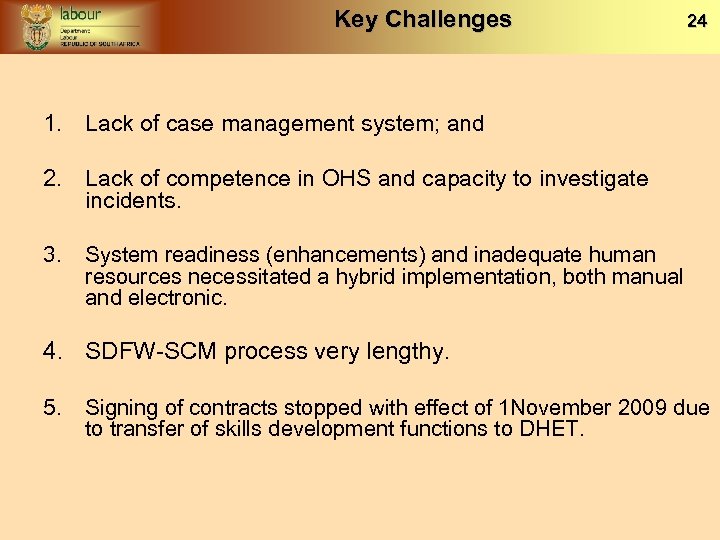
Key Challenges 24 1. Lack of case management system; and 2. Lack of competence in OHS and capacity to investigate incidents. 3. System readiness (enhancements) and inadequate human resources necessitated a hybrid implementation, both manual and electronic. 4. SDFW-SCM process very lengthy. 5. Signing of contracts stopped with effect of 1 November 2009 due to transfer of skills development functions to DHET.
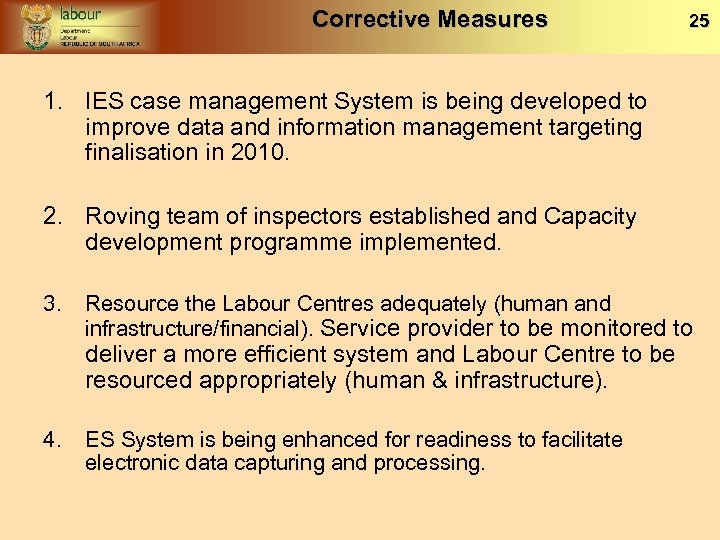
Corrective Measures 25 1. IES case management System is being developed to improve data and information management targeting finalisation in 2010. 2. Roving team of inspectors established and Capacity development programme implemented. 3. Resource the Labour Centres adequately (human and infrastructure/financial). Service provider to be monitored to deliver a more efficient system and Labour Centre to be resourced appropriately (human & infrastructure). 4. ES System is being enhanced for readiness to facilitate electronic data capturing and processing.
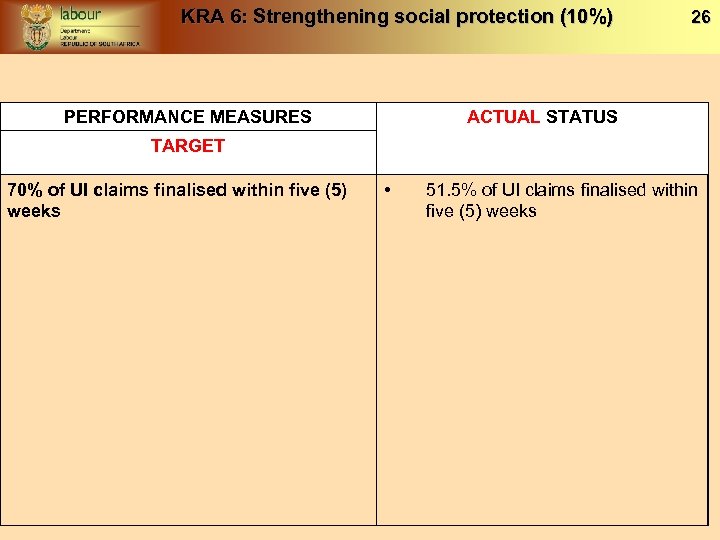
KRA 6: Strengthening social protection (10%) PERFORMANCE MEASURES 26 ACTUAL STATUS TARGET 70% of UI claims finalised within five (5) weeks • 51. 5% of UI claims finalised within five (5) weeks
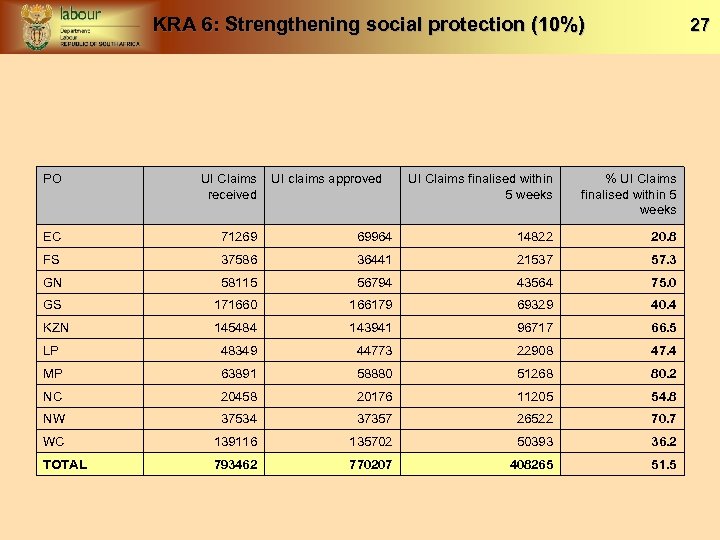
KRA 6: Strengthening social protection (10%) PO UI Claims UI claims approved received 27 UI Claims finalised within 5 weeks % UI Claims finalised within 5 weeks EC 71269 69964 14822 20. 8 FS 37586 36441 21537 57. 3 GN 58115 56794 43564 75. 0 GS 171660 166179 69329 40. 4 KZN 145484 143941 96717 66. 5 LP 48349 44773 22908 47. 4 MP 63891 58880 51268 80. 2 NC 20458 20176 11205 54. 8 NW 37534 37357 26522 70. 7 WC 139116 135702 50393 36. 2 TOTAL 793462 770207 408265 51. 5
28 Programme 3: Employment and Skills Development Services and Human Resources Development (ESDS) DDG: S Morotoba
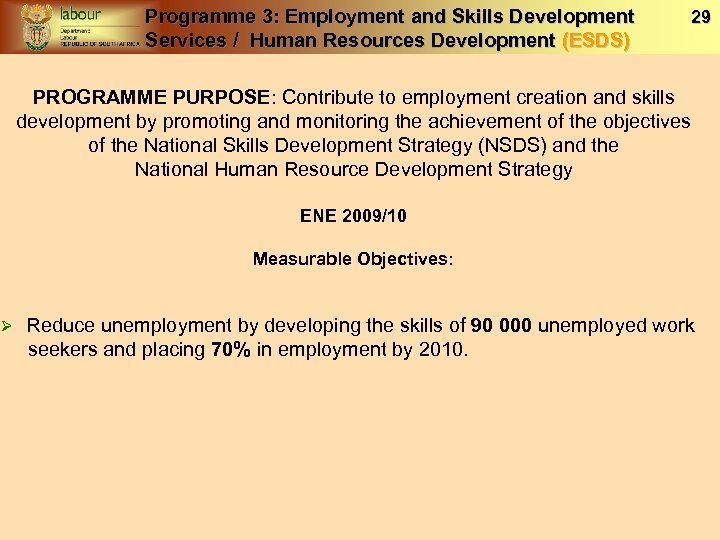
Programme 3: Employment and Skills Development Services / Human Resources Development (ESDS) 29 PROGRAMME PURPOSE: Contribute to employment creation and skills development by promoting and monitoring the achievement of the objectives of the National Skills Development Strategy (NSDS) and the National Human Resource Development Strategy ENE 2009/10 Measurable Objectives: Ø Reduce unemployment by developing the skills of 90 seekers and placing 70% in employment by 2010. 000 unemployed work

Programme 3: Employment and Skills Development Services / Human Resources Development (ESDS) (ESDS 30 Measurable Objectives: (Continued) Ø Enable growth, productivity and sustainability by supporting the National Skills Fund and Sector Education and Training Authorities (SETA’s) so that 2 000 non levy paying enterprises, non-government organisations and co-operatives receive skills development funding by 2010. Ø Increase the pool of qualified persons with scarce skills by providing top up funding to SETA’s, the National Student Financial Aid Scheme and the National Research Foundation in order to assist 26 000 unemployed learners to enter scarce and critical skills programmes in learnerships, apprenticeships, internships, bursaries and skills programmes by 2010.
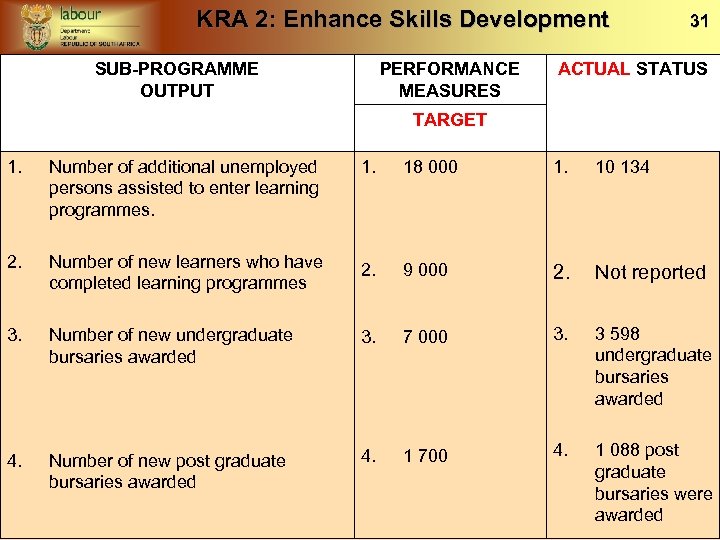
KRA 2: Enhance Skills Development SUB-PROGRAMME OUTPUT PERFORMANCE MEASURES 31 ACTUAL STATUS TARGET 1. Number of additional unemployed persons assisted to enter learning programmes. 18 000 1. 10 134 2. Number of new learners who have completed learning programmes 2. 9 000 2. Not reported 3. Number of new undergraduate bursaries awarded 3. 7 000 3. 3 598 undergraduate bursaries awarded 4. Number of new post graduate bursaries awarded 4. 1 700 4. 1 088 post graduate bursaries were awarded
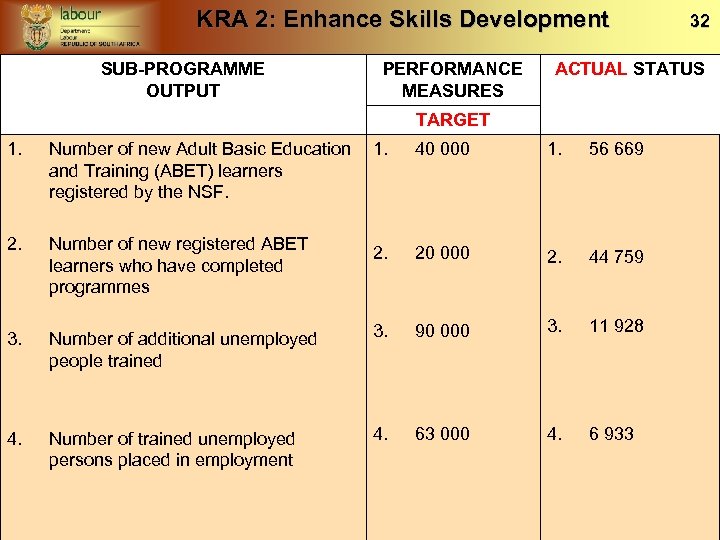
KRA 2: Enhance Skills Development SUB-PROGRAMME OUTPUT PERFORMANCE MEASURES 32 ACTUAL STATUS TARGET 1. Number of new Adult Basic Education 1. and Training (ABET) learners registered by the NSF. 40 000 1. 56 669 2. Number of new registered ABET learners who have completed programmes 2. 20 000 2. 44 759 3. Number of additional unemployed people trained 3. 90 000 3. 11 928 4. Number of trained unemployed persons placed in employment 4. 63 000 4. 6 933
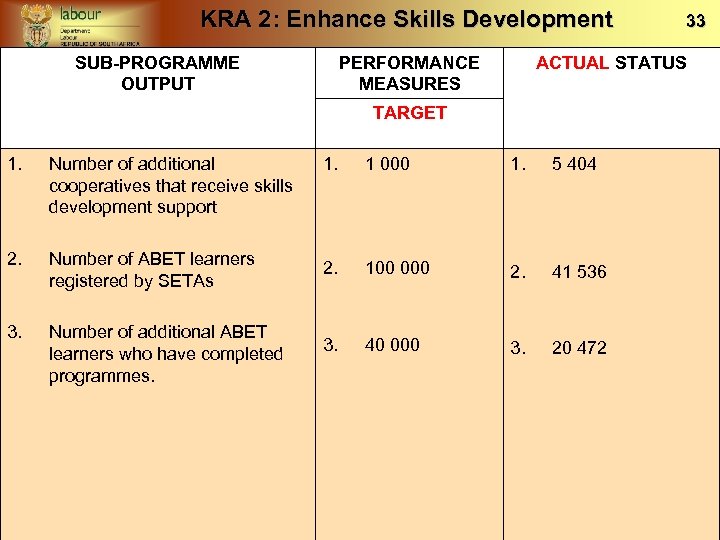
KRA 2: Enhance Skills Development SUB-PROGRAMME OUTPUT PERFORMANCE MEASURES 33 ACTUAL STATUS TARGET 1. Number of additional cooperatives that receive skills development support 1. 1 000 1. 5 404 2. Number of ABET learners registered by SETAs 2. 100 000 2. 41 536 3. Number of additional ABET learners who have completed programmes. 3. 40 000 3. 20 472
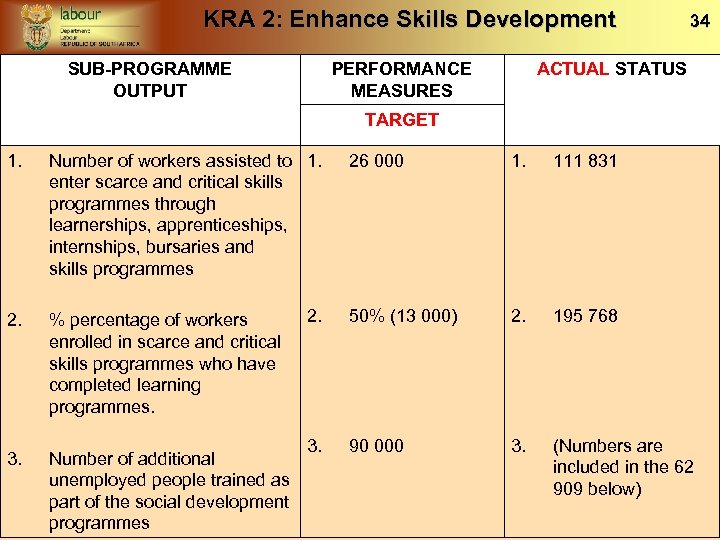
KRA 2: Enhance Skills Development SUB-PROGRAMME OUTPUT PERFORMANCE MEASURES 34 ACTUAL STATUS TARGET 1. Number of workers assisted to 1. enter scarce and critical skills programmes through learnerships, apprenticeships, internships, bursaries and skills programmes 2. % percentage of workers enrolled in scarce and critical skills programmes who have completed learning programmes. 3. Number of additional unemployed people trained as part of the social development programmes 26 000 1. 111 831 2. 50% (13 000) 2. 195 768 3. 90 000 3. (Numbers are included in the 62 909 below)
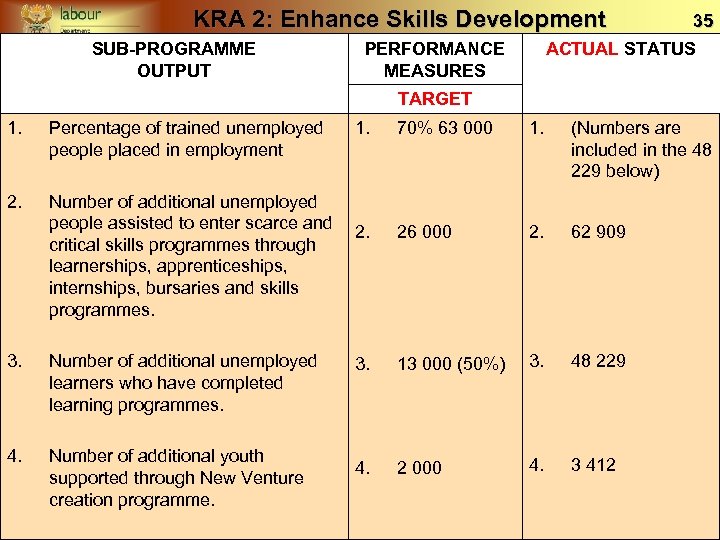
KRA 2: Enhance Skills Development SUB-PROGRAMME OUTPUT PERFORMANCE MEASURES 35 ACTUAL STATUS TARGET 1. Percentage of trained unemployed people placed in employment 2. Number of additional unemployed people assisted to enter scarce and 2. critical skills programmes through learnerships, apprenticeships, internships, bursaries and skills programmes. 3. Number of additional unemployed learners who have completed learning programmes. 4. Number of additional youth supported through New Venture creation programme. 1. 70% 63 000 1. (Numbers are included in the 48 229 below) 26 000 2. 62 909 3. 13 000 (50%) 3. 48 229 4. 2 000 4. 3 412
Challenges 36 Challenges experienced included the following : 1. The economic recession resulted in a lesser number of apprentices indentured. 2. Number of new learners who completed learning programmes couldn’t be verified since Provincial government reports were still outstanding by end of April 2010. 3. Insufficient applications from learners meeting requirements were received by NSFAS & NRF. 4. Uncertainties regarding funding allocation beyond 1 st November 2009 transfer of skills development functions to DHET by resulted in Do. L Provincial Offices not signing new contracts.
Challenges (cont. ) 37 5. Individual SETA targets on ABET were low and the target could not be achieved due to Sectoral or industry challenges experienced with ABET programmes. 6. The completion rate is based on the number of workers registered during the 2007 -2009 and some programmes that are 3 yrs long. Learners registered during 2009/10 were still in programmes. 7. The company intake of unemployed learners declined sharply partly due to economic recession challenges that they experienced during the 2009/10 financial year.

38 Programme 4: Labour Policy and Labour Market Programmes (LP & LMP) DDG: L Kettledas
Programme 4: Labour Policy and Labour Market Programmes 39 PURPOSE: Establish an equitable and sound labour relations environment and promote South Africa’s interests in international labour matters through research, analysing and evaluating labour policy, and providing statistical data on the labour market, including providing support to the institutions that promote social dialogue. Measurable Objective: Ø Improve employment equity by inspecting additional Johannesburg Stock Exchange listed companies each year for substantive compliance with legislation.
KRA 3: Promote Equity in the Labour Market Performance Indicators Target Implement the Director-General Review System (DG Review) Actual 1. 67 JSE listed companies were reviewed and Employment Equity Plans approved. 2. 12 National EE Awareness campaigns were successfully conducted in all Provinces. 3. New EEA Forms and Guidelines for on-line reporting were published. 4. The 10 th CEE Annual Report was published 40
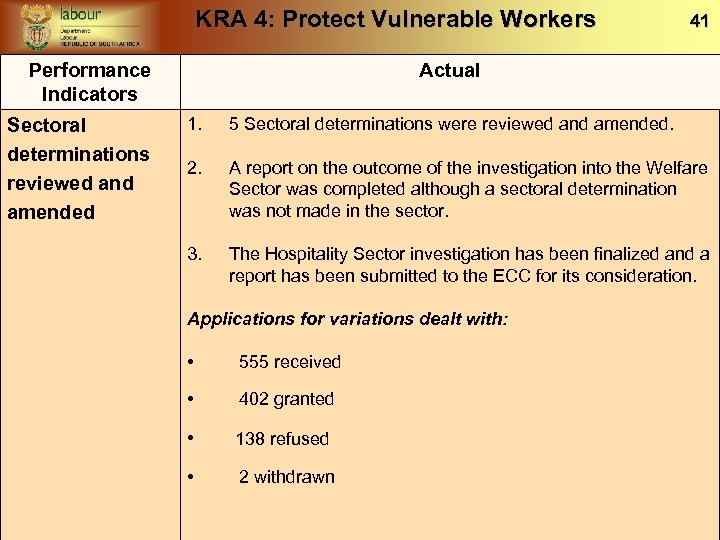
KRA 4: Protect Vulnerable Workers Performance Indicators Sectoral determinations reviewed and amended 41 Actual 1. 5 Sectoral determinations were reviewed and amended. 2. A report on the outcome of the investigation into the Welfare Sector was completed although a sectoral determination was not made in the sector. 3. The Hospitality Sector investigation has been finalized and a report has been submitted to the ECC for its consideration. Applications for variations dealt with: • 555 received • 402 granted • 138 refused • 2 withdrawn
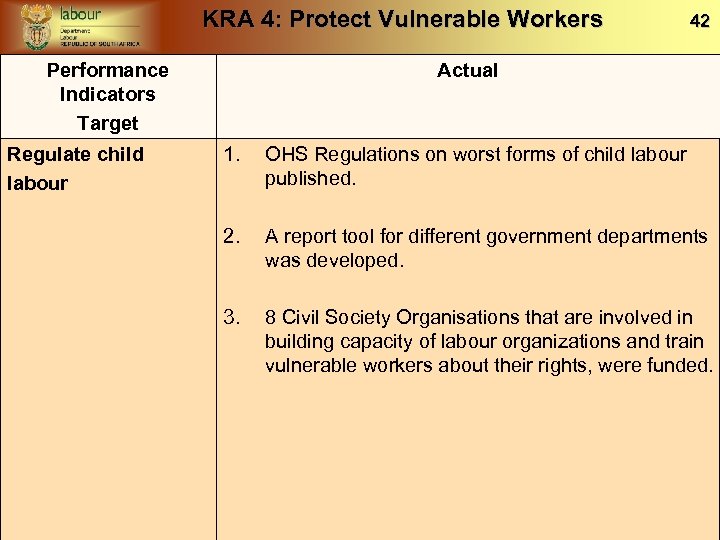
KRA 4: Protect Vulnerable Workers Performance Indicators Target Regulate child labour 42 Actual 1. OHS Regulations on worst forms of child labour published. 2. A report tool for different government departments was developed. 3. 8 Civil Society Organisations that are involved in building capacity of labour organizations and train vulnerable workers about their rights, were funded.
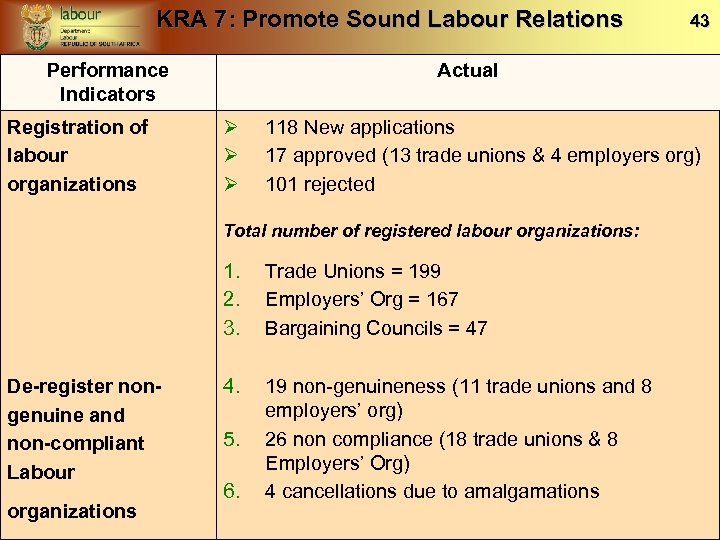
KRA 7: Promote Sound Labour Relations Performance Indicators Registration of labour organizations Actual Ø Ø Ø 118 New applications 17 approved (13 trade unions & 4 employers org) 101 rejected Total number of registered labour organizations: 1. 2. 3. De-register nongenuine and non-compliant Labour organizations 43 Trade Unions = 199 Employers’ Org = 167 Bargaining Councils = 47 4. 19 non-genuineness (11 trade unions and 8 employers’ org) 26 non compliance (18 trade unions & 8 Employers’ Org) 4 cancellations due to amalgamations 5. 6.
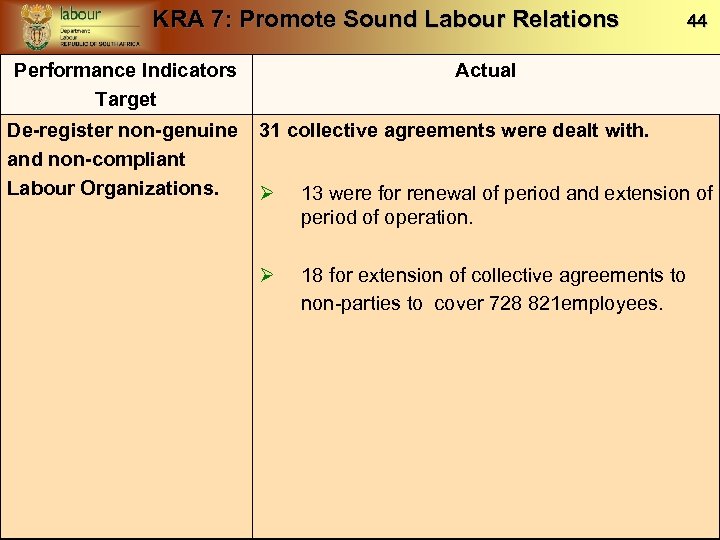
KRA 7: Promote Sound Labour Relations Performance Indicators Target De-register non-genuine and non-compliant Labour Organizations. 44 Actual 31 collective agreements were dealt with. Ø 13 were for renewal of period and extension of period of operation. Ø 18 for extension of collective agreements to non-parties to cover 728 821 employees.
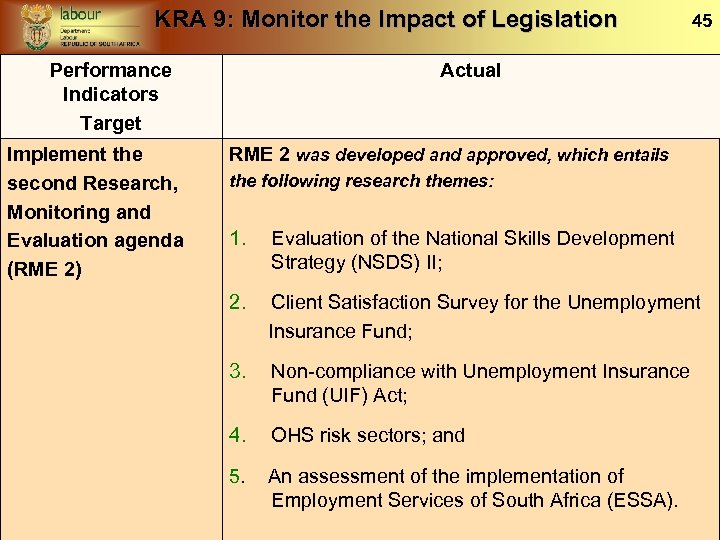
KRA 9: Monitor the Impact of Legislation Performance Indicators Target Implement the second Research, Monitoring and Evaluation agenda (RME 2) 45 Actual RME 2 was developed and approved, which entails the following research themes: 1. Evaluation of the National Skills Development Strategy (NSDS) II; 2. Client Satisfaction Survey for the Unemployment Insurance Fund; 3. Non-compliance with Unemployment Insurance Fund (UIF) Act; 4. OHS risk sectors; and 5. An assessment of the implementation of Employment Services of South Africa (ESSA).
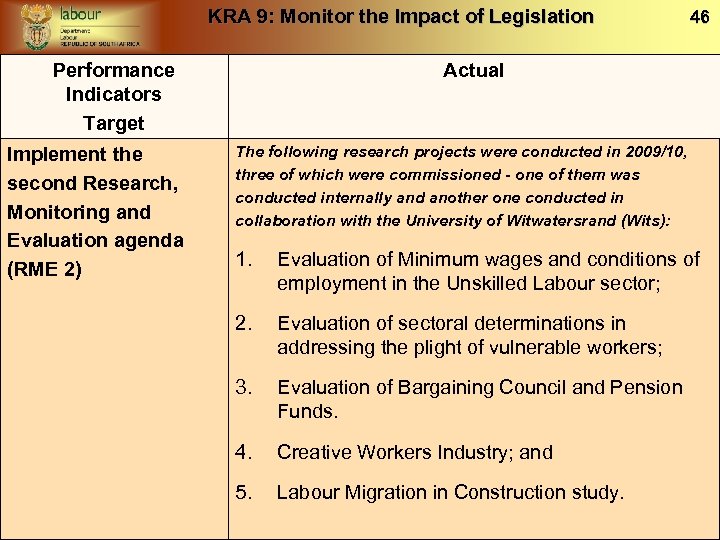
KRA 9: Monitor the Impact of Legislation Performance Indicators Target Implement the second Research, Monitoring and Evaluation agenda (RME 2) 46 Actual The following research projects were conducted in 2009/10, three of which were commissioned - one of them was conducted internally and another one conducted in collaboration with the University of Witwatersrand (Wits): 1. Evaluation of Minimum wages and conditions of employment in the Unskilled Labour sector; 2. Evaluation of sectoral determinations in addressing the plight of vulnerable workers; 3. Evaluation of Bargaining Council and Pension Funds. 4. Creative Workers Industry; and 5. Labour Migration in Construction study.
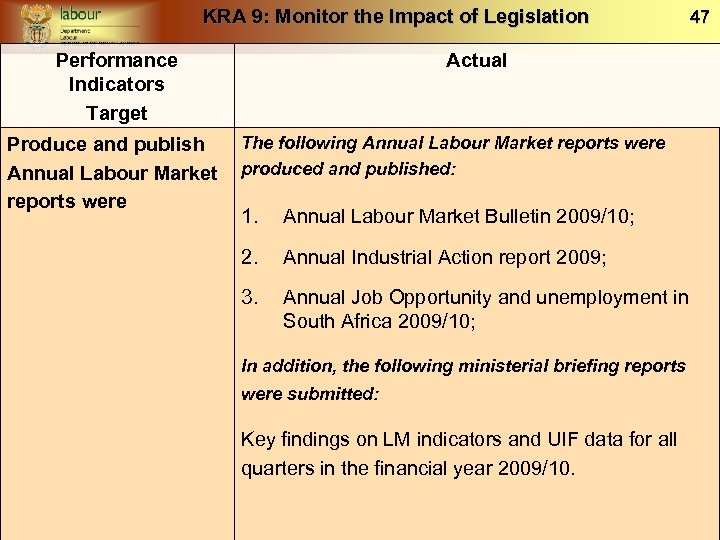
KRA 9: Monitor the Impact of Legislation Performance Indicators Target Produce and publish Annual Labour Market reports were 47 Actual The following Annual Labour Market reports were produced and published: 1. Annual Labour Market Bulletin 2009/10; 2. Annual Industrial Action report 2009; 3. Annual Job Opportunity and unemployment in South Africa 2009/10; In addition, the following ministerial briefing reports were submitted: Key findings on LM indicators and UIF data for all quarters in the financial year 2009/10.
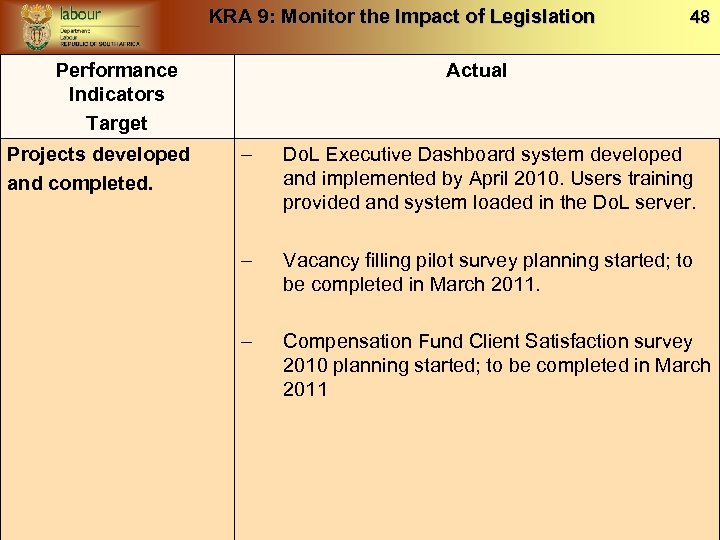
KRA 9: Monitor the Impact of Legislation Performance Indicators Target Projects developed and completed. 48 Actual – Do. L Executive Dashboard system developed and implemented by April 2010. Users training provided and system loaded in the Do. L server. – Vacancy filling pilot survey planning started; to be completed in March 2011. – Compensation Fund Client Satisfaction survey 2010 planning started; to be completed in March 2011
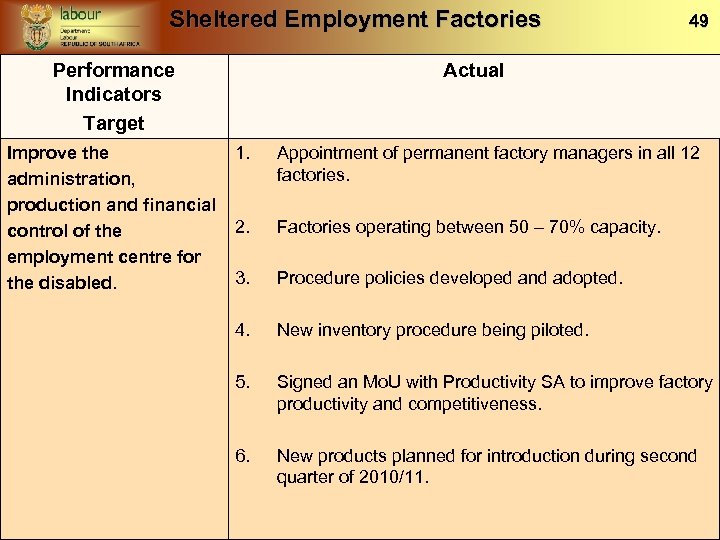
Sheltered Employment Factories Performance Indicators Target Improve the administration, production and financial control of the employment centre for the disabled. 49 Actual 1. Appointment of permanent factory managers in all 12 factories. 2. Factories operating between 50 – 70% capacity. 3. Procedure policies developed and adopted. 4. New inventory procedure being piloted. 5. Signed an Mo. U with Productivity SA to improve factory productivity and competitiveness. 6. New products planned for introduction during second quarter of 2010/11.

50 Finance Report CFO: Mr B Maduna
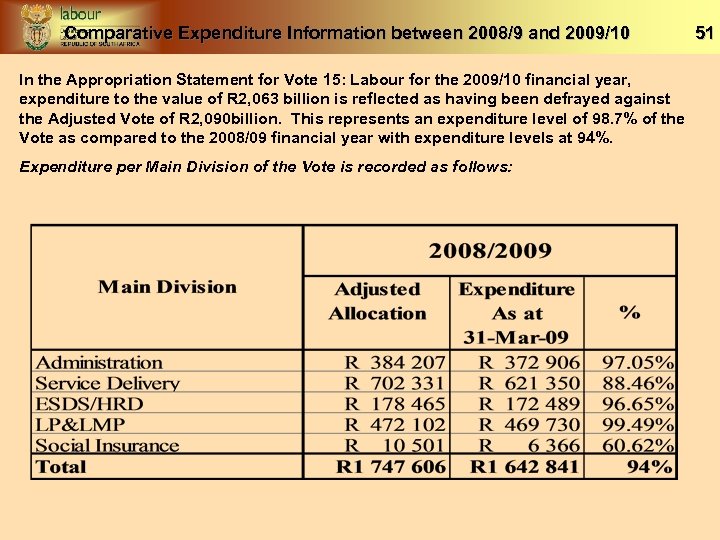
Comparative Expenditure Information between 2008/9 and 2009/10 In the Appropriation Statement for Vote 15: Labour for the 2009/10 financial year, expenditure to the value of R 2, 063 billion is reflected as having been defrayed against the Adjusted Vote of R 2, 090 billion. This represents an expenditure level of 98. 7% of the Vote as compared to the 2008/09 financial year with expenditure levels at 94%. Expenditure per Main Division of the Vote is recorded as follows: 51
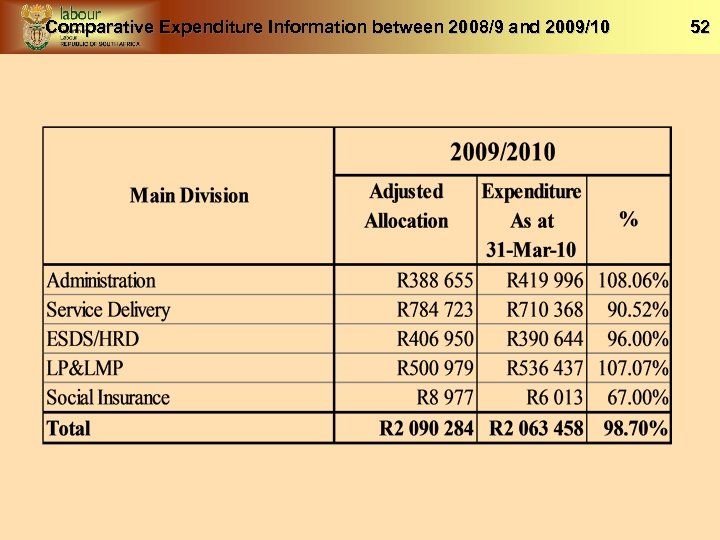
Comparative Expenditure Information between 2008/9 and 2009/10 52
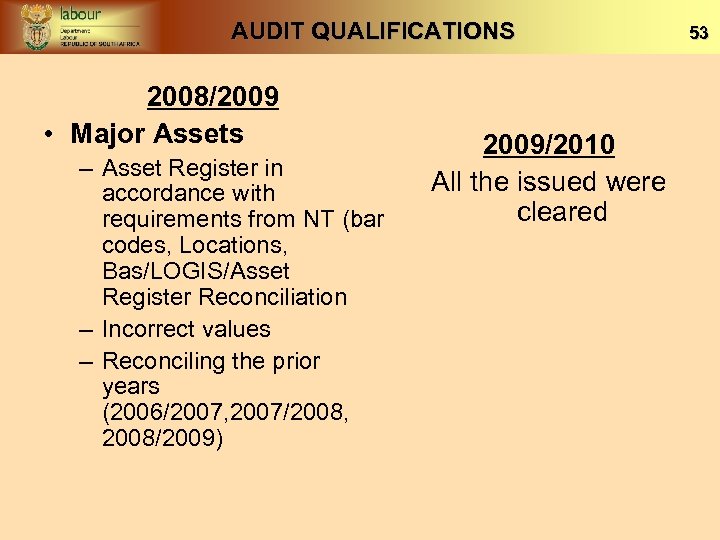
AUDIT QUALIFICATIONS 2008/2009 • Major Assets – Asset Register in accordance with requirements from NT (bar codes, Locations, Bas/LOGIS/Asset Register Reconciliation – Incorrect values – Reconciling the prior years (2006/2007, 2007/2008, 2008/2009) 2009/2010 All the issued were cleared 53
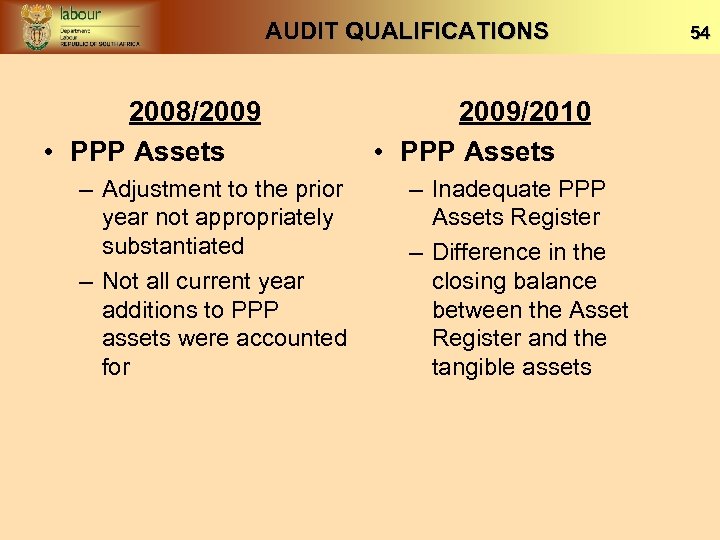
AUDIT QUALIFICATIONS 2008/2009 • PPP Assets – Adjustment to the prior year not appropriately substantiated – Not all current year additions to PPP assets were accounted for 2009/2010 • PPP Assets – Inadequate PPP Assets Register – Difference in the closing balance between the Asset Register and the tangible assets 54
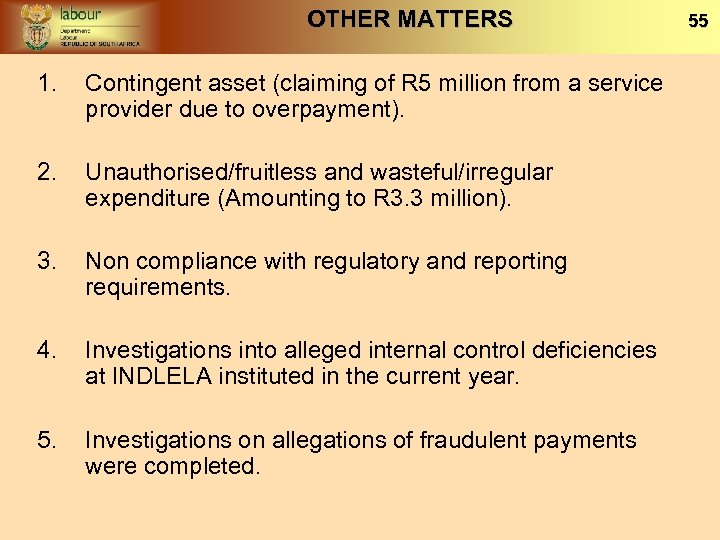
OTHER MATTERS 1. Contingent asset (claiming of R 5 million from a service provider due to overpayment). 2. Unauthorised/fruitless and wasteful/irregular expenditure (Amounting to R 3. 3 million). 3. Non compliance with regulatory and reporting requirements. 4. Investigations into alleged internal control deficiencies at INDLELA instituted in the current year. 5. Investigations on allegations of fraudulent payments were completed. 55

Thank you
Скачать презентацию Presentation to the Select Committee on Labour and
da3328339ba645a2e93bc94b849a050b.ppt