


 Скачать презентацию Presentation to the Portfolio Committee on Water Affairs
c6ccdb54307bd8c9f904ee0058a1b67d.ppt
- Количество слайдов: 17
 Presentation to the Portfolio Committee on Water Affairs & Forestry 3 rd May 2007 CSO INVOLVEMENT IN WATER SERVICES SECTOR (MASIBAMBANE ) Thoko Sigwaza Director Sector Collaboration & Rosetta Simelane National CSO Coordinator
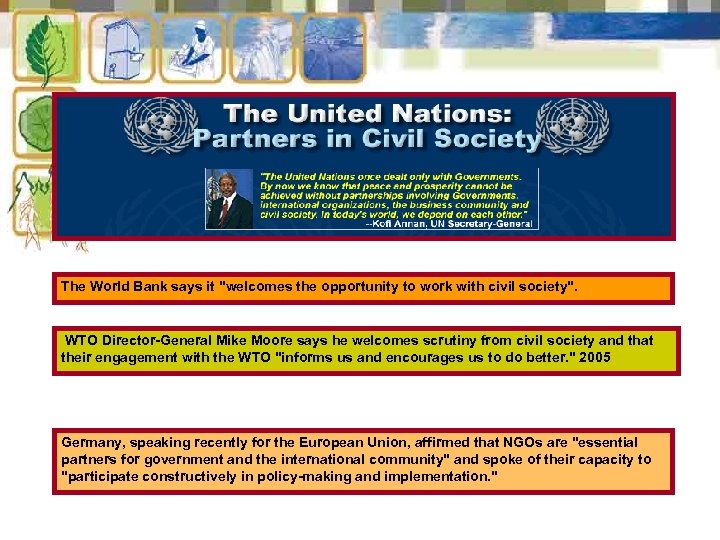 The World Bank says it "welcomes the opportunity to work with civil society". WTO Director-General Mike Moore says he welcomes scrutiny from civil society and that their engagement with the WTO "informs us and encourages us to do better. " 2005 Germany, speaking recently for the European Union, affirmed that NGOs are "essential partners for government and the international community" and spoke of their capacity to "participate constructively in policy-making and implementation. "
 INTRODUCTION –POLITICAL IMPERATIVES In the state of the nation address 2005, President Mbeki stated that; “The capital investment programme of government will be speeded up focusing on housing…, water & electricity. In part to facilitate this, urgent steps will be taken to strengthen the Public-Private Partnership mechanism in government by December 2005. At all times these partnerships should involve local communities”
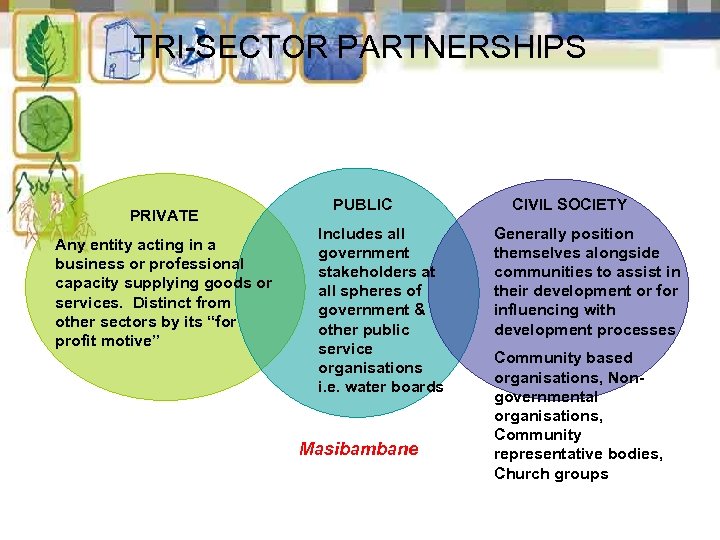 TRI-SECTOR PARTNERSHIPS PRIVATE Any entity acting in a business or professional capacity supplying goods or services. Distinct from other sectors by its “for profit motive” PUBLIC Includes all government stakeholders at all spheres of government & other public service organisations i. e. water boards Masibambane CIVIL SOCIETY Generally position themselves alongside communities to assist in their development or for influencing with development processes Community based organisations, Nongovernmental organisations, Community representative bodies, Church groups
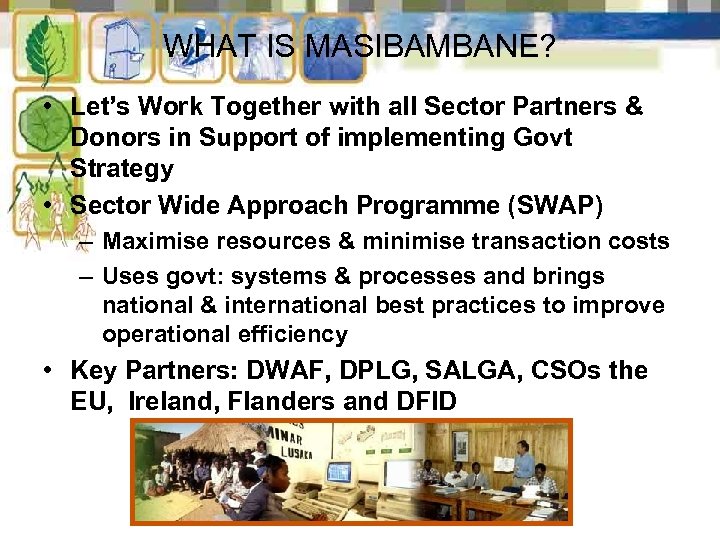 WHAT IS MASIBAMBANE? • Let’s Work Together with all Sector Partners & Donors in Support of implementing Govt Strategy • Sector Wide Approach Programme (SWAP) – Maximise resources & minimise transaction costs – Uses govt: systems & processes and brings national & international best practices to improve operational efficiency • Key Partners: DWAF, DPLG, SALGA, CSOs the EU, Ireland, Flanders and DFID
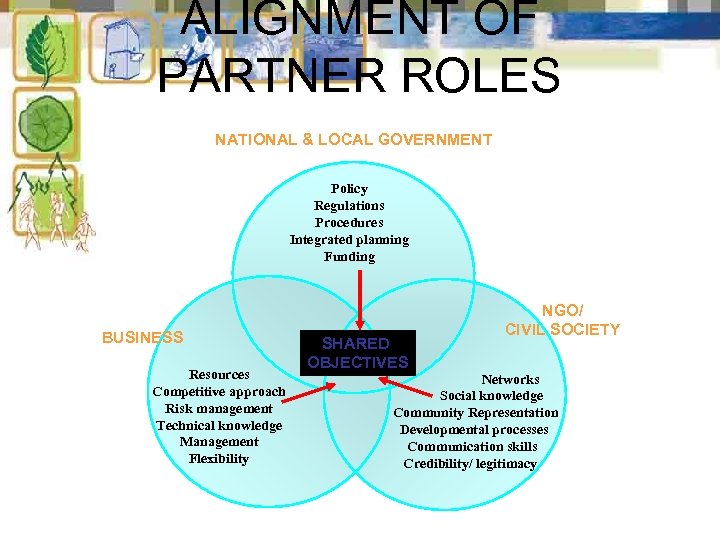 ALIGNMENT OF PARTNER ROLES NATIONAL & LOCAL GOVERNMENT Policy Regulations Procedures Integrated planning Funding BUSINESS Resources Competitive approach Risk management Technical knowledge Management Flexibility SHARED OBJECTIVES NGO/ CIVIL SOCIETY Networks Social knowledge Community Representation Developmental processes Communication skills Credibility/ legitimacy
 10 Yrs OF CWSS AND NGO COOPERATION • Policy and Strategy development • 1996 DWAF entered into a partnership agreement with NGO for service delivery - first of its kind • 10 m people served in 10 years at a cost of over R 8 billion • Created 400, 000 job opportunities of which over 50% are for women • ± R 300 m spent thro: NGOs • Training and capacity building of NGOs in SADC • Development of guidelines and tools for training capacity building
 NGO COOPERATION (cont. ) • Development and roll out of monitoring and evaluation • Participation in the Bo. TT programme • Broadening the participation of NGOs • Capacitating and influencing Private Sector partners on sustainability issues • Improving cost effectiveness • Assisting in the evaluation processes • Improving accountability and relating to “grass root” • Meeting conditionalities in EU and other donor programmes.
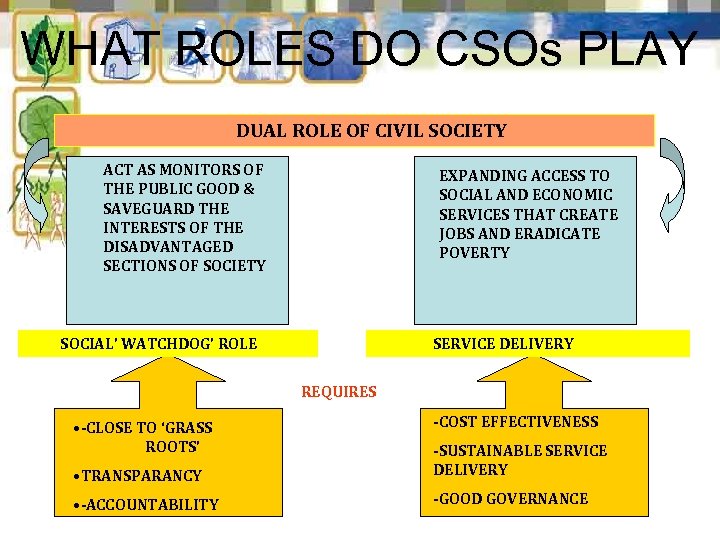 WHAT ROLES DO CSOs PLAY DUAL ROLE OF CIVIL SOCIETY ACT AS MONITORS OF THE PUBLIC GOOD & SAVEGUARD THE INTERESTS OF THE DISADVANTAGED SECTIONS OF SOCIETY EXPANDING ACCESS TO SOCIAL AND ECONOMIC SERVICES THAT CREATE JOBS AND ERADICATE POVERTY SOCIAL’ WATCHDOG’ ROLE SERVICE DELIVERY REQUIRES • -CLOSE TO ‘GRASS ROOTS’ -COST EFFECTIVENESS • TRANSPARANCY -SUSTAINABLE SERVICE DELIVERY • -ACCOUNTABILITY -GOOD GOVERNANCE
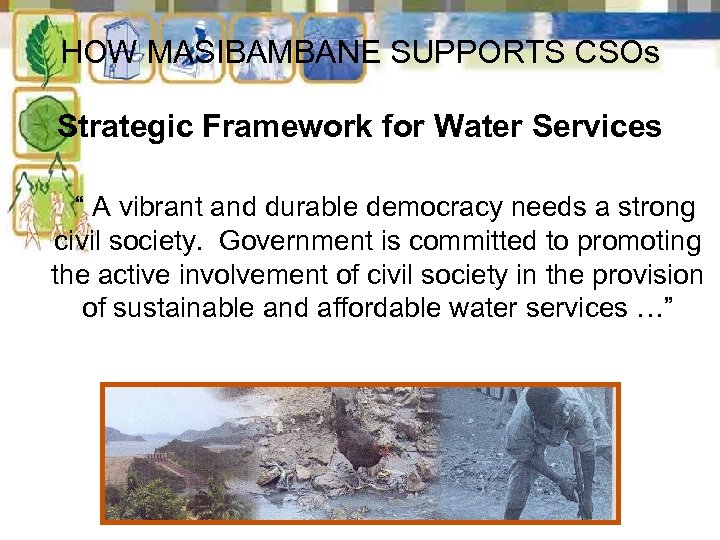 HOW MASIBAMBANE SUPPORTS CSOs Strategic Framework for Water Services “ A vibrant and durable democracy needs a strong civil society. Government is committed to promoting the active involvement of civil society in the provision of sustainable and affordable water services …”
 ‘WATCHDOG’ ROLE OF CSOs • Emphasis on communication with key stakeholders esp. Local Govt (to build trust and sound relations) • Advocacy programme to promote community participation and empowerment • Accredited training & Capacity building of NGOs & CBOs (Accreditation) • Assist with securing of funding
 AREAS OF INTERVENTION IN SERVICE DELIVERY • • • Project planning Project design ISD Gender Awareness and Equity Water Conservation and Environment Research and Policy and Networking M&E Health and Hygiene Awareness Capacity building and training Using innovative implementation models/approaches • Mentoring
 Successes-Current involvement in WS delivery • Mpumalanga- CSO contracted for social facilitation in communities and education on cost recovery issues in the Western Highveld area • LP-implementation of a sanitation programme in Sekhukhune district and Greater Tzaneen • Rehabilitation of hand pumps in remote areas to enable provisioning while larger infrastructure programmes are still in planning stages in Sekhukhune( Tsogang Water and sanitation) with Flanders govt donor support
 Current initiatives cont. • LP- Social facilitation, Hygiene and Health promotion (mobile water classroom(Eco Care Trust) • LP- Community facilitation and training (Thlavhama) • Sanitation delivery in Bohlabela District (AWARD) and piloting of Multiple use of water • NC, LP, EC sanitation delivery ( Mvula Trust)
 FUTURE CHALLENGES • Introduction to MIG and agree on 3% benchmark • Strengthening partnerships between CSOs & Local Gvt. • Accredited Capacity Building & Training in Water Services Business • Capacity on ‘watchdog role’ • Broaden CSO base in WS Sectors • Emphasis on sustainability • Funding for independent role of CSOs • Contracting and Procurement • Working for NEPAD to share experiences with other African countries.
 THANK YOU