 Скачать презентацию PRESENTATION TO THE PORTFOLIO COMMITTEE ON PUBLIC WORKS
1d9a1127256144887368ced8bb2a1b13.ppt
- Количество слайдов: 49



PRESENTATION TO THE PORTFOLIO COMMITTEE ON PUBLIC WORKS ON THE 2015 -2020 STRATEGIC PLAN AND 2015/16 ANNUAL PERFORMANCE PLAN OF THE DEPARTMENT OF PUBLIC WORKS Director-General Department of Public Works 24 March 2015
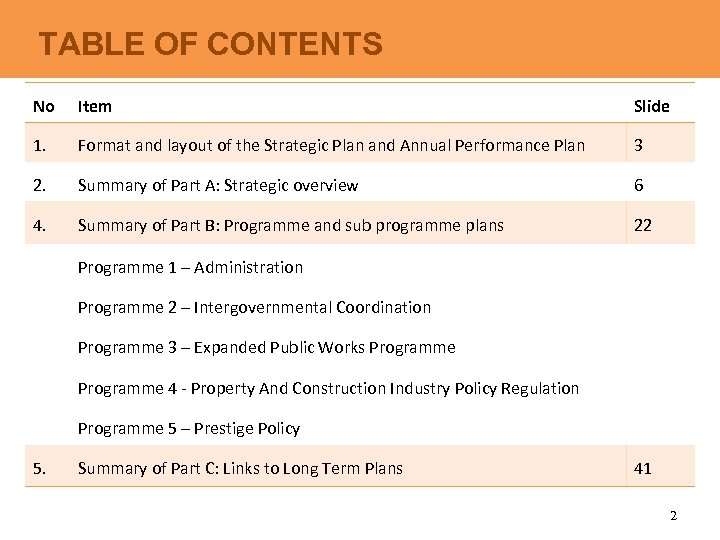
TABLE OF CONTENTS No Item Slide 1. Format and layout of the Strategic Plan and Annual Performance Plan 3 2. Summary of Part A: Strategic overview 6 4. Summary of Part B: Programme and sub programme plans 22 Programme 1 – Administration Programme 2 – Intergovernmental Coordination Programme 3 – Expanded Public Works Programme 4 - Property And Construction Industry Policy Regulation Programme 5 – Prestige Policy 5. Summary of Part C: Links to Long Term Plans 41 2
1 Format and layout of the Strategic Plan and Annual Performance Plan This section sets out the minimum requirement for Strategic Plans and Annual Performance Plans as per the Framework for Strategic Plans and Annual Performance Plans 3
NATIONAL TREASURY GUIDELINES FOR STRATEGIC PLANS AND ANNUAL PERFORMANCE PLANS • The Framework for Strategic Plans and Annual Performance Plans, issued in September 2010, provides a new format and revised timeframes for the compilation of the Strategic Plan and Annual Performance Plan. • National Treasury issued an Instruction Note (No. 33) in July 2011 on the full compliance to the mandatory requirements of the Framework for Strategic Plans and Annual Performance Plans. • A Strategic Plan covers a period of at least five years ideally from the first planning cycle following an election linked to the identified outcomes of the Presidency. • A Strategic Plan may be changed during the five year period it covers. However, such changes should be limited to revisions related to significant policy shifts or changes in the service delivery environment • The Annual Performance Plan sets out what the institution intends doing in the upcoming financial year and during the MTEF to implement its Strategic Plan. • The format of the APP (including the tables) is prescribed by the National Treasury Framework for Strategic Plans and Annual Performance Plans and aims is to link the plans, budget and performance of the Department. • Annual targets are broken up into quarterly targets where possible to ensure effective monitoring of performance on a quarterly basis 4
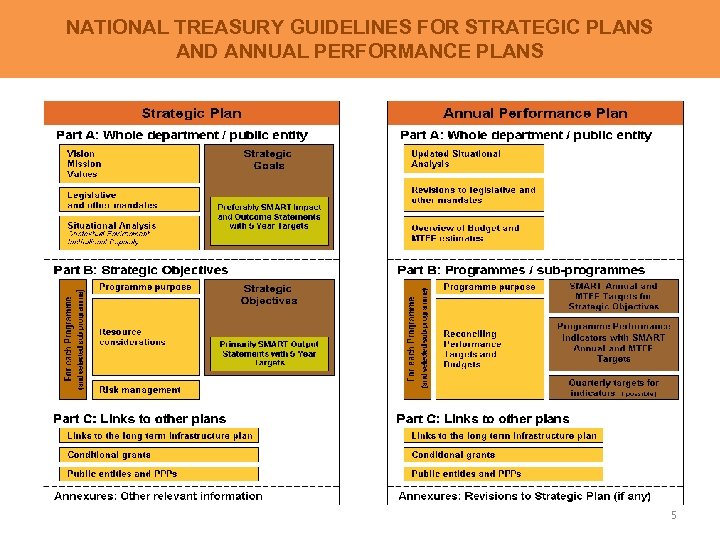
NATIONAL TREASURY GUIDELINES FOR STRATEGIC PLANS AND ANNUAL PERFORMANCE PLANS 5
2 PART A: Strategic overview This section specifies the vision, mission, values and the goals that the Department aims to achieve over a five-year period. (SP Pages 16 -68) 6
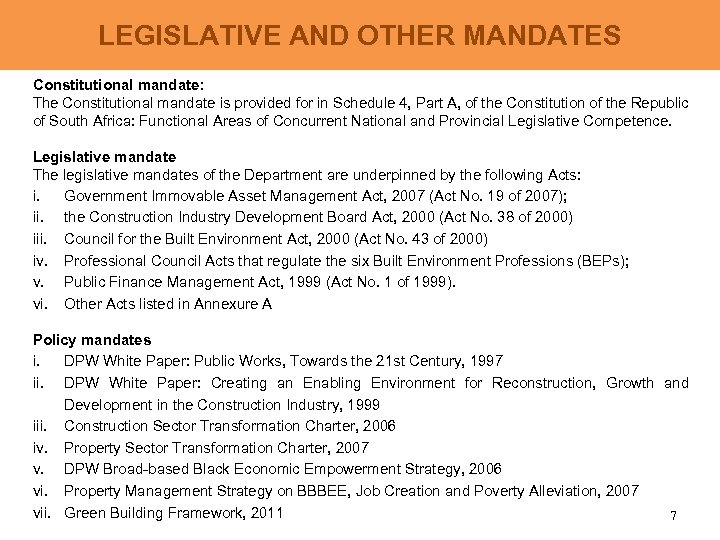
LEGISLATIVE AND OTHER MANDATES Constitutional mandate: The Constitutional mandate is provided for in Schedule 4, Part A, of the Constitution of the Republic of South Africa: Functional Areas of Concurrent National and Provincial Legislative Competence. Legislative mandate The legislative mandates of the Department are underpinned by the following Acts: i. Government Immovable Asset Management Act, 2007 (Act No. 19 of 2007); ii. the Construction Industry Development Board Act, 2000 (Act No. 38 of 2000) iii. Council for the Built Environment Act, 2000 (Act No. 43 of 2000) iv. Professional Council Acts that regulate the six Built Environment Professions (BEPs); v. Public Finance Management Act, 1999 (Act No. 1 of 1999). vi. Other Acts listed in Annexure A Policy mandates i. DPW White Paper: Public Works, Towards the 21 st Century, 1997 ii. DPW White Paper: Creating an Enabling Environment for Reconstruction, Growth and Development in the Construction Industry, 1999 iii. Construction Sector Transformation Charter, 2006 iv. Property Sector Transformation Charter, 2007 v. DPW Broad-based Black Economic Empowerment Strategy, 2006 vi. Property Management Strategy on BBBEE, Job Creation and Poverty Alleviation, 2007 vii. Green Building Framework, 2011 7
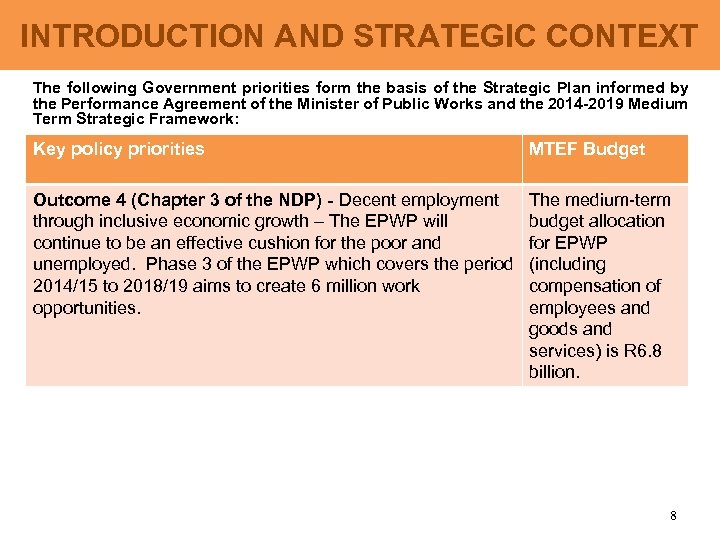
INTRODUCTION AND STRATEGIC CONTEXT The following Government priorities form the basis of the Strategic Plan informed by the Performance Agreement of the Minister of Public Works and the 2014 -2019 Medium Term Strategic Framework: Key policy priorities MTEF Budget Outcome 4 (Chapter 3 of the NDP) - Decent employment through inclusive economic growth – The EPWP will continue to be an effective cushion for the poor and unemployed. Phase 3 of the EPWP which covers the period 2014/15 to 2018/19 aims to create 6 million work opportunities. The medium-term budget allocation for EPWP (including compensation of employees and goods and services) is R 6. 8 billion. 8
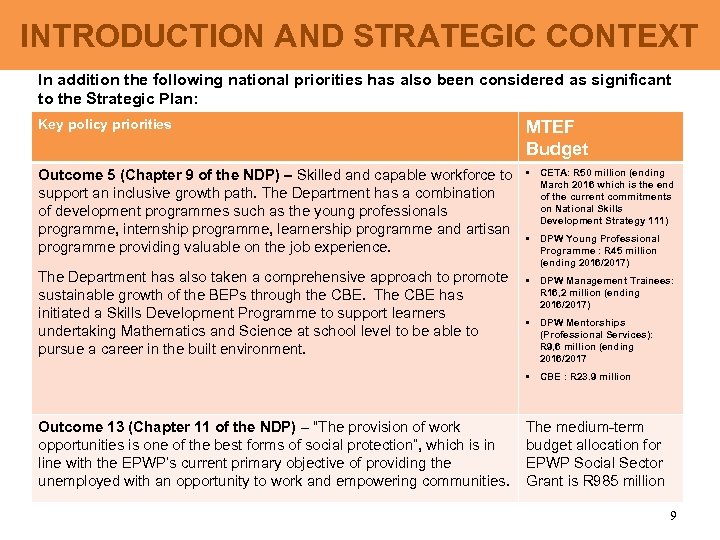
INTRODUCTION AND STRATEGIC CONTEXT In addition the following national priorities has also been considered as significant to the Strategic Plan: Key policy priorities MTEF Budget Outcome 5 (Chapter 9 of the NDP) – Skilled and capable workforce to support an inclusive growth path. The Department has a combination of development programmes such as the young professionals programme, internship programme, learnership programme and artisan programme providing valuable on the job experience. • CETA: R 50 million (ending March 2016 which is the end of the current commitments on National Skills Development Strategy 111) • DPW Young Professional Programme : R 45 million (ending 2016/2017) • DPW Management Trainees: R 16, 2 million (ending 2016/2017) • DPW Mentorships (Professional Services): R 9, 6 million (ending 2016/2017 • CBE : R 23. 9 million The Department has also taken a comprehensive approach to promote sustainable growth of the BEPs through the CBE. The CBE has initiated a Skills Development Programme to support learners undertaking Mathematics and Science at school level to be able to pursue a career in the built environment. Outcome 13 (Chapter 11 of the NDP) – “The provision of work opportunities is one of the best forms of social protection”, which is in line with the EPWP’s current primary objective of providing the unemployed with an opportunity to work and empowering communities. The medium-term budget allocation for EPWP Social Sector Grant is R 985 million 9
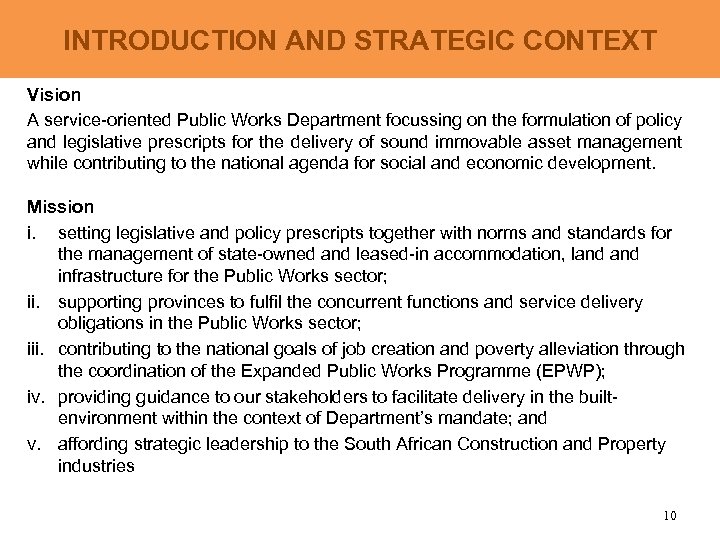
INTRODUCTION AND STRATEGIC CONTEXT Vision A service-oriented Public Works Department focussing on the formulation of policy and legislative prescripts for the delivery of sound immovable asset management while contributing to the national agenda for social and economic development. Mission i. setting legislative and policy prescripts together with norms and standards for the management of state-owned and leased-in accommodation, land infrastructure for the Public Works sector; ii. supporting provinces to fulfil the concurrent functions and service delivery obligations in the Public Works sector; iii. contributing to the national goals of job creation and poverty alleviation through the coordination of the Expanded Public Works Programme (EPWP); iv. providing guidance to our stakeholders to facilitate delivery in the builtenvironment within the context of Department’s mandate; and v. affording strategic leadership to the South African Construction and Property industries 10
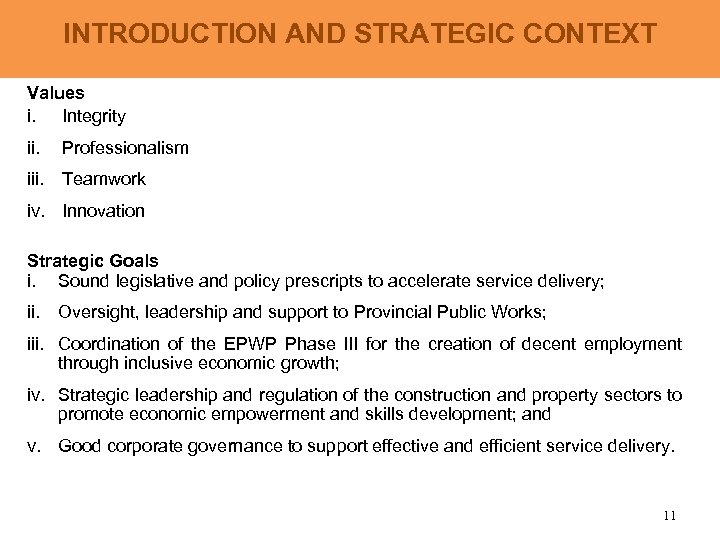
INTRODUCTION AND STRATEGIC CONTEXT Values i. Integrity ii. Professionalism iii. Teamwork iv. Innovation Strategic Goals i. Sound legislative and policy prescripts to accelerate service delivery; ii. Oversight, leadership and support to Provincial Public Works; iii. Coordination of the EPWP Phase III for the creation of decent employment through inclusive economic growth; iv. Strategic leadership and regulation of the construction and property sectors to promote economic empowerment and skills development; and v. Good corporate governance to support effective and efficient service delivery. 11
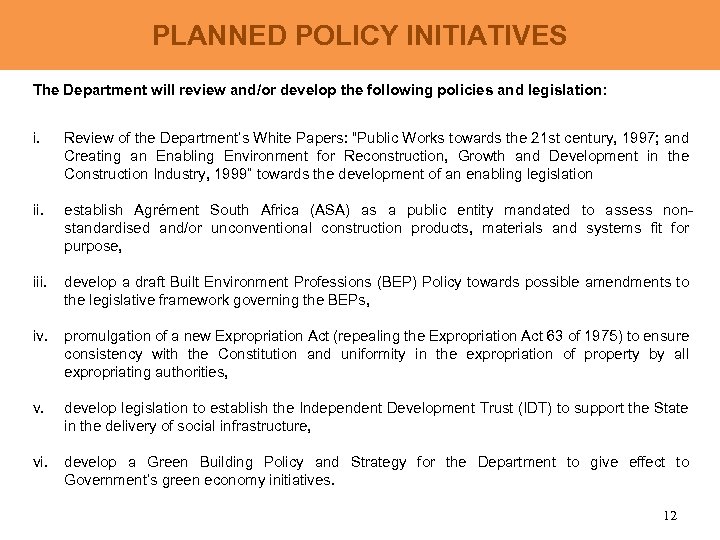
PLANNED POLICY INITIATIVES The Department will review and/or develop the following policies and legislation: i. Review of the Department’s White Papers: “Public Works towards the 21 st century, 1997; and Creating an Enabling Environment for Reconstruction, Growth and Development in the Construction Industry, 1999” towards the development of an enabling legislation ii. establish Agrément South Africa (ASA) as a public entity mandated to assess nonstandardised and/or unconventional construction products, materials and systems fit for purpose, iii. develop a draft Built Environment Professions (BEP) Policy towards possible amendments to the legislative framework governing the BEPs, iv. promulgation of a new Expropriation Act (repealing the Expropriation Act 63 of 1975) to ensure consistency with the Constitution and uniformity in the expropriation of property by all expropriating authorities, v. develop legislation to establish the Independent Development Trust (IDT) to support the State in the delivery of social infrastructure, vi. develop a Green Building Policy and Strategy for the Department to give effect to Government’s green economy initiatives. 12
STRATEGIC OVERVIEW – EXTERNAL ENVIRONMENT i. Economic trends and outlook - Whilst our economy will benefit from the reduction in the oil price and the immediate lift that provides for the trade and current account balances, the energy deficit that we face over the medium-term will remain a material constraint on economic performance. ii. The Property Sector - The current trends in the Property Sector offer some relief to the escalations in leasing costs to the PMTE. The challenges encountered by the PMTE include the backlog of maintenance on State-owned accommodation resulting in the over reliance on leased in accommodation. A coordinated and uniform approach in the management of its immovable assets will be undertaken to create a better balance between private leases and utilisation of existing stock of State-owned accommodation iii. The Construction Sector - The building and construction sector is expected to grow at an average of 4. 6%. Government’s ability to roll out its infrastructure programme has been criticized in the past few years. The Department has put in place various key interventions to build capacity to spend its infrastructure budget and to address fraud and corruption in the sector iv. Political Environment - Trends in the political environment are influenced by events taking place in other emerging economies worldwide. Domestic drivers of politics for the next five years will include issues of governance. To complement the drive for good governance the Department has put into place processes to strengthen the previously weak SCM operating model, procedures and processes. 13
STRATEGIC OVERVIEW – INTERNAL ENVIRONMENT The Department’s policy priorities are derived from the Policy Statement of the Minister of Public Works and the Seven Year Turnaround Plan 1. Key policy priorities i. The creation of 6 million work opportunities for poor and unemployed people through the labour-intensive delivery of public services and infrastructure. ii. The operationalisation of Property Management Entity (PMTE) and the transformation of the core property business (including construction management); iii. The operationalisation of the Governance, Risk and Compliance Branch to drive anti-corruption and to spearhead the second phase of the Turnaround Strategy; iv. A policy review which will culminate in a Public Works Act; and v. A renewed and sustained Programme of Action to transform the built environment and the construction and property sectors, as part of the second more radical phase of transition to democracy 14
STRATEGIC OVERVIEW – INTERNAL ENVIRONMENT 2. The Turnaround Strategy Phase I – The Stabilisation Phase This Phase was initiated during 2012 with the specific purpose of ensuring clear and systematic improvements across the Department. The Stabilisation Phase (ended on 31 March 2014) has achieved critical and foundational milestones although there are still various stabilisation projects continuing into the next phase. In this regard, the following successes are noted: • The operationalisation of the PMTE to oversee the State’s asset investment, property and facilities management functions in line with Generally Recognised Accounting Practice (GRAP). • Developing a complete and credible Real Estate Asset Register (REAR) under the Department’s custodianship in terms of which registered and unregistered land parcels were reconciled against the deeds records and other National and Provincial immovable asset registers. • A comprehensive audit of 2 161 leased properties was completed. This audit included the physical verification of 2 143 leased properties. • Substantial improvements by the Department were made as is evidenced by progression from disclaimers in 2010/11 and 2011/12 to a qualification in 2012/13 and an unqualified audit outcome in 2013/14. • Improved internal efficiencies within the Prestige portfolio have been realised by centralising this function in the office of the Director-General. 15
STRATEGIC OVERVIEW – INTERNAL ENVIRONMENT 2. The Turnaround Strategy (cont…. . ) Phase II – Efficiency Enhancement The Efficiency Enhancement Phase commenced on 01 April 2014 during which time, ten (10) projects were prioritised to drive this phase of the Turnaround Strategy. These projects include, among others: i. The Service Delivery Improvement Plan (SDIP) and Macro Service Delivery Model are in place. The SDIP, will in the longer term, become the business improvement process for the Department and PMTE; ii. The operationalisation of the PMTE and its establishment as a Trading Entity. 2. Supply Chain Management (SCM) is being restructured to meet the business requirements. 3. Improving internal efficiencies to meet the service delivery requirements of Prestige clients is underway to ensure that deliverables comply with the prescripts of the Ministerial Handbook. 4. Developing an Information Technology (ICT) strategy, architecture and platform as a key enabler has been prioritised for immediate implementation. i. Combating fraud and corruption within the Department as well as in the construction and property sectors, while holding transgressors accountable for their actions and 2. Implementing an effective Change Management Strategy to enable a performance driven culture has already been initiated in an effort to restore a performance management culture in the Department. 16
STRATEGIC OVERVIEW – INTERNAL ENVIRONMENT 3. The business model of the Department of Public Works Whilst operationalising the PMTE, the Department will place greater emphasis on: i. developing best practice within the sector; ii. managing the transformation and growth of the construction and property sectors; iii. drafting legislation and undertaking regulatory functions; iv. formulating policies and implementation guidelines for the sector; v. setting norms and standards for the Public Works Sector; vi. managing the norms and standards and policy formulation for the Prestige Client Portfolio; vii. coordinating the implementation of the EPWP; viii. focusing on its role in terms of the concurrent functions and the management of performance in this regard; and ix. carrying out oversight functions and coordination of the Entities. 17
PERFORMANCE ENVIRONMENT 1. The following achievements have been noted in the service delivery environment i. Commendable improvements in internal controls which has resulted in improved audit outcomes for DPW. ii. Achievements of EPWP Phase II with the creation of over 4 mil work opportunities. Significant contribution has been noted in various sectors. 2. Challenges in the current service delivery environment and strategies for redress i. Deficiencies in the internal control environment – The Department has compiled a comprehensive action plan which is also reviewed by Internal Audit. The Action Plan is updated quarterly and discussed at Accountability EXCO. ii. Inadequate internal performance management operating procedures – interventions include the development of policies, procedures and processes, proper record keeping, training, improved quality controls, M&E Forum 1. Lack of integration of performance information structures and systems within existing management processes and systems (ICT) – A 3 Phased approach to improving ICT infrastructure and systems has been developed. The business application stack is key in the stabilisation phase. i. Inability to retain and attract the required skilled personnel – A Change Management Strategy has been developed to address capacity challenges and manage the change process. The implementation of the new organisational structure will be supported by a 18 comprehensive Human Resource Plan.
PERFORMANCE ENVIRONMENT 3. Additional strategies identified to improve efficiencies in the performance environment i. Alignment of the concurrent functions ii. Development and implementation of the Service Delivery Model Framework (SDMF) iii. Meeting the needs of Prestige clients iv. Actively reducing fraud and corruption in the Department 4. Demand for services – Demand for EPWP in terms of the upscaling for Phase III i. High and growing rates of unemployment are a consequence of dynamics on both the demand supply sides of the labour market. ii. There has not been sufficient employment growth to absorb new labour market entrants or to provide jobs for those people who experienced job losses due to shrinking demand for labour iii. The EPWP is a nationwide programme covering all spheres of government and state-owned enterprises. It aims to draw significant numbers of unemployed people into productive work accompanied by training, so that they increase their capacity to earn an income. 3. Spending focus over the MTEF in accordance with the Department’s priorities i. The Department’s budget over the medium-term is R 20. 7 billion. The budget of R 6. 4 billion is projected to increase to R 6. 9 billion in 2016/17 and R 7. 4 billion in the 2017/18 financial years. ii. The devolution of the budget allocation of approximately R 11. 2 billion to the PMTE has resulted in the decrease in the Departmental budget allocations over the medium-term. The budget allocation for the devolved functions has been reclassified as transfers and subsidies to the PMTE within Programme 4. 19
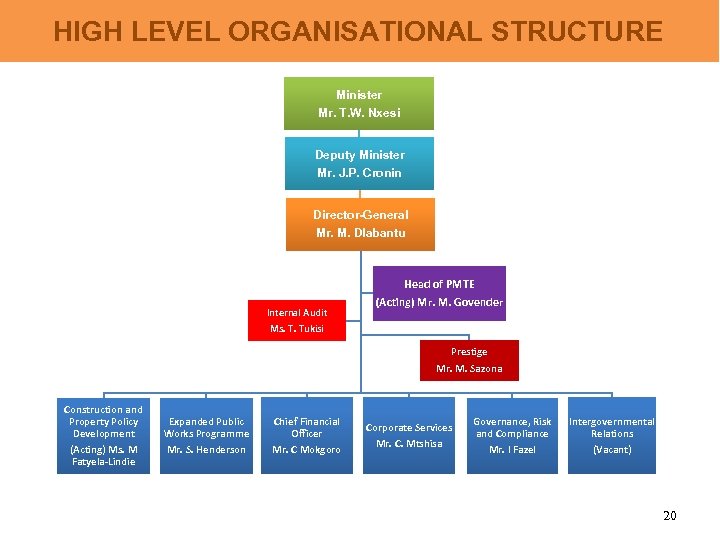
HIGH LEVEL ORGANISATIONAL STRUCTURE Minister Mr. T. W. Nxesi Deputy Minister Mr. J. P. Cronin Director-General Mr. M. Dlabantu Internal Audit Ms. T. Tukisi Head of PMTE (Acting) Mr. M. Govender Prestige Mr. M. Sazona Construction and Property Policy Development (Acting) Ms. M Fatyela-Lindie Expanded Public Works Programme Mr. S. Henderson Chief Financial Officer Mr. C Mokgoro Corporate Services Mr. C. Mtshisa Governance, Risk and Compliance Mr. I Fazel Intergovernmental Relations (Vacant) 20
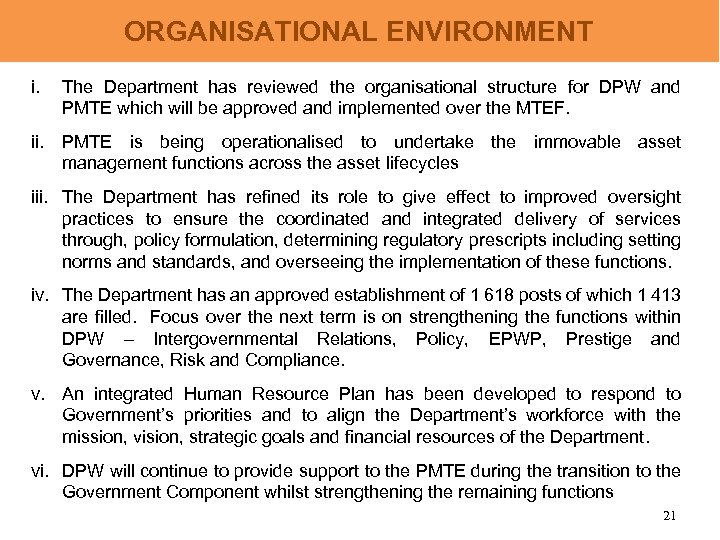
ORGANISATIONAL ENVIRONMENT i. The Department has reviewed the organisational structure for DPW and PMTE which will be approved and implemented over the MTEF. ii. PMTE is being operationalised to undertake the immovable asset management functions across the asset lifecycles iii. The Department has refined its role to give effect to improved oversight practices to ensure the coordinated and integrated delivery of services through, policy formulation, determining regulatory prescripts including setting norms and standards, and overseeing the implementation of these functions. iv. The Department has an approved establishment of 1 618 posts of which 1 413 are filled. Focus over the next term is on strengthening the functions within DPW – Intergovernmental Relations, Policy, EPWP, Prestige and Governance, Risk and Compliance. v. An integrated Human Resource Plan has been developed to respond to Government’s priorities and to align the Department’s workforce with the mission, vision, strategic goals and financial resources of the Department. vi. DPW will continue to provide support to the PMTE during the transition to the Government Component whilst strengthening the remaining functions 21
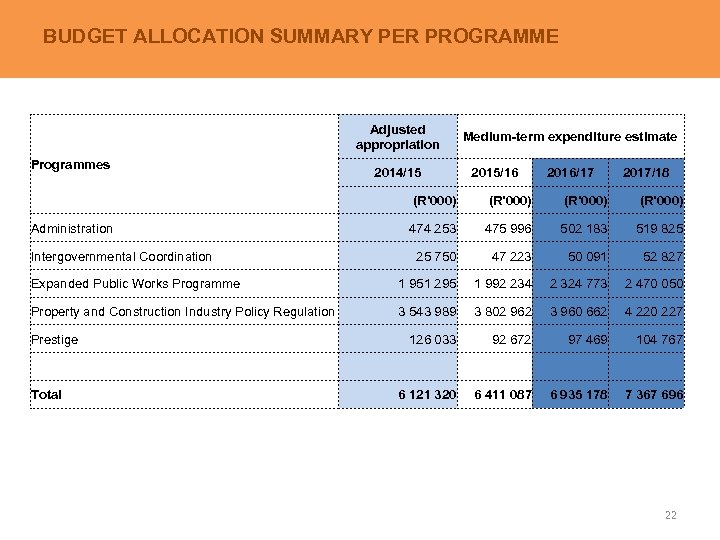
BUDGET ALLOCATION SUMMARY PER PROGRAMME Adjusted appropriation Programmes Medium-term expenditure estimate 2014/15 2015/16 (R’ 000) 2016/17 (R’ 000) 2017/18 (R’ 000) Administration 474 253 475 996 502 183 519 825 Intergovernmental Coordination 25 750 47 223 50 091 52 827 Expanded Public Works Programme 1 951 295 1 992 234 2 324 773 2 470 050 Property and Construction Industry Policy Regulation 3 543 989 3 802 962 3 960 662 4 220 227 Prestige 126 033 92 672 97 469 104 767 Total 6 121 320 6 411 087 6 935 178 7 367 696 22
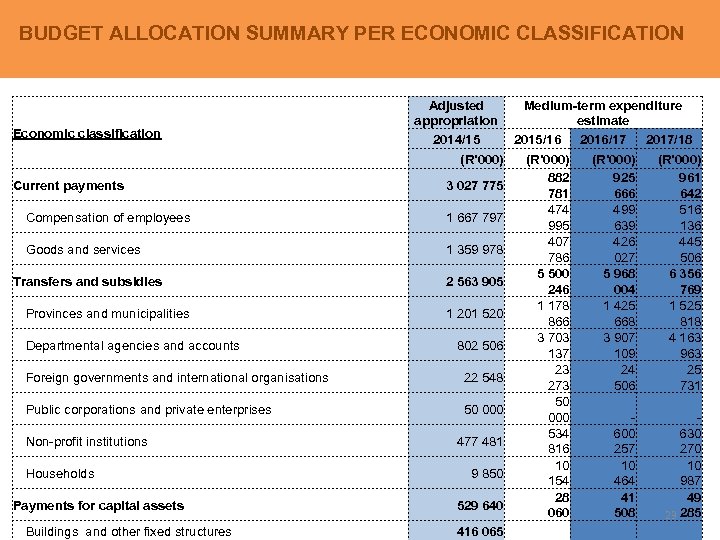
BUDGET ALLOCATION SUMMARY PER ECONOMIC CLASSIFICATION Economic classification Adjusted appropriation 2014/15 (R’ 000) Current payments 3 027 775 Compensation of employees 1 667 797 Goods and services 1 359 978 Transfers and subsidies 2 563 905 Provinces and municipalities 1 201 520 Departmental agencies and accounts 802 506 Foreign governments and international organisations 22 548 Public corporations and private enterprises 50 000 Non-profit institutions 477 481 Households 9 850 Payments for capital assets Buildings and other fixed structures 529 640 416 065 Medium-term expenditure estimate 2015/16 2016/17 2017/18 (R’ 000) 882 781 474 995 407 786 5 500 246 1 178 866 3 703 137 23 273 50 000 534 816 10 154 28 060 (R’ 000) 925 961 666 642 499 516 639 136 426 445 027 506 5 968 6 356 004 769 1 425 1 525 668 818 3 907 4 163 109 963 24 25 506 731 - - 600 630 257 270 10 464 987 41 49 508 23 285
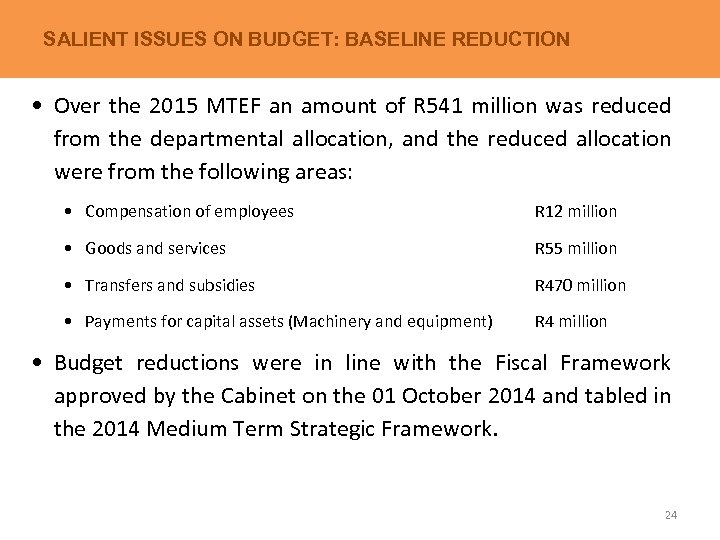
SALIENT ISSUES ON BUDGET: BASELINE REDUCTION • Over the 2015 MTEF an amount of R 541 million was reduced from the departmental allocation, and the reduced allocation were from the following areas: • Compensation of employees R 12 million • Goods and services R 55 million • Transfers and subsidies R 470 million • Payments for capital assets (Machinery and equipment) R 4 million • Budget reductions were in line with the Fiscal Framework approved by the Cabinet on the 01 October 2014 and tabled in the 2014 Medium Term Strategic Framework. 24
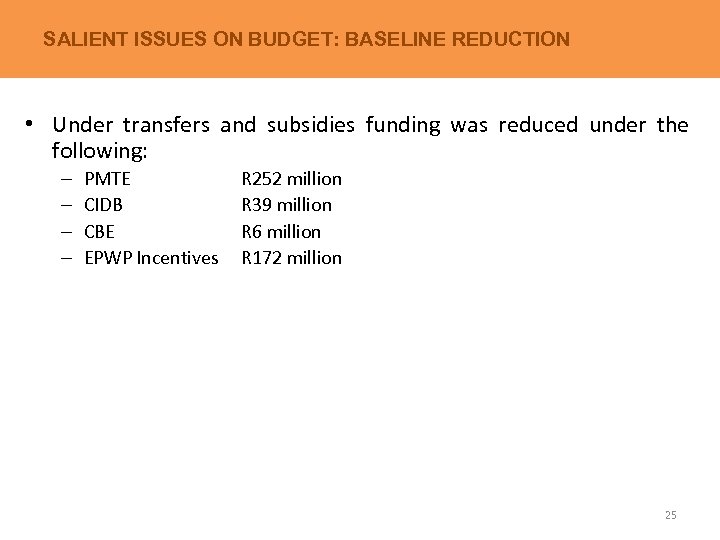
SALIENT ISSUES ON BUDGET: BASELINE REDUCTION • Under transfers and subsidies funding was reduced under the following: – – PMTE CIDB CBE EPWP Incentives R 252 million R 39 million R 6 million R 172 million 25
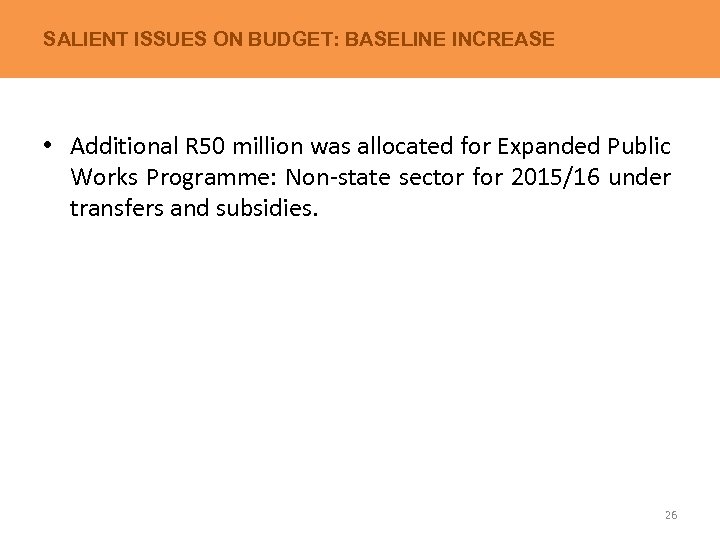
SALIENT ISSUES ON BUDGET: BASELINE INCREASE • Additional R 50 million was allocated for Expanded Public Works Programme: Non-state sector for 2015/16 under transfers and subsidies. 26
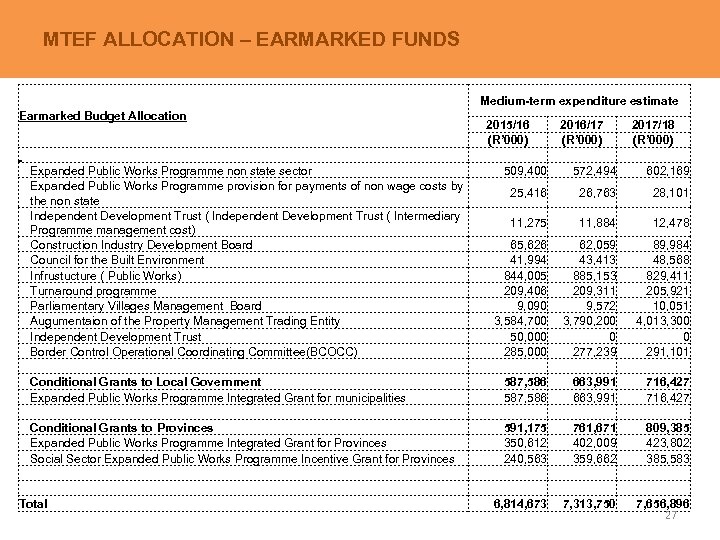
MTEF ALLOCATION – EARMARKED FUNDS Medium-term expenditure estimate Earmarked Budget Allocation Expanded Public Works Programme non state sector Expanded Public Works Programme provision for payments of non wage costs by the non state Independent Development Trust ( Intermediary Programme management cost) Construction Industry Development Board Council for the Built Environment Infrustucture ( Public Works) Turnaround programme Parliamentary Villages Management Board Augumentaion of the Property Management Trading Entity Independent Development Trust Border Control Operational Coordinating Committee(BCOCC) Conditional Grants to Local Government Expanded Public Works Programme Integrated Grant for municipalities Conditional Grants to Provinces Expanded Public Works Programme Integrated Grant for Provinces Social Sector Expanded Public Works Programme Incentive Grant for Provinces Total 2015/16 (R’ 000) 509, 400 2016/17 (R’ 000) 572, 494 2017/18 (R’ 000) 602, 169 25, 416 26, 763 28, 101 11, 275 11, 884 12, 478 65, 626 41, 994 844, 005 209, 406 9, 090 3, 584, 700 50, 000 285, 000 587, 586 591, 175 350, 612 240, 563 6, 814, 673 62, 059 43, 413 885, 153 209, 311 9, 572 3, 790, 200 0 277, 239 663, 991 761, 671 402, 009 359, 662 7, 313, 750 89, 984 48, 568 829, 411 205, 921 10, 051 4, 013, 300 0 291, 101 716, 427 809, 385 423, 802 385, 583 7, 656, 896 27
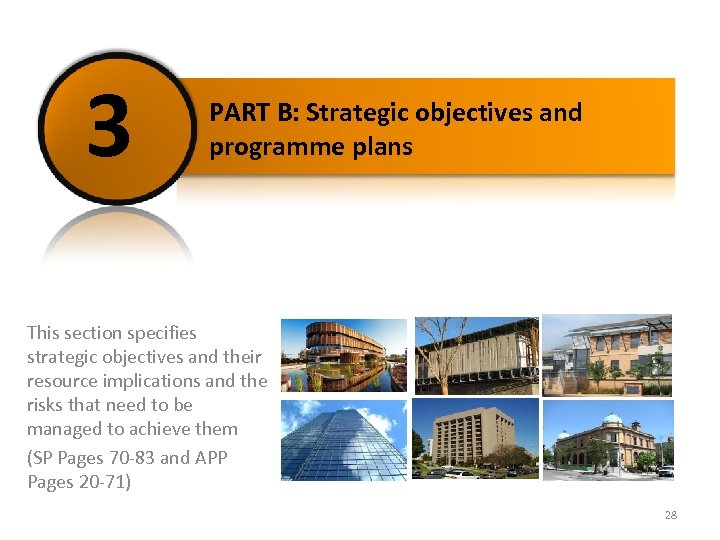
3 PART B: Strategic objectives and programme plans This section specifies strategic objectives and their resource implications and the risks that need to be managed to achieve them (SP Pages 70 -83 and APP Pages 20 -71) 28
PROGRAMME 1 - ADMINISTRATION 29
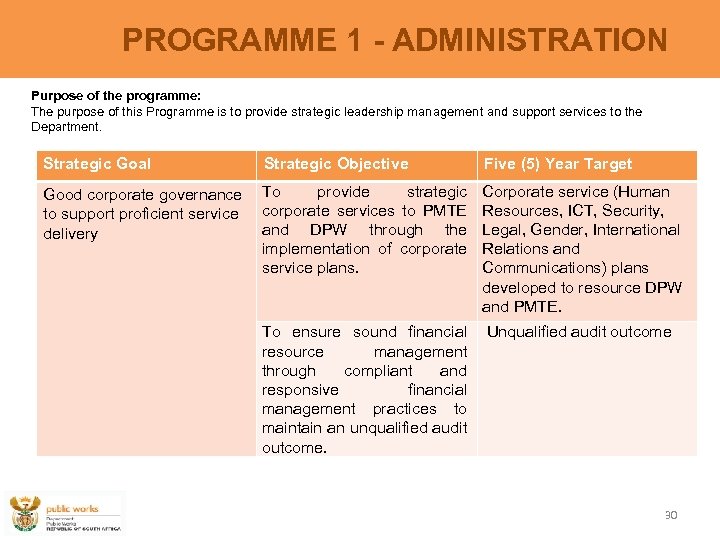
PROGRAMME 1 - ADMINISTRATION Purpose of the programme: The purpose of this Programme is to provide strategic leadership management and support services to the Department. Strategic Goal Strategic Objective provide strategic Good corporate governance To to support proficient service corporate services to PMTE and DPW through the delivery implementation of corporate service plans. Five (5) Year Target Corporate service (Human Resources, ICT, Security, Legal, Gender, International Relations and Communications) plans developed to resource DPW and PMTE. To ensure sound financial Unqualified audit outcome resource management through compliant and responsive financial management practices to maintain an unqualified audit outcome. 30
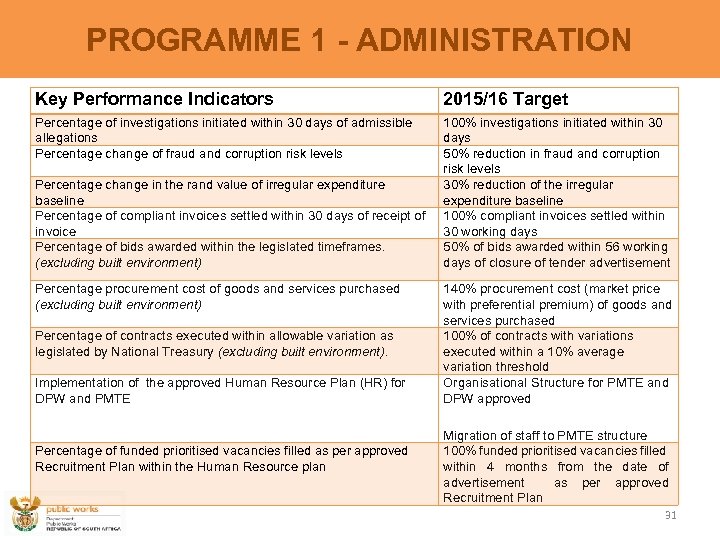
PROGRAMME 1 - ADMINISTRATION Key Performance Indicators 2015/16 Target Percentage of investigations initiated within 30 days of admissible allegations Percentage change of fraud and corruption risk levels 100% investigations initiated within 30 days 50% reduction in fraud and corruption risk levels 30% reduction of the irregular expenditure baseline 100% compliant invoices settled within 30 working days 50% of bids awarded within 56 working days of closure of tender advertisement Percentage change in the rand value of irregular expenditure baseline Percentage of compliant invoices settled within 30 days of receipt of invoice Percentage of bids awarded within the legislated timeframes. (excluding built environment) Percentage procurement cost of goods and services purchased (excluding built environment) Percentage of contracts executed within allowable variation as legislated by National Treasury (excluding built environment). Implementation of the approved Human Resource Plan (HR) for DPW and PMTE Percentage of funded prioritised vacancies filled as per approved Recruitment Plan within the Human Resource plan 140% procurement cost (market price with preferential premium) of goods and services purchased 100% of contracts with variations executed within a 10% average variation threshold Organisational Structure for PMTE and DPW approved Migration of staff to PMTE structure 100% funded prioritised vacancies filled within 4 months from the date of advertisement as per approved Recruitment Plan 31
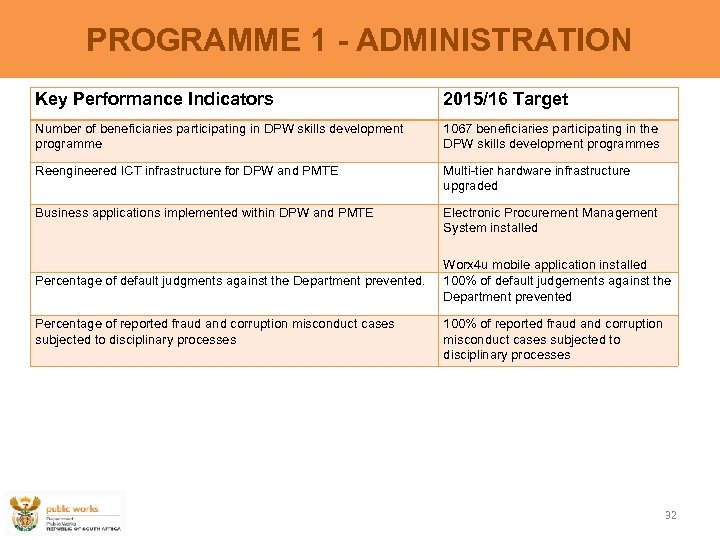
PROGRAMME 1 - ADMINISTRATION Key Performance Indicators 2015/16 Target Number of beneficiaries participating in DPW skills development programme 1067 beneficiaries participating in the DPW skills development programmes Reengineered ICT infrastructure for DPW and PMTE Multi-tier hardware infrastructure upgraded Business applications implemented within DPW and PMTE Electronic Procurement Management System installed Worx 4 u mobile application installed 100% of default judgements against the Department prevented Percentage of default judgments against the Department prevented. Percentage of reported fraud and corruption misconduct cases subjected to disciplinary processes 100% of reported fraud and corruption misconduct cases subjected to disciplinary processes 32
PROGRAMME 2 – INTERGOVERNMENTAL COORDINATION 33
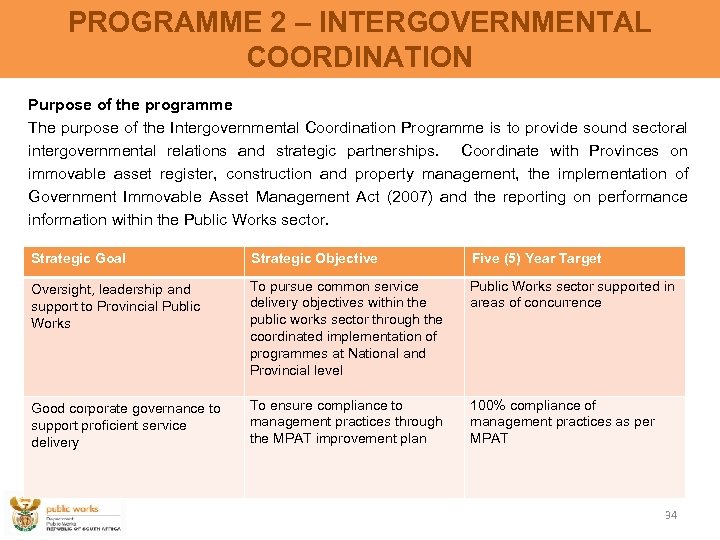
PROGRAMME 2 – INTERGOVERNMENTAL COORDINATION Purpose of the programme The purpose of the Intergovernmental Coordination Programme is to provide sound sectoral intergovernmental relations and strategic partnerships. Coordinate with Provinces on immovable asset register, construction and property management, the implementation of Government Immovable Asset Management Act (2007) and the reporting on performance information within the Public Works sector. Strategic Goal Strategic Objective Five (5) Year Target Oversight, leadership and support to Provincial Public Works To pursue common service delivery objectives within the public works sector through the coordinated implementation of programmes at National and Provincial level Public Works sector supported in areas of concurrence Good corporate governance to support proficient service delivery To ensure compliance to management practices through the MPAT improvement plan 100% compliance of management practices as per MPAT 34
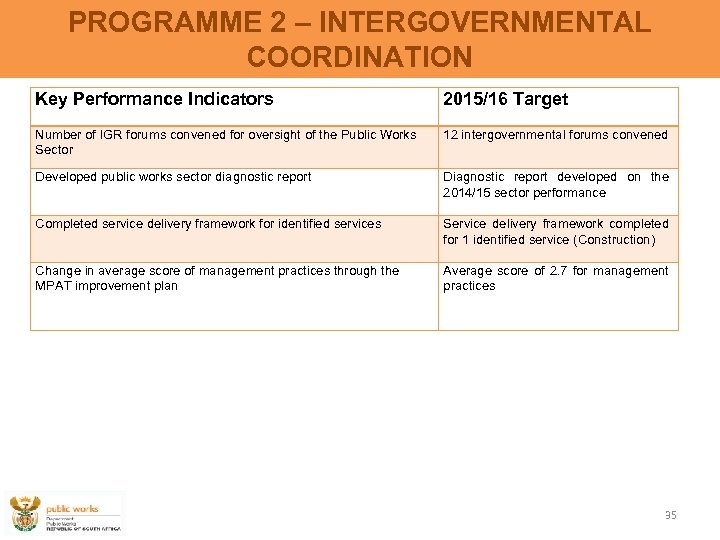
PROGRAMME 2 – INTERGOVERNMENTAL COORDINATION Key Performance Indicators 2015/16 Target Number of IGR forums convened for oversight of the Public Works Sector 12 intergovernmental forums convened Developed public works sector diagnostic report Diagnostic report developed on the 2014/15 sector performance Completed service delivery framework for identified services Service delivery framework completed for 1 identified service (Construction) Change in average score of management practices through the MPAT improvement plan Average score of 2. 7 for management practices 35
PROGRAMME 3 – EXPANDED PUBLIC WORKS PROGRAMME 36
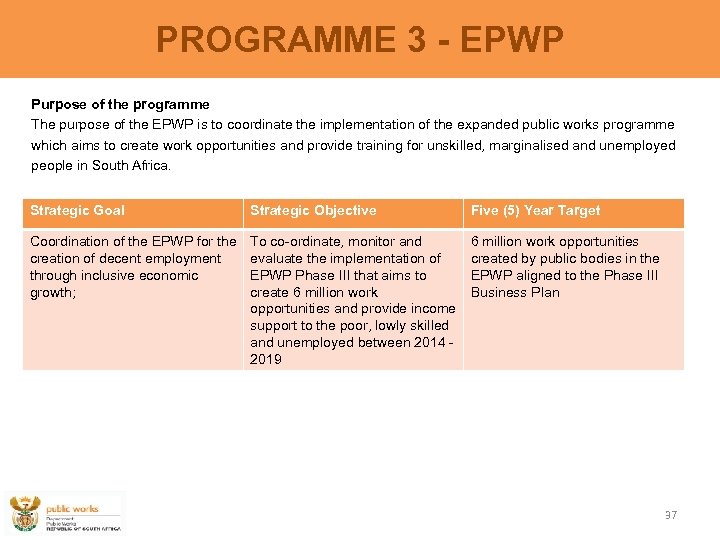
PROGRAMME 3 - EPWP Purpose of the programme The purpose of the EPWP is to coordinate the implementation of the expanded public works programme which aims to create work opportunities and provide training for unskilled, marginalised and unemployed people in South Africa. Strategic Goal Strategic Objective Five (5) Year Target Coordination of the EPWP for the creation of decent employment through inclusive economic growth; To co-ordinate, monitor and evaluate the implementation of EPWP Phase III that aims to create 6 million work opportunities and provide income support to the poor, lowly skilled and unemployed between 2014 - 2019 6 million work opportunities created by public bodies in the EPWP aligned to the Phase III Business Plan 37
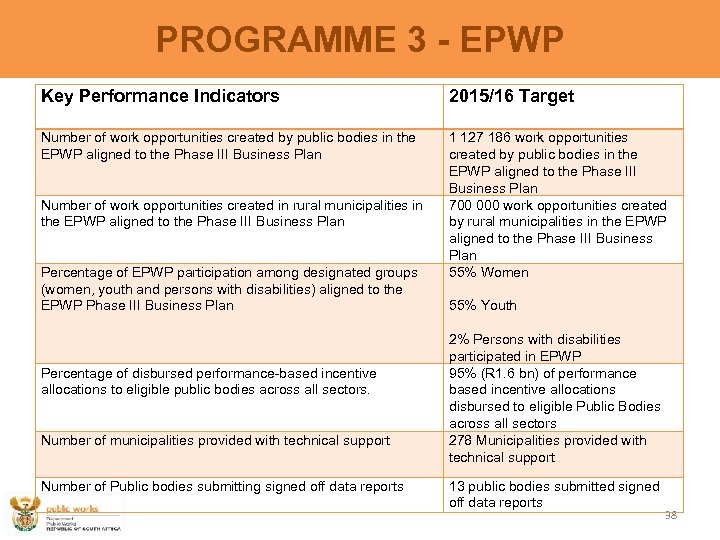
PROGRAMME 3 - EPWP Key Performance Indicators 2015/16 Target Number of work opportunities created by public bodies in the EPWP aligned to the Phase III Business Plan 1 127 186 work opportunities created by public bodies in the EPWP aligned to the Phase III Business Plan 700 000 work opportunities created by rural municipalities in the EPWP aligned to the Phase III Business Plan 55% Women 55% Youth 2% Persons with disabilities participated in EPWP 95% (R 1. 6 bn) of performance based incentive allocations disbursed to eligible Public Bodies across all sectors 278 Municipalities provided with technical support Number of work opportunities created in rural municipalities in the EPWP aligned to the Phase III Business Plan Percentage of EPWP participation among designated groups (women, youth and persons with disabilities) aligned to the EPWP Phase III Business Plan Percentage of disbursed performance-based incentive allocations to eligible public bodies across all sectors. Number of municipalities provided with technical support Number of Public bodies submitting signed off data reports 13 public bodies submitted signed off data reports 38
PROGRAMME 4 – PROPERTY AND CONSTRUCTION INDUSTRY POLICY REGULATIONS 39
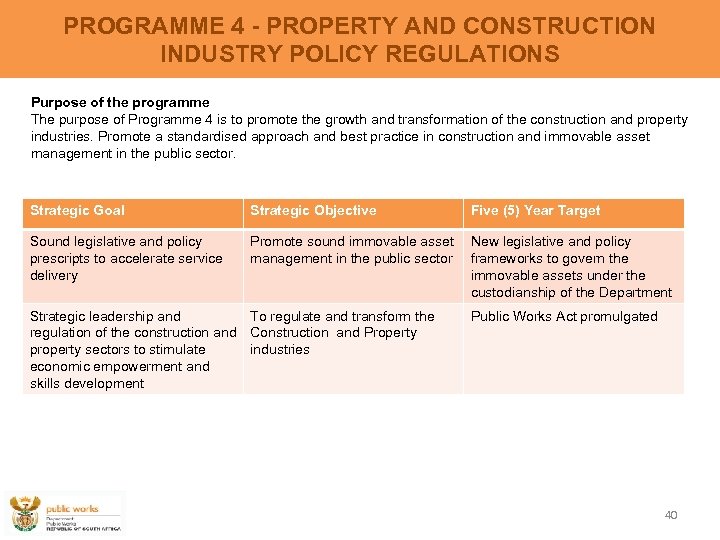
PROGRAMME 4 - PROPERTY AND CONSTRUCTION INDUSTRY POLICY REGULATIONS Purpose of the programme The purpose of Programme 4 is to promote the growth and transformation of the construction and property industries. Promote a standardised approach and best practice in construction and immovable asset management in the public sector. Strategic Goal Strategic Objective Sound legislative and policy prescripts to accelerate service delivery Promote sound immovable asset New legislative and policy management in the public sector frameworks to govern the immovable assets under the custodianship of the Department Strategic leadership and To regulate and transform the regulation of the construction and Construction and Property property sectors to stimulate industries economic empowerment and skills development Five (5) Year Target Public Works Act promulgated 40
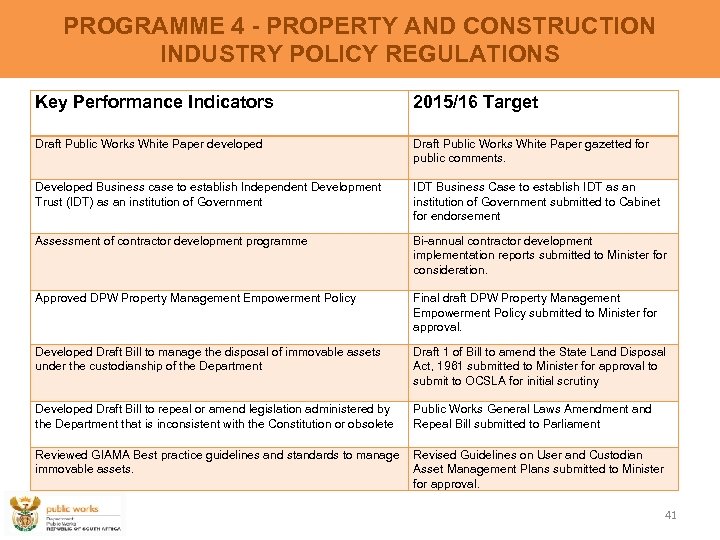
PROGRAMME 4 - PROPERTY AND CONSTRUCTION INDUSTRY POLICY REGULATIONS Key Performance Indicators 2015/16 Target Draft Public Works White Paper developed Draft Public Works White Paper gazetted for public comments. IDT Business Case to establish IDT as an institution of Government submitted to Cabinet for endorsement Developed Business case to establish Independent Development Trust (IDT) as an institution of Government Assessment of contractor development programme Approved DPW Property Management Empowerment Policy Developed Draft Bill to manage the disposal of immovable assets under the custodianship of the Department Developed Draft Bill to repeal or amend legislation administered by the Department that is inconsistent with the Constitution or obsolete Bi-annual contractor development implementation reports submitted to Minister for consideration. Final draft DPW Property Management Empowerment Policy submitted to Minister for approval. Draft 1 of Bill to amend the State Land Disposal Act, 1961 submitted to Minister for approval to submit to OCSLA for initial scrutiny Public Works General Laws Amendment and Repeal Bill submitted to Parliament Reviewed GIAMA Best practice guidelines and standards to manage Revised Guidelines on User and Custodian immovable assets. Asset Management Plans submitted to Minister for approval. 41
PROGRAMME 5 – PRESTIGE POLICY 42
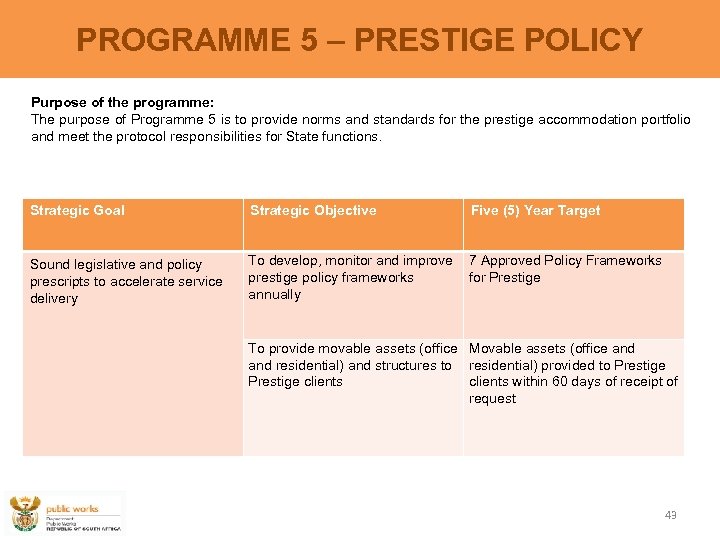
PROGRAMME 5 – PRESTIGE POLICY Purpose of the programme: The purpose of Programme 5 is to provide norms and standards for the prestige accommodation portfolio and meet the protocol responsibilities for State functions. Strategic Goal Strategic Objective Five (5) Year Target Sound legislative and policy prescripts to accelerate service delivery To develop, monitor and improve 7 Approved Policy Frameworks prestige policy frameworks for Prestige annually To provide movable assets (office Movable assets (office and residential) and structures to residential) provided to Prestige clients within 60 days of receipt of request 43
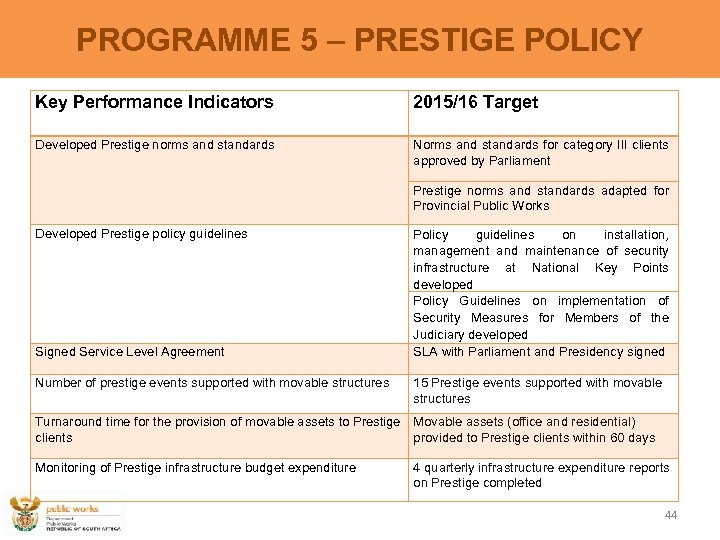
PROGRAMME 5 – PRESTIGE POLICY Key Performance Indicators 2015/16 Target Developed Prestige norms and standards Norms and standards for category III clients approved by Parliament Prestige norms and standards adapted for Provincial Public Works Developed Prestige policy guidelines Signed Service Level Agreement Number of prestige events supported with movable structures Policy guidelines on installation, management and maintenance of security infrastructure at National Key Points developed Policy Guidelines on implementation of Security Measures for Members of the Judiciary developed SLA with Parliament and Presidency signed 15 Prestige events supported with movable structures Turnaround time for the provision of movable assets to Prestige Movable assets (office and residential) clients provided to Prestige clients within 60 days Monitoring of Prestige infrastructure budget expenditure 4 quarterly infrastructure expenditure reports on Prestige completed 44
5 PART C: Links to long term infrastructure plan This section provides the details to other plans that the Department factors into its planning process, Public Entities reporting to the Department and Conditional Grants (SP Page 103 -147) 45
PART C – LINKS TO OTHER PLANS 1. Service Delivery Improvement Plan – The SDIP is a detailed plan with target to improve delivery in critical services over the next three (3) years. The SDIP is underpinned by the need to adopt the Infrastructure Delivery Management System (IDMS) as the primary system for the management of delivery. The SDIP sets out in clear terms the following three areas for improvement which have been identified through a scientific situational analysis process. i. iii. 2. Provisioning of accommodation through construction (aligned to the IDIP); Provisioning of accommodation through private leases (aligned to IDIP); and Customer relationship management. Strategic Risk Plan – Listed below are the strategic risks where specific attention and resources will be focused. i. Fraud and Corruption arising from failure to comply with legislative prescripts ii. Inability to implement the proposed structure iii. Insufficient technical capacity to support PMTE iv. Lack of integrated business systems v. Loss of State funds due to breach of contracts by non performing contractors vi. Uncertainty of Business Continuity resulting from change vii. Exposure to fraud and corruption viii. Failure to deliver quality services ix. Ineffective implementation of the Expanded Public Works by implementing bodies x. Low levels of transformation in the Construction and Property Industries xi. Non adherence to Prestige Regulatory frameworks by Prestige clients 46
PART C – CONDITIONAL GRANTS 3. The Department received the following conditional grants under the Expanded Public Works Programme: i. EPWP Integrated Grant to Provinces ii. EPWP Integrated Grant to Municipalities iii. Social Sector EPWP Grant for to Provinces iv. Non State Sector Wage Subsidy. 47
PART C – PUBLIC ENTITIES 4. There are four Public Entities reporting to the Department of Public Works. The Entities serve as an extension of and assist the Department in delivering on its mandate. i. Construction Industry Development Board (cidb): The cidb supports the Department by providing strategic direction and developing effective partnerships for growth, reform and improvement of the construction sector; ii. Council for Built Environment (CBE): The CBE implements projects and programmes that address the built environment issues and add value to the built environment professions, Government and the general public; iii. Agrément SA (ASA): ASA supports the Department by technically assessing innovative construction technologies and promoting their use to stimulate the creation of sustainable short and long-term work opportunities; iv. Independent Development Trust (IDT): The IDT supports the Department in contributing to Government’s priorities of job creation, sector skills development, green buildings initiatives and eradication of social infrastructure backlogs. 48
THANK YOU National Department of Public Works (NDPW) Head Office: Public Works CGO Building Cnr Bosman and Madiba Pretoria Central Private Bag X 65 Pretoria 0001 Website: http: //www. publicworks. gov. za 49
Скачать презентацию PRESENTATION TO THE PORTFOLIO COMMITTEE ON PUBLIC WORKS
1d9a1127256144887368ced8bb2a1b13.ppt