 Скачать презентацию Presentation to the Portfolio Committee on Public Enterprises
725d8266374f0745f3b34f44347060ba.ppt
- Количество слайдов: 35



Presentation to the Portfolio Committee on Public Enterprises: Progress on Job Creation and Skills Development Second Term: 28 June 2011 0
PROGRESS ON JOB CREATION AND SKILLS DEVELOPMENT The purpose of this presentation is to report on the Transnet progress against targets as per the initiatives as indicated below: • Job Creation; • Skills Delivery; • Skills Development; and • Employment Equity 1
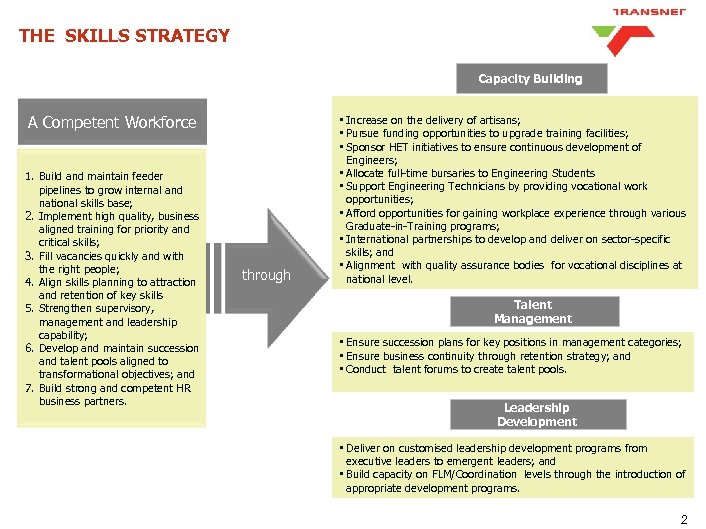
THE SKILLS STRATEGY Capacity Building A Competent Workforce 1. Build and maintain feeder pipelines to grow internal and national skills base; 2. Implement high quality, business aligned training for priority and critical skills; 3. Fill vacancies quickly and with the right people; 4. Align skills planning to attraction and retention of key skills 5. Strengthen supervisory, management and leadership capability; 6. Develop and maintain succession and talent pools aligned to transformational objectives; and 7. Build strong and competent HR business partners. through • Increase on the delivery of artisans; • Pursue funding opportunities to upgrade training facilities; • Sponsor HET initiatives to ensure continuous development of Engineers; • Allocate full-time bursaries to Engineering Students • Support Engineering Technicians by providing vocational work opportunities; • Afford opportunities for gaining workplace experience through various Graduate-in-Training programs; • International partnerships to develop and deliver on sector-specific skills; and • Alignment with quality assurance bodies for vocational disciplines at national level. Talent Management • Ensure succession plans for key positions in management categories; • Ensure business continuity through retention strategy; and • Conduct talent forums to create talent pools. Leadership Development • Deliver on customised leadership development programs from executive leaders to emergent leaders; and • Build capacity on FLM/Coordination levels through the introduction of appropriate development programs. 2

JOB CREATION 3
JOB CREATION INITIATIVES: DIRECT JOBS Direct job creation initiatives are focused on: • Creation of new positions as per OD requirements; • Establishment of operator pools to assist in the terminal operations; • Filling of vacancies through a robust recruitment plan per Operating Division; • Establishment of skills pools to address co-ordination and supervisory skills; • Appointment of critical skills; and • Appointments through trainee programs. 4
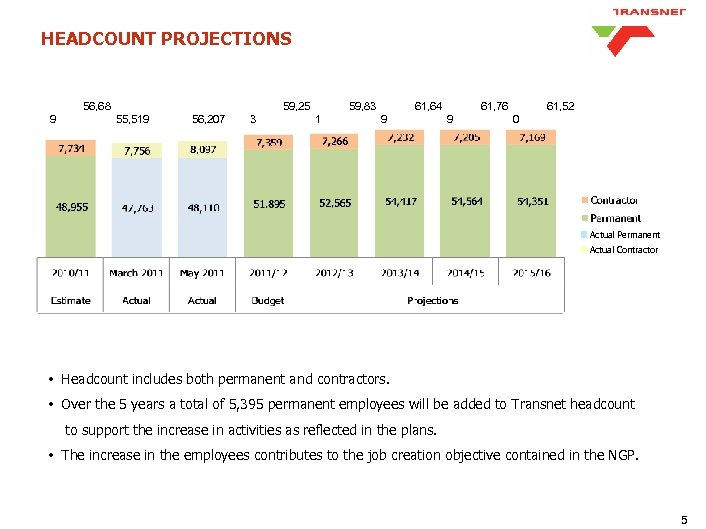
HEADCOUNT PROJECTIONS 56, 68 9 59, 25 55, 519 56, 207 3 59, 83 1 61, 64 9 61, 76 9 61, 52 0 Actual Permanent Actual Contractor • Headcount includes both permanent and contractors. • Over the 5 years a total of 5, 395 permanent employees will be added to Transnet headcount to support the increase in activities as reflected in the plans. • The increase in the employees contributes to the job creation objective contained in the NGP. 5
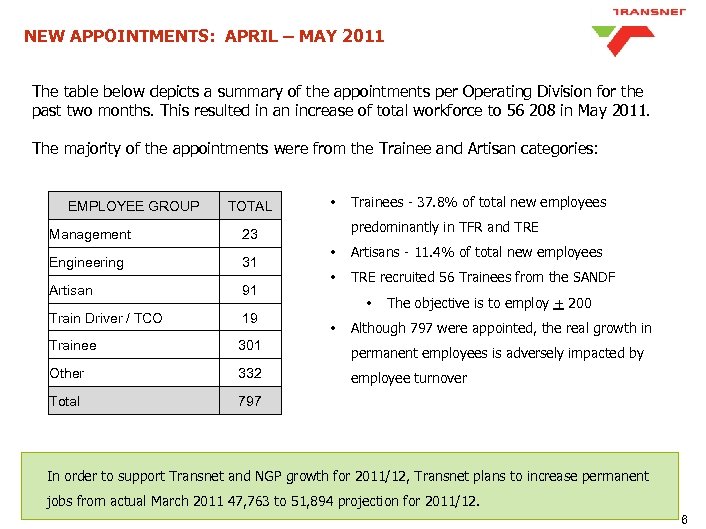
NEW APPOINTMENTS: APRIL – MAY 2011 The table below depicts a summary of the appointments per Operating Division for the past two months. This resulted in an increase of total workforce to 56 208 in May 2011. The majority of the appointments were from the Trainee and Artisan categories: EMPLOYEE GROUP TOTAL • Trainees - 37. 8% of total new employees predominantly in TFR and TRE Management 23 Engineering 31 Artisan 91 Train Driver / TCO 19 Trainee 301 permanent employees is adversely impacted by Other 332 employee turnover Total 797 • Artisans - 11. 4% of total new employees • TRE recruited 56 Trainees from the SANDF • • The objective is to employ + 200 Although 797 were appointed, the real growth in In order to support Transnet and NGP growth for 2011/12, Transnet plans to increase permanent jobs from actual March 2011 47, 763 to 51, 894 projection for 2011/12. 6
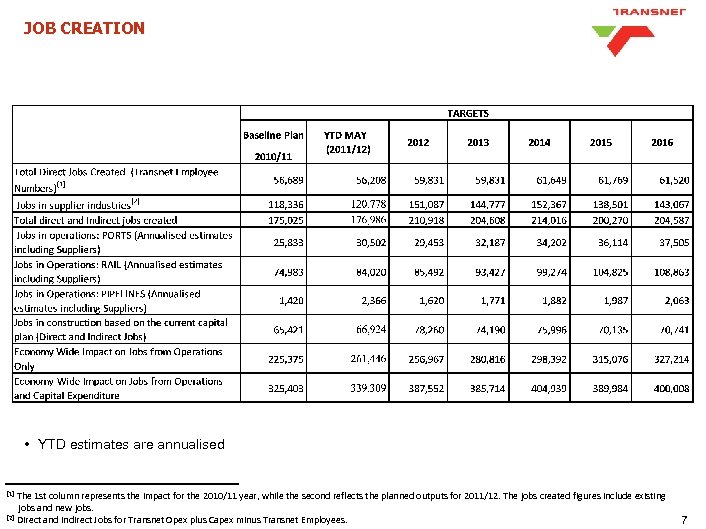
JOB CREATION • YTD estimates are annualised The 1 st column represents the impact for the 2010/11 year, while the second reflects the planned outputs for 2011/12. The jobs created figures include existing jobs and new jobs. [2] Direct and Indirect Jobs for Transnet Opex plus Capex minus Transnet Employees. [1] 7
DELIVERY OF SKILLS 8
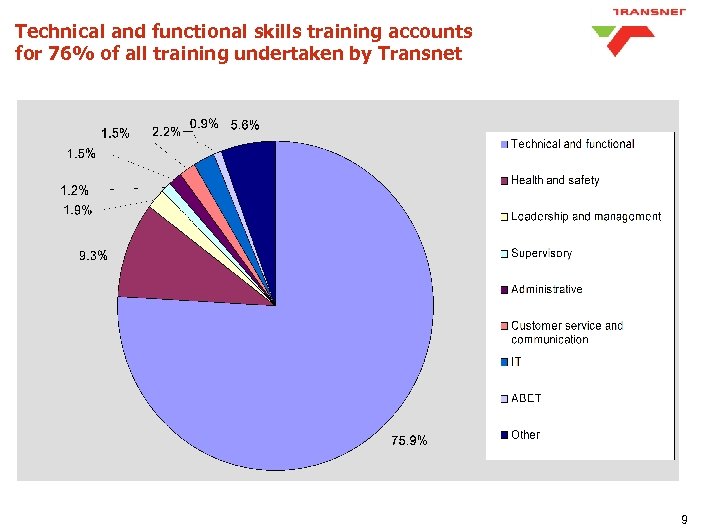
Technical and functional skills training accounts for 76% of all training undertaken by Transnet 9
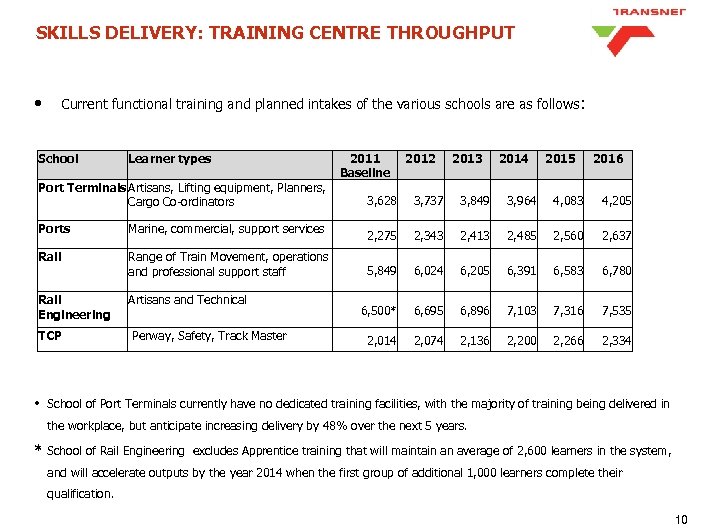
SKILLS DELIVERY: TRAINING CENTRE THROUGHPUT • Current functional training and planned intakes of the various schools are as follows : School Learner types 2011 Baseline 2012 2013 2014 2015 2016 Port Terminals Artisans, Lifting equipment, Planners, 3, 628 3, 737 3, 849 3, 964 4, 083 4, 205 Cargo Co-ordinators Ports Marine, commercial, support services Rail Range of Train Movement, operations 5, 849 6, 024 6, 205 6, 391 6, 583 6, 780 and professional support staff Rail Engineering Artisans and Technical TCP Perway, Safety, Track Master 2, 275 2, 343 2, 413 2, 485 2, 560 2, 637 6, 500* 6, 695 6, 896 7, 103 7, 316 7, 535 2, 014 2, 074 2, 136 2, 200 2, 266 2, 334 • School of Port Terminals currently have no dedicated training facilities, with the majority of training being delivered in the workplace, but anticipate increasing delivery by 48% over the next 5 years. * School of Rail Engineering excludes Apprentice training that will maintain an average of 2, 600 learners in the system, and will accelerate outputs by the year 2014 when the first group of additional 1, 000 learners complete their qualification. 10
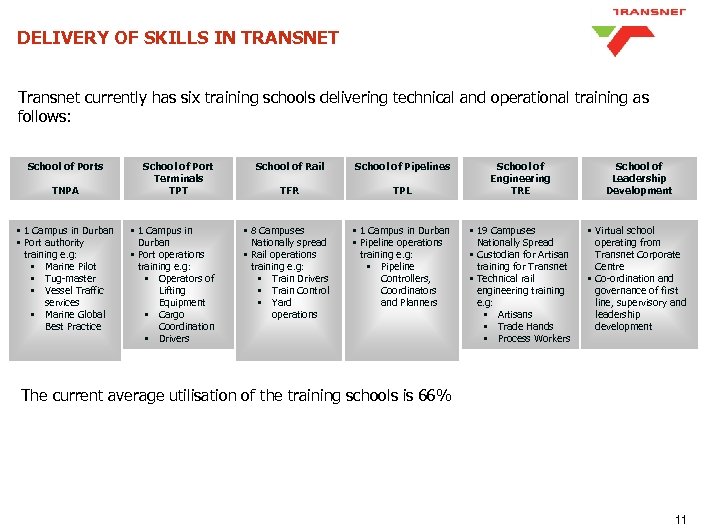
DELIVERY OF SKILLS IN TRANSNET Transnet currently has six training schools delivering technical and operational training as follows: School of Ports TNPA • 1 Campus in Durban • Port authority training e. g: • Marine Pilot • Tug-master • Vessel Traffic services • Marine Global Best Practice School of Port Terminals TPT • 1 Campus in Durban • Port operations training e. g: • Operators of Lifting Equipment • Cargo Coordination • Drivers School of Rail School of Pipelines TFR TPL • 8 Campuses Nationally spread • Rail operations training e. g: • Train Drivers • Train Control • Yard operations • 1 Campus in Durban • Pipeline operations training e. g: • Pipeline Controllers, Coordinators and Planners School of Engineering TRE School of Leadership Development • 19 Campuses Nationally Spread • Custodian for Artisan training for Transnet • Technical rail engineering training e. g: • Artisans • Trade Hands • Process Workers • Virtual school operating from Transnet Corporate Centre • Co-ordination and governance of first line, supervisory and leadership development The current average utilisation of the training schools is 66% 11
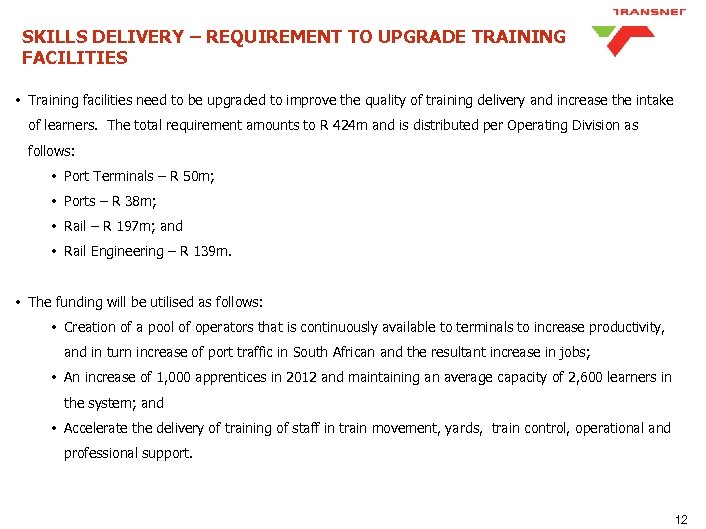
SKILLS DELIVERY – REQUIREMENT TO UPGRADE TRAINING FACILITIES • Training facilities need to be upgraded to improve the quality of training delivery and increase the intake of learners. The total requirement amounts to R 424 m and is distributed per Operating Division as follows: • Port Terminals – R 50 m; • Ports – R 38 m; • Rail – R 197 m; and • Rail Engineering – R 139 m. • The funding will be utilised as follows: • Creation of a pool of operators that is continuously available to terminals to increase productivity, and in turn increase of port traffic in South African and the resultant increase in jobs; • An increase of 1, 000 apprentices in 2012 and maintaining an average capacity of 2, 600 learners in the system; and • Accelerate the delivery of training of staff in train movement, yards, train control, operational and professional support. 12
SKILLS DEVELOPMENT 13
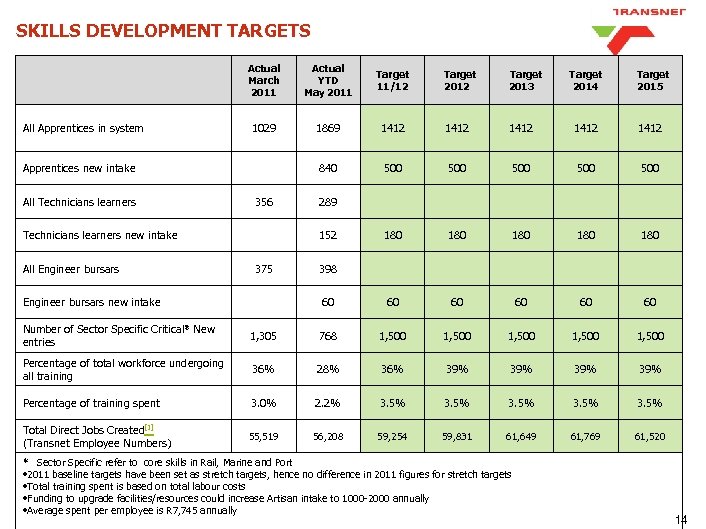
SKILLS DEVELOPMENT TARGETS Actual March 2011 All Apprentices in system Actual YTD May 2011 Target 11/12 Target 2013 1029 1869 1412 840 500 All Technicians learners 356 Technicians learners new intake All Engineer bursars Target 2015 1412 500 500 180 180 180 60 Apprentices new intake Target 2014 60 60 60 289 152 375 Engineer bursars new intake 398 Number of Sector Specific Critical* New entries 1, 305 768 1, 500 1, 500 Percentage of total workforce undergoing all training 36% 28% 36% 39% 39% Percentage of training spent 3. 0% 2. 2% 3. 5% Total Direct Jobs Created[1] (Transnet Employee Numbers) 55, 519 56, 208 59, 254 59, 831 61, 649 61, 769 61, 520 * Sector Specific refer to core skills in Rail, Marine and Port • 2011 baseline targets have been set as stretch targets, hence no difference in 2011 figures for stretch targets • Total training spent is based on total labour costs • Funding to upgrade facilities/resources could increase Artisan intake to 1000 -2000 annually • Average spent per employee is R 7, 745 annually 14
PARTNERSHIP WITH OTHER STATE OWNED ENTERPRISES • Transnet participates in the DPE Skills Development Forum. This forum engages on skills development matters related to all SOEs such as: – coordination and participation of SOEs in the Technical Skills Business Partnership; – participation in the Human Resource Development Technical Working Group; – coordination of sourcing funding from the National Skills Fund; – sharing of training facilities in future; and – sharing of relevant information. • Transnet has conducted benchmarking exercises with SASOL, ESKOM and TELKOM in relation to commonalities regarding bursary schemes, study aids, tuition, allowances, student ratios and good practice. 15

EMPLOYMENT EQUITY 16
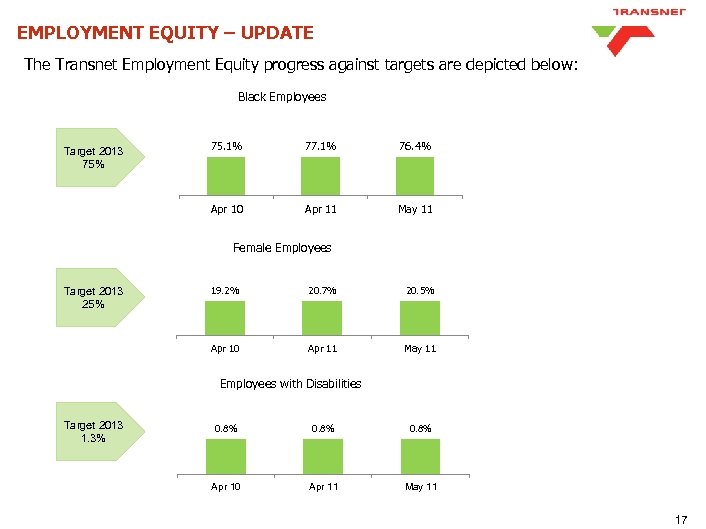
EMPLOYMENT EQUITY – UPDATE The Transnet Employment Equity progress against targets are depicted below: Black Employees 75. 1% 77. 1% 76. 4% Apr 10 Target 2013 75% Apr 11 May 11 Female Employees 19. 2% 20. 7% 20. 5% Apr 10 Target 2013 25% Apr 11 May 11 Employees with Disabilities Target 2013 1. 3% 0. 8% Apr 10 Apr 11 May 11 17
EMPLOYMENT EQUITY – PEOPLE WITH DISABILITIES The Transnet target of 1. 3% was set to ensure that a significant shift is made from the current actual achievement of 0, 8%. To enable this shift, the following interventions are in process: • Employee and Line Management engagement strategies to develop understanding of the meaning of Disability and create an environment that supports People with Disabilities; • Employees are encouraged to disclose their disabilities and where necessary provide reasonable accommodation to employees who require it; • Identifying positions within the organization that can be allocated to employees with disabilities; and • Accessibility audits to make the physical environment more accessible and accommodate disabilities. 18
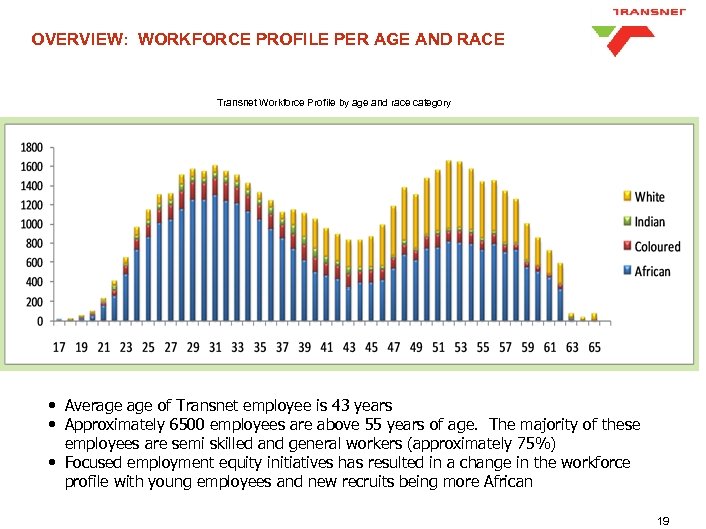
OVERVIEW: WORKFORCE PROFILE PER AGE AND RACE Transnet Workforce Profile by age and race category • Average of Transnet employee is 43 years • Approximately 6500 employees are above 55 years of age. The majority of these employees are semi skilled and general workers (approximately 75%) • Focused employment equity initiatives has resulted in a change in the workforce profile with young employees and new recruits being more African 19
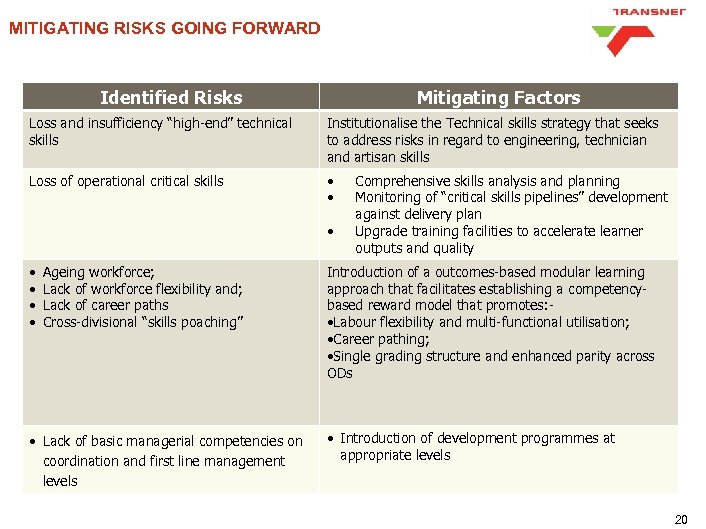
MITIGATING RISKS GOING FORWARD Identified Risks Mitigating Factors Loss and insufficiency “high-end” technical skills Institutionalise the Technical skills strategy that seeks to address risks in regard to engineering, technician and artisan skills Loss of operational critical skills • • Ageing workforce; Lack of workforce flexibility and; Lack of career paths Cross-divisional “skills poaching” • Lack of basic managerial competencies on coordination and first line management levels Comprehensive skills analysis and planning Monitoring of “critical skills pipelines” development against delivery plan Upgrade training facilities to accelerate learner outputs and quality Introduction of a outcomes-based modular learning approach that facilitates establishing a competencybased reward model that promotes: • Labour flexibility and multi-functional utilisation; • Career pathing; • Single grading structure and enhanced parity across ODs • Introduction of development programmes at appropriate levels 20
THANK YOU 21

BACK – UP SLIDES 22
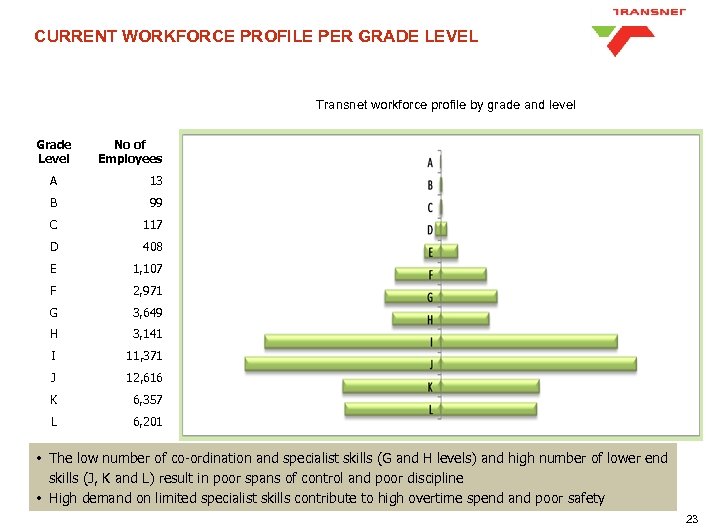
CURRENT WORKFORCE PROFILE PER GRADE LEVEL Transnet workforce profile by grade and level Grade Level No of Employees A 13 B 99 C 117 D 408 E 1, 107 F 2, 971 G 3, 649 H 3, 141 I 11, 371 J 12, 616 K 6, 357 L 6, 201 • The low number of co-ordination and specialist skills (G and H levels) and high number of lower end skills (J, K and L) result in poor spans of control and poor discipline • High demand on limited specialist skills contribute to high overtime spend and poor safety 23
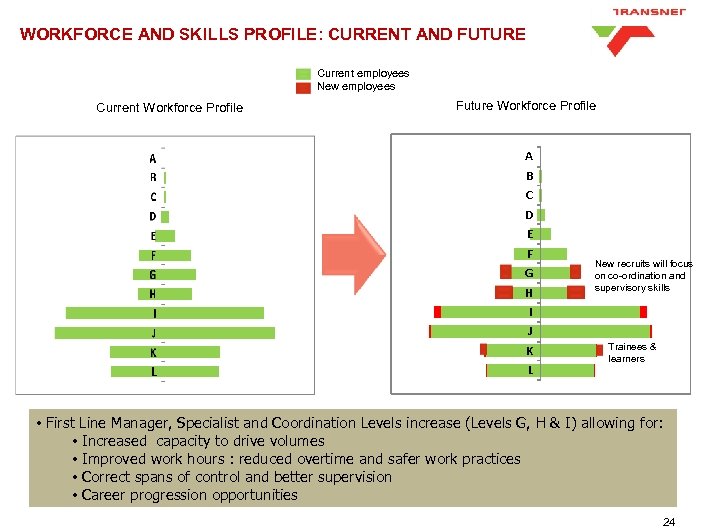
WORKFORCE AND SKILLS PROFILE: CURRENT AND FUTURE Current employees New employees Current Workforce Profile Future Workforce Profile A B C D E F G H I J K L New recruits will focus on co-ordination and supervisory skills Trainees & learners • First Line Manager, Specialist and Coordination Levels increase (Levels G, H & I) allowing for: • Increased capacity to drive volumes • Improved work hours : reduced overtime and safer work practices • Correct spans of control and better supervision • Career progression opportunities 24
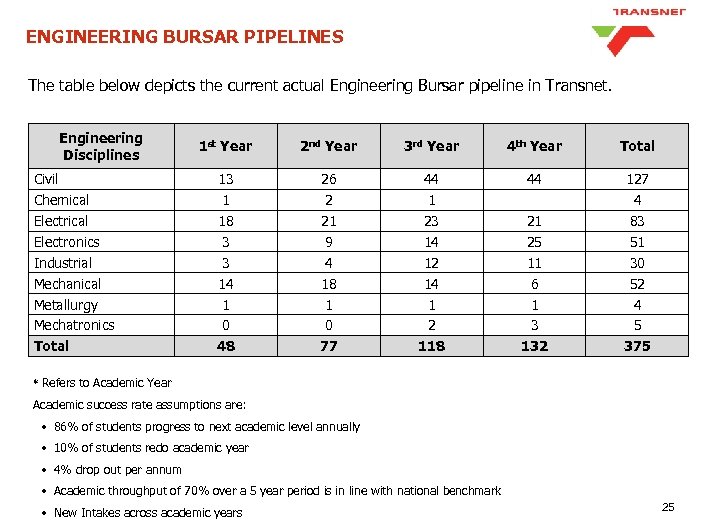
ENGINEERING BURSAR PIPELINES The table below depicts the current actual Engineering Bursar pipeline in Transnet. Engineering Disciplines Civil Chemical Electronics Industrial Mechanical Metallurgy Mechatronics Total 1 st Year 2 nd Year 3 rd Year 4 th Year Total 13 1 18 3 3 14 1 0 48 26 2 21 9 4 18 1 0 77 44 1 23 14 12 14 1 2 118 44 127 4 83 51 30 52 4 5 375 21 25 11 6 1 3 132 * Refers to Academic Year Academic success rate assumptions are: • 86% of students progress to next academic level annually • 10% of students redo academic year • 4% drop out per annum • Academic throughput of 70% over a 5 year period is in line with national benchmark • New Intakes across academic years 25
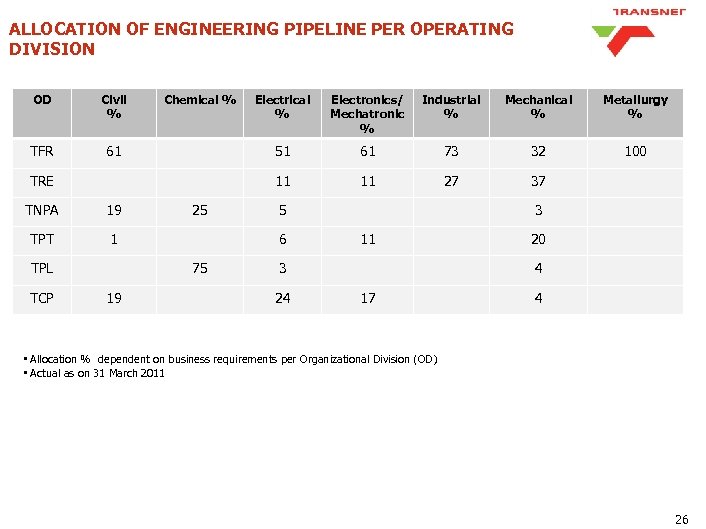
ALLOCATION OF ENGINEERING PIPELINE PER OPERATING DIVISION OD Civil % TFR Chemical % 61 19 TPT 1 TPL TCP 25 Mechanical % Metallurgy % 61 73 32 100 11 27 37 5 6 75 19 Industrial % 11 TNPA Electronics/ Mechatronic % 51 TRE Electrical % 3 11 3 24 20 4 17 4 • Allocation % dependent on business requirements per Organizational Division (OD) • Actual as on 31 March 2011 26
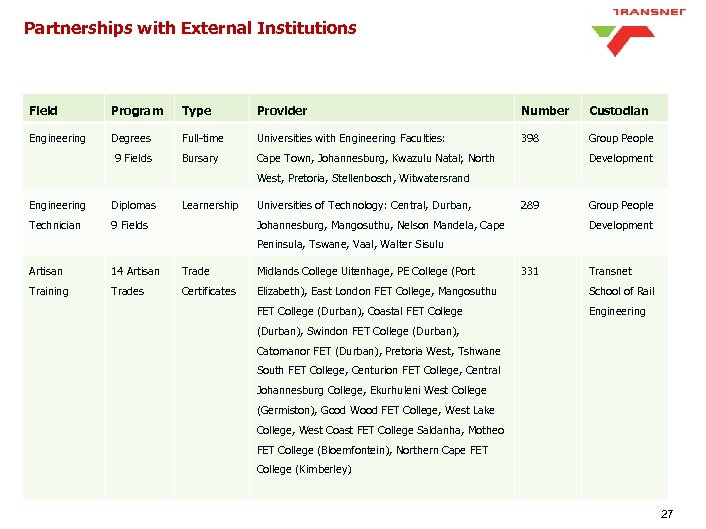
Partnerships with External Institutions Field Program Type Provider Number Custodian Engineering Degrees Full-time Universities with Engineering Faculties: 398 Group People 9 Fields Bursary Cape Town, Johannesburg, Kwazulu Natal; North Development West, Pretoria, Stellenbosch, Witwatersrand Engineering Diplomas Technician Learnership 9 Fields Universities of Technology: Central, Durban, 289 Johannesburg, Mangosuthu, Nelson Mandela, Cape Group People Development Peninsula, Tswane, Vaal, Walter Sisulu Artisan 14 Artisan Trade Midlands College Uitenhage, PE College (Port 331 Transnet Training Trades Certificates Elizabeth), East London FET College, Mangosuthu School of Rail FET College (Durban), Coastal FET College Engineering (Durban), Swindon FET College (Durban), Catomanor FET (Durban), Pretoria West, Tshwane South FET College, Centurion FET College, Central Johannesburg College, Ekurhuleni West College (Germiston), Good Wood FET College, West Lake College, West Coast FET College Saldanha, Motheo FET College (Bloemfontein), Northern Cape FET College (Kimberley) 27
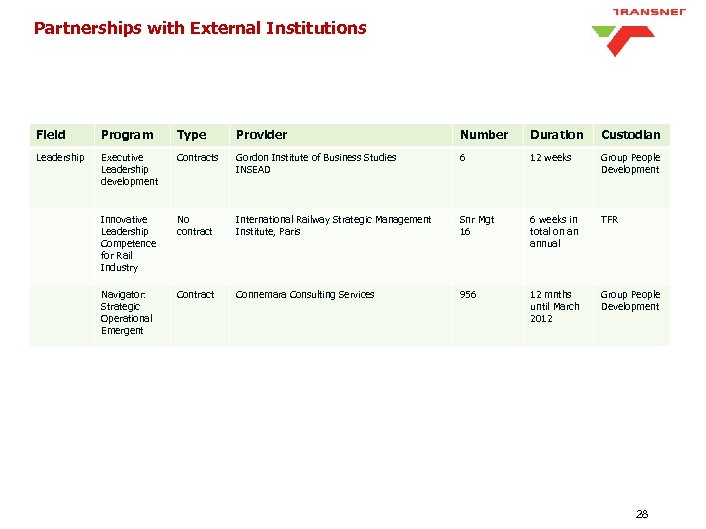
Partnerships with External Institutions Field Program Type Provider Number Duration Custodian Leadership Executive Leadership development Contracts Gordon Institute of Business Studies INSEAD 6 12 weeks Group People Development Innovative Leadership Competence for Rail Industry No contract International Railway Strategic Management Institute, Paris Snr Mgt 16 6 weeks in total on an annual TFR Navigator: Strategic Operational Emergent Contract Connemara Consulting Services 956 12 mnths until March 2012 Group People Development 28
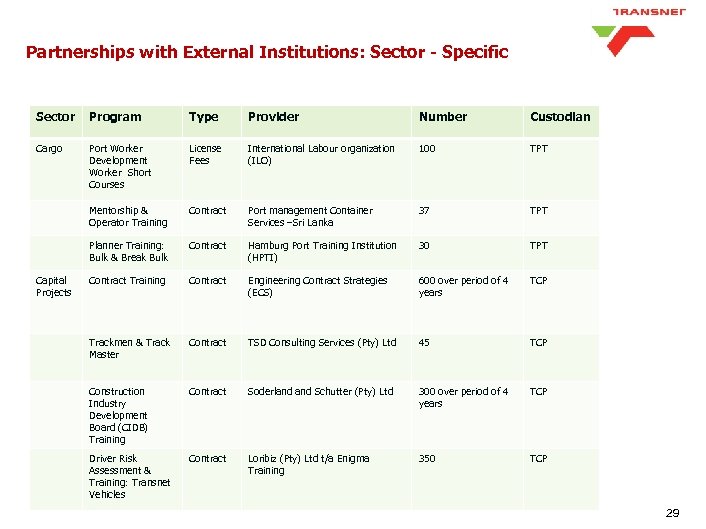
Partnerships with External Institutions: Sector - Specific Sector Program Type Provider Number Custodian Cargo Port Worker Development Worker Short Courses License Fees International Labour organization (ILO) 100 TPT Mentorship & Operator Training Contract Port management Container Services –Sri Lanka 37 TPT Planner Training: Bulk & Break Bulk Contract Hamburg Port Training Institution (HPTI) 30 TPT Contract Training Contract Engineering Contract Strategies (ECS) 600 over period of 4 years TCP Trackmen & Track Master Contract TSD Consulting Services (Pty) Ltd 45 TCP Construction Industry Development Board (CIDB) Training Contract Soderland Schutter (Pty) Ltd 300 over period of 4 years TCP Driver Risk Assessment & Training: Transnet Vehicles Contract Loribiz (Pty) Ltd t/a Enigma Training 350 TCP Capital Projects 29
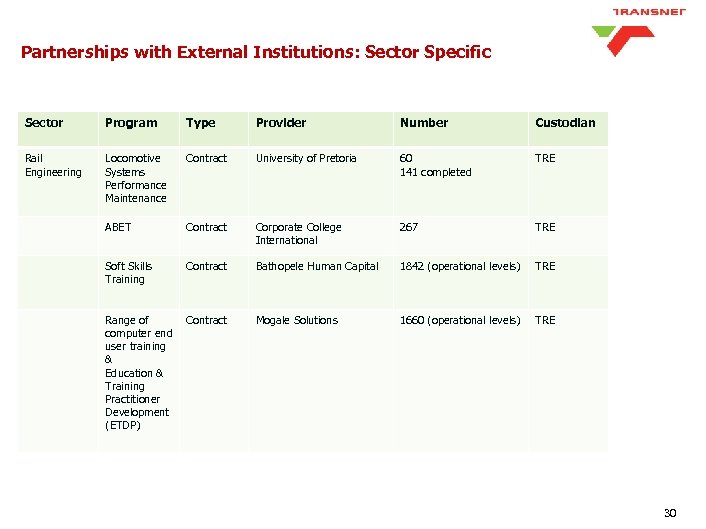
Partnerships with External Institutions: Sector Specific Sector Program Type Provider Number Custodian Rail Engineering Locomotive Systems Performance Maintenance Contract University of Pretoria 60 141 completed TRE ABET Contract Corporate College International 267 TRE Soft Skills Training Contract Bathopele Human Capital 1842 (operational levels) TRE Mogale Solutions 1660 (operational levels) TRE Range of Contract computer end user training & Education & Training Practitioner Development (ETDP) 30
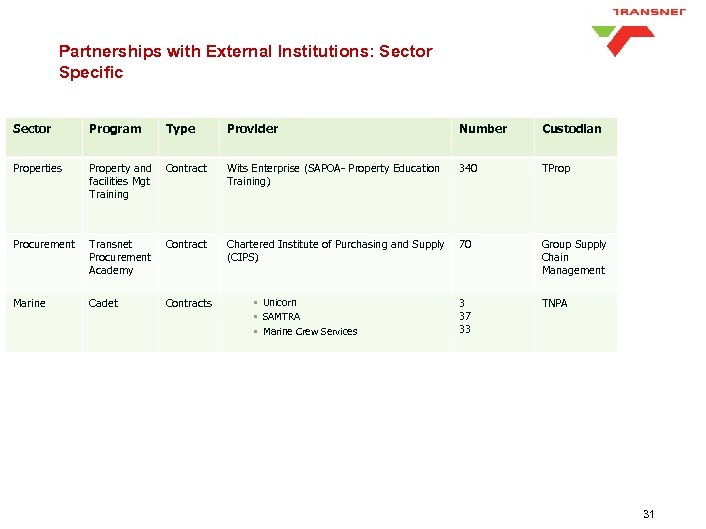
Partnerships with External Institutions: Sector Specific Sector Program Properties Type Provider Number Custodian Property and Contract facilities Mgt Training Wits Enterprise (SAPOA- Property Education Training) 340 TProp Procurement Transnet Procurement Academy Contract Chartered Institute of Purchasing and Supply 70 (CIPS) Marine Cadet Contracts • Unicorn • SAMTRA • Marine Crew Services 3 37 33 Group Supply Chain Management TNPA 31
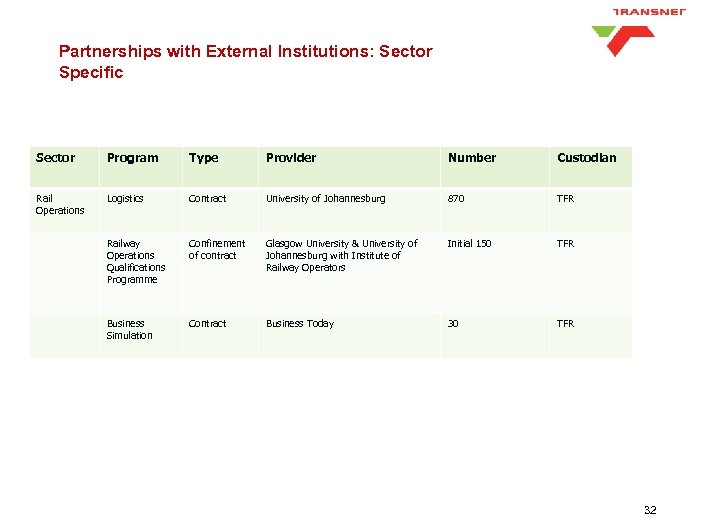
Partnerships with External Institutions: Sector Specific Sector Program Type Provider Number Custodian Rail Operations Logistics Contract University of Johannesburg 870 TFR Railway Operations Qualifications Programme Confinement of contract Glasgow University & University of Johannesburg with Institute of Railway Operators Initial 150 TFR Business Simulation Contract Business Today 30 TFR 32
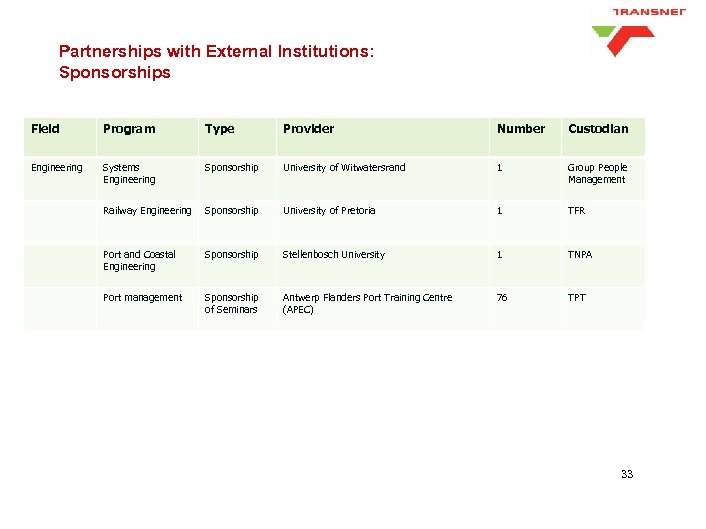
Partnerships with External Institutions: Sponsorships Field Program Type Provider Number Custodian Engineering Systems Engineering Sponsorship University of Witwatersrand 1 Group People Management Railway Engineering Sponsorship University of Pretoria 1 TFR Port and Coastal Engineering Sponsorship Stellenbosch University 1 TNPA Port management Sponsorship of Seminars Antwerp Flanders Port Training Centre (APEC) 76 TPT 33
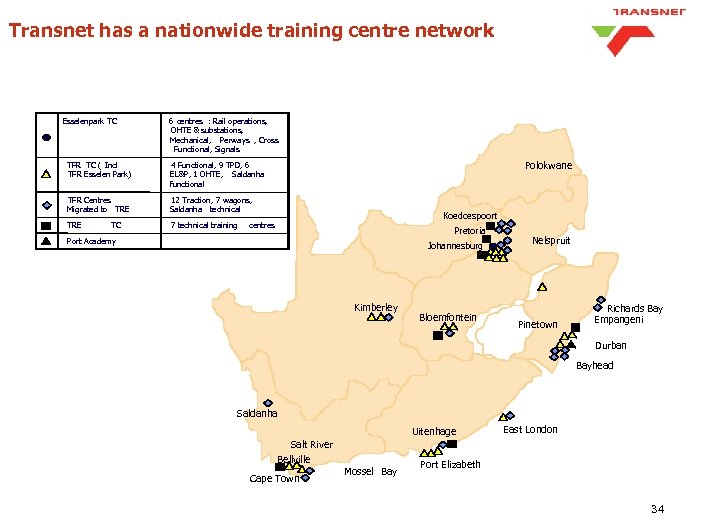
Transnet has a nationwide training centre network TRANSNET TRAINING CENTRES Esselenpark TC 6 centres : Rail operations, OHTE & substations, Mechanical, Perways , Cross Functional, Signals TFR TC ( Incl TFR Esselen Park) TFR Centres Migrated to TRE 12 Traction, 7 wagons, Saldanha technical TRE 7 technical training Polokwane 4 Functional, 9 TPD, 6 EL&P, 1 OHTE, Saldanha functional TC Koedoespoort centres Pretoria Port Academy Johannesburg Kimberley Bloemfontein Nelspruit Pinetown Richards Bay Empangeni Durban Bayhead Saldanha Uitenhage East London Salt River Bellville Cape Town Mossel Bay Port Elizabeth 34
Скачать презентацию Presentation to the Portfolio Committee on Public Enterprises
725d8266374f0745f3b34f44347060ba.ppt