


 Скачать презентацию Presentation to RR Meeting State and Trends of
f8cbe14d15b61a7165d5102f953ca647.ppt
- Количество слайдов: 19
 Presentation to RR Meeting State and Trends of the Carbon Markets Voluntary & Compliance Markets: Existing Carbon Reduction Units © 2006 UNDP. All Rights Reserved Worldwide. Proprietary and Confidential. Not For Distribution Without Prior Written Permission.
 Presentation Overview 1. Different Carbon Markets 2. Regulatory Framework and Structure of the Carbon Market 3. Allowance Markets 4. Project-Based Transactions 5. Prices of Emission Reductions and Allowances 6. Market outlook to 2012 1 1
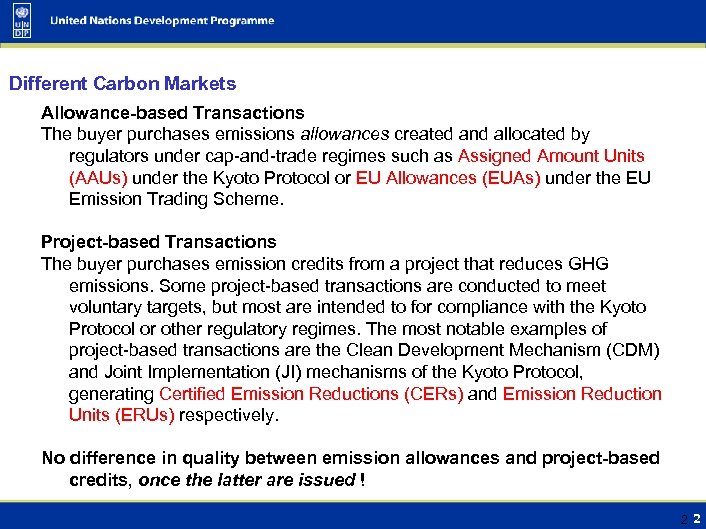 Different Carbon Markets Allowance-based Transactions The buyer purchases emissions allowances created and allocated by regulators under cap-and-trade regimes such as Assigned Amount Units (AAUs) under the Kyoto Protocol or EU Allowances (EUAs) under the EU Emission Trading Scheme. Project-based Transactions The buyer purchases emission credits from a project that reduces GHG emissions. Some project-based transactions are conducted to meet voluntary targets, but most are intended to for compliance with the Kyoto Protocol or other regulatory regimes. The most notable examples of project-based transactions are the Clean Development Mechanism (CDM) and Joint Implementation (JI) mechanisms of the Kyoto Protocol, generating Certified Emission Reductions (CERs) and Emission Reduction Units (ERUs) respectively. No difference in quality between emission allowances and project-based credits, once the latter are issued ! 2 2
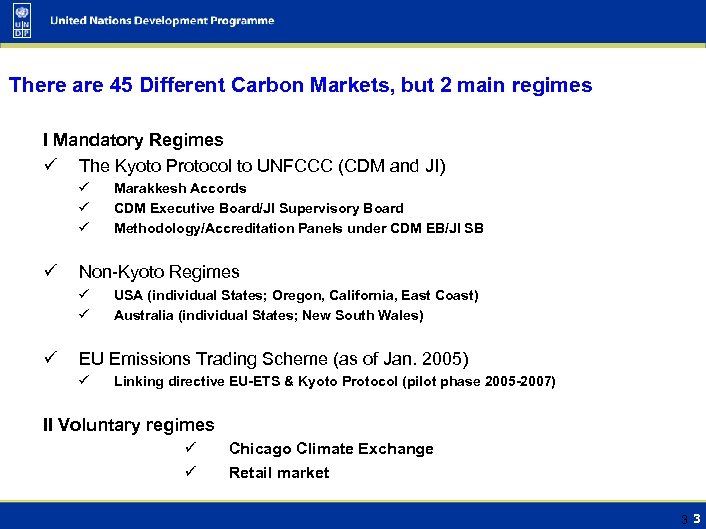 There are 45 Different Carbon Markets, but 2 main regimes I Mandatory Regimes ü The Kyoto Protocol to UNFCCC (CDM and JI) ü ü Non-Kyoto Regimes ü ü ü Marakkesh Accords CDM Executive Board/JI Supervisory Board Methodology/Accreditation Panels under CDM EB/JI SB USA (individual States; Oregon, California, East Coast) Australia (individual States; New South Wales) EU Emissions Trading Scheme (as of Jan. 2005) ü Linking directive EU-ETS & Kyoto Protocol (pilot phase 2005 -2007) II Voluntary regimes ü ü Chicago Climate Exchange Retail market 3 3
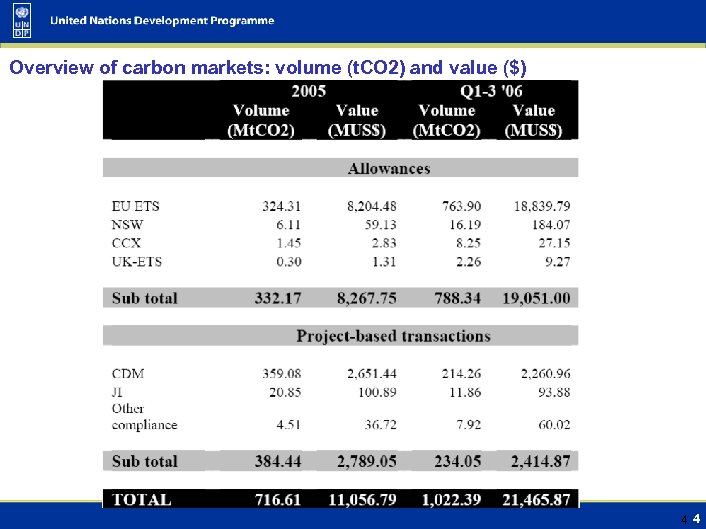 Overview of carbon markets: volume (t. CO 2) and value ($) 4 4
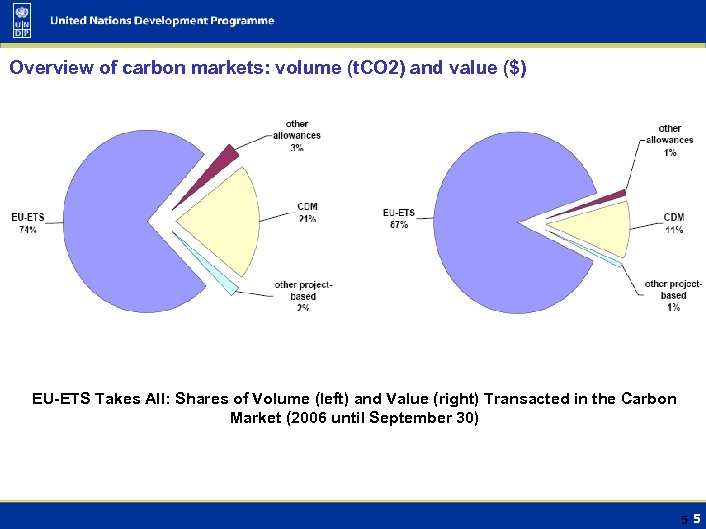 Overview of carbon markets: volume (t. CO 2) and value ($) EU-ETS Takes All: Shares of Volume (left) and Value (right) Transacted in the Carbon Market (2006 until September 30) 5 5
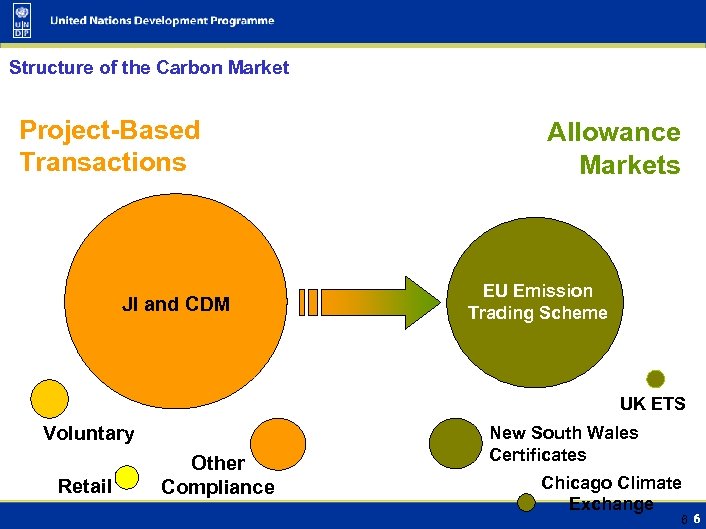 Structure of the Carbon Market Project-Based Transactions JI and CDM Allowance Markets EU Emission Trading Scheme UK ETS Voluntary Retail Other Compliance New South Wales Certificates Chicago Climate Exchange 6 6
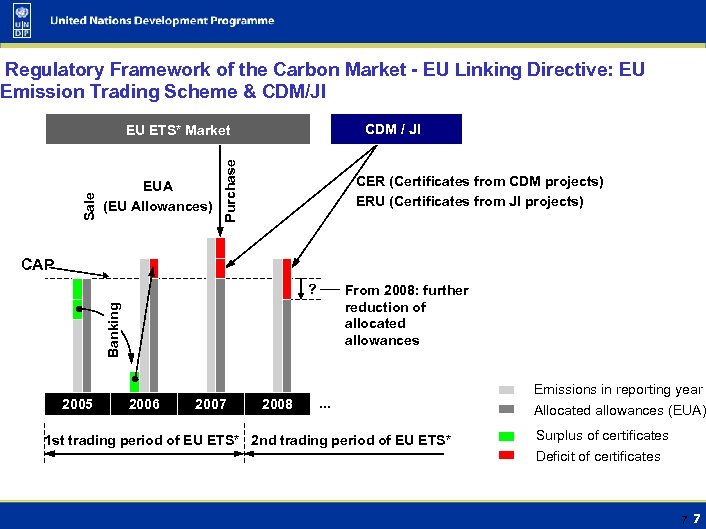 Regulatory Framework of the Carbon Market - EU Linking Directive: EU Emission Trading Scheme & CDM/JI CDM / JI EUA (EU Allowances) Purchase Sale EU ETS* Market CER (Certificates from CDM projects) ERU (Certificates from JI projects) CAP ? Banking From 2008: further reduction of allocated allowances 2005 2006 2007 2008 . . . 1 st trading period of EU ETS* 2 nd trading period of EU ETS* Emissions in reporting year Allocated allowances (EUA) Surplus of certificates Deficit of certificates 7 7
 Allowance Market Four active markets for GHG allowances: ü EU Emission Trading Scheme; ü UK Emission Trading Scheme; ü Chicago Climate Exchange; and ü New South Wales Trading System Cumulative trading volume is 788 Mt. CO 2 equivalent (1 -3 Q 2006) ü EU ETS is by far the largest 763 Mt. CO 2 equivalent (by September 2006) compared to approximately 324 Mt. CO 2 e traded in 2005 8 8
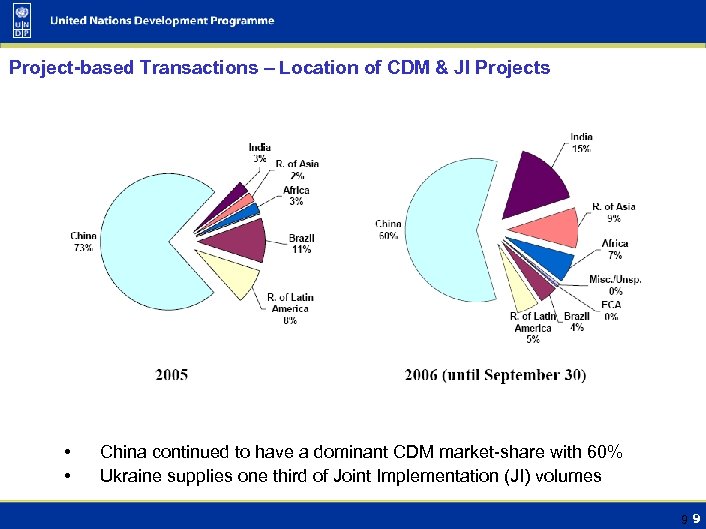 Project-based Transactions – Location of CDM & JI Projects • • China continued to have a dominant CDM market-share with 60% Ukraine supplies one third of Joint Implementation (JI) volumes 9 9
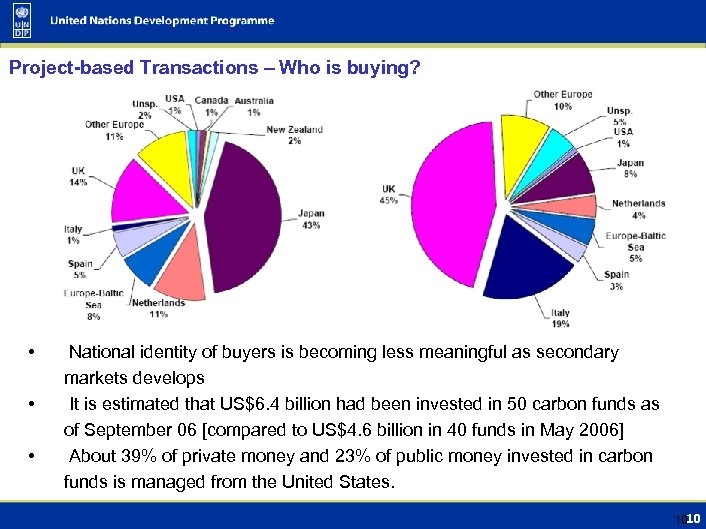 Project-based Transactions – Who is buying? • • • National identity of buyers is becoming less meaningful as secondary markets develops It is estimated that US$6. 4 billion had been invested in 50 carbon funds as of September 06 [compared to US$4. 6 billion in 40 funds in May 2006] About 39% of private money and 23% of public money invested in carbon funds is managed from the United States. 10 10
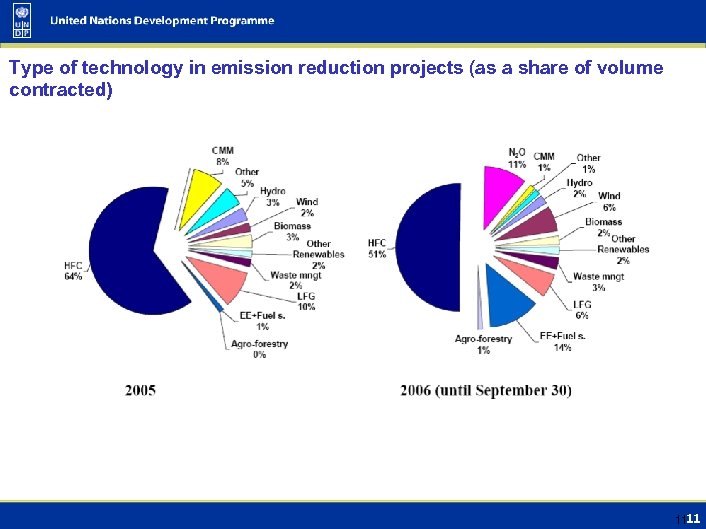 Type of technology in emission reduction projects (as a share of volume contracted) 11 11
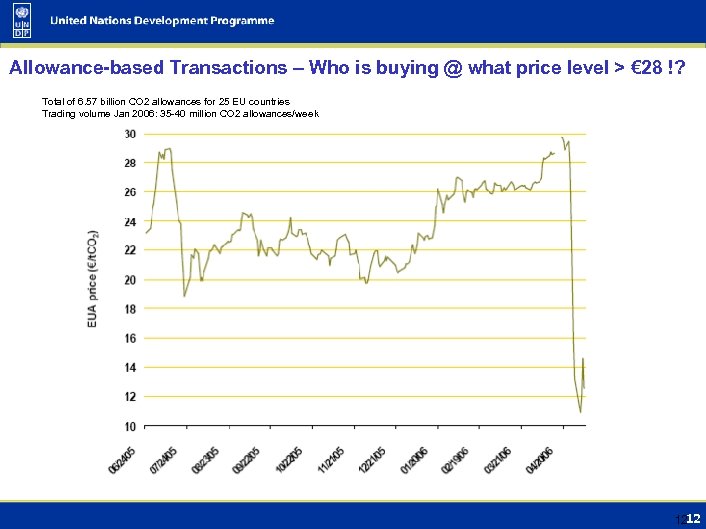 Allowance-based Transactions – Who is buying @ what price level > € 28 !? Total of 6. 57 billion CO 2 allowances for 25 EU countries Trading volume Jan 2006: 35 -40 million CO 2 allowances/week 12 12
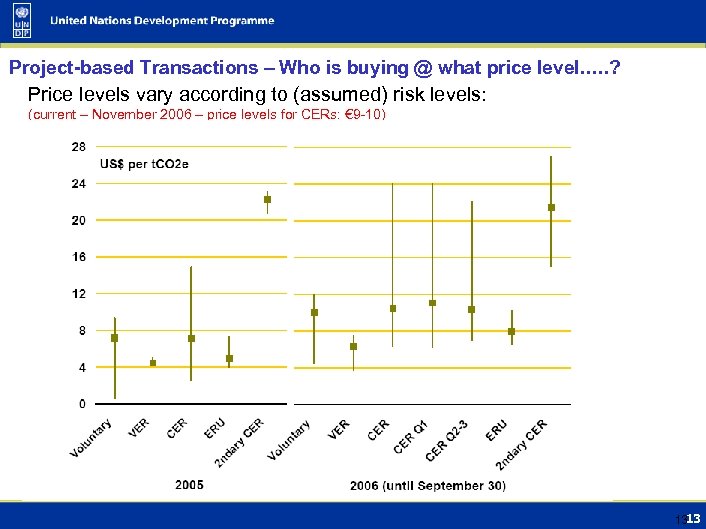 Project-based Transactions – Who is buying @ what price level…. . ? Price levels vary according to (assumed) risk levels: (current – November 2006 – price levels for CERs: € 9 -10) 13 13
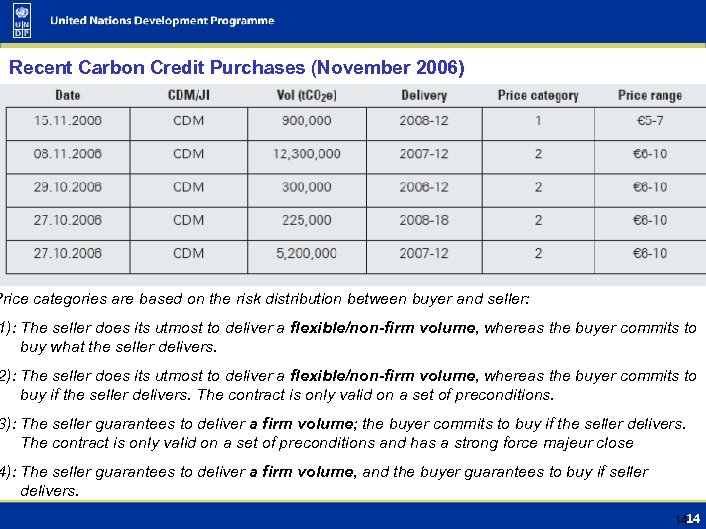 Recent Carbon Credit Purchases (November 2006) Price categories are based on the risk distribution between buyer and seller: 1): The seller does its utmost to deliver a flexible/non-firm volume, whereas the buyer commits to buy what the seller delivers. 2): The seller does its utmost to deliver a flexible/non-firm volume, whereas the buyer commits to buy if the seller delivers. The contract is only valid on a set of preconditions. 3): The seller guarantees to deliver a firm volume; the buyer commits to buy if the seller delivers. The contract is only valid on a set of preconditions and has a strong force majeur close 4): The seller guarantees to deliver a firm volume, and the buyer guarantees to buy if seller delivers. 14 14
 Prices: Allowance-based transactions Vs Project-based • 2008 EUA price is at a six-month low (8 €) • CER has not changed notably the last few weeks: for registered projects with non-guaranteed delivery CERs are still in the € 9 -10 range • The prices at which ERUs (JI) transacted in 2006 increased to an average of US$7. 98, representing a 60% year-on-year increase, but remained cheaper than CERs on average • Issued CERs with delivery into the buyer’s temporary holding account in the CDM registry are trading for 85 -90% of the EUA Dec 08 price. Why: • The Chinese price floor remains one reason for the CER price keeping stable • An increasing CER demand from Japanese buyers: Japanese buyers do not necessarily use the EUA price as reference to the same degree as the average EU buyer, and is thus less influenced by a falling EUA price. 15 15
 Market outlook to 2012 üThe countries with shortfalls in their Kyoto emission allowances are likely to need 4. 0 -5. 0 billion Kyoto compliant units by 2012 to meet their commitments. üBased on current trends the CDM is probably capable of supplying an average of 100 -200 million CERs per year during the commitment period or, in aggregate, around 800 million CERs by 2012. üJI is estimated to be able to supply an additional 40 -50 million ERUs per year during 2008 -2012, or in total 200 -250 million by 2012. üCombined CER and ERU supply to 2012 could be around 1, 000 million units, which would meet about 15 -25% of Kyoto market demand for compliance units. Source: UNDP-EEG, March 2006 16 16
 Market outlook to 2012 üAssuming prices of at least US$10/CER it appears that CDM projects will have a secure medium term market and project proponents are likely to be able to sell as many CERs that they are able to generate up to 2012. üAAU surplus countries (mainly Russia and Ukraine) will need to be willing to trade up to 3 -4 billion AAUs (around half the maximum potential supply) by 2012 to clear the market. üThat CDM and JI projects are likely to be price takers as market prices will largely be determined by AAU selling countries, and developments in negotiations for the post 2012 climate change mitigation regime. Source: UNDP-EEG, March 2006 17 17
 THANK YOU FOR YOUR KIND ATTENTION 18 18