


 Скачать презентацию Presentation Plus United States Government Democracy in Action
e771392b98394dd070e250fb314305c3.ppt
- Количество слайдов: 175
 Presentation Plus! United States Government: Democracy in Action Copyright © by The Mc. Graw-Hill Companies, Inc. Send all inquiries to: GLENCOE DIVISION Glencoe/Mc. Graw-Hill 8787 Orion Place Columbus, Ohio 43240
 Chapter Focus Section 1 Structure and Principles Section 2 Three Branches of Government Section 3 Amending the Constitution Section 4 The Amendments Chapter Assessment Click on a hyperlink to go to the corresponding content area. Press the ESC (escape) key at any time to exit the presentation.
 Chapter Objectives • Structure and Principles Describe the structure of and principles behind the Constitution. (Section 1) • Three Branches of Government Summarize the powers, duties, and roles of the three branches of the federal government. (Section 2) • Amending the Constitution Itemize the ways of proposing and ratifying amendments to the Constitution and detail methods of informal constitutional change. (Section 3) • The Amendments Classify amendments by type: those dealing with individual rights, those reflecting societal change, and those affecting the structure and powers of government. (Section 4) Click the mouse button or press the Space Bar to display the information.
 Chapter Concepts • • Section 1 Constitutional Interpretations Section 2 Separation of Powers Section 3 Political Processes Section 4 Growth of Democracy Click the mouse button or press the Space Bar to display the information.
 Making It Relevant Transparency The next slide was drawn as the Watergate Affair engulfed the nation, presenting new constitutional challenges.
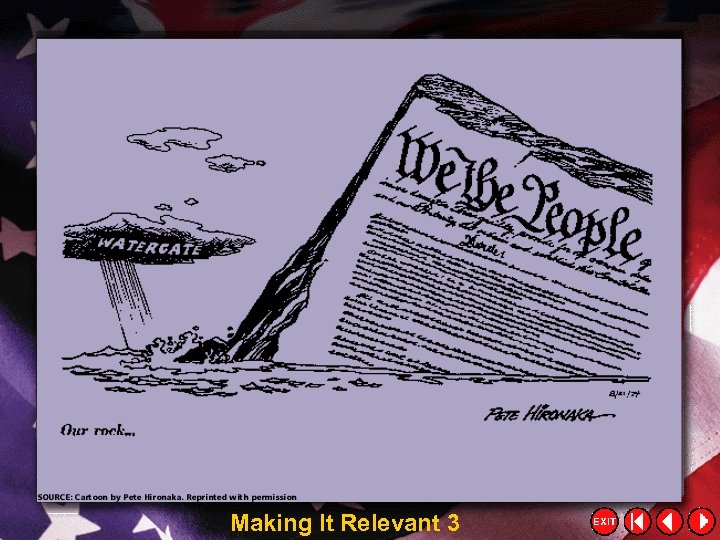 Making It Relevant 3
 End of Chapter Focus Click the mouse button to return to the Contents.
 Structure and Principles Key Terms article, jurisdiction, supremacy clause, amendment, popular sovereignty, federalism, separation of powers, checks and balances, veto, judicial review Find Out • What is the basic structure of the Constitution? • How did the Founders hope to prevent any one branch of government from gaining too much power? Click the mouse button or press the Space Bar to display the information. Additional lecture notes appear on the following slides.
 Structure and Principles Understanding Concepts Constitutional Interpretations What are the major principles of the Constitution that represent a social consensus in the United States? Section Objective Describe the structure of and principles behind the Constitution. Click the mouse button or press the Space Bar to display the information. Additional lecture notes appear on the following slides.
 Introduction • The Constitution established a republic and divided the federal government into legislative, judicial, and executive branches. • The success of this system of government depends on an informed, participating citizenry. • An understanding of the Constitution is key to understanding the structure and daily function of American government. Click the mouse button or press the Space Bar to display the information.
 Structure • Compared with the constitutions of other countries, the United States Constitution is simple and brief. • It contains about 7, 000 words and is divided into three parts: – the Preamble – the articles – the amendments Click the mouse button or press the Space Bar to display the information.
 The Preamble • The Preamble, or introduction, states why the Constitution was written. • In the Preamble, the Founders indicated that they wanted a government that would provide stability and order, protect citizens’ liberties, and serve the people. Click the mouse button or press the Space Bar to display the information.
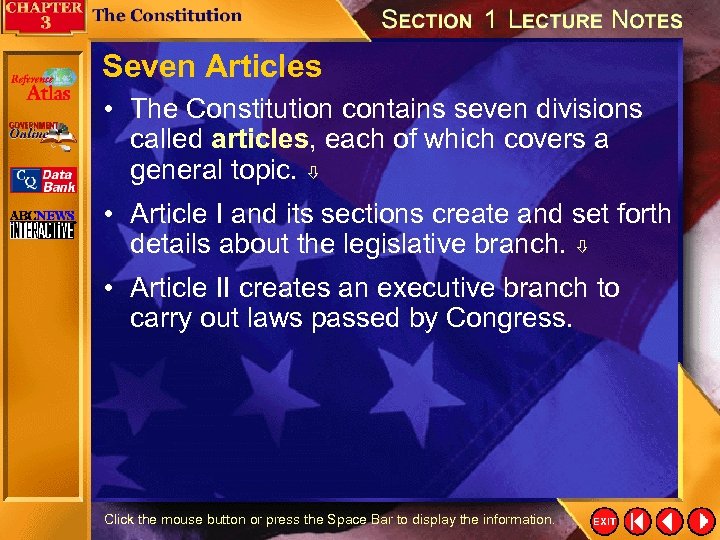 Seven Articles • The Constitution contains seven divisions called articles, each of which covers a general topic. • Article I and its sections create and set forth details about the legislative branch. • Article II creates an executive branch to carry out laws passed by Congress. Click the mouse button or press the Space Bar to display the information.
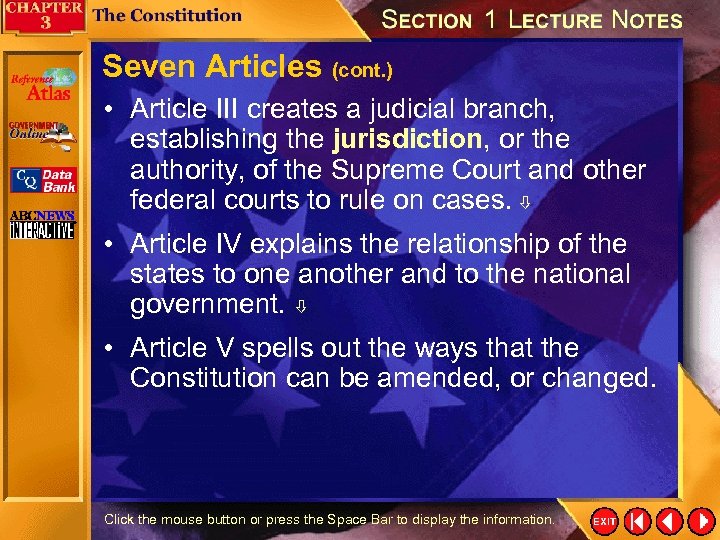 Seven Articles (cont. ) • Article III creates a judicial branch, establishing the jurisdiction, or the authority, of the Supreme Court and other federal courts to rule on cases. • Article IV explains the relationship of the states to one another and to the national government. • Article V spells out the ways that the Constitution can be amended, or changed. Click the mouse button or press the Space Bar to display the information.
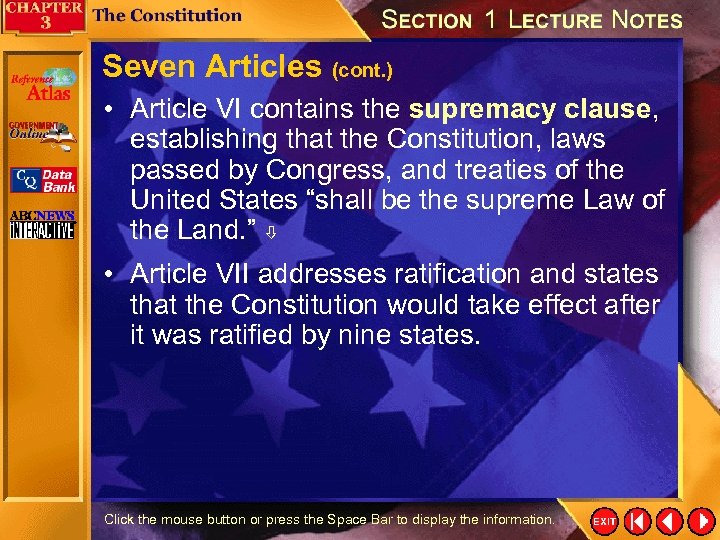 Seven Articles (cont. ) • Article VI contains the supremacy clause, establishing that the Constitution, laws passed by Congress, and treaties of the United States “shall be the supreme Law of the Land. ” • Article VII addresses ratification and states that the Constitution would take effect after it was ratified by nine states. Click the mouse button or press the Space Bar to display the information.
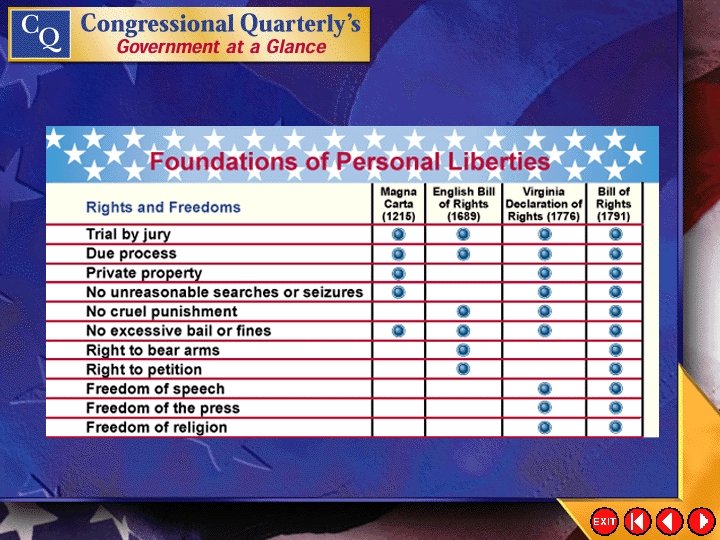
 The Amendments • The third part of the Constitution consists of amendments, or changes. • The Constitution has been amended 27 times. • The amendment process provides a way for this document to remain responsive to the needs of a changing nation. Click the mouse button or press the Space Bar to display the information.
 Major Principles • The Constitution rests on six major principles of government: – popular sovereignty – federalism – separation of powers – checks and balances – judicial review – limited government Click the mouse button or press the Space Bar to display the information.
 Popular Sovereignty • The Constitution is based on the concept of popular sovereignty–rule by the people. • The authority for the United States government flows from the people. Click the mouse button or press the Space Bar to display the information.
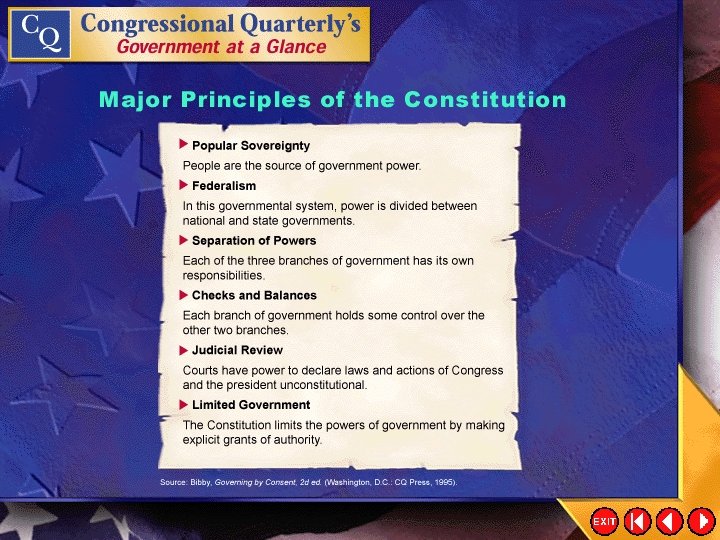
 Federalism • The Constitution created a federal system of government. • Under federalism, power is divided between national and state governments. • Federalism gives the United States a flexible system of government under which the national government has the power to act for the country as a whole, and states have power over many local matters. • The Founders chose federalism because it formed a strong union without giving all of the power to the central government. Click the mouse button or press the Space Bar to display the information.
 Separation of Powers • Under separation of powers, the Constitution limits the central government by dividing power among the legislative, executive, and judicial branches. • This separation helps prevent any branch from gaining too much power. Click the mouse button or press the Space Bar to display the information.
 Checks and Balances • To the principle of separation of powers the Founders added a system of checks and balances, whereby each branch of government exercises some control over the others. • For example, Congress passes laws. The president can veto, or reject, those laws. Click the mouse button or press the Space Bar to display the information.
 Checks and Balances (cont. ) • This veto power is balanced, however, by the power of Congress to override the veto by a two-thirds vote of each house. • Checks and balances created a system of shared powers. Click the mouse button or press the Space Bar to display the information.
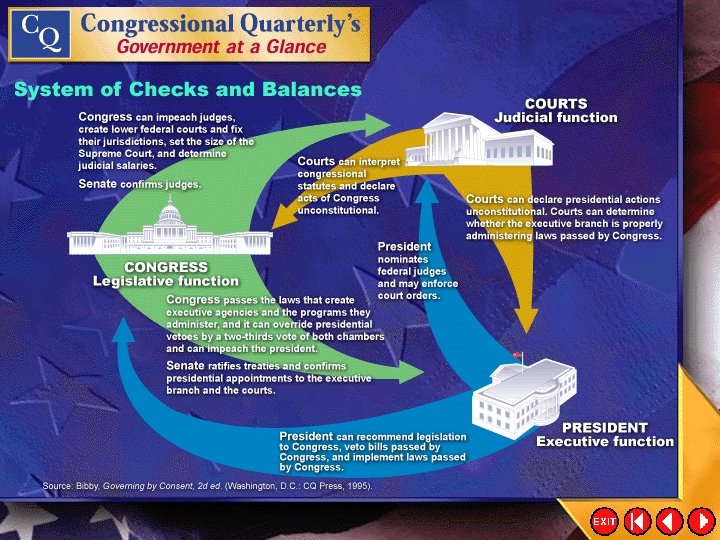
 Judicial Review • Judicial review is the power of the courts to declare laws and actions of local, state, or national governments invalid if they violate the Constitution. • All federal courts have this power, but the Supreme Court is the final authority on the meaning and the interpretation of the Constitution. Click the mouse button or press the Space Bar to display the information.
 Judicial Review (cont. ) • The Founders did not explicitly give such power to the judicial branch. • The Supreme Court established the precedent for federal courts to rule on the actions of the government in the case of Marbury v. Madison (1803). Click the blue hyperlink to explore the Supreme Court case.
 Limited Government • The principle of limited government means that the Constitution limits the actions of government by specifically listing powers it does and does not have. • The first 10 amendments set specific limits in the areas of freedom of expression, personal security, and fair trials. Click the mouse button or press the Space Bar to display the information.
 What is the basic structure of the Constitution? The Preamble is followed by Seven Articles, each divided into sections, then the Amendments. Click the mouse button or press the Space Bar to display the answer.
 How did the Founders hope to prevent any one branch of government from gaining too much power? They divided power among executive, legislative, and judicial branches. Click the mouse button or press the Space Bar to display the answer.
 End of Section 1 Click the mouse button to return to the Contents slide.
 Three Branches of Government Key Terms expressed powers, enumerated powers, elastic clause, federal bureaucracy Find Out • Why did the Constitution specifically describe the powers of Congress, but remain vague about the powers of the president? • Which of the three branches of federal government seems to have the most power today? Click the mouse button or press the Space Bar to display the information. Additional lecture notes appear on the following slides.
 Three Branches of Government Understanding Concepts Separation of Powers What is the chief function of each of the three branches of the federal government? Section Objective Summarize the powers, duties, and roles of the three branches of the federal government. Click the mouse button or press the Space Bar to display the information. Additional lecture notes appear on the following slides.
 Introduction • Article I of the Constitution created a legislature of two houses: the Senate and the House of Representatives. • The House is the voice of the people, chosen by popular vote. • The Senate represents the broad interests of entire states with senators being originally chosen by their state legislatures. Click the mouse button or press the Space Bar to display the information.
 Introduction (cont. ) • Article II created the executive branch of government. The presidency was an entirely new concept in 1787, and the Founders hotly debated the need for the office of president. • As a result of compromises, a presidency with specific, limited powers was established and further guarded by an impeachment clause. • Article III established the judicial branch. Click the mouse button or press the Space Bar to display the information.
 Introduction (cont. ) • The Constitution established only one court –the Supreme Court–but gave Congress the authority to set up additional courts as the need arose. • The Constitution recognized already operating state courts, limiting federal jurisdiction to cases arising under the Constitution, the laws of the United States, or to controversies that went outside the jurisdiction of state courts. Click the mouse button or press the Space Bar to display the information.
 The Legislative Branch • The Founders expected Congress to become the most important branch of the national government. • Because they feared the abuse of power that they experienced with the British Parliament, the Founders gave Congress expressed powers, or powers directly stated in the Constitution. Click the mouse button or press the Space Bar to display the information.
 Enumerated Powers • Most of the expressed powers of Congress are called enumerated powers because they are numbered 1– 18. • The enumerated powers deal with… – economic legislation. – defense. – naturalizing citizens. – establishing post offices. – securing patents and copyrights. – establishing courts. – governing the District of Columbia. Click the mouse button or press the Space Bar to display the information.
 Enumerated Powers (cont. ) • The final enumerated power, the socalled elastic clause, gives Congress the right to make all laws “necessary and proper” to carry out the powers expressed in the other clauses of Article I. • It is called the elastic clause because it lets Congress “stretch” its power to meet situations the Founders could never have anticipated. Click the mouse button or press the Space Bar to display the information.
 Enumerated Powers (cont. ) • A dispute over the meaning of “necessary and proper” was first addressed in 1819, in the case of Mc. Culloch v. Maryland. • In a broad interpretation, the Court ruled that the elastic clause gave Congress the right to make any laws necessary to carry out its other powers. Click the blue hyperlink to explore the Supreme Court case.
 Congress Then and Now • In 1789 Congress was first organized at Federal Hall in lower Manhattan, New York. • In the first Congress, the Senate introduced only 5 bills, and the House introduced 26. Today a total of about 10, 000 bills are introduced annually. • Attendance in legislative sessions was only a part-time job for many years. Congress did not sit in continuous session until the mid-twentieth century. Click the mouse button or press the Space Bar to display the information.
 The Executive Branch • The office of the presidency was initiated in response to the weakness of the Articles of Confederation. • It was significant that the office was described in the second, not the first, article of the Constitution. • Presidential powers have grown enormously since George Washington took office in 1789. Click the mouse button or press the Space Bar to display the information.
 Vague Constitutional Powers • The president is the head of the executive branch. The Founders recognized the need for a strong executive to carry out the acts of Congress. • The executive branch could protect liberty, private property, and business, and could hold the actions of the legislative branch in check. • The Constitution grants the president broad, but vaguely described powers. The exact meaning of the president’s power in specific situations is open to interpretation. Click the mouse button or press the Space Bar to display the information.
 Specific Powers • Sections 2 and 3 of Article II define some presidential powers. The president. . . – is commander in chief of the armed forces and the National Guard. – appoints–with the Senate’s consent–heads of executive departments. – may pardon people convicted of federal crimes, except in cases of impeachment, or reduce a person’s jail sentence or fine. – makes treaties with the advice and consent of the Senate. Click the mouse button or press the Space Bar to display the information.
 Specific Powers (cont. ) – appoints ambassadors, federal judges, and other top officials, with Senate consent. – delivers an annual State of the Union message to Congress. – calls Congress into special session when necessary. – meets with heads of state, ambassadors, and other foreign officials. – commissions all military officers of the United States. – ensures that the laws Congress passes are “faithfully executed. ” Click the mouse button or press the Space Bar to display the information.
 The Presidency Then and Now • Presidential government was a novel idea in 1789. George Washington was careful about setting precedents. • Early presidents would not recognize the office today. Early presidents had a lot of free time and only a handful of advisers and staff. Click the mouse button or press the Space Bar to display the information.
 The Presidency Then and Now (cont. ) • In contrast, modern presidents’ schedules are timed minute by minute. • Presidents preside over a White House staff numbering in the hundreds, a military force of millions, and a vast federal bureaucracy made up of all executive branch employees. Click the mouse button or press the Space Bar to display the information.
 The Judicial Branch • If judged by the length of Article III, the judicial branch appears to be the weakest of the branches of government. • The Framers were not concerned about the power of the justices, allowing them to hold office for life. Click the mouse button or press the Space Bar to display the information.
 Jurisdiction of Federal Courts • The judiciary of the United States has two different systems of courts. • One system consists of the federal courts, whose powers derive from the Constitution and federal laws. • The other includes the courts of each of the 50 states, whose powers derive from state constitutions and laws. Click the mouse button or press the Space Bar to display the information.
 Jurisdiction of Federal Courts (cont. ) • Every court has the authority to hear only certain kinds of cases. This authority is known as the jurisdiction of the court. • Federal courts try cases that involve United States laws, treaties with foreign nations, interpretations of the Constitution, admiralty or maritime law, and bankruptcy. Click the mouse button or press the Space Bar to display the information.
 Federal Courts Then and Now • When the federal government first moved to Washington, D. C. , in 1800, the Supreme Court met in a small chamber on the main floor of the Capitol. • When the Supreme Court was not in session, justices had to hear appeals in faraway district courts. • Despite not having its own building until 1935, the Supreme Court heads a powerful branch of government. Click the mouse button or press the Space Bar to display the information.
 Federal Courts Then and Now (cont. ) • The power to declare laws unconstitutional, known as judicial review, was established in the case of Marbury v. Madison (1803). • Judicial review elevated the Supreme Court to a status balancing the powers of the other branches. • When it rules on constitutional issues, the Supreme Court cannot be overturned except by a constitutional amendment. Click the blue hyperlink to explore the Supreme Court case.
 Shared Power and Conflict • The Constitution created three separate branches of government and spelled out some specific areas in which those branches would cooperate, such as passing legislation, conducting war, and spending money. • Many of the working relationships among the three branches are not specifically mentioned in the Constitution, but have developed over time. Click the mouse button or press the Space Bar to display the information.
 The President as Legislator • The executive and legislative branches must work together closely in order for legislation to become effective policy. • The president proposes much of the legislative agenda and spells out the details of programs that are enacted into law. • In order for programs to be effective, the executive branch must have the power to carry out legislative enactments. This often involves the creation of a bureaucracy. Click the mouse button or press the Space Bar to display the information.
 The President vs. Congress • The expansion of presidential power has, at times, troubled Congress. • At other times, presidents have charged Congress with attempts to encroach upon executive power. • Sometimes the two branches quarrel over the way the president interprets the will of Congress in bills it has passed. • When this happens, the federal courts may be called upon to interpret the intent of Congress. Click the mouse button or press the Space Bar to display the information.
 The President vs. Congress (cont. ) • If the executive office is controlled by one political party and the legislature by another, cooperation is unlikely. • At best, different parties in the executive and legislative branches develop carefully studied compromise policies. • At worst, they develop gridlock in which nothing productive can be accomplished. Click the mouse button or press the Space Bar to display the information.
 Congress vs. the Courts • The Constitution gave Congress the power both to create the lower federal courts and to limit the jurisdiction of the Supreme Court. • Congress, however, has been reluctant to use this authority. Click the mouse button or press the Space Bar to display the information.
 The Supreme Court vs. the President • Some Supreme Court decisions require compliance by the president in order that the decisions may be carried out. • Occasionally, a president who disagrees with the Court may refuse to enforce its decision. • For example, the Court denied the state of Georgia the right to pass laws affecting Native Americans living there, but President Andrew Jackson refused to provide military force to carry out the Court order. Click the mouse button or press the Space Bar to display the information.
 Why did the Constitution specifically describe the powers of Congress, but remain vague about the powers of the president? Experience convinced the Founders that an unchecked legislature could pass repressive laws and endanger liberty, private property, and business. Click the mouse button or press the Space Bar to display the answer.
 Which of the three branches of federal government seems to have the most power today? It depends how you look at it. In the public eye the executive branch may seem to have the most power, but that may be because of its high profile nature. Click the mouse button or press the Space Bar to display the answer.
 End of Section 2 Click the mouse button to return to the Contents slide.
 Amending the Constitution Key Terms ratify, petition, balanced budget, impeach, treaty, executive agreement, judicial restraint, judicial activism Find Out • How does the amendment process illustrate federalism? • What are the primary ways that informal changes are made in the Constitution? Click the mouse button or press the Space Bar to display the information. Additional lecture notes appear on the following slides.
 Amending the Constitution Understanding Concepts Political Processes Why did the Framers make the Constitution difficult to amend? Section Objective Itemize the ways of proposing and ratifying amendments to the Constitution and detail methods of informal constitutional change. Click the mouse button or press the Space Bar to display the information. Additional lecture notes appear on the following slides.
 Introduction • In 1787 the nation consisted of less than 4 million people living in 13 agricultural states along the Atlantic coast of North America. • The Constitution, written in 1787, provides the foundation for governing today’s industrial and highly technological nation of more than 275 million people in 50 states spread across the continent and beyond. • The priceless heritage of the Constitution has been its ability to adapt to new conditions while preserving the basic form of American government. Click the mouse button or press the Space Bar to display the information.
 The Amendment Process • The Founders created a Constitution that could be adapted to a future they could not foresee. • One way they provided for change was to describe how Congress and the states could amend the Constitution. • Amendments may be proposed and ratified, or approved, in two ways. Click the mouse button or press the Space Bar to display the information.
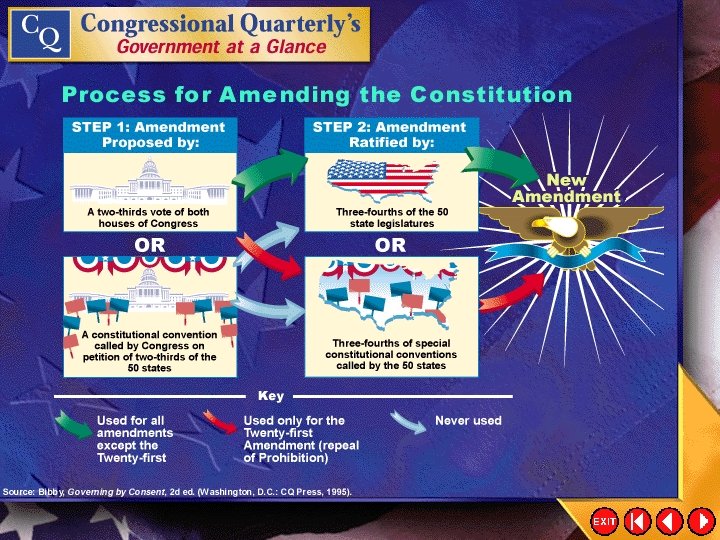
 Proposing Amendments • One method of proposing an amendment is by a two-thirds vote of each house of Congress. • This is the only method that has been used to date. • Dozens of resolutions asking for constitutional amendments are introduced in Congress each year, but very few win the necessary two-thirds vote. Click the mouse button or press the Space Bar to display the information.
 Proposing Amendments (cont. ) • The other method for proposing amendments is by a national convention called by Congress at the request of twothirds of the states. • This method has never been used, but in recent history it has almost occurred twice. • In 1963 states began to petition, or appeal to, Congress for a convention to propose an amendment to overturn Supreme Court decisions affecting the election of state lawmakers. The campaign failed. Click the mouse button or press the Space Bar to display the information.
 Proposing Amendments (cont. ) • Between 1975 and 1991, 32 state legislatures petitioned Congress for a convention to propose an amendment requiring a balanced budget–one in which the federal government’s spending never exceeds its income. • The convention method of proposing amendments is controversial, because such a convention is not required to limit itself to a specific amendment. Click the mouse button or press the Space Bar to display the information.
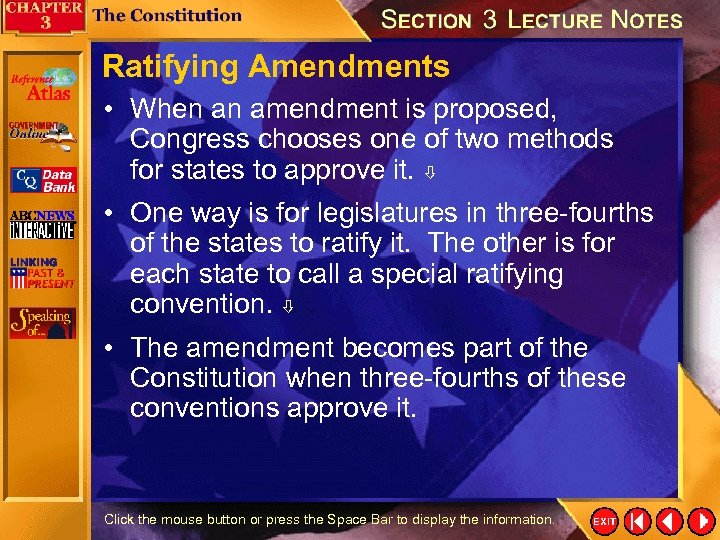 Ratifying Amendments • When an amendment is proposed, Congress chooses one of two methods for states to approve it. • One way is for legislatures in three-fourths of the states to ratify it. The other is for each state to call a special ratifying convention. • The amendment becomes part of the Constitution when three-fourths of these conventions approve it. Click the mouse button or press the Space Bar to display the information.
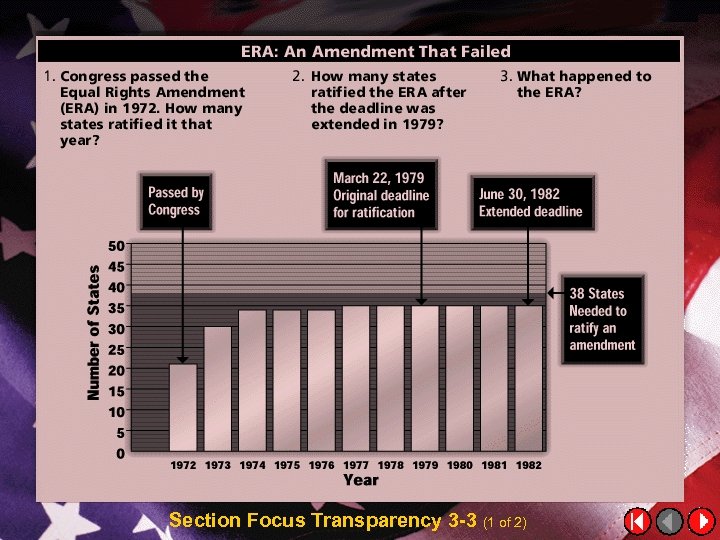
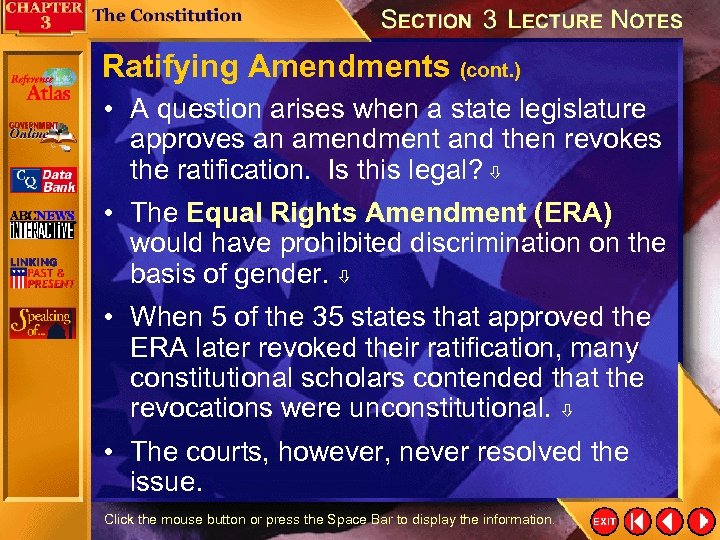 Ratifying Amendments (cont. ) • A question arises when a state legislature approves an amendment and then revokes the ratification. Is this legal? • The Equal Rights Amendment (ERA) would have prohibited discrimination on the basis of gender. • When 5 of the 35 states that approved the ERA later revoked their ratification, many constitutional scholars contended that the revocations were unconstitutional. • The courts, however, never resolved the issue. Click the mouse button or press the Space Bar to display the information.
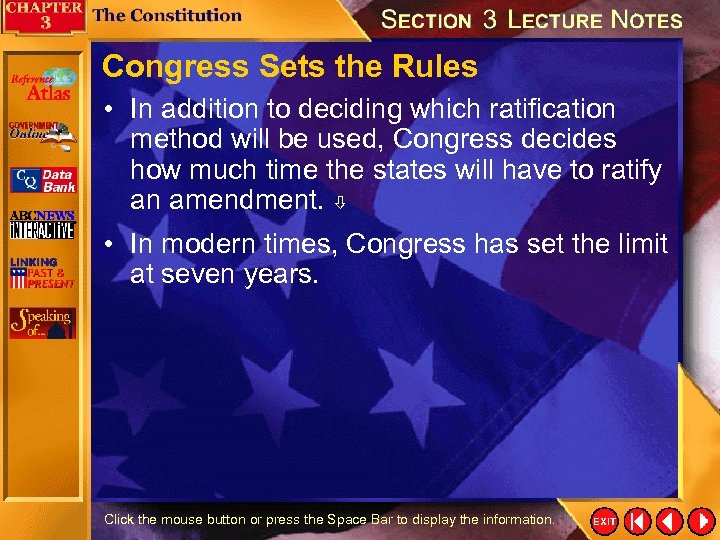 Congress Sets the Rules • In addition to deciding which ratification method will be used, Congress decides how much time the states will have to ratify an amendment. • In modern times, Congress has set the limit at seven years. Click the mouse button or press the Space Bar to display the information.
 Informal Changes • Informal changes do not involve changing the wording of the Constitution itself. • Rather, informal changes occur as government leaders and citizens fill in the details of the government on a day-to-day, year-to-year basis. Click the mouse button or press the Space Bar to display the information.
 Changes Through Law • Congress has passed laws that have enlarged or clarified many of the Constitution’s provisions. • The Founders gave Congress authority to spell out many details of the national government. • Article I, for example, gives Congress the power to “lay and collect taxes. ” Congress has applied the taxing authority of the Constitution and expanded its meaning by passing complex tax laws that fill many volumes. Click the mouse button or press the Space Bar to display the information.
 Changes Through Practices • Congress has also shaped the Constitution by the way it has used its other powers. • Under the Constitution, the House may impeach, or accuse, federal officials, while it is up to the Senate to determine the accused person’s guilt or innocence. • Congress has investigated more than 60 people on impeachment charges, including three presidents–Andrew Johnson, Richard Nixon, and Bill Clinton. Click the mouse button or press the Space Bar to display the information.
 Informal Presidential Changes • Presidential actions have added to the Constitution and affect the workings of the modern presidency. Click the mouse button or press the Space Bar to display the information.
 Presidential Succession • When a president dies in office, does the vice president actually become president, or merely act as president until the next election? – When William Henry Harrison became the first president to die in office, Vice President John Tyler took the presidential oath of office. – Many officials opposed Tyler’s interpretation of the Constitution, but his precedent was formally endorsed in the Constitution when the Twentyfifth Amendment was ratified in 1967. Click the mouse button or press the Space Bar to display the information.
 Foreign Affairs • Modern presidents usually conduct foreign affairs by executive agreement, instead of using the treaty process specified in the Constitution. • While a treaty is an agreement between nations, an executive agreement is made directly between the president and the head of state of another country. Click the mouse button or press the Space Bar to display the information.
 Domestic Affairs • The Founders thought the executive branch would be concerned mostly with carrying out laws initiated by Congress. • Yet in this century, presidents have been aggressive in requesting legislation from Congress. • Today the president plays a far greater and more powerful role in American government and politics than most of the Founders ever imagined. Click the mouse button or press the Space Bar to display the information.
 Court Decisions • As the Supreme Court and federal courts settle cases involving constitutional questions, they interpret the meaning of the Constitution’s sometimes vague words and phrases. Click the mouse button or press the Space Bar to display the information.
 Judicial Review • The most important device the Court uses to interpret the Constitution is judicial review. • Although the principle of judicial review is well established, some people advocate judicial restraint, while others advocate judicial activism. Click the mouse button or press the Space Bar to display the information.
 Judicial Review (cont. ) • Judicial restraint holds that the Court should avoid taking the initiative on social and political questions. • The Court should uphold acts of Congress unless the acts clearly violate a specific provision of the Constitution. • The philosophy of judicial activism holds that the Court should play a role in shaping national policies. The Court should apply the Constitution to social and political questions. Click the mouse button or press the Space Bar to display the information.
 Judicial Review (cont. ) • The Supreme Court under Chief Justice Earl Warren–from 1953 to 1969–accepted cases involving many controversial issues, particularly civil rights and the rights of the accused. • Although judicial activism is usually associated with liberal issues, it can mark either a conservative or liberal court. • However, political liberals have tended to support activism, while conservatives have argued for judicial restraint. Click the mouse button or press the Space Bar to display the information.
 Changing Court Rulings • Social and political conditions of the times have caused the Court occasionally to reverse its interpretations of the Constitution. • In 1896, for example, the Court ruled that “separate but equal” public facilities for African Americans were legal. • More than half a century later, in 1954, the Court reversed its position when it decided to outlaw racial segregation in public schools. Click the mouse button or press the Space Bar to display the information.
 Changes Through Custom and Usage • The Constitution has been informally enlarged through customs, such as political parties, that have developed over time. • The amendments added to the Constitution and changes achieved through precedent and practice have created a government that can respond to the conditions and needs of the times. • Thus, the Constitution has continued for more than two centuries to serve as the supreme law of the land. Click the mouse button or press the Space Bar to display the information.
 How does the amendment process illustrate federalism? Amendments are proposed at a national level, but they are ratified on a state-by-state basis. Click the mouse button or press the Space Bar to display the answer.
 What are the primary ways that informal changes are made in the Constitution? Informal changes are primarily made to the Constitution through congressional legislation and practices, presidential actions, court decisions, and custom and usage. Click the mouse button or press the Space Bar to display the answer.
 End of Section 3 Click the mouse button to return to the Contents slide.
 The Amendments Key Terms prior restraint, probable cause, search warrant, arrest warrant, due process of law, eminent domain, lame duck, poll tax Find Out • Why is it important in a democratic society that the government follow due process of law when trying suspected criminals? • How do the amendments to the Constitution show the development of democracy in the United States? Click the mouse button or press the Space Bar to display the information. Additional lecture notes appear on the following slides.
 The Amendments Understanding Concepts Growth of Democracy How do the amendments reflect changes in society’s perception of rights under the Constitution? Section Objective Classify amendments by type: those dealing with individual rights, those reflecting societal change, and those affecting the structure and powers of government. Click the mouse button or press the Space Bar to display the information. Additional lecture notes appear on the following slides.
 Introduction • Despite the difficulty of the amendment process, Americans put it to work almost immediately. • Congress quickly proposed 12 amendments and sent them to the states for ratification. • In 1791 the states ratified 10 of the amendments, which became known as the Bill of Rights. Click the mouse button or press the Space Bar to display the information.
 The Bill of Rights • The Bill of Rights limits the powers of government by protecting the rights of individual liberty. • Although the Bill of Rights originally applied only to the national government, almost all its provisions have been applied to the states. Click the mouse button or press the Space Bar to display the information.
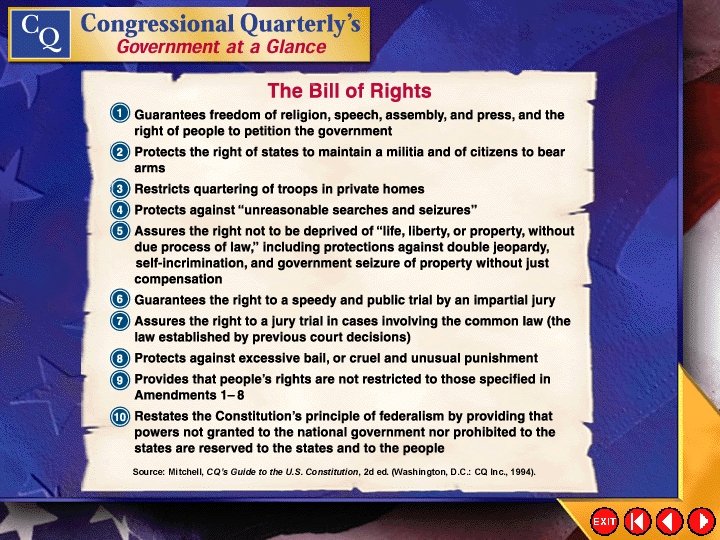
 The First Amendment • One of the most important amendments in the Bill of Rights, the First Amendment states: “Congress shall make no law respecting an establishment of religion, or prohibiting the free exercise thereof; or abridging the freedom of speech, or of the press; or the right of the people peaceably to assemble, and to petition the Government for a redress of grievances. ” • Americans can worship as they please, or have no religion. The United States has no official religion and does not promote any particular religion. Click the mouse button or press the Space Bar to display the information.
 The First Amendment (cont. ) • These principles are known as freedom of religion and separation of church and state. • In addition, the government cannot prevent individuals from freely expressing their opinions, even if they are unpopular or criticize government officials. Click the mouse button or press the Space Bar to display the information.
 The First Amendment (cont. ) • The First Amendment also protects the free circulation of ideas in the press. • Unlike the press in some other countries, the American press is not subject to prior restraint–that is, government censorship of information before it is published or broadcast. Click the mouse button or press the Space Bar to display the information.
 Freedom Within Limits • The freedoms of speech and press are not unlimited. The following forms of speech are not protected: – Slander is false speech intended to damage a person’s reputation. – Libel is similar to slander, except that it applies to written or published statements. – Endangering the nation’s safety by giving away military secrets or calling for the violent overthrow of the government is not protected. – Speech should be responsible, also. For example, no one has the right to cry “Fire!” in a crowded theater just to see what happens. Click the mouse button or press the Space Bar to display the information.
 Freedom Within Limits (cont. ) • Another freedom the First Amendment protects is the right to assemble in groups and hold demonstrations to call attention to a group’s beliefs. • Finally, the rights to sign petitions in support of an idea, to present those petitions to government officials, and to send letters to those officials are all protected. Click the mouse button or press the Space Bar to display the information.
 The Second Amendment • The Second Amendment ensures citizens and the nation the right to security. It states: “A well-regulated Militia being necessary to the security of a free State, the right of the people to keep and bear Arms shall not be infringed. ” • Before the Revolution, the British tried to take weapons away from colonial militia, or armed forces of citizens. Click the mouse button or press the Space Bar to display the information.
 The Second Amendment (cont. ) • This amendment seems to support the right for citizens to own firearms, but it does not prevent Congress from regulating the interstate sale of weapons. Click the mouse button or press the Space Bar to display the information.
 The Third Amendment • The Third Amendment prohibits the government from forcing people to quarter–to provide shelter for–soldiers in their homes, another British practice before the Revolution. Click the mouse button or press the Space Bar to display the information.
 The Fourth Amendment • To guard against intrusive searches and seizures, the Fourth Amendment protects the right to privacy. • It requires authorities to have a specific reason to search a premises or to seize evidence or people. • To be lawful, a search or an arrest must be based on probable cause, meaning that police must have a reasonable basis to believe the person or premises is linked to a crime. Click the mouse button or press the Space Bar to display the information.
 The Fourth Amendment (cont. ) • A search or an arrest also usually requires a search warrant or an arrest warrant. • These are orders signed by a judge describing a specific place to be searched for specific items or naming the individual to be arrested for a specific crime. Click the mouse button or press the Space Bar to display the information.
 The Fifth Amendment • The Fifth Amendment contains four important protections for people accused of crimes: – No one can be tried for a serious crime unless a grand jury has decided there is enough evidence to justify a trial. – A person who is found innocent of a crime may not be tried again for the same offense. – No one may be forced to testify against himself or herself. – The government may not deprive any person of life, liberty, or property without due process of law. Click the mouse button or press the Space Bar to display the information.
 The Fifth Amendment (cont. ) • Due process means that the government must follow proper constitutional procedures in trials and in other actions it takes against individuals. • The Fifth Amendment also defines government’s right of eminent domain– the power of the government to take private property for public use. • The government must pay a fair price for the property taken and must use it in a way that benefits the public. Click the mouse button or press the Space Bar to display the information.
 The Sixth Amendment • The Sixth Amendment gives an accused person several important rights: – A basic protection is the right to a speedy, public trial by an impartial jury. – An accused person may ask to be tried by a judge alone, or for a change of venue, or new trial location. – Accused persons also have the right to know the charges against them, to hear and question all witnesses against them, and to be defended by a lawyer. Click the mouse button or press the Space Bar to display the information.
 The Seventh Amendment • The Seventh Amendment provides for the right to a jury trial in federal courts to settle all disputes about property worth more than $20. • When both parties in conflict agree, however, a judge rather than a jury may hear evidence and settle the case. Click the mouse button or press the Space Bar to display the information.
 The Eighth Amendment • The Eighth Amendment prohibits excessive bail–money or property that the accused deposits with the court to gain release from jail until the trial. • The Eighth Amendment also prevents judges from ordering someone convicted of a crime to pay an excessive fine. Click the mouse button or press the Space Bar to display the information.
 The Eighth Amendment (cont. ) • Finally, this amendment bans “cruel and unusual punishment” for crimes. These are punishments that are out of proportion to the crime committed. • The Eighth Amendment also has been used to limit the use of the death penalty in some circumstances. Click the mouse button or press the Space Bar to display the information.
 The Ninth Amendment • The Ninth Amendment states that all other rights not spelled out in the Constitution are “retained by the people. ” • The amendment protects all basic or natural rights not specifically noted in the Constitution. Click the mouse button or press the Space Bar to display the information.
 The Tenth Amendment • Completing the Bill of Rights, the Tenth Amendment establishes that powers not given to the national government–or denied to the states–by the Constitution belong to the states or to the people. Click the mouse button or press the Space Bar to display the information.
 Other Amendments • The 27 amendments fall into 3 major groups. The first group includes the Bill of Rights and the Eleventh and Twelfth Amendments. • The Eleventh Amendment was added to prohibit a state from being sued in federal court by citizens of another state or of another nation. • In 1793 two citizens of South Carolina had sued Georgia over property rights. The Georgia legislature maintained that a sovereign state could not be sued. Click the mouse button or press the Space Bar to display the information.
 Other Amendments (cont. ) • In Chisholm v. Georgia the Supreme Court ruled against Georgia, but the day after the ruling, Congress introduced an amendment to limit the jurisdiction of the federal courts. • The Twelfth Amendment provides for the Electoral College to use separate ballots in voting for president and vice president. Click the blue hyperlink to explore the Supreme Court case.
 Civil War Amendments • The second group of amendments– Thirteen, Fourteen, and Fifteen–often are called the Civil War amendments because they grew out of that great conflict. • The Thirteenth Amendment (1865) outlaws slavery. • The Fourteenth Amendment (1868) originally was intended to protect the legal rights of the freed slaves and their descendants. Click the mouse button or press the Space Bar to display the information.
 Civil War Amendments (cont. ) • Today it protects the rights of citizenship in general by prohibiting a state from depriving any person of life, liberty, or property without “due process of law. ” • The Fifteenth Amendment (1870) prohibits the government from denying a person’s right to vote on the basis of race. Click the mouse button or press the Space Bar to display the information.
 The Later Amendments • The third group of amendments have all been added in the twentieth century. • The Sixteenth Amendment (1913) gives Congress the power to levy individual income taxes. • The Seventeenth Amendment (1913) states that the people, instead of state legislatures, elect United States senators. • The Eighteenth Amendment (1919) prohibits the manufacture, sale, or transportation of alcoholic beverages. Click the mouse button or press the Space Bar to display the information.
 The Later Amendments (cont. ) • The Nineteenth Amendment (1920) guarantees women the right to vote. • The Twentieth Amendment (1933) sets new dates for the Congress to begin its term and for the inauguration of the president and vice president. • Under the original Constitution, elected officials who retired or who had been defeated remained in office for several months. • Such outgoing officials were called lame ducks because they were so inactive. Click the mouse button or press the Space Bar to display the information.
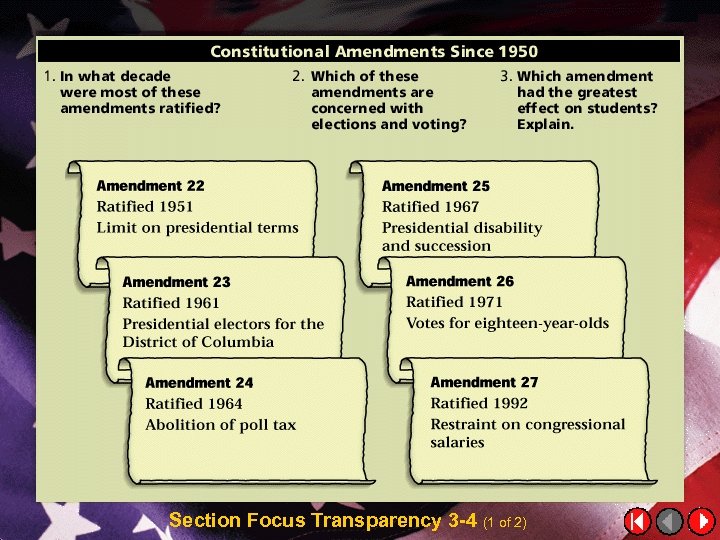
 The Later Amendments (cont. ) • The Twentieth Amendment ended the terms of senators and representatives on January 3, and the term of president on January 20 in the year following their November elections. • The Twenty-first Amendment (1933) repeals the unsuccessful Eighteenth Amendment. • The Twenty-second Amendment (1951) limits presidents to a maximum of two elected terms. Click the mouse button or press the Space Bar to display the information.
 The Later Amendments (cont. ) • The Twenty-third Amendment (1961) allows citizens living in Washington, D. C. , to vote for president and vice president, a right previously denied residents of the nation’s capital. • The Twenty-fourth Amendment (1964) prohibits poll taxes–taxes paid in order to vote–in federal elections. • Prior to the passage of this amendment, some states had used poll taxes to keep low-income African Americans from voting. Click the mouse button or press the Space Bar to display the information.
 The Later Amendments (cont. ) • The Twenty-fifth Amendment (1967) establishes a process for the vice president to take over leadership of the nation when a president is disabled. • It also sets procedures for filling a vacancy in the office of the vice president. • The Twenty-sixth Amendment (1971) lowers the voting age in both federal and state elections to 18. Click the mouse button or press the Space Bar to display the information.
 The Later Amendments (cont. ) • The Twenty-seventh Amendment (1992) makes congressional pay raises effective during the term following their passage. • Originally proposed by James Madison in 1789, this amendment lingered in obscurity for more than 200 years until it was discovered by a university student. Click the mouse button or press the Space Bar to display the information.
 Why is it important in a democratic society that the government follow due process of law when trying suspected criminals? Due process must be followed to prevent authorities from abusing power and to protect individual rights. Click the mouse button or press the Space Bar to display the answer.
 How do the amendments to the Constitution show the development of democracy in the United States? As democracy evolved, slavery and poll taxes were outlawed, suffrage was expanded, and opportunities to participate in the government were expanded. Click the mouse button or press the Space Bar to display the answer.
 End of Section 4 Click the mouse button to return to the Contents slide.
 What are the six goals of American government as identified in the Preamble to the Constitution? 1. To form a more perfect union 2. Establish justice 3. Ensure domestic tranquility 4. Provide for common defense 5. Promote general welfare 6. Secure blessings of liberty Click the mouse button or press the Space Bar to display the answer.
 Identify the six major principles of government on which the Constitution is based. 1. Popular sovereignty 2. Federalism 3. Separation of powers 4. Checks and balances 5. Judicial review 6. Limited government Click the mouse button or press the Space Bar to display the answer.
 What is the constitutional principle illustrated by the division of the national government into three branches? The constitutional principle is separation of powers. Click the mouse button or press the Space Bar to display the answer.
 In the Constitution, what right does the final enumerated power give Congress? The final enumerated power gives Congress the right to make all laws “necessary and proper” to carry out the powers expressed in the other clauses of Article I. Click the mouse button or press the Space Bar to display the answer.
 List five presidential powers as specified in the Constitution. 1. Serves as commander in chief of armed forces and state militias 2. Appoints heads of executive departments 3. May pardon people convicted of federal crimes except in cases of impeachment 4. Make treaties with the advice and consent of the Senate 5. Appoints ambassadors, federal court judges, and other top officials Click the mouse button or press the Space Bar to display the answer.
 Describe how an amendment to the Constitution is proposed and ratified. Proposed: Amendments are proposed by a two-thirds vote in each house of Congress or by national convention called by Congress at the request of two-thirds of the states. Ratified: Amendments are ratified by legislatures of three-fourths of the states or by special conventions in three-fourths of the states. Click the mouse button or press the Space Bar to display the answer.
 In what ways may the Constitution be changed informally? The Constitution can be changed informally through laws passed by Congress, congressional practices, presidential practices, court decisions, and custom and usage. Click the mouse button or press the Space Bar to display the answer.
 Describe a way in which a custom has enlarged the Constitution. Today political parties help organize government and conduct elections. Click the mouse button or press the Space Bar to display the answer.
 How would the federal system of government be affected if the Supreme Court did not have the power of judicial review? The legislative branch would gain more power than the judicial branch, or it would make the system of checks and balances less effective. Click the mouse button or press the Space Bar to display the answer.
 Chapter Bonus Question Who was the only president elected to more than two terms? Franklin D. Roosevelt was elected president for four terms– 1932, 1936, 1940, and 1944. Click the mouse button or press the Space Bar to display the answer.
 End of Chapter Assessment Click the mouse button to return to the Contents slide.

 Use the Mind. Jogger videoquiz as a preview, or both. Click the Videodisc button to play the Mind. Jogger video if you have a videodisc player attached to your computer. Disc 1 Side 1 Chapter 3 If you experience difficulties, check the Troubleshooting section in the Help system. Click the Videodisc button to play the Mind. Jogger video if you have a videodisc player attached to your computer.
 Powers of the Supreme Court Constitution and the Court This segment explores the separation of powers and illustrates examples of checks and balances. Click the Videodisc button to play the ABCNews Inter. Active™ video if you have a videodisc player attached to your computer. If you experience difficulties, check the Troubleshooting section in the Help system. Side 1 Chapter 3 Click the Videodisc button to play the video if you have a videodisc player attached to your computer.
 Powers of the President Constitutional Roles of the President Powers of the Congress Constitutional Powers of Congress Powers of the Congress The Elastic Clause Click a blue hyperlink to select an ABCNews Interactive video segment.
 Powers of the President Constitutional Roles of the President This segment explores the various roles of the president. Click the Videodisc button to play the ABCNews Inter. Active™ video if you have a videodisc player attached to your computer. If you experience difficulties, check the Troubleshooting section in the Help system. Side 1 Chapter 16 Click the Videodisc button to play the video if you have a videodisc player attached to your computer.
 Powers of the Congress Constitutional Powers of Congress This segment explores the purpose of Congress. Click the Videodisc button to play the ABCNews Inter. Active™ video if you have a videodisc player attached to your computer. If you experience difficulties, check the Troubleshooting section in the Help system. Side 1 Chapter 7 Click the Videodisc button to play the video if you have a videodisc player attached to your computer.
 Powers of the Congress The Elastic Clause This segment examines areas that are subject to federal legislation through this clause. Click the Videodisc button to play the ABCNews Inter. Active™ video if you have a videodisc player attached to your computer. If you experience difficulties, check the Troubleshooting section in the Help system. Side 1 Chapter 9 Click the Videodisc button to play the video if you have a videodisc player attached to your computer.
 Powers of the Congress Amending the Constitution This segment shows a debate on the House floor during consideration of a constitutional amendment. Click the Videodisc button to play the ABCNews Inter. Active™ video if you have a videodisc player attached to your computer. If you experience difficulties, check the Troubleshooting section in the Help system. Side 1 Chapter 10 Click the Videodisc button to play the video if you have a videodisc player attached to your computer.
 Powers of the Supreme Court Bill of Rights Powers of the Supreme Court Amendment 6 (1791): Right to a Fair Trial Powers of the Presidential Vacancy Click a blue hyperlink to select an ABCNews Interactive video segment.
 Powers of the Supreme Court Bill of Rights This segment explores the importance of the Bill of Rights. Click the Videodisc button to play the ABCNews Inter. Active™ video if you have a videodisc player attached to your computer. If you experience difficulties, check the Troubleshooting section in the Help system. Side 1 Chapter 6 Click the Videodisc button to play the video if you have a videodisc player attached to your computer.
 Powers of the Supreme Court Amendment 6 (1791): Right to a Fair Trial This segment explores the various phases of criminal prosecution. Click the Videodisc button to play the ABCNews Inter. Active™ video if you have a videodisc player attached to your computer. If you experience difficulties, check the Troubleshooting section in the Help system. Side 1 Chapter 18 Click the Videodisc button to play the video if you have a videodisc player attached to your computer.
 Powers of the Presidential Vacancy This segment displays historical images of John F. Kennedy’s assassination and Lyndon B. Johnson’s swearing in. Click the Videodisc button to play the ABCNews Inter. Active™ video if you have a videodisc player attached to your computer. If you experience difficulties, check the Troubleshooting section in the Help system. Side 1 Chapter 15 Click the Videodisc button to play the video if you have a videodisc player attached to your computer.
 Protecting Your Rights How well do you know your rights? What constitutional protections do you enjoy as a United States citizen? Few people know the Constitution very well, yet we all rely on its provisions to ensure a stable government that works within defined limits. The Chapter 3 video lesson The Constitution– A Living Document will show you how the Constitution protects your rights.
 The Constitution– Living Document A Disc 1 Side 1 Chapter 3 Click the Videodisc button anytime throughout this section to play the complete video if you have a videodisc player attached to your computer. Click inside this box to play the preview. Click the Forward button to view the discussion questions and other related slides.
 The Constitution– A Living Document Objectives Disc 1 Side 1 Chapter 3 • Realize that the Constitution and the Bill of Rights apply to issues in today’s society. • Understand the Bill of Rights as the embodiment of many of our constitutional protections. • Recognize that many constitutional rights are not absolute. • Perceive that the need for personal responsibility usually accompanies the rights granted by the Constitution. Click the mouse button or press the Space Bar to display the information.
 The Constitution– A Living Document Activity Which constitutional amendments cover a citizen’s right to privacy? Although the right to privacy is not explicitly covered by the Constitution, the Supreme Court has interpreted that the First Amendment and the Fourth Amendment both apply to protecting an individual’s right to privacy. Click the mouse button or press the Space Bar to display the answer. Disc 1 Side 1 Chapter 3
 The Constitution– A Living Document Activity The Fourth Amendment specifically protects against invasion of personal privacy by the. . . government. Click the mouse button or press the Space Bar to display the answer. Disc 1 Side 1 Chapter 3
 The Constitution– A Living Document Activity Disc 1 Side 1 Chapter 3 When Congress passed the Communications Decency Act of 1996, what groups challenged its constitutionality? A group of Internet online services as well as the library association, some educators and others sued the government on the grounds that the act was an infringement on First Amendment free speech rights. Click the mouse button or press the Space Bar to display the answer.
 End of Why It’s Important Click the mouse button to return to the Contents.
 Explore online information about the topics introduced in this chapter. Click on the Connect button to launch your browser and go to the United States Government: Democracy in Action Web site. At this site, you will find interactive activities, current events information, and Web sites correlated with the chapters and units in the textbook. When you finish exploring, exit the browser program to return to this presentation. If you experience difficulty connecting to the Web site, manually launch your Web browser and go to gov. glencoe. com
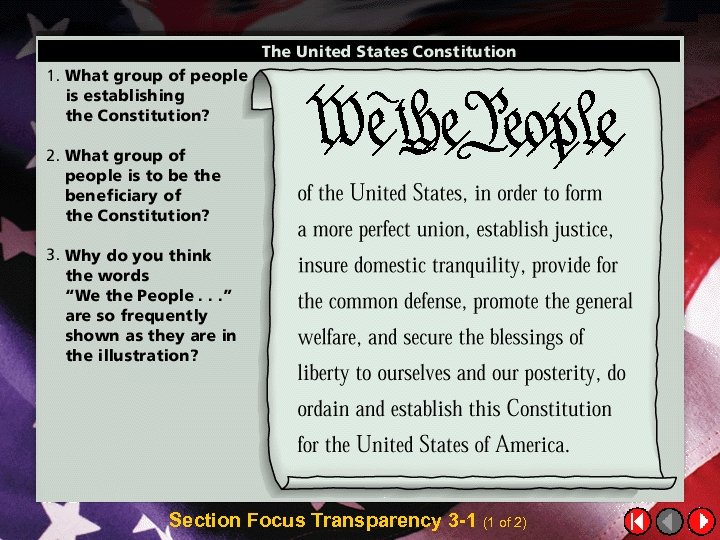 Section Focus Transparency 3 -1 (1 of 2)
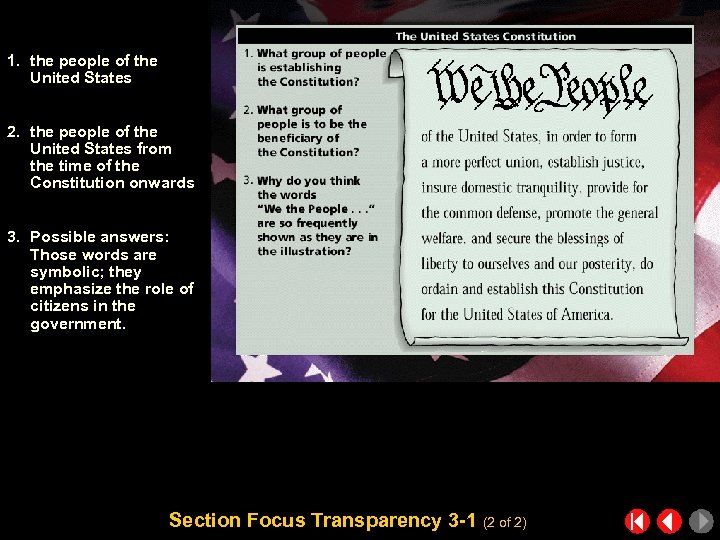 1. the people of the United States 2. the people of the United States from the time of the Constitution onwards 3. Possible answers: Those words are symbolic; they emphasize the role of citizens in the government. Section Focus Transparency 3 -1 (2 of 2)
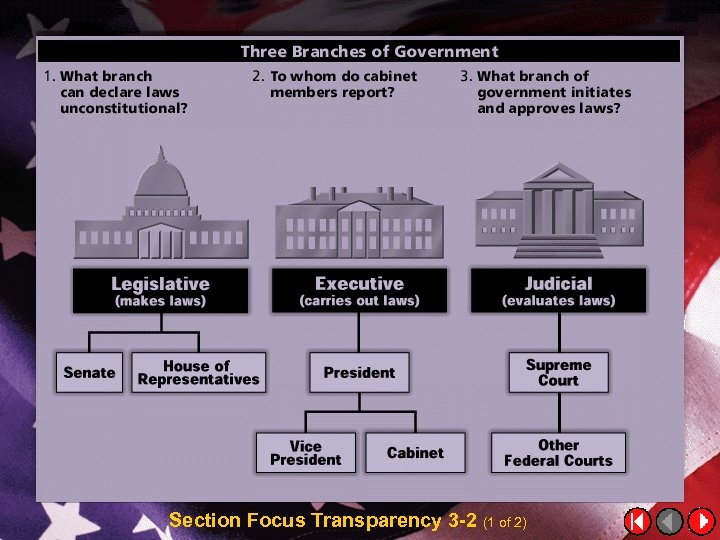 Section Focus Transparency 3 -2 (1 of 2)
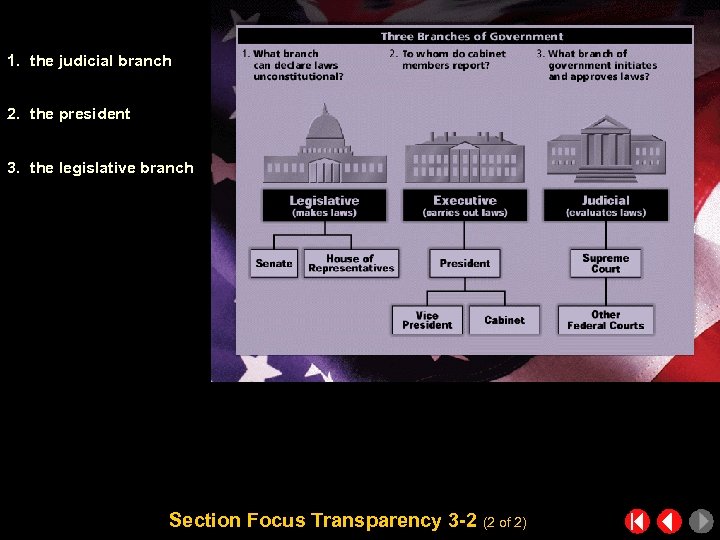 1. the judicial branch 2. the president 3. the legislative branch Section Focus Transparency 3 -2 (2 of 2)
 Section Focus Transparency 3 -3 (1 of 2)
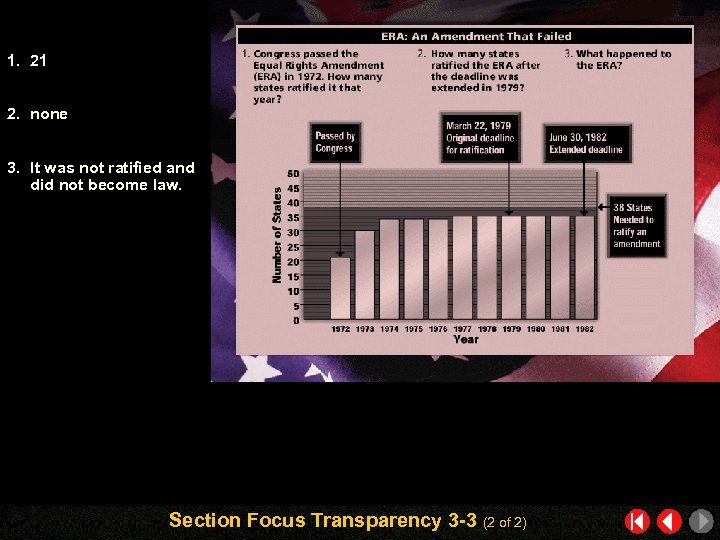 1. 21 2. none 3. It was not ratified and did not become law. Section Focus Transparency 3 -3 (2 of 2)
 Section Focus Transparency 3 -4 (1 of 2)
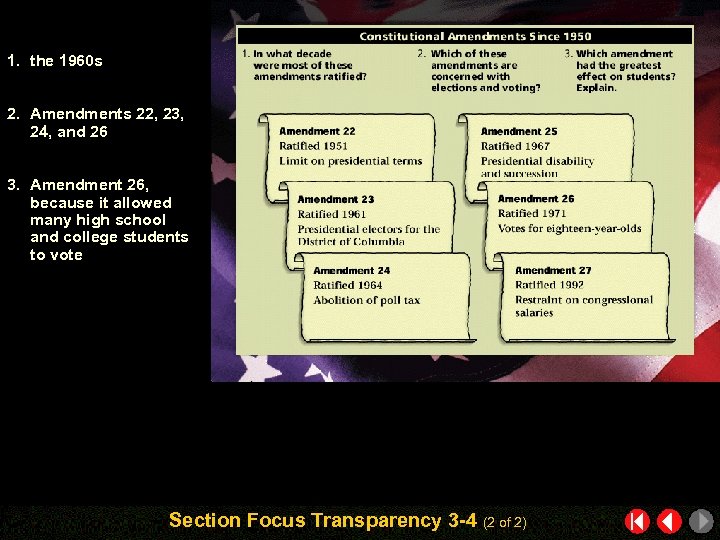 1. the 1960 s 2. Amendments 22, 23, 24, and 26 3. Amendment 26, because it allowed many high school and college students to vote Section Focus Transparency 3 -4 (2 of 2)
 Several recent polls show that many Americans want to amend the Constitution. Some people want an amendment to limit the terms of members of Congress. Another proposed change to the Constitution includes revising the Fourteenth Amendment so that children born to illegal immigrants in the United States would have to apply for naturalization when they turn 18 instead of receiving automatic citizenship. Other Americans demand a victims’ rights amendment to guarantee that the victim in every criminal prosecution be granted the right to be present and heard at all critical stages of judicial proceedings.
 ERA The earliest version of the ERA was proposed in 1923. Every year for the next 49 years, some version of the amendment was introduced in Congress. It was not discussed by the legislature until 1967. It passed Congress in 1972, but failed to be ratified by the states by the July 1982 deadline.
 Scared Silent An incident related by William Pierce of Georgia illustrates the Constitutional Convention’s obsession with secrecy. A delegate apparently dropped his copy of a paper containing one of the major proposals, the Virginia Plan of Union. Another delegate found it and turned it over to the presiding officer, George Washington. Just before adjourning for the day, Washington admonished the delegates about carelessness and tossed the paper on the table saying, “Let him who owns it take it. ” Washington then left the room “with a dignity so severe that every person seemed alarmed, ” Pierce wrote. But no one owned up to losing the paper.
 Slowest Approval The Twenty-seventh Amendment wins hands down as the one that took the longest to win ratification by threefourths of the states. It took 202 years from the time James Madison proposed it until it was finally adopted in 1992. Under its terms, Congress cannot give itself a midterm pay raise. A congressional election must intervene before the raise takes effect, giving the voters an opportunity to throw out the members who approved it. Although today Congress tacks time limits on the ratification of constitutional amendments–usually seven years–there were none on the pay amendment.
 Marbury v. Madison (1803) This case established one of the most significant principles of American constitutional law. In this case, the Supreme Court held that it is the Court itself that has the final say on what the Constitution means. It is also the Supreme Court that has the final say in whether or not an act of government–legislative or executive at the federal, state, or local level–violates the Constitution. Click the Section Start button to return to the lecture notes.
 Marbury v. Madison (1803) This case established one of the most significant principles of American constitutional law. In this case, the Supreme Court held that it is the Court itself that has the final say on what the Constitution means. It is also the Supreme Court that has the final say in whether or not an act of government–legislative or executive at the federal, state, or local level–violates the Constitution. Click the Section Start button to return to the lecture notes.
 Mc. Culloch v. Maryland (1819) This case established the foundation for the expansive authority of Congress. The Supreme Court held that the necessary and proper clause (U. S. Const. art. I, § 8, cl. 18) allows Congress to do more than the Constitution expressly authorizes it to do. This case says that Congress can enact nearly any law that will help achieve any of the ends set forth in Article I, Section 8. For example, Congress has the express authority to regulate interstate commerce; the necessary and proper clause permits Congress to do so in ways not specified in the Constitution. Click the Section Start button to return to the lecture notes.
 U. S. Constitution Article I, Section 8, Clause 18 The Congress shall have the Power…To make all Laws which shall be necessary and proper for carrying into Execution the foregoing Powers, and all other Powers vested by this Constitution in the Government of the United States, or in any Department or Officer thereof. Click the Section Start button to return to the lecture notes.
 Chisholm v. Georgia (1793) This case stripped the immunity of the states to lawsuits in federal court. In this case, the Supreme Court held that a citizen of one state could sue another state in federal court without that state consenting to the suit. The Court’s decision created a furor and directly led to the adoption of the Eleventh Amendment, which immunized, i. e. , protected, states from federal court suits by citizens of other states. Click the Section Start button to return to the lecture notes.
 End of Custom Shows WARNING! Do Not Remove This slide is intentionally blank and is set to auto-advance to end custom shows and return to the main presentation.
 End of the Slide Show Click the mouse button to return to the Contents slide.