 Скачать презентацию Presentation Plus The American Vision Copyright by
94608d7ca08975a5f46246f1561099f1.ppt
- Количество слайдов: 124




Presentation Plus! The American Vision Copyright © by The Mc. Graw-Hill Companies, Inc. Developed by FSCreations, Inc. , Cincinnati, Ohio 45202 Send all inquiries to: GLENCOE DIVISION Glencoe/Mc. Graw-Hill 8787 Orion Place Columbus, Ohio 43240
Chapter Introduction Section 1 Presidential Politics Section 2 A Growing Economy Section 3 The Policies of Prosperity Chapter Summary Chapter Assessment Click on a hyperlink to view the corresponding slides.
Click the Speaker button to listen to the audio again.
Chapter Objectives Section 1: Presidential Politics • Describe the corruption that tainted the Harding administration. • Explain how Calvin Coolidge restored public confidence after the presidency. Click the mouse button or press the Space Bar to display the information.
Chapter Objectives Section 2: A Growing Economy • Analyze how the growing importance of the automobile and other new industries improved the U. S. standard of living. • Analyze the growing economic crisis in farming in the 1920 s. Click the mouse button or press the Space Bar to display the information.
Chapter Objectives Section 3: The Policies of Prosperity • Explain Andrew Mellon’s economic strategies for maintaining prosperity. • Describe how the United States remained involved in world affairs without joining the League of Nations. Click the mouse button or press the Space Bar to display the information.
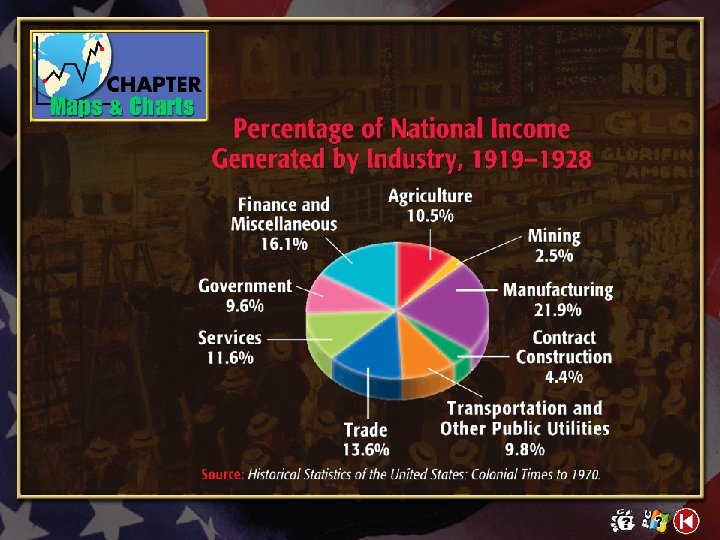
Why It Matters Prosperity was theme of the 1920 s, and national policy favored business. Although farmers were going through an economic depression, most people remained optimistic about the economy. The middle class bought on credit the many new convenience products available. One of the most popular purchases of the day was the automobile, which had a major impact on how Americans lived.
The Impact Today Important elements of American life were first seen at this time. • The automobile remains central to American transportation. • Credit is a standard means for making purchases. Click the mouse button or press the Space Bar to display the information.
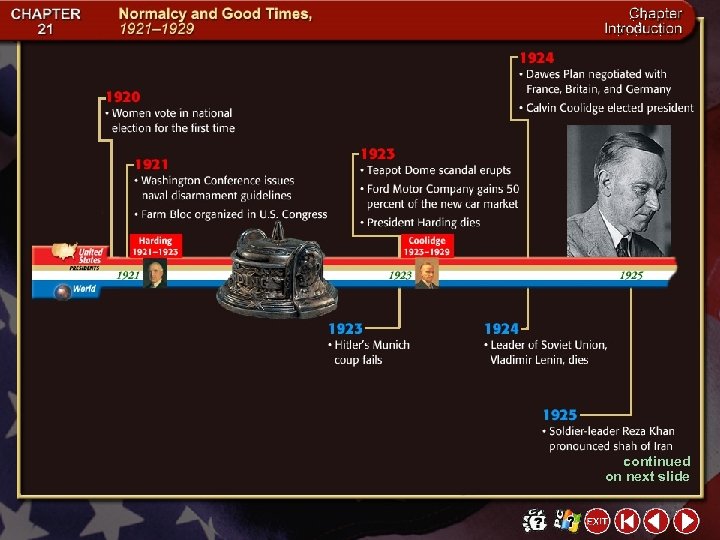
continued on next slide
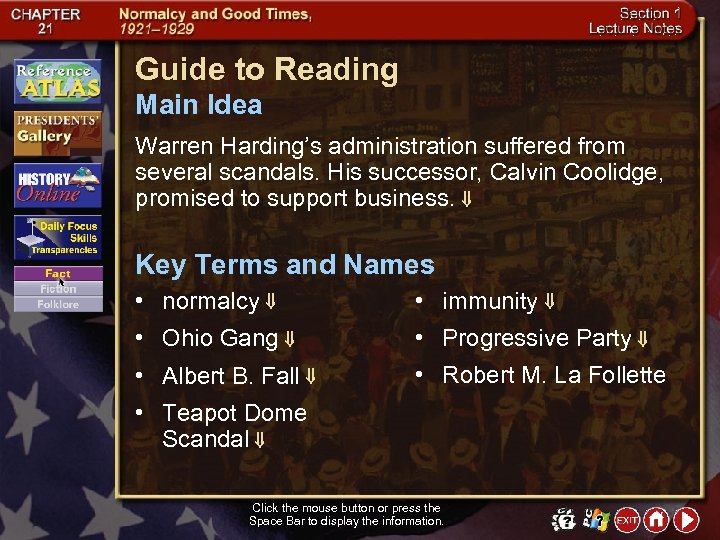
Guide to Reading Main Idea Warren Harding’s administration suffered from several scandals. His successor, Calvin Coolidge, promised to support business. Key Terms and Names • normalcy • immunity • Ohio Gang • Progressive Party • Albert B. Fall • Robert M. La Follette • Teapot Dome Scandal Click the mouse button or press the Space Bar to display the information.
Guide to Reading (cont. ) Reading Strategy Taking Notes As you read about Presidents Harding and Coolidge, use the major headings of the section to create an outline similar to the on page 636 of your textbook. Reading Objectives • Describe the corruption that tainted the Harding administration. • Explain how Calvin Coolidge restored public confidence after assuming the presidency. Click the mouse button or press the Space Bar to display the information.
Guide to Reading (cont. ) Section Theme Government and Democracy The “Ohio Gang” of the Harding administration created scandals and political upheaval.
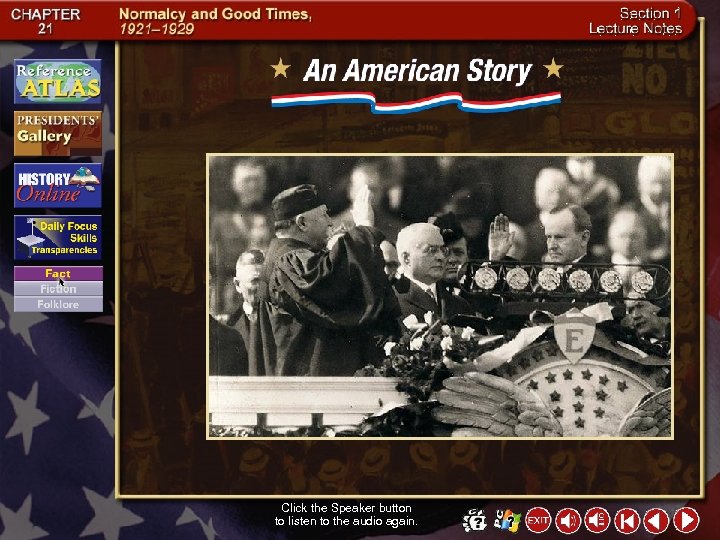
Click the Speaker button to listen to the audio again.
The Harding Administration • In 1920, when Warren G. Harding ran for president, most Americans wanted to return to simpler times. • His campaign slogan to return to normalcy, or a “normal” life after the war, made him very popular and he won the presidency. • Harding made a few distinguished appointments to the cabinet, but most appointments were given to friends. • His old poker-playing friends became known as the Ohio Gang. (pages 636– 638) Click the mouse button or press the Space Bar to display the information.
The Harding Administration (cont. ) • Some members used their government positions to sell jobs, pardons, and immunity from prosecution. • Before most of the scandals became public knowledge, Harding fell ill and died in 1923. • Harding’s secretary of the interior, Albert B. Fall, secretly allowed private interests to lease lands containing U. S. Navy oil reserves at Teapot Dome, Wyoming. • He received bribes totaling over $300, 000. (pages 636– 638) Click the mouse button or press the Space Bar to display the information.
The Harding Administration (cont. ) • The Teapot Dome scandal ended with Fall being the first cabinet officer in history to be sent to prison. • Another Harding administration scandal involved Attorney General Harry Daugherty. • He refused to turn over files and bank records for a German-owned American company. • Bribe money ended up in a bank account controlled by Daugherty. (pages 636– 638) Click the mouse button or press the Space Bar to display the information.
The Harding Administration (cont. ) • He refused to testify under oath, claiming immunity, or freedom from prosecution, on the grounds that he had confidential dealings with the president. • The new president, Calvin Coolidge, demanded Daugherty’s resignation. (pages 636– 638) Click the mouse button or press the Space Bar to display the information.
The Harding Administration (cont. ) What problems faced President Harding during his administration? (pages 636– 638) Click the mouse button or press the Space Bar to display the answer.
The Harding Administration (cont. ) Harding’s administration was plagued with scandals by cabinet members and other government officials appointed by Harding. Some members of the Ohio Gang used their government positions to sell jobs, pardons, and immunity from prosecution. Colonel Charles R. Forbes, head of the Veteran’s Bureau, sold scarce medical supplies from veteran’s hospitals and kept the money, which cost the taxpayers $250 million. Secretary of the interior, Albert B. Fall, secretly allowed private interests to lease lands containing U. S. Navy oil reserves at Teapot Dome, Wyoming. Attorney General Harry Daugherty refused to turn over files and bank records for a German-owned American company. Bribe money ended up in a bank account controlled by Daugherty. (pages 636– 638)
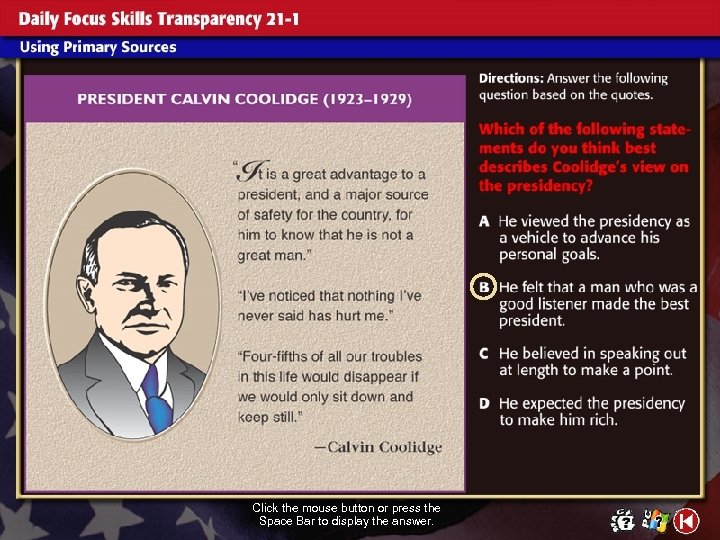
The Coolidge Administration • Vice President Calvin Coolidge became president after Harding’s death. • Coolidge distanced himself from the Harding administration. • His focus was on prosperity through business leadership with little government intervention. • He easily won the Republican Party’s nomination for president in 1924. (pages 638– 639) Click the mouse button or press the Space Bar to display the information.
The Coolidge Administration (cont. ) • The Democratic Party’s candidate was John W. Davis. • Those not wanting to choose between the Republican and Democratic Parties formed a new Progressive Party with Robert M. La Follette as their candidate. • Coolidge won the 1924 election with more than half the popular vote. • Coolidge promised to give the United States the normalcy that Harding had not. (pages 638– 639) Click the mouse button or press the Space Bar to display the information.
The Coolidge Administration (cont. ) How did Coolidge feel about business and government? Coolidge felt that business led to prosperity and that the government should not interfere. (pages 638– 639) Click the mouse button or press the Space Bar to display the answer.
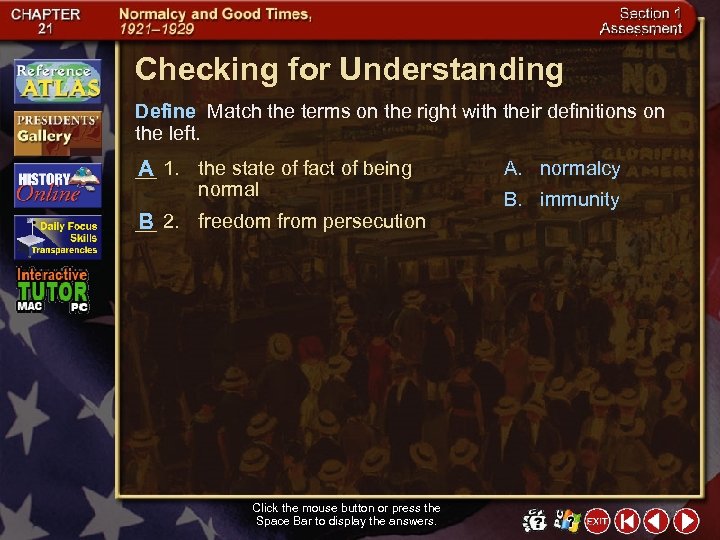
Checking for Understanding Define Match the terms on the right with their definitions on the left. __ 1. the state of fact of being A normal __ 2. freedom from persecution B Click the mouse button or press the Space Bar to display the answers. A. normalcy B. immunity
Checking for Understanding (cont. ) Evaluate the effects of the Teapot Dome scandal on citizens’ views of the federal government. Citizens viewed government as corrupt. Click the mouse button or press the Space Bar to display the answer.
Reviewing Themes Government and Democracy How did the Ohio Gang tarnish the Harding Administration? The Ohio Gang used their positions for personal advantage. Click the mouse button or press the Space Bar to display the answer.
Critical Thinking Interpreting How did the Democrats lose the chance for victory in the election of 1924? The Democrats could not agree on a nominee. Click the mouse button or press the Space Bar to display the answer.
Analyzing Visuals Analyzing Photographs Examine the photograph of Calvin Coolidge on page 639 of your textbook. How did Coolidge’s actions demonstrate effective leadership following the Harding administration? Coolidge avoided scandal and supported business prosperity. Click the mouse button or press the Space Bar to display the answer.
Close Explain how Calvin Coolidge restored public confidence after assuming the presidency.
Guide to Reading Main Idea The United States experienced stunning economic growth during the 1920 s. Key Terms and Names • mass production • assembly line • Model T • Charles Lindbergh • National Broadcasting Company • Columbia Broadcasting System • welfare capitalism • open shop Click the mouse button or press the Space Bar to display the information.
Guide to Reading (cont. ) Reading Strategy Organizing As you read about the booming era of the 1920 s, complete a graphic organizer similar to the on page 640 of your textbook to analyze the causes of economic growth and prosperity in the 1920 s. Reading Objectives • Analyze how the growing importance of the automobile and other new industries improved the U. S. standard of living. • Analyze the growing economic crisis in farming in the 1920 s. Click the mouse button or press the Space Bar to display the information.
Guide to Reading (cont. ) Section Theme Science and Technology New technology such as the automobile and radio helped reshape American lifestyles.
Click the Speaker button to listen to the audio again.
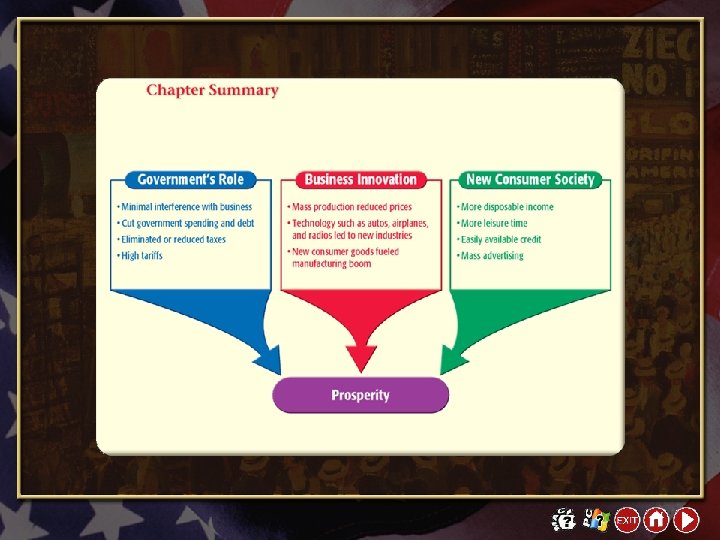
The Rise of New Industries • During the 1920 s, Americans enjoyed a new standard of living. • Wages increased, and work hours decreased. • Mass production, or large-scale product manufacturing usually done by machinery, increased the supply of goods and decreased costs. • Greater productivity led to the emergence of new industries. (pages 640– 644) Click the mouse button or press the Space Bar to display the information.
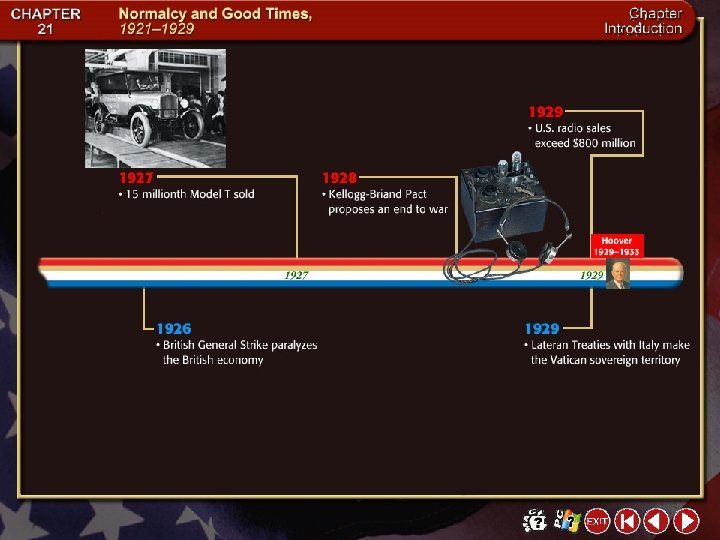
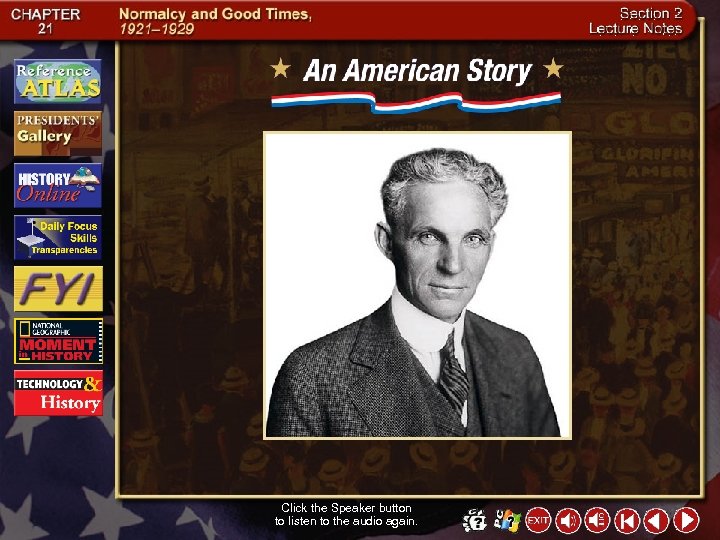
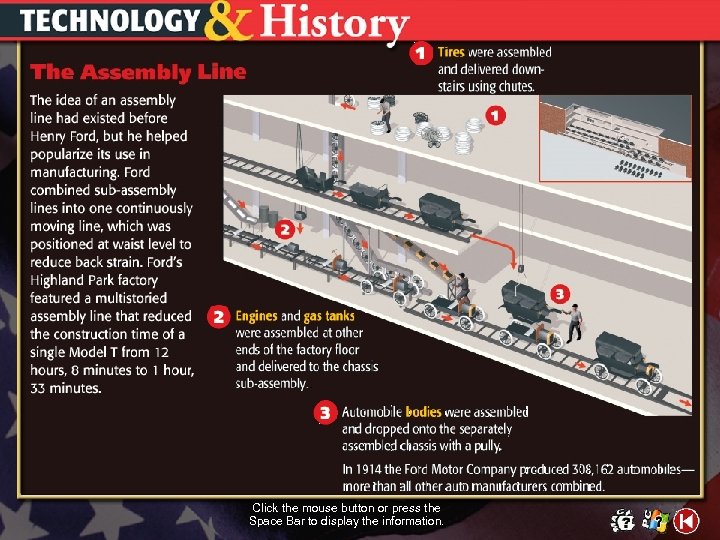
The Rise of New Industries (cont. ) • The assembly line, used by carmaker Henry Ford, greatly increased manufacturing efficiency by dividing up operations into simple tasks that unskilled workers could perform. • Ford’s assembly-line product, the Model T, sold for $850 the first year but dropped to $490 after being massproduced several years later. • By 1924 the Model T was selling for just $295. (pages 640– 644) Click the mouse button or press the Space Bar to display the information.
The Rise of New Industries (cont. ) • Ford increased workers’ wages and reduced the workday to gain workers’ loyalty and to undercut union organizers. • Henry Ford changed American life with his affordable automobiles. • Small businesses such as garages and gas stations opened. • The petroleum industry expanded tremendously. • The isolation of rural life ended. • People could live farther away from work –creating the auto commuter. (pages 640– 644) Click the mouse button or press the Space Bar to display the information.
The Rise of New Industries (cont. ) • More disposable income made innovations affordable. • From electric razors to frozen foods and household cleaning supplies to laborsaving appliances, Americans used their new income to make life easier. • By 1919 the Post Office had expanded airmail service across the continent with the help of the railroad. (pages 640– 644) Click the mouse button or press the Space Bar to display the information.
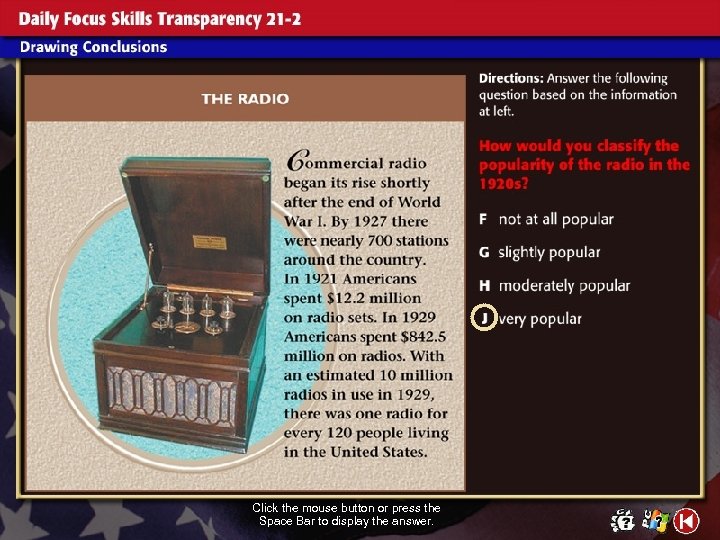
The Rise of New Industries (cont. ) • In 1927 Charles Lindbergh took a transatlantic solo flight, which gained support in the United States for the commercial flight. • By the end of 1928, 48 airlines were serving 355 American cities. • In 1926 the National Broadcasting Company (NBC) established a permanent network of radio stations to distribute daily programming. • In 1928 the Columbia Broadcasting System (CBS) set up coast-to-coast stations to compete with NBC. (pages 640– 644) Click the mouse button or press the Space Bar to display the information.
The Rise of New Industries (cont. ) How did mass production and the assembly line affect economic growth in the U. S. during the 1920 s? (pages 640– 644) Click the mouse button or press the Space Bar to display the answer.
The Rise of New Industries (cont. ) Mass production increased the supply of goods and decreased costs. Greater productivity led to the emergence of new industries. The assembly line greatly increased manufacturing efficiency by dividing up operations into simple tasks that unskilled workers could perform. More disposable income made innovations affordable. From electric razors to frozen foods and household cleaning supplies to labor-saving appliances, Americans used their new income to make life easier. The low prices made possible by mass production and the assembly line created great success in the auto industry and spurred the growth of other industries such as petroleum, rubber, plate glass, nickel, and lead. (pages 640– 644)
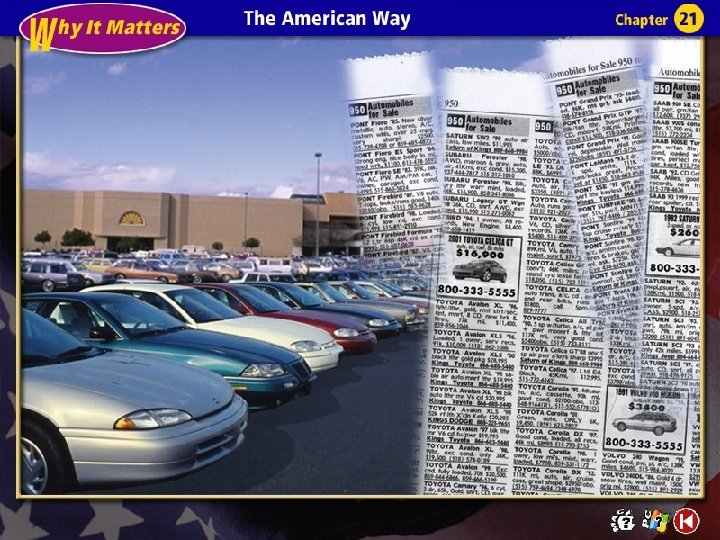
The Consumer Society • Higher wages and shorter workdays led to an economic boom as Americans traded thrift for their new role as consumers. • American attitudes about debt shifted, as they became confident that they could pay back what they owed at a later time. • Advertising was used to convince Americans that they needed new products. • Ads linked products with qualities that were popular to the modern era, such as convenience, leisure, success, fashion, and style. (pages 644– 645) Click the mouse button or press the Space Bar to display the information.
The Consumer Society (cont. ) • By the early 1920 s, many businesses hired professional managers and engineers. • The large number of managers expanded the size of the middle class. • In the 1920 s, unions lost influence and membership. • Employers promoted an open shop, a workplace where employees were not required to join a union. (pages 644– 645) Click the mouse button or press the Space Bar to display the information.
The Consumer Society (cont. ) • Welfare capitalism, where employees were able to purchase stock, participate in profit sharing, and receive benefits, made unions seem unnecessary. (pages 644– 645)
The Consumer Society (cont. ) Why did Americans’ attitudes towards consumerism change during the 1920 s? (pages 644– 645) Click the mouse button or press the Space Bar to display the answer.
The Consumer Society (cont. ) Higher wages and shorter workdays led to an economic boom as Americans traded thrift for their new role as consumers. American attitudes about debt shifted, as they became confident that they could pay back what they owed at a later time. Advertising was used to convince Americans that they needed new products. Ads linked products with qualities that were popular to the modern era, such as convenience, leisure, success, fashion, and style. The ads promised consumers self-improvement, happiness, and self-fulfillment. (pages 644– 645)
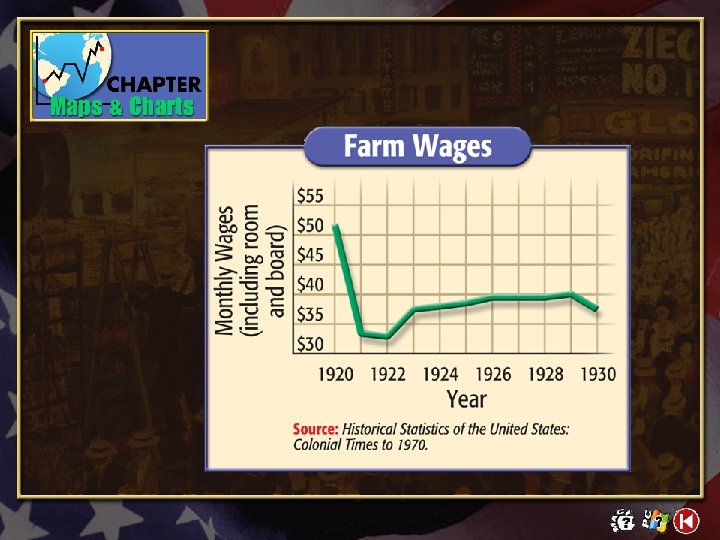
The Farm Crisis Returns • American farmers did not share in the prosperity of the 1920 s. • Instead, prices dropped dramatically while the cost to improve farmers’ technology increased. • During wartime, the government had encouraged farmers to produce more for food supplies needed in Europe. • Farmers borrowed money at inflated prices to buy new land new machinery to raise more crops. (pages 645– 646) Click the mouse button or press the Space Bar to display the information.
The Farm Crisis Returns (cont. ) • Farmers prospered during the war. • After the war, Europeans had little money to buy American farm products. • After Congress raised tariffs, farmers could no longer sell products overseas, and prices fell. • President Coolidge twice vetoed a bill to aid the farmers, fearing it would only make the situation worse. • American farmers remained in a recession throughout the 1920 s. (pages 645– 646) Click the mouse button or press the Space Bar to display the information.
The Farm Crisis Returns (cont. ) Why were farmers left out of the economic prosperity of the 1920 s? (pages 645– 646) Click the mouse button or press the Space Bar to display the answer.
The Farm Crisis Returns (cont. ) During wartime, the U. S. government had encouraged farmers to produce more for food supplies needed in Europe. Farmers borrowed money at inflated prices to buy new land new machinery to raise more crops. Farmers prospered during the war. After the war, Europeans had little money to buy American farm products. After Congress raised tariffs, farmers could no longer sell products overseas, and prices fell. The farmers had technological advances that enabled them to increase production, but because there was no increase in demand, they were forced to lower prices. (pages 645– 646)
Checking for Understanding Define Match the terms on the right with their definitions on the left. __ 1. a workplace where workers are D not required to join a union __ 2. a production system with B machines and workers arranged so that each person performs an assigned task again and again as the item passes before him or her __ 3. the production of large quantities A of goods using machinery and often an assembly line __ 4. system in which companies C enable employees to buy stock, participate in profit sharing, and receive benefits such as medical care, common in the 1920 s Click the mouse button or press the Space Bar to display the answers. A. mass production B. assembly line C. welfare capitalism D. open shop
Checking for Understanding (cont. ) Summarize the factors that led to the new consumer society in the United States during the 1920 s. Mass production, easy credit, mass advertisement, and economic prosperity led to the new consumer society. Click the mouse button or press the Space Bar to display the answer.
Reviewing Themes Science and Technology How did the automobile impact American society? The automobile eased rural isolation and allowed workers to live farther away from work. Click the mouse button or press the Space Bar to display the answer.
Critical Thinking Identifying Cause and Effect How did the United States government help spur the growth of the airline industry? Governmental airmail service and funds for airports helped spur the airline industry. Click the mouse button or press the Space Bar to display the answer.
Analyzing Visuals Analyzing Advertisements Examine the advertisement on page 644 of your textbook. How did the growing consumer culture impact the nation’s economy? The growing consumer culture raised the standard of living and encouraged Americans to buy new goods. Click the mouse button or press the Space Bar to display the answer.
Close Explain the growing economic crisis in farming.
Guide to Reading Main Idea Economic policies of the United States government encouraged the prosperity of the 1920 s. Key Terms and Names • supply-side economics • cooperative individualism • isolationism • Charles Evans Hughes • moratorium • Kellogg-Briand Pact • Charles G. Dawes Click the mouse button or press the Space Bar to display the information.
Guide to Reading (cont. ) Reading Strategy Organizing As you read about government policies in the 1920 s, complete a graphic organizer similar to the on page 647 of your textbook by filling in ways the government attempted to stimulate economic growth and prosperity. Reading Objectives • Explain Andrew Mellon’s economic strategies for maintaining prosperity. • Describe how the United States remained involved in world affairs without joining the League of Nations. Click the mouse button or press the Space Bar to display the information.
Guide to Reading (cont. ) Section Theme Economic Factors After World War I, the United States had to pay down a large amount of war debt while maintaining economic growth.
Click the Speaker button to listen to the audio again.
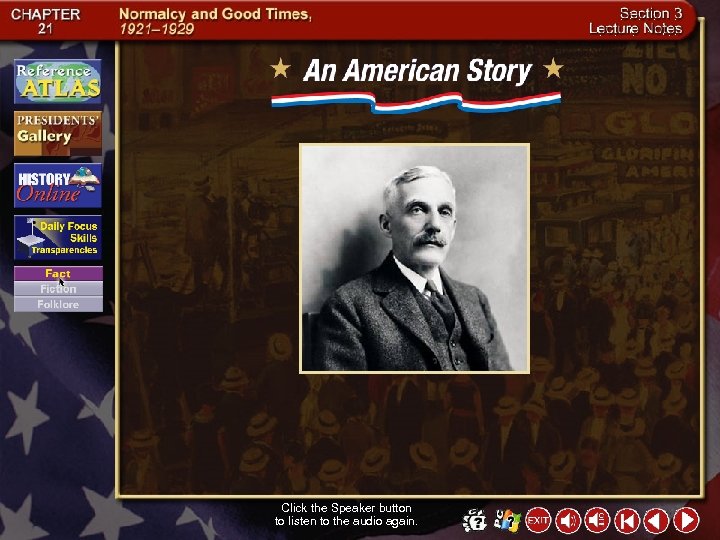
Promoting Prosperity • Andrew Mellon, named secretary of treasury by President Harding, reduced government spending and cut the federal budget. • The federal debt was reduced by $7 billion between 1921 and 1929. • Secretary Mellon applied the idea of supply-side economics to reduce taxes. • This idea suggested that lower taxes would allow businesses and consumers to spend and invest their extra money, resulting in economic growth. (pages 647– 648) Click the mouse button or press the Space Bar to display the information.
Promoting Prosperity (cont. ) • In the end, the government would collect more taxes at a lower rate. • Secretary of Commerce Herbert Hoover attempted to balance government regulation with cooperative individualism. • Manufacturers and distributors were asked to form their own trade associations and share information with the federal government’s Bureau of Standards. • Hoover felt this would reduce waste and costs and lead to economic stability. (pages 647– 648) Click the mouse button or press the Space Bar to display the information.
Promoting Prosperity (cont. ) How did the Harding administration encourage economic growth in the United States? (pages 647– 648) Click the mouse button or press the Space Bar to display the answer.
Promoting Prosperity (cont. ) Secretary of the Treasury Andrew Mellon refinanced the national debt to lower the interest on it and persuaded the Federal Reserve to lower interest rates as well. Mellon reduced government spending and cut the federal budget. Mellon applied the idea of supply-side economics to reduce taxes. This idea suggested that lower taxes would allow businesses and consumers to spend and invest their extra money, resulting in economic growth. In the end, the government would collect more taxes at a lower rate. Secretary of Commerce Herbert Hoover attempted to balance government regulation with cooperative individualism. Manufacturers and distributors were asked to form their own trade associations and share information with the federal government’s Bureau of Standards. Hoover felt this would reduce waste and costs and lead to economic stability. (pages 647– 648)
Trade and Arms Control • By the 1920 s, the United States was the dominant economic power in the world. • Allies owed the U. S. billions of dollars in war debts. • Also, the U. S. national income was far greater than that of Britain, Germany, France, and Japan combined. • Many Americans favored isolationism rather than involvement in international politics and issues. (pages 648– 650) Click the mouse button or press the Space Bar to display the information.
Trade and Arms Control (cont. ) • Americans wanted to be left alone to pursue prosperity. • The United States, however, was too powerful and interconnected in international affairs to remain isolated. • Other countries felt the United States should help with the war’s financial debt. • The United States government disagreed, arguing that the Allies had gained new territory and received reparations, or huge cash payments that Germany paid as punishment for starting the war. (pages 648– 650) Click the mouse button or press the Space Bar to display the information.
Trade and Arms Control (cont. ) • Reparations crippled the German economy. • As a result, Charles G. Dawes, an American diplomat and banker, negotiated an agreement–the Dawes Plan–with France, Britain, and Germany by which American banks would make loans to Germany so they could meet their reparation payments. • France and Britain agreed to accept less reparations and pay more on their war debts. (pages 648– 650) Click the mouse button or press the Space Bar to display the information.
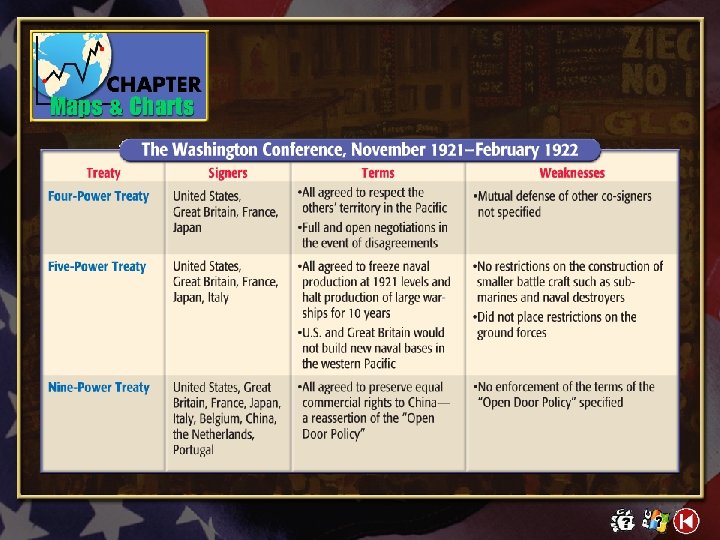
Trade and Arms Control (cont. ) • The Washington Conference held in 1921 invited countries to discuss the ongoing post-war naval arms race. • Secretary of State Charles Evans Hughes proposed a 10 -year moratorium, or pause, on the construction of major new warships. • The conference did nothing to limit land forces. • Japan was angry that the conference required Japan to keep a smaller navy than the United States and Great Britain. (pages 648– 650) Click the mouse button or press the Space Bar to display the information.
Trade and Arms Control (cont. ) • The Kellogg-Briand Pact was a treaty that outlawed war. • By signing the treaty, countries agreed to stop war and settle all disputes in a peaceful way. • On August 27, 1928, the United States and 14 other nations signed it, and eventually 62 nations ratified it. • The treaty had no binding force, but it was hailed as a victory. (pages 648– 650) Click the mouse button or press the Space Bar to display the information.
Trade and Arms Control (cont. ) How did the Dawes Plan affect Europe’s economic problems? The plan did little to help. Britain, France, and Germany tried to pay what they owed while going deeper in debt to American banks and corporations. (pages 648– 650) Click the mouse button or press the Space Bar to display the answer.
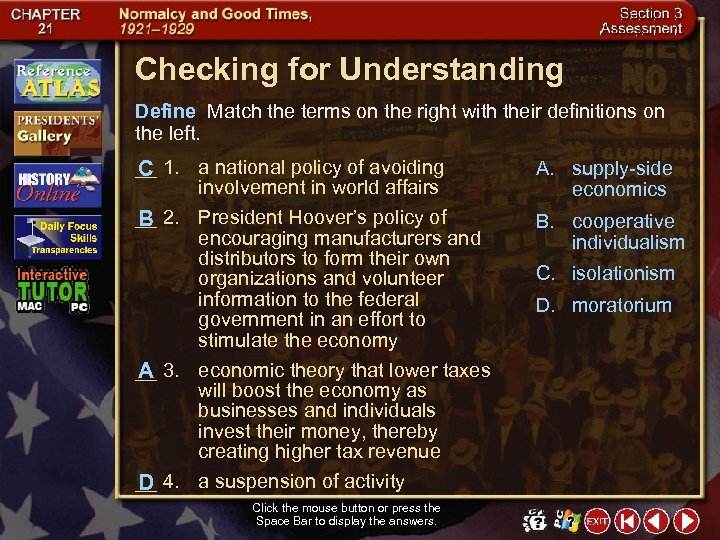
Checking for Understanding Define Match the terms on the right with their definitions on the left. __ 1. a national policy of avoiding C involvement in world affairs A. supply-side economics __ 2. President Hoover’s policy of B encouraging manufacturers and distributors to form their own organizations and volunteer information to the federal government in an effort to stimulate the economy B. cooperative individualism __ 3. economic theory that lower taxes A will boost the economy as businesses and individuals invest their money, thereby creating higher tax revenue __ 4. a suspension of activity D Click the mouse button or press the Space Bar to display the answers. C. isolationism D. moratorium
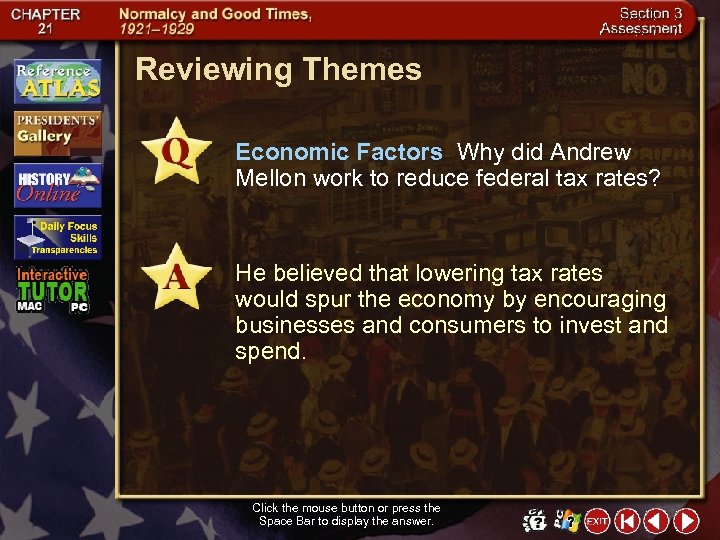
Reviewing Themes Economic Factors Why did Andrew Mellon work to reduce federal tax rates? He believed that lowering tax rates would spur the economy by encouraging businesses and consumers to invest and spend. Click the mouse button or press the Space Bar to display the answer.
Critical Thinking Evaluating What efforts did the United States make to promote permanent peace and worldwide economic recovery? Were these efforts successful? Explain your answer. Answers will vary. Click the mouse button or press the Space Bar to display the answer.
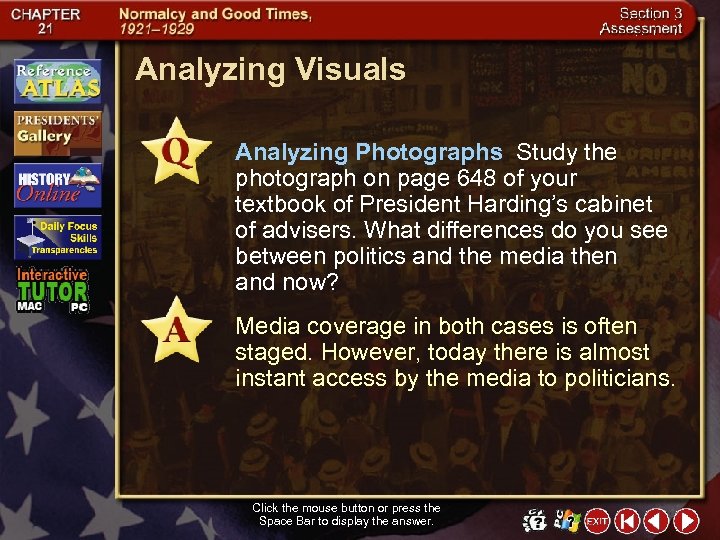
Analyzing Visuals Analyzing Photographs Study the photograph on page 648 of your textbook of President Harding’s cabinet of advisers. What differences do you see between politics and the media then and now? Media coverage in both cases is often staged. However, today there is almost instant access by the media to politicians. Click the mouse button or press the Space Bar to display the answer.
Close Explain how the United States remained involved in world affairs without being a League of Nations member.
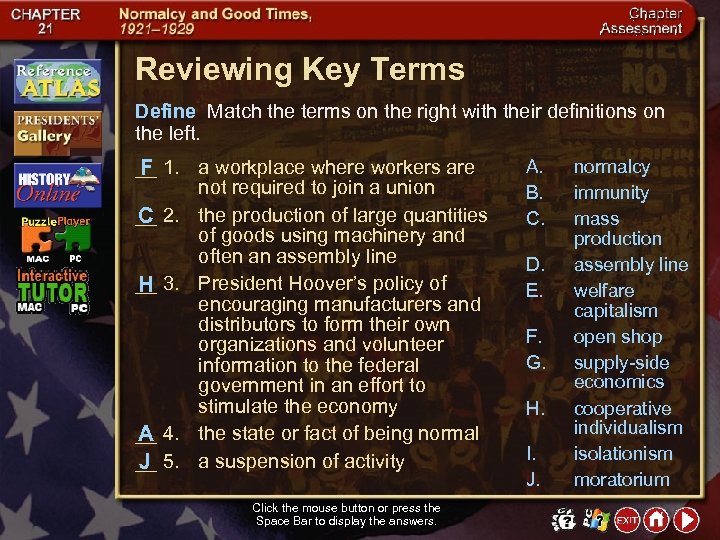
Reviewing Key Terms Define Match the terms on the right with their definitions on the left. __ 1. a workplace where workers are F not required to join a union __ 2. the production of large quantities C of goods using machinery and often an assembly line __ 3. President Hoover’s policy of H encouraging manufacturers and distributors to form their own organizations and volunteer information to the federal government in an effort to stimulate the economy __ 4. the state or fact of being normal A __ 5. a suspension of activity J Click the mouse button or press the Space Bar to display the answers. A. B. C. D. E. F. G. H. I. J. normalcy immunity mass production assembly line welfare capitalism open shop supply-side economics cooperative individualism isolationism moratorium
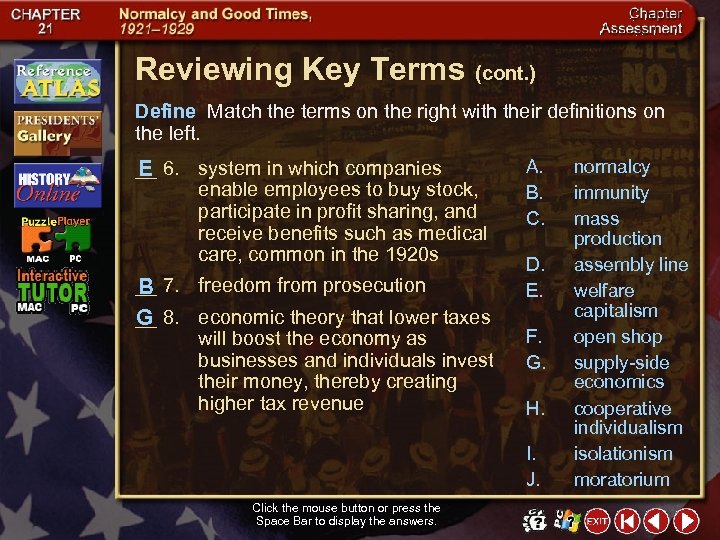
Reviewing Key Terms (cont. ) Define Match the terms on the right with their definitions on the left. __ 6. system in which companies E enable employees to buy stock, participate in profit sharing, and receive benefits such as medical care, common in the 1920 s __ 7. freedom from prosecution B __ 8. economic theory that lower taxes G will boost the economy as businesses and individuals invest their money, thereby creating higher tax revenue A. B. C. D. E. F. G. H. I. J. Click the mouse button or press the Space Bar to display the answers. normalcy immunity mass production assembly line welfare capitalism open shop supply-side economics cooperative individualism isolationism moratorium
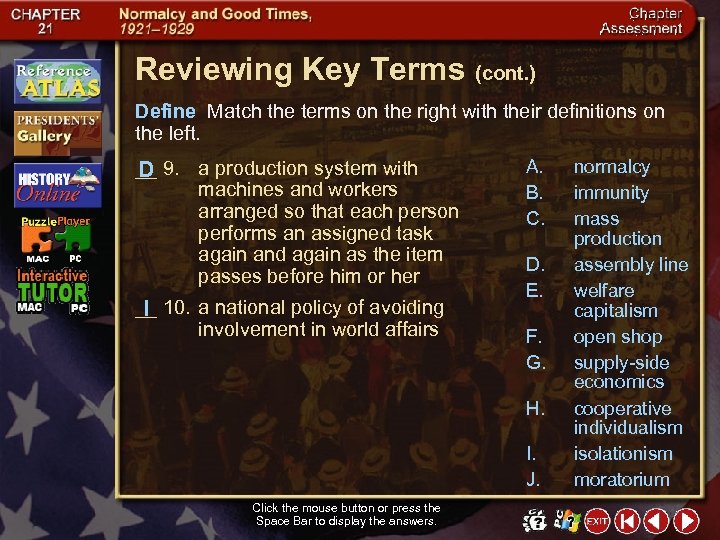
Reviewing Key Terms (cont. ) Define Match the terms on the right with their definitions on the left. __ 9. a production system with D machines and workers arranged so that each person performs an assigned task again and again as the item passes before him or her __ 10. a national policy of avoiding I involvement in world affairs A. B. C. D. E. F. G. H. I. J. Click the mouse button or press the Space Bar to display the answers. normalcy immunity mass production assembly line welfare capitalism open shop supply-side economics cooperative individualism isolationism moratorium
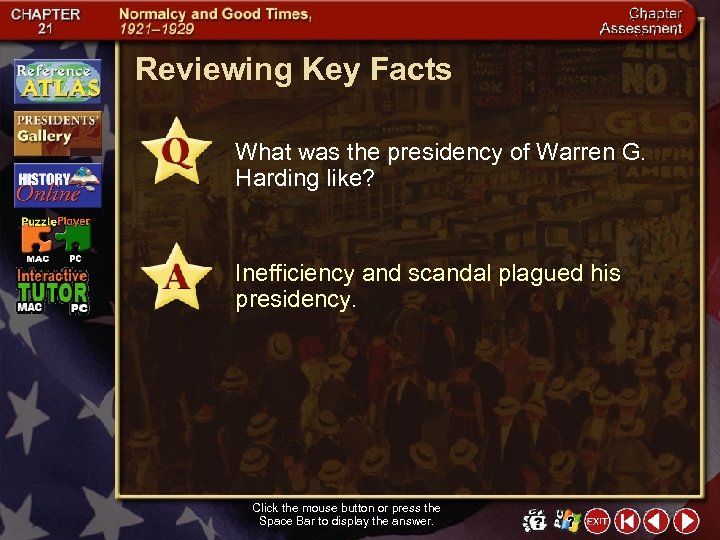
Reviewing Key Facts What was the presidency of Warren G. Harding like? Inefficiency and scandal plagued his presidency. Click the mouse button or press the Space Bar to display the answer.
Reviewing Key Facts (cont. ) How did President Coolidge restore public confidence? Coolidge distanced himself from the Harding administration and named the most capable individuals to his cabinet. Click the mouse button or press the Space Bar to display the answer.
Reviewing Key Facts (cont. ) What were four new industries, besides the automobile industry, that grew in importance during the 1920 s? Automobile-related industries such as garage and gas stations, the consumer goods, airlines, and radio industries grew in importance during the 1920 s. Click the mouse button or press the Space Bar to display the answer.
Reviewing Key Facts (cont. ) How did Henry Ford increase worker loyalty and impact the labor movement? He increased workers’ wages and reduced the workday, weakening the power of unions. Click the mouse button or press the Space Bar to display the answer.
Reviewing Key Facts (cont. ) What were Andrew Mellon’s strategies for maintaining postwar American prosperity? Mellon’s strategies were to reduce taxes, reduce the federal debt, and balance the budget. Click the mouse button or press the Space Bar to display the answer.
Critical Thinking Analyzing Themes: Culture and Traditions How did automobiles change the standard of living during the 1920 s? Automobiles allowed people to travel much greater distances more quickly and allowed workers to live outside cities. Rural Americans’ sense of isolation also decreased. Successful mass production resulted in new and cheaper consumer goods. Click the mouse button or press the Space Bar to display the answer.
Critical Thinking (cont. ) Evaluating How effective were President Coolidge’s attempts to distance himself from the Harding administration? Explain your answer. Coolidge was quite successful in distancing himself from Harding. He did this by choosing effective cabinet members and associating himself with prosperity and big business. Click the mouse button or press the Space Bar to display the answer.
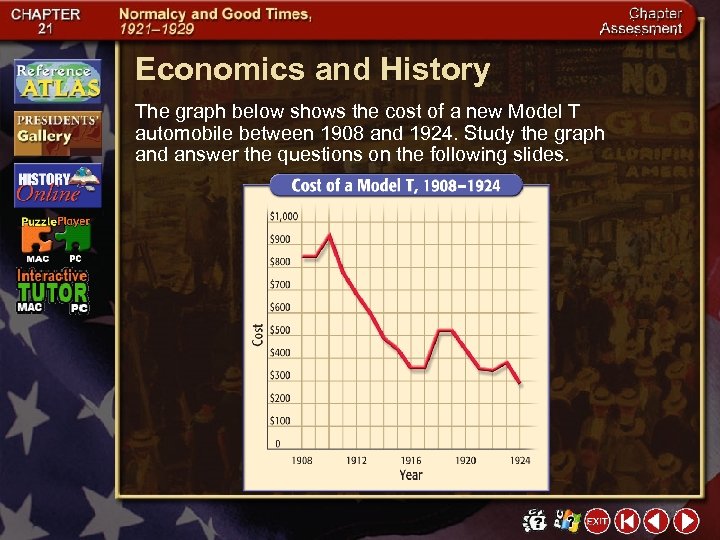
Economics and History The graph below shows the cost of a new Model T automobile between 1908 and 1924. Study the graph and answer the questions on the following slides.
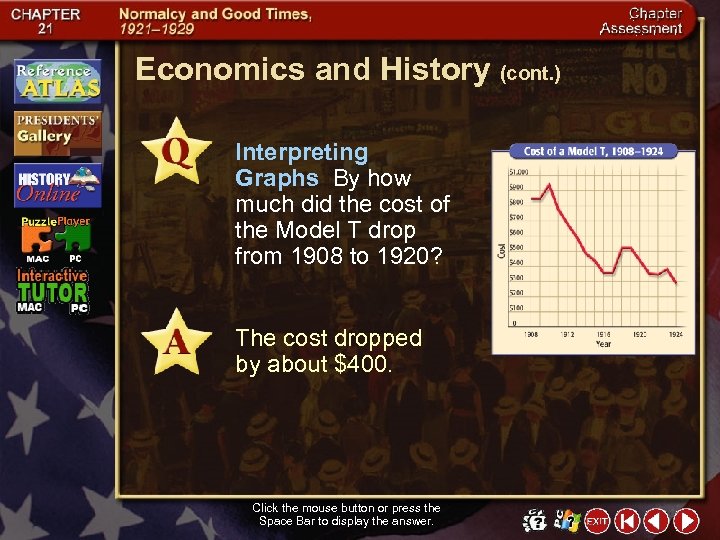
Economics and History (cont. ) Interpreting Graphs By how much did the cost of the Model T drop from 1908 to 1920? The cost dropped by about $400. Click the mouse button or press the Space Bar to display the answer.
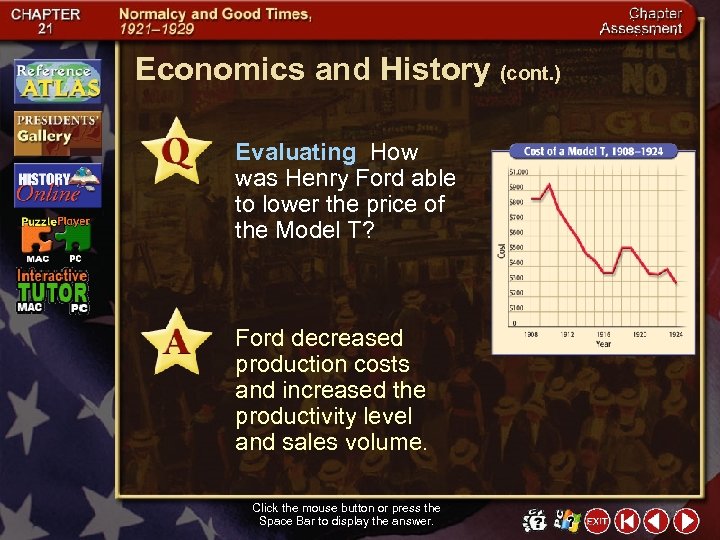
Economics and History (cont. ) Evaluating How was Henry Ford able to lower the price of the Model T? Ford decreased production costs and increased the productivity level and sales volume. Click the mouse button or press the Space Bar to display the answer.
Directions: Choose the best answer to the following question. One of the effects of World War I on the American economy was A a sharp rise in unemployment. B stronger government control over industry. C a sharp decrease in taxes. D the abolition of labor unions, which were seen as unpatriotic. Test-Taking Tip This question is asking for a cause-and-effect relationship. Look for an answer that can be directly related to the needs of a wartime economy. During the war, it was necessary to produce supplies and munitions for the armed forces (which also needed more personnel), so answer A must be incorrect. In fact, there were more jobs and fewer workers to fill them, so unemployment is not a logical choice. Click the mouse button or press the Space Bar to display the answer.
Explore online information about the topics introduced in this chapter. Click on the Connect button to launch your browser and go to The American Vision Web site. At this site, you will find interactive activities, current events information, and Web sites correlated with the chapters and units in the textbook. When you finish exploring, exit the browser program to return to this presentation. If you experience difficulty connecting to the Web site, manually launch your Web browser and go to http: //tav. glencoe. com
Cartoon Symbols Political cartoonists routinely use symbols to get their message across. Two of the most enduring have been the donkey, representing the Democrats, and the elephant, representing the Republicans (also known as the GOP, or the Grand Old Party). On November 7, 1874, cartoonist Thomas Nast became the first to use the symbols in a cartoon that appeared in Harper’s Weekly. The news media popularized the elephant and donkey symbols in election coverage.
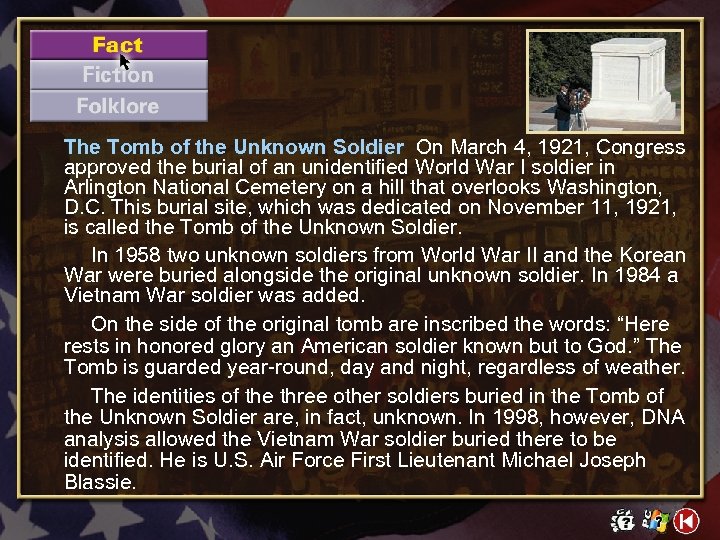
The Tomb of the Unknown Soldier On March 4, 1921, Congress approved the burial of an unidentified World War I soldier in Arlington National Cemetery on a hill that overlooks Washington, D. C. This burial site, which was dedicated on November 11, 1921, is called the Tomb of the Unknown Soldier. In 1958 two unknown soldiers from World War II and the Korean War were buried alongside the original unknown soldier. In 1984 a Vietnam War soldier was added. On the side of the original tomb are inscribed the words: “Here rests in honored glory an American soldier known but to God. ” The Tomb is guarded year-round, day and night, regardless of weather. The identities of the three other soldiers buried in the Tomb of the Unknown Soldier are, in fact, unknown. In 1998, however, DNA analysis allowed the Vietnam War soldier buried there to be identified. He is U. S. Air Force First Lieutenant Michael Joseph Blassie.
Airmail Charles Lindbergh Click on a hyperlink to view the corresponding slide.
As the automotive industry expanded, another technology was spreading its wings. Airmail was common in the early 1920 s, although the beginnings of this service were not so auspicious. Started in 1918, the service connected New York City, Philadelphia, and Washington, D. C. One day President Wilson dropped in to observe and he saw the plane bound for Philadelphia repeatedly fail to take off. After someone remembered to fill it with fuel, the pilot took off in the wrong direction and crashlanded in a field. The mail was sent by rail.
Born in 1902, Charles Lindbergh grew up in Minnesota. After two years at the University of Wisconsin, he started flying as a stunt pilot. Lindbergh completed flight training to become an Army Air Service Reserve pilot. Later he flew mail between Chicago and St. Louis. An offer of $25, 000 to become the first pilot to fly nonstop from New York to Paris inspired Lindbergh’s famous flight.
Click the Speaker button to listen to the audio again.
Distinguishing Fact From Opinion Imagine that you are watching two candidates for president debate the merits of the college loan program. One candidate says, “In my view, the college loan program must be reformed. Sixty percent of students do not repay their loans on time. ” The other candidate responds, “College costs are skyrocketing, but only 30 percent of students default on their loans for more than one year. I believe we should spend more money on this worthy program. ” How can you tell who or what to believe? First, you must learn to distinguish a fact from an opinion. Then you will be better prepared to evaluate the statements that other people make. Click the Speaker button to listen to the audio again.
Distinguishing Fact From Opinion Learning the Skill A fact is a statement that can be proven. In the example above, the statement, “Sixty percent of students do not repay their loans on time” may be a fact. By reviewing statistics on the number of student loan recipients who repay their loans, we can determine whether the statement is true or false. To identify potential facts, look for words and phrases indicating specific people, places, events, dates, amounts, or times.
Distinguishing Fact From Opinion Learning the Skill (cont. ) An opinion, on the other hand, expresses a personal belief, viewpoint, or emotion. Because opinions are subjective, we cannot prove or disprove them. In the example above, most statements by the candidates are opinions. To identify opinions, look for qualifying words and phrases such as I think, I believe, probably, seems to me, may, might, could, ought, should, in my judgment, and in my view. Also, look for expressions of approval or disapproval such as good, bad, poor, and satisfactory. Be aware of superlatives such as greatest, worst, finest, and best, and notice words with negative meanings and implications such as squander, contemptible, and disgrace. Also, identify generalizations such as none, every, always, and never.
Distinguishing Fact From Opinion Practicing the Skill For each pair of statements on the following slides, determine which is a fact and which is an opinion. Give a reason for each of your choices.
Distinguishing Fact From Opinion Practicing the Skill (cont. ) 1. a. President Harding was born in Ohio in 1865. This is a fact because it can be proven. b. Harding later became the most scandalous president in United States history. This is an opinion because it expresses a viewpoint and includes the word most. Click the mouse button or press the Space Bar to display the answer.
Distinguishing Fact From Opinion Practicing the Skill (cont. ) 2. a. Harding’s administration suffered numerous public scandals, including the Teapot Dome scandal. This is a fact because it can be proven. b. Calvin Coolidge was probably disgusted with Harding’s poor performance in the White House. This is an opinion because it includes the word probably. Click the mouse button or press the Space Bar to display the answer.
Distinguishing Fact From Opinion Practicing the Skill (cont. ) 3. a. Harding stated that the United States needed a return to normalcy, but he did not do anything to help the country. This is an opinion because it expresses a viewpoint. b. Coolidge took over the White House after Harding’s death and led the nation for the next several years. This is a fact because it can be proven. Click the mouse button or press the Space Bar to display the answer.
Distinguishing Fact From Opinion Practicing the Skill (cont. ) 4. a. Henry Ford significantly lowered the price of the automobile with his mass production methods. This is a fact because it can be proven. b. Ford’s Model T was the most significant invention of the 20 th century. This is an opinion because it expresses a point of view and includes the phrase most significant. Click the mouse button or press the Space Bar to display the answer.
Tuning in to Radio in the 1920 s Objectives After viewing “Tuning in to Radio in the 1920 s, ” you should: • Understand the impact that radio had on American life. • Know that anyone with some talent could perform on radio in the early days. • Consider differences between early radio and radio today. Click in the small window above to show a preview of The American Vision video. Click the mouse button or press the Space Bar to display the information.
Tuning in to Radio in the 1920 s Discussion Questions Before radio, what did people do when they wanted music in their homes? They played the piano or listened to phonograph records. Click the mouse button or press the Space Bar to display the answer.
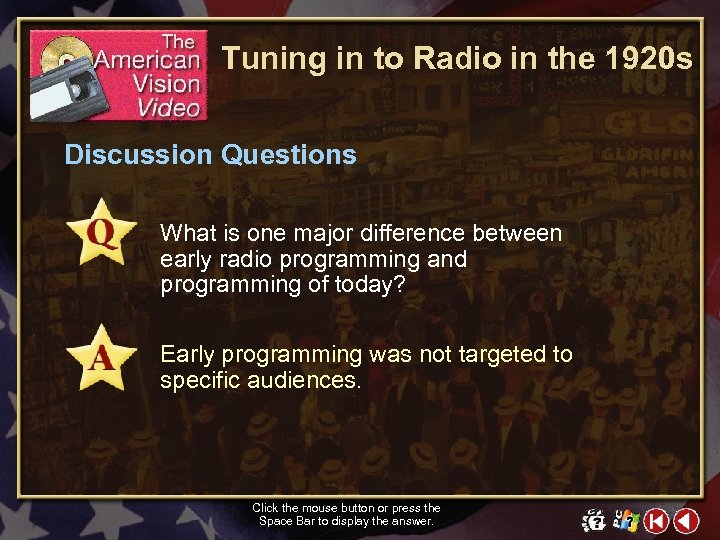
Tuning in to Radio in the 1920 s Discussion Questions What is one major difference between early radio programming and programming of today? Early programming was not targeted to specific audiences. Click the mouse button or press the Space Bar to display the answer.
Click the mouse button or press the Space Bar to display the information.
Click the mouse button or press the Space Bar to display the answer.
Click the mouse button or press the Space Bar to display the answer.
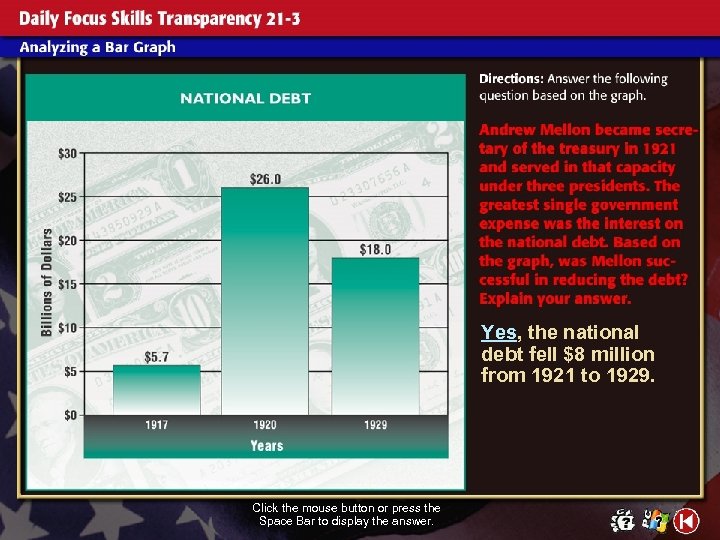
Yes, the national debt fell $8 million from 1921 to 1929. Click the mouse button or press the Space Bar to display the answer.

End of Custom Shows WARNING! Do Not Remove This slide is intentionally blank and is set to auto-advance to end custom shows and return to the main presentation.
 Скачать презентацию Presentation Plus The American Vision Copyright by
94608d7ca08975a5f46246f1561099f1.ppt