 Скачать презентацию Presentation Plus The American Republic Since 1877 Copyright
329832c1267a399a61ded121bb0d3204.ppt
- Количество слайдов: 154




Presentation Plus! The American Republic Since 1877 Copyright © by The Mc. Graw-Hill Companies, Inc. Developed by FSCreations, Inc. , Cincinnati, Ohio 45202 Send all inquiries to: GLENCOE DIVISION Glencoe/Mc. Graw-Hill 8787 Orion Place Columbus, Ohio 43240
Chapter Introduction Section 1 The Movement Begins Section 2 Challenging Segregation Section 3 New Issues Chapter Summary Chapter Assessment Click on a hyperlink to view the corresponding slides.
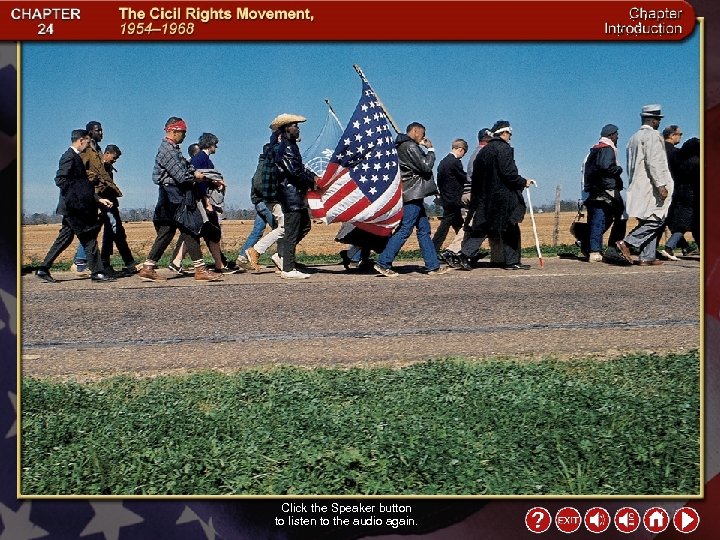
Click the Speaker button to listen to the audio again.
Chapter Objectives Section 1: The Movement Begins • Explain the origin of the Southern Christian Leadership Conference. • Discuss the changing role of the federal government in civil rights enforcement. Click the mouse button or press the Space Bar to display the information.
Chapter Objectives Section 2: Challenging Segregation • Evaluate the Civil Rights Act of 1964. • Summarize the efforts to establish voting rights for African Americans. Click the mouse button or press the Space Bar to display the information.
Chapter Objectives Section 3: New Issues • Describe the division between Dr. Martin Luther King, Jr. , and the black power movement. • Discuss the direction and progress of the civil rights movement after 1968. Click the mouse button or press the Space Bar to display the information.
Why It Matters In the 1950 s and 1960 s, African Americans made major strides. They began by challenging segregation in the South. With the Montgomery bus boycott, Martin Luther King, Jr. , achieved national and worldwide recognition. His peaceful resistance inspired many, especially students. After King’s assassination, the civil rights movement shifted focus. Many people in the movement began to see economic opportunity as the key to equality.
The Impact Today Changes brought about by the civil rights movement are still with us. • Civil rights legislation provides protection against discrimination for all citizens. • Economic programs for inner-city residents by government and social service agencies continue. Click the mouse button or press the Space Bar to display the information.
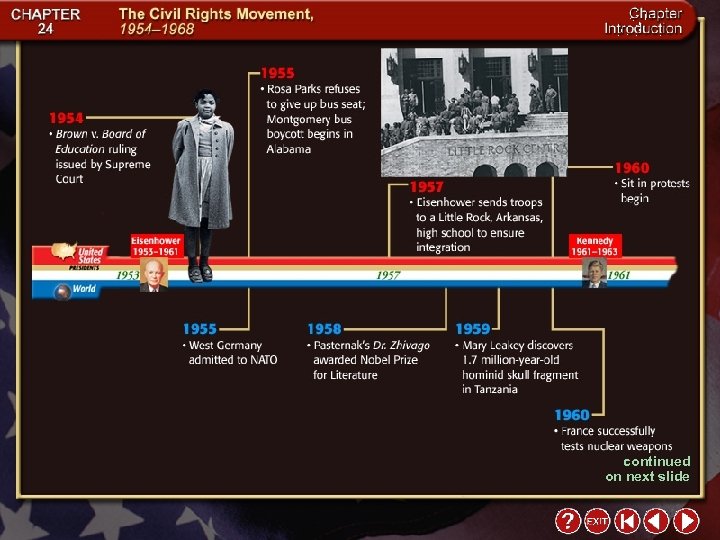
continued on next slide
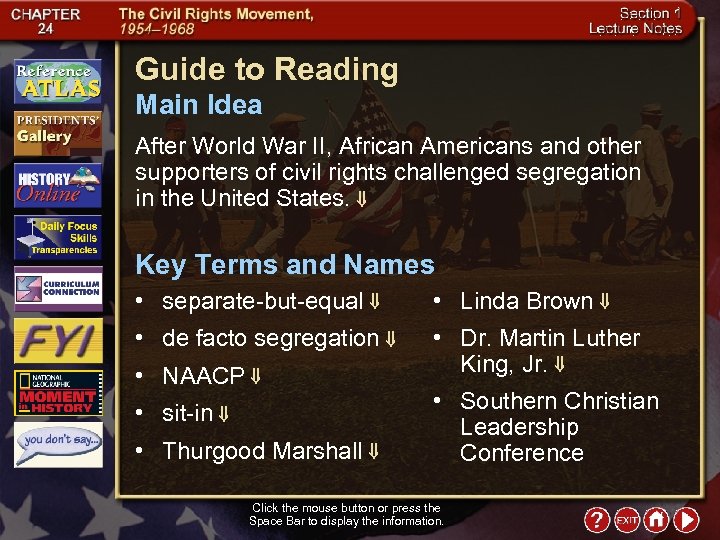
Guide to Reading Main Idea After World War II, African Americans and other supporters of civil rights challenged segregation in the United States. Key Terms and Names • separate-but-equal • Linda Brown • de facto segregation • Dr. Martin Luther King, Jr. • NAACP • sit-in • Thurgood Marshall • Southern Christian Leadership Conference Click the mouse button or press the Space Bar to display the information.
Guide to Reading (cont. ) Reading Strategy Organizing As you read about the birth of the civil rights movement, complete a graphic organizer similar to the on page 746 of your textbook by filling in the causes of the civil rights movement. Reading Objectives • Explain the origin of the Southern Christian Leadership Conference. • Discuss the changing role of the federal government in civil rights enforcement. Click the mouse button or press the Space Bar to display the information.
Guide to Reading (cont. ) Section Theme Government and Democracy In the 1950 s, African Americans began a movement to win greater social equality.
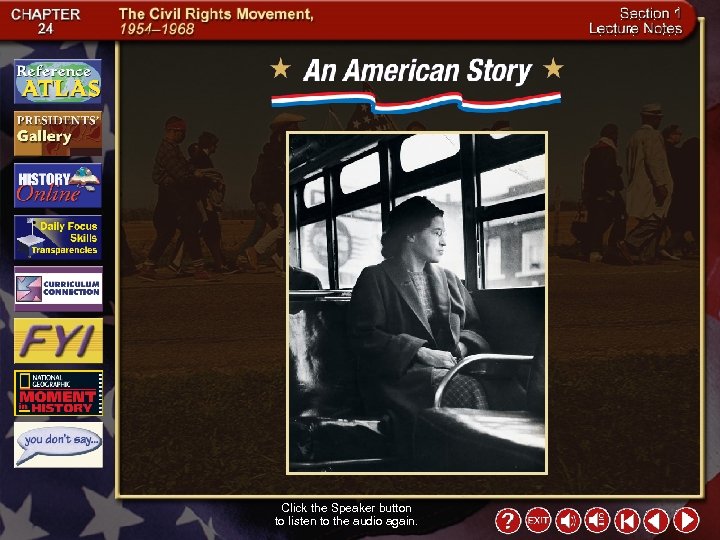
Click the Speaker button to listen to the audio again.
The Origins of the Movement • The African American civil rights movement began after Rosa Parks refused to give up her seat on a bus to a white man. • An organized boycott of the bus system was just the beginning as African Americans demanded equal rights. (pages 746– 748) Click the mouse button or press the Space Bar to display the information.
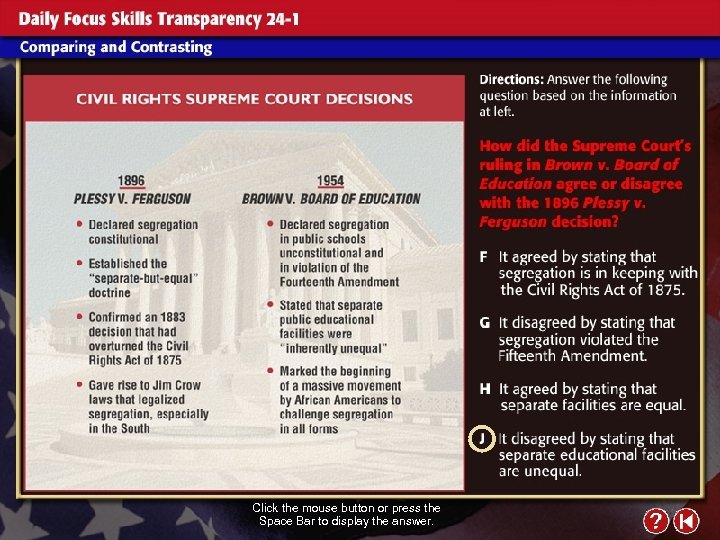
The Origins of the Movement (cont. ) • In 1896 the Supreme Court had declared segregation legal in Plessy v. Ferguson. • This ruling had established a separatebut-equal doctrine, making laws segregating African Americans legal as long as equal facilities were provided. • “Jim Crow” laws segregating African Americans and whites were common in the South after the Plessy v. Ferguson decision. (pages 746– 748) Click the mouse button or press the Space Bar to display the information.
The Origins of the Movement (cont. ) • In places without segregation laws, such as in the North, there was de facto segregation–segregation by custom and tradition. • The National Association for the Advancement of Colored People (NAACP) had supported court cases trying to overturn segregation since 1909. • It provided financial support and lawyers to African Americans. (pages 746– 748) Click the mouse button or press the Space Bar to display the information.
The Origins of the Movement (cont. ) • African Americans gained political power as they migrated to Northern cities where they could vote. • African Americans voted for politicians who listened to their concerns on civil rights issues, resulting in a strong Democratic Party. • In Chicago in 1942, the Congress of Racial Equality (CORE) was founded. • CORE used sit-ins as a form of protest against segregation and discrimination. (pages 746– 748) Click the mouse button or press the Space Bar to display the information.
The Origins of the Movement (cont. ) • In 1943 CORE used sit-ins to protest segregation in restaurants. • These sit-ins resulted in the integration of many restaurants, theaters, and other public facilities in Chicago, Detroit, Denver, and Syracuse. (pages 746– 748) Click the mouse button or press the Space Bar to display the information.
The Origins of the Movement (cont. ) How did the NAACP and CORE challenge the Supreme Court’s decision in Plessy v. Ferguson? (pages 746– 748) Click the mouse button or press the Space Bar to display the answer.
The Origins of the Movement (cont. ) The NAACP supported court cases intended to overturn segregation. It provided lawyers to African Americans and helped cover the costs of their cases. CORE used sit-ins as a form of protest against segregation and discrimination. In 1943 CORE used sit-ins to protest segregation in restaurants. These sit-ins resulted in the integration of many restaurants, theaters, and other public facilities in Chicago, Detroit, Denver, and Syracuse. (pages 746– 748)
The Civil Rights Movement Begins • When African Americans returned from World War II, they had hoped for equality. • When this did not occur, the civil rights movement began as African Americans planned protests and marches to end prejudice. • African American attorney and chief counsel for the NAACP Thurgood Marshall worked to end segregation in public schools. (pages 748– 750) Click the mouse button or press the Space Bar to display the information.
The Civil Rights Movement Begins (cont. ) • In 1954 several Supreme Court cases regarding segregation–including the case of Linda Brown–were combined in one ruling. • The girl had been denied admission to her neighborhood school in Topeka, Kansas, because she was African American. • In the Supreme Court case Brown v. Board of Education of Topeka, Kansas, the Court ruled that segregation in public schools was unconstitutional and violated the equal protection clause of the Fourteenth Amendment. (pages 748– 750) Click the mouse button or press the Space Bar to display the information.
The Civil Rights Movement Begins (cont. ) • Brown v. Board of Education convinced African Americans to challenge all forms of segregation, but it also angered many white Southerners who supported segregation. • On the day Rosa Parks appeared in court, the Women’s Political Council led African Americans in a boycott against the Montgomery bus system. • The Montgomery Improvement Association was created to run the boycott and negotiate with city leaders to end segregation. (pages 748– 750) Click the mouse button or press the Space Bar to display the information.
The Civil Rights Movement Begins (cont. ) • Dr. Martin Luther King, Jr. , elected to head the organization, called for a nonviolent passive resistant approach to end segregation and racism. • The boycott of the bus system continued for over a year as African Americans walked or participated in carpools. • In December 1956, the United States Supreme Court declared Alabama’s laws requiring segregation on buses to be unconstitutional. (pages 748– 750) Click the mouse button or press the Space Bar to display the information.
The Civil Rights Movement Begins (cont. ) How did the Court’s decision in Brown v. Board of Education of Topeka, Kansas, affect African Americans and Southerners? The ruling convinced many African Americans that it was time to challenge other forms of segregation. The ruling enraged many Southerners, who became even more determined to defend segregation. In 1956 a group of 101 Southern members of Congress signed the “Southern Manifesto” which denounced the Supreme Court rulings and encouraged Southerners to defy the Supreme Court by not upholding the ruling to end segregation. (pages 748– 750) Click the mouse button or press the Space Bar to display the answer.
African American Churches • African American churches played a key role in the success of the boycott. • Churches became a place forums, planning meetings, and organizing volunteers for civil rights campaigns. • The Southern Christian Leadership Conference (SCLC), led by Dr. Martin Luther King, Jr. , challenged the segregation of public transportation, housing, at the voting booths, and in public accommodations. (pages 750– 751) Click the mouse button or press the Space Bar to display the information.
African American Churches (cont. ) How did African American churches and ministers help the civil rights movement? African American churches served as forums for many of the protests and planning meetings. The churches also mobilized many of the volunteers for specific civil-rights campaigns. African American ministers, led by Dr. Martin Luther King, Jr. , established the SCLC, which was set up to eliminate segregation from American society and to encourage African Americans to register to vote. (pages 750– 751) Click the mouse button or press the Space Bar to display the answer.
Eisenhower and Civil Rights • President Eisenhower became the first president since Reconstruction to send federal troops into the South to protect African Americans and their constitutional rights. • In Little Rock, Arkansas, the governor ordered the Arkansas National Guard to prevent African American students from entering the Little Rock high school. • President Eisenhower demanded that the troops be removed. (pages 751– 752) Click the mouse button or press the Space Bar to display the information.
Eisenhower and Civil Rights (cont. ) • The governor withdrew the troops but left the school to the angry mob. • Two African American reporters were beaten, and many windows of the school were broken. • Eisenhower ordered the United States Army to surround the school, and the students were escorted into the building. • The troops remained for the entire school year. (pages 751– 752) Click the mouse button or press the Space Bar to display the information.
Eisenhower and Civil Rights (cont. ) • The Civil Rights Act of 1957 was created to protect the right of African Americans to vote. • It marked an important first step in bringing the federal government into the civil rights debate. (pages 751– 752) Click the mouse button or press the Space Bar to display the information.
Eisenhower and Civil Rights (cont. ) What did the SCLC do after the Civil Rights Act of 1957 was passed? The SCLC began a campaign to register 2 million new African American voters. (pages 751– 752) Click the mouse button or press the Space Bar to display the answer.
Checking for Understanding Define Match the terms on the right with their definitions on the left. __ 1. doctrine established by the A 1896 Supreme Court case Plessy v. Ferguson that permitted laws segregating African Americans as long as equal facilities were provided __ 2. a form of protest involving C occupying seats or sitting down on the floor of an establishment __ 3. segregation by custom and B tradition Click the mouse button or press the Space Bar to display the answers. A. separate-butequal B. de facto segregation C. sit-in
Checking for Understanding (cont. ) State the outcome of the Brown v. Board of Education case. Segregation in public schools is unconstitutional. Click the mouse button or press the Space Bar to display the answer.
Reviewing Themes Government and Democracy Why did the role of the federal government in civil rights enforcement change? The role of the federal government changed because its authority and decisions were challenged by individual states. Click the mouse button or press the Space Bar to display the answer.
Critical Thinking Interpreting Do you think the civil rights movement would have been successful in gaining civil rights for African Americans without the help of the NAACP and the SCLC? Explain. The NAACP and the SCLC provided financial support, leadership, and organization to the civil rights movement. Click the mouse button or press the Space Bar to display the answer.
Analyzing Visuals Examining Photographs Study the photograph of Central High School students on page 751 of your textbook. How would you describe Elizabeth Eckford’s demeanor compared to those around her? What might this tell you about her character? Answers will vary. Click the mouse button or press the Space Bar to display the answer.
Close Discuss the changing role of the federal government in civil rights enforcement.
Guide to Reading Main Idea African American citizens and white supporters created organizations that directed protests, targeted specific inequalities, and attracted the attention of the mass media and the government. Key Terms and Names • Jesse Jackson • cloture • Ella Baker • Civil Rights Act of 1964 • Freedom Riders • filibuster • poll tax Click the mouse button or press the Space Bar to display the information.
Guide to Reading (cont. ) Reading Strategy Organizing As you read about challenges to segregation in the South, complete a cause/effect chart like the on page 753 of your textbook. Reading Objectives • Evaluate the Civil Rights Act of 1964. • Summarize the efforts to establish voting rights for African Americans. Click the mouse button or press the Space Bar to display the information.
Guide to Reading (cont. ) Section Theme Science and Technology The civil rights movement gained momentum in the early 1960 s due to national television coverage.
Click the Speaker button to listen to the audio again.
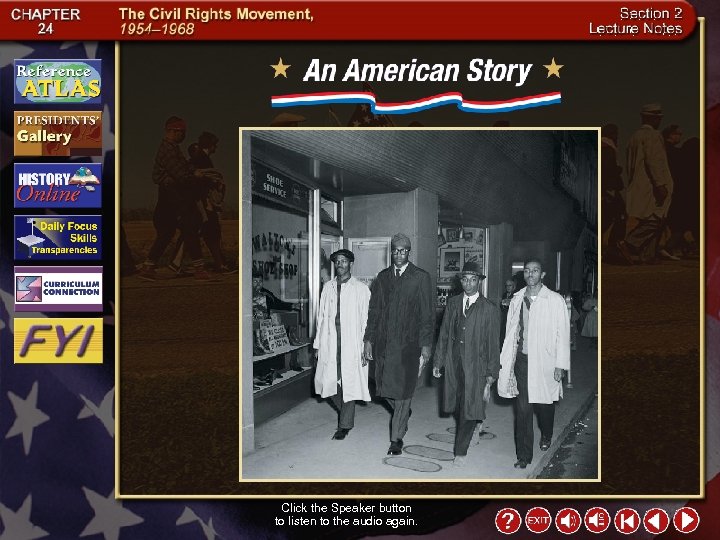
The Sit-In Movement • In 1960 four African Americans staged a sit-in at a Woolworth’s whites-only lunch counter. • This led to a mass movement for civil rights. • Soon sit-ins were occurring across the nation. • Students like Jesse Jackson from North Carolina Agricultural and Technical College felt that sit-ins gave them the power to change things. (pages 753– 754) Click the mouse button or press the Space Bar to display the answer.
The Sit-In Movement (cont. ) Why did the sit-in movement gain attention of Americans across the nation? Even after the demonstrators of the sit-ins were verbally and physically abused, they remained peaceful. (pages 753– 754) Click the mouse button or press the Space Bar to display the answer.
SNCC • As sit-ins became more popular, it was necessary to choose a leader to coordinate the effort. • Ella Baker, executive director of the SCLC, urged students to create their own organization. • The students formed the Student Nonviolent Coordinating Committee (SNCC) with Marion Barry, a student leader from Nashville, as their chairperson. (page 754) Click the mouse button or press the Space Bar to display the information.
SNCC (cont. ) • Robert Moses, an SNCC volunteer from New York, pointed out that most of the civil rights movement was focused on urban areas, and rural African Americans needed help as well. • When they went South, SNCC volunteers had their lives threatened and others were beaten. • In 1964 three SNCC workers were murdered as they tried to register African Americans to vote. (page 754) Click the mouse button or press the Space Bar to display the information.
SNCC (cont. ) • SNCC organizer Fannie Lou Hamer was arrested in Mississippi after encouraging African Americans to vote. • While in jail, she was beaten by police. • Later she helped organize the Mississippi Freedom Democratic Party. • She challenged the legality of the segregated Democratic Party at the 1964 Democratic National Convention. (page 754) Click the mouse button or press the Space Bar to display the information.
SNCC (cont. ) What was the role of the SNCC in the civil rights movement? The group led student sit-ins to desegregate public facilities in Southern communities. Members of the group went to rural areas of the Deep South to register African Americans to vote. (page 754) Click the mouse button or press the Space Bar to display the answer.
The Freedom Riders • In 1961 CORE leader James Farmer asked teams of African Americans and white Americans to travel into the South to integrate bus terminals. • The teams became known as Freedom Riders. • Violence erupted in several Alabama cities, making national news and shocking many Americans. • President John F. Kennedy was compelled to control the violence. (pages 754– 755) Click the mouse button or press the Space Bar to display the information.
The Freedom Riders (cont. ) What happened when the Freedom Riders arrived in Anniston, Birmingham, and Montgomery, Alabama? Angry mobs of white people attacked the Freedom Riders, throwing rocks and slitting the bus tires. In Birmingham, the riders were met by a gang that beat them. (pages 754– 755) Click the mouse button or press the Space Bar to display the answer.
John F. Kennedy and Civil Rights • During John F. Kennedy’s presidential campaign in 1960, he supported the civil rights movement, which resulted in African American votes that helped him narrowly win the race. • Once in office, President Kennedy became cautious on civil rights, realizing that in order to get other programs passed through Congress, he would have to avoid new civil rights legislation. (pages 755– 757) Click the mouse button or press the Space Bar to display the information.
John F. Kennedy and Civil Rights (cont. ) • President Kennedy had his brother, Robert F. Kennedy of the Justice Department, actively support the civil rights movement. • Robert Kennedy helped African Americans register to vote by having lawsuits filed throughout the South. • When violence broke out in Montgomery Alabama, the Kennedy brothers urged the Freedom Riders to stop for a “cooling off ” period. (pages 755– 757) Click the mouse button or press the Space Bar to display the information.
John F. Kennedy and Civil Rights (cont. ) • A deal was struck between Kennedy and Senator James Eastland of Mississippi. • The senator stopped the violence, and Kennedy agreed not to object if the Mississippi police arrested the Freedom Riders. • The CORE used all their funds to bail the riders out of jail, which threatened future rides. (pages 755– 757) Click the mouse button or press the Space Bar to display the information.
John F. Kennedy and Civil Rights (cont. ) • Thurgood Marshall offered the use of the NAACP’s Legal Defense Fund, and the rides began again. • President Kennedy ordered the Interstate Commerce Commission to increase regulations against segregation at bus terminals. • By 1962 segregation on interstate travel had ended. (pages 755– 757) Click the mouse button or press the Space Bar to display the information.
John F. Kennedy and Civil Rights (cont. ) • In 1962 James Meredith, an African American air force veteran, tried to register at the segregated University of Mississippi. • Meredith was met with the governor blocking his path. • President Kennedy ordered 500 federal marshals to escort Meredith to the campus. • A full-scale riot broke out with 160 marshals being wounded. (pages 755– 757) Click the mouse button or press the Space Bar to display the information.
John F. Kennedy and Civil Rights (cont. ) • The army sent in thousands of troops. • For the remainder of the year, Meredith attended classes under federal guard until he graduated the following August. • Martin Luther King, Jr. , was frustrated with the civil rights movement. • As the Cuban missile crisis escalated, foreign policy became the main priority at the White House. (pages 755– 757) Click the mouse button or press the Space Bar to display the information.
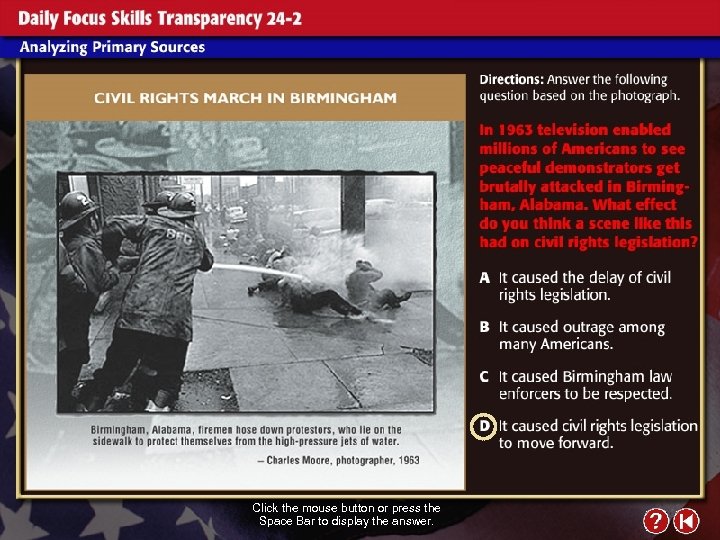
John F. Kennedy and Civil Rights (cont. ) • King agreed to hold demonstrations in Alabama, knowing they might end in violence but feeling that they were the only way to get the president’s attention. • King was jailed, and after his release the protests began again. • The televised events were seen by the nation. • Kennedy ordered his aides to prepare a civil rights bill. (pages 755– 757) Click the mouse button or press the Space Bar to display the information.
John F. Kennedy and Civil Rights (cont. ) Why did President Kennedy not take immediate action when violence erupted against the Freedom Riders? Kennedy was meeting with Soviet leader Nikita Khrushchev, and he did not want the violence in the South to make the United States seem weak and divided. (pages 755– 757) Click the mouse button or press the Space Bar to display the answer.
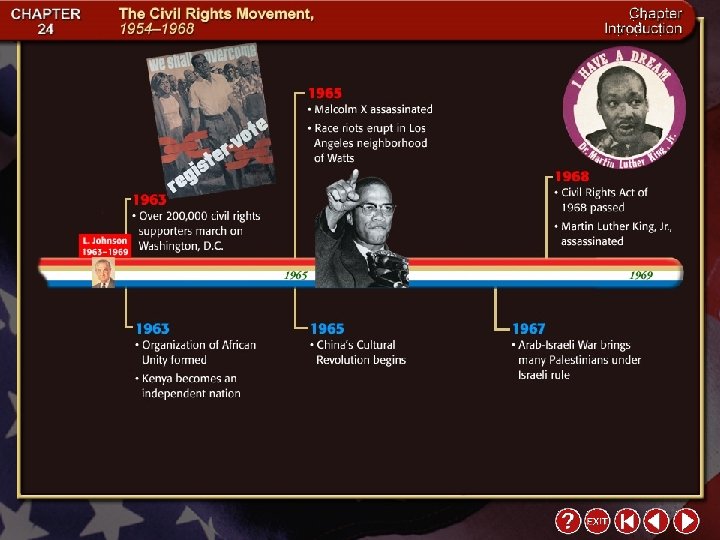
The Civil Rights Act of 1964 • After Alabama Governor George Wallace blocked the way for two African Americans to register for college, President Kennedy appeared on national television to announce his civil rights bill. • Martin Luther King, Jr. , wanted to pressure Congress to get Kennedy’s civil rights bill through. • On August 28, 1963, he led 200, 000 demonstrators of all races to the nation’s capital and staged a peaceful rally. (pages 757– 759) Click the mouse button or press the Space Bar to display the information.
The Civil Rights Act of 1964 (cont. ) • Opponents of the civil rights bill did whatever they could to slow the procedure to pass it. • The bill could easily pass in the House of Representatives, but it faced difficulty in the Senate. • Senators could speak for as long as they wanted while debating a bill. • A filibuster occurs when a small group of senators take turns speaking and refuse to stop the debate to allow the bill to be voted on. (pages 757– 759) Click the mouse button or press the Space Bar to display the information.
The Civil Rights Act of 1964 (cont. ) • Today a filibuster can be stopped if at least three-fifths of the Senate (60 senators) vote for cloture, a motion which cuts off debate and forces a vote. • In 1960 a cloture had to be two-thirds, or 67 senators. • The minority of senators opposed to the bill could easily prevent it from passing into law. • After Kennedy’s assassination, President Johnson committed himself to getting Kennedy’s program, including the civil rights bill, through Congress. (pages 757– 759) Click the mouse button or press the Space Bar to display the information.
The Civil Rights Act of 1964 (cont. ) • The Civil Rights Act of 1964 gave the federal government broad power to stop racial discrimination in the segregation in public places, to bring lawsuits to end school segregation, and to require employers to end discrimination in the workplace. (pages 757– 759)
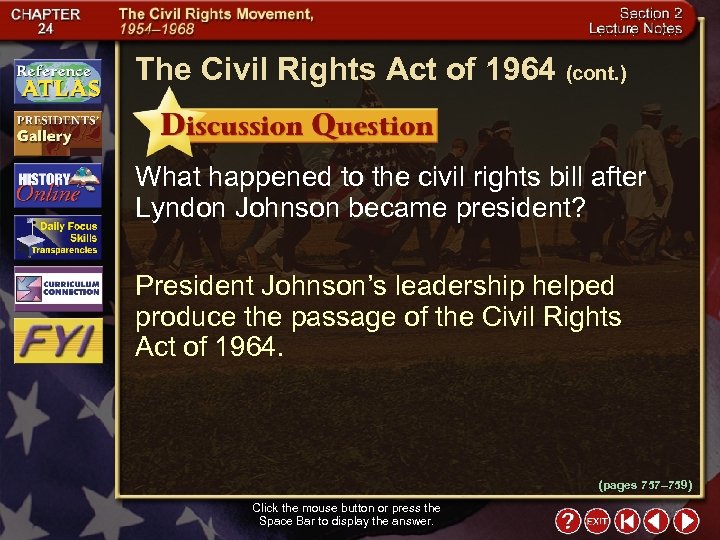
The Civil Rights Act of 1964 (cont. ) What happened to the civil rights bill after Lyndon Johnson became president? President Johnson’s leadership helped produce the passage of the Civil Rights Act of 1964. (pages 757– 759) Click the mouse button or press the Space Bar to display the answer.
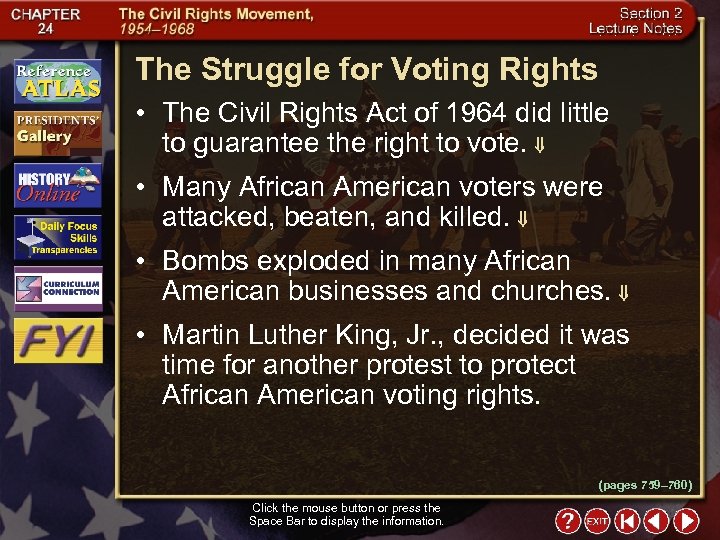
The Struggle for Voting Rights • The Civil Rights Act of 1964 did little to guarantee the right to vote. • Many African American voters were attacked, beaten, and killed. • Bombs exploded in many African American businesses and churches. • Martin Luther King, Jr. , decided it was time for another protest to protect African American voting rights. (pages 759– 760) Click the mouse button or press the Space Bar to display the information.
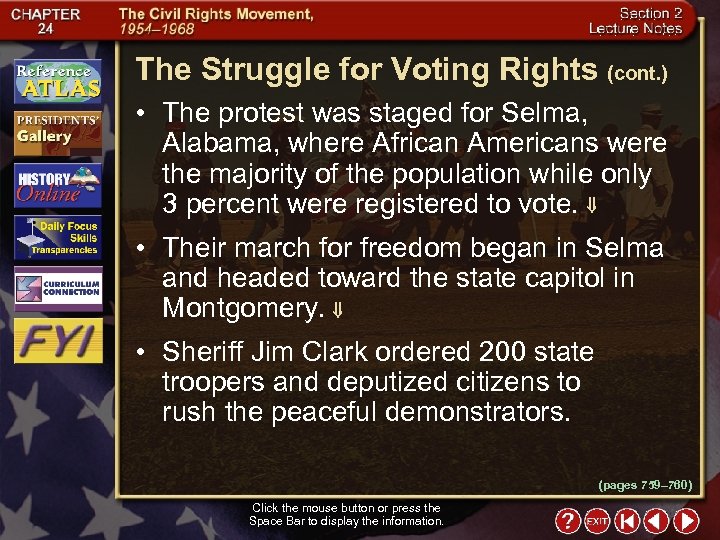
The Struggle for Voting Rights (cont. ) • The protest was staged for Selma, Alabama, where African Americans were the majority of the population while only 3 percent were registered to vote. • Their march for freedom began in Selma and headed toward the state capitol in Montgomery. • Sheriff Jim Clark ordered 200 state troopers and deputized citizens to rush the peaceful demonstrators. (pages 759– 760) Click the mouse button or press the Space Bar to display the information.
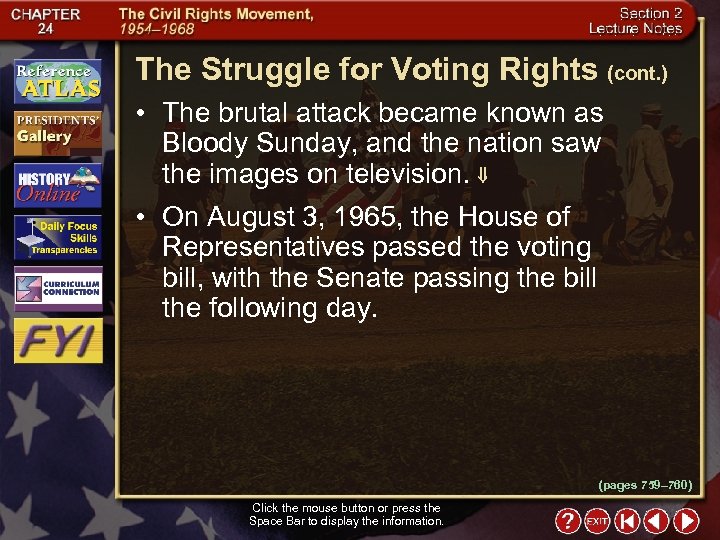
The Struggle for Voting Rights (cont. ) • The brutal attack became known as Bloody Sunday, and the nation saw the images on television. • On August 3, 1965, the House of Representatives passed the voting bill, with the Senate passing the bill the following day. (pages 759– 760) Click the mouse button or press the Space Bar to display the information.
The Struggle for Voting Rights (cont. ) • The Voting Rights Act of 1965 gave the attorney general the right to send federal examiners to register qualified voters, bypassing the local officials who often refused to register African Americans. • This resulted in 250, 000 new African American voters and an increase in African American elected officials in the South. (pages 759– 760) Click the mouse button or press the Space Bar to display the information.
The Struggle for Voting Rights (cont. ) How did the passage of the Voting Rights Act of 1965 mark a turning point in the civil rights movement? Two goals were now achieved: to outlaw segregation and to pass federal laws to stop discrimination and protect voting rights. (pages 759– 760) Click the mouse button or press the Space Bar to display the answer.
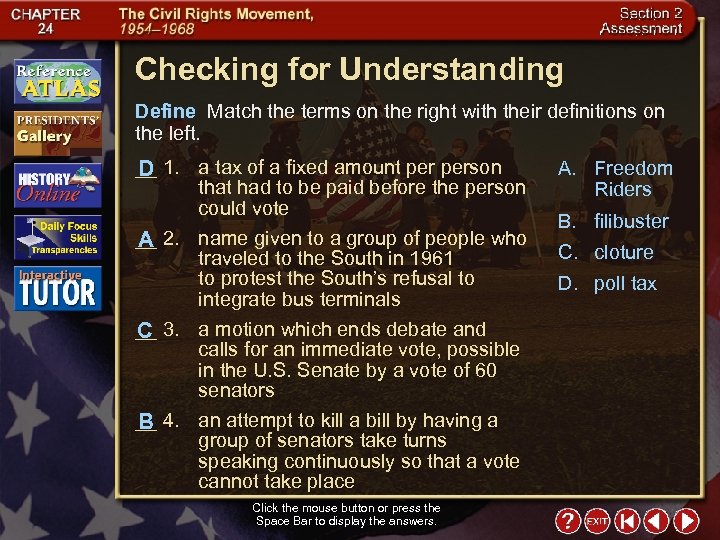
Checking for Understanding Define Match the terms on the right with their definitions on the left. __ 1. a tax of a fixed amount person D that had to be paid before the person could vote __ 2. name given to a group of people who A traveled to the South in 1961 to protest the South’s refusal to integrate bus terminals __ 3. a motion which ends debate and C calls for an immediate vote, possible in the U. S. Senate by a vote of 60 senators __ 4. an attempt to kill a bill by having a B group of senators take turns speaking continuously so that a vote cannot take place Click the mouse button or press the Space Bar to display the answers. A. Freedom Riders B. filibuster C. cloture D. poll tax
Checking for Understanding (cont. ) Describe the provisions of the Civil Rights Act of 1964 aimed at ending segregation and racial discrimination. The act gave the federal government broad powers to prevent racial discrimination in a number of areas. Click the mouse button or press the Space Bar to display the answer.
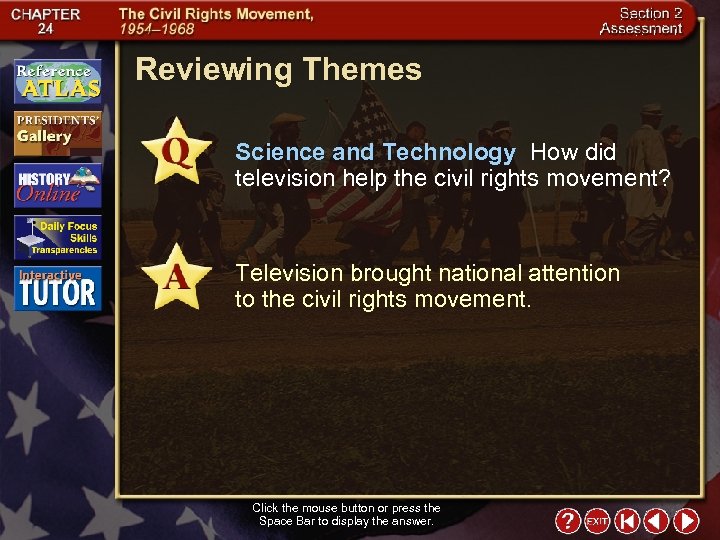
Reviewing Themes Science and Technology How did television help the civil rights movement? Television brought national attention to the civil rights movement. Click the mouse button or press the Space Bar to display the answer.
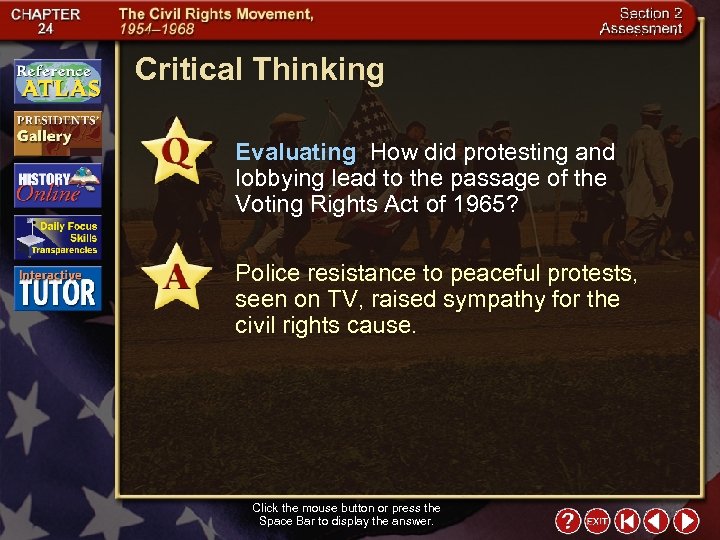
Critical Thinking Evaluating How did protesting and lobbying lead to the passage of the Voting Rights Act of 1965? Police resistance to peaceful protests, seen on TV, raised sympathy for the civil rights cause. Click the mouse button or press the Space Bar to display the answer.
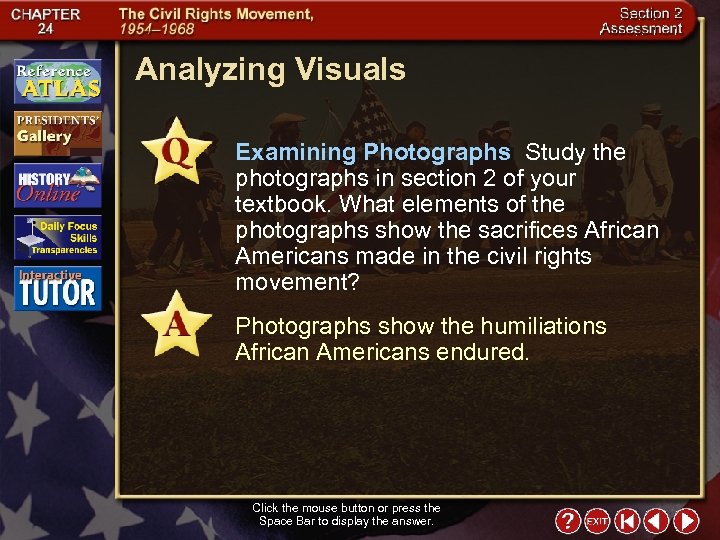
Analyzing Visuals Examining Photographs Study the photographs in section 2 of your textbook. What elements of the photographs show the sacrifices African Americans made in the civil rights movement? Photographs show the humiliations African Americans endured. Click the mouse button or press the Space Bar to display the answer.
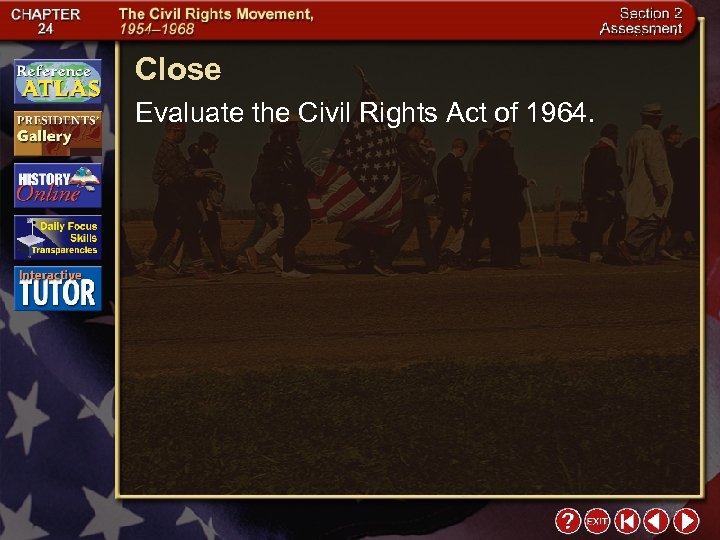
Close Evaluate the Civil Rights Act of 1964.
Guide to Reading Main Idea In the mid-1960 s, civil rights leaders began to understand that merely winning political rights for African Americans would not address the problem of African Americans’ economic status. Key Terms and Names • racism • Chicago Movement • Richard Daley • black power • Stokely Carmichael • Malcolm X • Black Panthers Click the mouse button or press the Space Bar to display the information.
Guide to Reading (cont. ) Reading Strategy Organizing As you read about the changing focus of the civil rights movement, complete a chart similar to the on page 761 of your textbook. Fill in five major violent events and their results. Reading Objectives • Describe the division between Dr. Martin Luther King, Jr. , and the black power movement. • Discuss the direction and progress of the civil rights movement after 1968. Click the mouse button or press the Space Bar to display the information.
Guide to Reading (cont. ) Section Theme Civic Rights and Responsibilities In the late 1960 s, the civil rights movement tried to address the persistent economic inequality of African Americans.
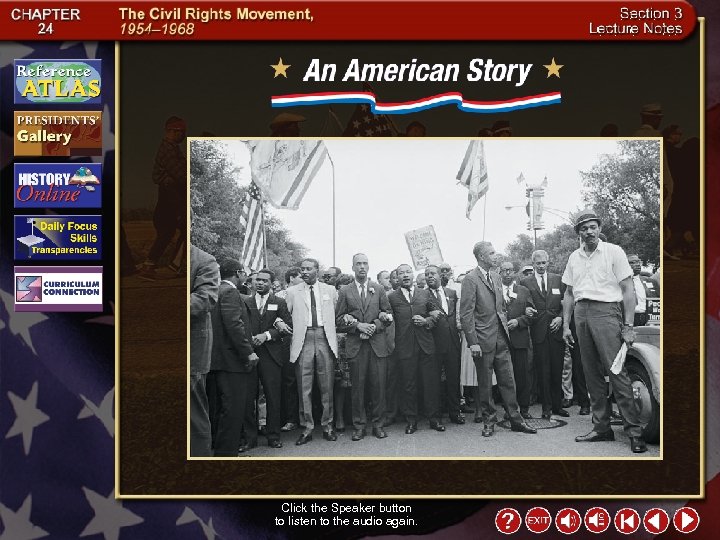
Click the Speaker button to listen to the audio again.
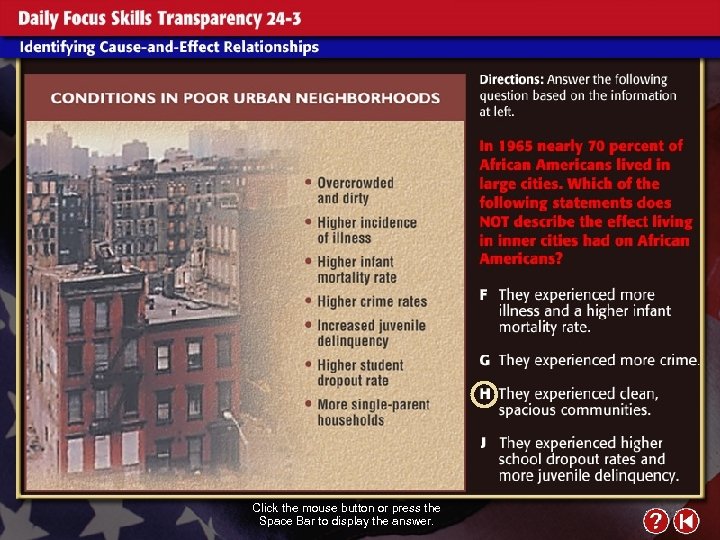
Problems Facing Urban African Americans • Even after the passage of civil rights laws in the 1950 s and 1960 s, racism, or prejudice or discrimination toward someone because of their race, was common. • The civil rights movement had resulted in many positive gains for African Americans, but their economic and social problems were much more difficult to address. (pages 761– 763) Click the mouse button or press the Space Bar to display the information.
Problems Facing Urban African Americans (cont. ) • Race riots broke out in many American cities between 1965 and 1968. • A race riot in Watts, a neighborhood in Los Angeles, lasted six days. • The worst of the riots occurred in Detroit when the United States Army was forced to send in tanks and soldiers with machine guns to gain control. • The Kerner Commission was created to make recommendations that would prevent further urban riots. (pages 761– 763) Click the mouse button or press the Space Bar to display the information.
Problems Facing Urban African Americans (cont. ) • It concluded that the problem was white society and white racism. • The commission suggested the creation of two million new jobs in inner cities and six million new units of public housing. • However, with the massive spending in the Vietnam War, President Johnson never endorsed the recommendation. (pages 761– 763) Click the mouse button or press the Space Bar to display the information.
Problems Facing Urban African Americans (cont. ) What was the difference between African American workers and white workers by 1965? African American workers found themselves in low-paying jobs with little chance of advancement. Some African Americans were able to get work in blue-collar factory jobs, but few advanced this far compared to whites. In 1965 only 15 percent of African Americans held professional, managerial, or clerical jobs, compared to 44 percent for whites. (pages 761– 763) Click the mouse button or press the Space Bar to display the answer.
The Shift to Economic Rights • By the mid-1960 s, Dr. Martin Luther King, Jr. , was criticized for his nonviolent strategy because it had failed to improve the economic condition of African Americans. • As a result, he began focusing on economic issues affecting African Americans. • The Chicago Movement was an effort to call attention to the deplorable housing conditions that many African Americans faced. (page 763) Click the mouse button or press the Space Bar to display the information.
The Shift to Economic Rights (cont. ) • Dr. Martin Luther King, Jr. , and his wife moved into a slum apartment in an African American neighborhood in Chicago. • Dr. King led a march through the white suburb of Marquette Park to demonstrate the need for open housing. • Mayor Richard Daley had police protect the marchers, and Daley met with King to propose a new program to clean up slums. (page 763) Click the mouse button or press the Space Bar to display the information.
The Shift to Economic Rights (cont. ) What was the result of the meeting between Mayor Richard Daley and Dr. Martin Luther King, Jr. ? Daley proposed a plan to clean up the slums. Associations of realtors and bankers agreed to promote open housing. The plan was not effective. (page 763) Click the mouse button or press the Space Bar to display the answer.
Black Power • After 1965 many African Americans began to turn away from the nonviolent teachings of Dr. King. • They sought new strategies, which included self-defense and the idea that African Americans should live free from the presence of whites. • Young African Americans called for black power, a term that had many different meanings. (pages 764– 765) Click the mouse button or press the Space Bar to display the information.
Black Power (cont. ) • To some it meant physical self-defense and violence. • For others, including SNCC leader Stokely Carmichael, it meant they should control the social, political, and economic direction of their struggle for equality. • Black power stressed pride in the African American culture and opposed cultural assimilation, or the philosophy of incorporating different racial or cultural groups into the dominant society. (pages 764– 765) Click the mouse button or press the Space Bar to display the information.
Black Power (cont. ) • These ideas were popular in poor urban neighborhoods, although Dr. King and many African American leaders were critical of black power. • In the early 1960 s, Malcolm X had become a symbol of the Black Power movement. • Malcolm X was a member of the Nation of Islam, known as the Black Muslims, who believed that African Americans should separate themselves from whites and form their own self-governing communities. (pages 764– 765) Click the mouse button or press the Space Bar to display the information.
Black Power (cont. ) • Malcolm X later broke from the Nation of Islam and began to believe an integrated society was possible. • In 1965 three members of the Nation of Islam shot and killed Malcolm X. • He would be remembered for his view that although African Americans had been victims in the past, they did not have to allow racism to victimize them now. (pages 764– 765) Click the mouse button or press the Space Bar to display the information.
Black Power (cont. ) • The formation of the Black Panthers was the result of a new generation of militant African American leaders preaching black power, black nationalism, and economic self-sufficiency. • The group believed that a revolution was necessary to gain equal rights. (pages 764– 765) Click the mouse button or press the Space Bar to display the information.
Black Power (cont. ) Why did the black power movement replace the nonviolent civil rights movement led by Dr. Martin Luther King, Jr. ? (pages 764– 765) Click the mouse button or press the Space Bar to display the answer.
Black Power (cont. ) Dr. King’s nonviolent civil rights movement failed to change the poor economic conditions that many African Americans faced in the 1960 s. Some African American leaders called for more aggressive forms of protest. They placed less emphasis on interracial cooperation with sympathetic whites. Many young African Americans called for black power–controlling the social, political, and economic direction of their struggle for equality. It stressed pride in the African American cultural group. It emphasized racial distinctiveness. (pages 764– 765)
The Assassination of Martin Luther King, Jr. • By the late 1960 s, the civil rights movement had fragmented into many competing organizations. • The result was no further legislation to help African Americans. • Dr. Martin Luther King, Jr. , was assassinated by a sniper on April 4, 1968, creating national mourning as well as riots in more than 100 cities. (pages 765– 766) Click the mouse button or press the Space Bar to display the information.
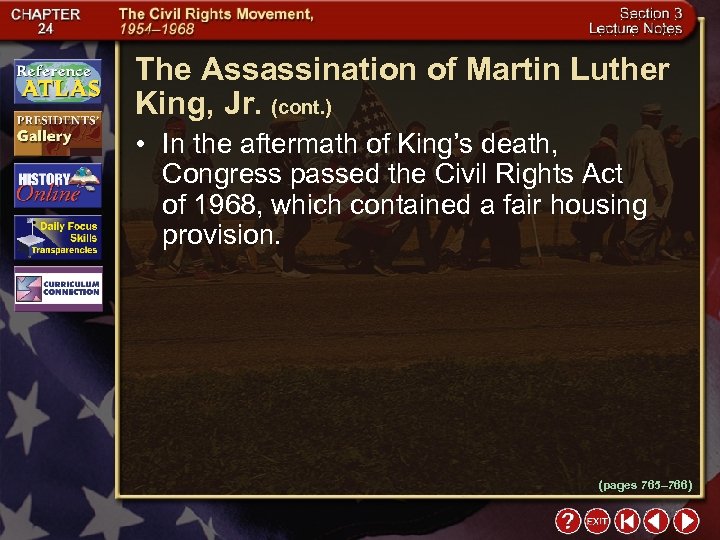
The Assassination of Martin Luther King, Jr. (cont. ) • In the aftermath of King’s death, Congress passed the Civil Rights Act of 1968, which contained a fair housing provision. (pages 765– 766)
The Assassination of Martin Luther King, Jr. (cont. ) What happened to the civil rights movement after Dr. King’s assassination? Congress passed the Civil Rights Act of 1968, which contained a fair housing provision, outlawed discrimination in the sale and rental of housing, and gave the Justice Department authority to bring suits against discrimination. The civil rights movement, however, lacked the unity of purpose and vision that Dr. King had given it. (pages 765– 766) Click the mouse button or press the Space Bar to display the answer.
Checking for Understanding Define Match the terms on the right with their definitions on the left. __ 1. prejudice or discrimination A against someone because of his or her race __ 2. the mobilization of the political B and economic power of African Americans, especially to compel respect for their rights and to improve their condition Click the mouse button or press the Space Bar to display the answers. A. racism B. black power
Checking for Understanding (cont. ) Explain the goals of the Nation of Islam in the 1960 s. It wanted separate self-governing communities for African Americans. Click the mouse button or press the Space Bar to display the answer.
Checking for Understanding (cont. ) Summarize the findings of the Kerner Commission. It blamed racism for inner-city problems and urged job and housing programs. Click the mouse button or press the Space Bar to display the answer.
Reviewing Themes Civic Rights and Responsibilities How was the Civil Rights Act of 1968 designed to help end discrimination? The Civil Rights Act of 1968 was designed to outlaw housing discrimination. Click the mouse button or press the Space Bar to display the answer.
Critical Thinking Identifying Cause and Effect What were the effects of the assassination of Dr. Martin Luther King, Jr. ? It touched off both national mourning and riots, and the Civil Rights Act of 1968 was passed. Click the mouse button or press the Space Bar to display the answer.
Analyzing Visuals Analyzing Political Cartoons The cartoon on page 762 of your textbook suggests that the violence of the mid 1960 s was as bad as the violence of the Vietnam War going on at the same time. What images does the cartoonist use to compare violence at home with the violence of the war? The artist uses ocean ships and floating mines. Click the mouse button or press the Space Bar to display the answer.
Close Discuss the direction and progress of the civil rights movement after 1968.
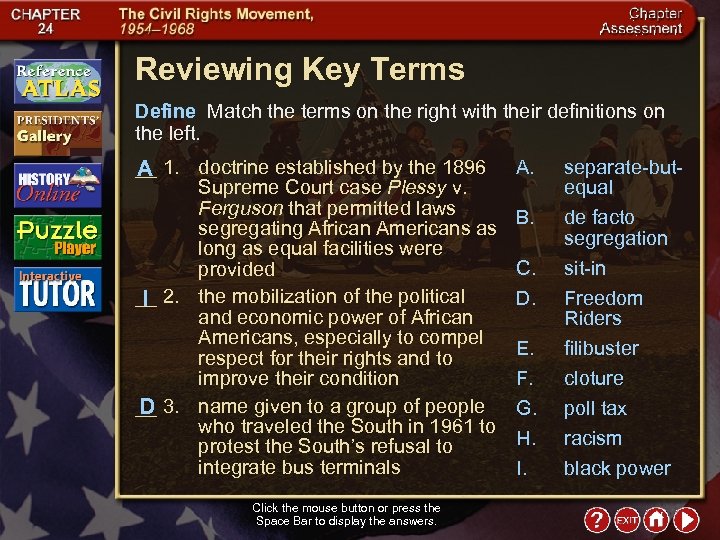
Reviewing Key Terms Define Match the terms on the right with their definitions on the left. __ 1. doctrine established by the 1896 A Supreme Court case Plessy v. Ferguson that permitted laws segregating African Americans as long as equal facilities were provided __ 2. the mobilization of the political I and economic power of African Americans, especially to compel respect for their rights and to improve their condition __ 3. name given to a group of people D who traveled the South in 1961 to protest the South’s refusal to integrate bus terminals Click the mouse button or press the Space Bar to display the answers. A. separate-butequal B. de facto segregation sit-in C. D. Freedom Riders E. filibuster F. G. H. I. cloture poll tax racism black power
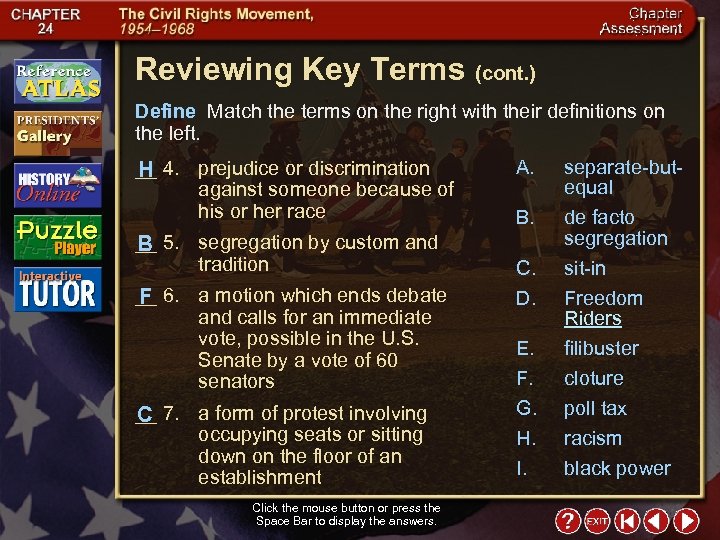
Reviewing Key Terms (cont. ) Define Match the terms on the right with their definitions on the left. __ 4. prejudice or discrimination H against someone because of his or her race __ 5. segregation by custom and B tradition __ 6. a motion which ends debate F and calls for an immediate vote, possible in the U. S. Senate by a vote of 60 senators __ 7. a form of protest involving C occupying seats or sitting down on the floor of an establishment Click the mouse button or press the Space Bar to display the answers. A. separate-butequal B. de facto segregation sit-in C. D. Freedom Riders E. filibuster F. G. H. I. cloture poll tax racism black power
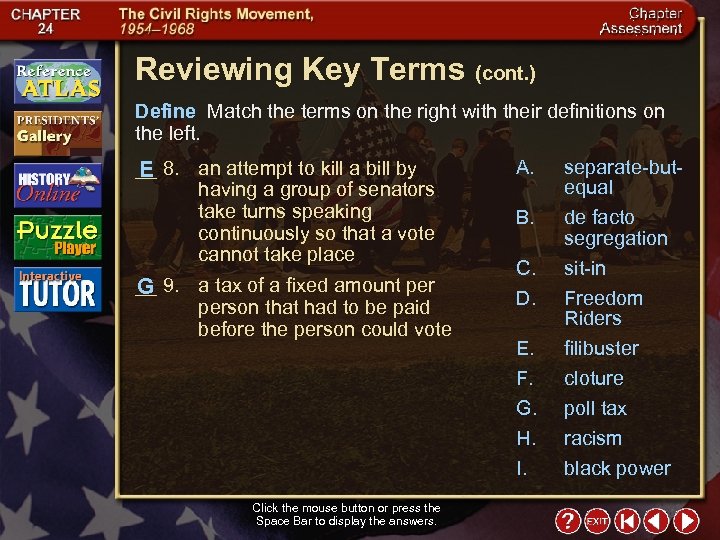
Reviewing Key Terms (cont. ) Define Match the terms on the right with their definitions on the left. __ 8. an attempt to kill a bill by E having a group of senators take turns speaking continuously so that a vote cannot take place __ 9. a tax of a fixed amount per G person that had to be paid before the person could vote A. separate-butequal B. de facto segregation sit-in C. Freedom Riders E. filibuster F. G. H. I. Click the mouse button or press the Space Bar to display the answers. D. cloture poll tax racism black power
Reviewing Key Facts What event led to the bus boycott in Montgomery, Alabama? Rosa Parks’s arrest led to the bus boycott. Click the mouse button or press the Space Bar to display the answer.
Reviewing Key Facts (cont. ) Why was the decision in Brown v. Board of Education a significant step toward ending segregation? It was the first case in which the Court found segregation to be unconstitutional. Click the mouse button or press the Space Bar to display the answer.
Reviewing Key Facts (cont. ) What was the role of SNCC in the civil rights movement? It worked for the desegregation of public facilities and voter registration. Click the mouse button or press the Space Bar to display the answer.
Reviewing Key Facts (cont. ) How did the government react to race riots in cities such as Los Angeles and Detroit? It sent in National Guard and U. S. Army troops and appointed the Kerner Commission. Click the mouse button or press the Space Bar to display the answer.
Reviewing Key Facts (cont. ) What were two changes in the focus of the civil rights movement in the mid 1960 s? It moved from focusing on ending segregation to focusing on full social and economic equality. It also moved from nonviolent resistance to militancy. Click the mouse button or press the Space Bar to display the answer.
Critical Thinking Analyzing Themes: Civic Rights and Responsibilities Do you agree with the viewpoint of Dr. Martin Luther King, Jr. , or with that of the Black Panthers concerning the civil rights movement? Explain your answer. Answers will vary. Click the mouse button or press the Space Bar to display the answer.
Critical Thinking (cont. ) Evaluating Why did the civil rights movement make fewer gains after 1968? After Martin Luther King, Jr. , was assassinated, the movement fragmented. In addition, economic gains were harder to win. Click the mouse button or press the Space Bar to display the answer.
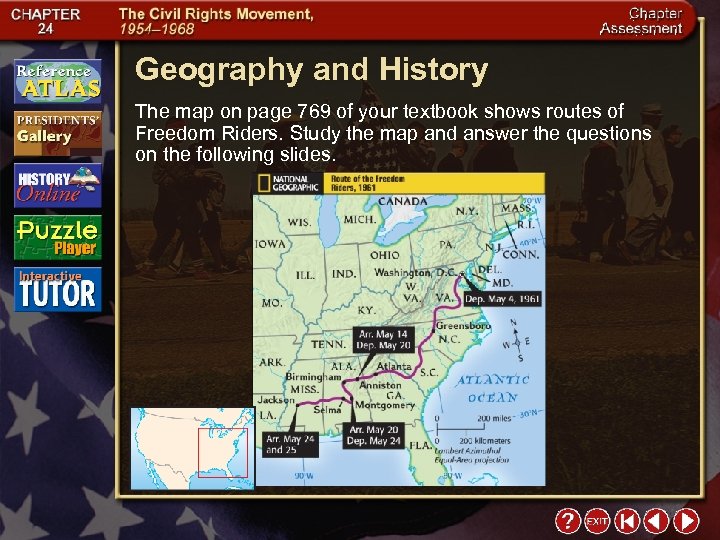
Geography and History The map on page 769 of your textbook shows routes of Freedom Riders. Study the map and answer the questions on the following slides.
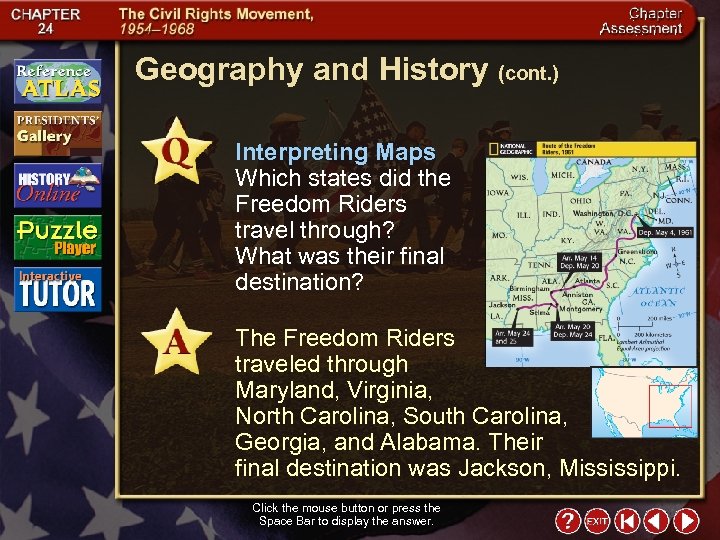
Geography and History (cont. ) Interpreting Maps Which states did the Freedom Riders travel through? What was their final destination? The Freedom Riders traveled through Maryland, Virginia, North Carolina, South Carolina, Georgia, and Alabama. Their final destination was Jackson, Mississippi. Click the mouse button or press the Space Bar to display the answer.
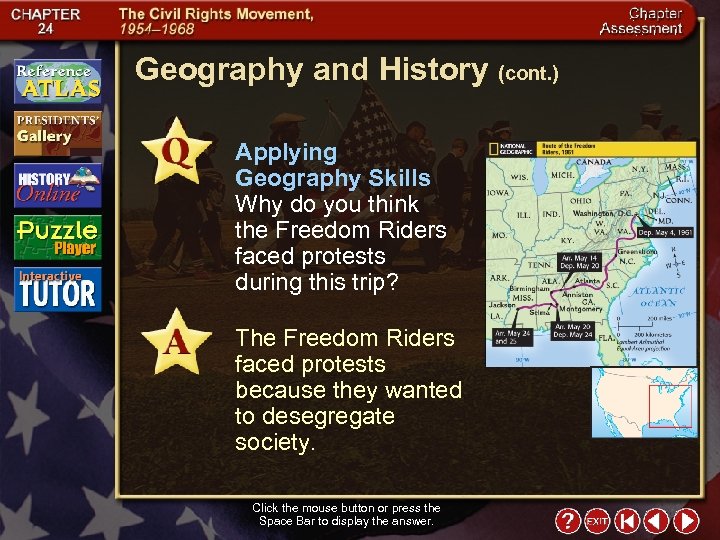
Geography and History (cont. ) Applying Geography Skills Why do you think the Freedom Riders faced protests during this trip? The Freedom Riders faced protests because they wanted to desegregate society. Click the mouse button or press the Space Bar to display the answer.
Directions: Choose the best answer to the following question. One difference between the strategies of Dr. Martin Luther King, Jr. , and some later civil rights groups was that King was committed to A ending discrimination in housing and unemployment. B using only nonviolent forms of protest. C demanding equal rights for African Americans. D gaining improvements in living conditions for African Americans. Test-Taking Tip If you read this question carefully, you will notice that it asks for one difference in civil rights strategies. Three of the answer choices will represent common goals. Be careful to read through all the choices to find the one that represents a different type of strategy. Click the mouse button or press the Space Bar to display the answer.
What was the purpose of the March on Washington? The purpose was to build public support for passage of the Civil Rights Act of 1964. Click the mouse button or press the Space Bar to display the answer.
Explore online information about the topics introduced in this chapter. Click on the Connect button to launch your browser and go to The American Republic Since 1877 Web site. At this site, you will find interactive activities, current events information, and Web sites correlated with the chapters and units in the textbook. When you finish exploring, exit the browser program to return to this presentation. If you experience difficulty connecting to the Web site, manually launch your Web browser and go to http: //tarvol 2. glencoe. com
Language Arts African American authors wrote about their experiences during the civil rights movement. James Baldwin’s Notes of a Native Son is a classic example of such literature.
Government Like many leading political figures in Southern states, George Wallace opposed integration. Elected in 1962 as the governor of Alabama, his actions and words, such as his statement, “segregation now, segregation tomorrow, segregation forever, ” openly defied the federal government’s efforts. So strong was Southern anger over the segregation issue that Wallace would garner much support in his 1968 and 1972 presidential bids. Wallace eventually apologized for his racist beliefs.
Art Many African American artists used African motifs in their creations, which often expressed outrage with society or portrayed scenes from African American history. An example is Wall of Love by William Walker.
Independent Spirit Supreme Court Justice Thurgood Marshall, the great-grandson of an enslaved person “of independent spirit, ” served with the NAACP for 25 years, argued 32 major cases for the organization, and won 29 of them.
Rosa Parks Hattie Mc. Daniel Click on a hyperlink to view the corresponding slide.
Rosa Parks and her husband both lost their jobs as a result of taking part in the bus boycott.
Hattie Mc. Daniel was the first African American woman to sing on American radio. In the 1930 s and 1940 s, she appeared in many films, generally in the role of a maid. She won an Academy Award for her role in the movie Gone with the Wind.
John Siegenthaler Southern Poverty Law Center Click on a hyperlink to view the corresponding slide.
Presidential aide John Siegenthaler recounted the mob scene at the bus terminal: “The Freedom Riders emerging from the bus were being mauled. It looked like two hundred, three hundred people all over them. There were screams and shouts. . ” The one white man aboard the bus, Jim Zwerg, was viciously attacked–as if the mob was furious that he would side with African Americans.
In 1989 the Southern Poverty Law Center dedicated the Civil Rights Memorial to those who died during the struggle for civil rights in the South. Located in Montgomery, Alabama– the scene of so many of the events in that cause–the memorial serves to inform and educate young people about the civil rights movement. Maya Lin, the creator of the Vietnam Veterans memorial in Washington, D. C. , designed the monument.
Click the Speaker button to listen to the audio again.
Preparing a Bibliography When you write research reports, you should include a list of the sources used to find your information. This list, called a bibliography, allows you to credit the sources you cited and supports the report’s accuracy. Click the Speaker button to listen to the audio again.
Preparing a Bibliography Learning the Skill A bibliography is a list of sources used in a research report. These sources include books; articles from newspapers, magazines, and journals; interviews; and other sources. There are two main reasons to write a bibliography. First, those who read your report may want to learn more about the topic. Second, a bibliography supports the reliability of your report. Click the mouse button or press the Space Bar to display the information.
Preparing a Bibliography Learning the Skill (cont. ) A bibliography follows an established format. The entry for each source contains all the information needed to find that source, including the author, title, page numbers, publisher information, and publication date. You should document this information as you carry out your research. If you neglect this step early in your research, you must locate your sources again in order to credit them in your report.
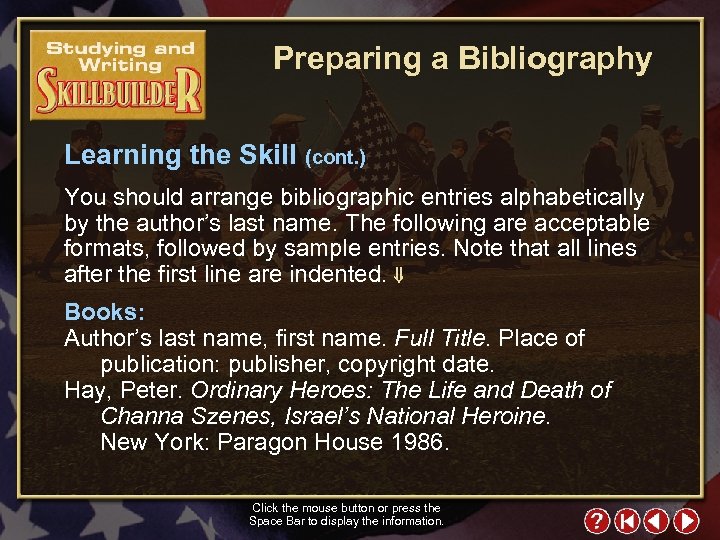
Preparing a Bibliography Learning the Skill (cont. ) You should arrange bibliographic entries alphabetically by the author’s last name. The following are acceptable formats, followed by sample entries. Note that all lines after the first line are indented. Books: Author’s last name, first name. Full Title. Place of publication: publisher, copyright date. Hay, Peter. Ordinary Heroes: The Life and Death of Channa Szenes, Israel’s National Heroine. New York: Paragon House 1986. Click the mouse button or press the Space Bar to display the information.
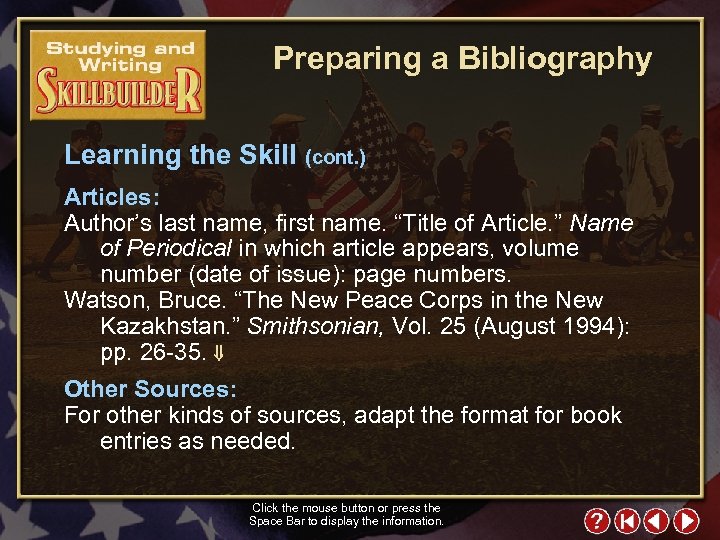
Preparing a Bibliography Learning the Skill (cont. ) Articles: Author’s last name, first name. “Title of Article. ” Name of Periodical in which article appears, volume number (date of issue): page numbers. Watson, Bruce. “The New Peace Corps in the New Kazakhstan. ” Smithsonian, Vol. 25 (August 1994): pp. 26 -35. Other Sources: For other kinds of sources, adapt the format for book entries as needed. Click the mouse button or press the Space Bar to display the information.
Preparing a Bibliography Practicing the Skill Review the sample bibliography on page 767 of your textbook from a report on Martin Luther King, Jr. Then answer the questions on the following slides.
Preparing a Bibliography Practicing the Skill (cont. ) 1. Are the bibliography entries in the correct order? Why or why not? No, they should be in alphabetical order using the last name of each author. 2. What is missing from the second book listing? The publication date is missing. Click the mouse button or press the Space Bar to display the answers.
Preparing a Bibliography Practicing the Skill (cont. ) 3. What features are missing from the second article listing? Quotes around the title of the article and italics for the New York Times Magazine are missing. Click the mouse button or press the Space Bar to display the answer.
The Civil Rights Movement Objectives After viewing “The Civil Rights Movement, ” you should: • Know how and why African Americans faced discrimination in the South. • Recognize the dangers the Little Rock Nine faced in going to Central High School. • Understand why African Americans were willing to confront harassment and violence to gain equal rights. Click in the small window above to show a preview of The American Republic Since 1877 video. Click the mouse button or press the Space Bar to display the information.
The Civil Rights Movement Discussion Questions What were African Americans seeking in the Civil Rights Movement? African Americans sought social, economic, and political equality with whites. Click the mouse button or press the Space Bar to display the answer.
The Civil Rights Movement Discussion Questions Why did President Eisenhower send paratroopers to Little Rock? Eisenhower sent in paratroopers to stop mob violence and to escort the Little Rock Nine to school. Click the mouse button or press the Space Bar to display the answer.
Click the mouse button or press the Space Bar to display the answer.
Click the mouse button or press the Space Bar to display the answer.
Click the mouse button or press the Space Bar to display the answer.

End of Custom Shows WARNING! Do Not Remove This slide is intentionally blank and is set to auto-advance to end custom shows and return to the main presentation.
 Скачать презентацию Presentation Plus The American Republic Since 1877 Copyright
329832c1267a399a61ded121bb0d3204.ppt