


 Скачать презентацию Presentation Plus Human Heritage A World History Copyright
1ac20a3391124b9a97e1d0715f219676.ppt
- Количество слайдов: 97
 Presentation Plus! Human Heritage: A World History Copyright © by The Mc. Graw-Hill Companies, Inc. Developed by FSCreations, Inc. , Cincinnati, Ohio 45202 Send all inquiries to: GLENCOE DIVISION Glencoe/Mc. Graw-Hill 8787 Orion Place Columbus, Ohio 43240 1
 2
2
 CHAPTER FOCUS SECTION 1 The End of the Cold War SECTION 2 World Challenges SECTION 3 The World Today CHAPTER SUMMARY & STUDY GUIDE CHAPTER ASSESSMENT 3 Click a hyperlink to go to the corresponding section. Press the ESC key at any time to exit the presentation.
 Overview • Chapter 39 discusses the end of the cold war and the challenges facing the global community at the start of the 2000 s. – Section 1 describes the collapse of communism in Eastern Europe and the breakup of the Soviet Union. – Section 2 explores global crises following the cold war. – Section 3 examines terrorism and other global challenges facing nations today. 4 Click the mouse button or press the Space Bar to display the information.
 Objectives After studying this chapter, you will be able to: • discuss how independence came to Eastern Europe. • describe life in Russia after the breakup of the Soviet Union. • explain how nations responded to issues of war and peace after the cold war ended. • identify world challenges at the start of the 21 st century. 5 Click the mouse button or press the Space Bar to display the information.
 Read to Discover • How independence came to the nations of Eastern Europe • What changes came to Russia after the breakup of the Soviet Union • How nations responded to issues of war and peace after the cold war ended • What challenges the world faces in the 2000 s 6 Click the mouse button or press the Space Bar to display the information. The Chapter Focus is on page 645 of your textbook.
 Terms to Learn People to Know (cont. ) • • • Osama bin Laden • Nelson Mandela aggression coup sovereign secede autonomous terrorism apartheid euro People to Know • • 7 Boris Yeltsin Lech Walesa Saddam Hussein George W. Bush Places to Locate • • • Berlin Chechnya Persian Gulf Afghanistan Kosovo Northern Ireland Hong Kong Taiwan East Timor Click the mouse button or press the Space Bar to display the information. Click the Speaker On button to listen to the words.
 Why It’s Important The 1980 s and 1990 s saw the end of the cold war and the collapse of the Soviet Union. People looked forward to a new era of peace. However, national and ethnic rivalries soon erupted around the world. Regional conflicts forced leaders to develop new rules for stopping aggression, or warlike acts, and intervening in the affairs of other nations. As the 2000 s opened, another threat came from groups that used violence against ordinary citizens to achieve political aims. It had become clear that nations needed to work together to solve these and other problems. 8 Click the Speaker On button to replay audio.
 9
9
 The End of the Cold War • The 1990 s saw the collapse of communism in Eastern Europe and the breakup of the Soviet Union. • Newly independent nations throughout the region struggled to develop new economic and political systems. 10 Click the mouse button or press the Space Bar to display the information. Section 1 begins on page 645 of your textbook.
 A Spirit of Democracy • The Communist hold on government weakened under Soviet premier Mikhail Gorbachev when he introduced his new policy of glasnost, or openness, to the Soviet Union. • The first successful challenge to Communist rule occurred in Poland when voters elected Solidarity members to two-thirds of the seats in the Polish legislature. • For the first time, a Communist government in Eastern Europe had lost power as a result of an election. 11 Click the mouse button or press the Space Bar to display the information. Section 1 begins on page 645 of your textbook.
 Fall of the Berlin Wall • In October 1989, Communist leader Erich Honecker resigned, and on November 9, at the stroke of midnight, officials in East Berlin threw open the main gate in the Berlin Wall– a 28 -mile-long, steel-and-concrete symbol of the cold war. • The next morning, soldiers began to knock down the wall; civilians joined them, whacking away with hammers, axes, and chisels. 12 Click the mouse button or press the Space Bar to display the information.
 The Last Satellites • East German demands for freedom sparked changes in other Eastern European nations. – A week after the fall of the Berlin Wall, Bulgaria's hard-line Communist boss resigned. – Popular elections overturned Communist rule in Hungary and Czechoslovakia. – The Communist leader of Romania was tried and then executed for crimes against the people. – In early 1990, East Germany held its first democratic election since the rise of Adolf Hitler and was reunited with West Germany. 13 Click the mouse button or press the Space Bar to display the information.
 The Last Satellites (cont. ) • The cold war, which had begun with the division of Germany after World War II, was over. 14
 Conflict Within the Soviet Union • Trouble brewed within the Soviet Union as openness introduced by Gorbachev allowed dissent, or criticism, against the government. • Gorbachev was attacked by hard-liners for “giving up” Eastern Europe and by reformers, led by Boris Yeltsin, for the slow pace of change. • Yeltsin responded by winning election as president of Russia, and by publicly quitting the Communist party to defy hardliners. 15 Click the mouse button or press the Space Bar to display the information.
 Conflict Within the Soviet Union (cont. ) • Meanwhile, people in the other 14 Soviet republics began to proclaim their freedom. • Hard-liners exploded at the breakup, and the military and secret police arranged a coup, or forced takeover of the government, placed Gorbachev under house arrest, and vowed to rebuild the Communist state. • In a tense, three-day struggle known as the “Second Russian Revolution, ” Yeltsin shut down the Communist party, ending 74 years of Communist rule. 16 Click the mouse button or press the Space Bar to display the information.
 Independence and Ethnic Rivalries • By the end of 1991, all 15 Soviet republics had proclaimed their independence and Gorbachev had resigned. • The Commonwealth of Independent States (CIS)–a loose confederation of sovereign, or self-governing, nations–was formed. • Yugoslavia began to split apart as ethnic rivalries erupted in war. 17 Click the mouse button or press the Space Bar to display the information.
 Independence and Ethnic Rivalries (cont. ) • Czechoslovakia peacefully split into the Czech Republic and the Republic of Slovakia. • Within Russia, rebels in the state of Chechnya tried to secede, or withdraw, to form their own government. 18 Click the mouse button or press the Space Bar to display the information.
 Economic Hardships • Governments moved to privatize, or allow the private ownership of, state-owned stores, businesses, and factories, but few people had enough money or experience to run businesses based on free competition– the cornerstone of capitalism. • When communism collapsed, the principle of supply and demand went into effect. • Goods were in short supply, high demand drove up prices, unemployment soared, and wages dropped. 19 Click the mouse button or press the Space Bar to display the information.
 Political Challenges • Open elections allowed rival political parties to challenge the popularity of independence. • In 1995, a former Communist defeated Lech Walesa–the leader of Solidarity–in his bid for reelection as the president of Poland. • By the end of the 1990 s, no nation had returned to communism. 20 Click the mouse button or press the Space Bar to display the information.
 Political Challenges (cont. ) • That year, the North Atlantic Treaty Organization (NATO) felt secure enough in the political future of Poland, Hungary, and the Czech Republic to admit all three former Soviet satellites as members. • Suddenly, on December 31, 1999, Russian president Boris Yeltsin resigned, and there was a peaceful transfer to Vladimir Putin as the appointed acting president. 21 Click the mouse button or press the Space Bar to display the information.
 Section Assessment What changes took place in Eastern Europe as a result of reforms introduced by Mikhail Gorbachev? Changes that took place include the collapse of communism, fall of the Berlin Wall, Eastern European independence. 22 Click the mouse button or press the Space Bar to display the answer.
 Section Assessment (cont. ) Why did hard-liners in the Soviet Union try to take control of the government? because they were angry that Gorbachev let Soviet satellite regimes collapse 23 Click the mouse button or press the Space Bar to display the answer.
 Section Assessment (cont. ) Making Predictions Do you think the world has seen the last of communism in Russia? Why or why not? Answers will vary. 24 Click the mouse button or press the Space Bar to display the answer.
 Section Assessment (cont. ) Draw a diagram like the on page 652 of your textbook, and use it to show some of the problems faced by former Soviet satellites. Possible answers include ethnic rivalries, soaring prices, high unemployment, low wages, worker strikes, skyrocketing interest rates, political challenges by the Communists. 25 Click the mouse button or press the Space Bar to display the answer.
 26
26
 World Challenges • During the cold war, the United States and the Soviet Union had used their money, power, and influence to dominate events in other nations. • Now, long-standing national and ethnic tensions erupted in violence and confusion. • Nations struggle to find new ways of resolving regional threats to peace. 27 Click the mouse button or press the Space Bar to display the information. Section 2 begins on page 652 of your textbook.
 Iraq • One of the most challenging problems after the cold war was dealing with the Middle Eastern country of Iraq. • In August 1990, Iraq’s leader, dictator Saddam Hussein, ordered the invasion of his oil-rich neighbor Kuwait. • He also moved Iraqi troops close to the border of Saudi Arabia, site of the world’s largest known oil reserves. 28 Click the mouse button or press the Space Bar to display the information.
 Iraq (cont. ) • The United States used the United Nations (UN) as a forum, or meeting place. A coalition, or temporary union of nations, was put together to free Kuwait. • A coalition army attacked Iraq in January 1991, after Hussein ignored a UN deadline to remove his troops. • This action was named the Persian Gulf War because of Kuwait’s location along the Persian Gulf. By late February, Kuwait had been freed. 29 Click the mouse button or press the Space Bar to display the information.
 Iraq (cont. ) • The Persian Gulf War had mixed results. Although Iraq was forced to leave Kuwait, Hussein was still the country’s leader. • UN inspectors were not allowed to check areas in Iraq where they thought dangerous weapons were being stored or built. • During the early 2000 s, the weapons inspections issue was still a problem. 30 Click the mouse button or press the Space Bar to display the information.
 Balkan Wars • The republic of Serbia tried to rule all of Yugoslavia. Four other republics, Slovenia, Croatia, Bosnia-Herzegovina, and Macedonia, opposed Serb control and declared their independence. • Different groups were struggling for power within each republic in the late 1980 s and early 1990 s. • With UN support, NATO carried out air strikes in order to force the different groups to take part in peace talks. 31 Click the mouse button or press the Space Bar to display the information.
 Balkan Wars (cont. ) • In 1995, the leaders of Bosnia-Herzegovina, Yugoslavia, and Croatia met in Dayton, Ohio. They signed the Dayton Accords. • This peace agreement divided Bosnia into Croat-Muslim and Serb regions. • Meanwhile, Serb pride was still strong in Yugoslavia. The Serbs decided to try to remove Muslim Albanians from Kosovo. 32 Click the mouse button or press the Space Bar to display the information.
 Balkan Wars (cont. ) • Kosovo had been an autonomous, or selfgoverning, province of Yugoslavia. • The Serbs finally allowed a NATO peacekeeping force to enter Kosovo. In the fall of 2000, a new democratic government emerged in Serbia. 33 Click the mouse button or press the Space Bar to display the information.
 Arabs and Israelis • The conflict in the Middle East between Arabs and Israelis has deep roots. • In 1947, the UN voted to divide Palestine into a Jewish state and an Arab state. • The Arabs in Palestine and in neighboring countries did not support this plan. • In 1948, the Jews established the nation of Israel in their part of Palestine. • Five Arab nations waged war on the new nation. The war ended with Israel’s victory. 34 Click the mouse button or press the Space Bar to display the information.
 Arabs and Israelis (cont. ) • An Arab group known as the Palestine Liberation Organization (PLO) opposed Israel and wanted an entirely Palestinian state, rather than the state of Israel. • In 2000, violence erupted between the Israelis and Arabs after peace talks failed. Observers believed that ending violence and restoring trust would be necessary before any new peace talks could begin. 35 Click the mouse button or press the Space Bar to display the information.
 Toward Peace in Ireland • In Ireland, violent clashes between the Catholics and Protestants in British-ruled Northern Ireland flared in the 1960 s and 1970 s. • Both groups wanted to control the government. • In 1998, a peace agreement was reached that went into effect the following year. Catholics and Protestants in Northern Ireland agreed to share power in the government. 36 Click the mouse button or press the Space Bar to display the information.
 Changes in China • Chinese leaders in the 1990 s set up policies to change the economic system of communism. • Hong Kong, a busy port on the South China coast, was returned to China in 1997. The Chinese government promised to allow Hong Kong to keep its capitalist system for 50 years. 37 Click the mouse button or press the Space Bar to display the information.
 Changes in China (cont. ) • Fears over the future of Hong Kong grew worse because of the Chinese action toward Taiwan. • Taiwan is an independent country located near China claims Taiwan as its territory. • People living in Taiwan however, do not want to be under Chinese Communist rule. 38 Click the mouse button or press the Space Bar to display the information.
 Indonesia • For much of the past century, Indonesia has had many problems. • In 1949, Indonesia won its independence after centuries of Dutch rule. • In 1965, the Communists attempted to take over the government. Army forces quickly put the uprising down. • The government approved the takeover of East Timor, a Portuguese island colony, to block the spread of communism. 39 Click the mouse button or press the Space Bar to display the information.
 Indonesia (cont. ) • The strict government was replaced in 1999. The new government agreed to hold a referendum, or popular vote, for the independence of East Timor. • When the East Timorese voted overwhelmingly to form their own nation it set off a wave of violence. • In 2002, peace and independence finally came to East Timor. 40 Click the mouse button or press the Space Bar to display the information.
 Struggles and Progress in Africa • Lack of experience in self government had opened the door to authoritarian rule, or government in which one ruler or political party holds power, in Africa. • Since its independence in 1926, South Africa had moved toward a system of apartheid, or forced separation of races, which became law in 1948, ensuring that a white minority held power. 41 Click the mouse button or press the Space Bar to display the information.
 Struggles and Progress in Africa (cont. ) • To force an end to apartheid, the United States and other nations set up trade restrictions against South Africa in the 1980 s. • The election of F. W. de Klerk as president of South Africa opened the door to change when he lifted the long-standing ban on the African National Congress (ANC), the political group that spoke for most black South Africans. • In 1990, he released Nelson Mandela, the head of the ANC, from prison. 42 Click the mouse button or press the Space Bar to display the information.
 Struggles and Progress in Africa (cont. ) • In 1994, South Africa held its first democratic election open to blacks and whites alike. • Nelson Mandela became president. • In 1999, the country held its second allrace election. 43 Click the mouse button or press the Space Bar to display the information.
 Section Assessment What type of economic system did China move toward in the 1990 s? China moved toward capitalism. 44 Click the mouse button or press the Space Bar to display the answer.
 Section Assessment (cont. ) Making Predictions What role do you think South Africa will play in world affairs during the next 100 years? South Africa will take a leading role in helping to spread democracy in the region. 45 Click the mouse button or press the Space Bar to display the answer.
 Section Assessment (cont. ) Draw a chart like the on page 660 in your textbook, and use it to summarize the responses of the world community to the global issues listed on the chart. Charts will vary. 46 Click the mouse button or press the Space Bar to display the answer.
 47
47
 The World Today • Today the world faces many challenges that call for cooperation among nations. 48 Section 3 begins on page 663 of your textbook.
 Global Terrorism • The use of violence to reach a political goal –terrorism–has become a major global concern. • In 2001, the United States government identified nearly 30 terrorist groups operating in Asia, Europe, the Americas, and Africa. • United States leaders believe that the most dangerous of these terrorists is the Islamic group, al-Qaeda, or “the Base. ” 49 Click the mouse button or press the Space Bar to display the information.
 Global Terrorism (cont. ) • In the late 1990 s, al-Qaeda leader Osama bin Laden told Muslims to work toward removing U. S. influence from the Middle East. • The terrorist group is most widely known for its link to the attacks on the United States that took place on September 11, 2001. • The U. S. government acted swiftly. President George W. Bush called for steps to organize government efforts more efficiently in order to protect Americans from further terrorist attacks. 50 Click the mouse button or press the Space Bar to display the information.
 Global Terrorism (cont. ) • The first military action against terrorism began in the Southwest Asian nation of Afghanistan. • Afghanistan’s rulers, known as the Taliban, strictly controlled the Afghan people. The Taliban refused to hand over those accused of planning the September 11 attacks. • In October 2001, American and British warplanes began bombing Afghan military targets. Military forces captured major cities and scattered the Taliban. Within three months, the Taliban government had fallen. 51 Click the mouse button or press the Space Bar to display the information.
 Dangerous Weapons and Terrorism • By the 1990 s, many nations had developed weapons of mass destruction. • Weapons of mass destruction include nuclear bombs, poisonous chemicals, and biological weapons that spread disease. • World leaders feared that some nations might give weapons of mass destruction to terrorists. 52 Click the mouse button or press the Space Bar to display the information.
 A Growing Population • From 1900 to 2000, the earth’s population quadrupled. • In August 2002, the earth’s population had reached almost 6. 3 billion. • A number of reasons accounted for the growth: increased food production, improved medical care, and better living conditions. 53 Click the mouse button or press the Space Bar to display the information.
 Improving Health Care • In many developing nations, millions of people still die from communicable diseases, or diseases passed along from an infected person or animal to another person or animal. • Increased contact among nations through improved travel has increased the possibility of pandemics, or epidemics spread over a wide region, such as the Black Death in the Middle Ages. 54 Click the mouse button or press the Space Bar to display the information.
 Protecting the Environment • In 1995, UN-sponsored scientists sounded an alarm about the buildup of carbon dioxide in the atmosphere trapping heat released from the earth's surface, like the glass in a greenhouse. • They believed this so-called greenhouse effect was pushing up the earth's temperatures to dangerous levels, prompting scientists to predict that the polar ice caps might even melt. 55 Click the mouse button or press the Space Bar to display the information.
 Global Links • Progress in the 21 st century depends upon global cooperation on issues across national boundaries, such as water shortages. • In 1992, 15 western European nations formed the European Union (EU). • Twelve of the 15 EU nations have adopted a common currency called the euro. 56 Click the mouse button or press the Space Bar to display the information.
 Other Trade Agreements • Trade agreements were made between the countries of North America. • In 1993, the United States, Canada, and Mexico reduced trade barriers under the North American Free Trade Agreement (NAFTA). • In 1995, blocs of nations in South America signed similar trade agreements. 57 Click the mouse button or press the Space Bar to display the information.
 Other Trade Agreements (cont. ) • Contact among nations has been further increased by new forms of communications. • The result has been the rise of what some experts call a global culture. • Today’s generation of teenagers has the chance to work together to solve some of the earth’s most serious challenges. 58 Click the mouse button or press the Space Bar to display the information.
 Section Assessment What serous events occurred in the United States on September 11, 2001? Planes hijacked by terrorists flew into the World Trade Center towers, the Pentagon, and a field in Pennsylvania, killing thousands. 59 Click the mouse button or press the Space Bar to display the answer.
 Section Assessment (cont. ) What environmental challenges must be solved in the years ahead? Environmental challenges include the greenhouse effect, melting polar ice caps, pollution, and overpopulation. 60 Click the mouse button or press the Space Bar to display the answer.
 Section Assessment (cont. ) Identifying Alternatives What, if any, obligation do you think the United States has in reducing the gap between rich and poor nations in the world? Answers will vary. 61 Click the mouse button or press the Space Bar to display the answer.
 Section Assessment (cont. ) Draw a diagram like the on page 666 of your textbook, and use it to show the way your own life has been touched by increased contact and communication with other nations. Diagrams will vary. 62 Click the mouse button or press the Space Bar to display the answer.
 63
63
 Chapter Summary & Study Guide • Between 1989 and 1991, communism collapsed in Eastern Europe and the cold war came to an end. • By late 1991, the Soviet Union had dissolved into 15 independent republics. • Differences among people and economic hardships created many challenges for nations formerly under Soviet control. • In 1997, NATO offered membership to Poland, Hungary, and the Czech Republic. 64 Click the mouse button or press the Space Bar to display the information.
 Chapter Summary & Study Guide (cont. ) • Following Iraq’s invasion of Kuwait, a coalition of nations attacked Iraq. • Ethnic conflicts in Bosnia and Kosovo led to NATO air strikes against Serbia. • In the Middle East, Israel and several other Arab nations took steps toward peace, but conflict remained between Israelis and Palestinians. • In 1999, Catholics and Protestants agreed to joint rule of Northern Ireland. 65 Click the mouse button or press the Space Bar to display the information.
 Chapter Summary & Study Guide (cont. ) • Hong Kong was returned to China in 1997. • East Timor gained freedom, while a democratic government was established in Indonesia. • The September 11, 2001, attacks on the United States encouraged a global struggle against terrorism. • Population growth and health and environmental issues challenge the global community. 66 Click the mouse button or press the Space Bar to display the information.
 67
67
 Understanding the Main Idea What was the symbolic importance of destroying the Berlin Wall? symbolized the collapse of communism in Eastern Europe 68 Click the mouse button or press the Space Bar to display the answer.
 Understanding the Main Idea What problems did Russia face in reforming its government and economy? shortages, high prices, high interest rates, wage disputes, unemployment 69 Click the mouse button or press the Space Bar to display the answer.
 Understanding the Main Idea What were the short-term and longterm outcomes of the Persian Gulf War? short term–stopped Iraqi aggression; long term–left Hussein in power, left Iraqi weapons production and related conflicts unresolved 70 Click the mouse button or press the Space Bar to display the answer.
 Understanding the Main Idea What was the role of NATO in Bosnia and Kosovo? forced negotiations, then remained to ensure the peace and protect returning refugees 71 Click the mouse button or press the Space Bar to display the answer.
 Understanding the Main Idea What obstacles to peace exist in Africa? lack of experience in selfgovernment, ethnic differences 72 Click the mouse button or press the Space Bar to display the answer.
 Understanding the Main Idea What forms of communication link nations in the 2000 s? telephones, faxes, and computers 73 Click the mouse button or press the Space Bar to display the answer.
 Critical Thinking Do you agree that trade is linked to the growth of democracy in the People’s Republic of China? Why or why not? The new ideas are spread through trade and these ideas will influence the young people of China. 74 Click the mouse button or press the Space Bar to display the answer.
 Critical Thinking Do you support the United States giving financial help to peacekeeping forces in place like Bosnia and Kosovo? Explain. Some may say that the money should be spent to solve problems at home, while others will cite the importance of peace in an interdependent world. 75 Click the mouse button or press the Space Bar to display the answer.
 Critical Thinking How do you think the events of September 11, 2001, changed the world? Answers will vary. 76 Click the mouse button or press the Space Bar to display the answer.
 Geography in History Places and Regions Look at the population map on page 651 of your textbook. Scientists are predicting great increases in the population by the year 2050. In what regions would you expect the most growth to take place? Explain. Areas that are already heavily populated are likely to become more densely populated in the future. 77 Click the mouse button or press the Space Bar to display the answer.
 Think about the following challenges facing the world today, rank each, and explain your rankings: controlling renegade nations, producing enough food, protecting the environment, improving health care. 78
 79
79
 Explore online information about the topics introduced in this chapter. Click on the Connect button to launch your browser and go to the Human Heritage: A World History Web site. At this site, you will find interactive activities, current events information, and Web sites correlated with the chapters and units in the textbook. When you finish exploring, exit the browser program to return to this presentation. If you experience difficulty connecting to the Web site, manually launch your Web browser and go to http: //www. humanheritage. glencoe. com 80
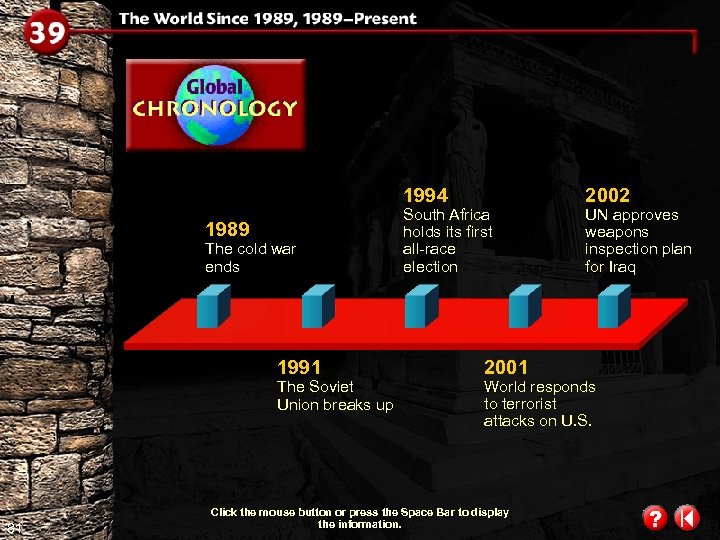 1994 1989 The cold war ends 1991 The Soviet Union breaks up 81 South Africa holds its first all-race election 2001 2002 UN approves weapons inspection plan for Iraq World responds to terrorist attacks on U. S. Click the mouse button or press the Space Bar to display the information.
 Nelson Mandela 1918–present South African Statesman Born of royal parents, Nelson Mandela experienced apartheid while working in a South African gold mine. He went on to study law and to help form the ANC. Imprisoned in 1964 for his opposition to apartheid, he emerged in 1990 to help F. W. de Klerk end the hated system. In 1993, the two men shared the Nobel Peace Prize. 82
 East Germany Fast Food Lech Walesa 83 Click a hyperlink to go to the corresponding section. Press the ESC key at any time to exit the presentation.
 East Germany On October 7, 1989, East Germany celebrated its 40 th anniversary. When Gorbachev showed up to speak in East Berlin, thousands of protestors shouted, “Gorbi, help us!” They then started chanting a popular political slogan, “We are the people!” 84
 Fast Food In 1990, Mc. Donald’s opened its first restaurant in Moscow. By 1998 there were 15 Mc. Donald’s, serving more than a million orders of french fries each month. 85
 Lech Walesa first worked as an electrician. He organized the trade union Solidarity, and later became Poland’s first freely elected President. He won the Nobel Peace Prize in 1983. 86
 Oil Production Kuwait and Saudi Arabia are believed to possess more than 50 percent of the world’s known oil reserves. Kuwait has an estimated 20 percent, while Saudi Arabia has 33 percent. 87
 Macao On December 20, 1999, Portugal returned Macao–a peninsula and two islands on the south coast of China–to the People’s Republic. Founded in 1557, the port was the oldest European outpost in China. As with Hong Kong, Chinese officials promised to respect Macao’s way of life for 50 years after the start of Chinese rule. 88
 Reading A Demographic Map • In order to show information about where people live on the earth, mapmakers use demographic maps. • Among other things, these maps can show population density, or the average number of people per square mile, or square kilometer, of land. Continued on next slide. 89 Click the mouse button or press the Space Bar to display the information.
 Reading A Demographic Map • Some parts of the world have many people living in each square mile, or square kilometer. • People generally live in areas with good physical environments. • Other parts of the world have few people, and there are even some areas in which no people live. Continued on next slide. 90 Click the mouse button or press the Space Bar to display the information.
 Reading A Demographic Map • These are known as uninhabited areas. • For example, on the “World Population” map on page 651 of your textbook, the color green indicates areas, such as Southeast Asia, with more than 250 people per square mile, or 97 people per square kilometer. • This is the highest population density shown. Continued on next slide. 91 Click the mouse button or press the Space Bar to display the information.
 Reading A Demographic Map • The color light brown indicates areas, such as Antarctica, that are uninhabited. Continued on next slide. 92
 Reading A Demographic Map Study the “World Population” map on page 651 of your textbook. Then answer the questions that follow. Continued on next slide. 93
 Reading A Demographic Map What color represents 60– 125 people per square mile (25– 50 per sq. km)? pink Continued on next slide. 94 Click the mouse button or press the Space Bar to display the answer.
 Reading A Demographic Map What areas in South America have densities of 2– 60 people per square mile (1– 25 per sq. km)? much of the coastal areas 95 Click the mouse button or press the Space Bar to display the answer.
 End of Custom Shows WARNING! Do Not Remove This slide is intentionally blank and is set to auto-advance to end custom shows and return to the main presentation. 96
 97
97