 Скачать презентацию Presentation Pack Corporate responsibility and business success in
db6a1bdb9dee99e8f0ee864a2d529a28.ppt
- Количество слайдов: 80



Presentation Pack Corporate responsibility and business success in China
Structure Sustainable development Facts about China Sustainable development in China Business role and responsibilities Business implementation
Getting started “Sustainable development meets the needs of the present without compromising the ability of future generations to meet their needs” Brundtland Commission, “Our common future”, 1987 §Who has previously heard about sustainability? In what contex §What would be your definition of sustainable development? def·i·ni·tion §How important is sustainable development: "de-f&-'ni-sh&n üTo you? üTo your company? Q
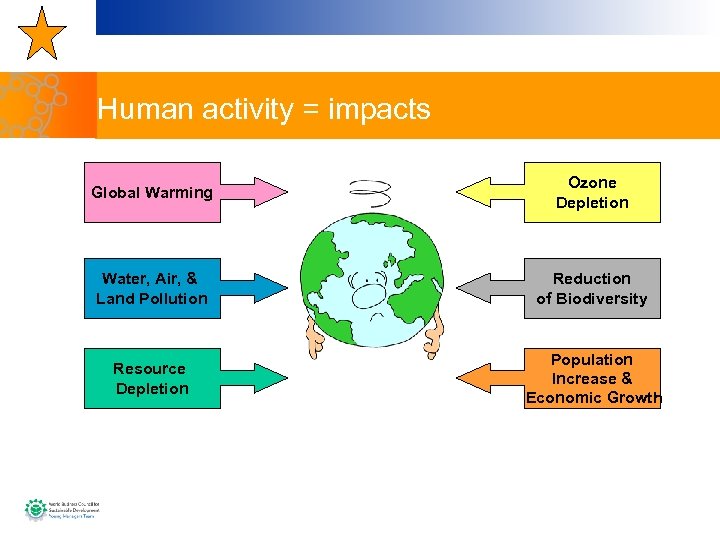
Human activity = impacts Global Warming Ozone Depletion Water, Air, & Land Pollution Reduction of Biodiversity Resource Depletion Population Increase & Economic Growth
Sustainable development covers many topics § Demography § Wealth § Nutrition § Health § Education § Consumption § Energy § Pollution § Emissions and waste generation § Efficiency § Ecosystems § Climate change § Agriculture § Human rights § Water § Urbanization § Mobility § Communications § Labor § Democracy § Accountability § Privatization § Biodiversity
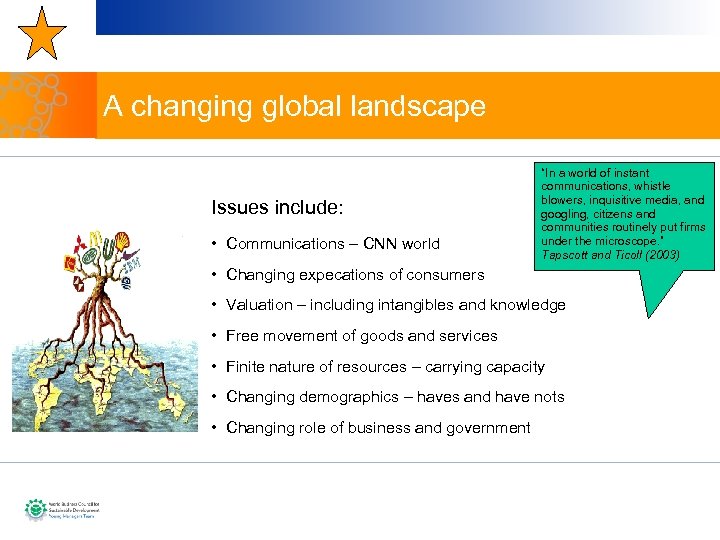
A changing global landscape Issues include: • Communications – CNN world “In a world of instant communications, whistle blowers, inquisitive media, and googling, citizens and communities routinely put firms under the microscope. ” Tapscott and Ticoll (2003) • Changing expecations of consumers • Valuation – including intangibles and knowledge • Free movement of goods and services • Finite nature of resources – carrying capacity • Changing demographics – haves and have nots • Changing role of business and government
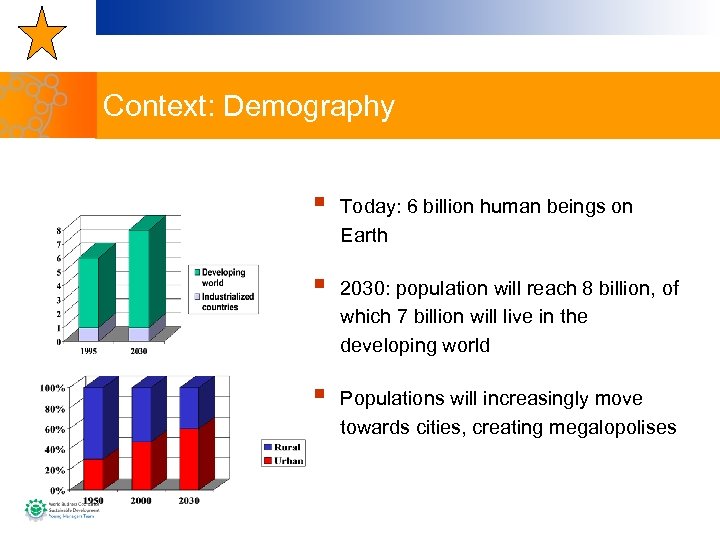
Context: Demography § Today: 6 billion human beings on Earth § 2030: population will reach 8 billion, of which 7 billion will live in the developing world § Populations will increasingly move towards cities, creating megalopolises
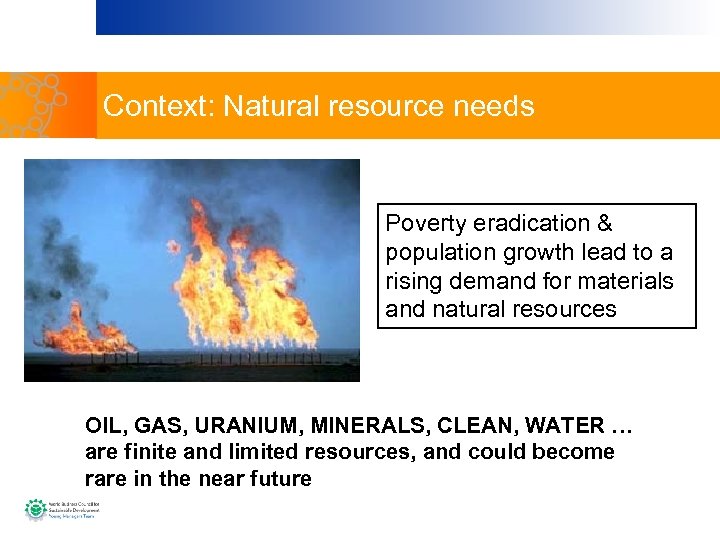
Context: Natural resource needs Poverty eradication & population growth lead to a rising demand for materials and natural resources OIL, GAS, URANIUM, MINERALS, CLEAN, WATER … are finite and limited resources, and could become rare in the near future
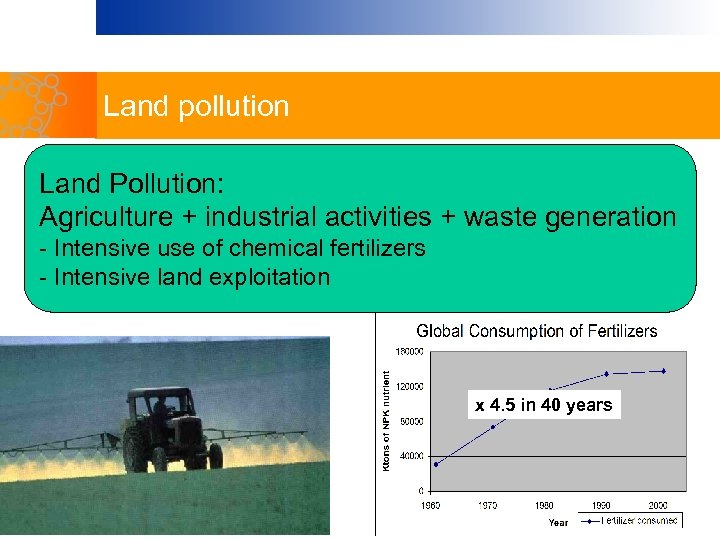
Land pollution Land Pollution: Agriculture + industrial activities + waste generation - Intensive use of chemical fertilizers - Intensive land exploitation x 4. 5 in 40 years
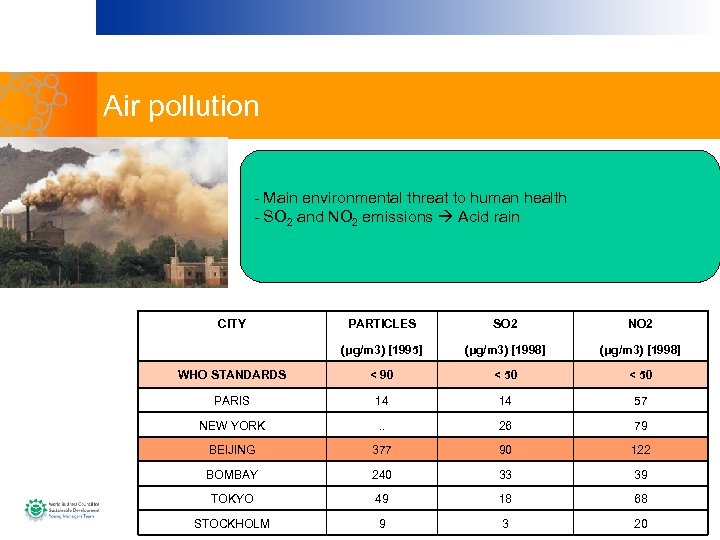
Air pollution - Main environmental threat to human health - SO 2 and NO 2 emissions Acid rain CITY PARTICLES SO 2 NO 2 (μg/m 3) [1995] (μg/m 3) [1998] WHO STANDARDS < 90 < 50 PARIS 14 14 57 NEW YORK . . 26 79 BEIJING 377 90 122 BOMBAY 240 33 39 TOKYO 49 18 68 STOCKHOLM 9 3 20
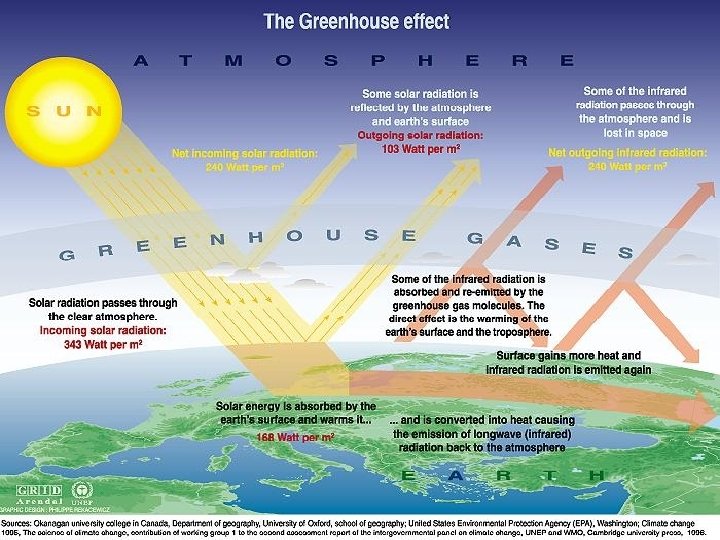
The Greenhouse Effect
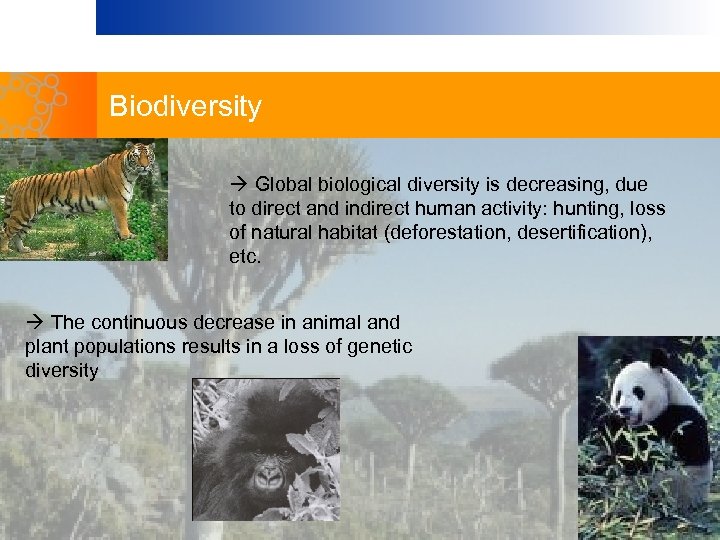
Biodiversity Global biological diversity is decreasing, due to direct and indirect human activity: hunting, loss of natural habitat (deforestation, desertification), etc. The continuous decrease in animal and plant populations results in a loss of genetic diversity
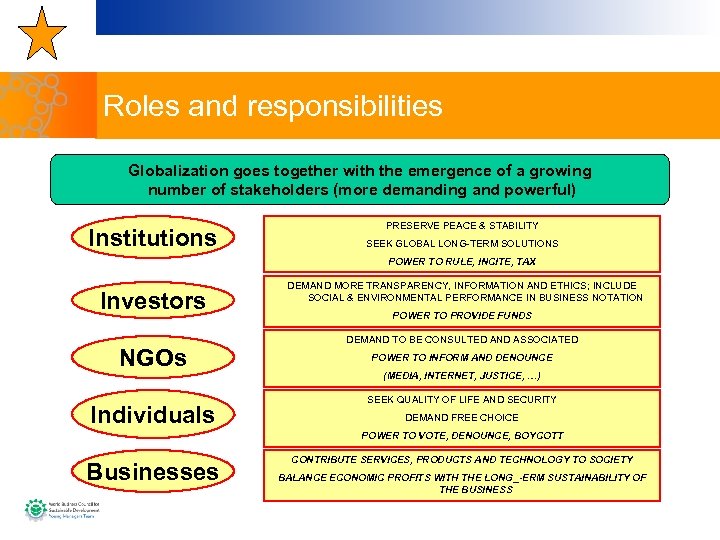
Roles and responsibilities Globalization goes together with the emergence of a growing number of stakeholders (more demanding and powerful) Institutions PRESERVE PEACE & STABILITY SEEK GLOBAL LONG-TERM SOLUTIONS POWER TO RULE, INCITE, TAX Investors NGOs Individuals DEMAND MORE TRANSPARENCY, INFORMATION AND ETHICS; INCLUDE SOCIAL & ENVIRONMENTAL PERFORMANCE IN BUSINESS NOTATION POWER TO PROVIDE FUNDS DEMAND TO BE CONSULTED AND ASSOCIATED POWER TO INFORM AND DENOUNCE (MEDIA, INTERNET, JUSTICE, …) SEEK QUALITY OF LIFE AND SECURITY DEMAND FREE CHOICE POWER TO VOTE, DENOUNCE, BOYCOTT Businesses CONTRIBUTE SERVICES, PRODUCTS AND TECHNOLOGY TO SOCIETY BALANCE ECONOMIC PROFITS WITH THE LONG_-ERM SUSTAINABILITY OF THE BUSINESS
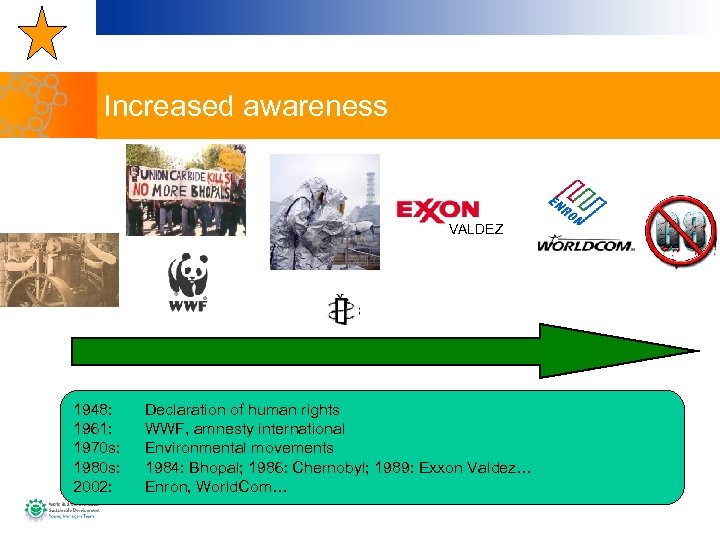
Increased awareness VALDEZ 1948: 1961: 1970 s: 1980 s: 2002: Declaration of human rights WWF, amnesty international Environmental movements 1984: Bhopal; 1986: Chernobyl; 1989: Exxon Valdez… Enron, World. Com…
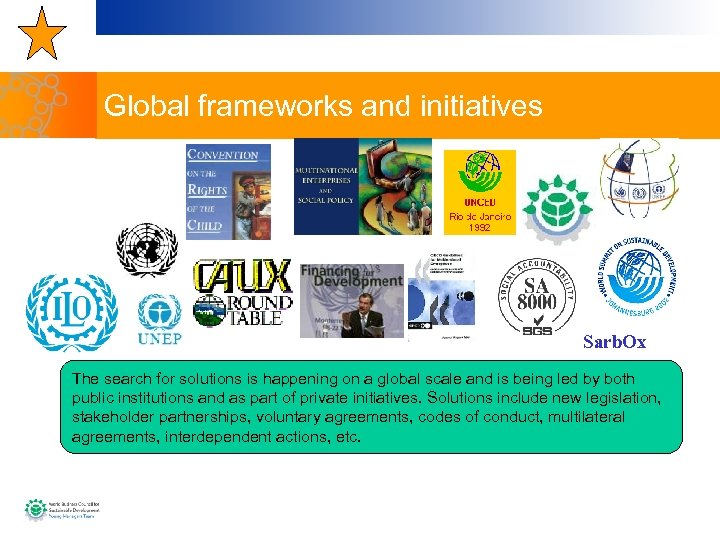
Global frameworks and initiatives Sarb. Ox The search for solutions is happening on a global scale and is being led by both public institutions and as part of private initiatives. Solutions include new legislation, stakeholder partnerships, voluntary agreements, codes of conduct, multilateral agreements, interdependent actions, etc.
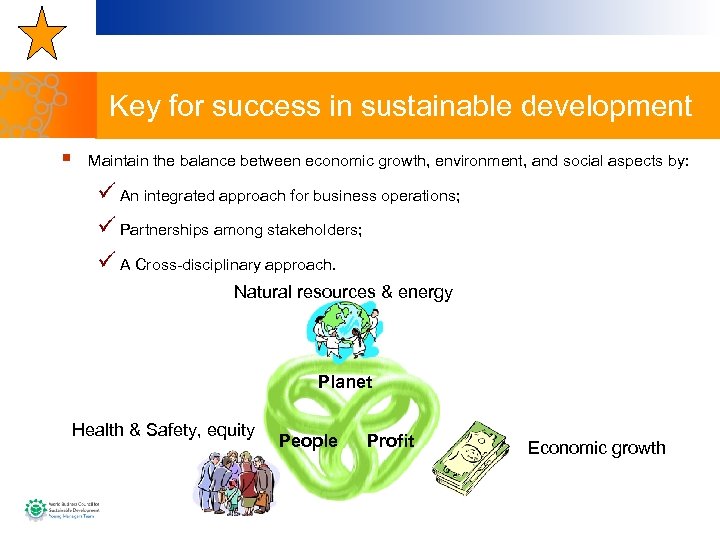
Key for success in sustainable development § Maintain the balance between economic growth, environment, and social aspects by: ü An integrated approach for business operations; ü Partnerships among stakeholders; ü A Cross-disciplinary approach. Natural resources & energy Planet Health & Safety, equity People Profit Economic growth
Structure Sustainable development Facts about China Sustainable development in China Business role and responsibilities Business implementation
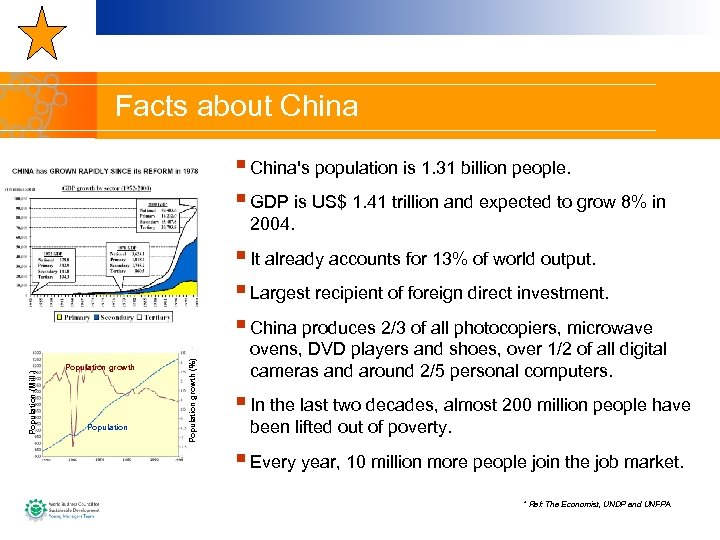
Facts about China § China's population is 1. 31 billion people. § GDP is US$ 1. 41 trillion and expected to grow 8% in 2004. Population growth (%) Population (Mill. ) § It already accounts for 13% of world output. § Largest recipient of foreign direct investment. § China produces 2/3 of all photocopiers, microwave ovens, DVD players and shoes, over 1/2 of all digital cameras and around 2/5 personal computers. § In the last two decades, almost 200 million people have been lifted out of poverty. § Every year, 10 million more people join the job market. * Ref: The Economist, UNDP and UNFPA
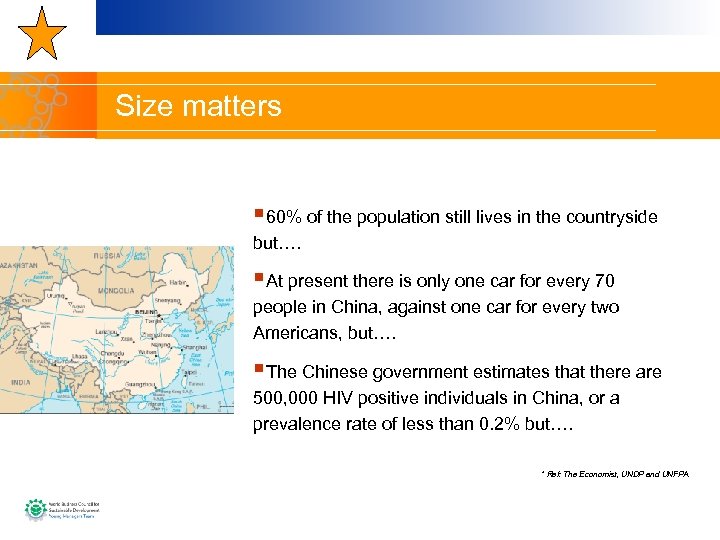
Size matters § 60% of the population still lives in the countryside but…. §At present there is only one car for every 70 people in China, against one car for every two Americans, but…. §The Chinese government estimates that there are 500, 000 HIV positive individuals in China, or a prevalence rate of less than 0. 2% but…. * Ref: The Economist, UNDP and UNFPA
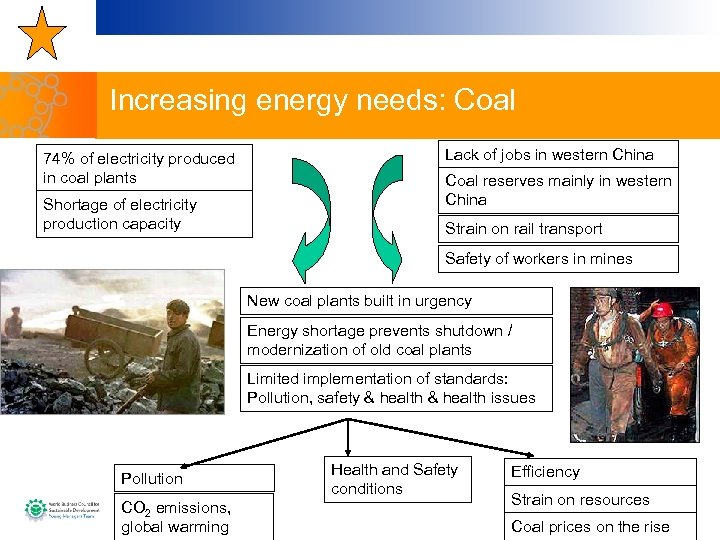
Increasing energy needs: Coal 74% of electricity produced in coal plants Shortage of electricity production capacity Lack of jobs in western China Coal reserves mainly in western China Strain on rail transport Safety of workers in mines New coal plants built in urgency Energy shortage prevents shutdown / modernization of old coal plants Limited implementation of standards: Pollution, safety & health issues Pollution CO 2 emissions, global warming Health and Safety conditions Efficiency Strain on resources Coal prices on the rise
Increasing energy needs: Oil China is the second largest consumer of oil after the USA, and accounts for two-fifths of the increase in global consumption since 2000. China occupies the second place among the major greenhouse gas emitters worldwide (13. 5%). China only has 1. 7% of worldwide oil reserves. Expected % of needs to be imported: 50% in 2010; 85% in 2030.
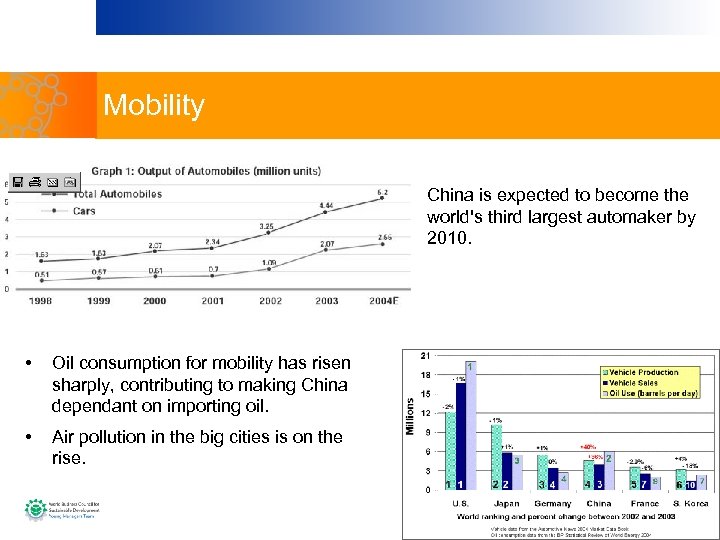
Mobility China is expected to become the world's third largest automaker by 2010. • Oil consumption for mobility has risen sharply, contributing to making China dependant on importing oil. • Air pollution in the big cities is on the rise.
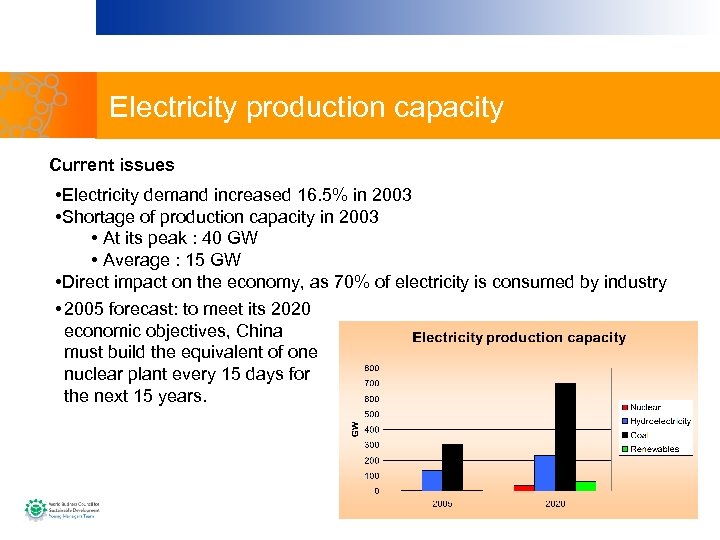
Electricity production capacity Current issues • Electricity demand increased 16. 5% in 2003 • Shortage of production capacity in 2003 • At its peak : 40 GW • Average : 15 GW • Direct impact on the economy, as 70% of electricity is consumed by industry • 2005 forecast: to meet its 2020 economic objectives, China must build the equivalent of one nuclear plant every 15 days for the next 15 years.
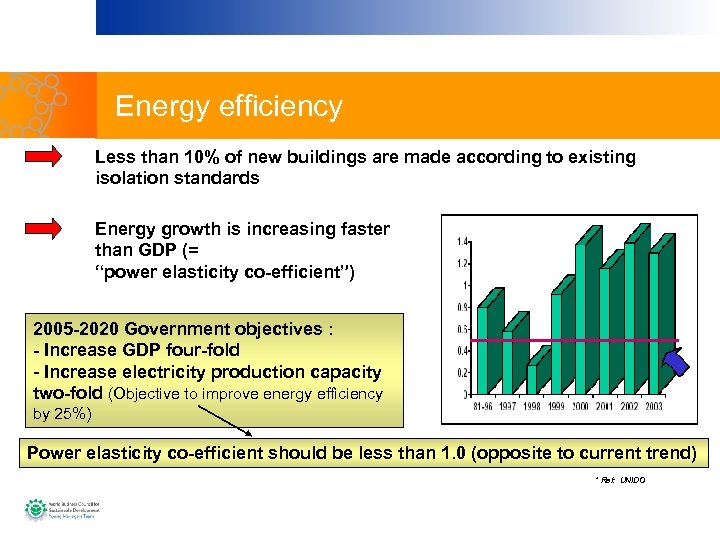
Energy efficiency Less than 10% of new buildings are made according to existing isolation standards Energy growth is increasing faster than GDP (= “power elasticity co-efficient”) 2005 -2020 Government objectives : - Increase GDP four-fold - Increase electricity production capacity two-fold (Objective to improve energy efficiency by 25%) Power elasticity co-efficient should be less than 1. 0 (opposite to current trend) * Ref: UNIDO
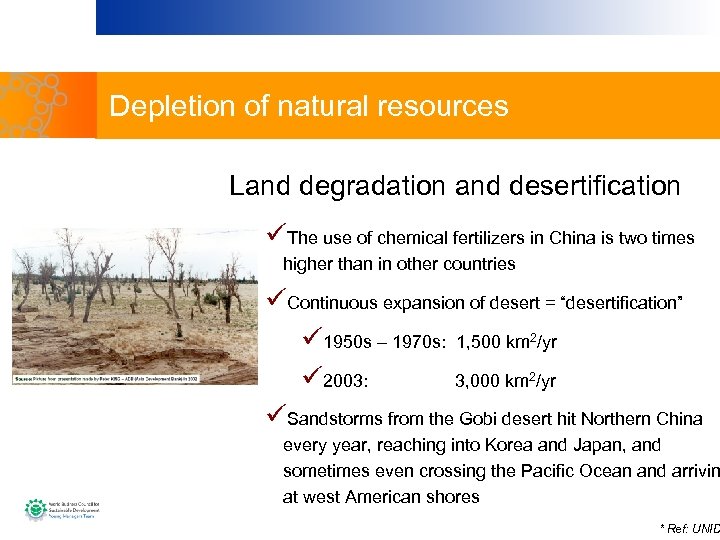
Depletion of natural resources Land degradation and desertification üThe use of chemical fertilizers in China is two times higher than in other countries üContinuous expansion of desert = “desertification” ü 1950 s – 1970 s: 1, 500 km 2/yr ü 2003: 3, 000 km 2/yr üSandstorms from the Gobi desert hit Northern China every year, reaching into Korea and Japan, and sometimes even crossing the Pacific Ocean and arrivin at west American shores * Ref: UNID
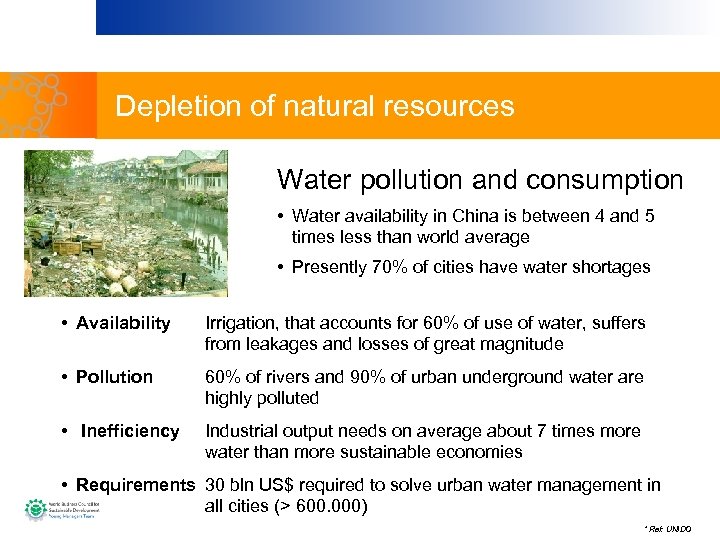
Depletion of natural resources Water pollution and consumption • Water availability in China is between 4 and 5 times less than world average • Presently 70% of cities have water shortages • Availability Irrigation, that accounts for 60% of use of water, suffers from leakages and losses of great magnitude • Pollution 60% of rivers and 90% of urban underground water are highly polluted • Inefficiency Industrial output needs on average about 7 times more water than more sustainable economies • Requirements 30 bln US$ required to solve urban water management in all cities (> 600. 000) * Ref: UNIDO
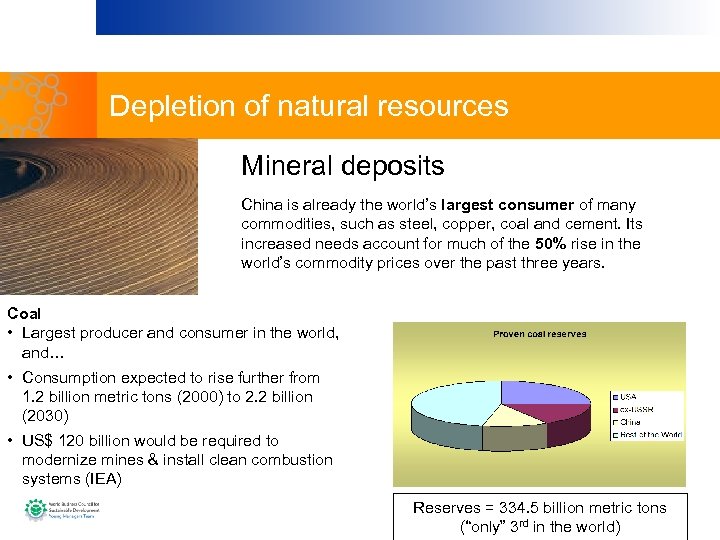
Depletion of natural resources Mineral deposits China is already the world’s largest consumer of many commodities, such as steel, copper, coal and cement. Its increased needs account for much of the 50% rise in the world’s commodity prices over the past three years. Coal • Largest producer and consumer in the world, and… • Consumption expected to rise further from 1. 2 billion metric tons (2000) to 2. 2 billion (2030) • US$ 120 billion would be required to modernize mines & install clean combustion systems (IEA) Reserves = 334. 5 billion metric tons (“only” 3 rd in the world)
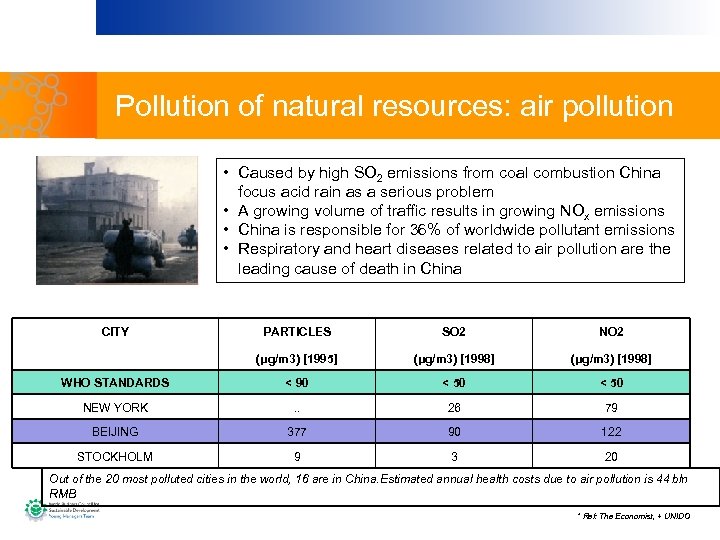
Pollution of natural resources: air pollution • Caused by high SO 2 emissions from coal combustion China focus acid rain as a serious problem • A growing volume of traffic results in growing NOx emissions • China is responsible for 36% of worldwide pollutant emissions • Respiratory and heart diseases related to air pollution are the leading cause of death in China CITY PARTICLES SO 2 NO 2 (μg/m 3) [1995] (μg/m 3) [1998] WHO STANDARDS < 90 < 50 NEW YORK . . 26 79 BEIJING 377 90 122 STOCKHOLM 9 3 20 Out of the 20 most polluted cities in the world, 16 are in China. Estimated annual health costs due to air pollution is 44 bln RMB * Ref: The Economist, + UNIDO
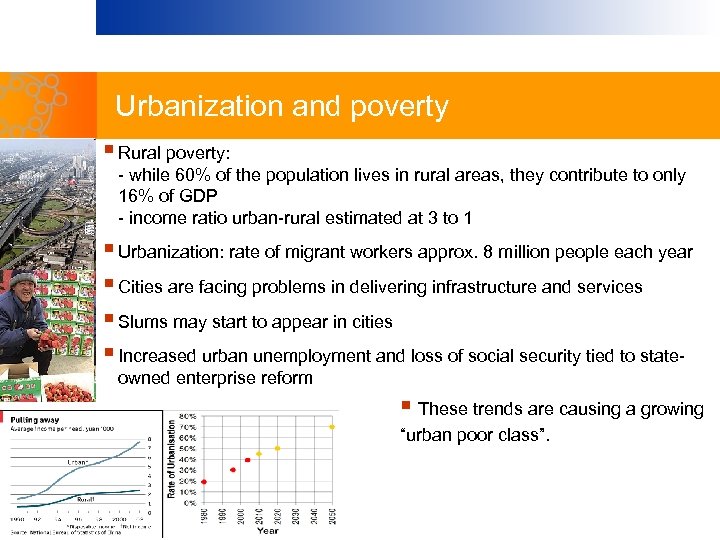
Urbanization and poverty § Rural poverty: - while 60% of the population lives in rural areas, they contribute to only 16% of GDP - income ratio urban-rural estimated at 3 to 1 § Urbanization: rate of migrant workers approx. 8 million people each year § Cities are facing problems in delivering infrastructure and services § Slums may start to appear in cities § Increased urban unemployment and loss of social security tied to stateowned enterprise reform § These trends are causing a growing “urban poor class”.
Structure Sustainable development Facts about China Sustainable development in China Business role and responsibilities Business implementation
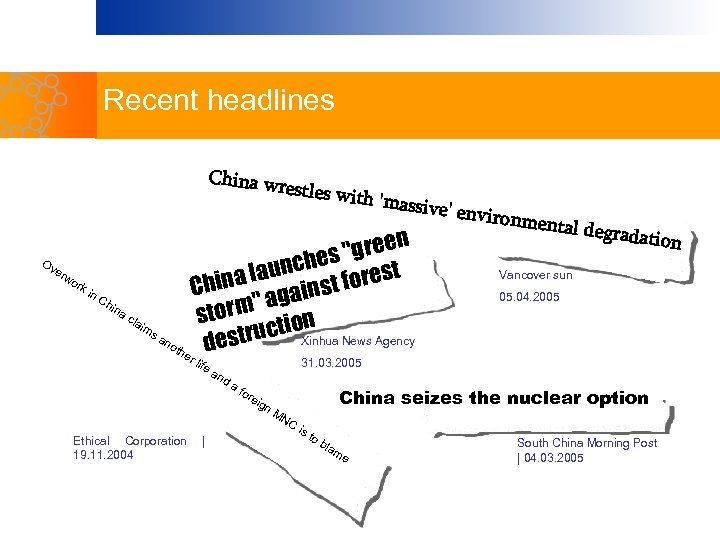
Recent headlines China wr estles wit h 'massiv n "gree s Ov erw unche orest la ork in China gainst f C hin a a c torm" ion s lai ms an struct Xinhua News Agency oth e er d life fo Ethical Corporation | 19. 11. 2004 nmental degradati on Vancover sun 05. 04. 2005 31. 03. 2005 an d a e' enviro rei China seizes the nuclear option gn M NC is to bl am e South China Morning Post | 04. 03. 2005
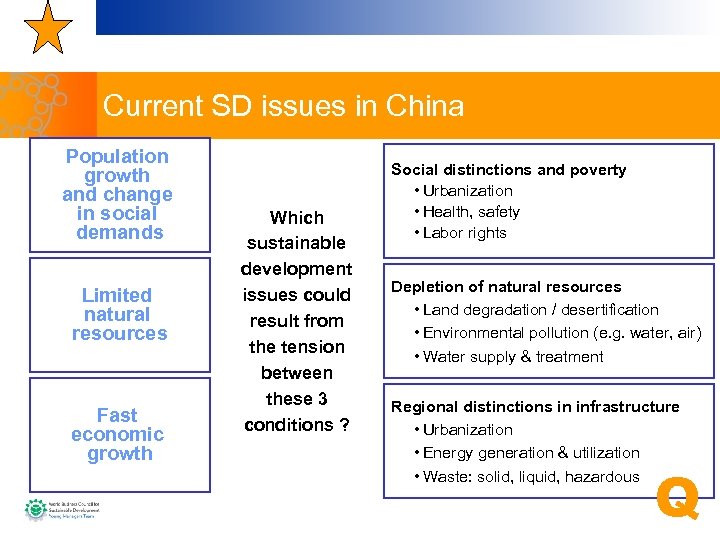
Current SD issues in China Population growth and change in social demands Limited natural resources Fast economic growth Which sustainable development issues could result from the tension between these 3 conditions ? Social distinctions and poverty • Urbanization • Health, safety • Labor rights Depletion of natural resources • Land degradation / desertification • Environmental pollution (e. g. water, air) • Water supply & treatment Regional distinctions in infrastructure • Urbanization • Energy generation & utilization • Waste: solid, liquid, hazardous Q
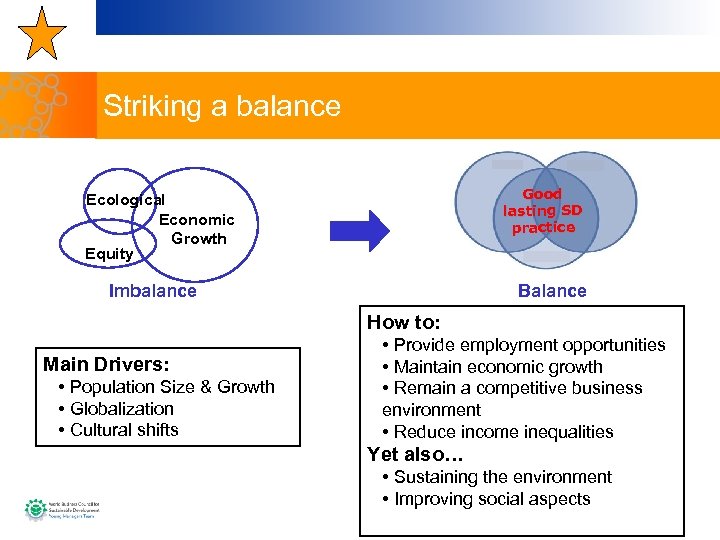
Striking a balance Good lasting SD practice Ecological Economic Growth Equity Imbalance Balance How to: Main Drivers: • Population Size & Growth • Globalization • Cultural shifts • Provide employment opportunities • Maintain economic growth • Remain a competitive business environment • Reduce income inequalities Yet also… • Sustaining the environment • Improving social aspects
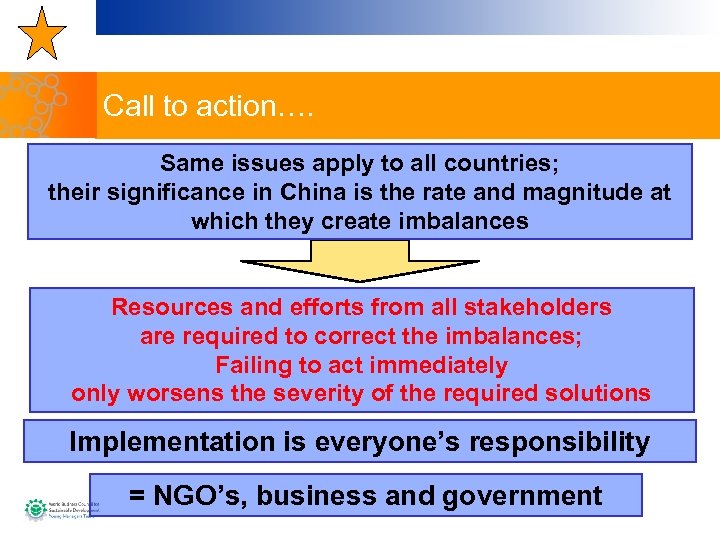
Call to action…. Same issues apply to all countries; their significance in China is the rate and magnitude at which they create imbalances Resources and efforts from all stakeholders are required to correct the imbalances; Failing to act immediately only worsens the severity of the required solutions Implementation is everyone’s responsibility = NGO’s, business and government
Legislation Central government recognizes the need for action. Programs initiated to counter China’s SD challenges: § § § Agenda 21 Millennium Development Goals Xiaokang (1980) & Tenth Five-Year Plan (2001)
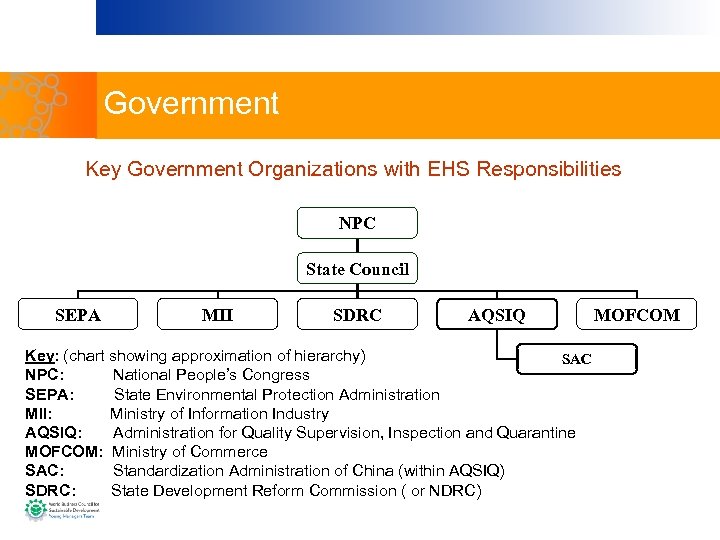
Government Key Government Organizations with EHS Responsibilities NPC State Council SEPA MII SDRC AQSIQ Key: (chart showing approximation of hierarchy) SAC NPC: National People’s Congress SEPA: State Environmental Protection Administration MII: Ministry of Information Industry AQSIQ: Administration for Quality Supervision, Inspection and Quarantine MOFCOM: Ministry of Commerce SAC: Standardization Administration of China (within AQSIQ) SDRC: State Development Reform Commission ( or NDRC) MOFCOM
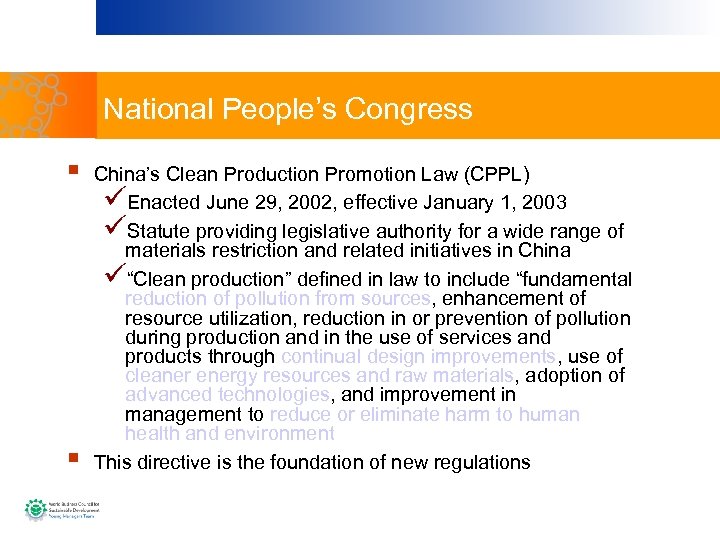
National People’s Congress § § China’s Clean Production Promotion Law (CPPL) üEnacted June 29, 2002, effective January 1, 2003 üStatute providing legislative authority for a wide range of materials restriction and related initiatives in China ü“Clean production” defined in law to include “fundamental reduction of pollution from sources, enhancement of resource utilization, reduction in or prevention of pollution during production and in the use of services and products through continual design improvements, use of cleaner energy resources and raw materials, adoption of advanced technologies, and improvement in management to reduce or eliminate harm to human health and environment This directive is the foundation of new regulations
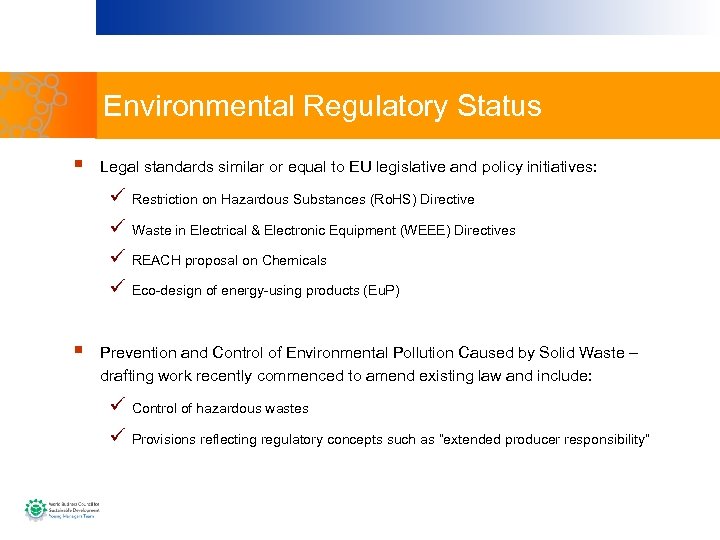
Environmental Regulatory Status § Legal standards similar or equal to EU legislative and policy initiatives: ü Restriction on Hazardous Substances (Ro. HS) Directive ü Waste in Electrical & Electronic Equipment (WEEE) Directives ü REACH proposal on Chemicals ü Eco-design of energy-using products (Eu. P) § Prevention and Control of Environmental Pollution Caused by Solid Waste – drafting work recently commenced to amend existing law and include: ü Control of hazardous wastes ü Provisions reflecting regulatory concepts such as “extended producer responsibility”
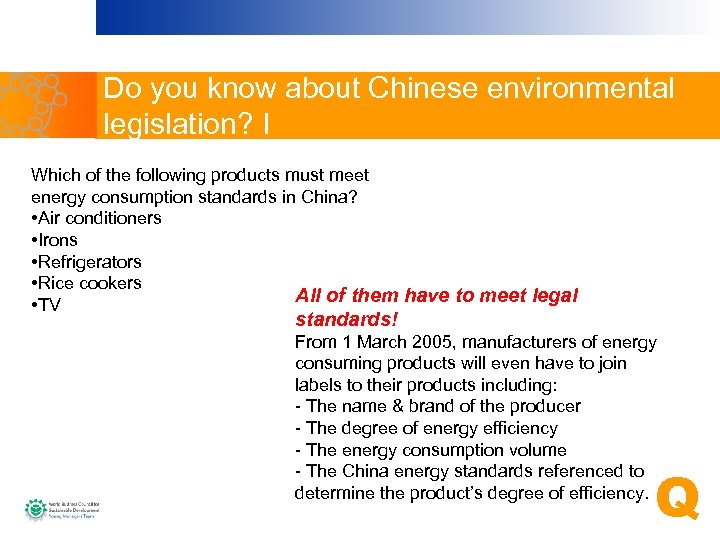
Do you know about Chinese environmental legislation? I Which of the following products must meet energy consumption standards in China? • Air conditioners • Irons • Refrigerators • Rice cookers All of them have to meet legal • TV standards! From 1 March 2005, manufacturers of energy consuming products will even have to join labels to their products including: - The name & brand of the producer - The degree of energy efficiency - The energy consumption volume - The China energy standards referenced to determine the product’s degree of efficiency. Q
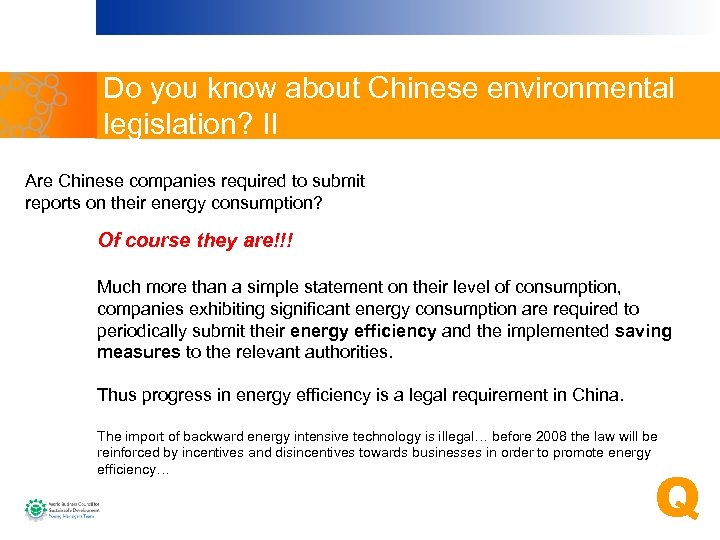
Do you know about Chinese environmental legislation? II Are Chinese companies required to submit reports on their energy consumption? Of course they are!!! Much more than a simple statement on their level of consumption, companies exhibiting significant energy consumption are required to periodically submit their energy efficiency and the implemented saving measures to the relevant authorities. Thus progress in energy efficiency is a legal requirement in China. The import of backward energy intensive technology is illegal… before 2008 the law will be reinforced by incentives and disincentives towards businesses in order to promote energy efficiency… Q
Do you know about Chinese environmental legislation? III The approach to hazardous solid waste identification is defined by the law as the prevention and control of environmental pollution by solid waste. What about liquid waste? The hazardous waste identification approach applies to liquid as well as solid waste. Main aspects of the law are the following : - entities engaged in the business of collecting, storing and disposing hazardous waste shall apply for licenses; - Government may impose discharge fees on those responsible for the waste discharge that do not comply with relevant environmental laws; - Hazardous wastes are listed in an exhaustive catalogue; - Changing the land use of a previously waste dedicated area is submitted to legal control. Q
Do you know about Chinese environmental legislation? IV Is it legal to import waste into China? Waste import is basically forbidden (or at least highly restricted), except when it can be used as raw material. Movements of waste are strictly monitored and controlled. This is true for trans-boundary waste shipment, as well as for waste movements between Chinese provinces. Q
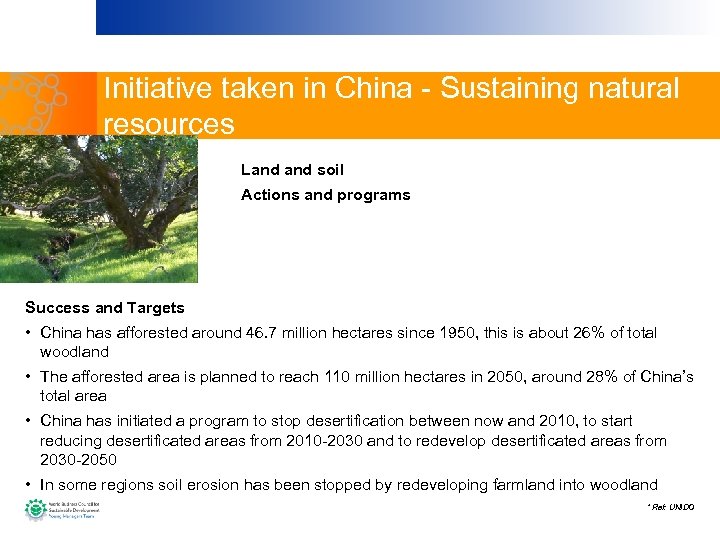
Initiative taken in China - Sustaining natural resources Land soil Actions and programs Success and Targets • China has afforested around 46. 7 million hectares since 1950, this is about 26% of total woodland • The afforested area is planned to reach 110 million hectares in 2050, around 28% of China’s total area • China has initiated a program to stop desertification between now and 2010, to start reducing desertificated areas from 2010 -2030 and to redevelop desertificated areas from 2030 -2050 • In some regions soil erosion has been stopped by redeveloping farmland into woodland * Ref: UNIDO
Structure Sustainable development Facts about China Sustainable development in China Business role and responsibilities Implementation
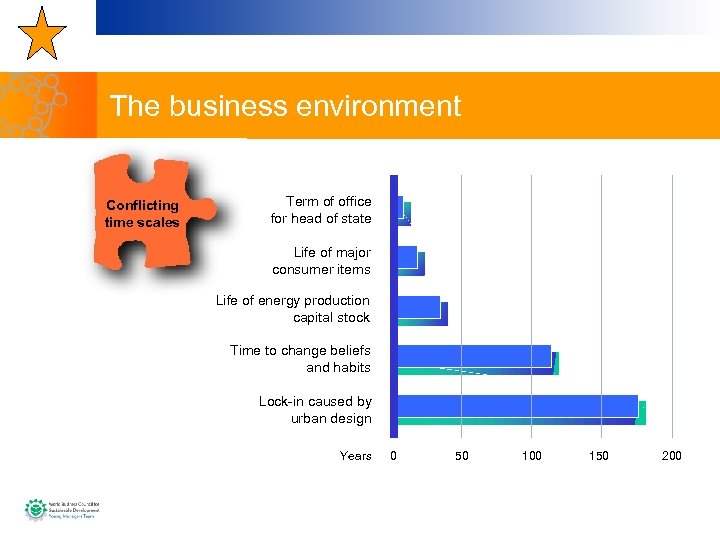
The business environment Conflicting time scales Term of office for head of state Life of major consumer items Life of energy production capital stock Time to change beliefs and habits Lock-in caused by urban design Years 0 50 100 150 200
Business demands § Doing Business in a networked world ü Information, knowledge, people and goods move around the globe as never before. § Beyond compliance, businesses need to meet international agreements & standards ü Investors & international market - increasing demand for sound SD practices ü Trends : accountability and transparency § Companies face increasing and partly conflicting demands from stakeholders: § § § Shareholders - high returns Customers - affordable and high-quality products Public pressure groups - more environmental protection and social engagement Trends – accountability and transparency Employees – safe and healthy workplace with fair compensation
In summary: Why is SD in China so important for businesses? § § China’s environmental impact affects the whole world § § Investors increasingly demand sound SD practices § Olympics scheduled in Beijing in 2008 Great business opportunities for both Chinese and foreign companies ü Major economic growth in China: large country of (potential) consumers ü Economy open to both foreign and local investors ü High quality and availability of labor force Sound SD practices as a criterion in selection of suppliers ü Sound SD practice is becoming a “license-to-export” ü Compliance with global environmental regulations required ü Opportunity to show the world that Chinese business practice includes sound environmental and social management
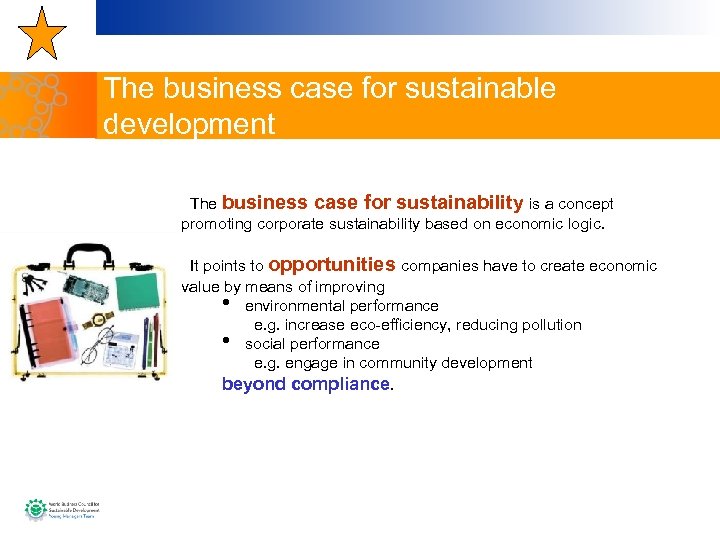
The business case for sustainable development • The business case for sustainability is a concept promoting corporate sustainability based on economic logic. • It points to opportunities companies have to create economic value by means of improving • environmental performance e. g. increase eco-efficiency, reducing pollution • social performance e. g. engage in community development beyond compliance.
Improving business performance Short term § Demand from the emerging world = huge market opportunities § Cleaner & more efficient production = better industrial efficiency and costeffectiveness § More efficient/eco-friendly products = Less use of resources and energy and less waste generation = cost effective for the business and for consumers § § Transparency, social standards, codes of conduct are part of the company‘s image ü Consider local needs and conditions SD policy is taken into account more and more by investment groups and financial analysts = providing the company more financial access (Even stock exchanges are joining the Global Compact!)
From risk to opportunity Longer term § § § Sustainable use of finite resources Minimizing environmental impacts of business operations Enhance stability in the communities where the business operates ü The reduction of regional inequities on a global scale is necessary to preserve the stability that business needs to make profit.
Example: Cleaner production Efficient use of water, energy, raw materials Starting “at the source” (not end-of-pipe) Cost savings on water, energy, raw materials, directly add to bottom-line result Improved efficiency = reduced waste/leakage Technology leadership Contribution to solve environmental issues Positive company reputation C
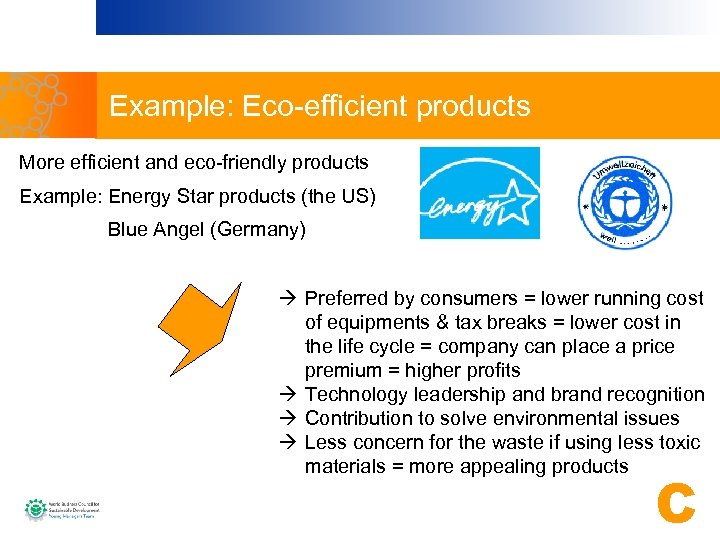
Example: Eco-efficient products More efficient and eco-friendly products Example: Energy Star products (the US) Blue Angel (Germany) Preferred by consumers = lower running cost of equipments & tax breaks = lower cost in the life cycle = company can place a price premium = higher profits Technology leadership and brand recognition Contribution to solve environmental issues Less concern for the waste if using less toxic materials = more appealing products C
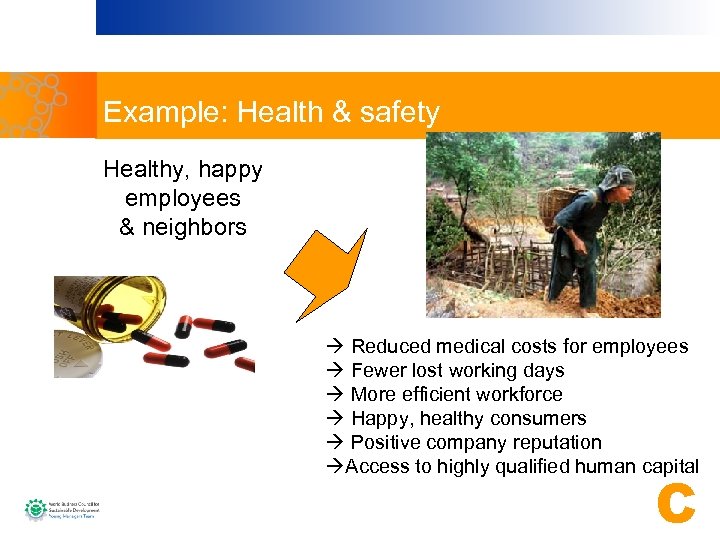
Example: Health & safety Healthy, happy employees & neighbors Reduced medical costs for employees Fewer lost working days More efficient workforce Happy, healthy consumers Positive company reputation Access to highly qualified human capital C
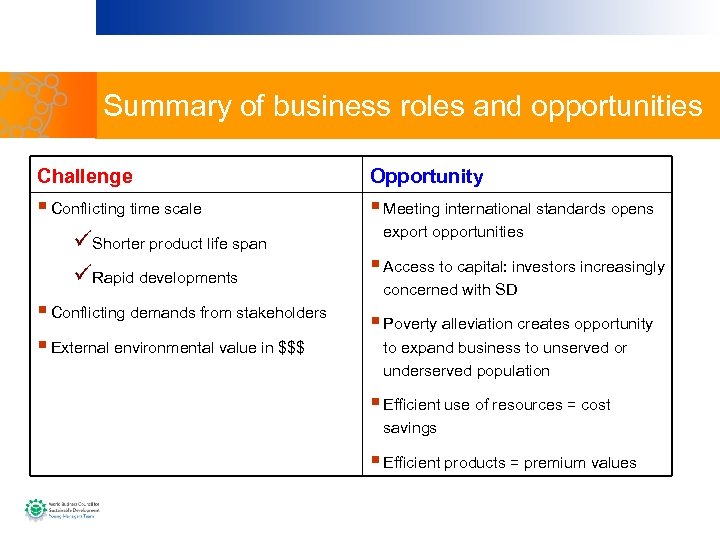
Summary of business roles and opportunities Challenge Opportunity § Conflicting time scale üShorter product life span üRapid developments § Conflicting demands from stakeholders § External environmental value in $$$ § Meeting international standards opens export opportunities § Access to capital: investors increasingly concerned with SD § Poverty alleviation creates opportunity to expand business to unserved or underserved population § Efficient use of resources = cost savings § Efficient products = premium values
Structure Sustainable development Facts about China Sustainable development in China Business role and responsibilities Business implementation
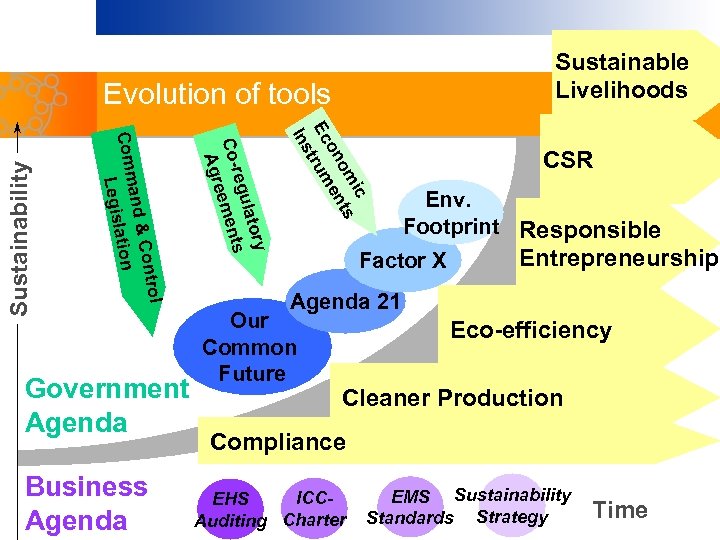
Sustainable Livelihoods Business Agenda ic om ts on en Ec trum Ins Government Agenda ry lato egu s Co-r eement Agr ol Contr and & Comm islation Leg Sustainability Evolution of tools CSR Env. Footprint Responsible Entrepreneurship Factor X Agenda 21 Our Common Future Eco-efficiency Cleaner Production Compliance ICCEHS Auditing Charter EMS Sustainability Standards Strategy Time
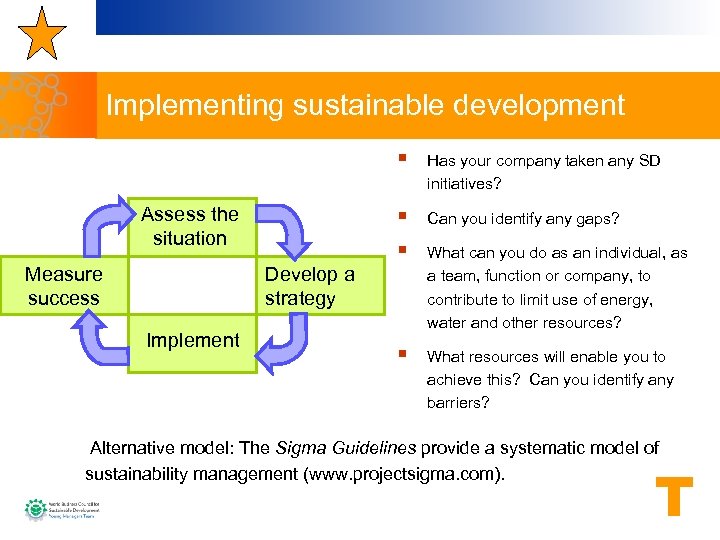
Implementing sustainable development § Assess the situation Measure success Develop a strategy Implement Has your company taken any SD initiatives? § § Can you identify any gaps? § What resources will enable you to achieve this? Can you identify any barriers? What can you do as an individual, as a team, function or company, to contribute to limit use of energy, water and other resources? Alternative model: The Sigma Guidelines provide a systematic model of sustainability management (www. projectsigma. com). T
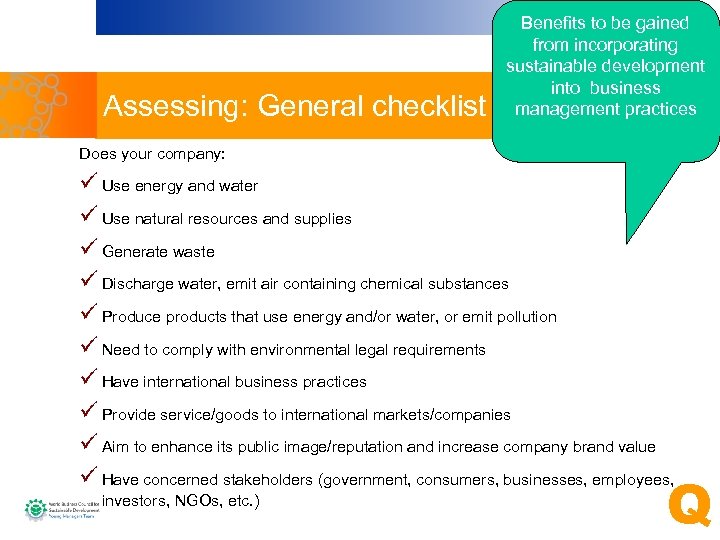
Assessing: General checklist Benefits to be gained from incorporating sustainable development into business management practices Does your company: ü Use energy and water ü Use natural resources and supplies ü Generate waste ü Discharge water, emit air containing chemical substances ü Produce products that use energy and/or water, or emit pollution ü Need to comply with environmental legal requirements ü Have international business practices ü Provide service/goods to international markets/companies ü Aim to enhance its public image/reputation and increase company brand value ü Have concerned stakeholders (government, consumers, businesses, employees, investors, NGOs, etc. ) Q
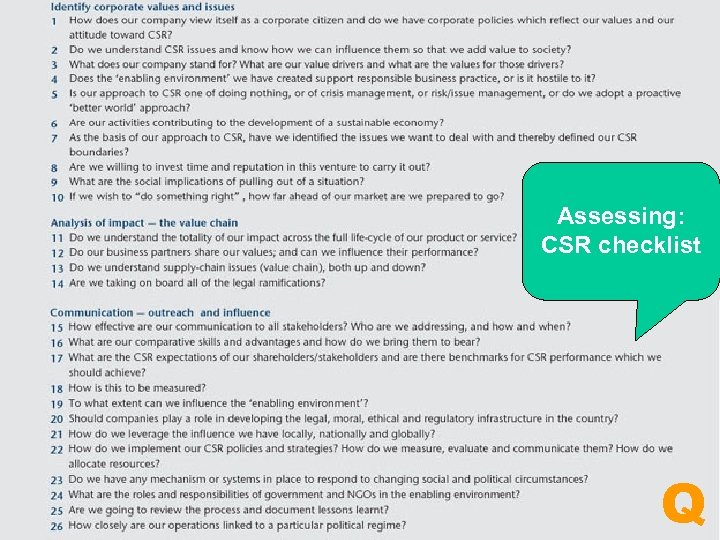
Questions for the board Assessing: CSR checklist Q
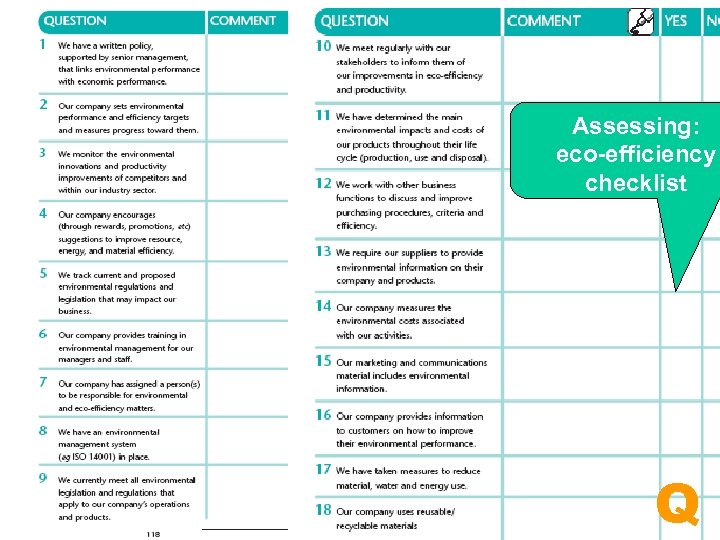
Assessing: eco-efficiency checklist Q
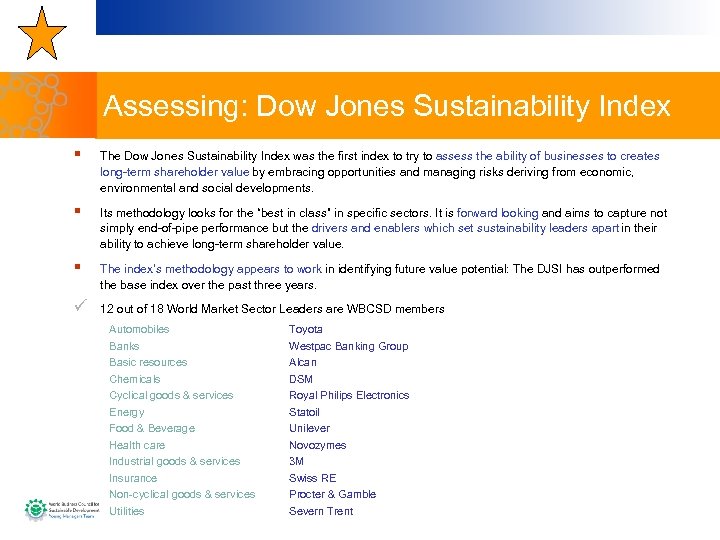
Assessing: Dow Jones Sustainability Index § The Dow Jones Sustainability Index was the first index to try to assess the ability of businesses to creates long-term shareholder value by embracing opportunities and managing risks deriving from economic, environmental and social developments. § Its methodology looks for the “best in class” in specific sectors. It is forward looking and aims to capture not simply end-of-pipe performance but the drivers and enablers which set sustainability leaders apart in their ability to achieve long-term shareholder value. § The index’s methodology appears to work in identifying future value potential: The DJSI has outperformed the base index over the past three years. ü 12 out of 18 World Market Sector Leaders are WBCSD members Automobiles Toyota Banks Basic resources Chemicals Cyclical goods & services Energy Food & Beverage Health care Industrial goods & services Insurance Non-cyclical goods & services Utilities Westpac Banking Group Alcan DSM Royal Philips Electronics Statoil Unilever Novozymes 3 M Swiss RE Procter & Gamble Severn Trent
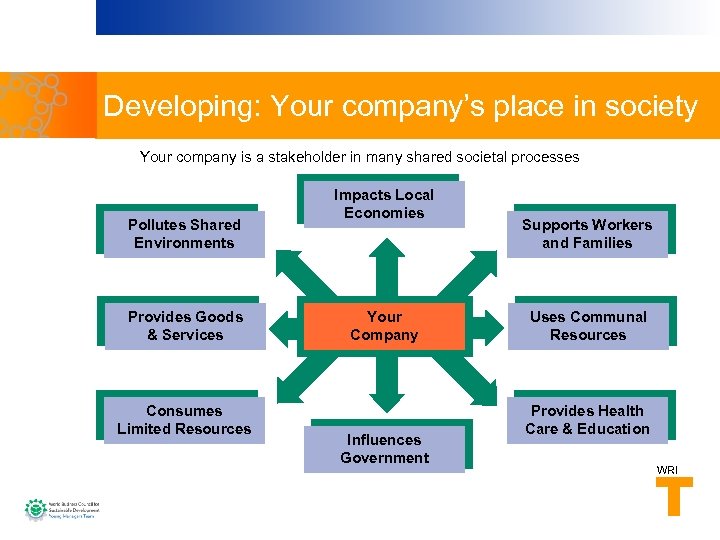
Developing: Your company’s place in society Your company is a stakeholder in many shared societal processes Pollutes Shared Environments Provides Goods & Services Consumes Limited Resources Impacts Local Economies Your Company Influences Government Supports Workers and Families Uses Communal Resources Provides Health Care & Education T WRI
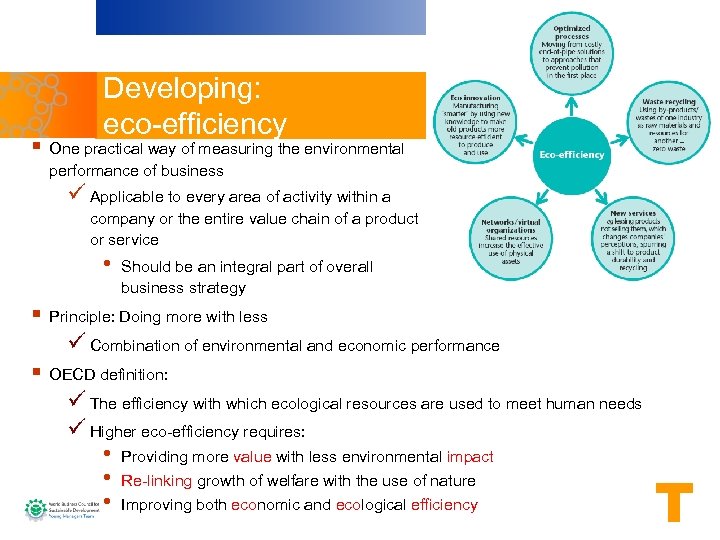
Developing: eco-efficiency § One practical way of measuring the environmental performance of business ü Applicable to every area of activity within a company or the entire value chain of a product or service • Should be an integral part of overall business strategy § Principle: Doing more with less ü Combination of environmental and economic performance § OECD definition: ü The efficiency with which ecological resources are used to meet human needs ü Higher eco-efficiency requires: • Providing more value with less environmental impact • Re-linking growth of welfare with the use of nature • Improving both economic and ecological efficiency T
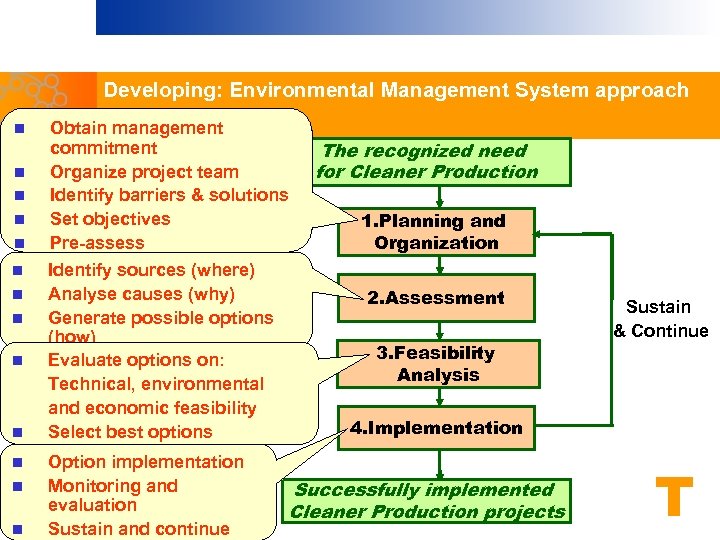
Developing: Environmental Management System approach n n n n Obtain management commitment Organize project team Identify barriers & solutions Set objectives Pre-assess Identify sources (where) Analyse causes (why) Generate possible options (how) Evaluate options on: Technical, environmental and economic feasibility Select best options Option implementation Monitoring and evaluation Sustain and continue The recognized need for Cleaner Production 1. Planning and Organization 2. Assessment 3. Feasibility Analysis Sustain & Continue 4. Implementation Successfully implemented Cleaner Production projects T
Benefits of an environmentally sound business practice (e. g. EMS) üIncreases productivity üReduces production costs üProduces safer and better products üReduces levels of pollution and risk üImproves worker’s safety and health üComplies with Environmental Management Systems (ISO 14000) Recognition from business partners üLink-up with international markets üImproves company image Implementation of EMS in all aspects of business will make a company more profitable and competitive T
Implementing: Chronos -- the WBCSD’s e-learning tutorial • Chronos® is an electronic tutorial designed to increase business interest in, and action on, sustainable development • Developed in partnership with the Cambridge University Programme for Industry • Aims to encourage employees in a wide range of companies and sectors to reflect on personal experiences, explore situations, and hone problem-solving skills www. sdchronos. org T
Implementing: GHG Protocol § The GHG Protocol’s mission is to develop internationally accepted greenhouse gas (GHG) accounting and reporting standards for business and to promote their broad adoption. § The GHG Protocol Initiative comprises two separate but linked standards: ü GHG Protocol Corporate Accounting and Reporting Standard which provides a step-by-step guide for companies to use in quantifying and reporting their GHG emissions) ü GHG Protocol Project Quantification Standard forthcoming, a guide for quantifying reductions from GHG mitigation projects) T
Measuring (codes, frameworks, guidelines): Global Reporting Initiative § The Global Reporting Initiative (GRI) Sustainability Guidelines are the first attempt to develop a generalized set of sustainability indicators for organizations. § It has become the main point of reference for companies that produce sustainability reports, although only a minority are able to claim their reports are “in accordance” with the Guidelines. § The Guidelines’ development is influenced by companies through a structured dialogue process and the GRI’s multi-stakeholder governance process. § The GRI has well developed linkages with other standards within an emerging “global architecture”. (e. g. AA 1000 Assurance Standard, UN Global Compact, etc. ) § (www. globalreporting. org). T
Measuring (codes, frameworks, guidelines): Global Compact § This international partnership brings together UN agencies, business, civil society and public sector organizations. Membership is based on a highlevel commitment to its ten principles, derived from key UN and international declarations on labor, human rights, and the environment. § The principles themselves are not new, but by bringing internationally accepted standards together and framing them as business commitments, the UN Global Compact has set a principle-based global benchmark form corporate citizenship. § It is seen as one of the most significant institutions working to align business and sustainable development. But while more than 1, 200 companies have signed up, including 200 large multinationals, very few major US companies have joined. § www. unglobalcompact. org T
Measuring (codes, frameworks, guidelines): OECD Guidelines for Multinational Enterprises § The OECD Guidelines for Multinational Enterprises are the closest thing we have to an comprehensive global corporate code of conduct. It is a key reference point of international norms for business. § While the Guidelines are non-binding on businesses, adhering governments are committed to promoting them and to making them influential among companies operating in or from their territories. T
Case in Point Stakeholder dialogue to partnerships: Degussa Summary: Degussa AG with support from DEG (a German investment and development company), in a public-private partnership, conducted a series of training events in Beijing for employees of Chinese paper mills on how to optimize wastewater circuits (2004 -2005). Drivers/Benefits: To help paper mills reduce their amount of wastewater. Results so far: One paper mill implementing zero-effluent technology; several mills short-listed as “Nations Model Clean Production Enterprise”. Key success factors: Expert knowledge, working in a public-private partnership, drive of participants to transfer training into practice. C
Case in Point Stakeholder dialogue to partnerships: ABB Summary: ABB, with the Alliance for Global Sustainability, devised the China Energy Technology Program (CETP), an extensive partnership program bringing together a diverse group of participants to assess the relative costs and environmental performance of different strategies for meeting power demand in China. Drivers/Benefits: To identify the true costs of electrical power generation and use and develop cost-effective and efficient solutions for the future, to bring significant environmental benefits, not just to China, but globally. Key success factors: Active involvement and participation of academia, industry and the stakeholders involved. C
Case in Point Energy recovery facilities: CH 2 M HILL Summary: CH 2 M HILL was hired to assist the State Environmental Protection Agency of China to advise on technical and economic feasibility and construction requirements for energy recovery facilities at municipal waste landfills. Drivers/Benefits: Promote better waste management practices, rewarded with economic benefits from selling recovered methane as fuel. Challenges: Institutional barriers to progress; communication & translation problems, funding difficulties Key success factors: Commitment from all; quality communication and translation; careful choice of the host country lead agency C
Case in Point Local and global standards: Lafarge Summary: Lafarge and Du. Jiang. Yan Building Materials Co. , joint venture agreement to construct a new cement plant in Cheng. Du, Sichuan province, in line with latest technology, quality and safety standards. Drivers/Benefits: For Lafarge -- establishment of substantial & profitable position in region, where an accelerated infrastructure development program fuels increase in demand for high quality cement; for Chinese government -- strategic importance for regional economic development & to reduce persistent supply/demand gap in the region. Challenges: Quality control during construction, cultural differences, implementing safety practices, Song relics on site, heavy rains. Key success factors: Financial strength and technical support; strong management team; good working relations between Chinese and foreign partners; Government support; listening to the different parties. C
Case in Point Introducing EMS: Automobile Company in Anhui Summary: This Chinese automobile company first started production in 1968. It went from a loss-making venture with revenue of less than 3 million RMB in 1990 to one of the most important Chinese automobile producers with 5 wholly owned subsidiaries and revenues of 26 billion RMB in 2000. Drivers/Benefits: Systemization of processes & operations and introduction of EMS increased efficiency and quality, timely delivery to customers, reduced waste, improved company image. Challenges: Culture change within the company needed; long-term process. Key success factors: Strong management vision, employee commitment, good cooperation with local government, starting from “at-the-source” principles as opposed to “end-of-pipe”. From “Greening Chinese Business” by Ulrich Steger, Fang Zhaoben and Lu Wei C
Case in Point Responsible care auditing: BASF Summary: BASF systematically conducts Responsible Care (RC) audits of its service suppliers; RC = a voluntary improvement process of the chemical industry, dealing with Environment, Health and Safety (EHS). Drivers/Benefits: The systematic method provides a tool to evaluate supplier site risks, in order to select the best alliance partner and to deliver a contribution to society and the environment; contributes to positive company reputation. Challenges: Investment in time and effort from both auditing company and service supplier. Key success factors: Systematic, realistic method and timescale, using principle of risk = EHS performance x hazard potential; good collaboration between service provider and (potential) customer. C
Case in Point “Global” standards: DSM Summary: Jinling-DSM Resins is a Chinese-Dutch joint venture producing resins in Nanjing. Employment conditions of its 17 temporary workers were improved to a level in between those of surrounding temporary workers and employees. Drivers/Benefits: Achieving the optimum, realistic balance between international standards and local circumstances. Challenges: Building on the inheritance of a non-greenfield operation; different cultural perceptions of appropriate employment conditions for temporary and permanent workers. Key success factors: Open discussion between management and employees; finding the optimum mix between foreign views and local culture and habits. C
Case in Point Sustainable use of waste: Novozymes Summary: Novozymes supplies treated wastewater and converted biomass from its production processes free of charge to TEDA to be used for irrigation and as biological fertilizer (Novo. Gro). Drivers/Benefits: Sustainable use of wastes, reduced consumption of limited resource, support for eco-industry, responsible neighbor and good company reputation Challenges: Infrastructure for storage and transportation of treated wastewater, composting and expanded application of Novo. Gro to ensure more sustainable use. Key success factors: Close cooperation with TEDA, advanced waste treatment technology, experience in the production and application of Novo. Gro from Europe and US. C
Case in Point: Fuyang Chemical General Works Summary: Chinese fertilizer plant, in collaboration with Chinese authorities and CIDA implemented Cleaner Production, starting with zero- and low-cost measures and continuing by implementing medium cost measures. Drivers/Benefits: Enabled reduction of product losses, efficient use of raw materials and energy, reduced emissions, reduced waste, healthier working environment, increased revenues, improved company reputation. Challenges: Collaboration between parties with different experience levels, overcome initial investment requirements for medium cost measures. Key success factors: Management commitment & employee participation, tackling zero- and low-cost elements first, partnership with Chinese government, training & sharing of information, stimulating gender equity. From the China-Canada Cooperation Project in Cleaner Production “Picking Low-hanging Fruit: The Strategic Role of CP in China” by M. Osterman, LL. L. CEA C
“There will be no sustainable world without a sustainable China”
Скачать презентацию Presentation Pack Corporate responsibility and business success in
db6a1bdb9dee99e8f0ee864a2d529a28.ppt