


 Скачать презентацию Presentation Outline Introduction Space in Modern Life Why
9d5bcdb63b2c29c085e101abb7ce4332.ppt
- Количество слайдов: 8
 Presentation Outline Introduction ¨Space in Modern Life ¨Why & How ? n Israel in Space n Strategic Methodology n ISA - CNES Joint Initiative: (VENµS) Vegetation and Environment monitoring New µicro- Satellite n Concluding Remarks n 18/03/2018 2
 Presentation’s Outline n Introduction Ø Space in Modern Life Ø Why & How ? n n Israel in Space ISA - CNES Joint Initiative: (VENµS) Vegetation and Environment Monitoring New µicro- Satellite n n Future Programs Concluding Remarks 18/03/2018 3
 SPACE TODAY The conquest of “SPACE” is recent in mankind history only 65 years ago first rockets, 50 years ago first artificial moon -“Sputnik” 40 years ago first human stepping on the moon Yet Space R&D is Essential: for exploring and understanding the universe n for the protection of life on our planet n as a key for the existence of modern society and developed an economy based on a “know-how” n for inspiring and educating our young generation n for security and defense n 18/03/2018 4
 Presentation’s Outline n Introduction Ø Space in Modern Life Ø Why & How ? n n Israel in Space ISA - CNES Joint Initiative: (VENµS) Vegetation and Environment Monitoring New µicro- Satellite n n Future Programs Concluding Remarks 18/03/2018 5
 SPACE TODAY The conquest of “SPACE” is recent in mankind history only 65 years ago first rockets, 50 years ago first artificial moon -“Sputnik” 40 years ago first human stepping on the moon Yet Space R&D is Essential: for exploring and understanding the universe n for the protection of life on our planet n as a key for the existence of modern society and developed an economy based on a “know-how” n for inspiring and educating our young generation n for security and defense n 18/03/2018 6
 Space Evolution -Lessons Learned n Response to National or Specific Defense Needs n Transfer to Civilian Applications- “Dual Use” n A Core of Scientific or Technology “Breakthrough” Enables Usage, or a Driver for Services’ Cost Reduction Often, A Strategic Decision Established by Policy Makers 18/03/2018 7
 Israel’ Space Past to Present
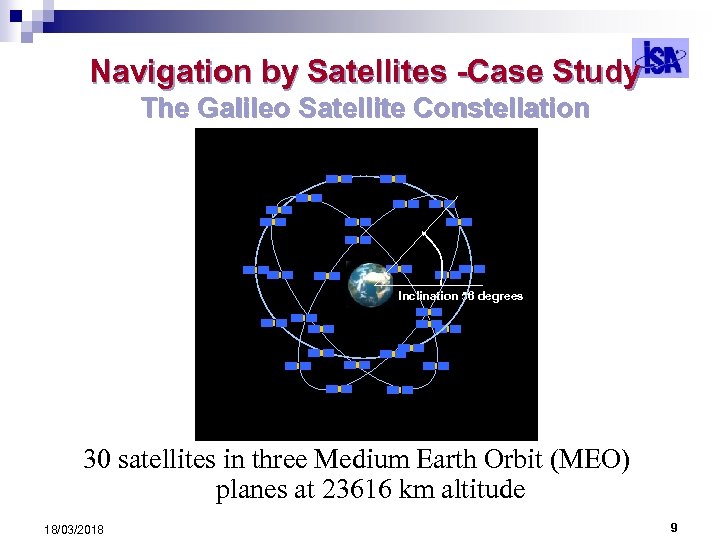 Navigation by Satellites -Case Study The Galileo Satellite Constellation Inclination 56 degrees 30 satellites in three Medium Earth Orbit (MEO) planes at 23616 km altitude 18/03/2018 9