 Скачать презентацию Presentation on the topic Russia by Den Nezhevlyak
Russia.pptx
- Количество слайдов: 10



Presentation on the topic: Russia by. Den Nezhevlyak
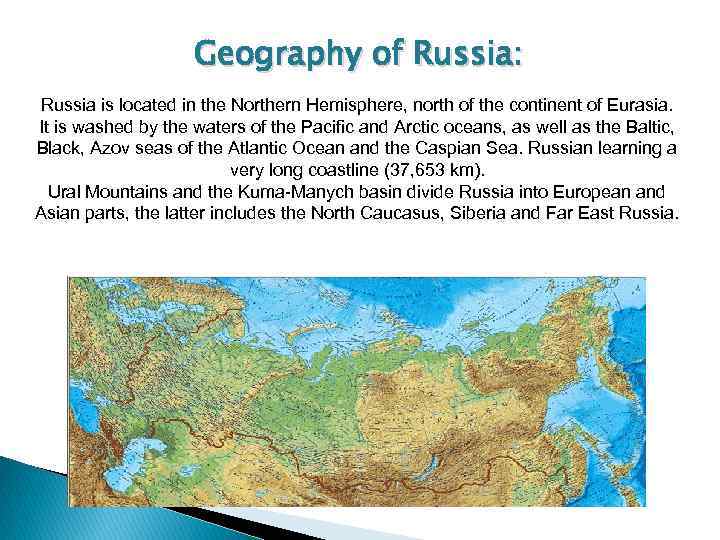
Geography of Russia: Russia is located in the Northern Hemisphere, north of the continent of Eurasia. It is washed by the waters of the Pacific and Arctic oceans, as well as the Baltic, Black, Azov seas of the Atlantic Ocean and the Caspian Sea. Russian learning a very long coastline (37, 653 km). Ural Mountains and the Kuma-Manych basin divide Russia into European and Asian parts, the latter includes the North Caucasus, Siberia and Far East Russia.
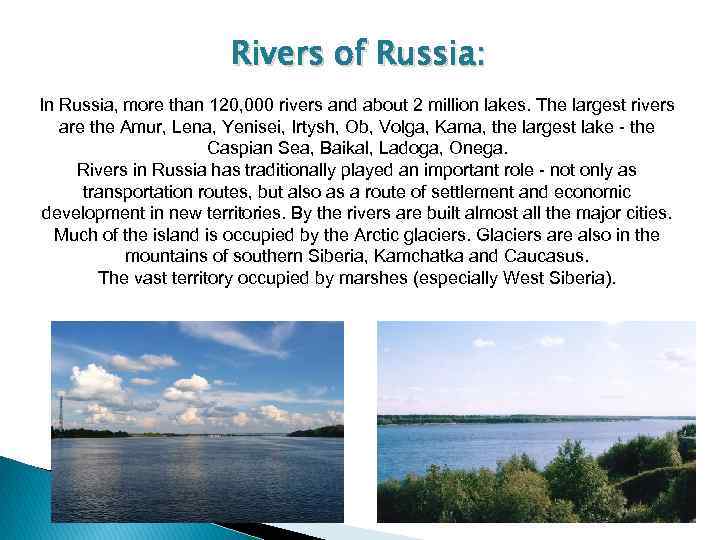
Rivers of Russia: In Russia, more than 120, 000 rivers and about 2 million lakes. The largest rivers are the Amur, Lena, Yenisei, Irtysh, Ob, Volga, Kama, the largest lake - the Caspian Sea, Baikal, Ladoga, Onega. Rivers in Russia has traditionally played an important role - not only as transportation routes, but also as a route of settlement and economic development in new territories. By the rivers are built almost all the major cities. Much of the island is occupied by the Arctic glaciers. Glaciers are also in the mountains of southern Siberia, Kamchatka and Caucasus. The vast territory occupied by marshes (especially West Siberia).
Climate of Russia: The position of Russia in the northern part of Eurasia (the territory of the country lies mainly north of 50 °. M. ) Caused its placement in the arctic, subarctic, temperate and partly in subtropical climates. The majority of the territory is located in the temperate zone. A variety of climate also depends on the topography and the proximity or remoteness of the ocean. Latitudinal zonality is most evident in the plains. The most complete range of natural areas distinguishes the European part of the country, where a north-south zone is consistently replaced by arctic desert, tundra, forest tundra, boreal forest, mixed forest, forest steppe, semi-desert. With the advancement in the east the climate becomes more continental, the number of natural areas in the same latitudinal range is greatly reduced. Average temperatures in January, according to different regions, ranging from 6 to -50 ° C, from 1 July to 25 ° C; precipitation ranging from 150 to 2000 mm per year. Permafrost occupies 65% of Russian territory. Over 70% of Russian territory - a zone of risky agriculture. Growing season in most parts of Russia takes 2 -3 months. At the same time, Russia has 10% of all arable land in the world. The highest temperature ever recorded in the territory of modern Russia was +45, 4 ° C. The lowest temperature was recorded informally in Oymyakon academician Sergei Obruchev winter 1924 and amounted to -71, 2 ° C.
Flora and fauna: Forests cover 40% of the territory. On the territory of Russia is one-fifth of the world's forests and half of the world's coniferous forests. The fauna is diverse and is home to polar bears and walruses and tigers, and leopards, and others In Russia there are 35 national parks and 84 reserves. The country's only national park, located in the city - Omsk "Bird Harbor. "
Public and political structure of Russia: Russia - a federal democratic presidential-parliamentary republic with broad powers of the president. Russia's constitution approved by referendum on December 12, 1993. Head of State - President of Russia, elected by popular vote. Legislative power is vested in the Federal Assembly - the parliament, consisting of the top (the Federation Council) and lower (State Duma) chambers. Executive power is exercised by the Government. Judicial power is exercised by the courts: the Constitutional Court, courts of general jurisdiction, headed by the Supreme Court and the tribunals, headed by the Supreme Arbitration Court.
Foreign policy and international relations: Russia - one of the key players in international communication. As one of the five permanent members of UN Security Council remains one of the traditional great powers, [and is responsible for the maintenance of international peace. Russia is also a "Big Eight" industrialized countries. Is a member of a large number of other international organizations, including the Council of Europe and OSCE. A special place is occupied by the organization, created in the former USSR, mainly under the leadership of Russia: CIS, Eur. As. EC, CSTO and SCO. Russia together with Belarus Union State account. Russia's foreign policy is determined by the President and implemented by the Ministry of Foreign Affairs. Russia is pursuing a multi-vectored foreign policy. It maintains diplomatic relations with 191 countries, has diplomatic missions in 144 countries. Russia does not have diplomatic relations with Georgia, Bhutan, Tuvalu and Solomon Islands.

The federal structure of Russia - a country with a federal structure. The Russian Federation 83 peer entity, including the 21 republics, 9 territories, 46 regions, 2 federal cities, 1 autonomous region, 4 autonomous districts. Localities have their own administrative-territorial division. As a rule, the basic units in the subject areas and cities are the national (regional, regional) values.
The population of Russia: The first general census of the Russian Empire was held in 1897 and showed a population of 67 million 473 thousand people. The population of Russia in 2002 amounted to 145, 166, 731 people, representatives of more than 180 nationalities At the end of the twentieth century, the beginning of the twenty-first appeared in Russia's demographic crisis (ie, people died than were born. ) In recent years there has been a gradual improvement of the demographic situation. The resident population of the Russian Federation on June 1, 2009 amounted to 141 million 846 thousand 679 people. Resettlement: Most of Russia's population is concentrated in the main strip of settlement - a triangle whose vertices are the Saint-Petersburg, Sochi and Irkutsk. In Siberia, an area of nearly 3/4 in Russia, lives less than a quarter of the population. The western and central parts of European Russia, the most densely populated and urbanized. These areas are the largest cities of Russia and the traditional centers of culture and industry. In Siberia, the population is concentrated along the route of the Trans-Siberian Railroad, and in the Kuznetsk coal basin.
Religion in Russia: Russia is a secular state. The Constitution guarantees "freedom of conscience, freedom of religion, including the right to profess, individually or jointly with others any religion or no religion, to freely choose, possess and disseminate religious and other beliefs and act in accordance with them. " In Russia, are Christian (mainly Orthodox), Islam, Buddhism, Judaism, paganism and other religions. According to opinion polls conducted in January 2010, the share of Russian citizens consider themselves Orthodox, increased in 2009 from 70 to 75%.
Скачать презентацию Presentation on the topic Russia by Den Nezhevlyak
Russia.pptx