


 Скачать презентацию Presentation on social welfare entitlements University of Limerick
85b455b75f26d0b2ddaa0840c19d0757.ppt
- Количество слайдов: 43
 Presentation on social welfare entitlements University of Limerick Thursday, 14 th July 2016
 Main topics covered in this presentation 1. Social insurance contributions 2. Jobseeker’s Benefit 3. State Pension (Contributory)
 Important Question Will you work your entire career in the public sector? • If you started working in public sector employment before 6/4/95 and • you have spent all your career to date in the public sector and • you intend to remain in public sector employment for the remainder of your career then the only SW payment that may apply in your case is Widow/er’s or Surviving Civil Partner’s (Contributory) Pension.
 Part 1 Social Insurance Contributions
 Types of social insurance contributions • Paid, Credited and Voluntary contributions All contributions are divided into classes: • Classes A, E, F, G, H and N are known as fullrate contributions • Classes B, C & D are reduced-rate contributions. • Each Class of contribution gives entitlement to different social welfare benefits.
 Class A Contributions Provide cover for 12 benefits including • State Pension (Contributory) • Widow/er’s or Surviving Civil Partner’s (Contributory) Pension. • Invalidity Pension • Jobseeker’s Benefit (previously known as Unemployment Benefit)
 Class D Contributions Provide cover for 4 benefits as follows: • Widow/er’s or Surviving Civil Partner’s Contributory Pension • Guardian’s Payment (Contributory) • Limited Occupational Injuries Benefit • Carer’s Benefit Note: Class D does not provide cover for a standard State Pension (Contributory) or Jobseeker’s Benefit.
 Who pays the different types of contributions? Class A are paid by • People in private sector employment • civil and public servants recruited on or after 6/4/95 Classes B & D are paid by • Civil & Public servants recruited before 6/4/95 Class S are paid by self-employed people
 Part 2 Jobseeker’s Benefit
 Jobseeker’s Benefit To qualify for JB, you must • be unemployed (for at least 4 days out of 7 consecutive days). • be aged 18 to 65 • satisfy certain PRSI (Class A) conditions • have sustained a substantial loss of employment and be • available for work • capable of work • genuinely seeking full-time work
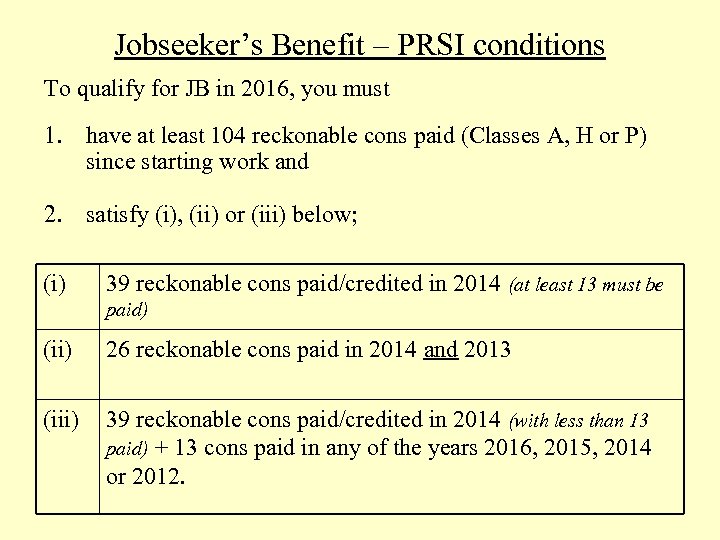 Jobseeker’s Benefit – PRSI conditions To qualify for JB in 2016, you must 1. have at least 104 reckonable cons paid (Classes A, H or P) since starting work and 2. satisfy (i), (ii) or (iii) below; (i) 39 reckonable cons paid/credited in 2014 (at least 13 must be paid) (ii) 26 reckonable cons paid in 2014 and 2013 (iii) 39 reckonable cons paid/credited in 2014 (with less than 13 paid) + 13 cons paid in any of the years 2016, 2015, 2014 or 2012.
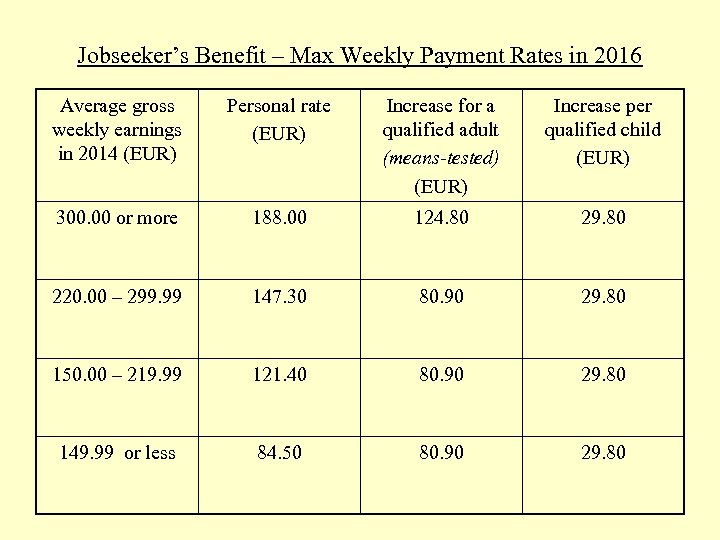 Jobseeker’s Benefit – Max Weekly Payment Rates in 2016 Average gross weekly earnings in 2014 (EUR) Personal rate (EUR) Increase for a qualified adult (means-tested) (EUR) Increase per qualified child (EUR) 300. 00 or more 188. 00 124. 80 29. 80 220. 00 – 299. 99 147. 30 80. 90 29. 80 150. 00 – 219. 99 121. 40 80. 90 29. 80 149. 99 or less 84. 50 80. 90 29. 80
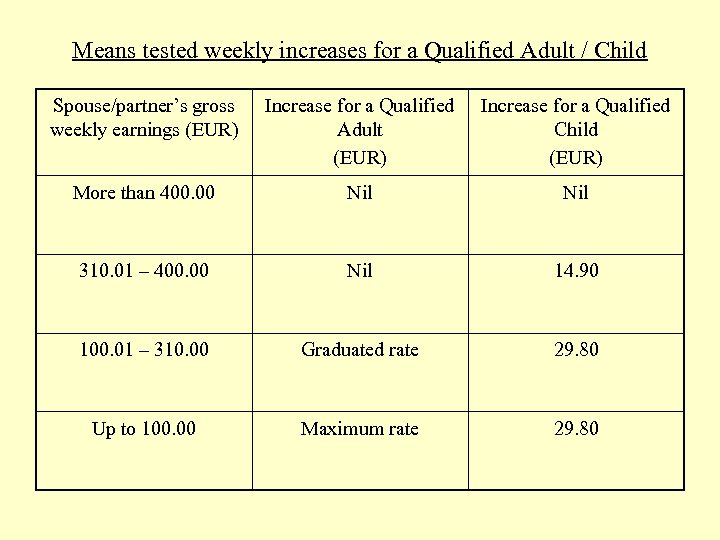 Means tested weekly increases for a Qualified Adult / Child Spouse/partner’s gross weekly earnings (EUR) Increase for a Qualified Adult (EUR) Increase for a Qualified Child (EUR) More than 400. 00 Nil 310. 01 – 400. 00 Nil 14. 90 100. 01 – 310. 00 Graduated rate 29. 80 Up to 100. 00 Maximum rate 29. 80
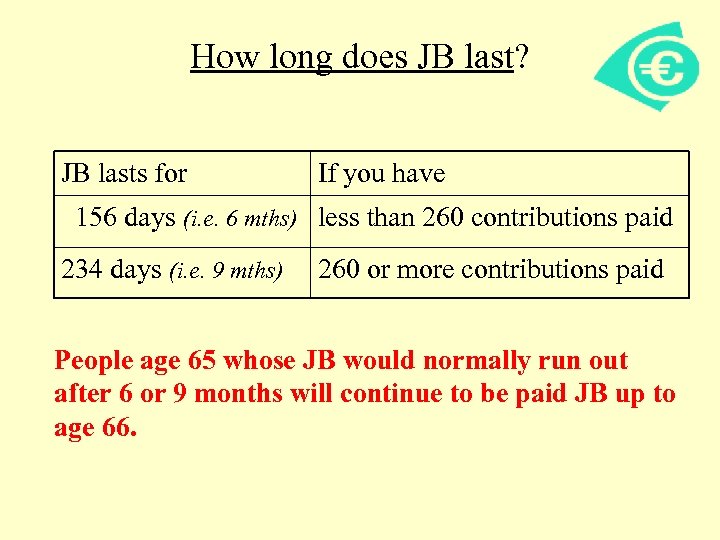 How long does JB last? JB lasts for If you have 156 days (i. e. 6 mths) less than 260 contributions paid 234 days (i. e. 9 mths) 260 or more contributions paid People age 65 whose JB would normally run out after 6 or 9 months will continue to be paid JB up to age 66.
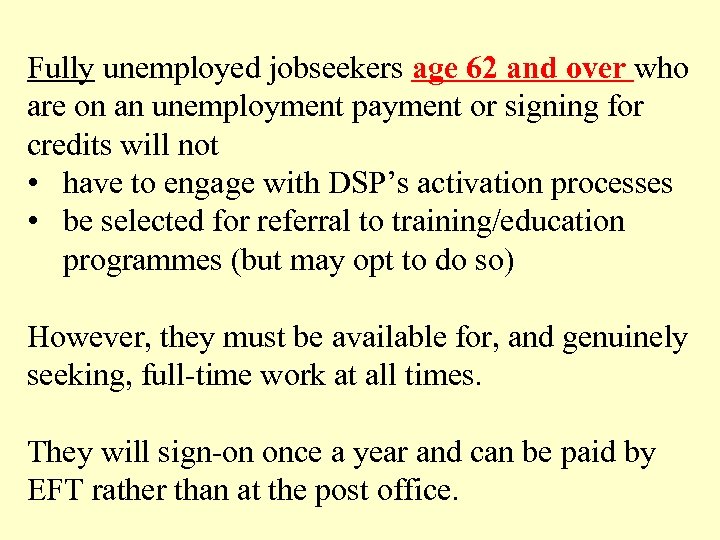 Fully unemployed jobseekers age 62 and over who are on an unemployment payment or signing for credits will not • have to engage with DSP’s activation processes • be selected for referral to training/education programmes (but may opt to do so) However, they must be available for, and genuinely seeking, full-time work at all times. They will sign-on once a year and can be paid by EFT rather than at the post office.
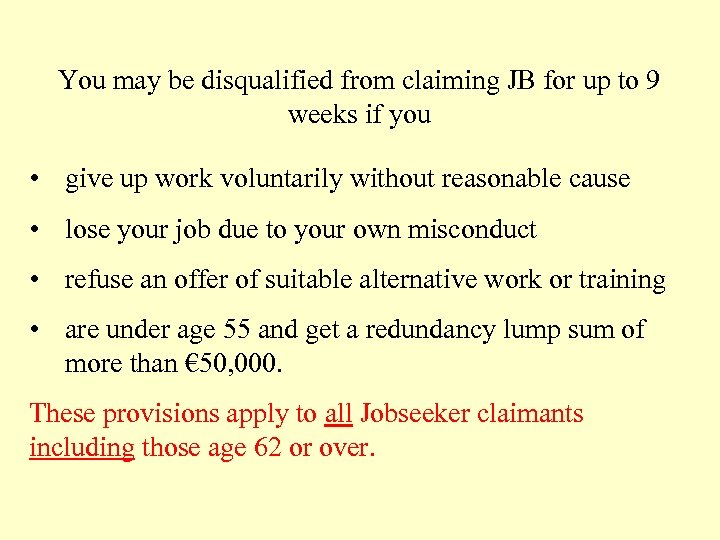 You may be disqualified from claiming JB for up to 9 weeks if you • give up work voluntarily without reasonable cause • lose your job due to your own misconduct • refuse an offer of suitable alternative work or training • are under age 55 and get a redundancy lump sum of more than € 50, 000. These provisions apply to all Jobseeker claimants including those age 62 or over.
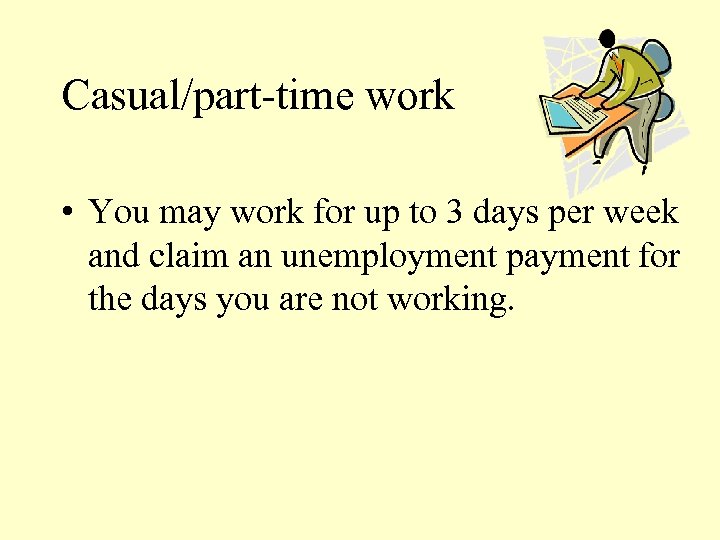 Casual/part-time work • You may work for up to 3 days per week and claim an unemployment payment for the days you are not working.
 Signing for ‘credits’ If you are unemployed and don’t qualify for JB or JA, you may sign-on for credited contributions (‘credits’) at your local Intreo Centre. You must be available for, capable of, and genuinely seeking full-time work. Credits are important as they help to preserve your social insurance contribution record (e. g. for State pension purposes). Alternatively, you may wish to pay Voluntary Contributions.
 Part 3 Social Welfare Contributory Pensions
 Main types of social welfare contributory pensions • State Pension (Contributory) (previously known as Old Age Contributory Pension) • State Pension (Contributory Pro-Rata) • Widow/er’s or Surviving Civil Partner’s (Contributory) Pension.
 State Pension (Contributory) Applicant must • be age 66 or over • have started paying insurance contributions before age 56 • have at least 520 full-rate contributions paid (or if at least 260 full-rate cons paid, the balance can be made up of full-rate voluntary cons) • have a minimum yearly average number of contributions.
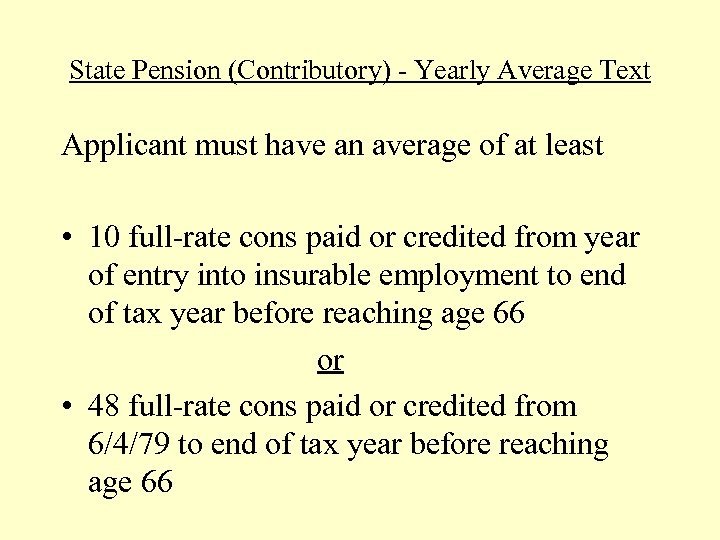 State Pension (Contributory) - Yearly Average Text Applicant must have an average of at least • 10 full-rate cons paid or credited from year of entry into insurable employment to end of tax year before reaching age 66 or • 48 full-rate cons paid or credited from 6/4/79 to end of tax year before reaching age 66
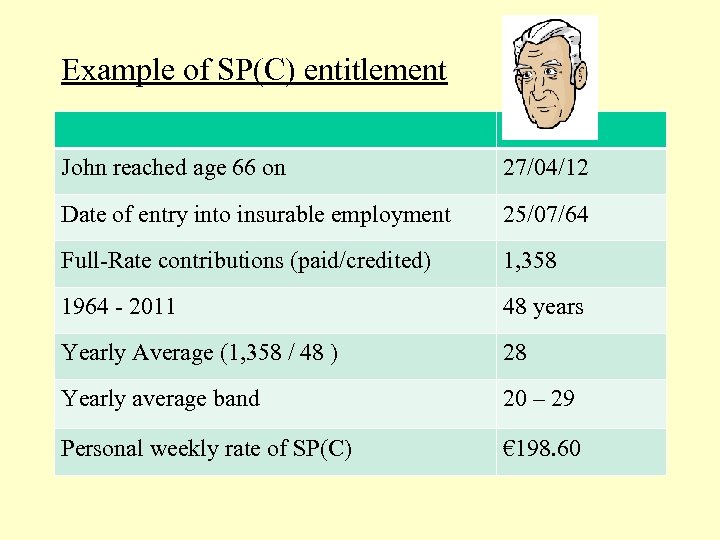 Example of SP(C) entitlement John reached age 66 on 27/04/12 Date of entry into insurable employment 25/07/64 Full-Rate contributions (paid/credited) 1, 358 1964 - 2011 48 years Yearly Average (1, 358 / 48 ) 28 Yearly average band 20 – 29 Personal weekly rate of SP(C) € 198. 60
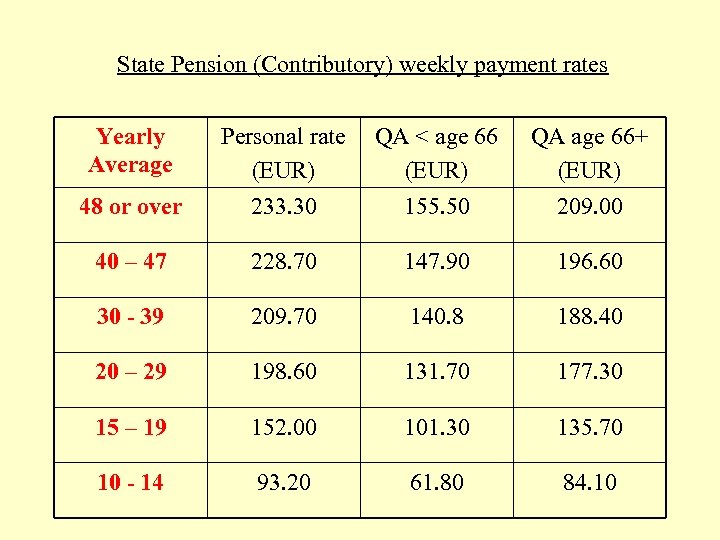 State Pension (Contributory) weekly payment rates Yearly Average 48 or over Personal rate (EUR) 233. 30 QA < age 66 (EUR) 155. 50 QA age 66+ (EUR) 209. 00 40 – 47 228. 70 147. 90 196. 60 30 - 39 209. 70 140. 8 188. 40 20 – 29 198. 60 131. 70 177. 30 15 – 19 152. 00 101. 30 135. 70 10 - 14 93. 20 61. 80 84. 10
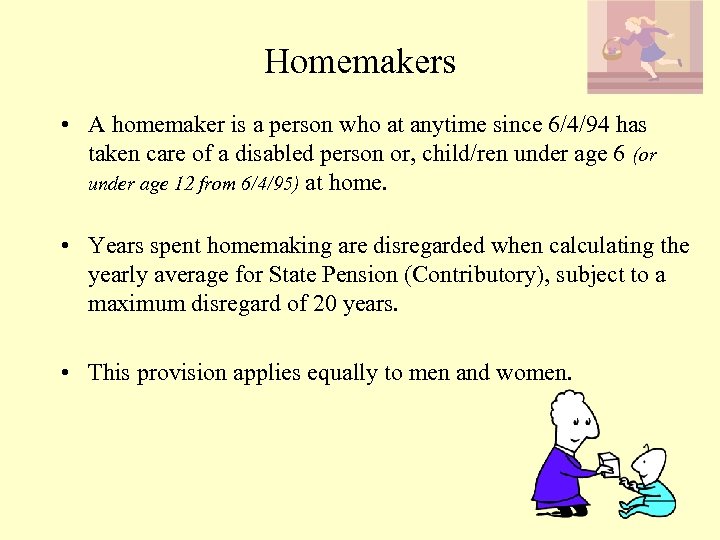 Homemakers • A homemaker is a person who at anytime since 6/4/94 has taken care of a disabled person or, child/ren under age 6 (or under age 12 from 6/4/95) at home. • Years spent homemaking are disregarded when calculating the yearly average for State Pension (Contributory), subject to a maximum disregard of 20 years. • This provision applies equally to men and women.
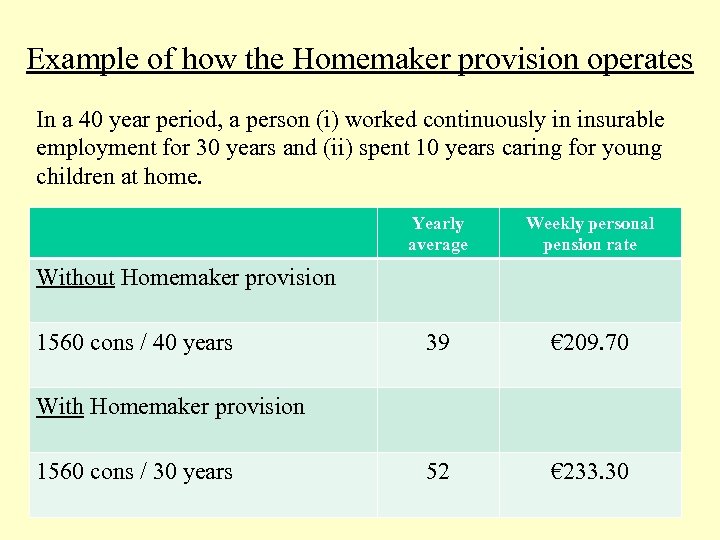 Example of how the Homemaker provision operates In a 40 year period, a person (i) worked continuously in insurable employment for 30 years and (ii) spent 10 years caring for young children at home. Yearly average Weekly personal pension rate 39 € 209. 70 52 € 233. 30 Without Homemaker provision 1560 cons / 40 years With Homemaker provision 1560 cons / 30 years
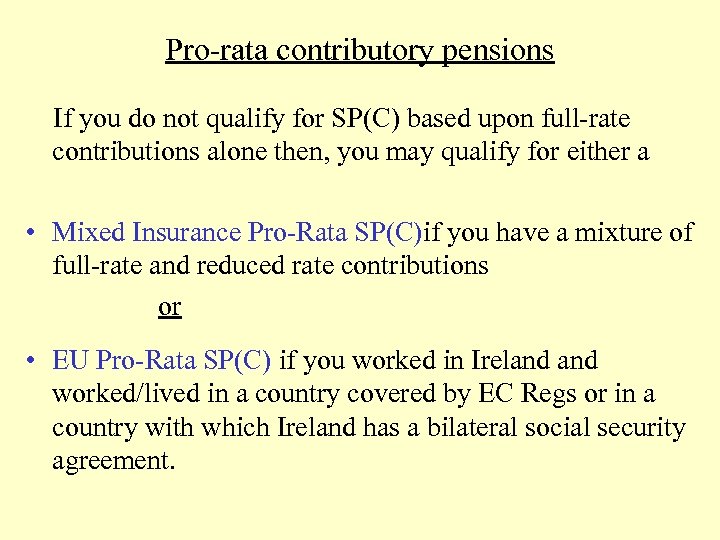 Pro-rata contributory pensions If you do not qualify for SP(C) based upon full-rate contributions alone then, you may qualify for either a • Mixed Insurance Pro-Rata SP(C)if you have a mixture of full-rate and reduced rate contributions or • EU Pro-Rata SP(C) if you worked in Ireland worked/lived in a country covered by EC Regs or in a country with which Ireland has a bilateral social security agreement.
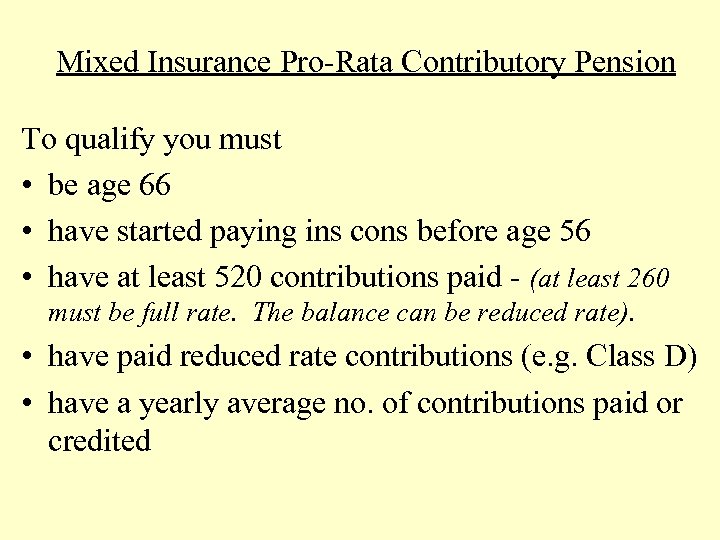 Mixed Insurance Pro-Rata Contributory Pension To qualify you must • be age 66 • have started paying ins cons before age 56 • have at least 520 contributions paid - (at least 260 must be full rate. The balance can be reduced rate). • have paid reduced rate contributions (e. g. Class D) • have a yearly average no. of contributions paid or credited
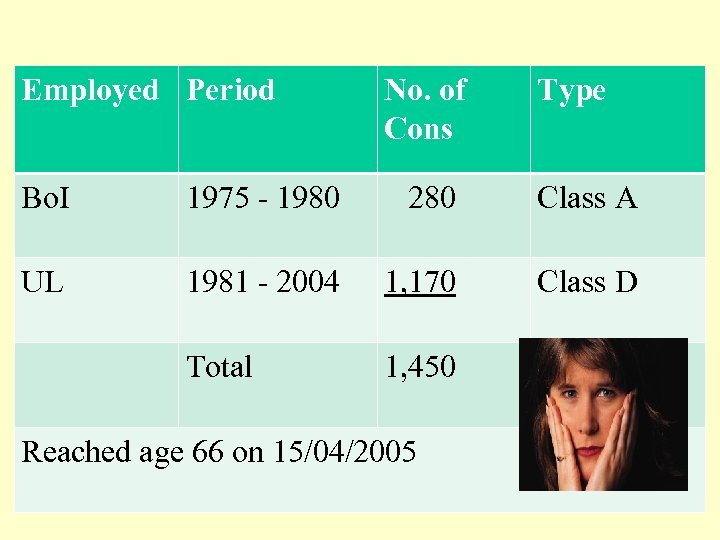 Employed Period No. of Cons Type Bo. I 1975 - 1980 280 Class A UL 1981 - 2004 1, 170 Class D Total 1, 450 Reached age 66 on 15/04/2005
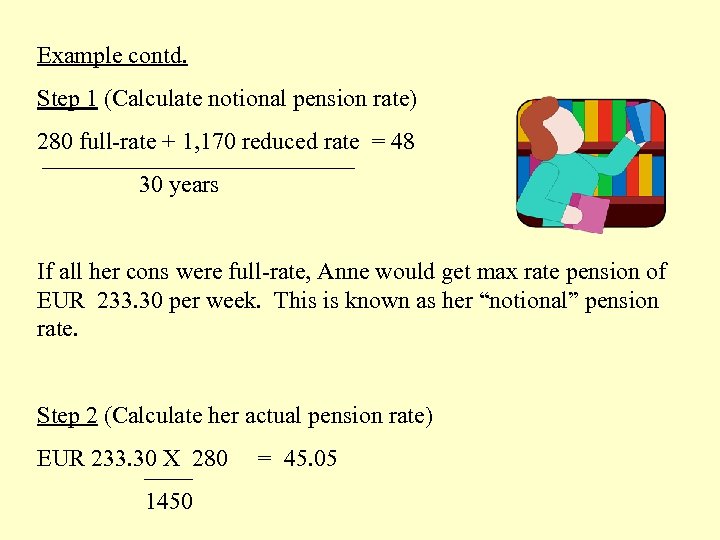 Example contd. Step 1 (Calculate notional pension rate) 280 full-rate + 1, 170 reduced rate = 48 30 years If all her cons were full-rate, Anne would get max rate pension of EUR 233. 30 per week. This is known as her “notional” pension rate. Step 2 (Calculate her actual pension rate) EUR 233. 30 X 280 1450 = 45. 05
 Points to note about SW contributory pensions • You do not have to give up work to get a contributory pension. • All pensions are taxable. • You can get a SW contributory pension and an occupational pension at the same time (- however see rule on integration). • You will only get one SW pension even if you satisfy the conditions for receipt of two or more pensions. • You do not have to live in Ireland.
 Important advice for Jobsharers • An ins. con. is paid for each con. week or part of a con. week that you work. • An ins. con. wk. begins on 1 January each year. (In 2017, it will begin on a Sunday and end on a Friday). • If you work week on/week off in 2017, you would only get 26 cons instead of 52 cons. • Solution: Change your work pattern so that you work a portion of each and every contribution week.
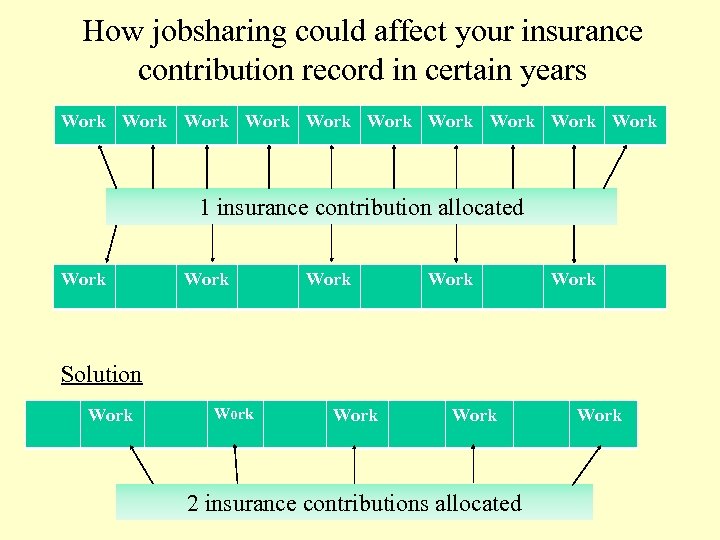 How jobsharing could affect your insurance contribution record in certain years Work Work Work 1 insurance contribution allocated Work Work Solution Work 2 insurance contributions allocated Work
 Extra benefits payable with SW pension • Living Alone Increase – EUR 9 per week • Household Benefits (electricity allowance, free TV licence) • • Over-80 allowance – EUR 10 pw Fuel Allowance (means-tested) Increase for qualified adult (means-tested) Increase for qualified child/ren
 Apply for pension on time Please apply for your SW pension on time i. e. THREE months before you reach age 66 or SIX months before age 66 if you worked in a country covered by EC Regulations or in a country with which Ireland has a bilateral agreement on Social Security. In most cases, late claims may only be backdated for a maximum period of 6 months if there is ‘good cause’ to do so.
 To obtain a copy of your social insurance contribution record 1. Log-on to www. welfare. ie 2. On the RHS of the page, click on the “More Services” tab in “Online services” box 3. In the “Frequent Online Services” box, go to “Other Services” and click “Request a copy of my social insurance record” 4. Fill in your details and press “submit” button
 Alternatively you can write to Department of Social Protection, Client Eligibility Services, Inner Relief Road, Ardaravan, Buncrana, Co Donegal. (Tel: 1890 690) Please quote your PPS number and give some details of your employment history to date (e. g. names & addresses of employers, periods of employment).
 Integration • If you qualify for a SW contributory pension and an occupational pension then • depending upon the rules of your occupational pension scheme, your occupational pension may be adjusted to take account of your SW contributory pension. • This is known as integration. • Contact your HR Office for further details.
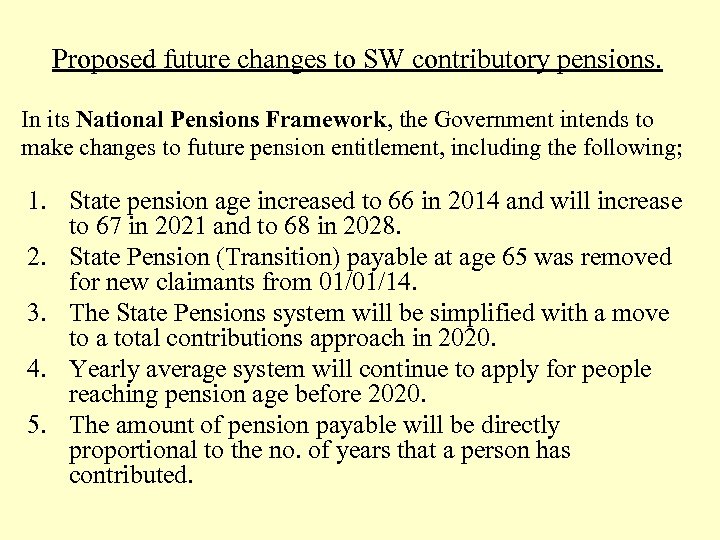 Proposed future changes to SW contributory pensions. In its National Pensions Framework, the Government intends to make changes to future pension entitlement, including the following; 1. State pension age increased to 66 in 2014 and will increase to 67 in 2021 and to 68 in 2028. 2. State Pension (Transition) payable at age 65 was removed for new claimants from 01/01/14. 3. The State Pensions system will be simplified with a move to a total contributions approach in 2020. 4. Yearly average system will continue to apply for people reaching pension age before 2020. 5. The amount of pension payable will be directly proportional to the no. of years that a person has contributed.
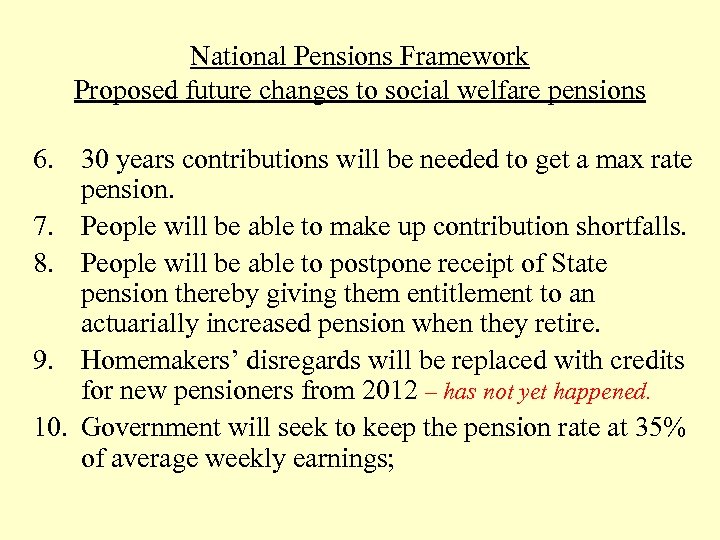 National Pensions Framework Proposed future changes to social welfare pensions 6. 30 years contributions will be needed to get a max rate pension. 7. People will be able to make up contribution shortfalls. 8. People will be able to postpone receipt of State pension thereby giving them entitlement to an actuarially increased pension when they retire. 9. Homemakers’ disregards will be replaced with credits for new pensioners from 2012 – has not yet happened. 10. Government will seek to keep the pension rate at 35% of average weekly earnings;
 Publications of The Pensions Authority • • • Women and Pensions checklist How does my pension scheme work? A Brief Guide to Annuities What are my Pension Options? PRSAs – A consumer and employers’ guide Pensions on separation and divorce checklist. Available on The Pensions Authority website (www. pensionsauthority. ie). Tel. 1890 656565
 Still confused? Need more information? • See our website www. welfare. ie • Contact me at fintan. hanson@welfare. ie Address : Dept. Social & Family Affairs Government Buildings Cranmore Road, Sligo Tel: 071 -9140532
 End of Presentation