 Скачать презентацию Presentation On How is ITS improving bus system
c4fd1b92366c90a45faf0b1ec346fa02.ppt
- Количество слайдов: 35



Presentation On How is ITS improving bus system management in India Presented By. Alok Sethi DGM – IT , Transportation Technology Solutions
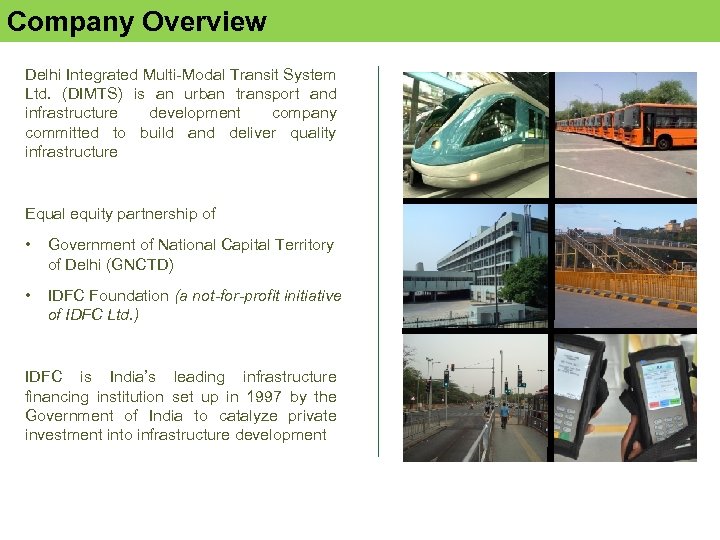
Company Overview Delhi Integrated Multi-Modal Transit System Ltd. (DIMTS) is an urban transport and infrastructure development company committed to build and deliver quality infrastructure Equal equity partnership of • Government of National Capital Territory of Delhi (GNCTD) • IDFC Foundation (a not-for-profit initiative of IDFC Ltd. ) IDFC is India’s leading infrastructure financing institution set up in 1997 by the Government of India to catalyze private investment into infrastructure development
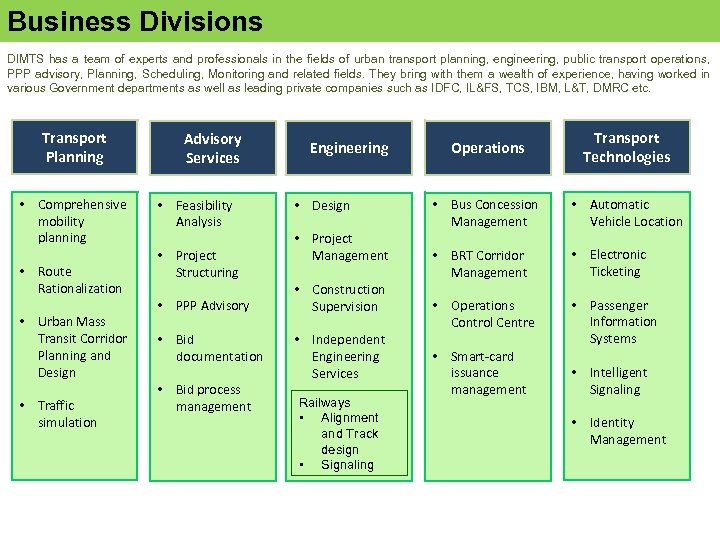
Business Divisions DIMTS has a team of experts and professionals in the fields of urban transport planning, engineering, public transport operations, PPP advisory, Planning, Scheduling, Monitoring and related fields. They bring with them a wealth of experience, having worked in various Government departments as well as leading private companies such as IDFC, IL&FS, TCS, IBM, L&T, DMRC etc. Transport Planning • Comprehensive mobility planning • Route Rationalization • Urban Mass Transit Corridor Planning and Design • Traffic simulation Advisory Services • Feasibility Analysis • Project Structuring • PPP Advisory • Bid documentation • Bid process management Engineering • Design • Project Management • Construction Supervision • Independent Engineering Services Railways • Alignment and Track design • Signaling Operations Transport Technologies • Bus Concession Management • Automatic Vehicle Location • BRT Corridor Management • Electronic Ticketing • Operations Control Centre • Passenger Information Systems • Smart-card issuance management • Intelligent Signaling • Identity Management
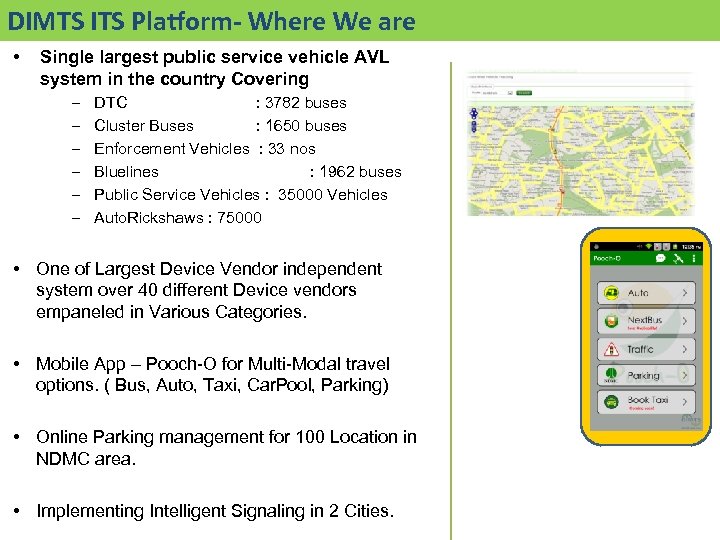
DIMTS ITS Platform- Where We are • Single largest public service vehicle AVL system in the country Covering – – – DTC : 3782 buses Cluster Buses : 1650 buses Enforcement Vehicles : 33 nos Bluelines : 1962 buses Public Service Vehicles : 35000 Vehicles Auto. Rickshaws : 75000 • One of Largest Device Vendor independent system over 40 different Device vendors empaneled in Various Categories. • Mobile App – Pooch-O for Multi-Modal travel options. ( Bus, Auto, Taxi, Car. Pool, Parking) • Online Parking management for 100 Location in NDMC area. • Implementing Intelligent Signaling in 2 Cities.
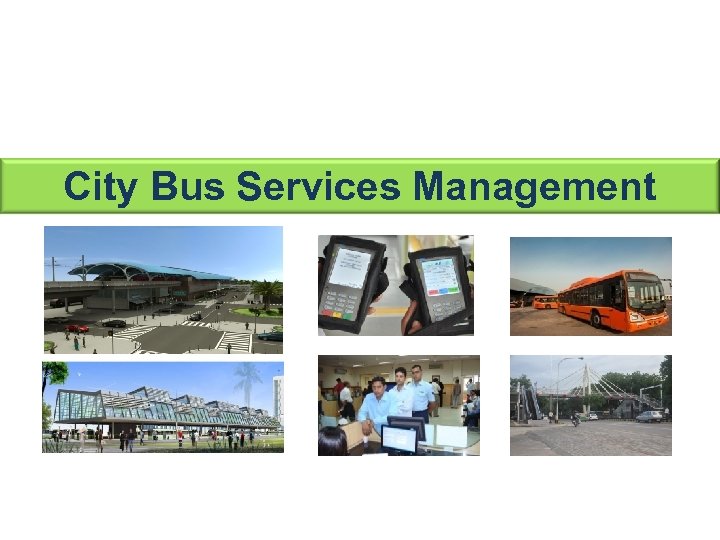
City Bus Services Management
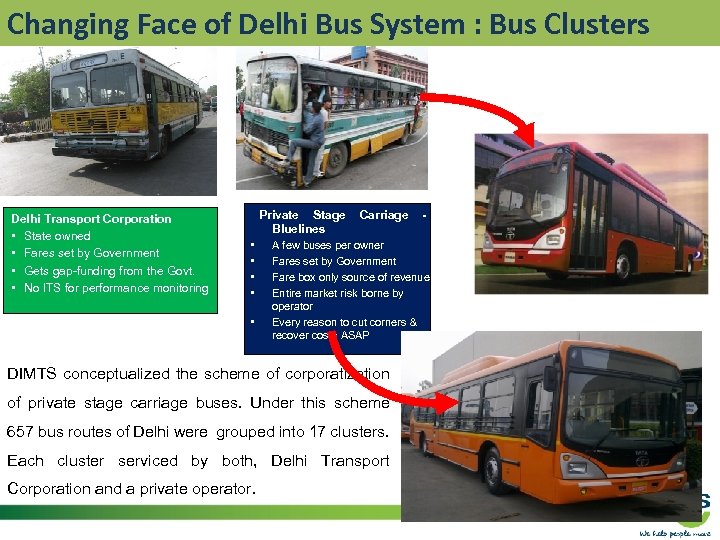
Changing Face of Delhi Bus System : Bus Clusters Delhi Transport Corporation • State owned • Fares set by Government • Gets gap-funding from the Govt. • No ITS for performance monitoring Private Stage Carriage - Bluelines • A few buses per owner • Fares set by Government • Fare box only source of revenue • Entire market risk borne by • operator Every reason to cut corners & recover costs ASAP DIMTS conceptualized the scheme of corporatization of private stage carriage buses. Under this scheme 657 bus routes of Delhi were grouped into 17 clusters. Each cluster serviced by both, Delhi Transport Corporation and a private operator.
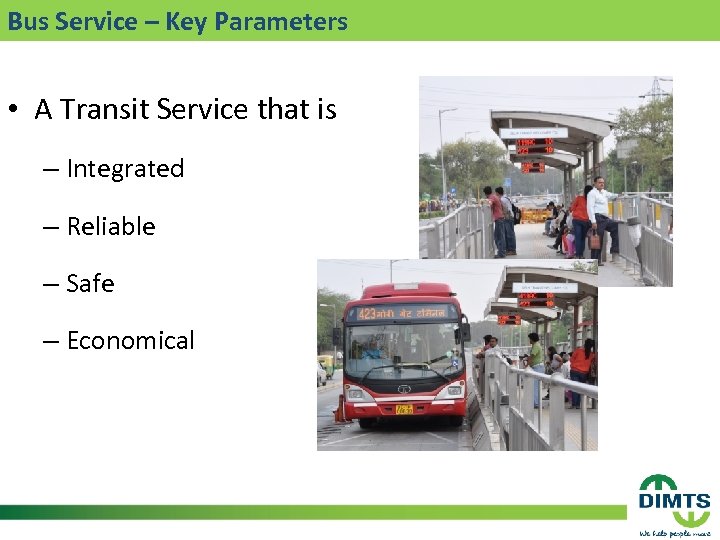
Bus Service – Key Parameters • A Transit Service that is – Integrated – Reliable – Safe – Economical
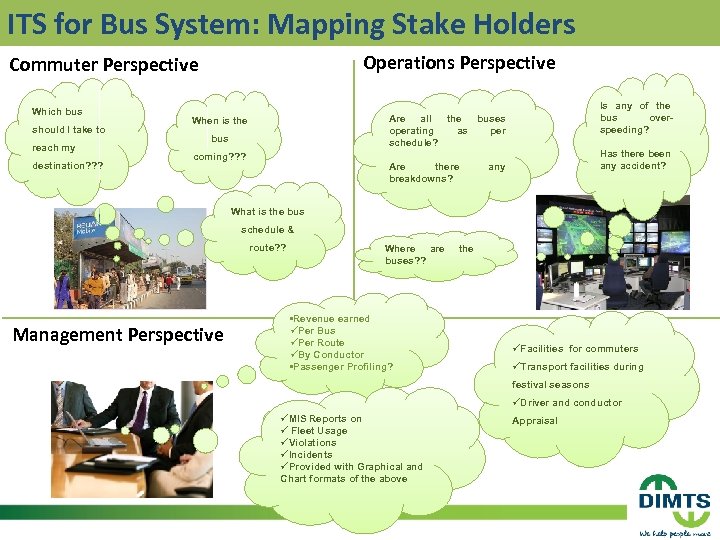
ITS for Bus System: Mapping Stake Holders Operations Perspective Commuter Perspective Which bus should I take to reach my destination? ? ? Is any of the bus overspeeding? Are all the buses operating as per schedule? When is the bus coming? ? ? Are there breakdowns? Has there been any accident? any What is the bus schedule & route? ? Management Perspective Where are buses? ? • Revenue earned üPer Bus üPer Route üBy Conductor • Passenger Profiling? the üFacilities for commuters üTransport facilities during festival seasons üDriver and conductor üMIS Reports on ü Fleet Usage üViolations üIncidents üProvided with Graphical and Chart formats of the above Appraisal
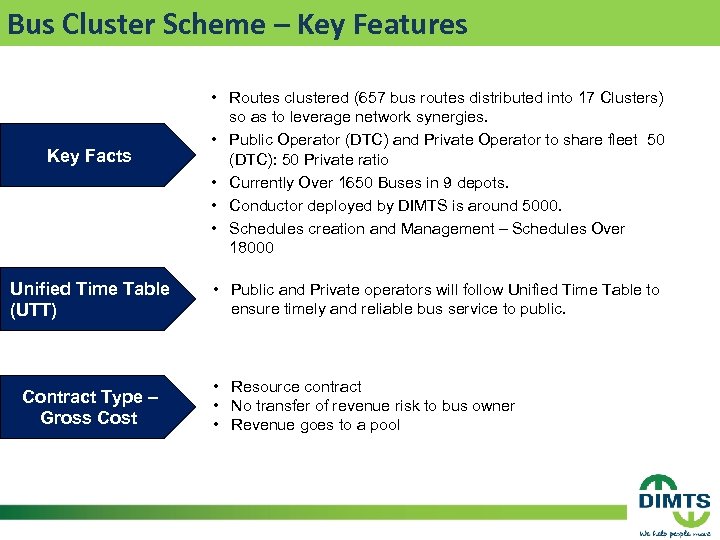
Bus Cluster Scheme – Key Features Key Facts Unified Time Table (UTT) Contract Type – Gross Cost • Routes clustered (657 bus routes distributed into 17 Clusters) so as to leverage network synergies. • Public Operator (DTC) and Private Operator to share fleet 50 (DTC): 50 Private ratio • Currently Over 1650 Buses in 9 depots. • Conductor deployed by DIMTS is around 5000. • Schedules creation and Management – Schedules Over 18000 • Public and Private operators will follow Unified Time Table to ensure timely and reliable bus service to public. • Resource contract • No transfer of revenue risk to bus owner • Revenue goes to a pool
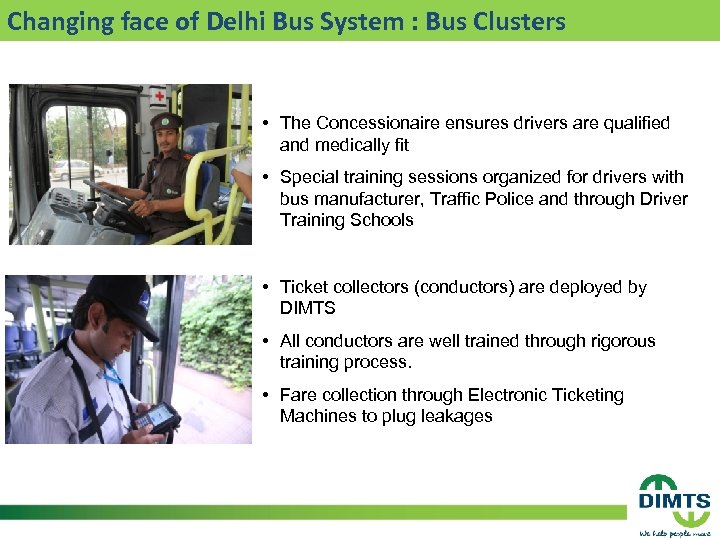
Changing face of Delhi Bus System : Bus Clusters • The Concessionaire ensures drivers are qualified and medically fit • Special training sessions organized for drivers with bus manufacturer, Traffic Police and through Driver Training Schools • Ticket collectors (conductors) are deployed by DIMTS • All conductors are well trained through rigorous training process. • Fare collection through Electronic Ticketing Machines to plug leakages
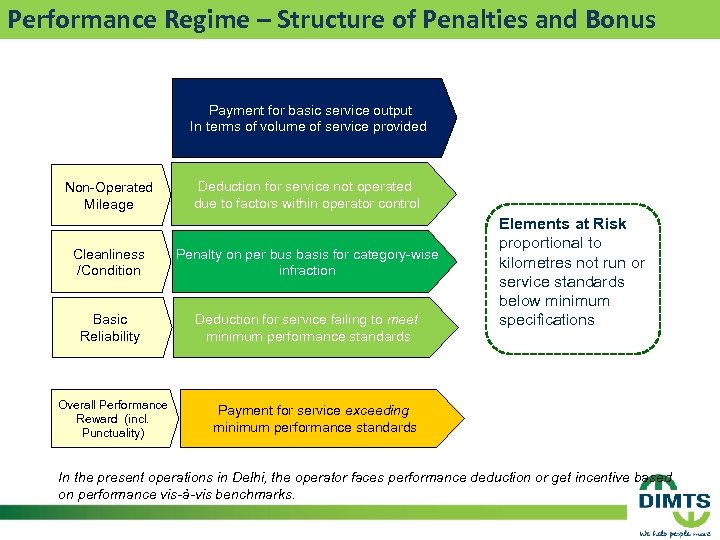
Performance Regime – Structure of Penalties and Bonus Payment for basic service output In terms of volume of service provided Non-Operated Mileage Deduction for service not operated due to factors within operator control Cleanliness /Condition Penalty on per bus basis for category-wise infraction Basic Reliability Deduction for service failing to meet minimum performance standards Overall Performance Reward (incl. Punctuality) Elements at Risk proportional to kilometres not run or service standards below minimum specifications Payment for service exceeding minimum performance standards In the present operations in Delhi, the operator faces performance deduction or get incentive based on performance vis-à-vis benchmarks.
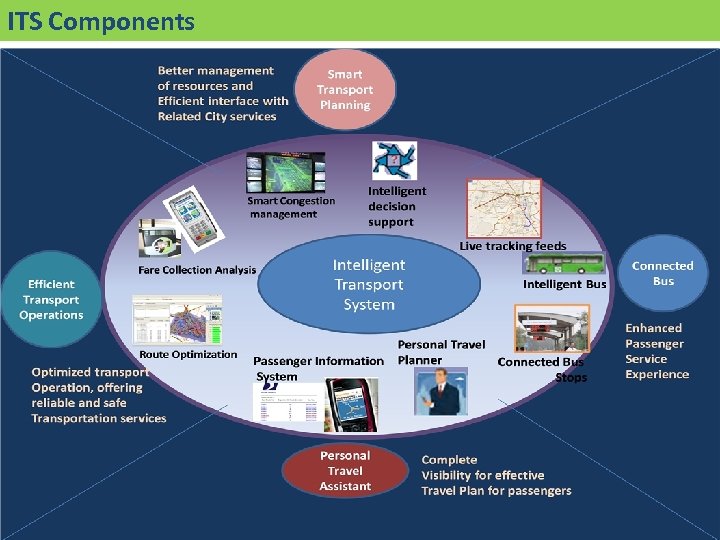
ITS Components
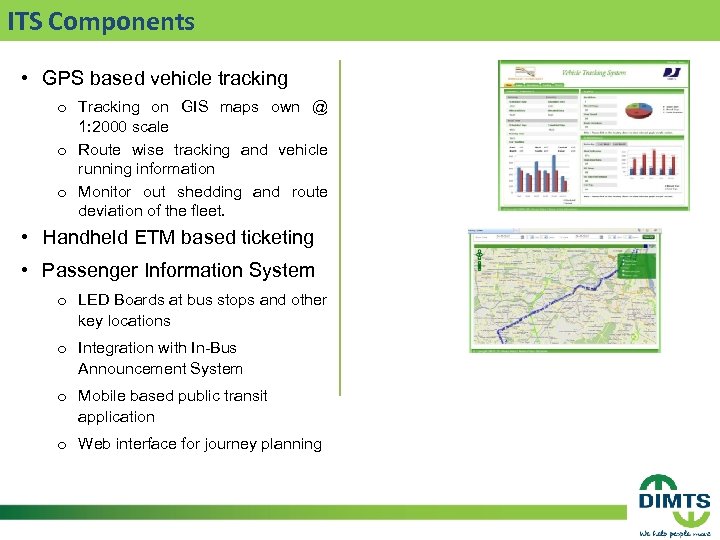
ITS Components • GPS based vehicle tracking o Tracking on GIS maps own @ 1: 2000 scale o Route wise tracking and vehicle running information o Monitor out shedding and route deviation of the fleet. • Handheld ETM based ticketing • Passenger Information System o LED Boards at bus stops and other key locations o Integration with In-Bus Announcement System o Mobile based public transit application o Web interface for journey planning
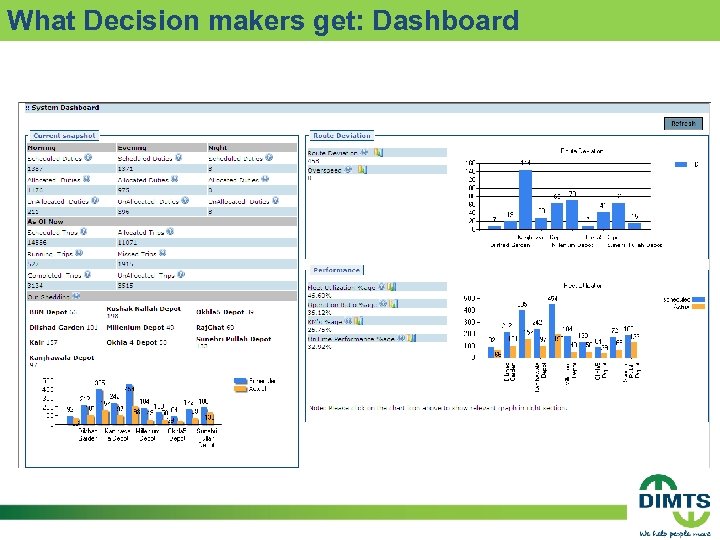
What Decision makers get: Dashboard
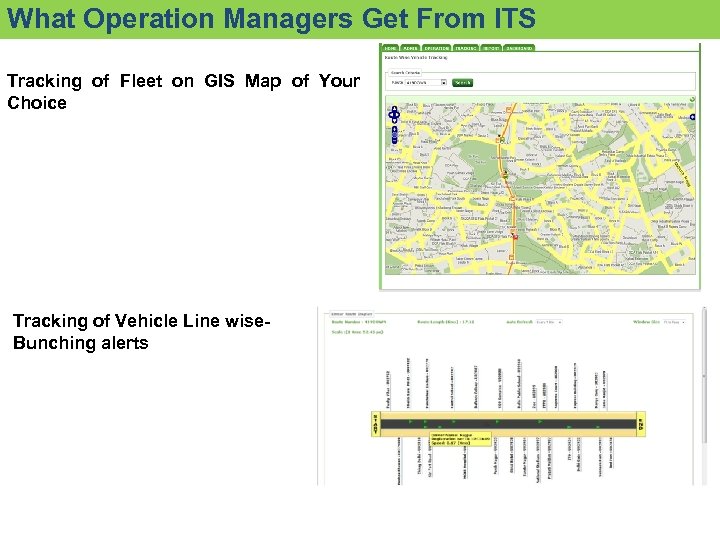
What Operation Managers Get From ITS Tracking of Fleet on GIS Map of Your Choice Tracking of Vehicle Line wise- Bunching alerts
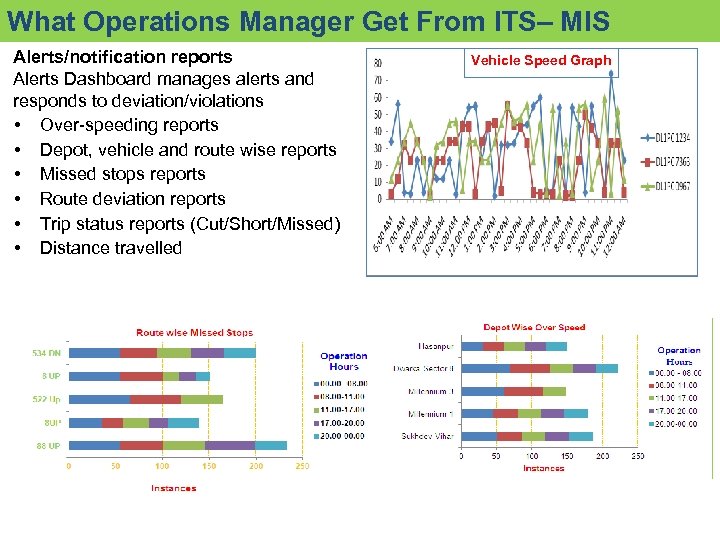
What Operations Manager Get From ITS– MIS Alerts/notification reports Alerts Dashboard manages alerts and responds to deviation/violations • Over-speeding reports • Depot, vehicle and route wise reports • Missed stops reports • Route deviation reports • Trip status reports (Cut/Short/Missed) • Distance travelled Vehicle Speed Graph
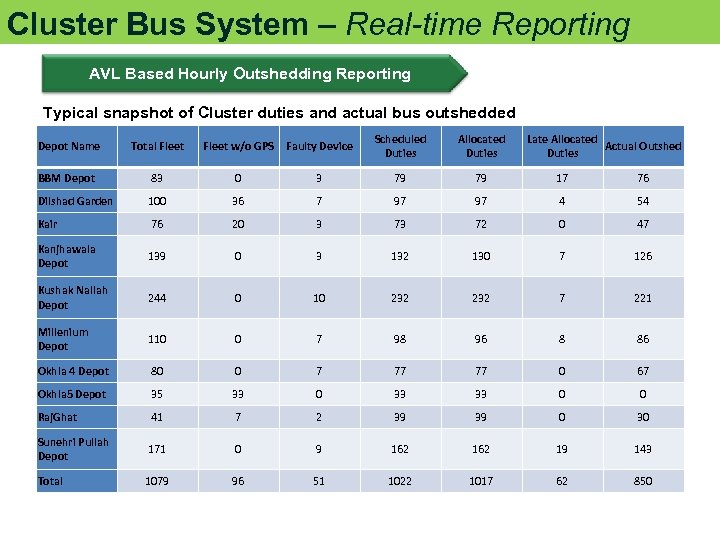
Cluster Bus System – Real-time Reporting AVL Based Hourly Outshedding Reporting Typical snapshot of Cluster duties and actual bus outshedded Depot Name Total Fleet w/o GPS Faulty Device Scheduled Duties Allocated Duties Late Allocated Actual Outshed Duties BBM Depot 83 0 3 79 79 17 76 Dilshad Garden 100 36 7 97 97 4 54 Kair 76 20 3 73 72 0 47 Kanjhawala Depot 139 0 3 132 130 7 126 Kushak Nallah Depot 244 0 10 232 7 221 Millenium Depot 110 0 7 98 96 8 86 Okhla 4 Depot 80 0 7 77 77 0 67 Okhla 5 Depot 35 33 0 33 33 0 0 Raj. Ghat 41 7 2 39 39 0 30 Sunehri Pullah Depot 171 0 9 162 19 143 Total 1079 96 51 1022 1017 62 850
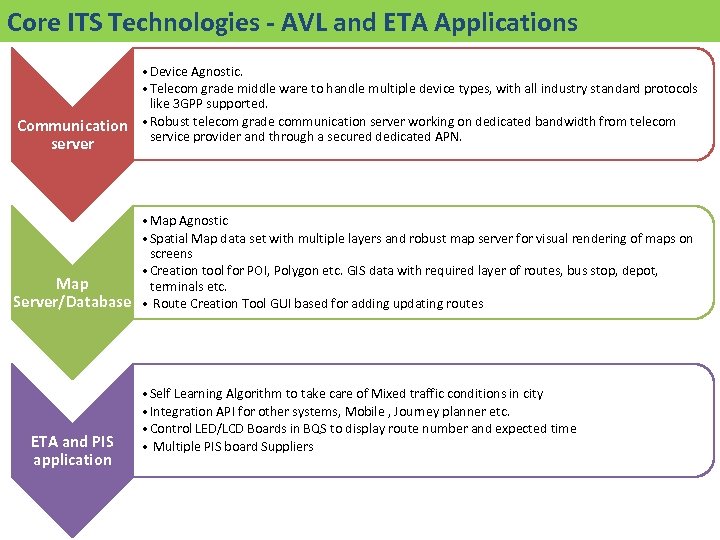
Core ITS Technologies - AVL and ETA Applications • Device Agnostic. • Telecom grade middle ware to handle multiple device types, with all industry standard protocols like 3 GPP supported. Communication • Robust telecom grade communication server working on dedicated bandwidth from telecom service provider and through a secured dedicated APN. server • Map Agnostic • Spatial Map data set with multiple layers and robust map server for visual rendering of maps on screens • Creation tool for POI, Polygon etc. GIS data with required layer of routes, bus stop, depot, Map terminals etc. Server/Database • Route Creation Tool GUI based for adding updating routes ETA and PIS application • Self Learning Algorithm to take care of Mixed traffic conditions in city • Integration API for other systems, Mobile , Journey planner etc. • Control LED/LCD Boards in BQS to display route number and expected time • Multiple PIS board Suppliers
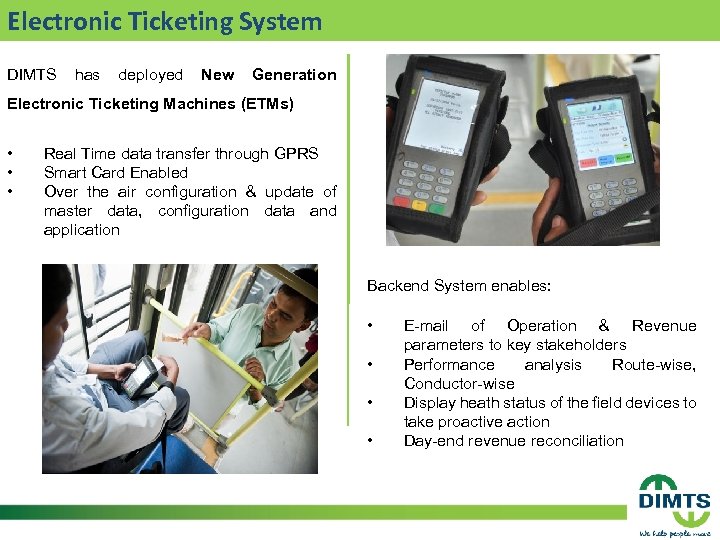
Electronic Ticketing System DIMTS has deployed New Generation Electronic Ticketing Machines (ETMs) • • • Real Time data transfer through GPRS Smart Card Enabled Over the air configuration & update of master data, configuration data and application Backend System enables: • • E-mail of Operation & Revenue parameters to key stakeholders Performance analysis Route-wise, Conductor-wise Display heath status of the field devices to take proactive action Day-end revenue reconciliation
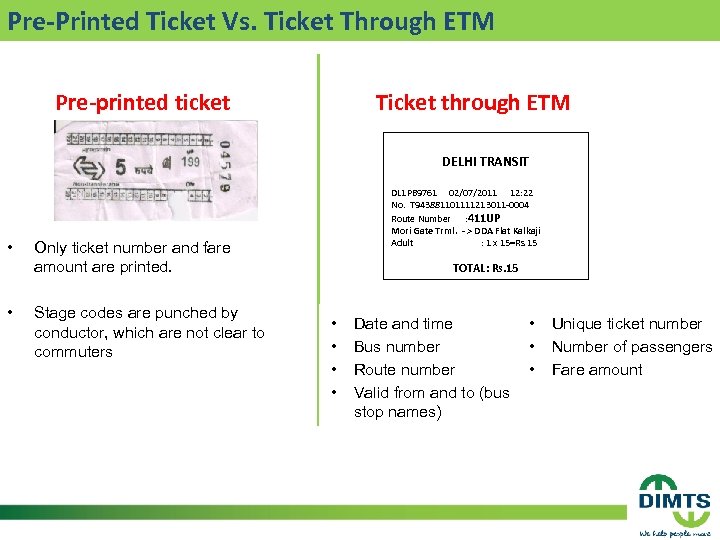
Pre-Printed Ticket Vs. Ticket Through ETM Pre-printed ticket Ticket through ETM DELHI TRANSIT • • DL 1 PB 9761 02/07/2011 12: 22 No. T 943881101111213011 -0004 Route Number : 411 UP Mori Gate Trml. - > DDA Flat Kalkaji Adult : 1 x 15=Rs 15 Only ticket number and fare amount are printed. Stage codes are punched by conductor, which are not clear to commuters TOTAL: Rs. 15 • • Date and time Bus number Route number Valid from and to (bus stop names) • • • Unique ticket number Number of passengers Fare amount
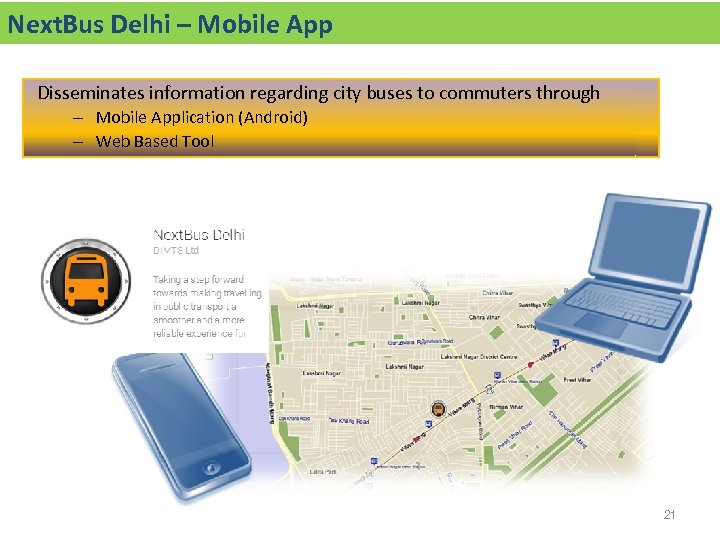
Next. Bus Delhi – Mobile App Disseminates information regarding city buses to commuters through – Mobile Application (Android) – Web Based Tool 21
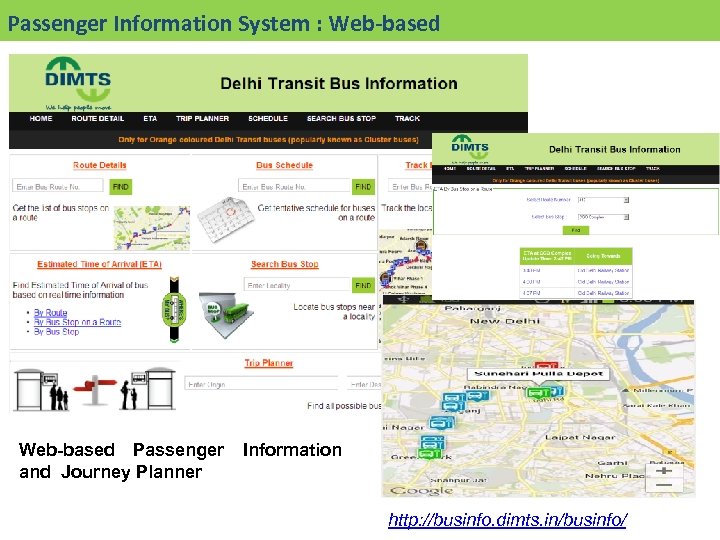
Passenger Information System : Web-based Passenger Information and Journey Planner http: //businfo. dimts. in/businfo/
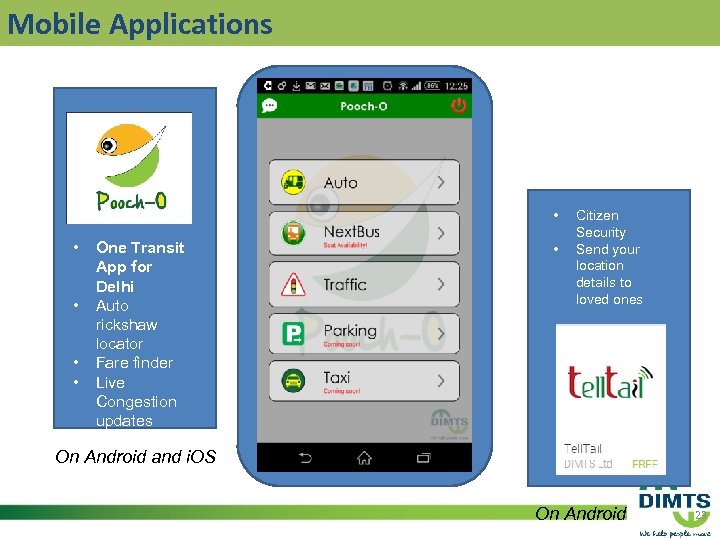
Mobile Applications • • • One Transit App for Delhi Auto rickshaw locator Fare finder Live Congestion updates • • • Seat Availability Time of Arrival Bus schedule Route Details Track location of bus Citizen Security Send your location details to loved ones On Android and i. OS On Android 23
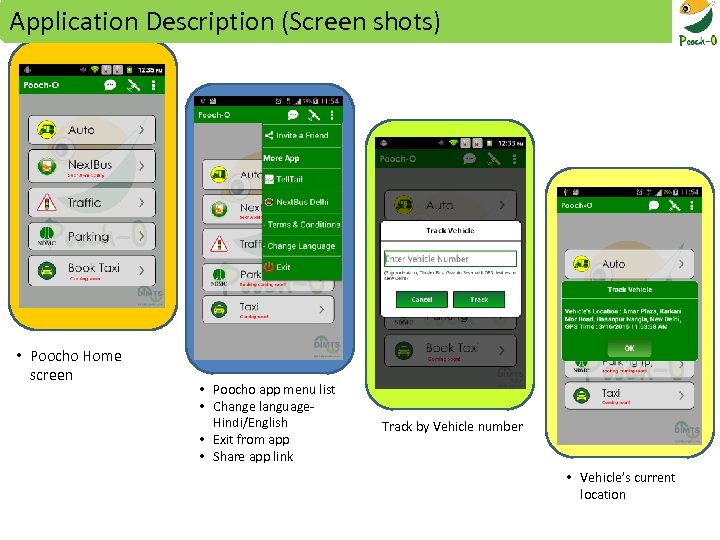
Application Description (Screen shots) • Poocho Home screen • Poocho app menu list • Change language- Hindi/English • Exit from app • Share app link Track by Vehicle number • Vehicle’s current location
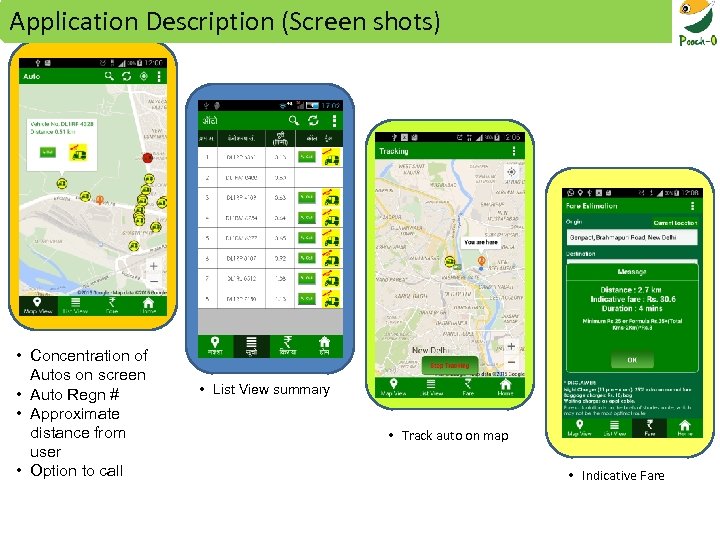
Application Description (Screen shots) • Concentration of Autos on screen • Auto Regn # • Approximate distance from user • Option to call • List View summary • Track auto on map • Indicative Fare
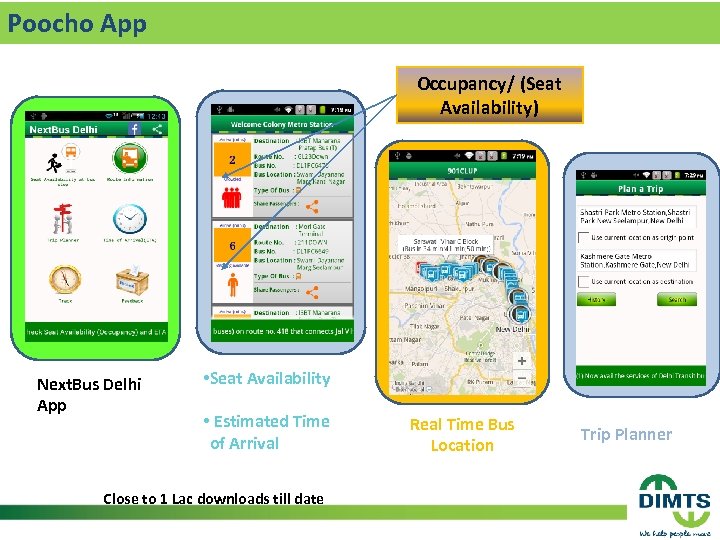
Poocho App Occupancy/ (Seat Availability) Next. Bus Delhi App • Seat Availability • Estimated Time of Arrival Close to 1 Lac downloads till date Real Time Bus Location Trip Planner

AVL & PIS- Tracking and ETA App– Key Identified Challenges Master Data • Creation / Modification of Driver, Vehicle • GPS device , Vehicle Mapping Routes and Schedules • Route surveys, Creation/ modification of Routes – Over 657 Official Routes, 5000 Plus Bus stops • Schedules creation and Management – Schedules Over 18000 • Buses run on multiple Routes/ daily allocation of resources. Easy allocation. Map data and Geo Analysis Engine • Map upload, configuration and Updates • Creation of Custom location, Depot Geo-fences • Customizable, Configurable Geo Analysis Engine Reporting • Flexible , customizable Reporting tools Integration • Ease of integration with other systems like Depot, Fare collection system • Third party PIS application
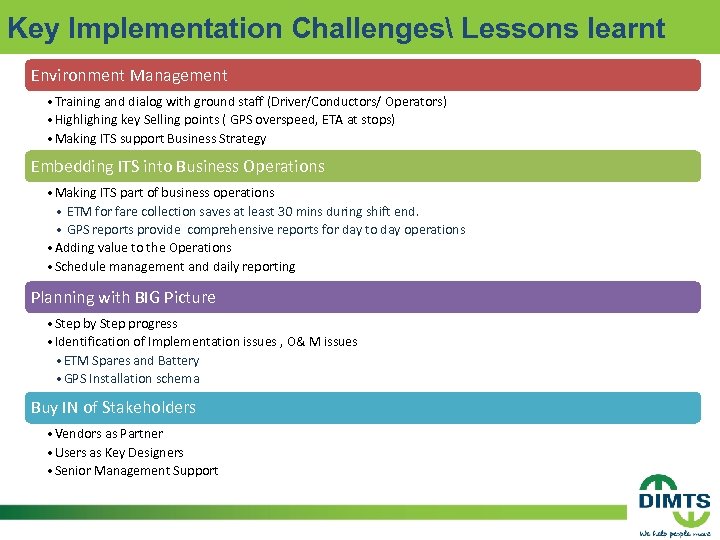
Key Implementation Challenges Lessons learnt Environment Management • Training and dialog with ground staff (Driver/Conductors/ Operators) • Highlighing key Selling points ( GPS overspeed, ETA at stops) • Making ITS support Business Strategy Embedding ITS into Business Operations • Making ITS part of business operations • ETM for fare collection saves at least 30 mins during shift end. • GPS reports provide comprehensive reports for day to day operations • Adding value to the Operations • Schedule management and daily reporting Planning with BIG Picture • Step by Step progress • Identification of Implementation issues , O& M issues • ETM Spares and Battery • GPS Installation schema Buy IN of Stakeholders • Vendors as Partner • Users as Key Designers • Senior Management Support
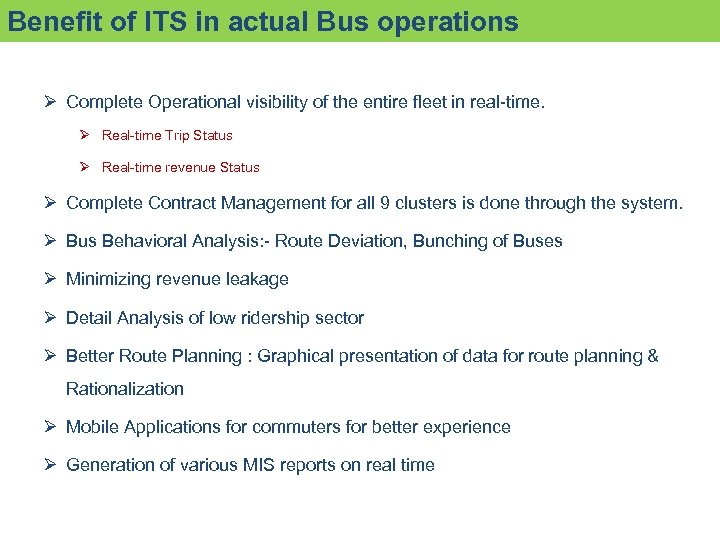
Benefit of ITS in actual Bus operations Ø Complete Operational visibility of the entire fleet in real-time. Ø Real-time Trip Status Ø Real-time revenue Status Ø Complete Contract Management for all 9 clusters is done through the system. Ø Bus Behavioral Analysis: - Route Deviation, Bunching of Buses Ø Minimizing revenue leakage Ø Detail Analysis of low ridership sector Ø Better Route Planning : Graphical presentation of data for route planning & Rationalization Ø Mobile Applications for commuters for better experience Ø Generation of various MIS reports on real time
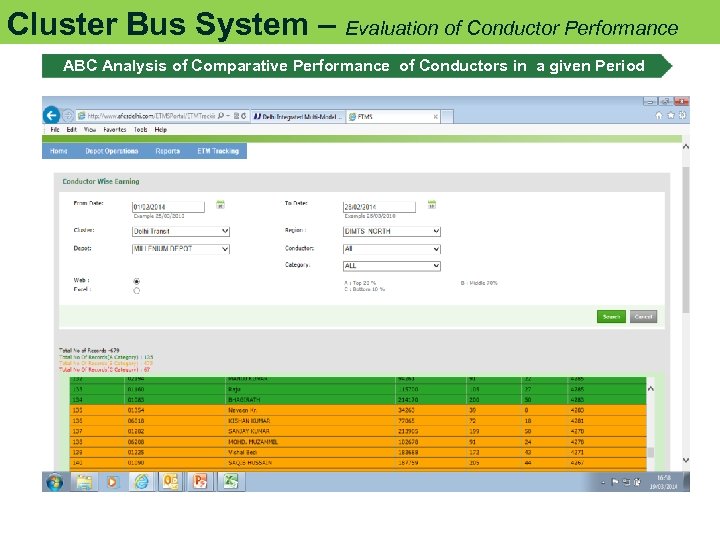
Cluster Bus System – Evaluation of Conductor Performance ABC Analysis of Comparative Performance of Conductors in a given Period
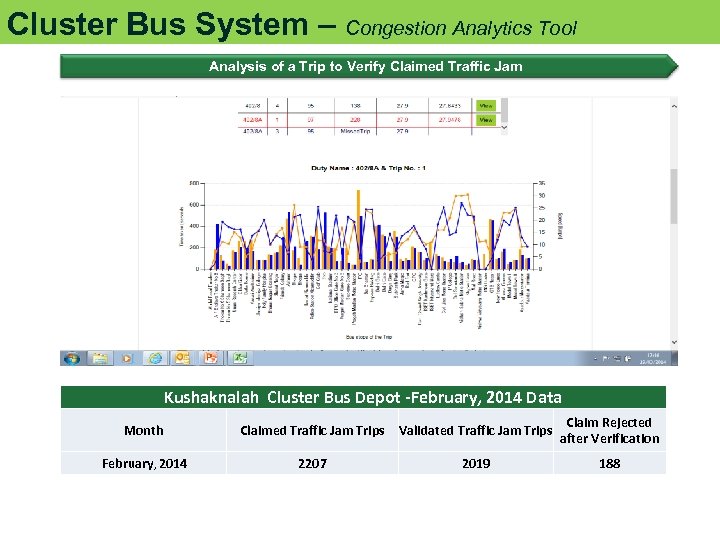
Cluster Bus System – Congestion Analytics Tool Analysis of a Trip to Verify Claimed Traffic Jam Kushaknalah Cluster Bus Depot -February, 2014 Data Month Claimed Traffic Jam Trips Validated Traffic Jam Trips Claim Rejected after Verification February, 2014 2207 2019 188
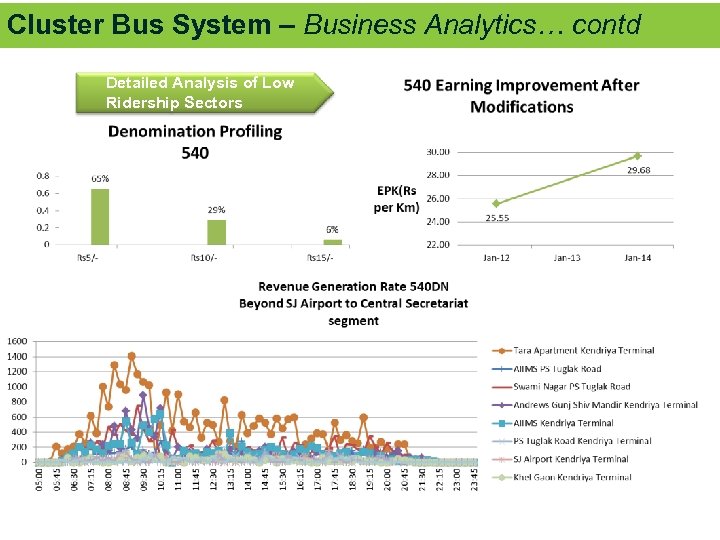
Cluster Bus System – Business Analytics… contd Detailed Analysis of Low Ridership Sectors
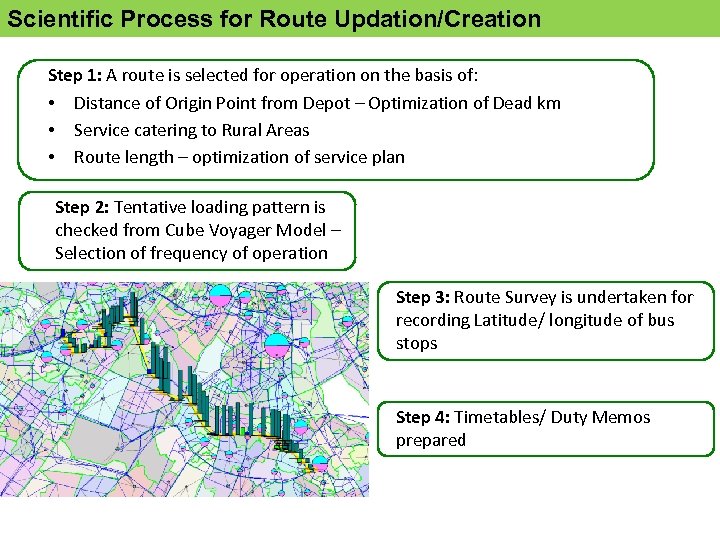
Scientific Process for Route Updation/Creation Step 1: A route is selected for operation on the basis of: • Distance of Origin Point from Depot – Optimization of Dead km • Service catering to Rural Areas • Route length – optimization of service plan Step 2: Tentative loading pattern is checked from Cube Voyager Model – Selection of frequency of operation Step 3: Route Survey is undertaken for recording Latitude/ longitude of bus stops Step 4: Timetables/ Duty Memos prepared
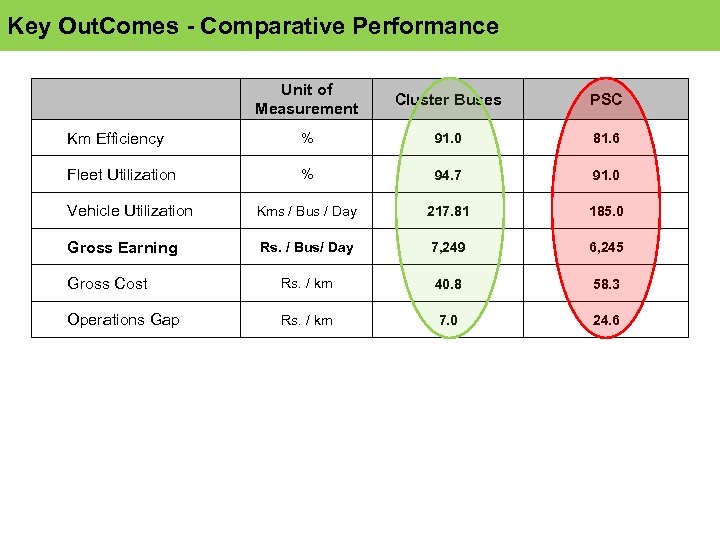
Key Out. Comes - Comparative Performance Unit of Measurement Cluster Buses PSC Km Efficiency % 91. 0 81. 6 Fleet Utilization % 94. 7 91. 0 Vehicle Utilization Kms / Bus / Day 217. 81 185. 0 Gross Earning Rs. / Bus/ Day 7, 249 6, 245 Gross Cost Rs. / km 40. 8 58. 3 Operations Gap Rs. / km 7. 0 24. 6
Roadmap Endless possibilities benefiting the commuters…. Thank You
Скачать презентацию Presentation On How is ITS improving bus system
c4fd1b92366c90a45faf0b1ec346fa02.ppt