


 Скачать презентацию Presentation of the Grid activities at CERN
62fb96e221791802cdb3f19a5ab5ce2f.ppt
- Количество слайдов: 13
 Presentation of the Grid activities at CERN Visit of Dr. Eli Opper, Research and Development Chief Scientist Ministry of Industry and Trade, Israel Wednesday 18 February 2004
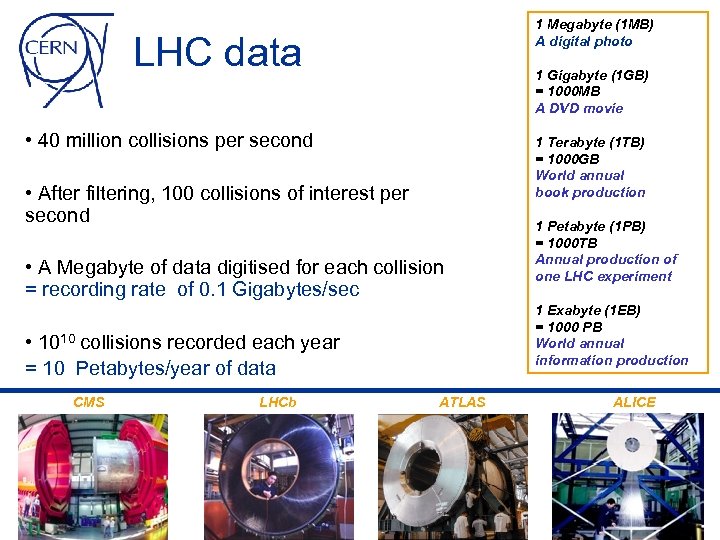 1 Megabyte (1 MB) A digital photo LHC data 1 Gigabyte (1 GB) = 1000 MB A DVD movie • 40 million collisions per second 1 Terabyte (1 TB) = 1000 GB World annual book production • After filtering, 100 collisions of interest per second • A Megabyte of data digitised for each collision = recording rate of 0. 1 Gigabytes/sec 1 Exabyte (1 EB) = 1000 PB World annual information production • 1010 collisions recorded each year = 10 Petabytes/year of data CMS LHCb 1 Petabyte (1 PB) = 1000 TB Annual production of one LHC experiment ATLAS ALICE
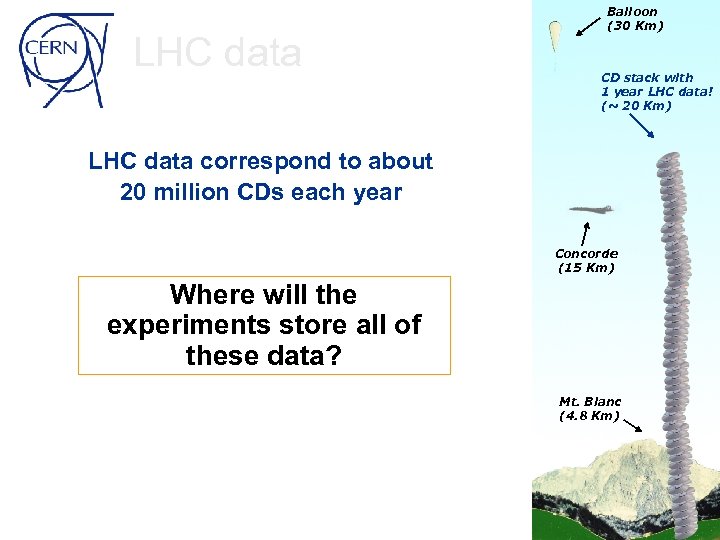 LHC data Balloon (30 Km) CD stack with 1 year LHC data! (~ 20 Km) LHC data correspond to about 20 million CDs each year Concorde (15 Km) Where will the experiments store all of these data? Mt. Blanc (4. 8 Km)
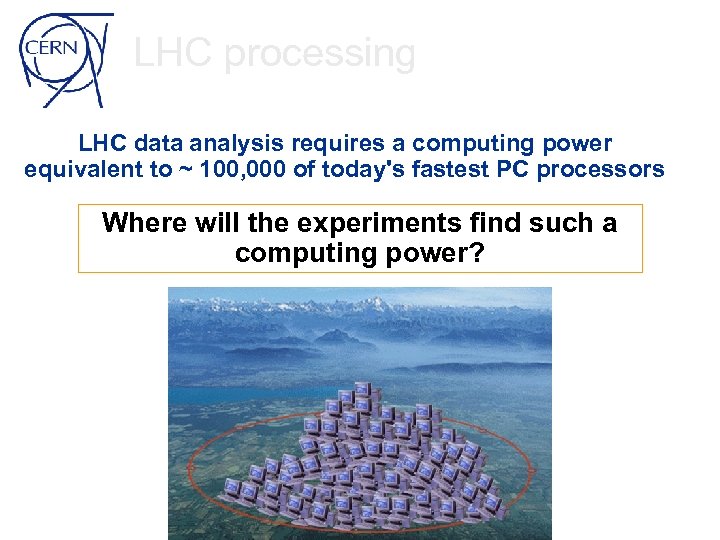 LHC processing LHC data analysis requires a computing power equivalent to ~ 100, 000 of today's fastest PC processors Where will the experiments find such a computing power?
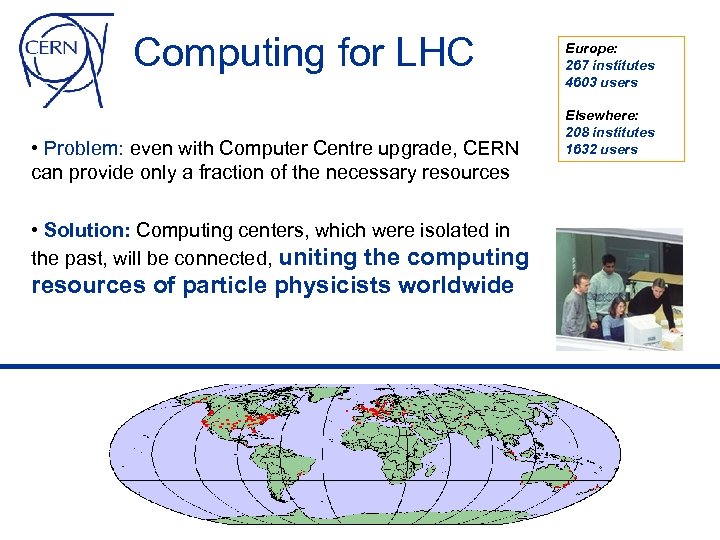 Computing for LHC • Problem: even with Computer Centre upgrade, CERN can provide only a fraction of the necessary resources • Solution: Computing centers, which were isolated in the past, will be connected, uniting the computing resources of particle physicists worldwide Europe: 267 institutes 4603 users Elsewhere: 208 institutes 1632 users
 What is the Grid? • The World Wide Web provides seamless access to information that is stored in many millions of different geographical locations • In contrast, the Grid is an emerging infrastructure that provides seamless access to computing power and data storage capacity distributed over the globe.
 Grid @ CERN • CERN projects: LHC Computing Grid (LCG) • EC funded projects led by CERN: Enabling Grids for E-Science in Europe (EGEE) European Data. Grid (EDG) European Data. TAG (EDT) +others • Industry funded projects: CERN openlab for Data. Grid applications
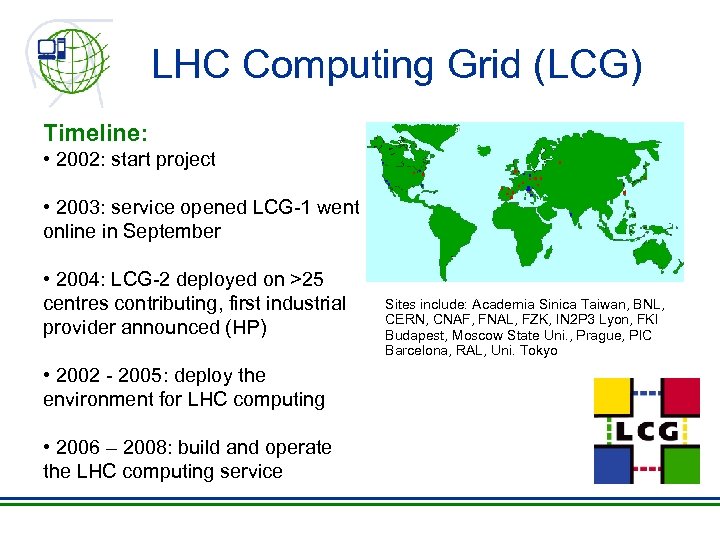 LHC Computing Grid (LCG) Timeline: • 2002: start project • 2003: service opened LCG-1 went online in September • 2004: LCG-2 deployed on >25 centres contributing, first industrial provider announced (HP) • 2002 - 2005: deploy the environment for LHC computing • 2006 – 2008: build and operate the LHC computing service Sites include: Academia Sinica Taiwan, BNL, CERN, CNAF, FNAL, FZK, IN 2 P 3 Lyon, FKI Budapest, Moscow State Uni. , Prague, PIC Barcelona, RAL, Uni. Tokyo
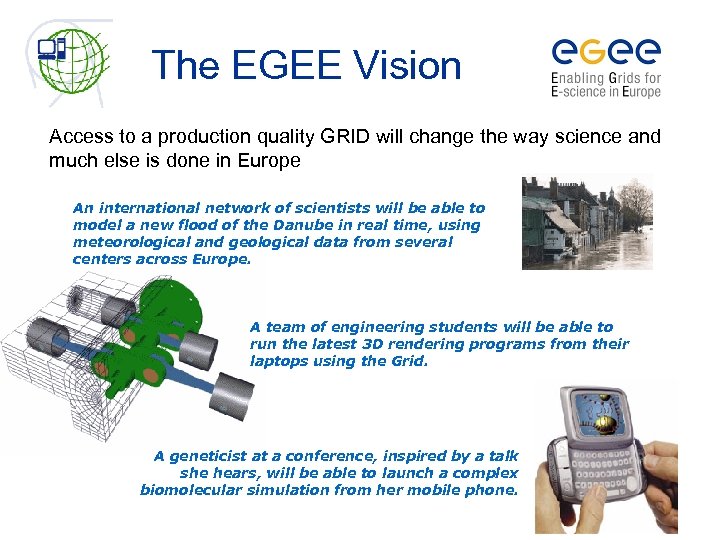 The EGEE Vision Access to a production quality GRID will change the way science and much else is done in Europe An international network of scientists will be able to model a new flood of the Danube in real time, using meteorological and geological data from several centers across Europe. A team of engineering students will be able to run the latest 3 D rendering programs from their laptops using the Grid. A geneticist at a conference, inspired by a talk she hears, will be able to launch a complex biomolecular simulation from her mobile phone.
 Data. TAG Internet 2 Landspeed Record at Telecom 2003: From Starlight in Chicago to CERN in Geneva, 1. 1 Tera. Byte of data across 7’ 067 km in less than 30 min. at TCP rate of 5. 44 Gbps (= 38, 420. 54 petabit-meters/sec) This speed record is equivalent to: Transferring a full 680 Mbytes CD in 1 second Transferring 450 full length DVD movies in one hour (i. e. 1 DVD in 8 seconds)
 sponsored by
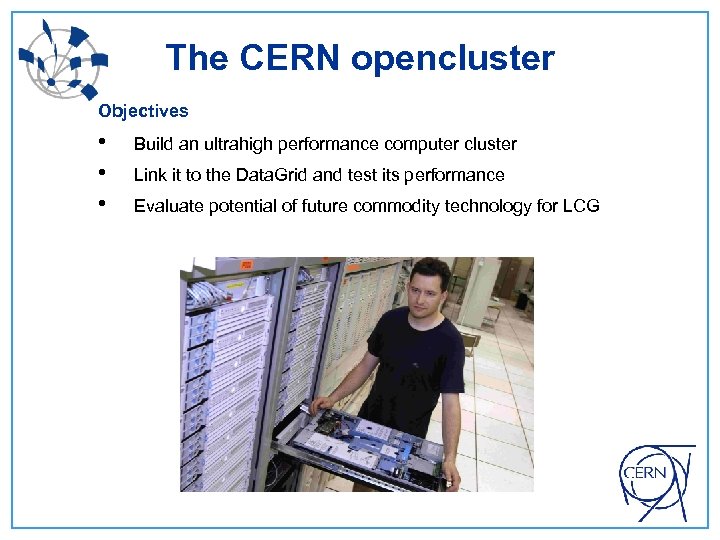 The CERN opencluster Objectives • • • Build an ultrahigh performance computer cluster Link it to the Data. Grid and test its performance Evaluate potential of future commodity technology for LCG
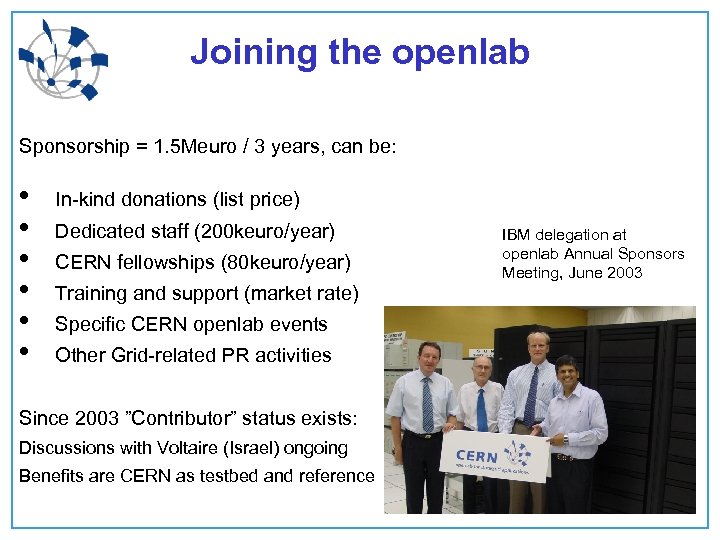 Joining the openlab Sponsorship = 1. 5 Meuro / 3 years, can be: • • • In-kind donations (list price) Dedicated staff (200 keuro/year) CERN fellowships (80 keuro/year) Training and support (market rate) Specific CERN openlab events Other Grid-related PR activities Since 2003 ”Contributor” status exists: Discussions with Voltaire (Israel) ongoing Benefits are CERN as testbed and reference IBM delegation at openlab Annual Sponsors Meeting, June 2003