


 Скачать презентацию Presentation of annual results for the year ending
8d8ed9875e334391b2479ab799281593.ppt
- Количество слайдов: 63
 Presentation of annual results for the year ending June 2003 Presented by: Carl Grim – Chief executive Dennis Gammie – Financial director
 Vision “We wish to be a value driven construction, steel and cement group leveraging ‘best in class’ construction capabilities across subsidiaries and associates in selected areas of the developing world” In summary : “a globally competitive construction-related group focused principally on the developing world”
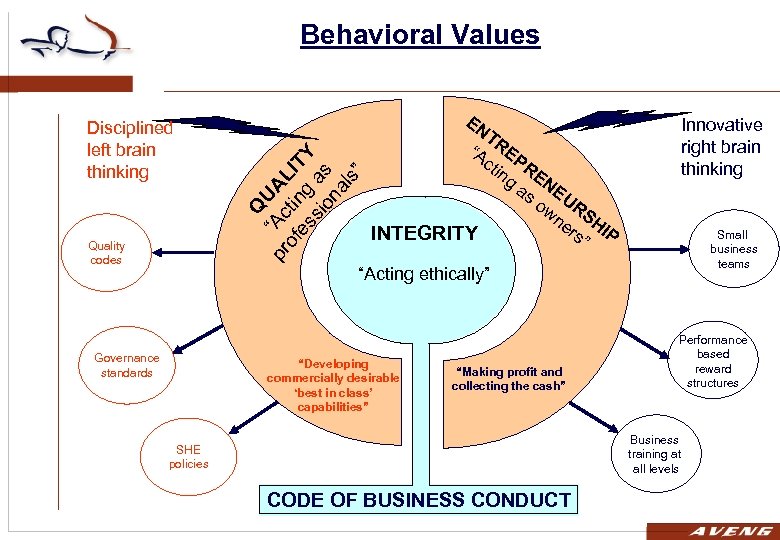 Behavioral Values Quality codes EN Q U pr “Ac AL of tin IT es g Y sio as na ls” Disciplined left brain thinking T “A REP cti R ng EN as EU ow R ne SH rs IP INTEGRITY ” Innovative right brain thinking Small business teams “Acting ethically” Governance standards “Developing commercially desirable ‘best in class’ capabilities” “Making profit and collecting the cash” Performance based reward structures Business training at all levels SHE policies CODE OF BUSINESS CONDUCT
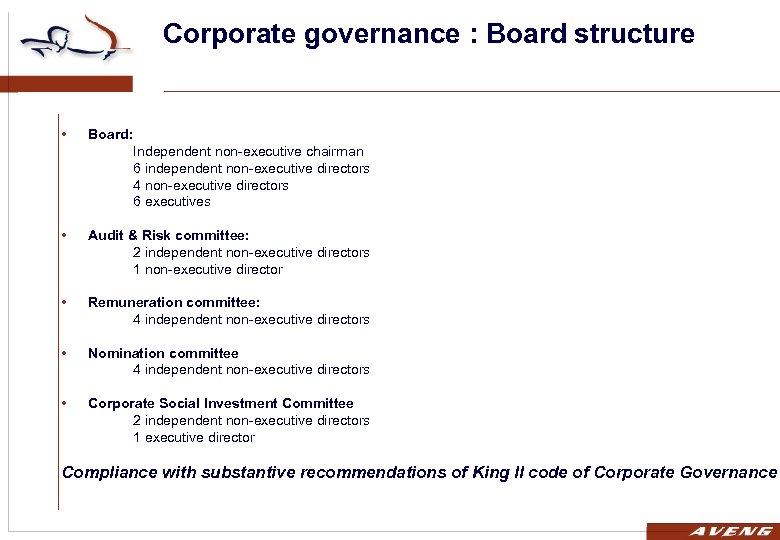 Corporate governance : Board structure • Board: Independent non-executive chairman 6 independent non-executive directors 4 non-executive directors 6 executives • Audit & Risk committee: 2 independent non-executive directors 1 non-executive director • Remuneration committee: 4 independent non-executive directors • Nomination committee 4 independent non-executive directors • Corporate Social Investment Committee 2 independent non-executive directors 1 executive director Compliance with substantive recommendations of King II code of Corporate Governance
 “Best in class” capabilities locally • steel processing and trading • construction in specific niches across most engineering disciplines • manufacture of cement, aggregates and concrete developing world • selected mining services for demanding clients • specialised energy-related projects and pipelines • complex infrastructure and marine projects
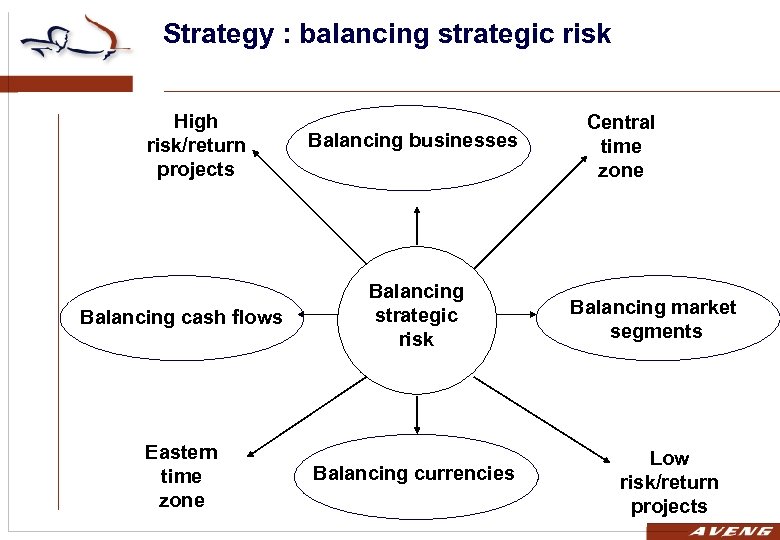 Strategy : balancing strategic risk High risk/return projects Balancing businesses Balancing cash flows Balancing strategic risk Eastern time zone Balancing currencies Central time zone Balancing market segments Low risk/return projects
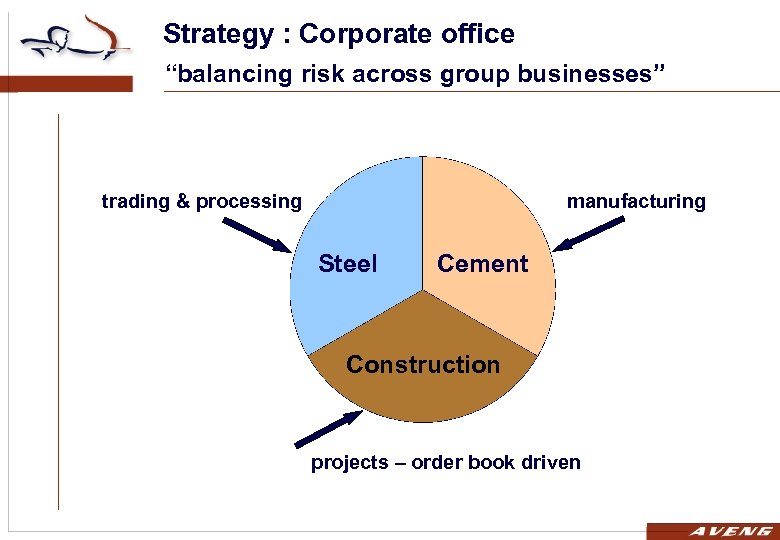 Strategy : Corporate office “balancing risk across group businesses” trading & processing manufacturing Steel Cement Construction projects – order book driven
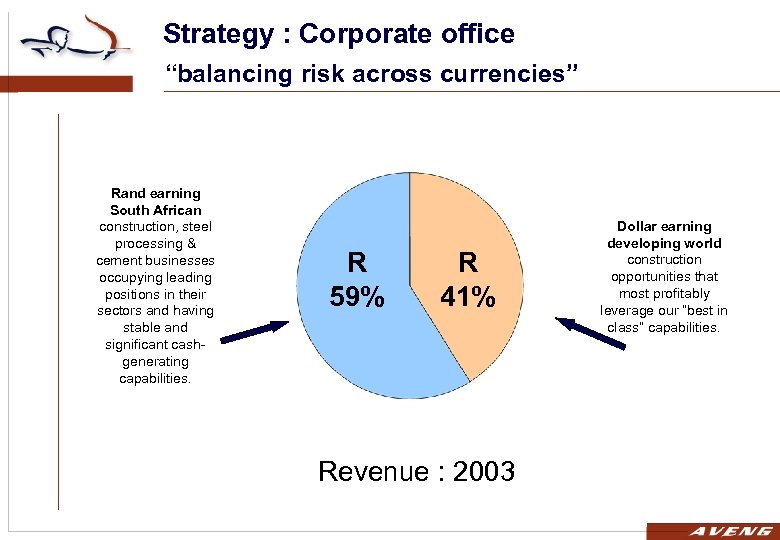 Strategy : Corporate office “balancing risk across currencies” Rand earning South African construction, steel processing & cement businesses occupying leading positions in their sectors and having stable and significant cashgenerating capabilities. R 59% R 41% Revenue : 2003 Dollar earning developing world construction opportunities that most profitably leverage our “best in class” capabilities.
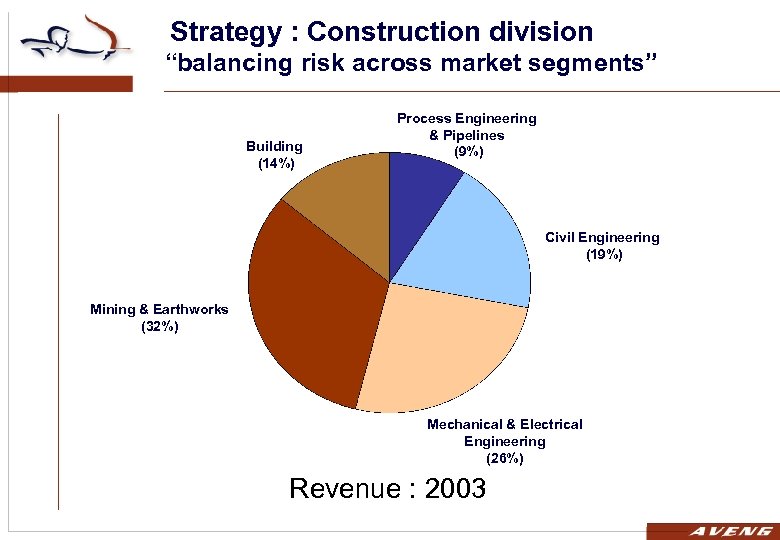 Strategy : Construction division “balancing risk across market segments” Building (14%) Process Engineering & Pipelines (9%) Civil Engineering (19%) Mining & Earthworks (32%) Mechanical & Electrical Engineering (26%) Revenue : 2003
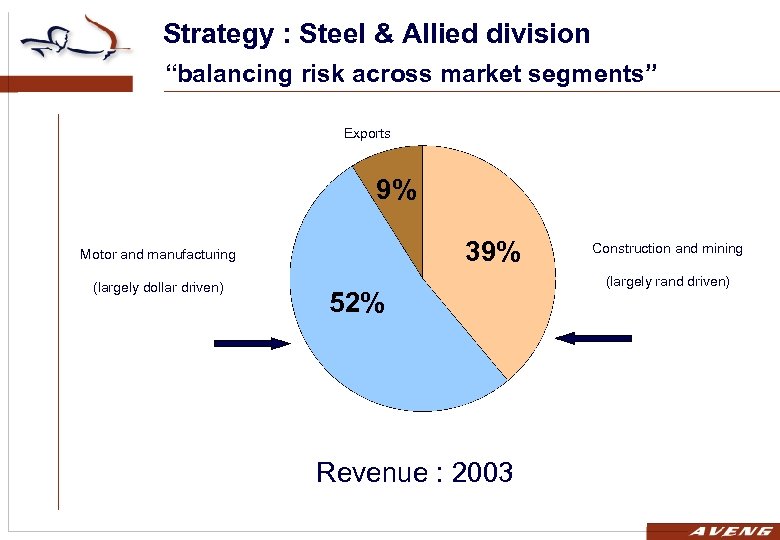 Strategy : Steel & Allied division “balancing risk across market segments” Exports 9% 39% Motor and manufacturing (largely dollar driven) 52% Revenue : 2003 Construction and mining (largely rand driven)
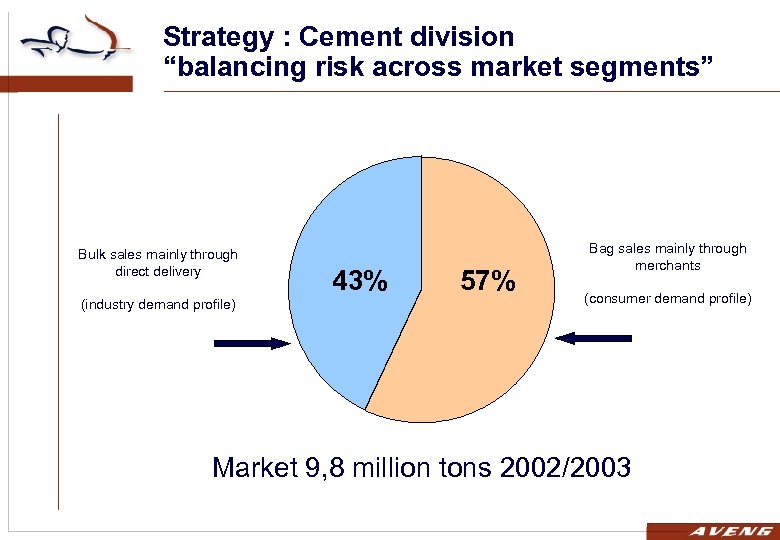 Strategy : Cement division “balancing risk across market segments” Bulk sales mainly through direct delivery (industry demand profile) 43% 57% Bag sales mainly through merchants (consumer demand profile) Market 9, 8 million tons 2002/2003
 Strategy : Balancing risk Our strategy is about risk, focusing on it and seeking to understand it better by mapping the unique dynamics associated with each major risk and then attempting to balance complementary risk against one another. • The corporate office balances strategic risk between businesses, currencies, market segments and cash flow • Business units balance operational risk between projects and opportunities with different risk profiles
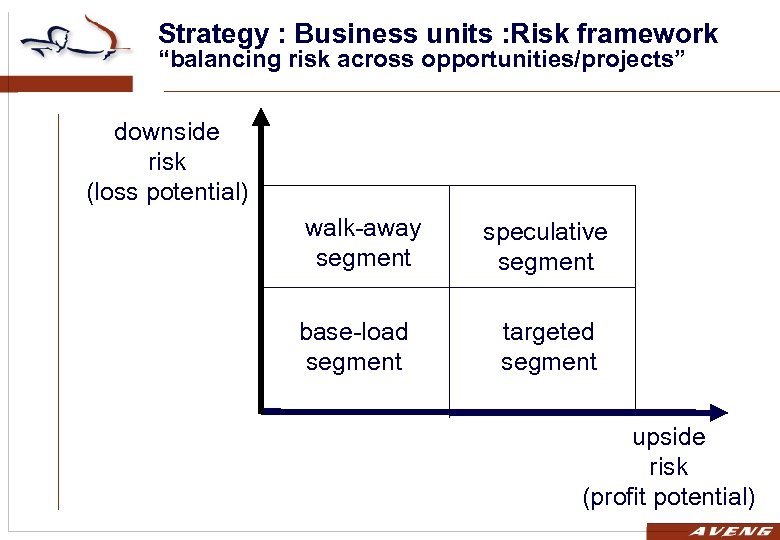 Strategy : Business units : Risk framework “balancing risk across opportunities/projects” downside risk (loss potential) walk-away segment base-load segment speculative segment targeted segment upside risk (profit potential)
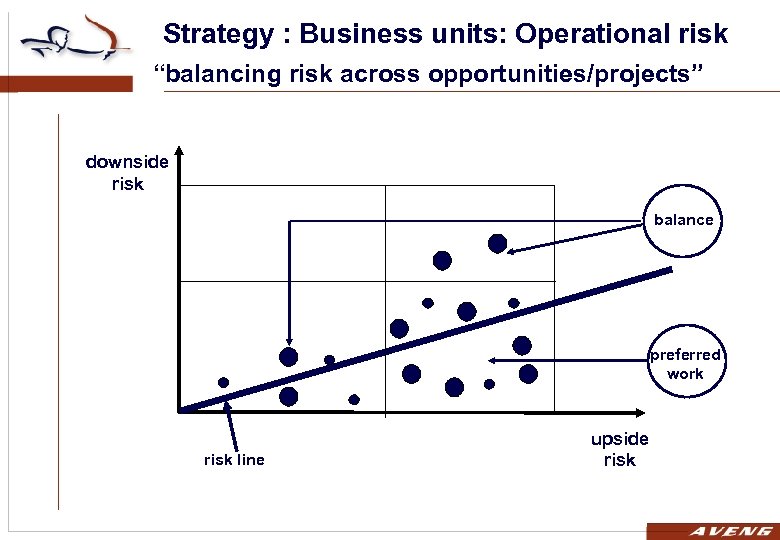 Strategy : Business units: Operational risk “balancing risk across opportunities/projects” downside risk balance preferred work risk line upside risk
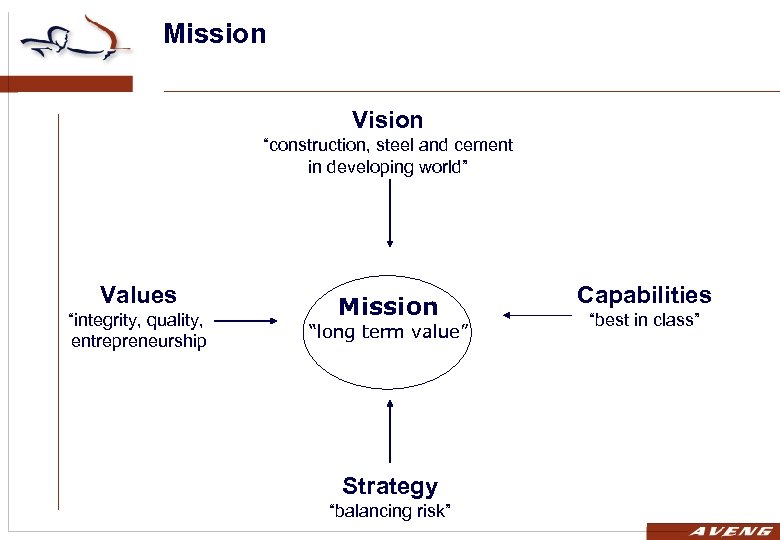 Mission Vision “construction, steel and cement in developing world” Values “integrity, quality, entrepreneurship Mission “long term value” Strategy “balancing risk” Capabilities “best in class”
 Mission To deliver consistent long term value for all stakeholders by: • managing the group in a way that nurtures the behavioural values of integrity, quality and entrepreneurship • incentivising each business unit to develop commercially desirable ‘best in class’ capabilities and then find opportunities to leverage these with fellow Aveng companies locally or elsewhere • balancing risk strategically across construction, steel and cement; between the rand hard currencies; and across market segments with different client bases and cash flow characteristics; and balancing risk operationally between projects and opportunities with different risk characteristics using the Aveng risk framework methodology.
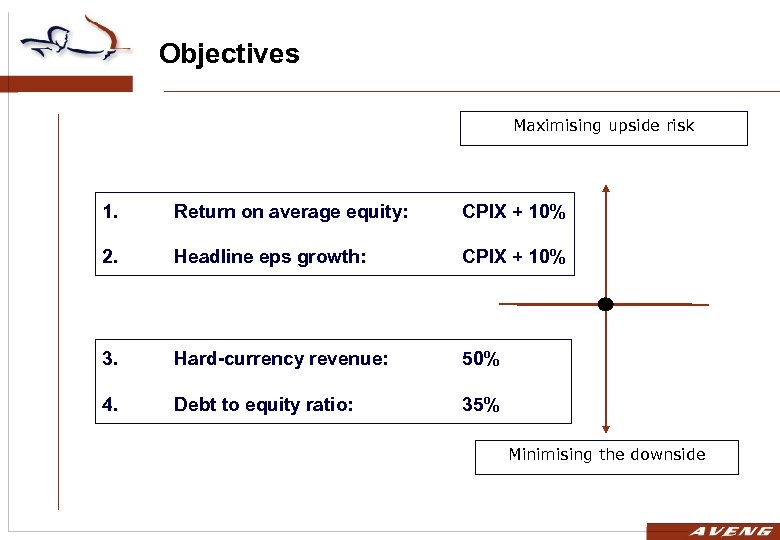 Objectives Maximising upside risk 1. Return on average equity: CPIX + 10% 2. Headline eps growth: CPIX + 10% 3. Hard-currency revenue: 50% 4. Debt to equity ratio: 35% Minimising the downside
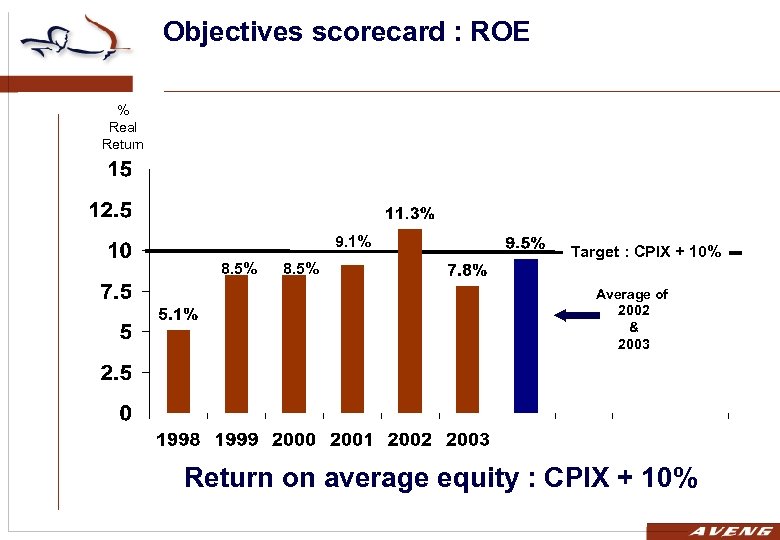 Objectives scorecard : ROE % Real Return 9. 1% 8. 5% Target : CPIX + 10% Average of 2002 & 2003 Return on average equity : CPIX + 10%
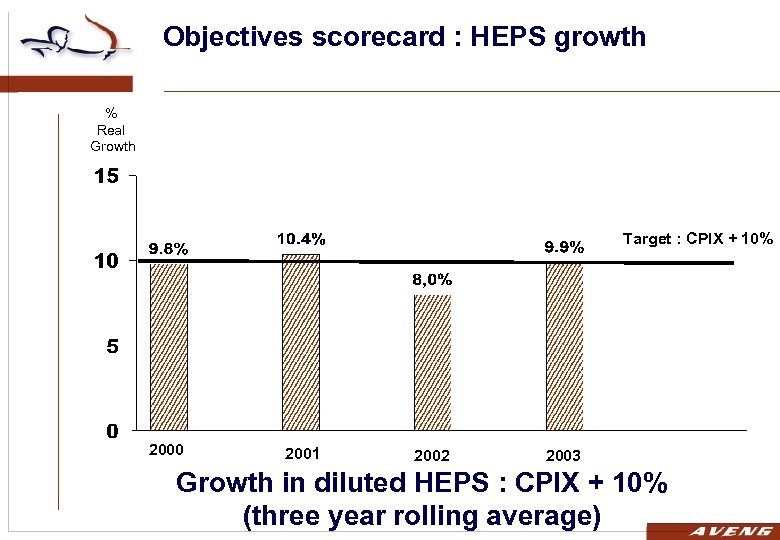 Objectives scorecard : HEPS growth % Real Growth Target : CPIX + 10% 2000 2001 2002 2003 Growth in diluted HEPS : CPIX + 10% (three year rolling average)
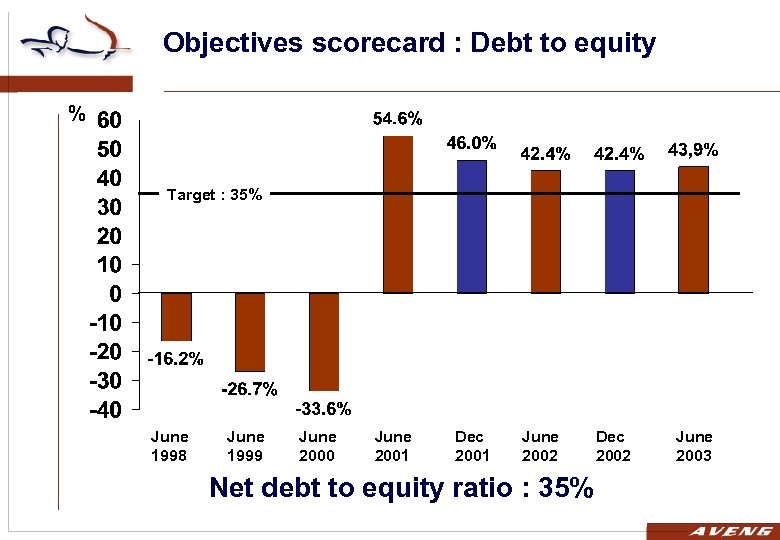 Objectives scorecard : Debt to equity % Target : 35% June 1998 June 1999 June 2000 June 2001 Dec 2001 June 2002 Net debt to equity ratio : 35% Dec 2002 June 2003
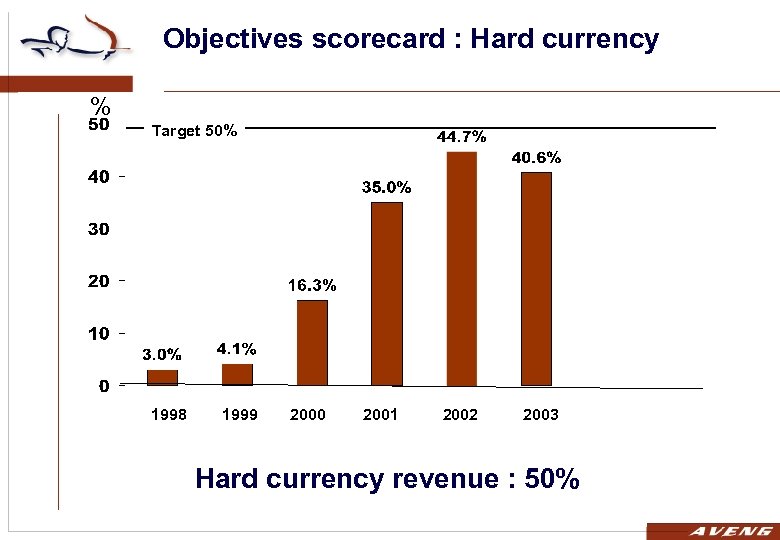 Objectives scorecard : Hard currency % Target 50% 1998 1999 2000 2001 2002 2003 Hard currency revenue : 50%
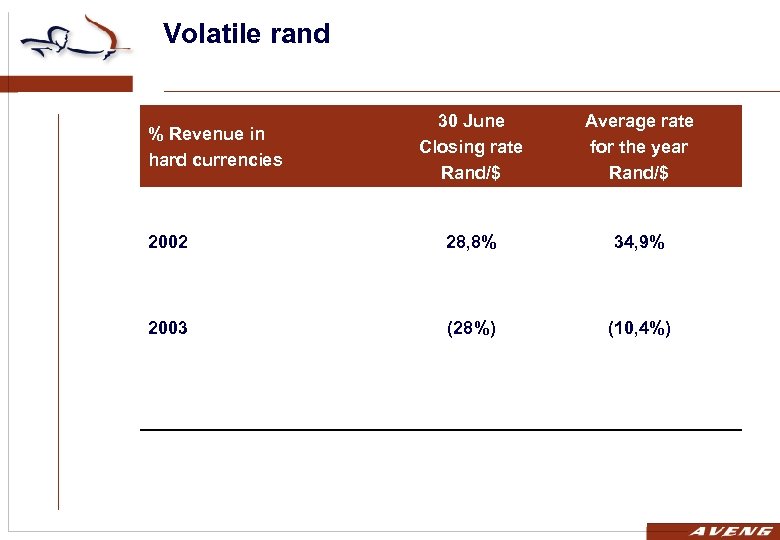 Volatile rand 30 June Closing rate Rand/$ Average rate for the year Rand/$ 2002 28, 8% 34, 9% 2003 (28%) (10, 4%) % Revenue in hard currencies
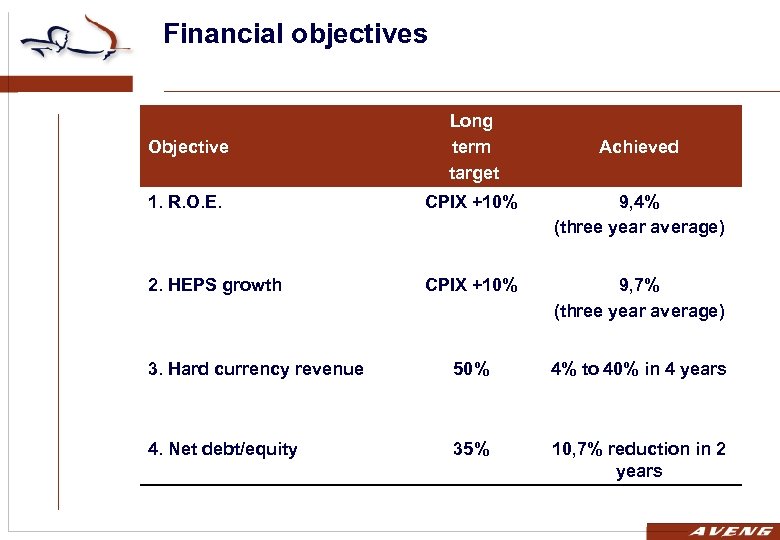 Financial objectives Objective Long term target 1. R. O. E. CPIX +10% 9, 4% (three year average) 2. HEPS growth CPIX +10% 9, 7% (three year average) 3. Hard currency revenue 50% 4% to 40% in 4 years 4. Net debt/equity 35% 10, 7% reduction in 2 years Achieved
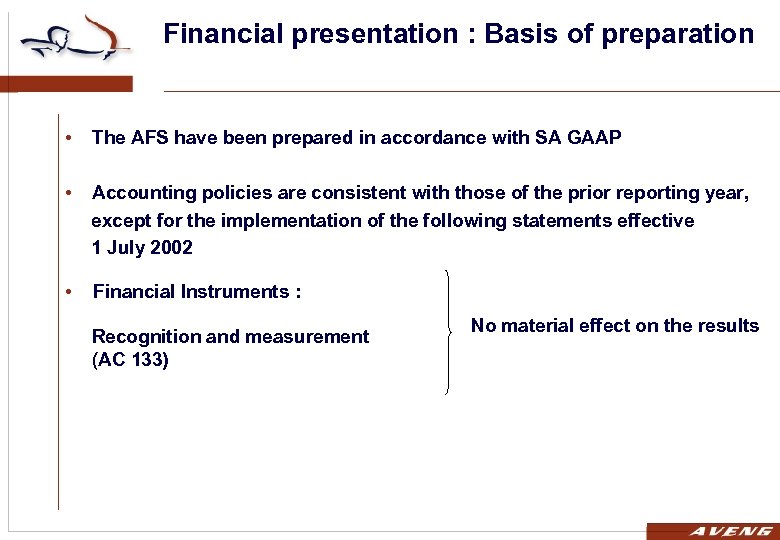 Financial presentation : Basis of preparation • The AFS have been prepared in accordance with SA GAAP • Accounting policies are consistent with those of the prior reporting year, except for the implementation of the following statements effective 1 July 2002 • Financial Instruments : Recognition and measurement (AC 133) No material effect on the results
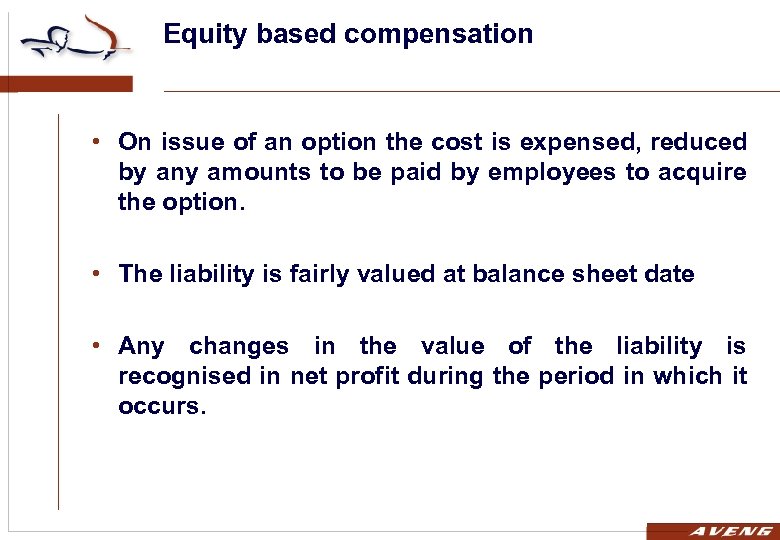 Equity based compensation • On issue of an option the cost is expensed, reduced by any amounts to be paid by employees to acquire the option. • The liability is fairly valued at balance sheet date • Any changes in the value of the liability is recognised in net profit during the period in which it occurs.
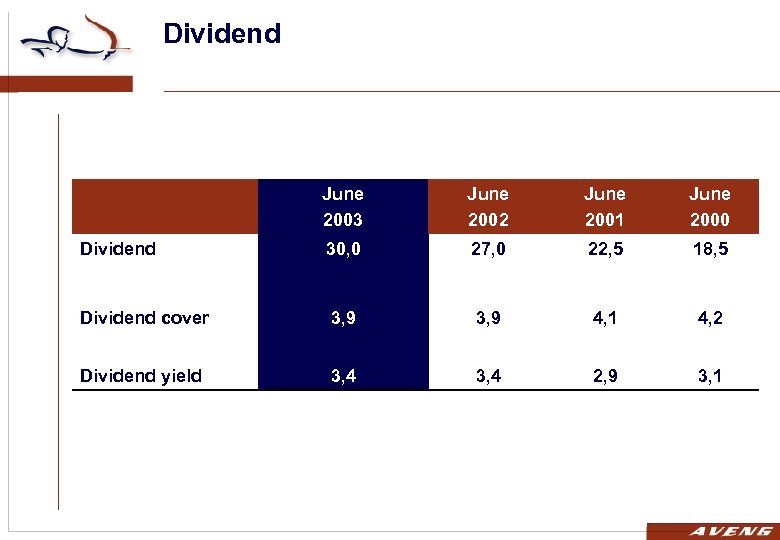 Dividend June 2003 June 2002 June 2001 June 2000 Dividend 30, 0 27, 0 22, 5 18, 5 Dividend cover 3, 9 4, 1 4, 2 Dividend yield 3, 4 2, 9 3, 1
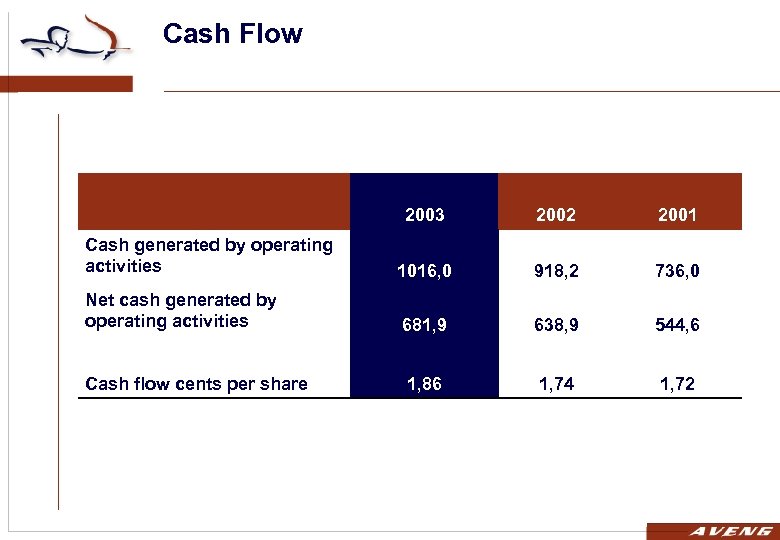 Cash Flow 2003 2002 2001 Cash generated by operating activities 1016, 0 918, 2 736, 0 Net cash generated by operating activities 681, 9 638, 9 544, 6 Cash flow cents per share 1, 86 1, 74 1, 72
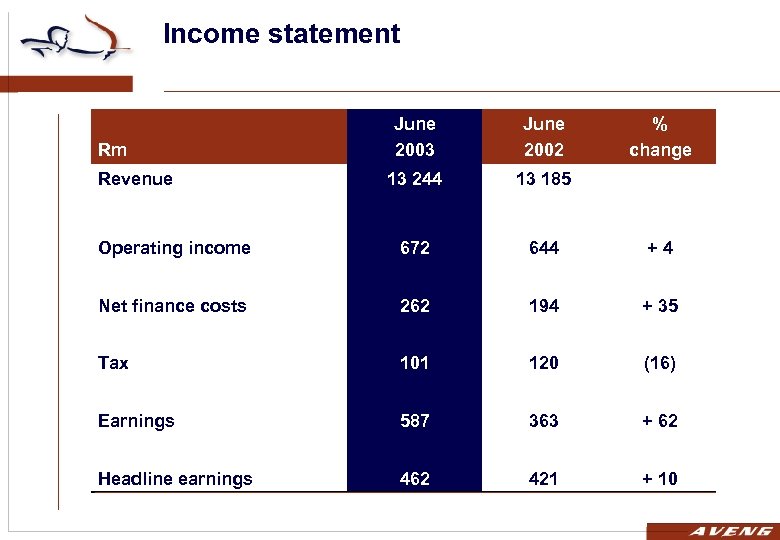 Income statement June 2003 June 2002 13 244 13 185 Operating income 672 644 +4 Net finance costs 262 194 + 35 Tax 101 120 (16) Earnings 587 363 + 62 Headline earnings 462 421 + 10 Rm Revenue % change
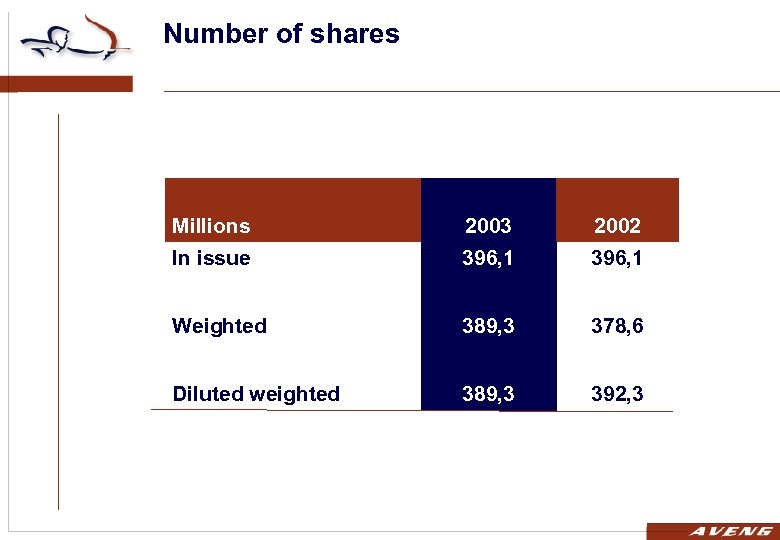 Number of shares Millions 2003 2002 In issue 396, 1 Weighted 389, 3 378, 6 Diluted weighted 389, 3 392, 3
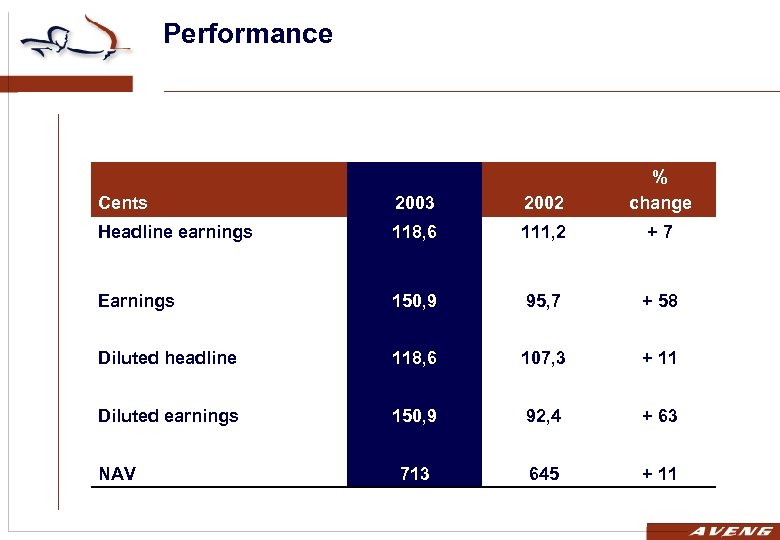 Performance Cents 2003 2002 % change Headline earnings 118, 6 111, 2 +7 Earnings 150, 9 95, 7 + 58 Diluted headline 118, 6 107, 3 + 11 Diluted earnings 150, 9 92, 4 + 63 713 645 + 11 NAV
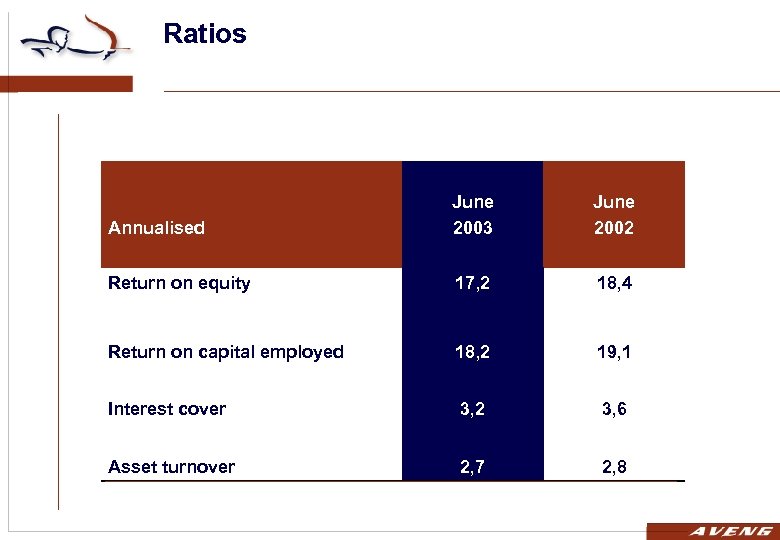 Ratios Annualised June 2003 June 2002 Return on equity 17, 2 18, 4 Return on capital employed 18, 2 19, 1 Interest cover 3, 2 3, 6 Asset turnover 2, 7 2, 8
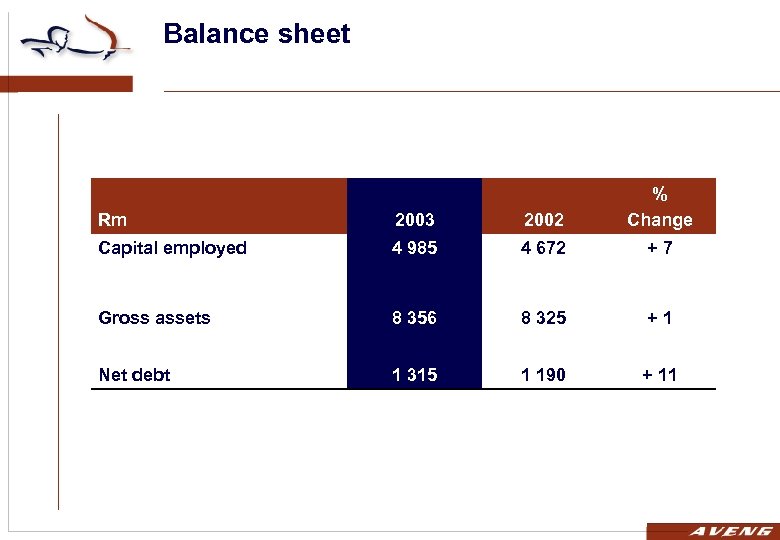 Balance sheet Rm 2003 2002 % Change Capital employed 4 985 4 672 +7 Gross assets 8 356 8 325 +1 Net debt 1 315 1 190 + 11
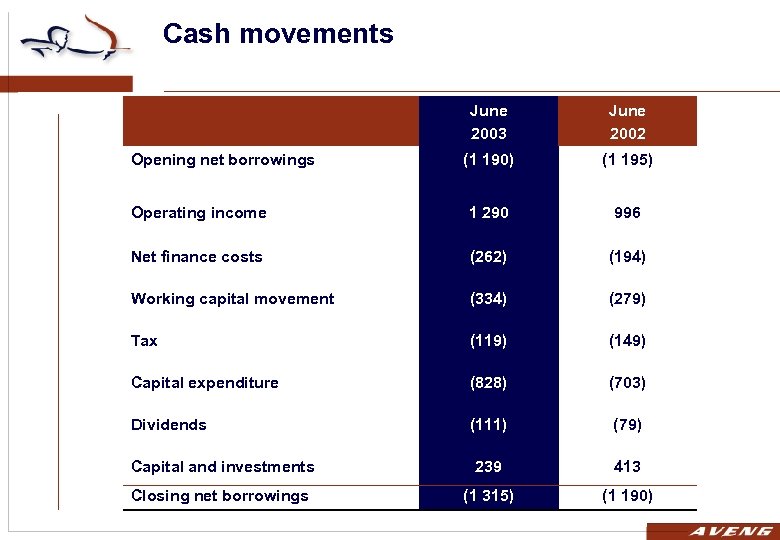 Cash movements June 2003 June 2002 (1 190) (1 195) Operating income 1 290 996 Net finance costs (262) (194) Working capital movement (334) (279) Tax (119) (149) Capital expenditure (828) (703) Dividends (111) (79) Capital and investments 239 413 Closing net borrowings (1 315) (1 190) Opening net borrowings
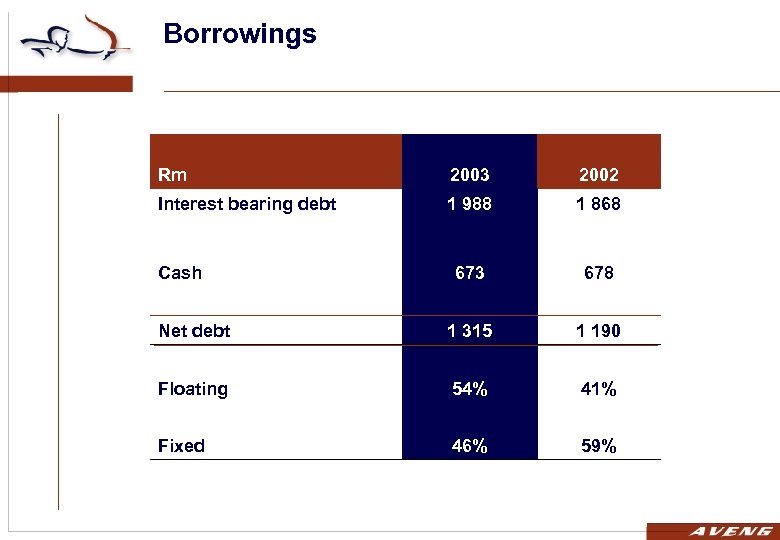 Borrowings Rm 2003 2002 Interest bearing debt 1 988 1 868 673 678 Net debt 1 315 1 190 Floating 54% 41% Fixed 46% 59% Cash
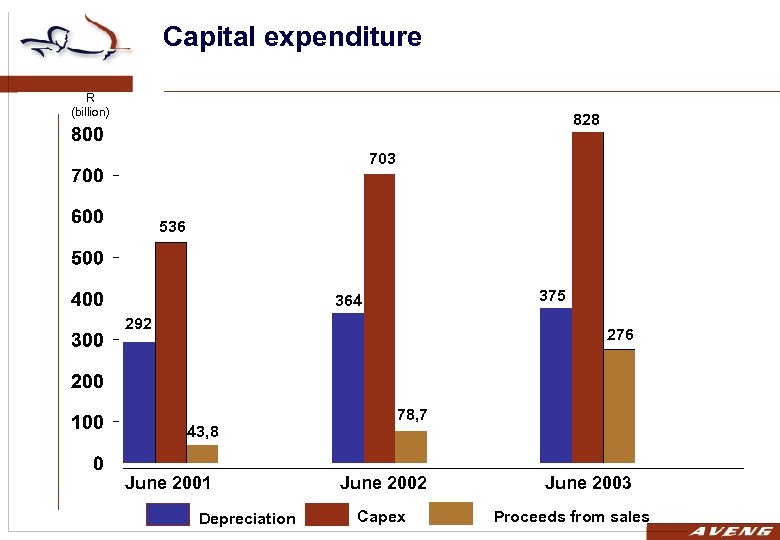 Capital expenditure R (billion) 828 703 536 375 364 292 276 43, 8 June 2001 Depreciation 78, 7 June 2002 Capex June 2003 Proceeds from sales
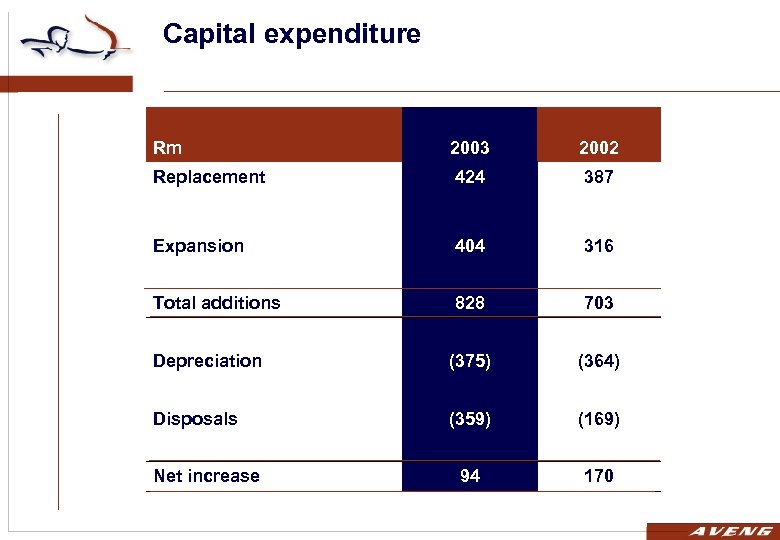 Capital expenditure Rm 2003 2002 Replacement 424 387 Expansion 404 316 Total additions 828 703 Depreciation (375) (364) Disposals (359) (169) 94 170 Net increase
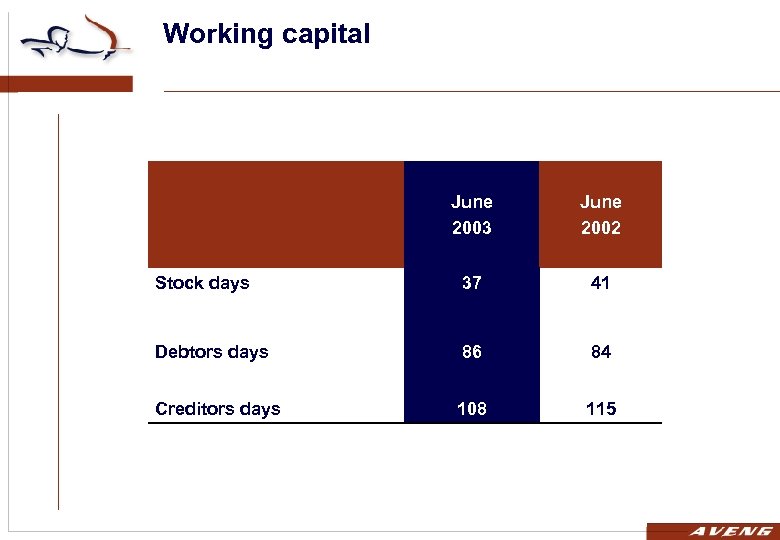 Working capital June 2003 June 2002 Stock days 37 41 Debtors days 86 84 Creditors days 108 115
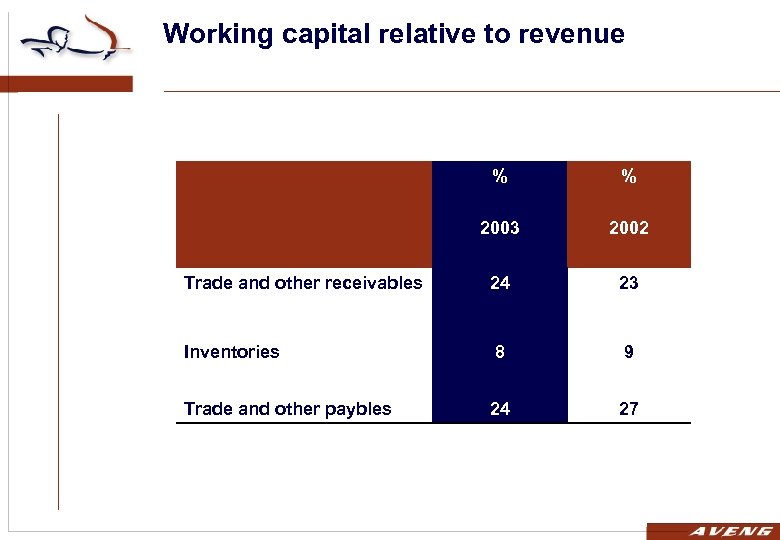 Working capital relative to revenue % % 2003 2002 Trade and other receivables 24 23 Inventories 8 9 Trade and other paybles 24 27
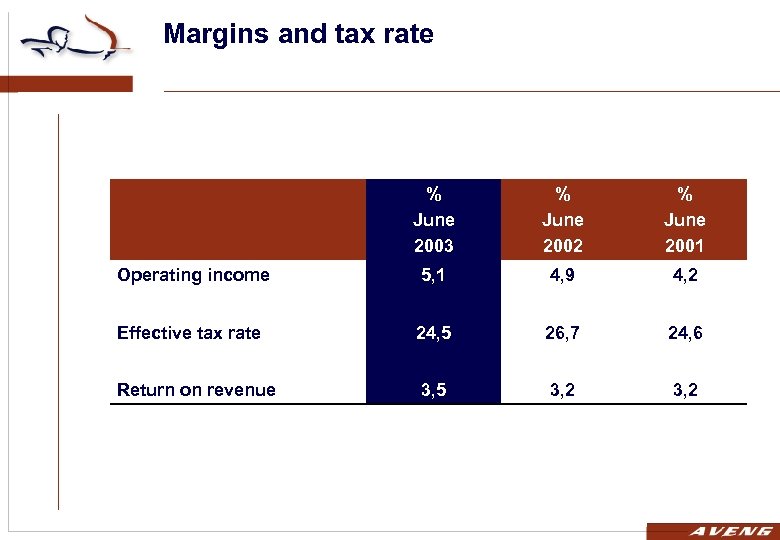 Margins and tax rate % June 2003 % June 2002 % June 2001 Operating income 5, 1 4, 9 4, 2 Effective tax rate 24, 5 26, 7 24, 6 Return on revenue 3, 5 3, 2
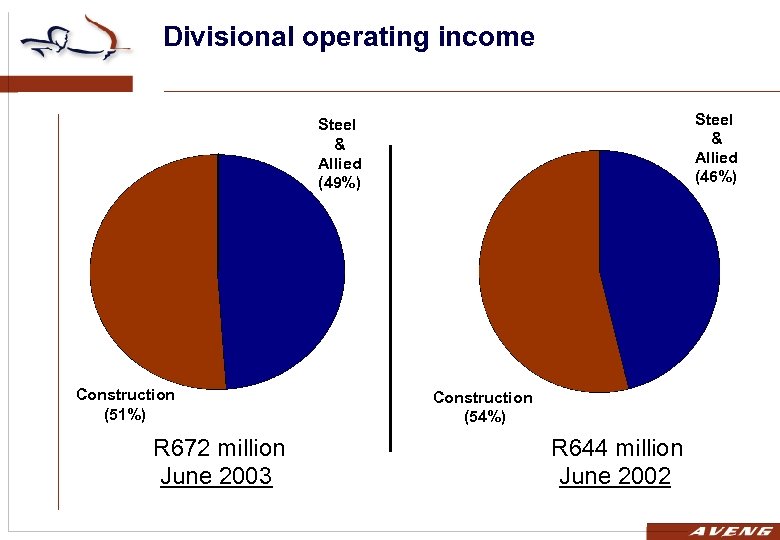 Divisional operating income Steel & Allied (46%) Steel & Allied (49%) Construction (51%) R 672 million June 2003 Construction (54%) R 644 million June 2002
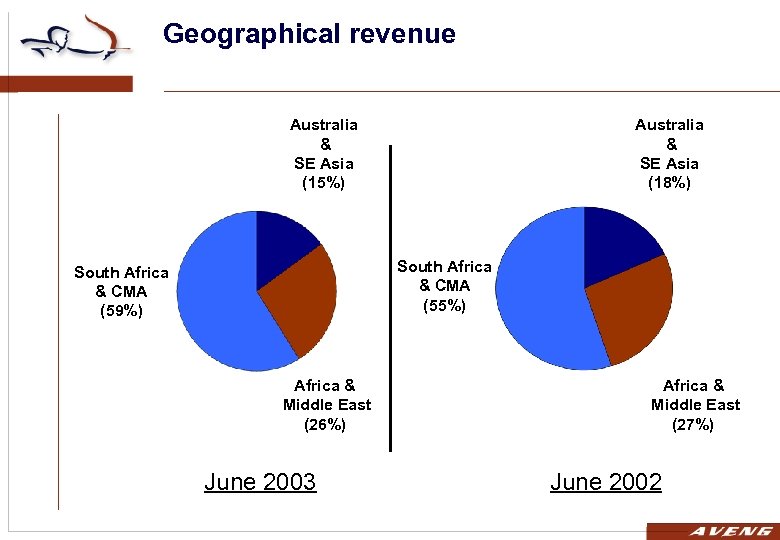 Geographical revenue Australia & SE Asia (15%) Australia & SE Asia (18%) South Africa & CMA (55%) South Africa & CMA (59%) Africa & Middle East (26%) June 2003 Africa & Middle East (27%) June 2002
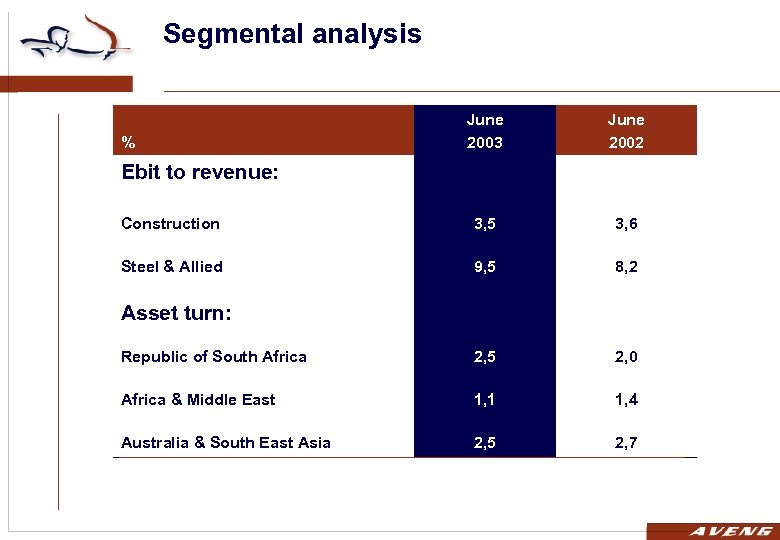 Segmental analysis June 2003 June 2002 Construction 3, 5 3, 6 Steel & Allied 9, 5 8, 2 Republic of South Africa 2, 5 2, 0 Africa & Middle East 1, 1 1, 4 Australia & South East Asia 2, 5 2, 7 % Ebit to revenue: Asset turn:
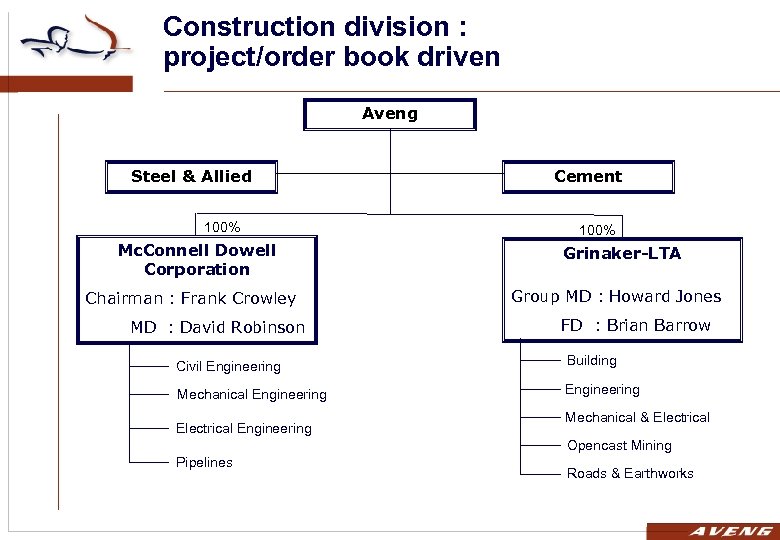 Construction division : project/order book driven Aveng Steel & Allied 100% Mc. Connell Dowell Corporation Chairman : Frank Crowley MD : David Robinson Cement 100% Grinaker-LTA Group MD : Howard Jones FD : Brian Barrow Civil Engineering Building Mechanical Engineering Electrical Engineering Mechanical & Electrical Opencast Mining Pipelines Roads & Earthworks
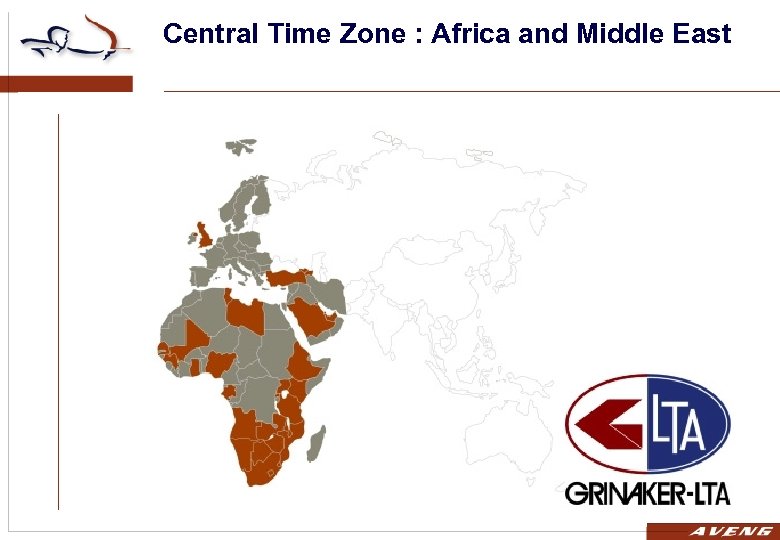 Central Time Zone : Africa and Middle East
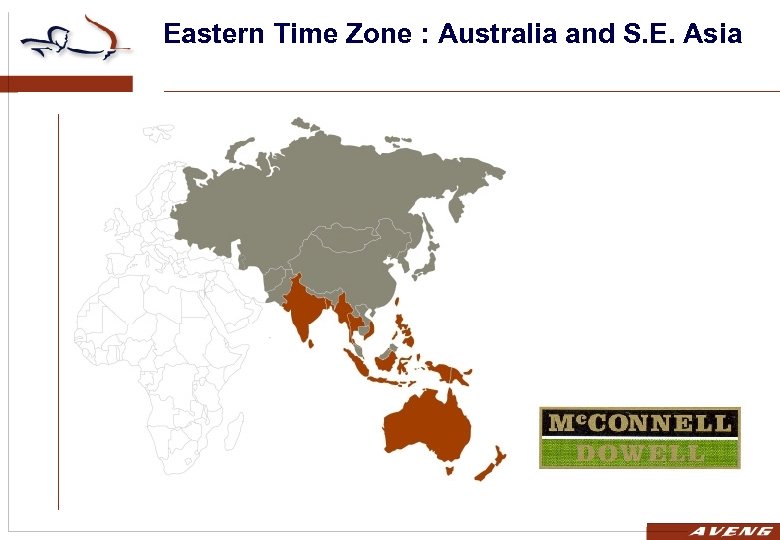 Eastern Time Zone : Australia and S. E. Asia
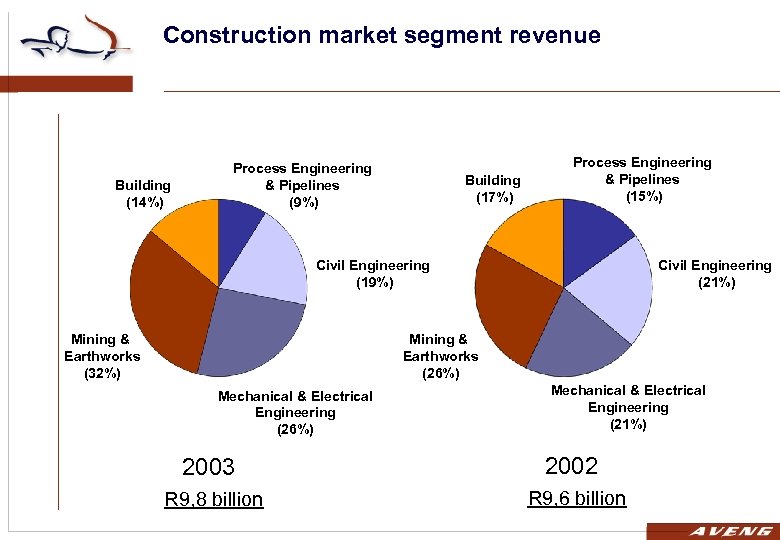 Construction market segment revenue Building (14%) Process Engineering & Pipelines (9%) Building (17%) Process Engineering & Pipelines (15%) Civil Engineering (19%) Mining & Earthworks (32%) Civil Engineering (21%) Mining & Earthworks (26%) Mechanical & Electrical Engineering (21%) 2003 2002 R 9, 8 billion R 9, 6 billion
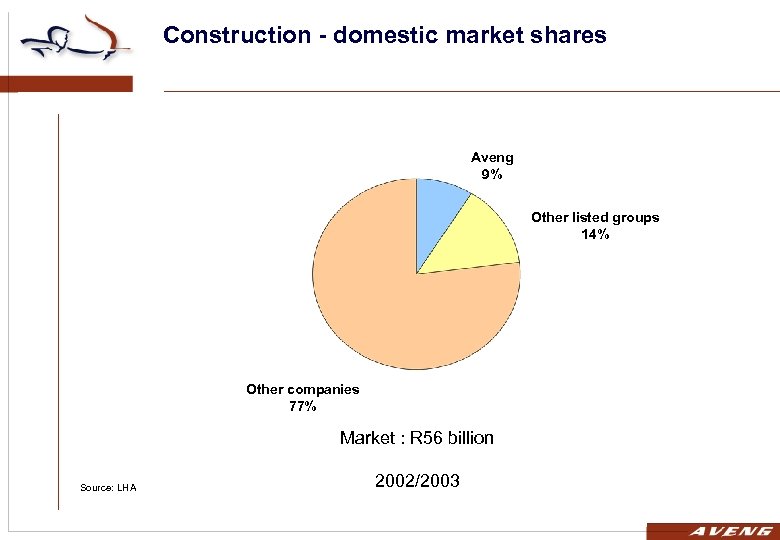 Construction - domestic market shares Aveng 9% Other listed groups 14% Other companies 77% Market : R 56 billion Source: LHA 2002/2003
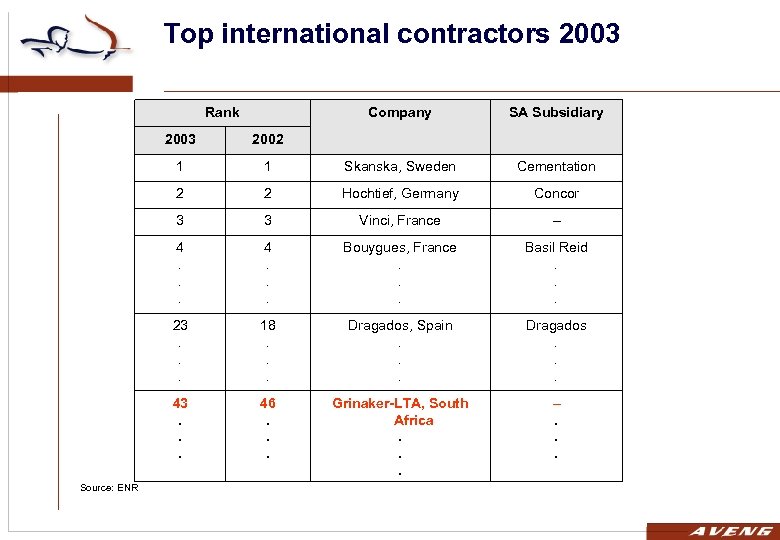 Top international contractors 2003 Rank Company SA Subsidiary 2003 1 1 Skanska, Sweden Cementation 2 2 Hochtief, Germany Concor 3 3 Vinci, France – 4. . . Bouygues, France. . . Basil Reid. . . 23. . . 18. . . Dragados, Spain. . . Dragados. . . 43. . . Source: ENR 2002 46. . . Grinaker-LTA, South Africa. . . –. . .
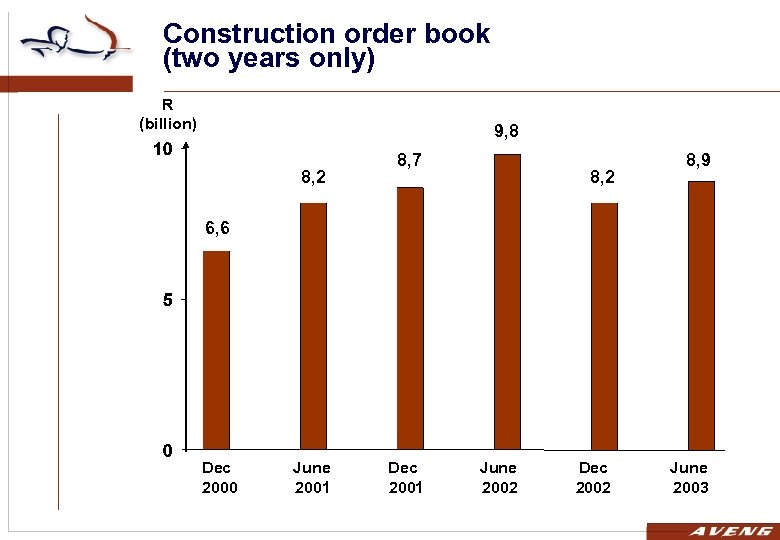 Construction order book (two years only) R (billion) 9, 8 8, 2 8, 7 8, 2 8, 9 6, 6 Dec 2000 June 2001 Dec 2001 June 2002 Dec 2002 June 2003
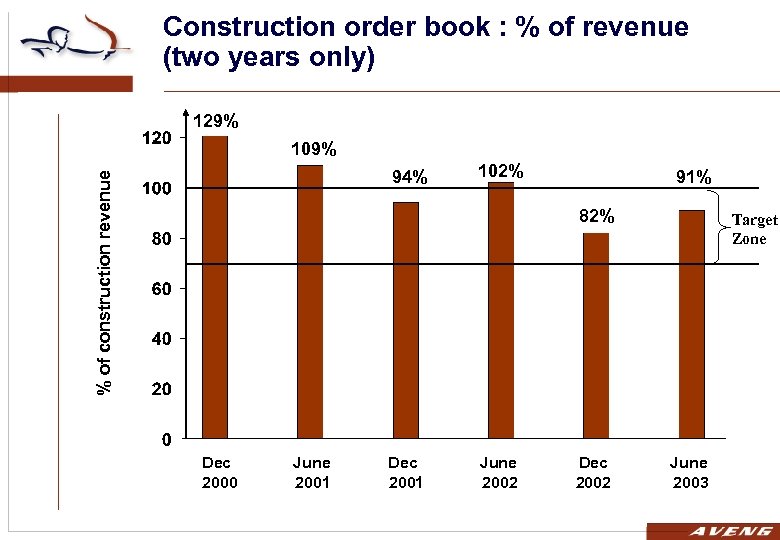 Construction order book : % of revenue (two years only) 129% 109% % of construction revenue 94% 102% 91% 82% Dec 2000 June 2001 Dec 2001 June 2002 Dec 2002 Target Zone June 2003
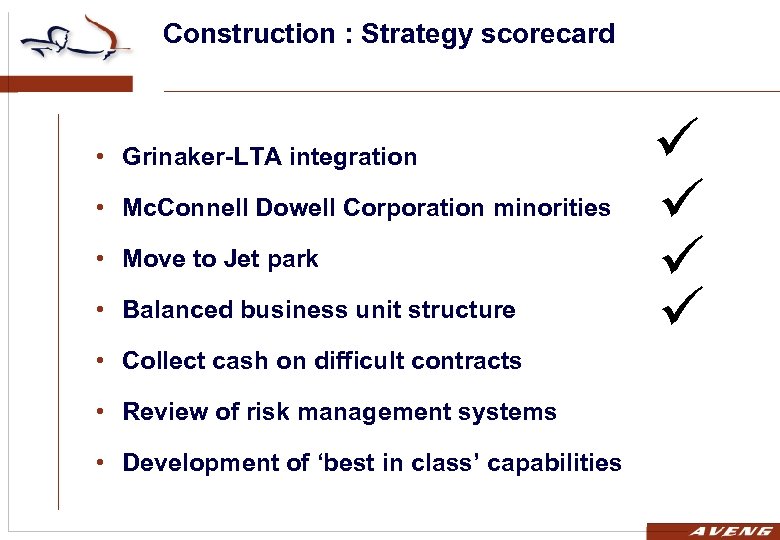 Construction : Strategy scorecard • Grinaker-LTA integration • Mc. Connell Dowell Corporation minorities • Move to Jet park • Balanced business unit structure • Collect cash on difficult contracts • Review of risk management systems • Development of ‘best in class’ capabilities
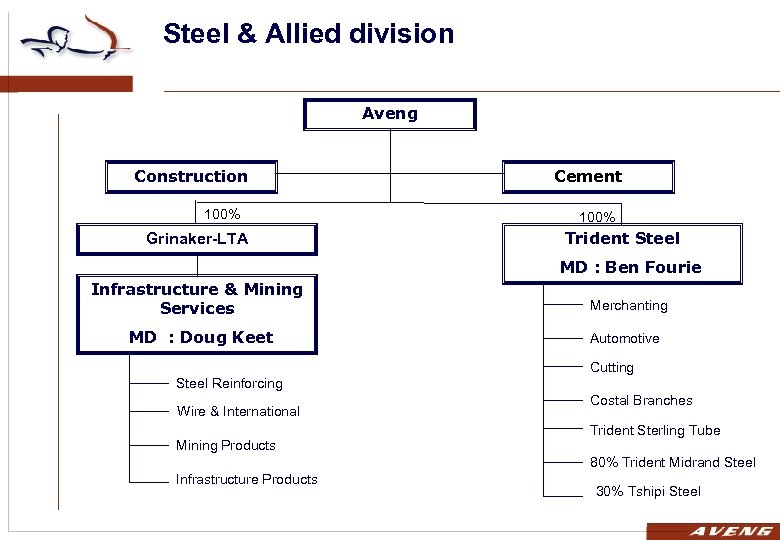 Steel & Allied division Aveng Construction 100% Grinaker-LTA Cement 100% Trident Steel MD : Ben Fourie Infrastructure & Mining Services Merchanting MD : Doug Keet Automotive Cutting Steel Reinforcing Wire & International Costal Branches Trident Sterling Tube Mining Products 80% Trident Midrand Steel Infrastructure Products 30% Tshipi Steel
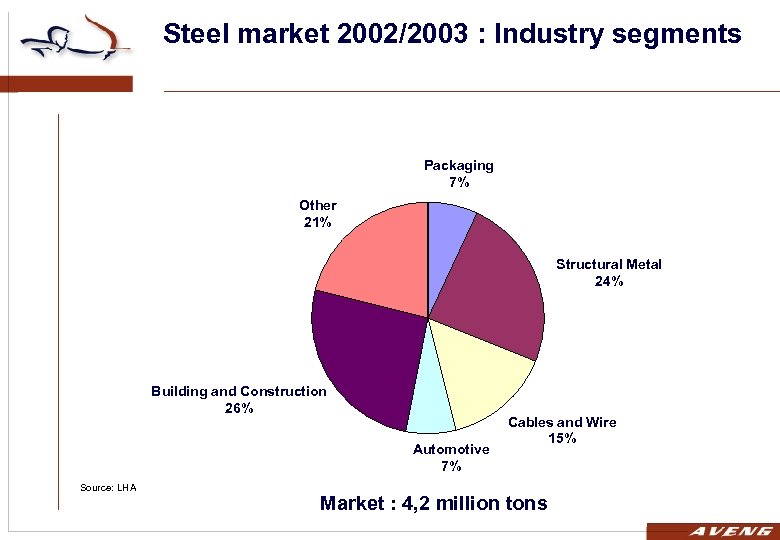 Steel market 2002/2003 : Industry segments Packaging 7% Other 21% Structural Metal 24% Building and Construction 26% Automotive 7% Source: LHA Cables and Wire 15% Market : 4, 2 million tons
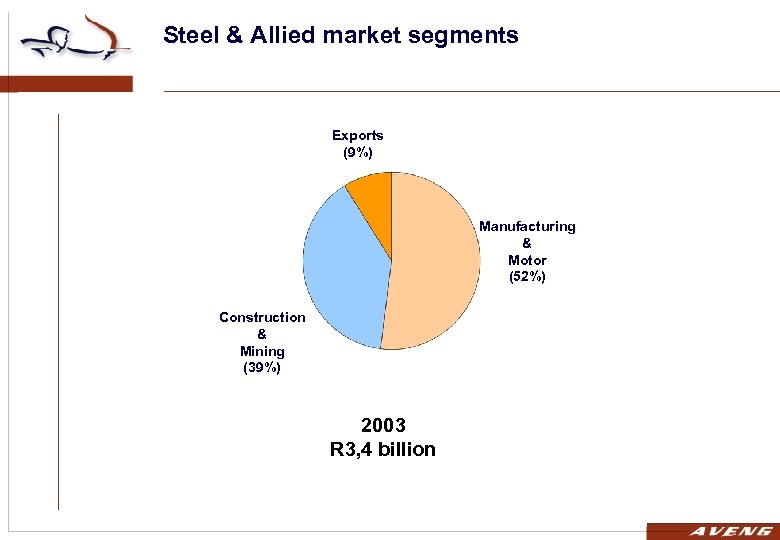 Steel & Allied market segments Exports (9%) Manufacturing & Motor (52%) Construction & Mining (39%) 2003 R 3, 4 billion
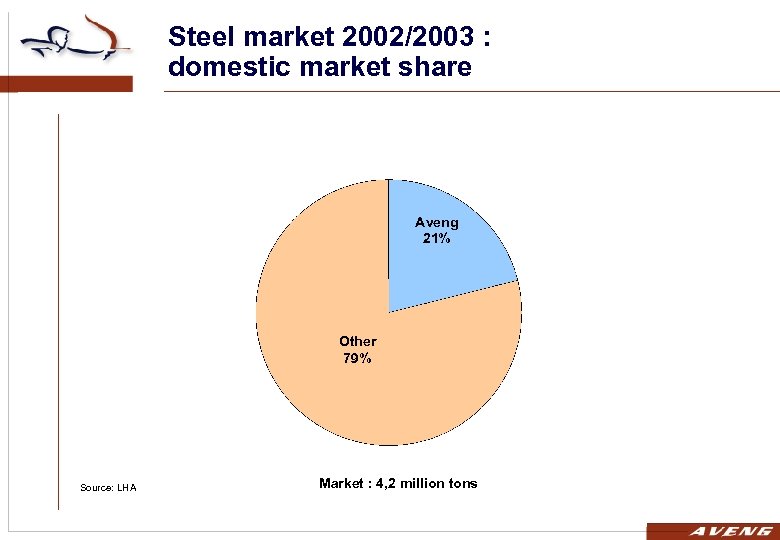 Steel market 2002/2003 : domestic market share Aveng 21% Other 79% Source: LHA Market : 4, 2 million tons
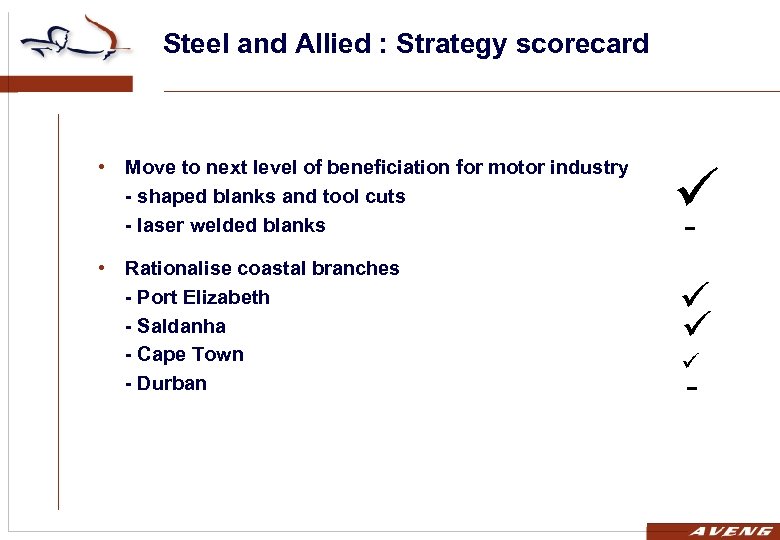 Steel and Allied : Strategy scorecard • Move to next level of beneficiation for motor industry - shaped blanks and tool cuts - laser welded blanks • Rationalise coastal branches - Port Elizabeth - Saldanha - Cape Town - Durban -
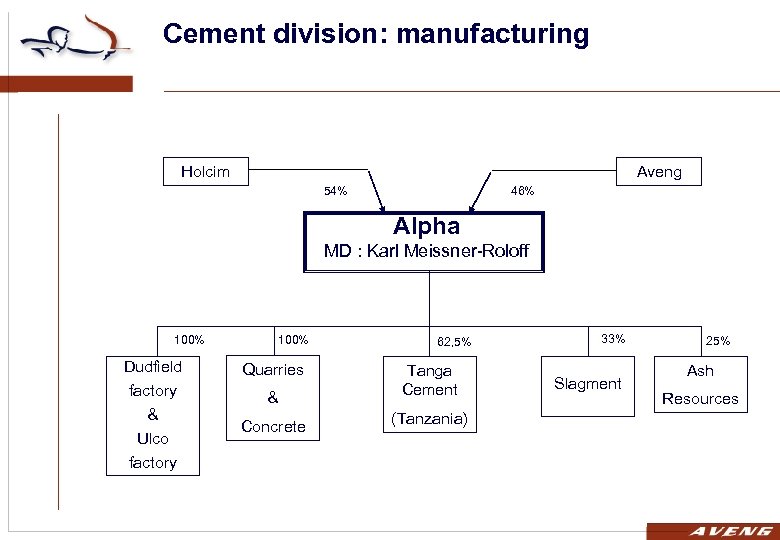 Cement division: manufacturing Holcim Aveng 54% 46% Alpha MD : Karl Meissner-Roloff 100% Dudfield Quarries factory & Ulco factory & Concrete 62, 5% Tanga Cement (Tanzania) 33% Slagment 25% Ash Resources
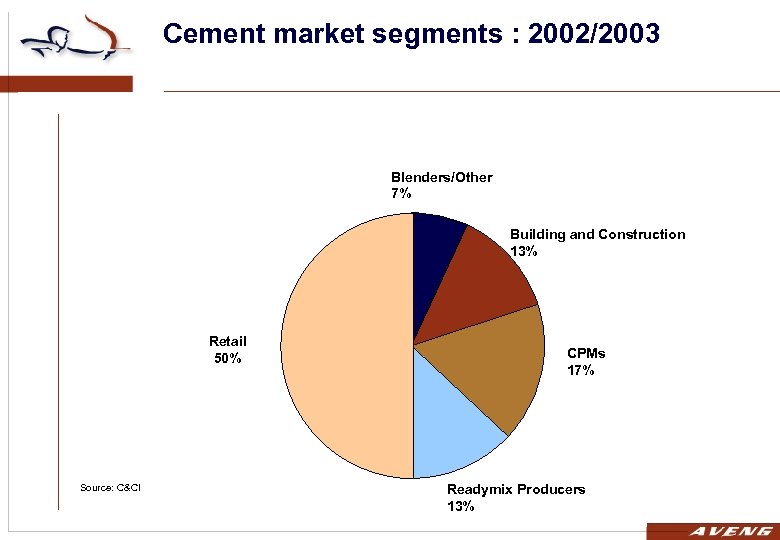 Cement market segments : 2002/2003 Blenders/Other 7% Building and Construction 13% Retail 50% Source: C&CI CPMs 17% Readymix Producers 13%
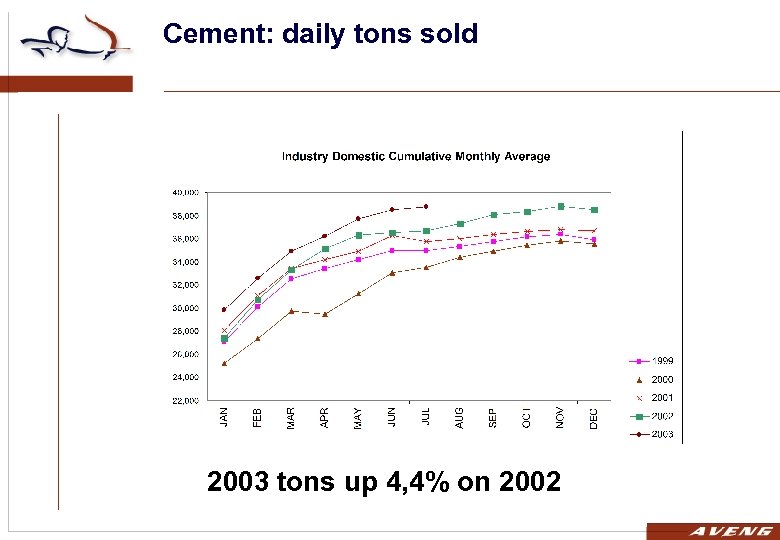 Cement: daily tons sold 2003 tons up 4, 4% on 2002
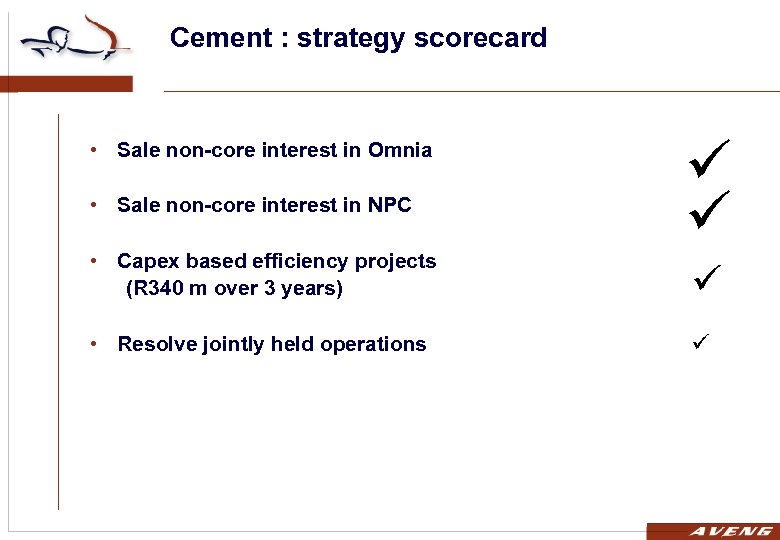 Cement : strategy scorecard • Sale non-core interest in Omnia • Sale non-core interest in NPC • Capex based efficiency projects (R 340 m over 3 years) • Resolve jointly held operations
 Challenges : 2004 • business environment • black economic empowerment • ownership • employment equity • procurement • adapting to new construction environment • working capital management/debt reduction • managing HIV/Aids • skills development/people capacity
 Future outlook • construction order book 91% of revenue • rand volatile • pent up demand locally and exciting projects pending • international construction market tough • mining investment inertia – steel market down • declining interest rates – positive impact on cement
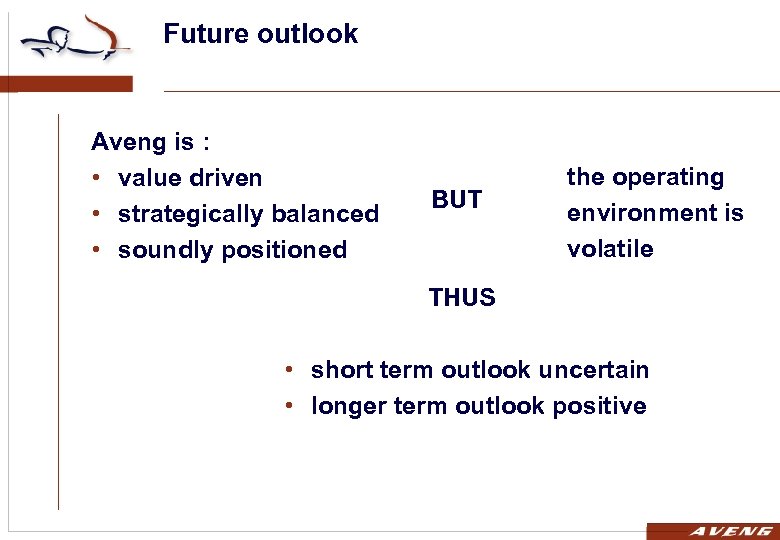 Future outlook Aveng is : • value driven • strategically balanced • soundly positioned BUT the operating environment is volatile THUS • short term outlook uncertain • longer term outlook positive