 Скачать презентацию Presentation GNSS 4 2 by H Cabler ICAO
d22dd0ff8f28a30aa08d24caee58d26b.ppt
- Количество слайдов: 24



Presentation GNSS 4. 2 by H. Cabler ICAO CAR/SAM ATN/GNSS SEMINAR
Modernization History n Need for GPS Modernization recognized by US as GPS entered Full Operational Capability (1995) Recognized growing importance of GPS to both sectors n National Policy imperative to enhance GPS as single world standard n Better, more reliable civilian service n Need to rethink GPS architecture for the future n n Multiple studies indicated diverse set of needs New signals, Higher Power, Greater Accuracy n Greater focus on dual-use nature n System Integrity, Survivability, and Prevention of hostile use n Better Spectrum Management n 2
Background n 1996 Presidential Decision Directive (PDD) and 1998/99 Vice Presidential announcements committed US to modernization and improvement path Selective Availability (SA) turned to zero NLT 2006 n Two new civil signals and new military signals n Free world-wide use n n Move from studies to action initiated in FY 2000 n SA Set to zero in May 00 directed changes to existing and future satellites n IIF program terminated at 12 satellites and GPS III development began n Modernization Now in Full Swing 3
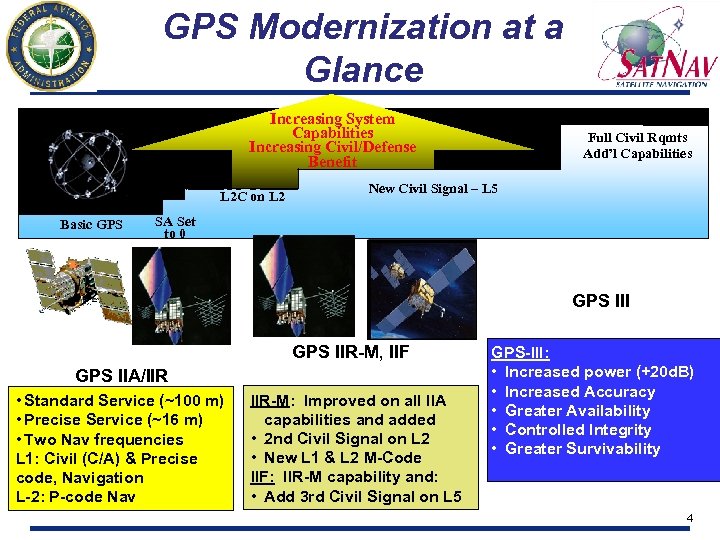
GPS Modernization at a Glance Increasing System Capabilities Increasing Civil/Defense Benefit L 2 C on L 2 Basic GPS Full Civil Rqmts Add’l Capabilities New Civil Signal – L 5 SA Set to 0 GPS III GPS IIR-M, IIF GPS IIA/IIR • Standard Service (~100 m) • Precise Service (~16 m) • Two Nav frequencies L 1: Civil (C/A) & Precise code, Navigation L-2: P-code Nav IIR-M: Improved on all IIA capabilities and added • 2 nd Civil Signal on L 2 • New L 1 & L 2 M-Code IIF: IIR-M capability and: • Add 3 rd Civil Signal on L 5 GPS-III: • Increased power (+20 d. B) • Increased Accuracy • Greater Availability • Controlled Integrity • Greater Survivability 4
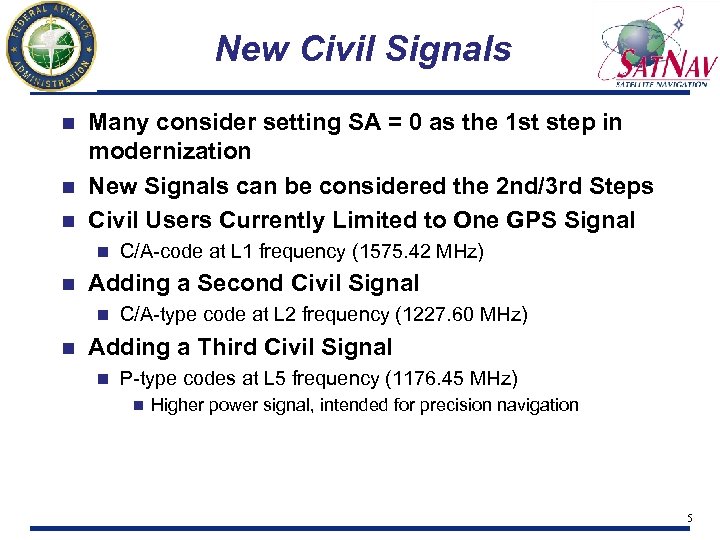
New Civil Signals Many consider setting SA = 0 as the 1 st step in modernization n New Signals can be considered the 2 nd/3 rd Steps n Civil Users Currently Limited to One GPS Signal n n n Adding a Second Civil Signal n n C/A-code at L 1 frequency (1575. 42 MHz) C/A-type code at L 2 frequency (1227. 60 MHz) Adding a Third Civil Signal n P-type codes at L 5 frequency (1176. 45 MHz) n Higher power signal, intended for precision navigation 5
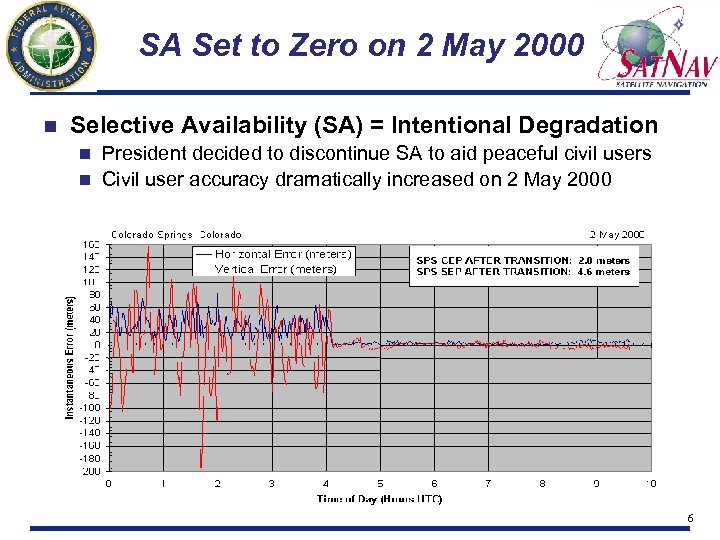
SA Set to Zero on 2 May 2000 n Selective Availability (SA) = Intentional Degradation President decided to discontinue SA to aid peaceful civil users n Civil user accuracy dramatically increased on 2 May 2000 n 6
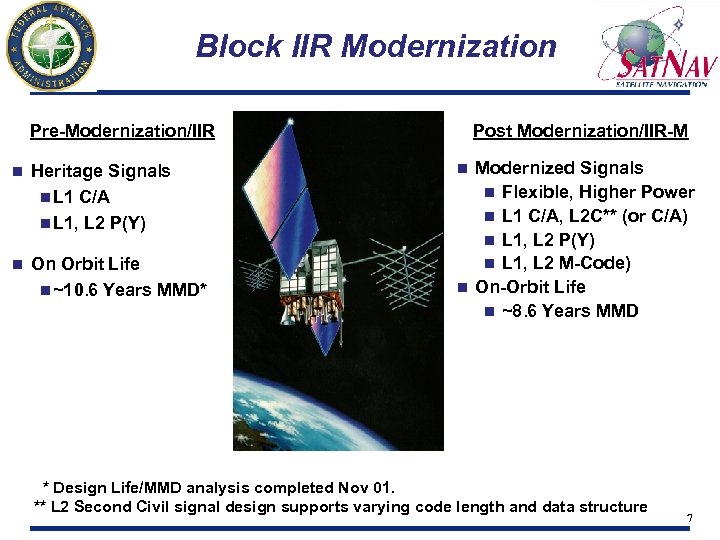
Block IIR Modernization Pre-Modernization/IIR n Heritage Signals n L 1 C/A n L 1, L 2 P(Y) n On Orbit Life n ~10. 6 Years MMD* Post Modernization/IIR-M Modernized Signals n Flexible, Higher Power n L 1 C/A, L 2 C** (or C/A) n L 1, L 2 P(Y) n L 1, L 2 M-Code) n On-Orbit Life n ~8. 6 Years MMD n * Design Life/MMD analysis completed Nov 01. ** L 2 Second Civil signal design supports varying code length and data structure 7
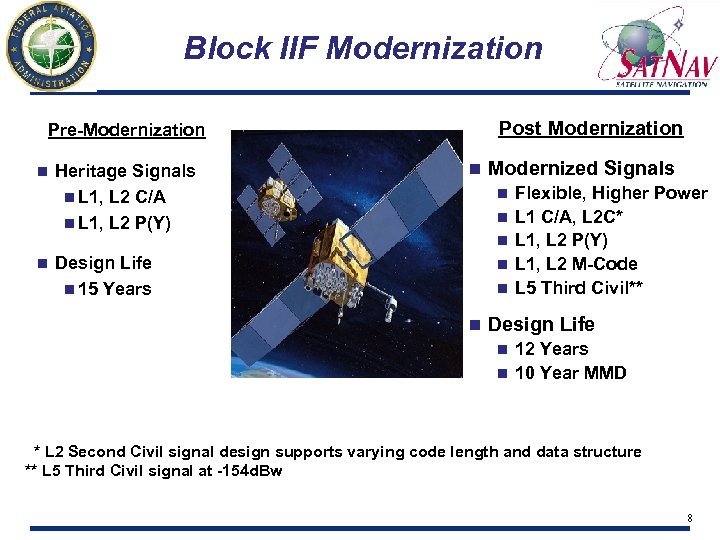
Block IIF Modernization Post Modernization Pre-Modernization n Heritage Signals n L 1, L 2 C/A n L 1, L 2 P(Y) n Modernized Signals n n Design Life n 15 Years n n n Flexible, Higher Power L 1 C/A, L 2 C* L 1, L 2 P(Y) L 1, L 2 M-Code L 5 Third Civil** Design Life 12 Years n 10 Year MMD n * L 2 Second Civil signal design supports varying code length and data structure ** L 5 Third Civil signal at -154 d. Bw 8
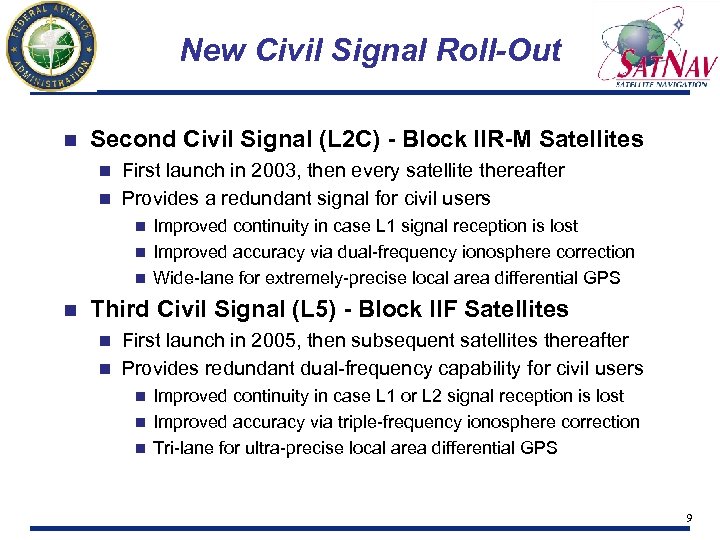
New Civil Signal Roll-Out n Second Civil Signal (L 2 C) - Block IIR-M Satellites First launch in 2003, then every satellite thereafter n Provides a redundant signal for civil users n Improved continuity in case L 1 signal reception is lost n Improved accuracy via dual-frequency ionosphere correction n Wide-lane for extremely-precise local area differential GPS n n Third Civil Signal (L 5) - Block IIF Satellites First launch in 2005, then subsequent satellites thereafter n Provides redundant dual-frequency capability for civil users n Improved continuity in case L 1 or L 2 signal reception is lost n Improved accuracy via triple-frequency ionosphere correction n Tri-lane for ultra-precise local area differential GPS n 9
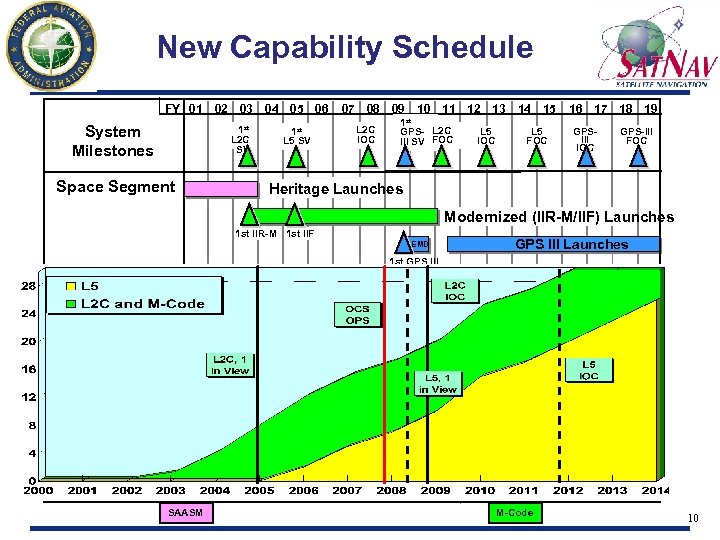
New Capability Schedule FY 01 02 03 04 05 06 System Milestones 1 st L 2 C SV Space Segment 1 st L 5 SV 07 08 09 10 11 12 13 14 15 L 2 C IOC 1 st GPS- L 2 C III SV FOC L 5 IOC L 5 FOC 16 17 18 19 GPSIII IOC GPS-III FOC Heritage Launches Modernized (IIR-M/IIF) Launches 1 st IIR-M 1 st IIF EMD GPS III Launches 1 st GPS III SAASM M-Code 10
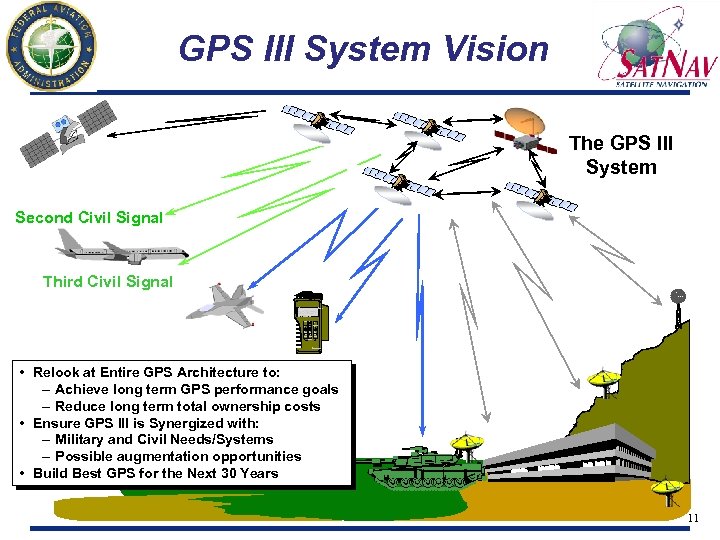
GPS III System Vision The GPS III System Second Civil Signal Third Civil Signal FIX FOM 1 N 42* 01” 46. 12” W 091* 38’ 54. 36” EL + 00862 ft 1 ON 2 3 menu 4 5 6 7 WPT 8 POS 9 NAV CLR MARK 0 OFF NUM LOCK ZEROIZE Rockwell • Relook at Entire GPS Architecture to: – Achieve long term GPS performance goals – Reduce long term total ownership costs • Ensure GPS III is Synergized with: – Military and Civil Needs/Systems – Possible augmentation opportunities • Build Best GPS for the Next 30 Years 11
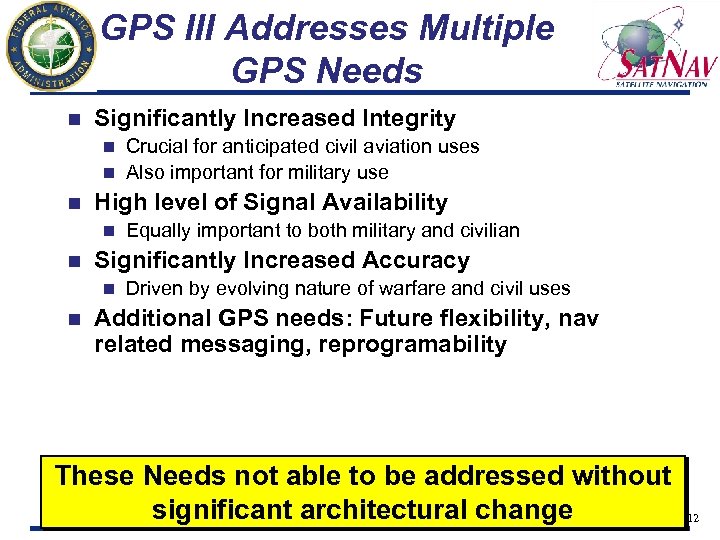
GPS III Addresses Multiple GPS Needs n Significantly Increased Integrity Crucial for anticipated civil aviation uses n Also important for military use n n High level of Signal Availability n n Significantly Increased Accuracy n n Equally important to both military and civilian Driven by evolving nature of warfare and civil uses Additional GPS needs: Future flexibility, nav related messaging, reprogramability These Needs not able to be addressed without significant architectural change 12
GPS III Integrated Approach GPS Originally Designed without benefit of an Established User Base n Civil Users Previously Solicited for Suggested Changes to Existing System to Meet their Needs n GPS III has Novel Approach for Integrating Needs of the Do. D, DOT, FAA… n Just completed System Architecture and Requirements Definition phase gathered and identified future requirements n Interagency Forum for Operation Requirements created to identify and assemble new requirements for GPS n Civil and military requirements to be approved in totality by joint committee n Coast Guard Navigation Center soliciting requirements via website n 13
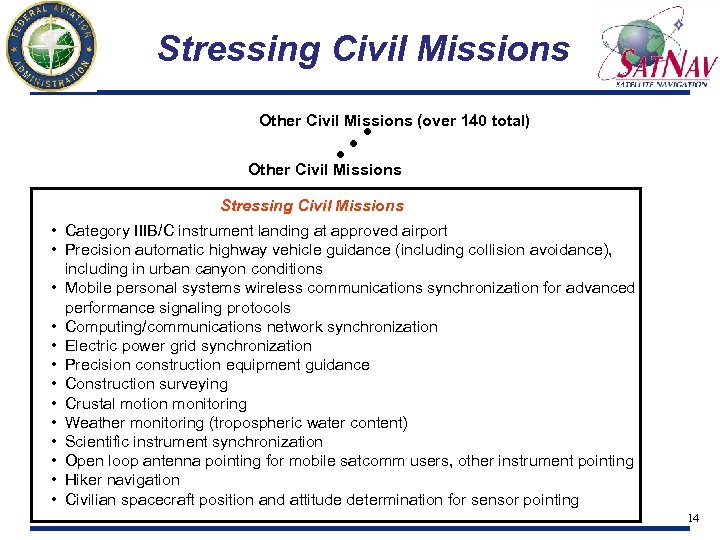
Stressing Civil Missions . . . Other Civil Missions (over 140 total) Other Civil Missions Stressing Civil Missions • Category IIIB/C instrument landing at approved airport • Precision automatic highway vehicle guidance (including collision avoidance), including in urban canyon conditions • Mobile personal systems wireless communications synchronization for advanced performance signaling protocols • Computing/communications network synchronization • Electric power grid synchronization • Precision construction equipment guidance • Construction surveying • Crustal motion monitoring • Weather monitoring (tropospheric water content) • Scientific instrument synchronization • Open loop antenna pointing for mobile satcomm users, other instrument pointing • Hiker navigation • Civilian spacecraft position and attitude determination for sensor pointing 14
GPS III Increased Capability n Assured Delivery of GPS Signals n Higher Power Military & Civil Signals n Higher Accuracy Service for All Users n Increased Integrity Inherent in GPS 15
GPS III Assured Delivery n Dual-Use GPS is more than just Adding Civil Signals n Assuring availability and continuity of signals Realization that GPS is considered a Critical Part of Worldwide Infrastructure n Availability/Continuity Key Factors in GPS III Design n n n Crosslink architecture Number of orbital planes Number of satellites Sparing strategy Replacement strategy Control segment 16
GPS III Increased Accuracy Augmented and standalone missions identified that require more accuracy than modernized GPS n Signal-in-space improvements must keep pace with those in users equipment n Advanced technology clocks n Inter-satellite ranging n Improved ephemeris and orbital models n Age of Data reduction and more timely updates via crosslinks n 17
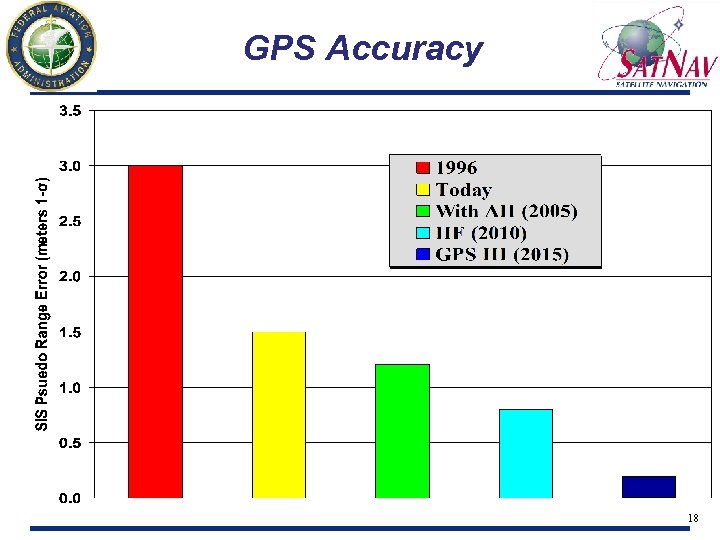
GPS Accuracy 18
GPS III Increased Integrity Aviation applications one of key drivers n GPS III architectural changes n Improved monitoring and reporting n Planned interfaces between GPS and augmentations n n Potential for meeting broad array of civil and military needs via GPS alone 19
Sufficient Means of Navigation? n Sufficient to be used anywhere, anytime Without precluding use of other systems or augmentations n Without requiring use of other systems or augmentations n n n Except for most demanding applications (LAAS) With assured delivery n Availability and continuity (and higher power) With high accuracy n With high integrity n 20
Ground Augmentation n By itself, GPS III will have very good Accuracy and Integrity n n Good enough for most navigation applications Ground Augmentation Gives Major Improvements n For Ultra High Accuracy ~1 m with Local Area Differential GPS (LADGPS) n ~1 cm with Real-Time Kinematic (RTK) n n For Ultra High Integrity n n 1 -1 x 10 -9/operation or even better is achievable Precision Landing Needs High Accuracy/Integrity n Prime example of GPS ground augmentation system usage n Civil: Local Area Augmentation System (LAAS) 21
Challenges n Maintaining a healthy constellation while adding system capabilities Constellation sustainment strategies n Operational Control Segment (OCS) upgrades n Testing / validating new signals - design and operations n Transition to modernized OCS n Spectrum Protection n International Cooperation n 22
International Cooperation Need a strategic view for US interaction with Galileo n Work the policy and technical issues on how these two system can coexist and leverage one another n Opportunity is now for us to begin working to ensure a single, integrated Navigation service n Improves civil aviation, interoperability, and spectrum protection n Will save money if done properly n n GPS III Acquisition effort is the right place to push for this to happen 23
Summary GPS Modernization activities well underway n GPS Modernization offers superb opportunity to satisfy both military requirements and civil needs n n GPS III exploring complementary Do. D/civil augmentation opportunities Working through challenges n GPS III Architecture – Working hard toward a robust, supportable, flexible, international capability for the next 30 years n 24
Скачать презентацию Presentation GNSS 4 2 by H Cabler ICAO
d22dd0ff8f28a30aa08d24caee58d26b.ppt