


 Скачать презентацию Presentation for Adam Smith Conference THE ROLE OF
eee9219ed8256639a0bf5e6db6db4acf.ppt
- Количество слайдов: 19
 Presentation for Adam Smith Conference THE ROLE OF ALTERNATIVE INVESTMENT IN SWF MANAGEMENT Vavilov A. P.
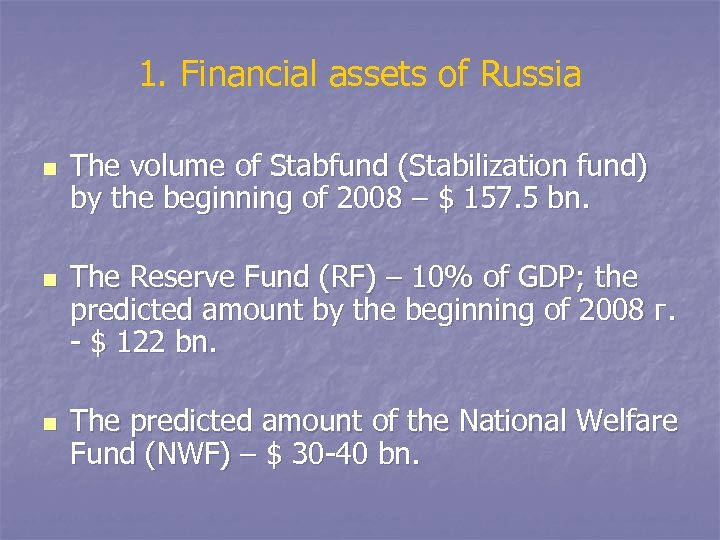 1. Financial assets of Russia n n n The volume of Stabfund (Stabilization fund) by the beginning of 2008 – $ 157. 5 bn. The Reserve Fund (RF) – 10% of GDP; the predicted amount by the beginning of 2008 г. - $ 122 bn. The predicted amount of the National Welfare Fund (NWF) – $ 30 -40 bn.
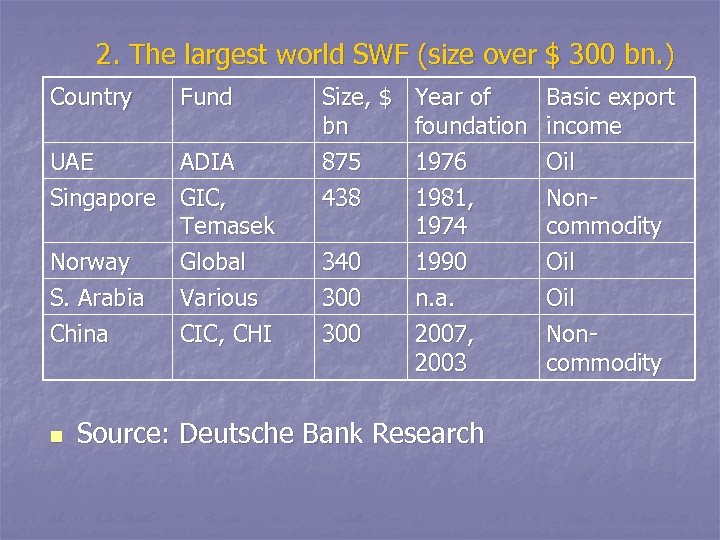 2. The largest world SWF (size over $ 300 bn. ) Country Fund UAE ADIA Singapore GIC, Temasek Norway Global S. Arabia China n Various CIC, CHI Size, $ bn 875 438 340 300 Year of foundation 1976 1981, 1974 1990 Basic export income Oil Noncommodity Oil n. a. 2007, 2003 Oil Noncommodity Source: Deutsche Bank Research
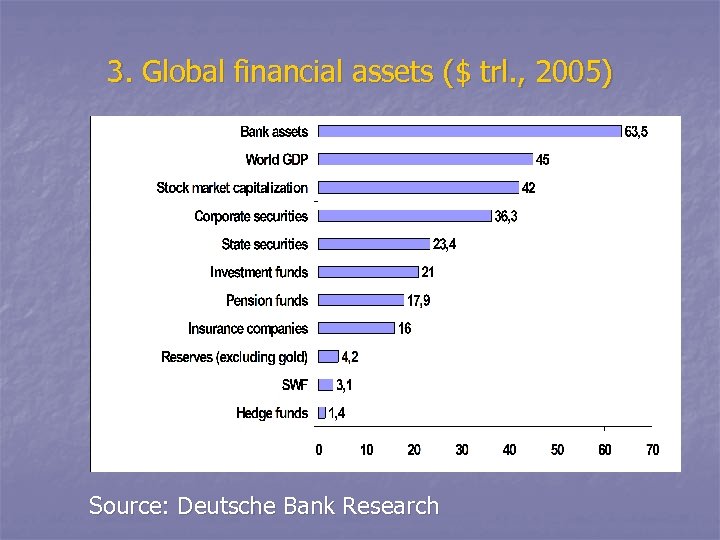 3. Global financial assets ($ trl. , 2005) Source: Deutsche Bank Research
 4. The new rules for the Sovereign Oil and Gas Fund of Russia n RF is 10% of GDP; NWF is residual. n NWF will not increase if the oil price drops below 50 -52 $/bar. n On the contrary, the RF in real terms will grow automatically with GDP growth and ruble appreciation. n The ration of RF to NWF will be around 4: 1. n For a moderate proportion of shares and debt instruments in the NWF as 50%: 50%, the fraction of shares in the Russian SWF will be only 12. 5%.
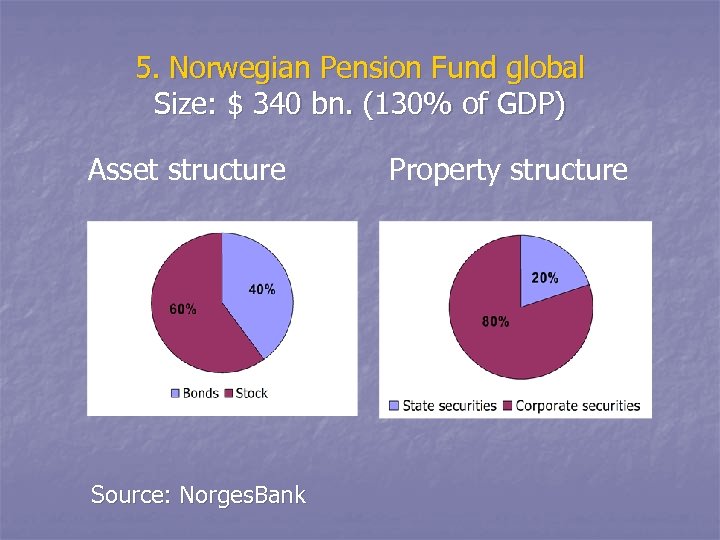 5. Norwegian Pension Fund global Size: $ 340 bn. (130% of GDP) Asset structure Source: Norges. Bank Property structure
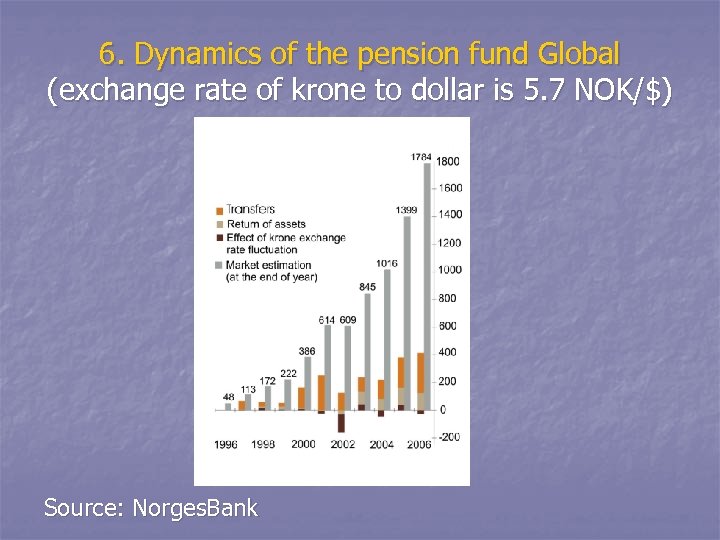 6. Dynamics of the pension fund Global (exchange rate of krone to dollar is 5. 7 NOK/$) Source: Norges. Bank
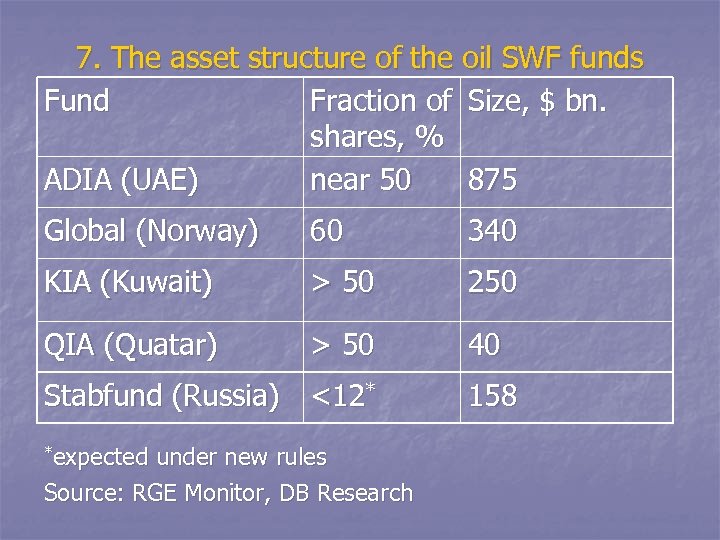 7. The asset structure of the oil SWF funds Fund Fraction of Size, $ bn. shares, % ADIA (UAE) near 50 875 Global (Norway) 60 340 KIA (Kuwait) > 50 250 QIA (Quatar) > 50 40 Stabfund (Russia) <12* *expected under new rules Source: RGE Monitor, DB Research 158
 8. Does Russia really need the financial reserve 10% of GDP? n n A) Protection against possible financial crisis? B) Total official foreign reserves ($ 476 bn. ) should be taken into account; C) The liquidity of state assets is the problem for monetary authority rather than the Fiscal authority; D) Political economy: liquid state assets are weakly protected from lobbyist pressure.
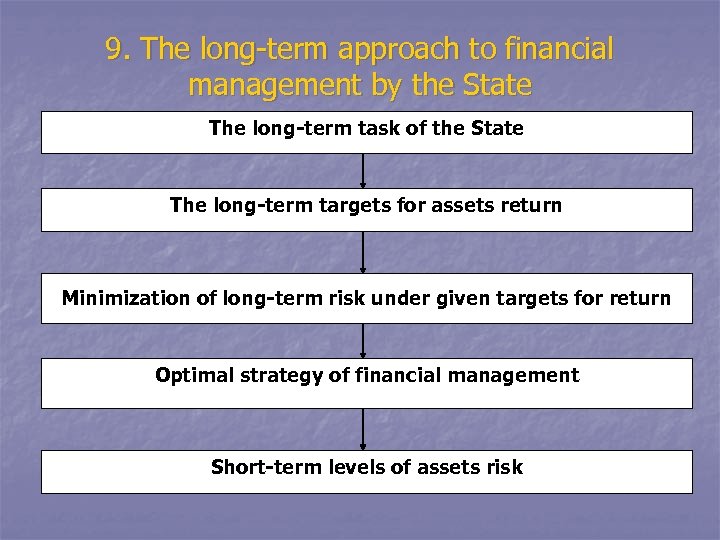 9. The long-term approach to financial management by the State The long-term task of the State The long-term targets for assets return Minimization of long-term risk under given targets for return Optimal strategy of financial management Short-term levels of assets risk
 10. A dynamic model of financial management Informal description A) The target level of NWF by some year; B) The target level of long-term return on asset portfolio of the state; C) The objective function is minimum of integral risk (time-weighted volatility of return); D) The dynamic budget constraint of the fiscal authority; F) The short-term risk-return ratios are determined from the global portfolio.
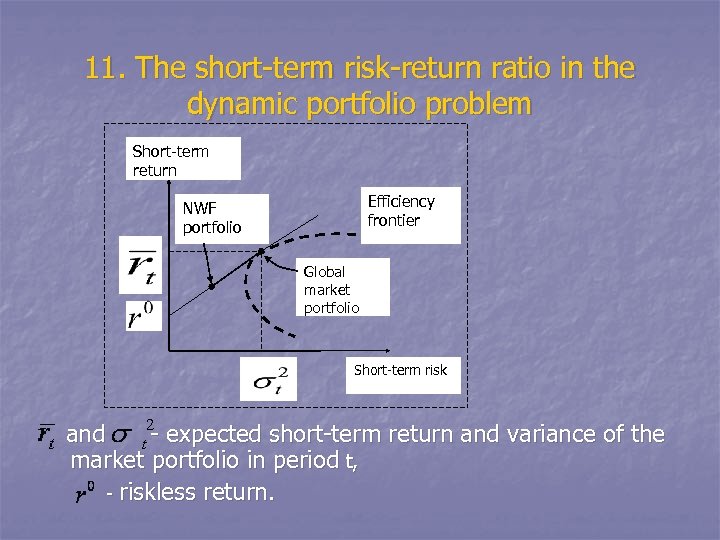 11. The short-term risk-return ratio in the dynamic portfolio problem Short-term return Efficiency frontier NWF portfolio Global market portfolio Short-term risk and - expected short-term return and variance of the market portfolio in period t, - riskless return.
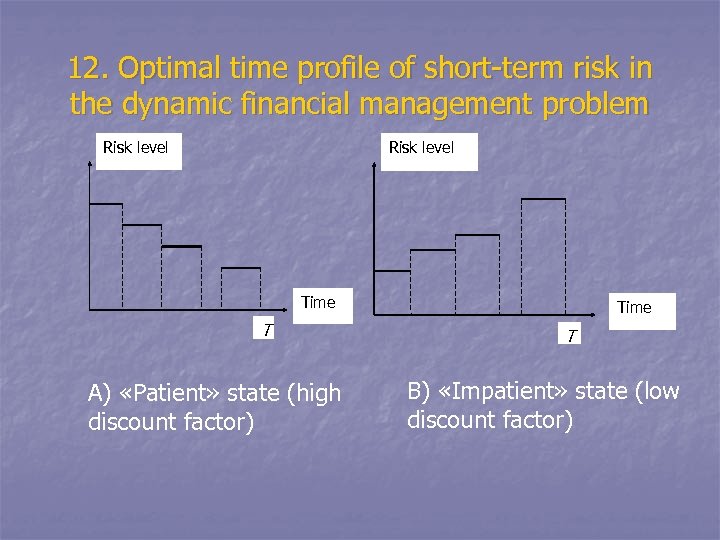 12. Optimal time profile of short-term risk in the dynamic financial management problem Risk level Time T A) «Patient» state (high discount factor) Time T B) «Impatient» state (low discount factor)
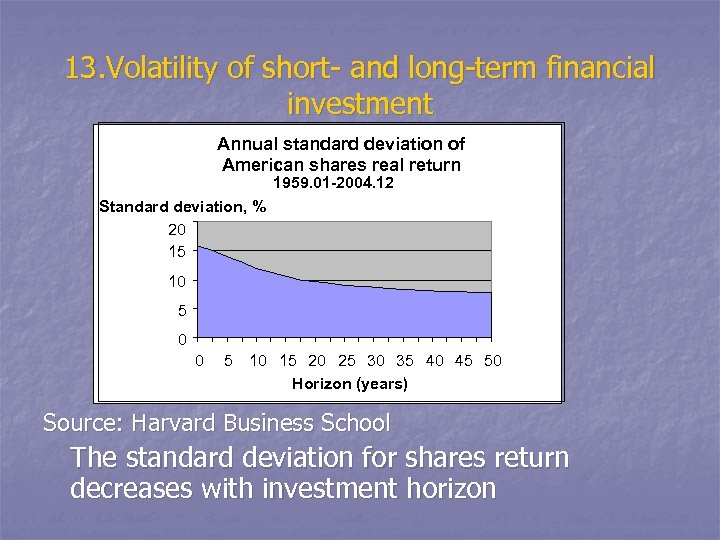 13. Volatility of short- and long-term financial investment Annual standard deviation of American shares real return 1959. 01 -2004. 12 Standard deviation, % 20 15 10 5 0 0 5 10 15 20 25 30 35 40 45 50 Horizon (years) Source: Harvard Business School The standard deviation for shares return decreases with investment horizon
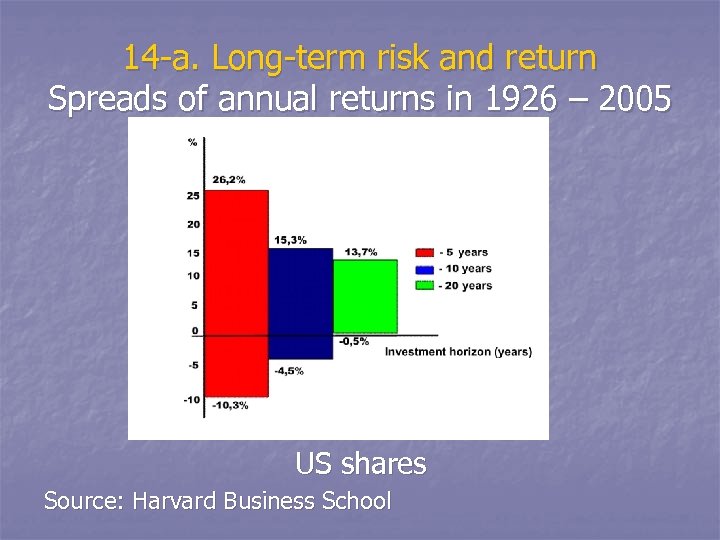 14 -а. Long-term risk and return Spreads of annual returns in 1926 – 2005 US shares Source: Harvard Business School
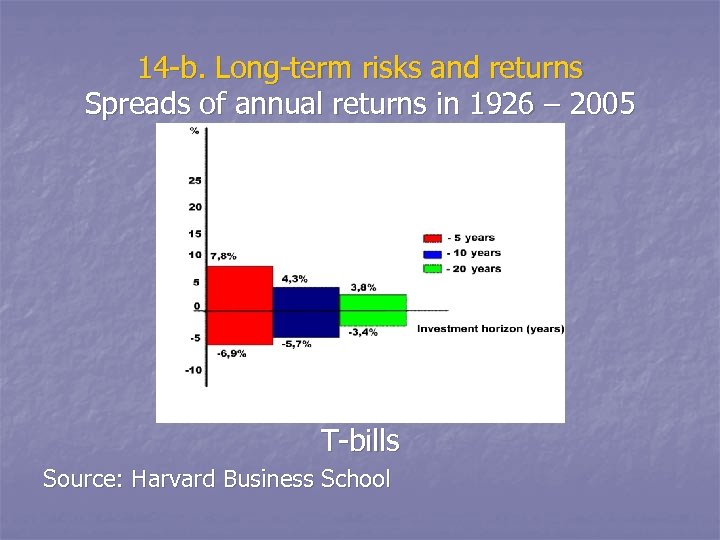 14 -b. Long-term risks and returns Spreads of annual returns in 1926 – 2005 T-bills Source: Harvard Business School
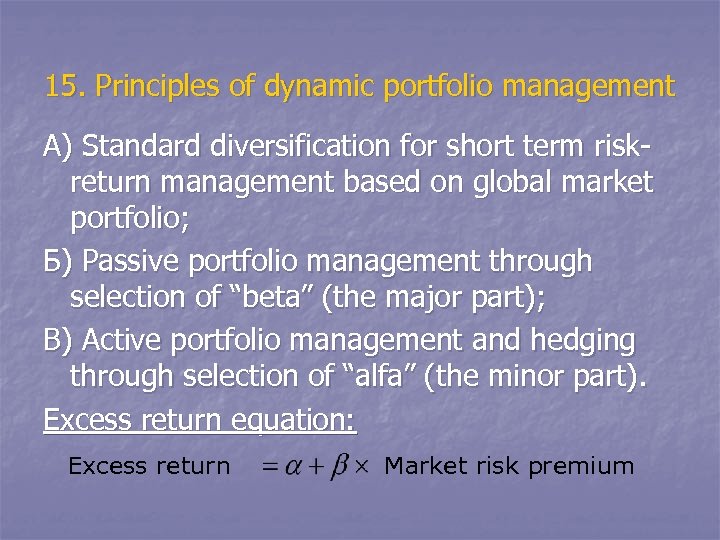 15. Principles of dynamic portfolio management А) Standard diversification for short term riskreturn management based on global market portfolio; Б) Passive portfolio management through selection of “beta” (the major part); В) Active portfolio management and hedging through selection of “alfa” (the minor part). Excess return equation: Excess return Market risk premium
 16. Implementation 1: Making beta 1. Standardized formal procedures of passive management (should be specified in the budget code) 2. 70 -80% of government assets should be invested in a globally diversified market portfolio including corporate equities, bonds, commodities, real estate, derivatives (Portfolio of Norwegian fund Global embraces 3500 issuers. ) 3. Passive style of management to ensure market returns. Long-term contracting with large global financial intermediaries
 17. Implementation 2: Making alpha 1. Alternative (market-neutral) instruments The state agency provides collateral. 2. Incentive problems (e. g. making beta instead of alpha). Solution: a) managerial fees and risk sharing between the government agency and the financial intermediary; b) specification of investment style in the short-term (annual) contracts 3. The issues of monitoring and control. Solution: deals should pass through a special account of the state agency (like Swedish pension fund AP-7). Transparency will remove unjustified political pressure on financial management.