 Скачать презентацию Presentation by Anand Desai Managing Partner DSK
42e92277fe0b9af3795cbc1567186ba6.ppt
- Количество слайдов: 31



Presentation by Anand Desai Managing Partner © DSK Legal 2016 │ All rights reserved │ Not for circulation Development of Technology Laws Jurisprudence in India 1
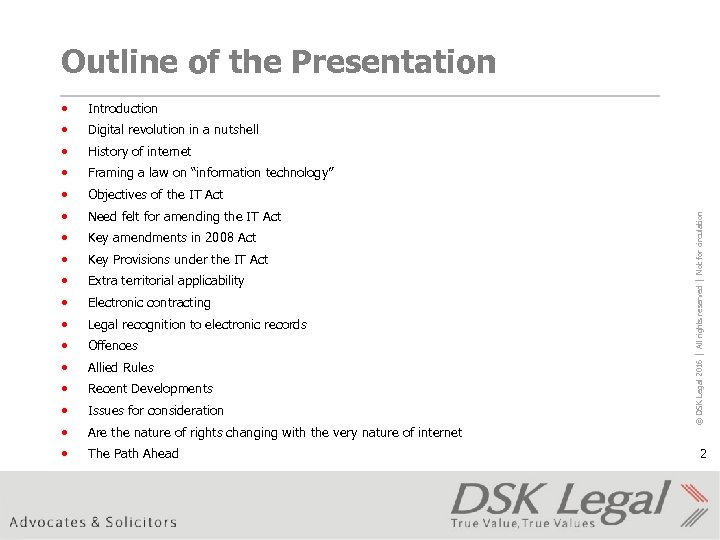
Outline of the Presentation Introduction • Digital revolution in a nutshell • History of internet • Framing a law on “information technology” • Objectives of the IT Act • Need felt for amending the IT Act • Key amendments in 2008 Act • Key Provisions under the IT Act • Extra territorial applicability • Electronic contracting • Legal recognition to electronic records • Offences • Allied Rules • Recent Developments • Issues for consideration • Are the nature of rights changing with the very nature of internet • The Path Ahead © DSK Legal 2016 │ All rights reserved │ Not for circulation • 2
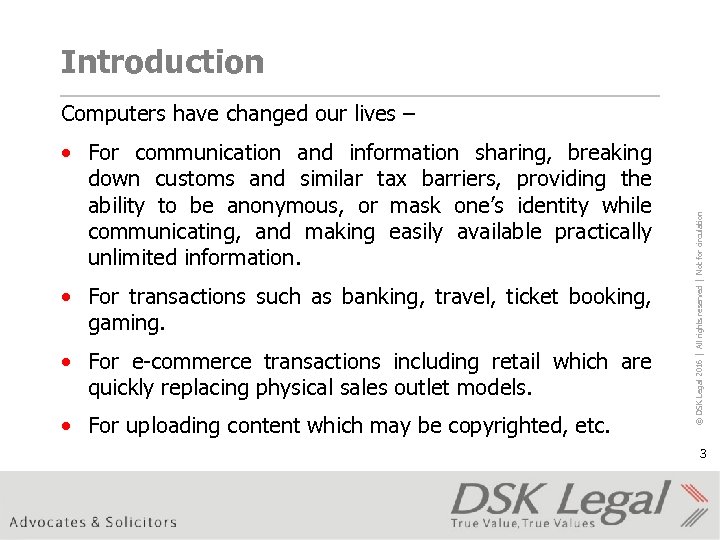
Introduction • For communication and information sharing, breaking down customs and similar tax barriers, providing the ability to be anonymous, or mask one’s identity while communicating, and making easily available practically unlimited information. • For transactions such as banking, travel, ticket booking, gaming. • For e-commerce transactions including retail which are quickly replacing physical sales outlet models. • For uploading content which may be copyrighted, etc. © DSK Legal 2016 │ All rights reserved │ Not for circulation Computers have changed our lives – 3
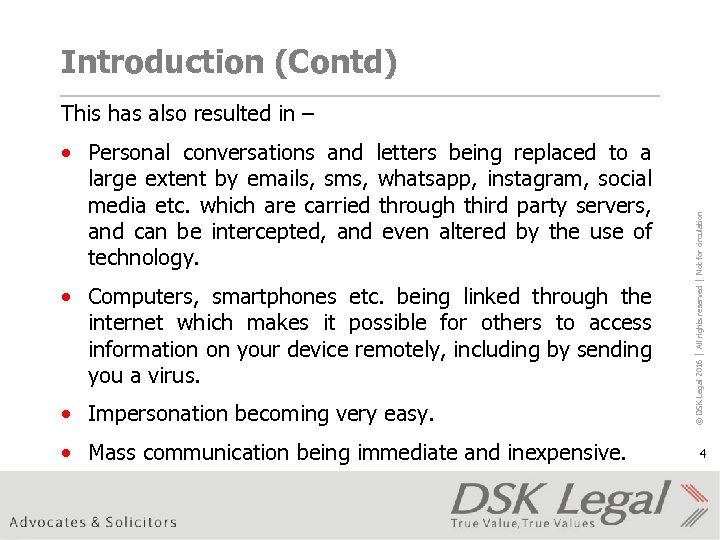
Introduction (Contd) • Personal conversations and letters being replaced to a large extent by emails, sms, whatsapp, instagram, social media etc. which are carried through third party servers, and can be intercepted, and even altered by the use of technology. • Computers, smartphones etc. being linked through the internet which makes it possible for others to access information on your device remotely, including by sending you a virus. • Impersonation becoming very easy. • Mass communication being immediate and inexpensive. © DSK Legal 2016 │ All rights reserved │ Not for circulation This has also resulted in – 4
Introduction (Contd) This has also resulted in – • Use of the internet for effecting service of summons, and soon there will be an integrated online system for judicial work. • Crimes now increasingly involve the use of communication through devices and channels that are “secure” – the Backberry case. • Personal relations being built on the internet – shaadi. com as a wedding site, dating sites, business matching sites. • One’s reputation can be built or destroyed online. © DSK Legal 2016 │ All rights reserved │ Not for circulation • E-governance – online filing of tax returns, passport applications, computerization of courts etc. 5
History of internet The theory of packet switching, which was to form the basis of Internet connections was developed by Leonard Kleinrock of MIT and later UCLA. • The Internet, then known as ARPANET, was brought online in 1969 which connected four major computers at universities in the southwestern US. • E-mail was adapted for ARPANET by Ray Tomlinson of BBN in 1972. • The first move to index the Internet was made in 1989, as Peter Deutsch and Alan Emtage, students at Mc. Gill University in Montreal, created an archiver for ftp sites, which was named Archie. • Internet being initially funded by the government, it was originally limited to research purposes. Commercial use was prohibited unless they directly served the goals of research and education. This policy continued until early 90's, when independent commercial networks began to grow. © DSK Legal 2016 │ All rights reserved │ Not for circulation • 6
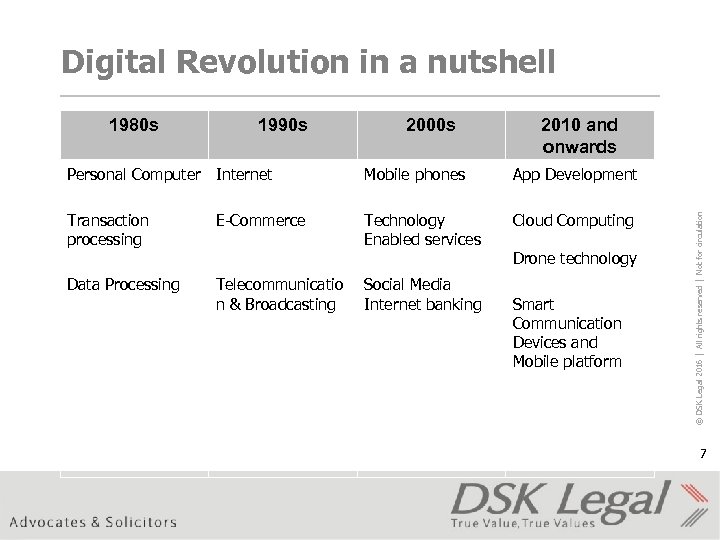
Digital Revolution in a nutshell 1980 s 1990 s 2000 s 2010 and onwards Mobile phones App Development Transaction processing E-Commerce Technology Enabled services Cloud Computing Data Processing Telecommunicatio n & Broadcasting Social Media Internet banking Drone technology Smart Communication Devices and Mobile platform © DSK Legal 2016 │ All rights reserved │ Not for circulation Personal Computer Internet 7
• In 1999, prompted by United Nations Commission on International Trade Law’s Model Law on Electronic Commerce and developments in certain Asian countries like Singapore, the Indian legislature moved towards framing a legislation governing electronic transactions. • The Information Technology Bill was referred to a 42 member parliamentary standing committee following which it received Presidential assent on June 9, 2000 and became the Information Technology Act, 2000 (“IT Act”). © DSK Legal 2016 │ All rights reserved │ Not for circulation Framing a law on “information technology” 8
Objectives of the IT Act • Uniformity of the law applicable to e-commerce. • Promote electronic filing and efficient government services. • Amending statutes such as Indian Penal Code, 1860, the Indian Evidence Act, 1872. © DSK Legal 2016 │ All rights reserved │ Not for circulation • Legal recognition of e-commerce through functional equivalence. 9
Need felt for amending the IT Act, 2000 • Overall increase in e-commerce, growth in outsourcing business, new forms of transactions, new means of identification, consumers concern, emergence of new forms of computer misuse like child pornography, video voyeurism, identity theft and e-commerce frauds like phishing and online theft, a need was felt to review the IT Act. • With the terror attacks in Mumbai, this amendment was portrayed as a major anti terror legislation and the Information Technology Amendment Act, 2008 (“ 2008 Act”) was passed and notified on October 27, 2009. © DSK Legal 2016 │ All rights reserved │ Not for circulation • The IT Act was enacted keeping in view the technology directions and scenario as it existed at that point of time viz. 10
Key amendments in 2008 Act Technology neutrality adopted. • Privacy safeguards enhanced: Section 43 A inserted prohibiting unauthorized disclosure of “sensitive personal information”. A new section 72 A inserted criminalizing disclosure of information in breach of a lawful contract. • New sections added to cover offences such as identity theft, cyber terrorism, violation of privacy, cheating by personation, transmitting sexually explicit act, child pornography etc. • Intermediary liability recast: As a result of the much publicized case of Avnish Bajaj Vs NCT Delhi (2005) 3 Comp. LJ 364 Del) where the CEO of e. Bay India was made a co-defendant on allegations that e. Bay facilitated sale of pornography through its website. © DSK Legal 2016 │ All rights reserved │ Not for circulation • 11
Key amendments in 2008 Act (Contd) • Formation of the Indian Computer Emergency Response Team. • The amendments under Section 69 gave the power to the State to issue directions for interception or monitoring of decryption of any information through any computer resource. © DSK Legal 2016 │ All rights reserved │ Not for circulation • Formation of the National Nodal Agency. 12
© DSK Legal 2016 │ All rights reserved │ Not for circulation Key Provisions under the IT Act 13
Extra territorial applicability • This long arm jurisdiction was criticized on the ground that given individuals are not aware of the virtual spaces that it crosses, it was unfair for subject individuals to laws of applicable to such space. • Enforceability of local laws on foreign nationals has been an issue. For e. g. The creator of “I love you” virus, a Philippines national was identified by US Government. Under the Philippines US Extradition Treaty, the act for which extradition is sought should be a crime in both US and Philippines. Since there were no laws in the Philippines against writing malware at the time, he was were released with all charges dropped. © DSK Legal 2016 │ All rights reserved │ Not for circulation • Extra territorial applicability of the IT Act gives the court unrestricted jurisdiction to extend provisions of the IT Act. 14
Electronic contracting of electronical Ø Individually negotiated contracts similar to the traditional kinds except negotiations and formations happen over emails. Ø Click wrap contracts: These are standard form contracts used by website owners which require users to enter into such contracts by clicking on a box marked as “I agree to”. • Enforceability of such contracts are at nascent stage in India. Acceptance of the contract remains a debatable issue. © DSK Legal 2016 │ All rights reserved │ Not for circulation • Electronic contracting: Two kinds contracting are mostly prevalent: 15
Legal recognition to electronic records Ø Rendered or made available in electronic form; and Ø Accessible so as to be usable for a subsequent reference. • The Supreme Court has recently in Anvar v. Basheer (2014) 10 SCC 473) held that unless the conditions set out in Section 65 B of the Evidence Act, 1872 are satisfied, electronic records would not be admissible in evidence. © DSK Legal 2016 │ All rights reserved │ Not for circulation • Legal recognition to electronic records: The section contains two prerequisites before legal recognition can be imparted to electronic records, which are electronic record should be: 16
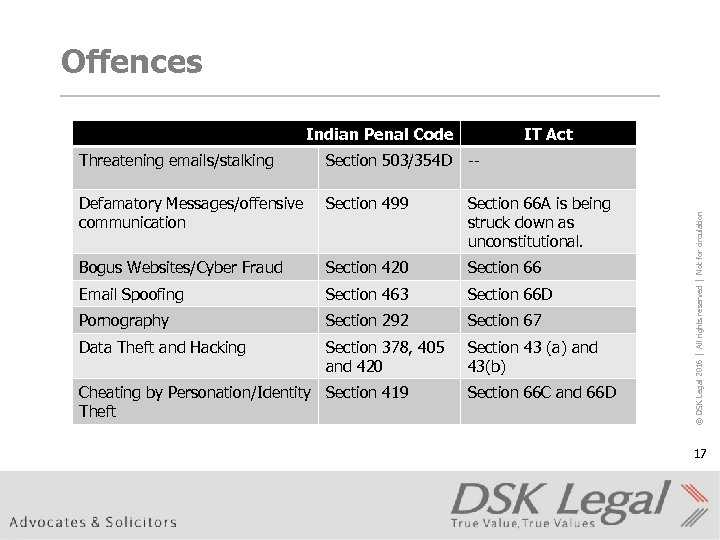
Offences Indian Penal Code IT Act Section 503/354 D -- Defamatory Messages/offensive communication Section 499 Section 66 A is being struck down as unconstitutional. Bogus Websites/Cyber Fraud Section 420 Section 66 Email Spoofing Section 463 Section 66 D Pornography Section 292 Section 67 Data Theft and Hacking Section 378, 405 and 420 Section 43 (a) and 43(b) Cheating by Personation/Identity Section 419 Theft Section 66 C and 66 D © DSK Legal 2016 │ All rights reserved │ Not for circulation Threatening emails/stalking 17
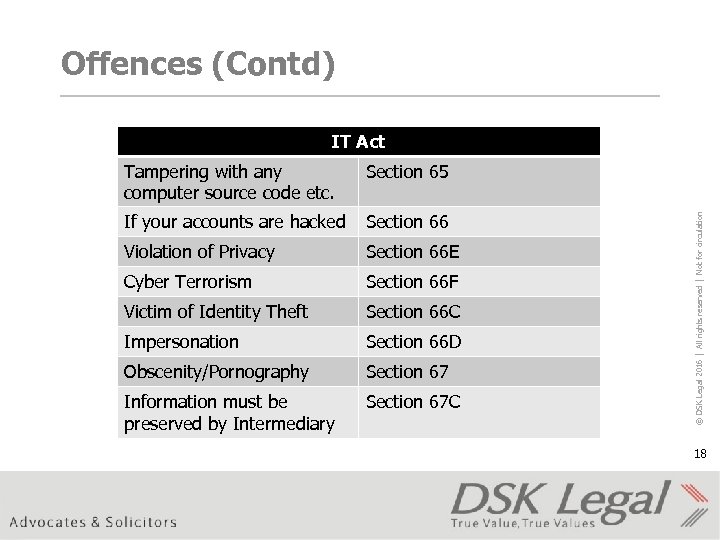
Offences (Contd) IT Act Section 65 If your accounts are hacked Section 66 Violation of Privacy Section 66 E Cyber Terrorism Section 66 F Victim of Identity Theft Section 66 C Impersonation Section 66 D Obscenity/Pornography Section 67 Information must be preserved by Intermediary Section 67 C © DSK Legal 2016 │ All rights reserved │ Not for circulation Tampering with any computer source code etc. 18
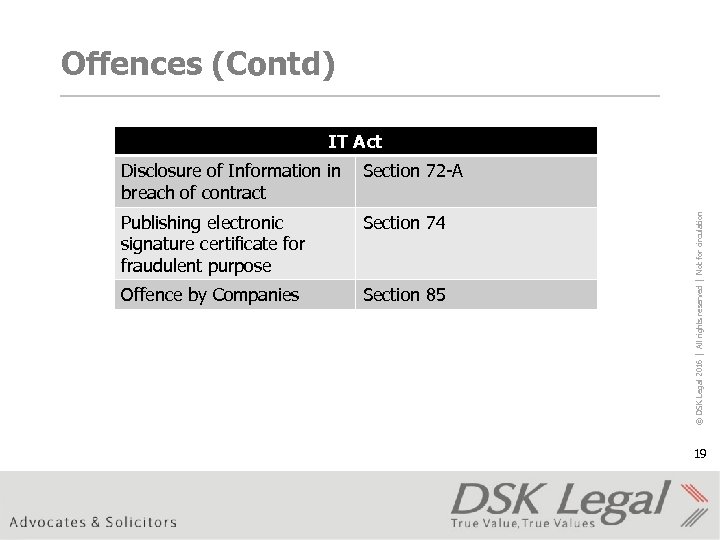
Offences (Contd) IT Act Section 72 -A Publishing electronic signature certificate for fraudulent purpose Section 74 Offence by Companies Section 85 © DSK Legal 2016 │ All rights reserved │ Not for circulation Disclosure of Information in breach of contract 19
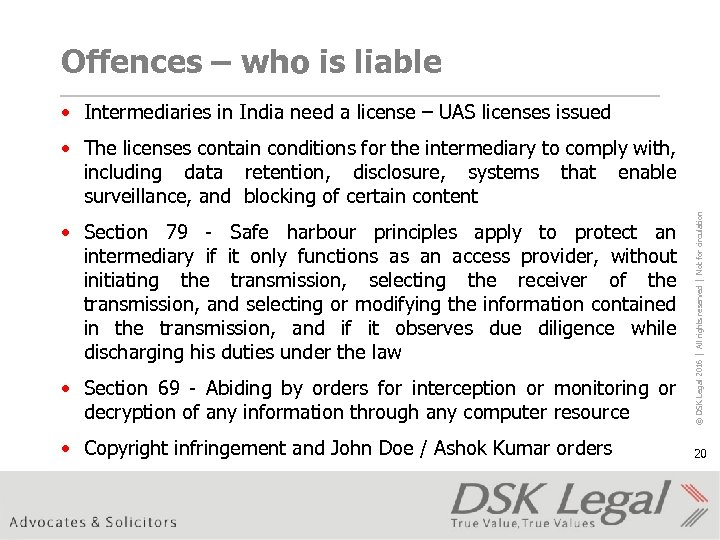
Offences – who is liable • Intermediaries in India need a license – UAS licenses issued • Section 69 - Abiding by orders for interception or monitoring or decryption of any information through any computer resource © DSK Legal 2016 │ All rights reserved │ Not for circulation • The licenses contain conditions for the intermediary to comply with, including data retention, disclosure, systems that enable surveillance, and blocking of certain content • Copyright infringement and John Doe / Ashok Kumar orders 20 • Section 79 - Safe harbour principles apply to protect an intermediary if it only functions as an access provider, without initiating the transmission, selecting the receiver of the transmission, and selecting or modifying the information contained in the transmission, and if it observes due diligence while discharging his duties under the law

© DSK Legal 2016 │ All rights reserved │ Not for circulation Allied Rules 21
Rules framed under the IT Act The Department of Information Technology has notified four sets of rules effective from April 11, 2011. IT (Reasonable Security Practices and Procedures and sensitive personal data or information) Rules, 2011 (“Reasonable Security Practices Rules”) Ø These lay down the minimum security practices and procedures to be adopted while collecting any sensitive personal information. • Information Technology (Intermediaries guidelines) Rules, 2011. Ø These provide for the due diligences to be observed by the intermediaries so as to be exempted from liability in certain cases. • The Information Technology (Electronic Service Delivery) Rules, 2011 and Information Technology (Guidelines for Cyber Cafe) Rules, 2011. Ø providing for respectively the electronic delivery of public services by the Government and mandatory due diligences to be observed by the cyber cafe owners have also been notified. © DSK Legal 2016 │ All rights reserved │ Not for circulation • 22
• In Shreya Singhal, Section 66 A (Punishment for sending offensive messages through communication service) was held unconstitutional under Article 19(1)(a), Constitution Of India, 1950 stating that it arbitrarily, excessively and disproportionately invades right of free speech. Section 69 A was upheld. • Internet safety campaign to be launched by India in collaboration with Google. • Indian government has enforced the e-mail policy of India whereby using private e-mail services have been banned for official communications in India. • Dr. Gulshan Rai has been appointed the first chief information security officer (CISO) of India. © DSK Legal 2016 │ All rights reserved │ Not for circulation Recent developments 23
© DSK Legal 2016 │ All rights reserved │ Not for circulation Issues for consideration 24
Issues with Enforcement • Difficulty in Detection of Crimes – role of victim / complainant. • Masking of Identity – Anonymity. • Awareness of Rights, experience in this area of police, lawyers and judges. • Admissibility of Digital Evidence. • Data protection – once the damage is done how can it be reversed. • Jurisdiction – Territorial, quantum involved, different levels of legal protection in different countries, extra-territorial Jurisdiction. © DSK Legal 2016 │ All rights reserved │ Not for circulation • Volumes of data on the internet. 25
Issues with Enforcement (Contd) • Bank frauds – external and internal examples. • Defamation – what was the intent behind the communication. • Tax evasion. • Liability of those who give access to the internet. • Misuse of “secure communication devices”. © DSK Legal 2016 │ All rights reserved │ Not for circulation • Masking of Identity – Anonymity. 26
Other Issues for consideration • Child pornography continues to be on a rise. • Online scams: Recent case of arrest of an IAF personnel for providing confidential information. • Online gambling. • Cyber terrorism. • Are the nature of rights changing? Privacy, right to publicity, censorship, copyright etc. by the very nature of the internet. © DSK Legal 2016 │ All rights reserved │ Not for circulation • Recruitment for unlawful activities. 27
Are nature of rights changing with the very nature of internet Freedom of speech and expression: Internet has stretched word of mouth into a virtual realm (blogs, social media etc. ) • Freedom of association and assembly: Individuals can assemble virtually and coordinate activities like protests etc. • Privacy: Internet had opened up new ways in which privacy could be invaded and personal information used against the interests or without the knowledge of those concerned. • Right to publicity: Today a celebrities' image can be used for publicity, invasion of privacy etc. much more easily and quickly. For. e. g. Julia Roberts case wherein the defendant ran a website named Julia Roberts. Com and through the same website the defendant used to run an online auction programmer to sell his goods using the popularity of the celebrity. • Copyright: Downloading content from the internet without permission from owner could infringe copyright. © DSK Legal 2016 │ All rights reserved │ Not for circulation • 28
The Path Ahead • Introducing technology training so that awareness about the different ways technology can be used is disseminated. • Training police, prosecutors and judicial officers is a must. Cybercells have been a big step forward. Cyberlabs and NASSCOM support has helped in India with initiatives like cyber-safety week. • Investigations and legal sophisticated, and stricter. enforcement need to be more • With rapid evolvement of communication methods and technology, laws need to be aligned. © DSK Legal 2016 │ All rights reserved │ Not for circulation • Educating people about the pitfalls and the negative impact the internet can have. 29

© DSK Legal 2016 │ All rights reserved │ Not for circulation THANK YOU 30
Delhi Office: 4, Aradhana Enclave, R. K Puram, Sector 13, Opposite Hotel Hyatt, New Delhi 110 066 Tel +91 11 6666 Fax +91 11 6661 6600 Mumbai Office (Litigation Group): C-16, Dhanraj Mahal, Chhatrapati Shivaji Marg, Apollo Bunder, Mumbai 400001 Tel +91 22 6152 6000 Fax +91 22 6152 6001 Pune Office: 301, Power Point, Lane No. 6, Koregoan Park, Pune 411 001 Tel + 91 20 6900 0930 For more details: www. dsklegal. com Disclaimer The contents of this document are privileged and confidential and not for public circulation. This document is for general information of our clients and others to whom it is specifically provided. The information contained in this document is derived from public sources, which we believe to be reliable but which, without further investigation, cannot be warranted as to their accuracy, completeness or correctness and we are not obligated to update or amend the same. The information contained in this document is not intended to be nor should be regarded as legal advice and no one should act on such information without appropriate professional advice. DSK Legal accepts no responsibility for any loss arising from any action taken or not taken by anyone using this material. © DSK Legal 2016 │ All rights reserved │ Not for circulation Comments and feedback: anand. desai@dsklegal. com Mumbai Office: 1203, One Indiabulls Centre, Tower 2, Floor 12 -B, 841, Senapati Bapat Marg, Elphinstone Road, Mumbai 400013 Tel +91 22 6658 8000 Fax +91 22 6658 8001 31
Скачать презентацию Presentation by Anand Desai Managing Partner DSK
42e92277fe0b9af3795cbc1567186ba6.ppt